
Risks Risk Factors Impacts and Implications Mitigations Risk
- Slides: 22
Risks, Risk Factors, Impacts and Implications, Mitigations
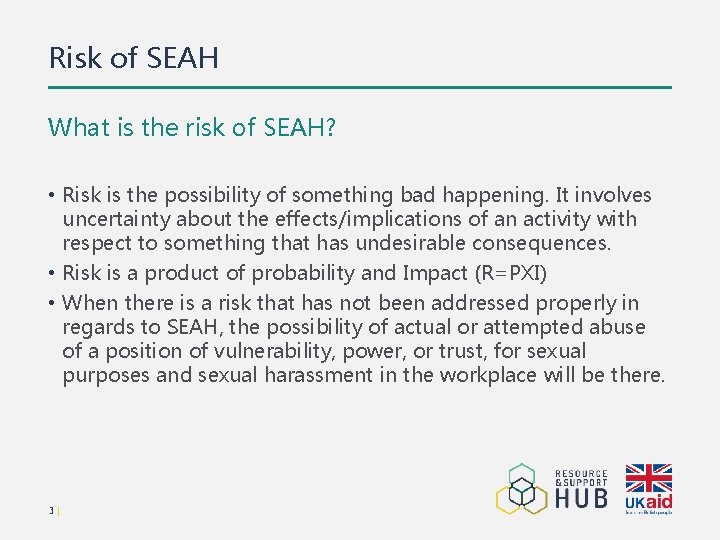
Risk of SEAH What is the risk of SEAH? • Risk is the possibility of something bad happening. It involves uncertainty about the effects/implications of an activity with respect to something that has undesirable consequences. • Risk is a product of probability and Impact (R=PXI) • When there is a risk that has not been addressed properly in regards to SEAH, the possibility of actual or attempted abuse of a position of vulnerability, power, or trust, for sexual purposes and sexual harassment in the workplace will be there. 3|
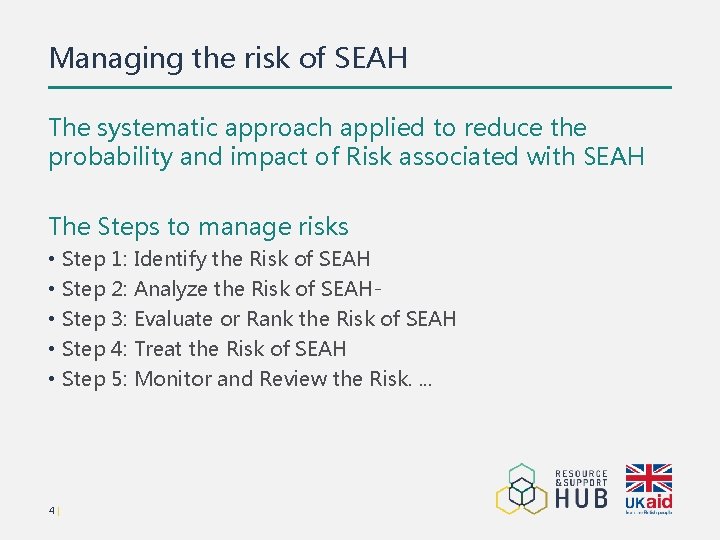
Managing the risk of SEAH The systematic approach applied to reduce the probability and impact of Risk associated with SEAH The Steps to manage risks • • • 4| Step 1: Identify the Risk of SEAH Step 2: Analyze the Risk of SEAHStep 3: Evaluate or Rank the Risk of SEAH Step 4: Treat the Risk of SEAH Step 5: Monitor and Review the Risk. .
How to reduce the risk of SEAH • Risk can be reduced in managing the probability of occurrence and its impact. • The probability of concurrence of SEAH can be managed with preventive mechanisms, e. g. Policy and Procedures • The impact can be managed with reporting the incident, counseling and providing support to the victims
Risk Factors or Red Flags of SEAH Risks Factors/Red Flags • • Lack of meaningful data Conflict areas Shortage of guidance Privacy of workspace Factors/ Red Flags • Knowledge of grievance procedure • Unprofessional working environment • Hostile Work Environment
Consequences of Risks of SEAH EMOTIONAL EFFECTS • Emotional trauma can be as disabling to a person as a visible, physical wound. Sexual harassment is humiliating and degrading, and can cause victims to suffer a loss of selfconfidence and selfesteem. • Loss of Reputation PHYSICAL EFFECTS • The victim may not realize it, but emotional distress can—and often does —have a direct effect on other bodily functions. Sleeplessness may lead to fatigue, which may contribute to aches, pains, or increased susceptibility to illness. • Lossof of. Business business ECONOMIC EFFECTS • Sexual harassment may have severe economic effects on a victim. A woman may be denied training opportunities, a promotion, or a raise. In retaliation for complaining, she may be reassigned to a difficult position or transferred away from her family and support.
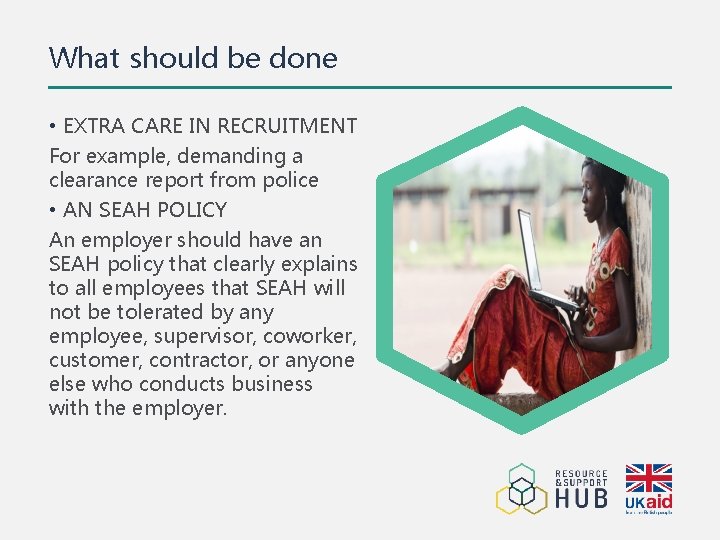
What should be done • EXTRA CARE IN RECRUITMENT For example, demanding a clearance report from police • AN SEAH POLICY An employer should have an SEAH policy that clearly explains to all employees that SEAH will not be tolerated by any employee, supervisor, coworker, customer, contractor, or anyone else who conducts business with the employer.
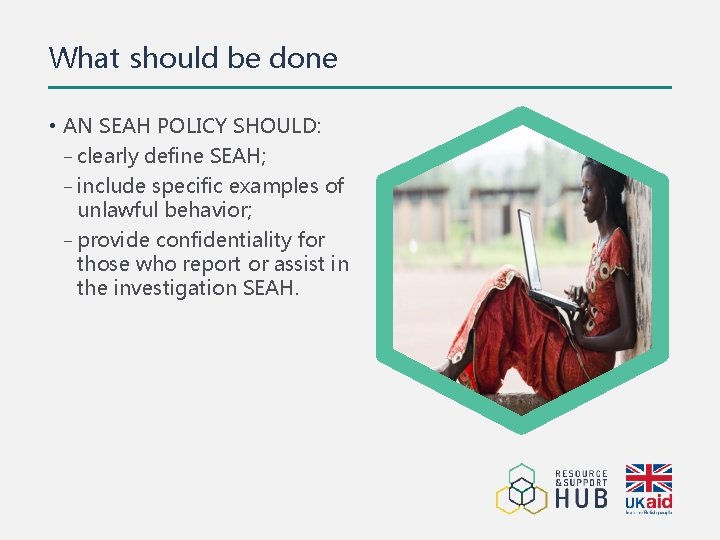
What should be done • AN SEAH POLICY SHOULD: − clearly define SEAH; − include specific examples of unlawful behavior; − provide confidentiality for those who report or assist in the investigation SEAH.
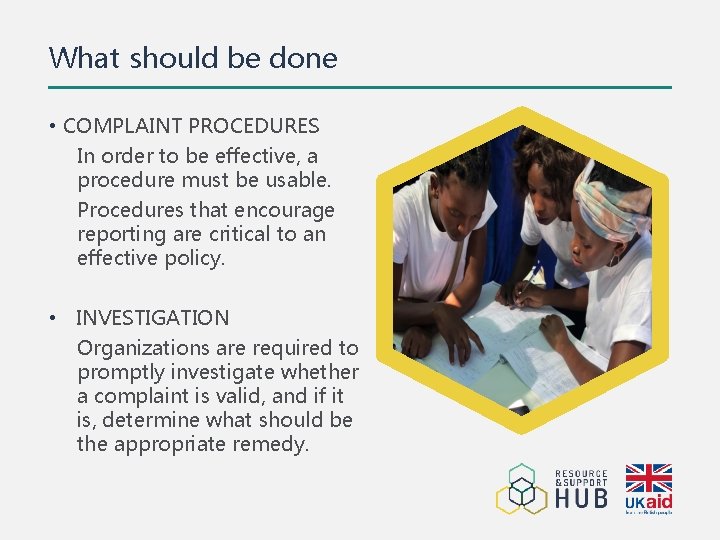
What should be done • COMPLAINT PROCEDURES In order to be effective, a procedure must be usable. Procedures that encourage reporting are critical to an effective policy. • INVESTIGATION Organizations are required to promptly investigate whether a complaint is valid, and if it is, determine what should be the appropriate remedy.
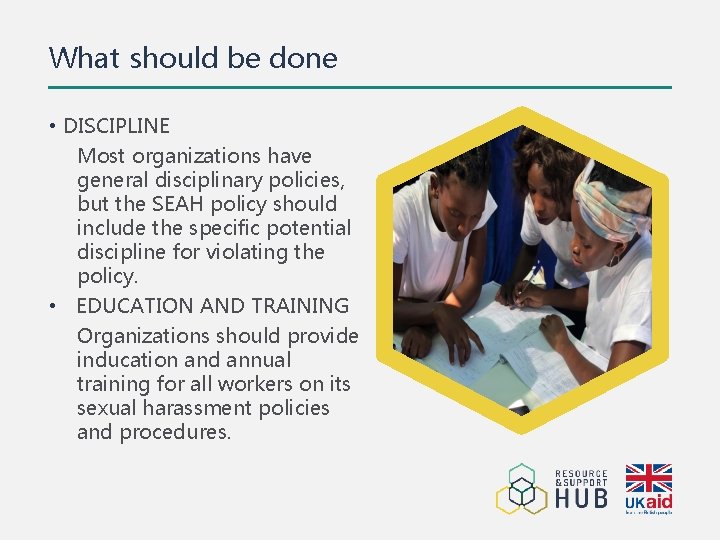
What should be done • DISCIPLINE Most organizations have general disciplinary policies, but the SEAH policy should include the specific potential discipline for violating the policy. • EDUCATION AND TRAINING Organizations should provide inducation and annual training for all workers on its sexual harassment policies and procedures.
How to conduct effective risk assessment and systems
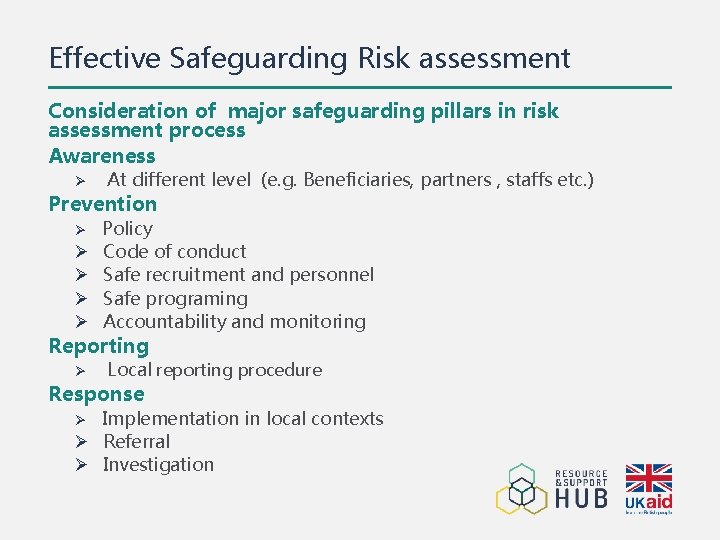
Effective Safeguarding Risk assessment Consideration of major safeguarding pillars in risk assessment process Awareness Ø At different level (e. g. Beneficiaries, partners , staffs etc. ) Prevention Ø Ø Ø Policy Code of conduct Safe recruitment and personnel Safe programing Accountability and monitoring Reporting Ø Local reporting procedure Response Implementation in local contexts Ø Referral Ø Investigation Ø
Overview of Simplified PSEAH Risk assessment tool What is the purpose of the tool? • Part of preventative measures for PSEAH violence • A simplified and user friendly tool that reflects local context − Risks are specific to Ethiopian context − Translated into local language • Provides the right recommendations for the possible mitigation strategy
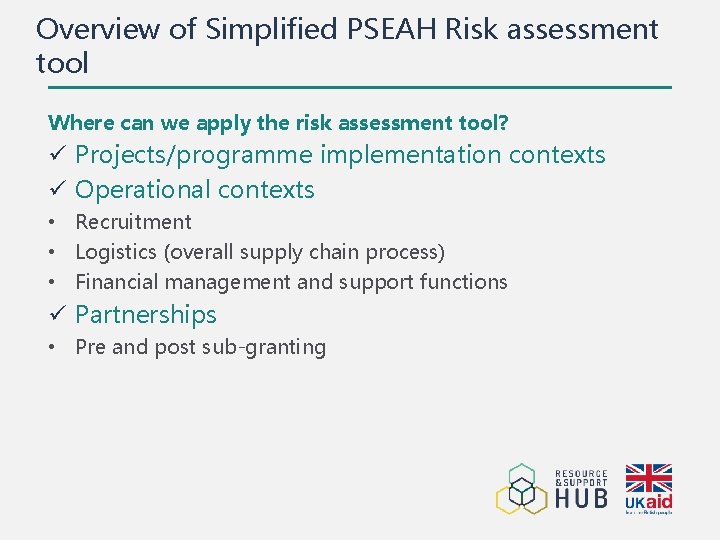
Overview of Simplified PSEAH Risk assessment tool Where can we apply the risk assessment tool? ü Projects/programme implementation contexts ü Operational contexts • Recruitment • Logistics (overall supply chain process) • Financial management and support functions ü Partnerships • Pre and post sub-granting
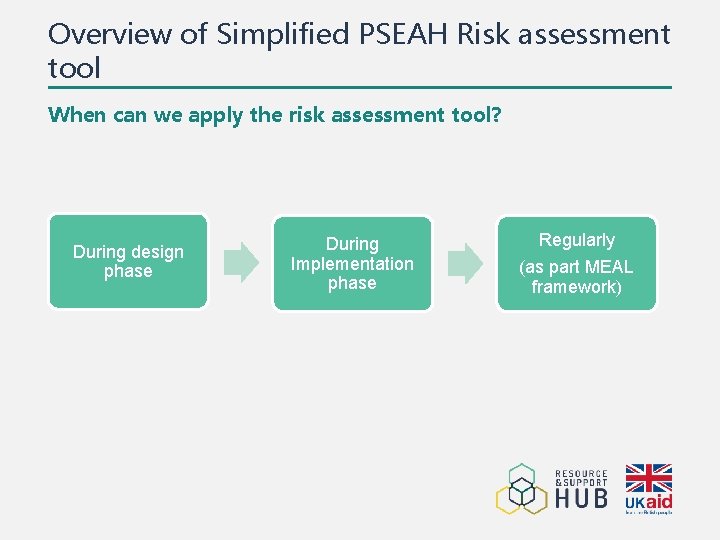
Overview of Simplified PSEAH Risk assessment tool When can we apply the risk assessment tool? During design phase During Implementation phase Regularly (as part MEAL framework)
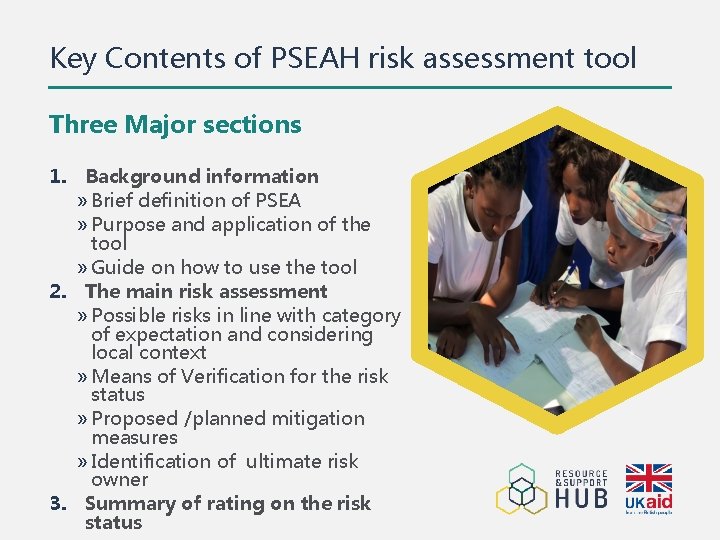
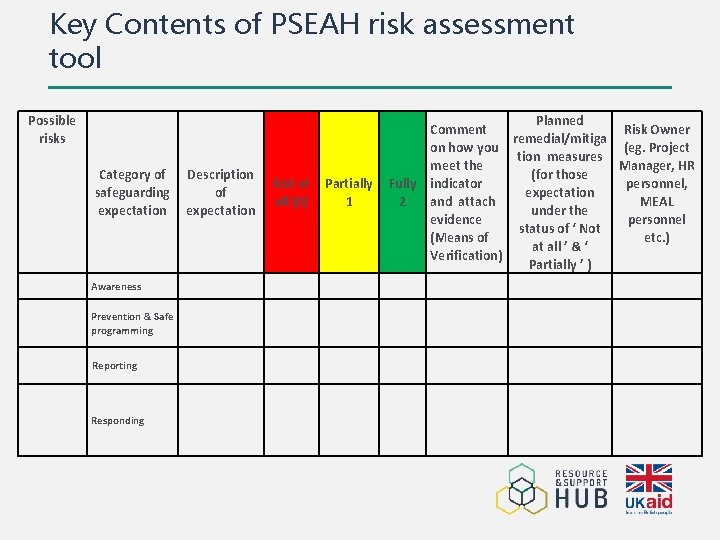
Key Contents of PSEAH risk assessment tool Three Major sections 1. Background information » Brief definition of PSEA » Purpose and application of the tool » Guide on how to use the tool 2. The main risk assessment » Possible risks in line with category of expectation and considering local context » Means of Verification for the risk status » Proposed /planned mitigation measures » Identification of ultimate risk owner 3. Summary of rating on the risk status
Key Contents of PSEAH risk assessment tool Possible risks Category of safeguarding expectation Awareness Prevention & Safe programming Reporting Responding Description of expectation Not at all (0) Partially 1 Fully 2 Planned Comment Risk Owner remedial/mitiga on how you (eg. Project tion measures meet the Manager, HR (for those indicator personnel, expectation and attach MEAL under the evidence personnel status of ‘ Not (Means of etc. ) at all ’ & ‘ Verification) Partially ’ )
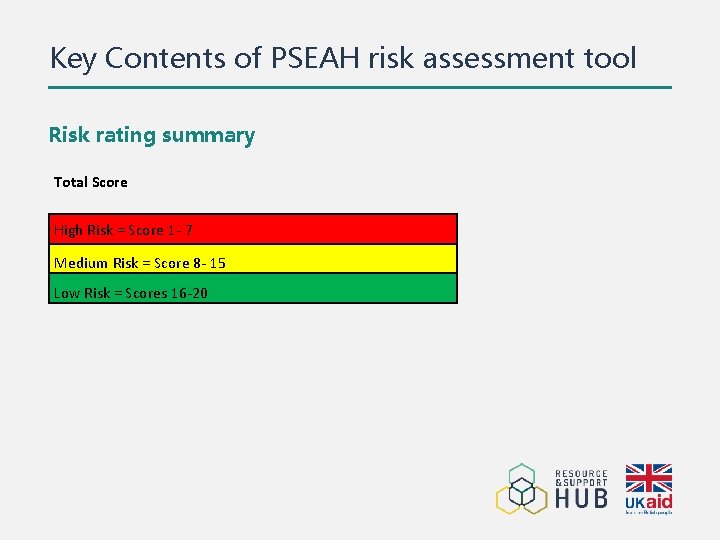
Key Contents of PSEAH risk assessment tool Risk rating summary Total Score High Risk = Score 1 - 7 Medium Risk = Score 8 - 15 Low Risk = Scores 16 -20
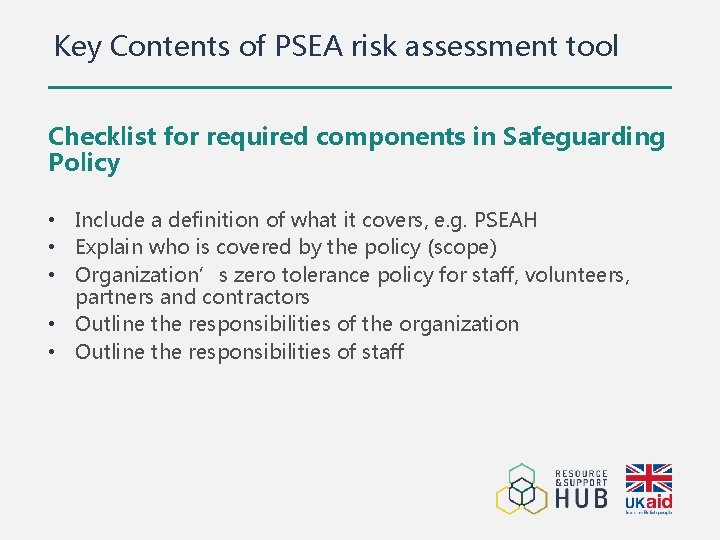
Key Contents of PSEA risk assessment tool Checklist for required components in Safeguarding Policy • Include a definition of what it covers, e. g. PSEAH • Explain who is covered by the policy (scope) • Organization’s zero tolerance policy for staff, volunteers, partners and contractors • Outline the responsibilities of the organization • Outline the responsibilities of staff
Key Contents of PSEA risk assessment tool Checklist for required components in Safeguarding Policy • • Clearly state what conducts are prohibited Linking with whistleblower procedure Include additional guidelines on behavior with children Listing of vulnerable peoples and level of contact with program staffs
For more information: Contact Semhal Getachew Email: Semhal@rshub. org. uk OR check out our Hub on http: //safeguardingsupporthub. org/ethiopia We will have more coming on Twitter, Facebook, Linked. In and Youtube