
Risks from Geoengineering Solar Radiation Management Alan Robock
Risks from Geoengineering (Solar Radiation Management) Alan Robock Department of Environmental Sciences Rutgers University, New Brunswick, New Jersey robock@envsci. rutgers. edu http: //envsci. rutgers. edu/~robock
Geoengineering is defined as “deliberate large-scale manipulation of the planetary environment to counteract anthropogenic climate change. ” Shepherd, J. G. S. et al. , 2009: Geoengineering the climate: Science, governance and uncertainty, RS Policy Document 10/09, (London: The Royal Society). Alan Robock Department of Environmental Sciences
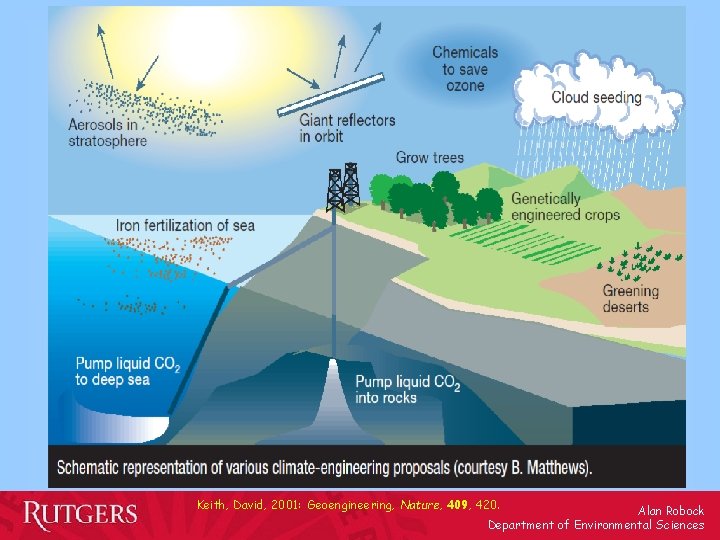
Keith, David, 2001: Geoengineering, Nature, 409, 420. Alan Robock Department of Environmental Sciences
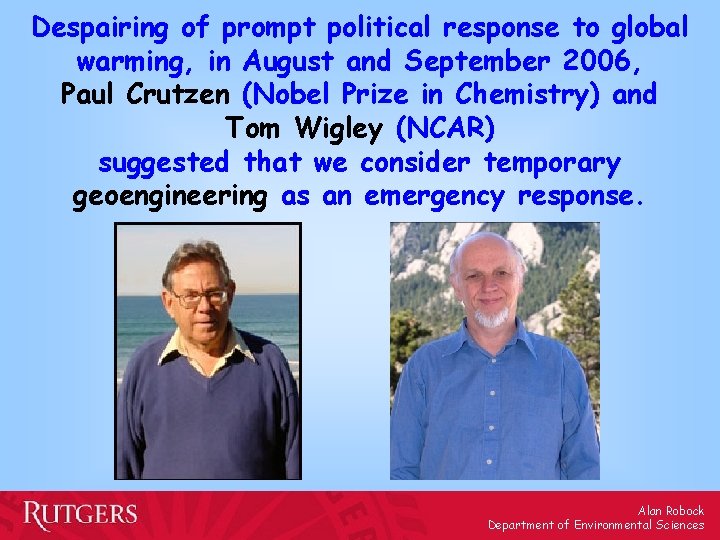
Despairing of prompt political response to global warming, in August and September 2006, Paul Crutzen (Nobel Prize in Chemistry) and Tom Wigley (NCAR) suggested that we consider temporary geoengineering as an emergency response. Alan Robock Department of Environmental Sciences
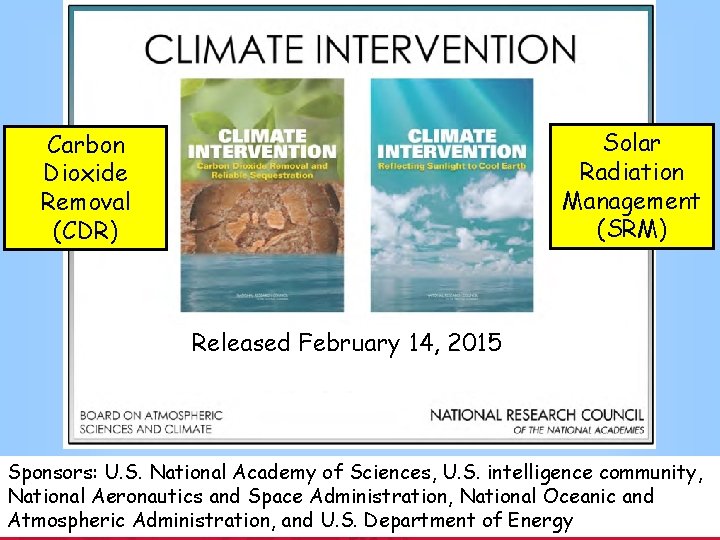
Solar Radiation Management (SRM) Carbon Dioxide Removal (CDR) Released February 14, 2015 Sponsors: U. S. National Academy of Sciences, U. S. intelligence community, National Aeronautics and Space Administration, National Oceanic and Alan Robock Atmospheric Administration, and U. S. Department of Energy Department of Environmental Sciences
Alan Robock Department of Environmental Sciences
Alan Robock Department of Environmental Sciences
Alan Robock Department of Environmental Sciences
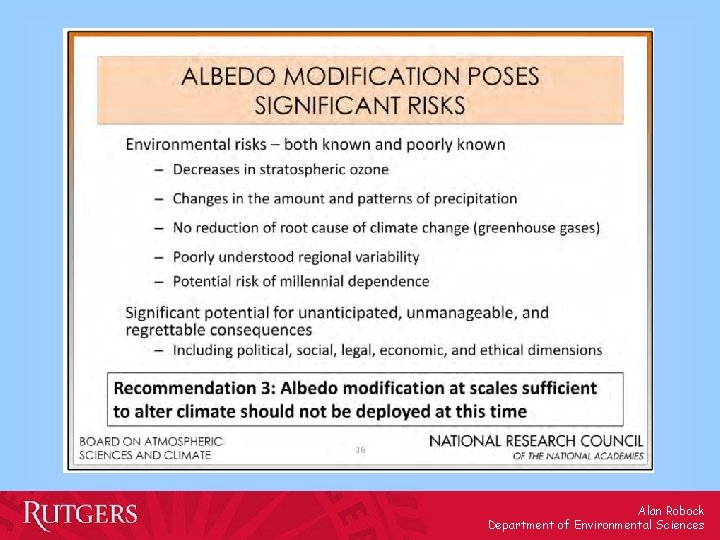
Alan Robock Department of Environmental Sciences
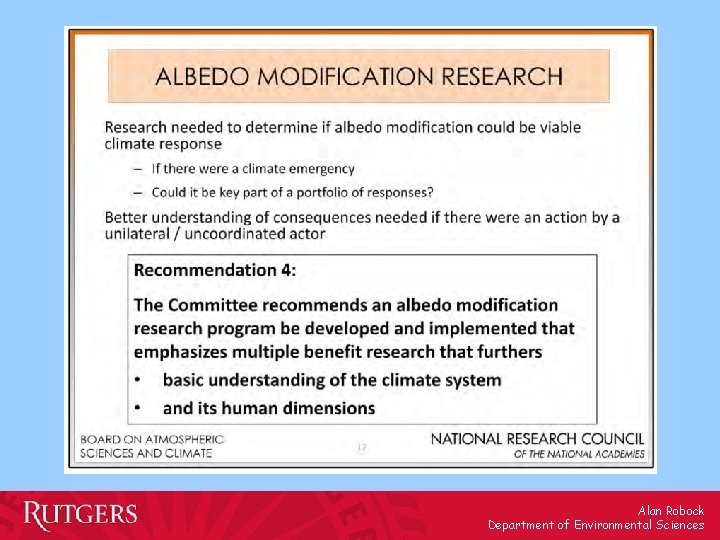
Alan Robock Department of Environmental Sciences
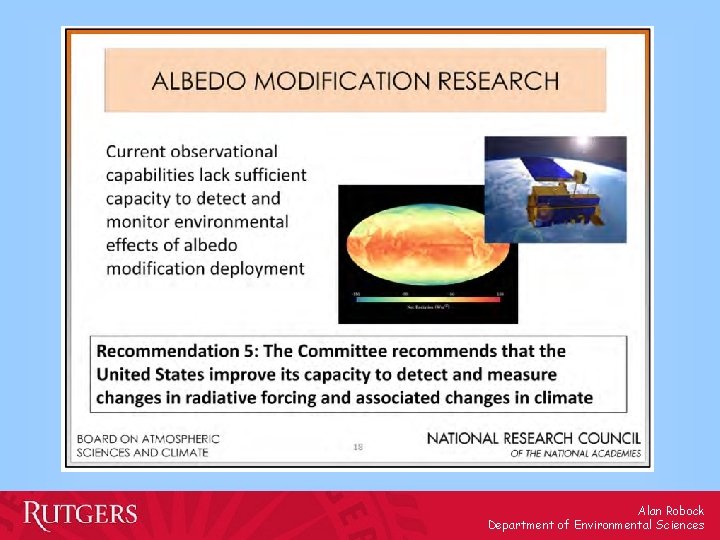
Alan Robock Department of Environmental Sciences
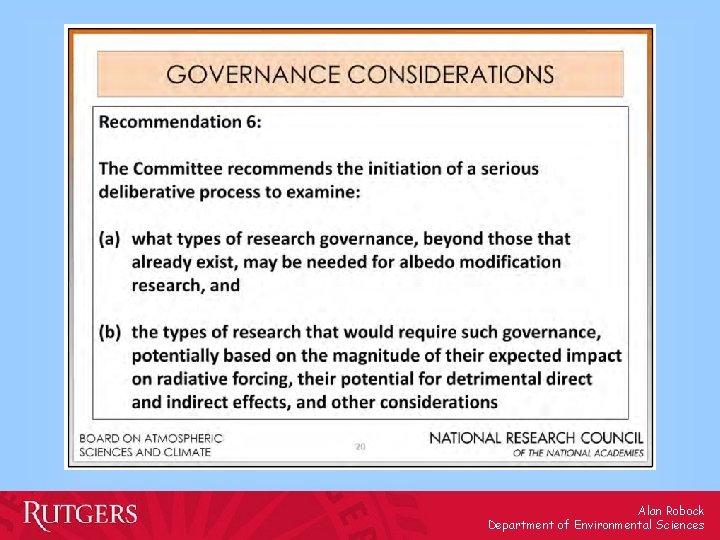
Alan Robock Department of Environmental Sciences
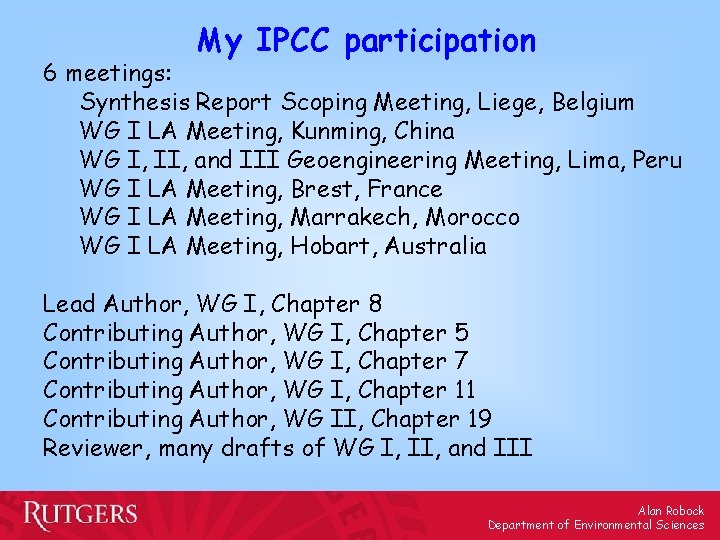
My IPCC participation 6 meetings: Synthesis Report Scoping Meeting, Liege, Belgium WG I LA Meeting, Kunming, China WG I, II, and III Geoengineering Meeting, Lima, Peru WG I LA Meeting, Brest, France WG I LA Meeting, Marrakech, Morocco WG I LA Meeting, Hobart, Australia Lead Author, WG I, Chapter 8 Contributing Author, WG I, Chapter 5 Contributing Author, WG I, Chapter 7 Contributing Author, WG I, Chapter 11 Contributing Author, WG II, Chapter 19 Reviewer, many drafts of WG I, II, and III Alan Robock Department of Environmental Sciences
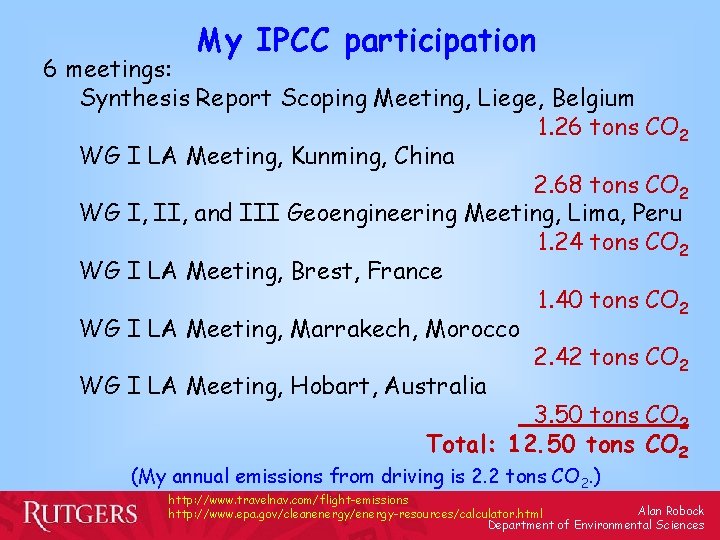
My IPCC participation 6 meetings: Synthesis Report Scoping Meeting, Liege, Belgium 1. 26 tons CO 2 WG I LA Meeting, Kunming, China 2. 68 tons CO 2 WG I, II, and III Geoengineering Meeting, Lima, Peru 1. 24 tons CO 2 WG I LA Meeting, Brest, France 1. 40 tons CO 2 WG I LA Meeting, Marrakech, Morocco 2. 42 tons CO 2 WG I LA Meeting, Hobart, Australia 3. 50 tons CO 2 Total: 12. 50 tons CO 2 (My annual emissions from driving is 2. 2 tons CO 2. ) http: //www. travelnav. com/flight-emissions Alan Robock http: //www. epa. gov/cleanenergy/energy-resources/calculator. html Department of Environmental Sciences
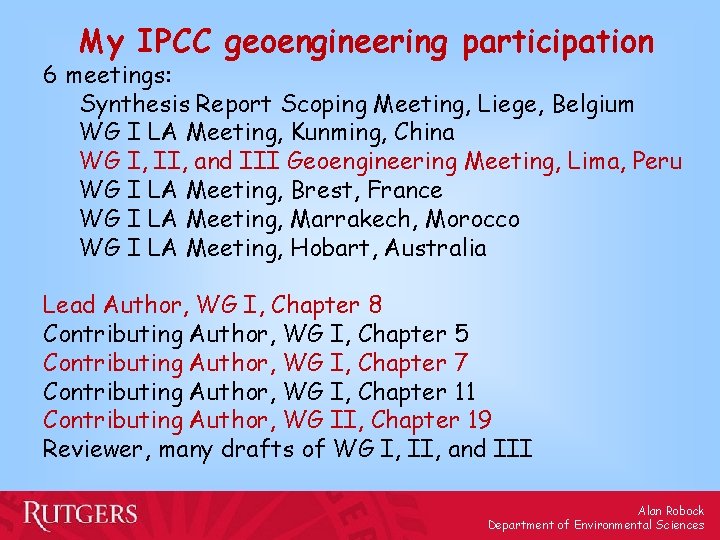
My IPCC geoengineering participation 6 meetings: Synthesis Report Scoping Meeting, Liege, Belgium WG I LA Meeting, Kunming, China WG I, II, and III Geoengineering Meeting, Lima, Peru WG I LA Meeting, Brest, France WG I LA Meeting, Marrakech, Morocco WG I LA Meeting, Hobart, Australia Lead Author, WG I, Chapter 8 Contributing Author, WG I, Chapter 5 Contributing Author, WG I, Chapter 7 Contributing Author, WG I, Chapter 11 Contributing Author, WG II, Chapter 19 Reviewer, many drafts of WG I, II, and III Alan Robock Department of Environmental Sciences

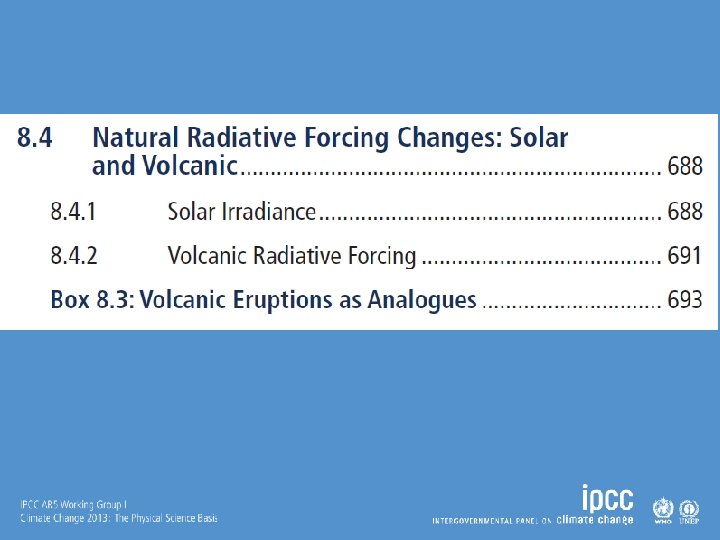
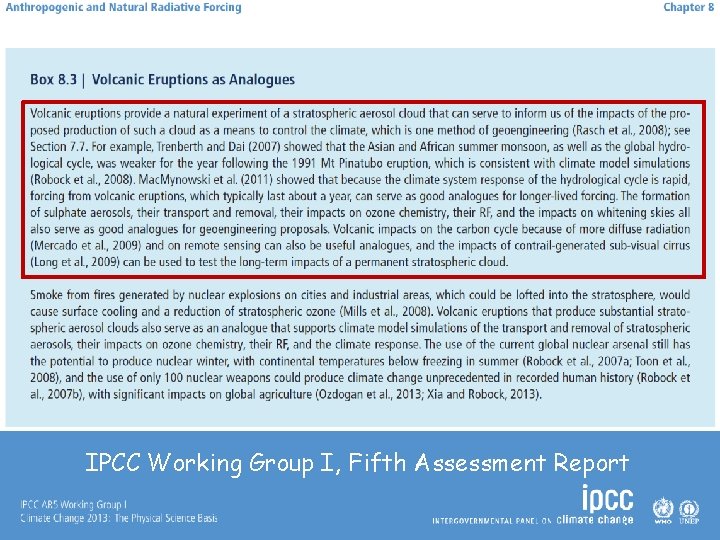
IPCC Working Group I, Fifth Assessment Report
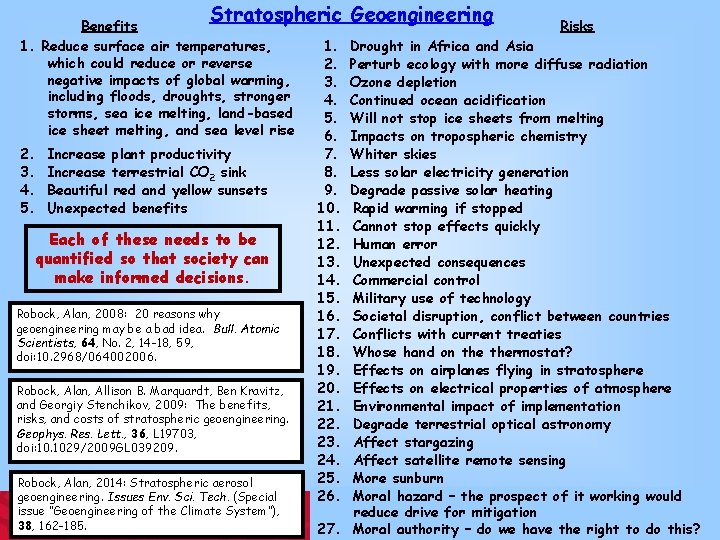
Stratospheric Geoengineering Benefits 1. Reduce surface air temperatures, which could reduce or reverse negative impacts of global warming, including floods, droughts, stronger storms, sea ice melting, land-based ice sheet melting, and sea level rise 2. 3. 4. 5. Increase plant productivity Increase terrestrial CO 2 sink Beautiful red and yellow sunsets Unexpected benefits Each of these needs to be quantified so that society can make informed decisions. Robock, Alan, 2008: 20 reasons why geoengineering may be a bad idea. Bull. Atomic Scientists, 64, No. 2, 14 -18, 59, doi: 10. 2968/064002006. Robock, Alan, Allison B. Marquardt, Ben Kravitz, and Georgiy Stenchikov, 2009: The benefits, risks, and costs of stratospheric geoengineering. Geophys. Res. Lett. , 36, L 19703, doi: 10. 1029/2009 GL 039209. Robock, Alan, 2014: Stratospheric aerosol geoengineering. Issues Env. Sci. Tech. (Special issue “Geoengineering of the Climate System”), 38, 162 -185. 1. 2. 3. 4. 5. 6. 7. 8. 9. 10. 11. 12. 13. 14. 15. 16. 17. 18. 19. 20. 21. 22. 23. 24. 25. 26. Risks Drought in Africa and Asia Perturb ecology with more diffuse radiation Ozone depletion Continued ocean acidification Will not stop ice sheets from melting Impacts on tropospheric chemistry Whiter skies Less solar electricity generation Degrade passive solar heating Rapid warming if stopped Cannot stop effects quickly Human error Unexpected consequences Commercial control Military use of technology Societal disruption, conflict between countries Conflicts with current treaties Whose hand on thermostat? Effects on airplanes flying in stratosphere Effects on electrical properties of atmosphere Environmental impact of implementation Degrade terrestrial optical astronomy Affect stargazing Affect satellite remote sensing More sunburn Moral hazard – the prospect of it working would Alan Robock reduce drive for mitigation Environmental 27. Moral authority – do. Department we have of the right to do. Sciences this?
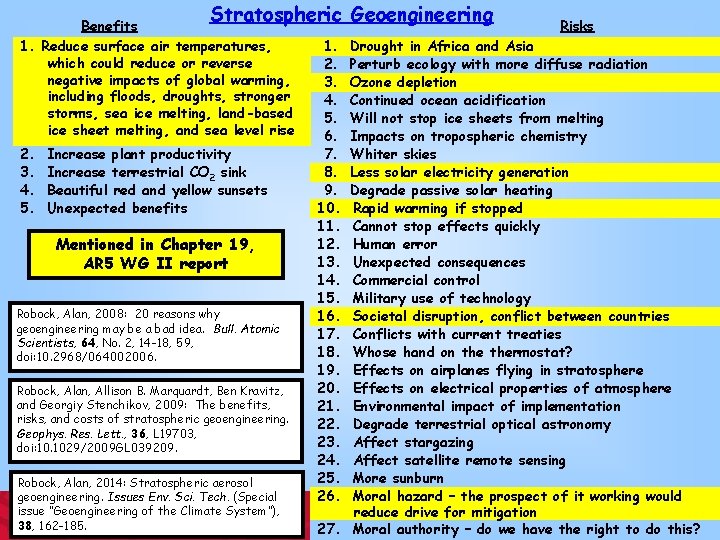
Stratospheric Geoengineering Benefits 1. Reduce surface air temperatures, which could reduce or reverse negative impacts of global warming, including floods, droughts, stronger storms, sea ice melting, land-based ice sheet melting, and sea level rise 2. 3. 4. 5. Increase plant productivity Increase terrestrial CO 2 sink Beautiful red and yellow sunsets Unexpected benefits Mentioned in Chapter 19, AR 5 WG II report Robock, Alan, 2008: 20 reasons why geoengineering may be a bad idea. Bull. Atomic Scientists, 64, No. 2, 14 -18, 59, doi: 10. 2968/064002006. Robock, Alan, Allison B. Marquardt, Ben Kravitz, and Georgiy Stenchikov, 2009: The benefits, risks, and costs of stratospheric geoengineering. Geophys. Res. Lett. , 36, L 19703, doi: 10. 1029/2009 GL 039209. Robock, Alan, 2014: Stratospheric aerosol geoengineering. Issues Env. Sci. Tech. (Special issue “Geoengineering of the Climate System”), 38, 162 -185. 1. 2. 3. 4. 5. 6. 7. 8. 9. 10. 11. 12. 13. 14. 15. 16. 17. 18. 19. 20. 21. 22. 23. 24. 25. 26. Risks Drought in Africa and Asia Perturb ecology with more diffuse radiation Ozone depletion Continued ocean acidification Will not stop ice sheets from melting Impacts on tropospheric chemistry Whiter skies Less solar electricity generation Degrade passive solar heating Rapid warming if stopped Cannot stop effects quickly Human error Unexpected consequences Commercial control Military use of technology Societal disruption, conflict between countries Conflicts with current treaties Whose hand on thermostat? Effects on airplanes flying in stratosphere Effects on electrical properties of atmosphere Environmental impact of implementation Degrade terrestrial optical astronomy Affect stargazing Affect satellite remote sensing More sunburn Moral hazard – the prospect of it working would Alan Robock reduce drive for mitigation Environmental 27. Moral authority – do. Department we have of the right to do. Sciences this?
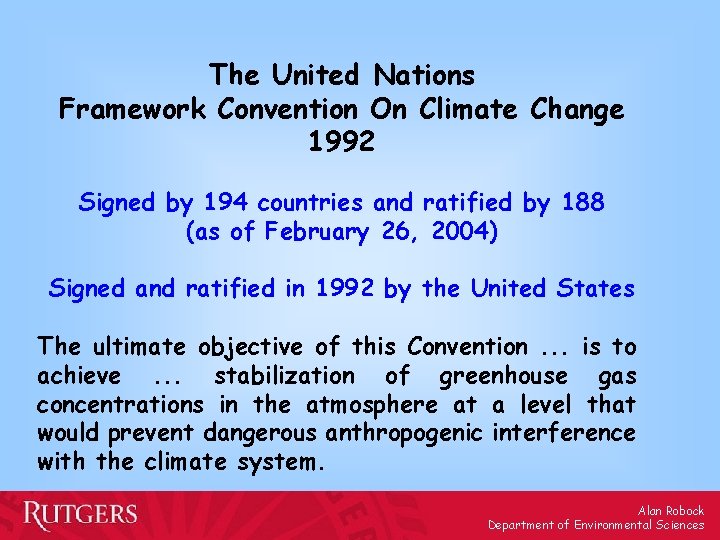
The United Nations Framework Convention On Climate Change 1992 Signed by 194 countries and ratified by 188 (as of February 26, 2004) Signed and ratified in 1992 by the United States The ultimate objective of this Convention. . . is to achieve. . . stabilization of greenhouse gas concentrations in the atmosphere at a level that would prevent dangerous anthropogenic interference with the climate system. Alan Robock Department of Environmental Sciences
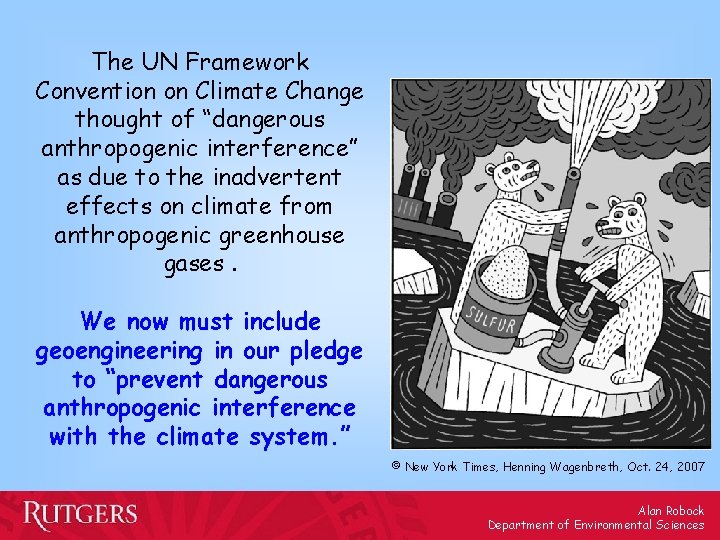
The UN Framework Convention on Climate Change thought of “dangerous anthropogenic interference” as due to the inadvertent effects on climate from anthropogenic greenhouse gases. We now must include geoengineering in our pledge to “prevent dangerous anthropogenic interference with the climate system. ” © New York Times, Henning Wagenbreth, Oct. 24, 2007 Alan Robock Department of Environmental Sciences
IPCC is policy-relevant, but not policy-prescriptive. But personally, I feel obligated to recommend policy responses.

Alan Robock Department of Environmental Sciences
- Slides: 24