
Risking Connection A Training Model for Working with
- Slides: 109
Risking Connection® A Training Model for Working with Survivors of Trauma and Adverse Childhood Experiences (ACEs) (2017 -2018 Revision) © 2006 Sidran Institute. Risking Connection® is a registered trademark of Sidran Institute 1
Presented by the Traumatic Stress Institute of Klingberg Family Centers And the Sidran Institute © 2006 Sidran Institute. Risking Connection® is a registered trademark of Sidran Institute 2
Risking Connection Program Evaluation Data Collection (Optional) © 2006 Sidran Institute. Risking Connection® is a registered trademark of Sidran Institute 3
Risking Connection : 3 -Day Basic Training ® Day 1 © 2006 Sidran Institute. Risking Connection® is a registered trademark of Sidran Institute 4
Frame of Training © 2006 Sidran Institute. Risking Connection® is a registered trademark of Sidran Institute 5
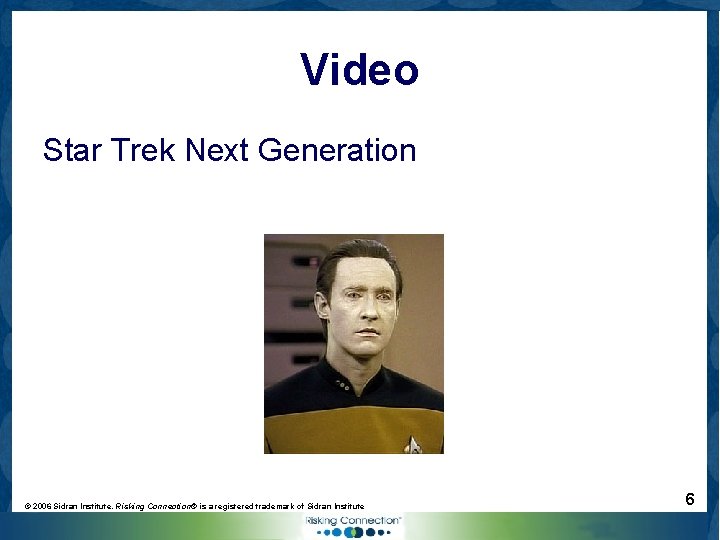
Video Star Trek Next Generation © 2006 Sidran Institute. Risking Connection® is a registered trademark of Sidran Institute 6
Origins of Risking Connection From consumer trauma survivors grassroots effort in Maine Mental health services making clients worse, not better Maine and New York launch plan to train public mental health workers in trauma-sensitive treatment Sidran and TREATI – write, field test, disseminate RC curriculum and training program Risking Connection born of consumer advocacy © 2006 Sidran Institute. Risking Connection® is a registered trademark of Sidran Institute 7
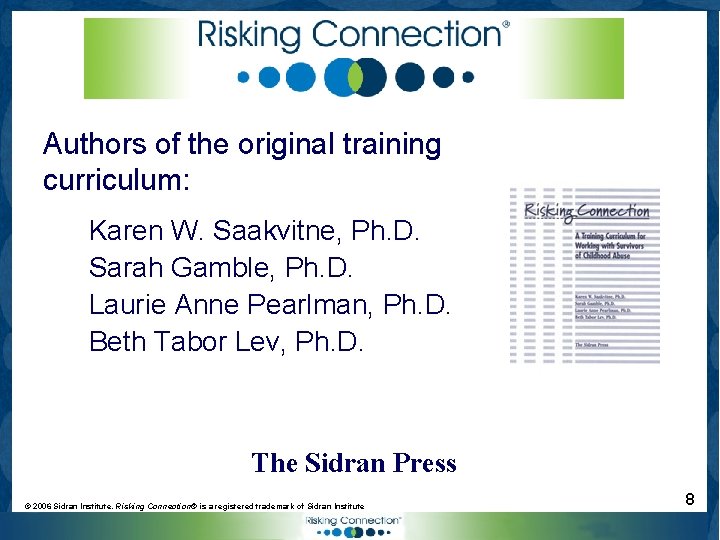
Authors of the original training curriculum: Karen W. Saakvitne, Ph. D. Sarah Gamble, Ph. D. Laurie Anne Pearlman, Ph. D. Beth Tabor Lev, Ph. D. The Sidran Press © 2006 Sidran Institute. Risking Connection® is a registered trademark of Sidran Institute 8
Groundrules © 2006 Sidran Institute. Risking Connection® is a registered trademark of Sidran Institute 9
Overview of Training Day 1 Topics • Lifelong Impact of Trauma (ACEs Study) • Traditional Model vs. Trauma. Informed Model • Understanding and Applying the RC Trauma Framework • Vicarious Traumatization (VT) © 2006 Sidran Institute. Risking Connection® is a registered trademark of Sidran Institute 10
Overview of Training Day 2 Topics • Healing Attachment • Frame and Boundaries • Strengthening Self-Capacities (Feeling Skills) • Using RC principles to Collaborative Crisis Management • Rethinking “Manipulation” • VT and Crisis © 2006 Sidran Institute. Risking Connection® is a registered trademark of Sidran Institute 11
Overview of Training Day 3 Topics • Dissociation and Grounding (optional) • Countertransference – Using Our Responses to Clients to Promote Healing • Indicators of an RC Approach in Programs • Addressing and Transforming VT • Putting It All Together and Closing © 2006 Sidran Institute. Risking Connection® is a registered trademark of Sidran Institute 12
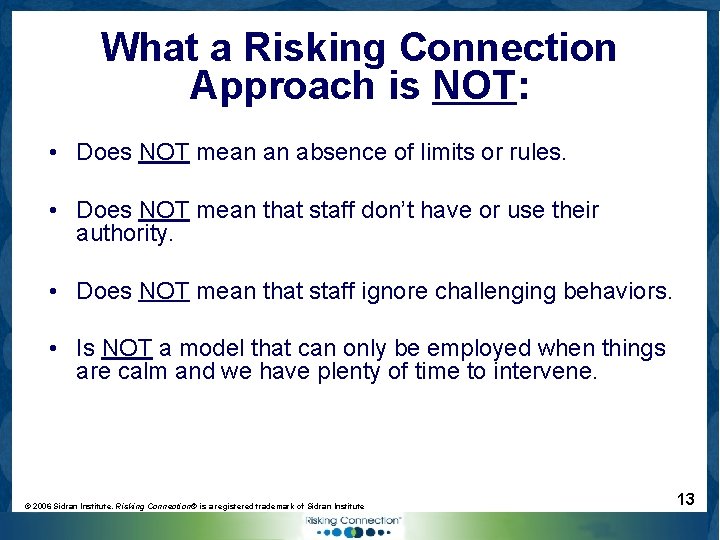
What a Risking Connection Approach is NOT: • Does NOT mean an absence of limits or rules. • Does NOT mean that staff don’t have or use their authority. • Does NOT mean that staff ignore challenging behaviors. • Is NOT a model that can only be employed when things are calm and we have plenty of time to intervene. © 2006 Sidran Institute. Risking Connection® is a registered trademark of Sidran Institute 13
Review Day 1 Agenda © 2006 Sidran Institute. Risking Connection® is a registered trademark of Sidran Institute 14
Lifelong Impact of Trauma Adverse Childhood Experiences (ACE) Study “The most important study you never heard of. ” Jane Stevens, Acesconnection. com © 2006 Sidran Institute. Risking Connection® is a registered trademark of Sidran Institute 15
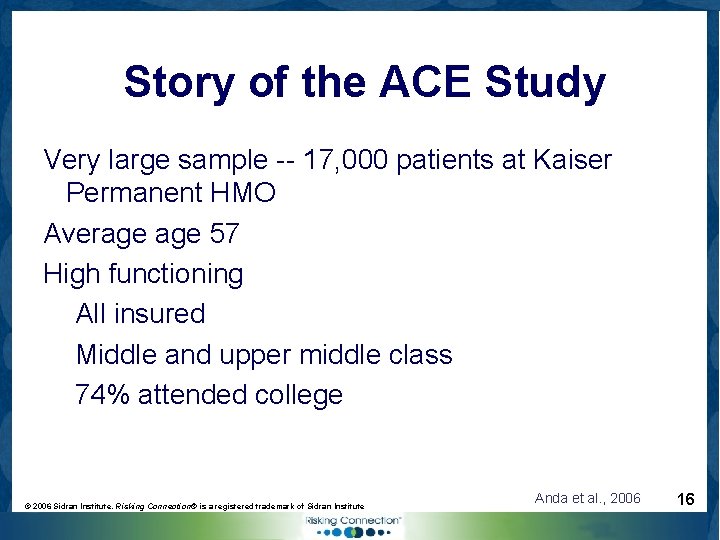
Story of the ACE Study Very large sample -- 17, 000 patients at Kaiser Permanent HMO Average 57 High functioning All insured Middle and upper middle class 74% attended college © 2006 Sidran Institute. Risking Connection® is a registered trademark of Sidran Institute Anda et al. , 2006 16
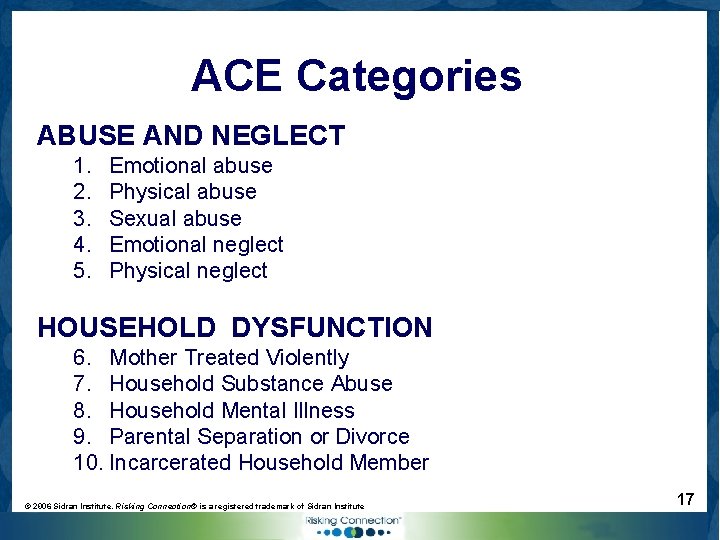
ACE Categories ABUSE AND NEGLECT 1. 2. 3. 4. 5. Emotional abuse Physical abuse Sexual abuse Emotional neglect Physical neglect HOUSEHOLD DYSFUNCTION 6. Mother Treated Violently 7. Household Substance Abuse 8. Household Mental Illness 9. Parental Separation or Divorce 10. Incarcerated Household Member • © 2006 Sidran Institute. Risking Connection® is a registered trademark of Sidran Institute 17
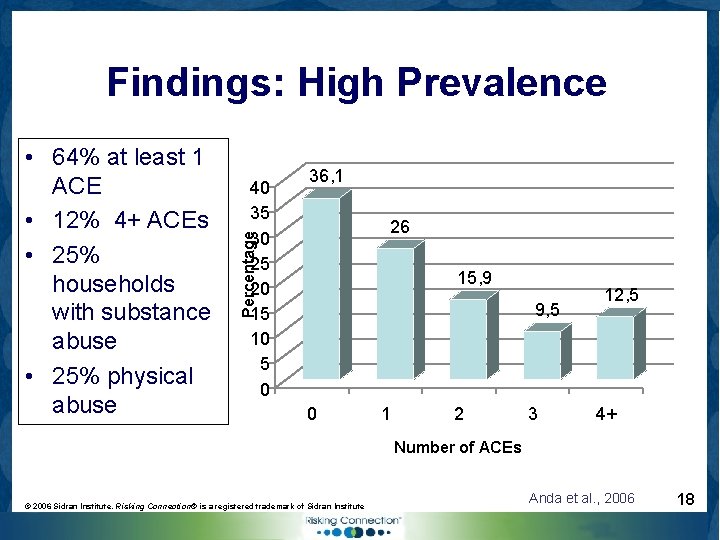
Findings: High Prevalence 40 35 30 25 20 15 10 5 0 36, 1 26 Percentage • 64% at least 1 ACE • 12% 4+ ACEs • 25% households with substance abuse • 25% physical abuse 15, 9 9, 5 0 1 2 3 12, 5 4+ Number of ACEs © 2006 Sidran Institute. Risking Connection® is a registered trademark of Sidran Institute Anda et al. , 2006 18
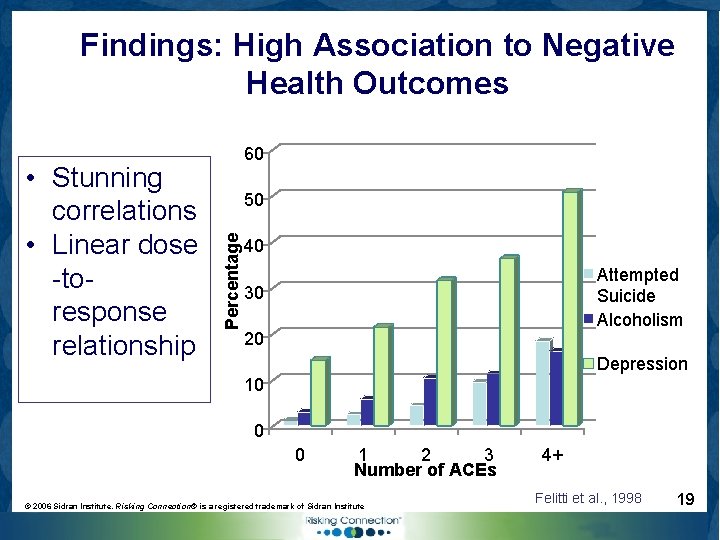
Findings: High Association to Negative Health Outcomes 50 Percentage • Stunning correlations • Linear dose -toresponse relationship 60 40 Attempted Suicide Alcoholism 30 20 Depression 10 0 0 1 2 3 Number of ACEs © 2006 Sidran Institute. Risking Connection® is a registered trademark of Sidran Institute 4+ Felitti et al. , 1998 19
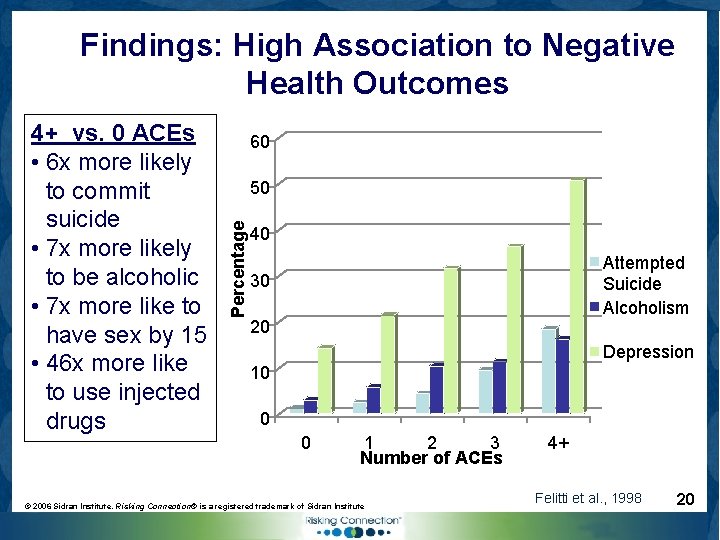
Findings: High Association to Negative Health Outcomes 60 50 Percentage 4+ vs. 0 ACEs • 6 x more likely to commit suicide • 7 x more likely to be alcoholic • 7 x more like to have sex by 15 • 46 x more like to use injected drugs 40 Attempted Suicide Alcoholism 30 20 Depression 10 0 0 1 2 3 Number of ACEs © 2006 Sidran Institute. Risking Connection® is a registered trademark of Sidran Institute 4+ Felitti et al. , 1998 20
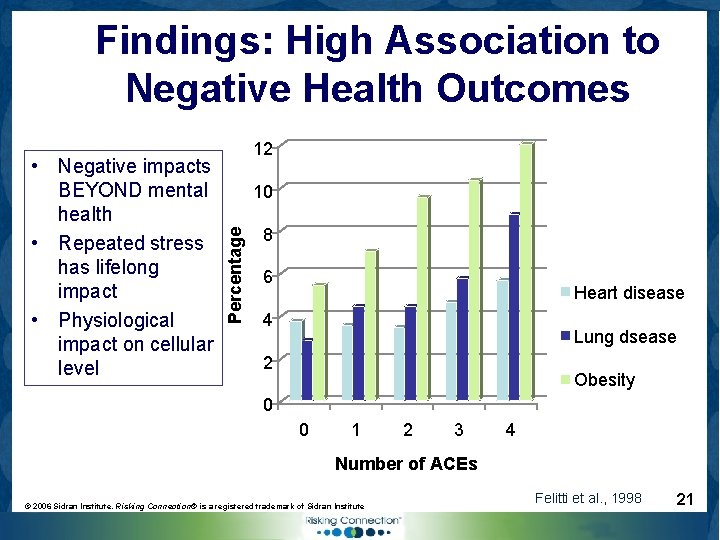
Findings: High Association to Negative Health Outcomes 10 Percentage • Negative impacts BEYOND mental health • Repeated stress has lifelong impact • Physiological impact on cellular level 12 8 6 Heart disease 4 Lung dsease 2 Obesity 0 0 1 2 3 4 Number of ACEs © 2006 Sidran Institute. Risking Connection® is a registered trademark of Sidran Institute Felitti et al. , 1998 21
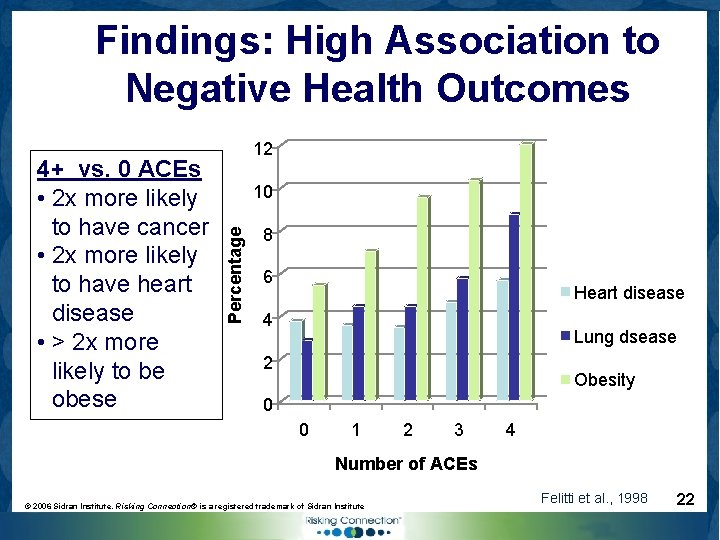
Findings: High Association to Negative Health Outcomes 10 Percentage 4+ vs. 0 ACEs • 2 x more likely to have cancer • 2 x more likely to have heart disease • > 2 x more likely to be obese 12 8 6 Heart disease 4 Lung dsease 2 Obesity 0 0 1 2 3 4 Number of ACEs © 2006 Sidran Institute. Risking Connection® is a registered trademark of Sidran Institute Felitti et al. , 1998 22
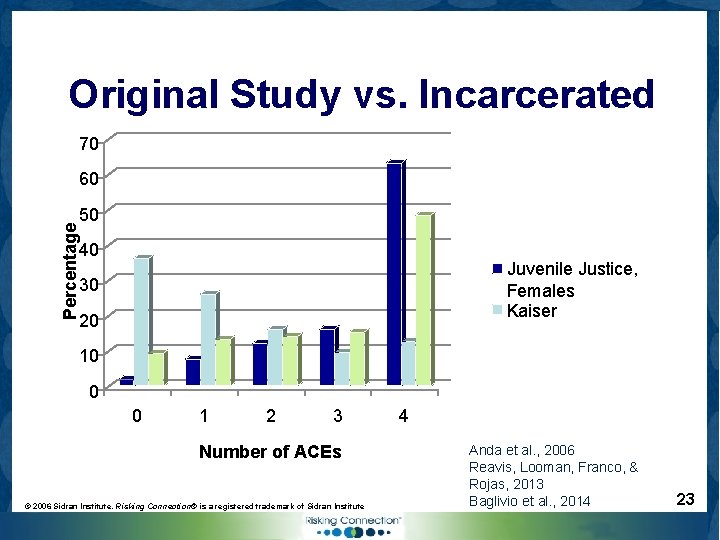
Original Study vs. Incarcerated 70 60 Percentage 50 40 Juvenile Justice, Females Kaiser 30 20 10 0 0 1 2 3 Number of ACEs © 2006 Sidran Institute. Risking Connection® is a registered trademark of Sidran Institute 4 Anda et al. , 2006 Reavis, Looman, Franco, & Rojas, 2013 Baglivio et al. , 2014 23
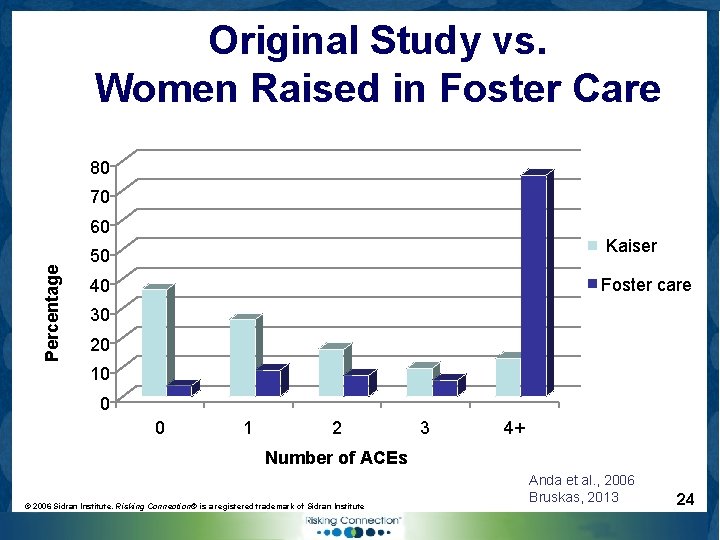
Original Study vs. Women Raised in Foster Care 80 70 Percentage 60 Kaiser 50 Foster care 40 30 20 10 0 0 1 2 3 4+ Number of ACEs © 2006 Sidran Institute. Risking Connection® is a registered trademark of Sidran Institute Anda et al. , 2006 Bruskas, 2013 24
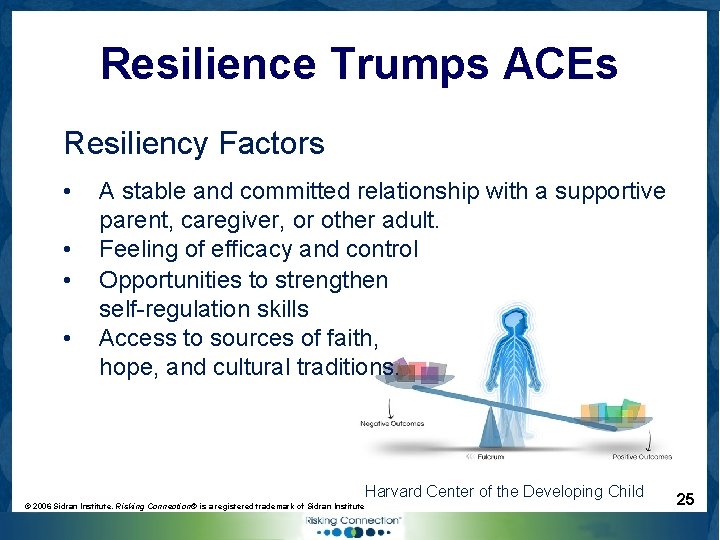
Resilience Trumps ACEs Resiliency Factors • • A stable and committed relationship with a supportive parent, caregiver, or other adult. Feeling of efficacy and control Opportunities to strengthen self-regulation skills Access to sources of faith, hope, and cultural traditions. Harvard Center of the Developing Child © 2006 Sidran Institute. Risking Connection® is a registered trademark of Sidran Institute 25
If child abuse ended today… If child abuse ended today, in 10 years the jails would be empty and the DSM would be a pamphlet. – adapted from John Briere, Ph. D. © 2006 Sidran Institute. Risking Connection® is a registered trademark of Sidran Institute 26
Why So Important? Trauma is a public health epidemic Roots of poor health in childhood trauma are unrecognized Physiological impact of chronic stress/trauma Addressing trauma prevents health problems throughout life span TRAUMA-INFORMED CARE!!!! © 2006 Sidran Institute. Risking Connection® is a registered trademark of Sidran Institute 27
What Is Trauma-Informed Care? “The 4 Rs” An approach where all levels of a system: REALIZE the pervasive impact of ACEs and trauma RECOGNIZE the signs of trauma in clients RESPOND by applying the principles of TIC to all areas of the system RESIST RE-TRAUMATIZATION - provide service that heals rather than make things worse (SAMHSA, 2014) © 2006 Sidran Institute. Risking Connection® is a registered trademark of Sidran Institute 28
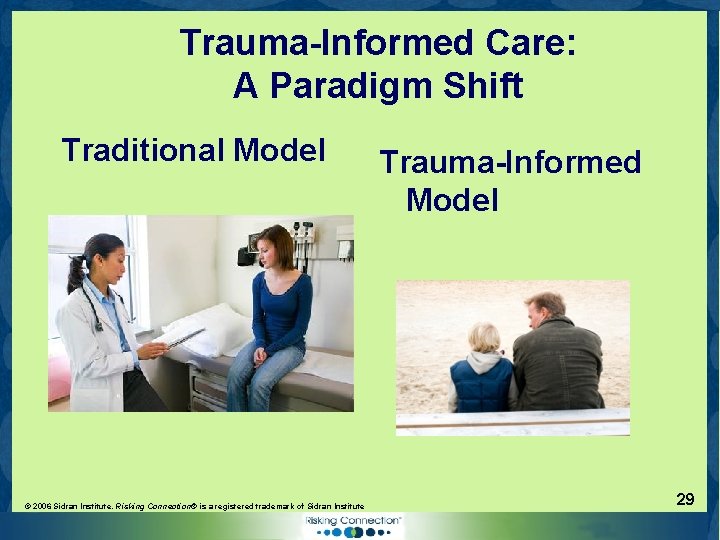
Trauma-Informed Care: A Paradigm Shift Traditional Model © 2006 Sidran Institute. Risking Connection® is a registered trademark of Sidran Institute Trauma-Informed Model 29
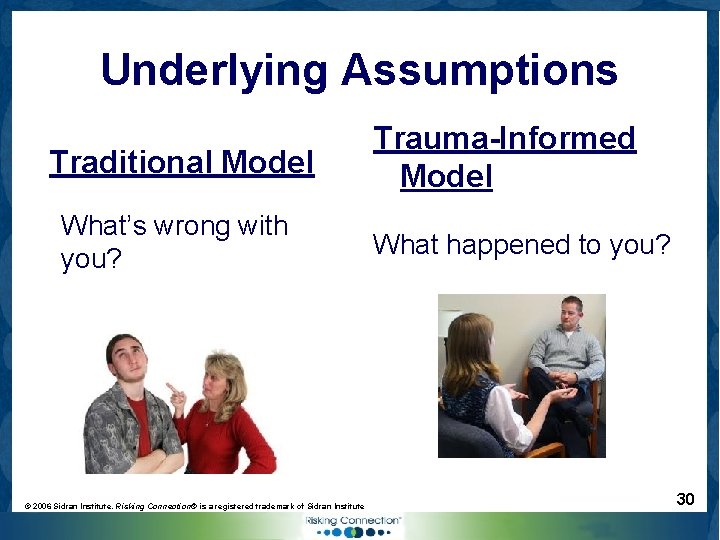
Underlying Assumptions Traditional Model What’s wrong with you? © 2006 Sidran Institute. Risking Connection® is a registered trademark of Sidran Institute Trauma-Informed Model What happened to you? 30
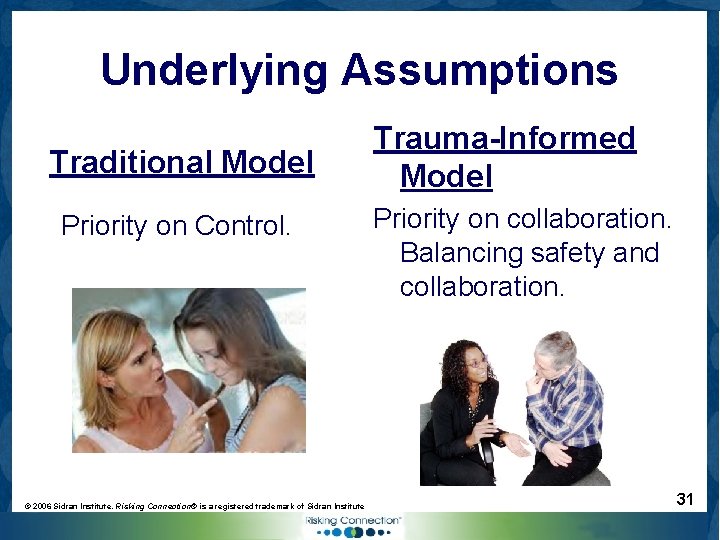
Underlying Assumptions Traditional Model Priority on Control. © 2006 Sidran Institute. Risking Connection® is a registered trademark of Sidran Institute Trauma-Informed Model Priority on collaboration. Balancing safety and collaboration. 31
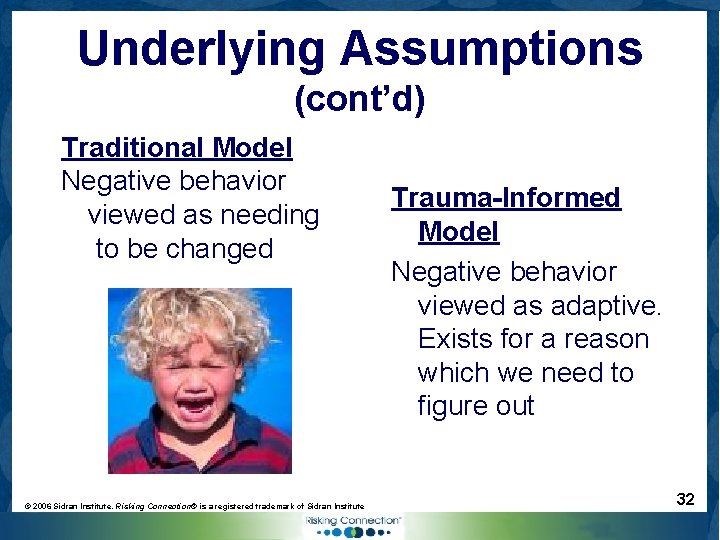
Underlying Assumptions (cont’d) Traditional Model Negative behavior viewed as needing to be changed © 2006 Sidran Institute. Risking Connection® is a registered trademark of Sidran Institute Trauma-Informed Model Negative behavior viewed as adaptive. Exists for a reason which we need to figure out 32
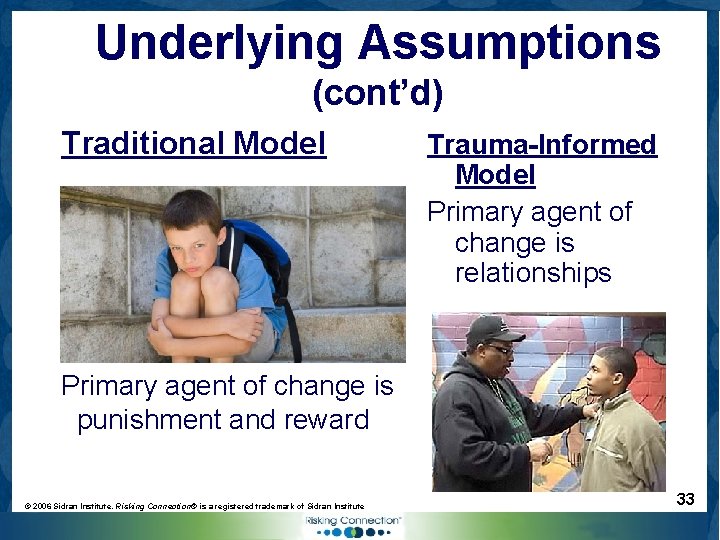
Underlying Assumptions (cont’d) Traditional Model Trauma-Informed Model Primary agent of change is relationships Primary agent of change is punishment and reward © 2006 Sidran Institute. Risking Connection® is a registered trademark of Sidran Institute 33
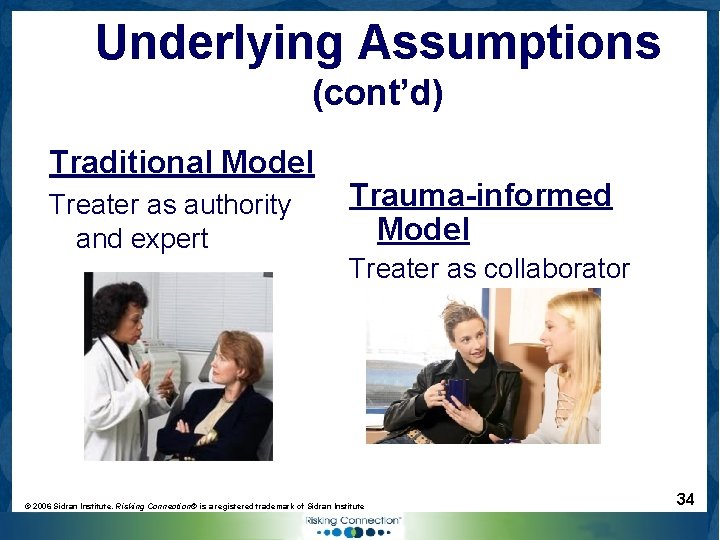
Underlying Assumptions (cont’d) Traditional Model Treater as authority and expert Trauma-informed Model Treater as collaborator © 2006 Sidran Institute. Risking Connection® is a registered trademark of Sidran Institute 34
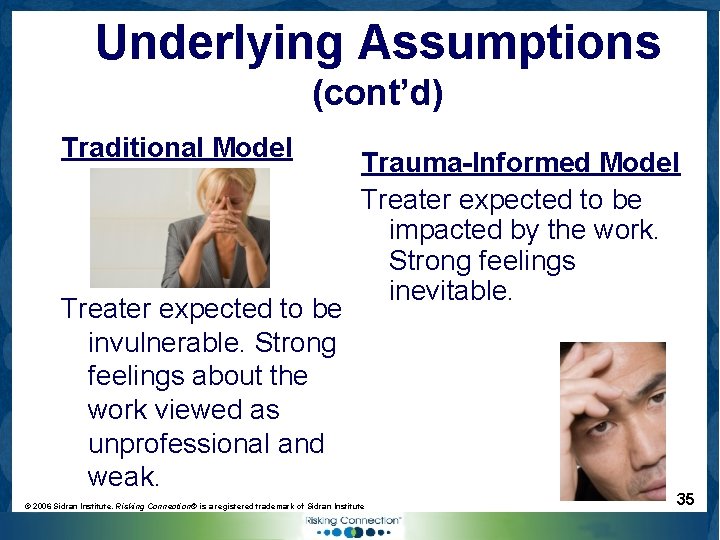
Underlying Assumptions (cont’d) Traditional Model Treater expected to be invulnerable. Strong feelings about the work viewed as unprofessional and weak. Trauma-Informed Model Treater expected to be impacted by the work. Strong feelings inevitable. © 2006 Sidran Institute. Risking Connection® is a registered trademark of Sidran Institute 35
Role Play Exercise Meeting a client for the first time with a traditional vs. trauma-informed lens. © 2006 Sidran Institute. Risking Connection® is a registered trademark of Sidran Institute 36
Break © 2006 Sidran Institute. Risking Connection® is a registered trademark of Sidran Institute 37
Definitions The RC Trauma Framework © 2006 Sidran Institute. Risking Connection® is a registered trademark of Sidran Institute 38
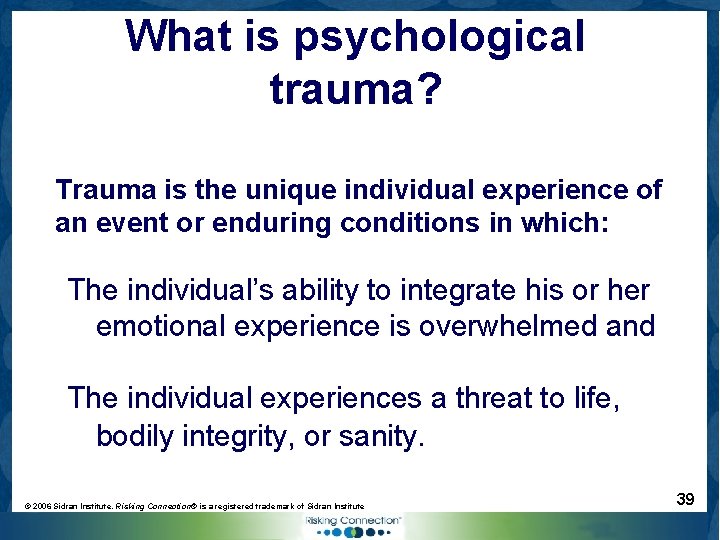
What is psychological trauma? Trauma is the unique individual experience of an event or enduring conditions in which: The individual’s ability to integrate his or her emotional experience is overwhelmed and The individual experiences a threat to life, bodily integrity, or sanity. © 2006 Sidran Institute. Risking Connection® is a registered trademark of Sidran Institute 39
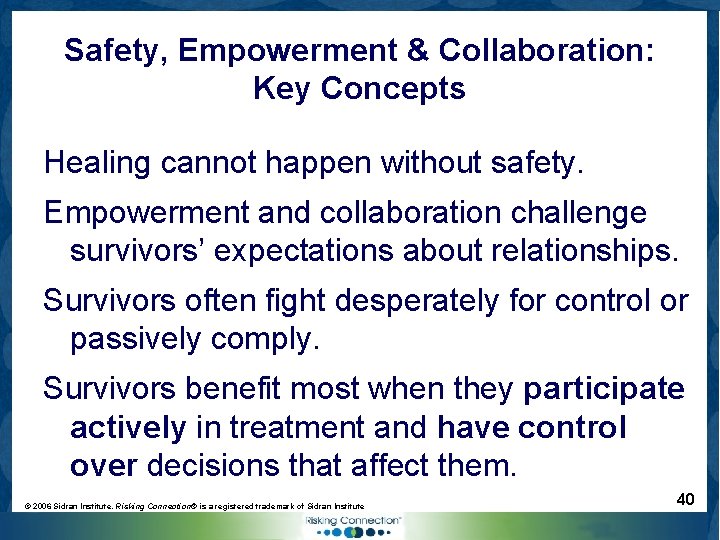
Safety, Empowerment & Collaboration: Key Concepts Healing cannot happen without safety. Empowerment and collaboration challenge survivors’ expectations about relationships. Survivors often fight desperately for control or passively comply. Survivors benefit most when they participate actively in treatment and have control over decisions that affect them. © 2006 Sidran Institute. Risking Connection® is a registered trademark of Sidran Institute 40
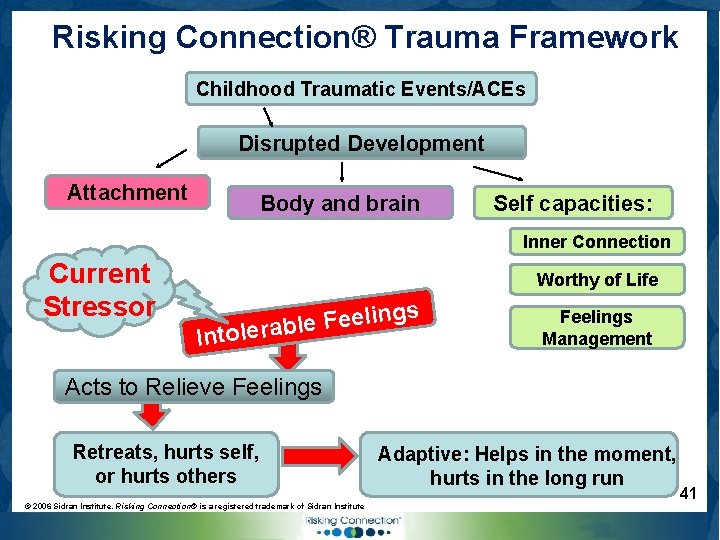
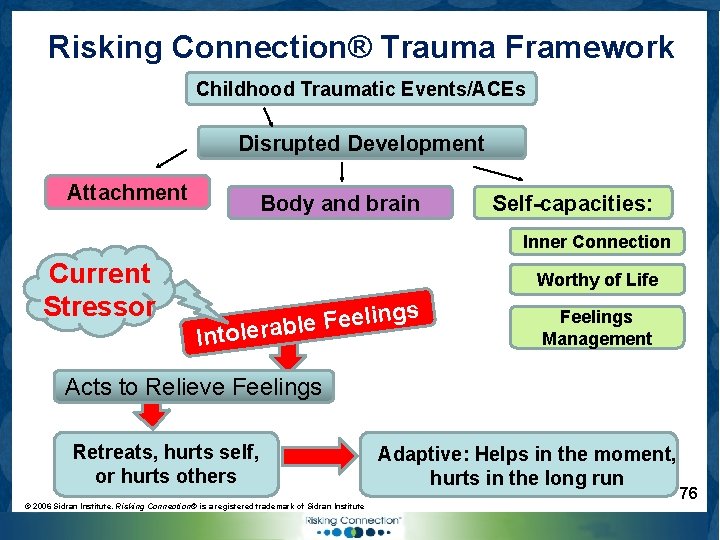
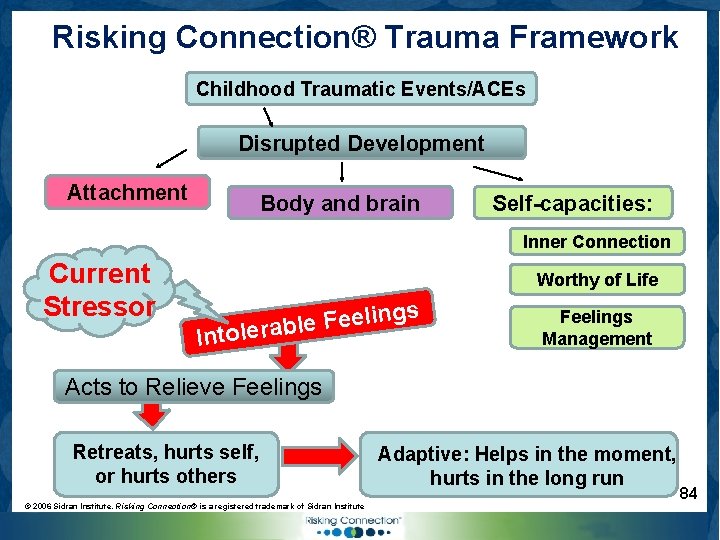
Risking Connection® Trauma Framework Childhood Traumatic Events/ACEs Disrupted Development Attachment Body and brain Self capacities: Inner Connection Current Stressor Worthy of Life gs n i l e e F e tolerabl In Feelings Management Acts to Relieve Feelings Retreats, hurts self, or hurts others © 2006 Sidran Institute. Risking Connection® is a registered trademark of Sidran Institute Adaptive: Helps in the moment, hurts in the long run 41
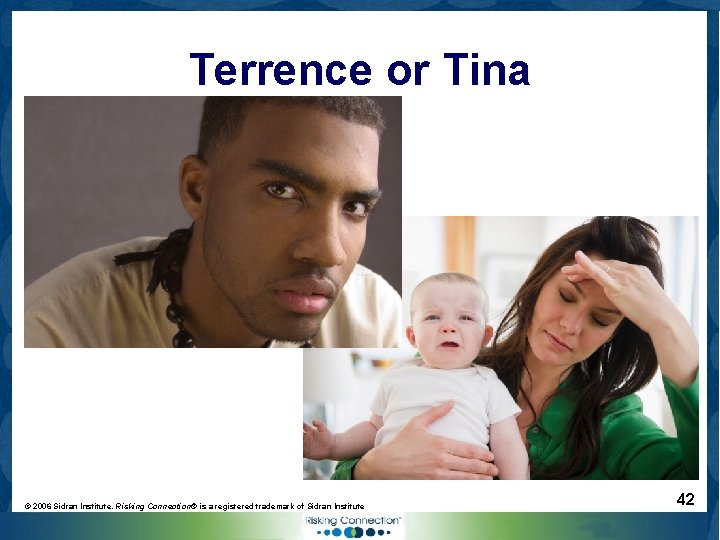
Terrence or Tina © 2006 Sidran Institute. Risking Connection® is a registered trademark of Sidran Institute 42
The Impact of Trauma on Attachment © 2006 Sidran Institute. Risking Connection® is a registered trademark of Sidran Institute 43
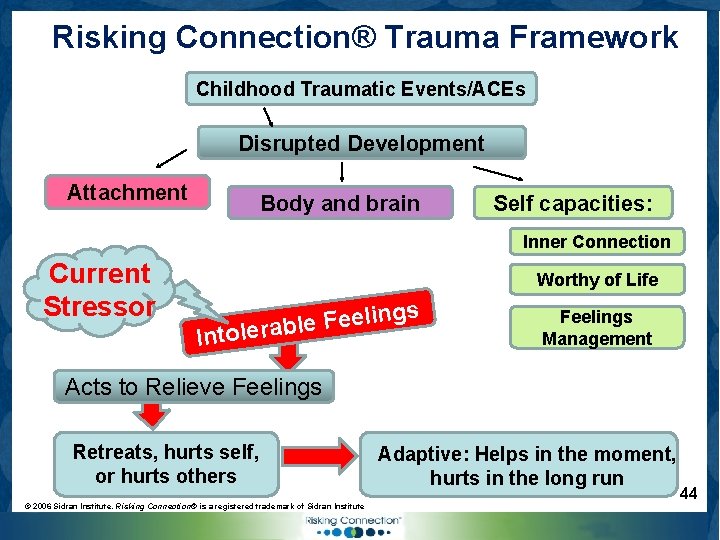
Risking Connection® Trauma Framework Childhood Traumatic Events/ACEs Disrupted Development Attachment Body and brain Self capacities: Inner Connection Current Stressor Worthy of Life gs n i l e e F e tolerabl In Feelings Management Acts to Relieve Feelings Retreats, hurts self, or hurts others © 2006 Sidran Institute. Risking Connection® is a registered trademark of Sidran Institute Adaptive: Helps in the moment, hurts in the long run 44
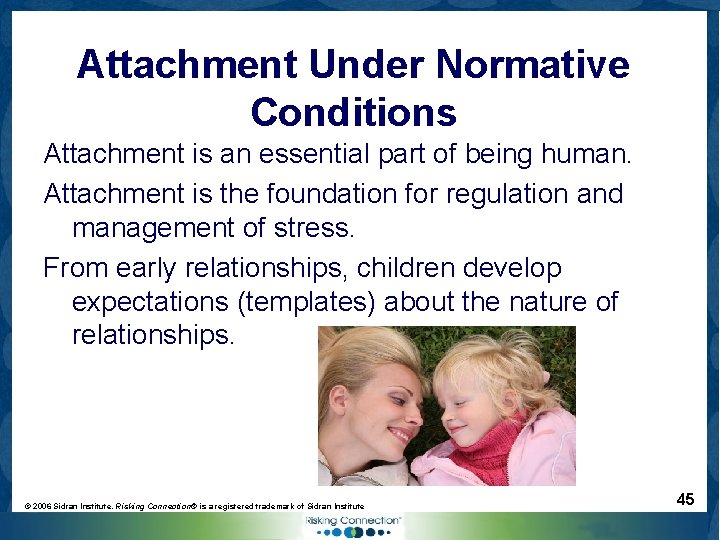
Attachment Under Normative Conditions Attachment is an essential part of being human. Attachment is the foundation for regulation and management of stress. From early relationships, children develop expectations (templates) about the nature of relationships. © 2006 Sidran Institute. Risking Connection® is a registered trademark of Sidran Institute 45
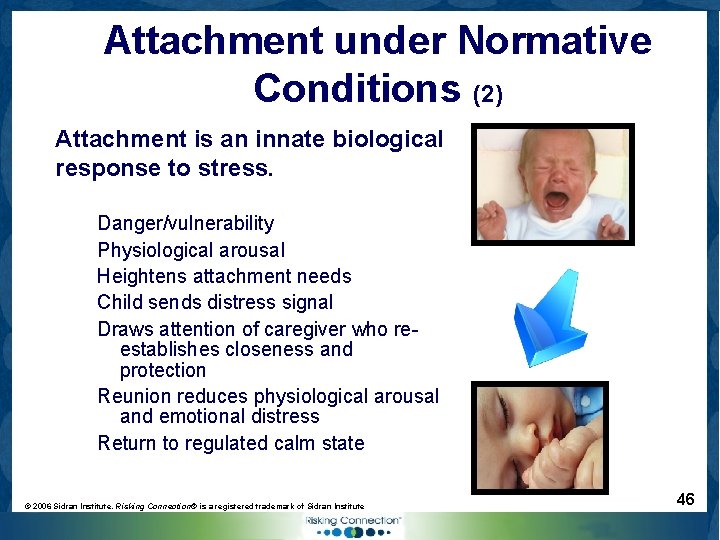
Attachment under Normative Conditions (2) Attachment is an innate biological response to stress. Danger/vulnerability Physiological arousal Heightens attachment needs Child sends distress signal Draws attention of caregiver who reestablishes closeness and protection Reunion reduces physiological arousal and emotional distress Return to regulated calm state © 2006 Sidran Institute. Risking Connection® is a registered trademark of Sidran Institute 46
Attachment under Normative Conditions (3) This process happens thousands and thousands of times during normal development. Continual rupture and repair of relationship Children, over time, begin to learn to regulate their own distress. Adult distress regulation rooted in childhood. © 2006 Sidran Institute. Risking Connection® is a registered trademark of Sidran Institute 47
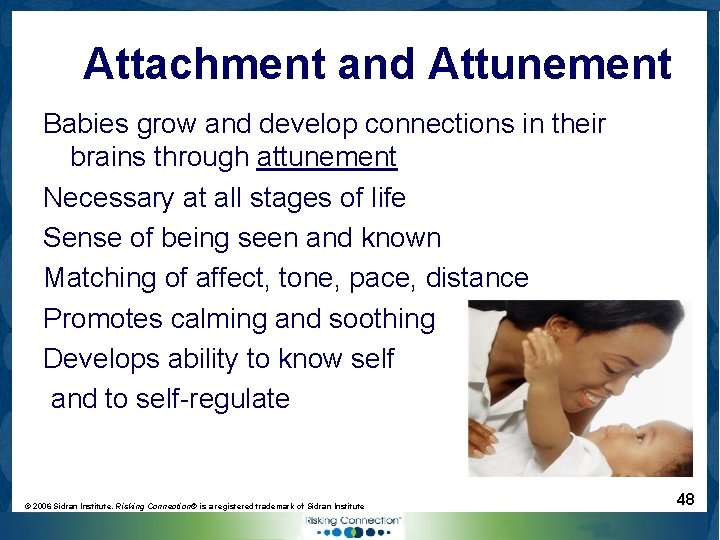
Attachment and Attunement Babies grow and develop connections in their brains through attunement Necessary at all stages of life Sense of being seen and known Matching of affect, tone, pace, distance Promotes calming and soothing Develops ability to know self and to self-regulate © 2006 Sidran Institute. Risking Connection® is a registered trademark of Sidran Institute 48
Exercise • Attunement © 2006 Sidran Institute. Risking Connection® is a registered trademark of Sidran Institute 49
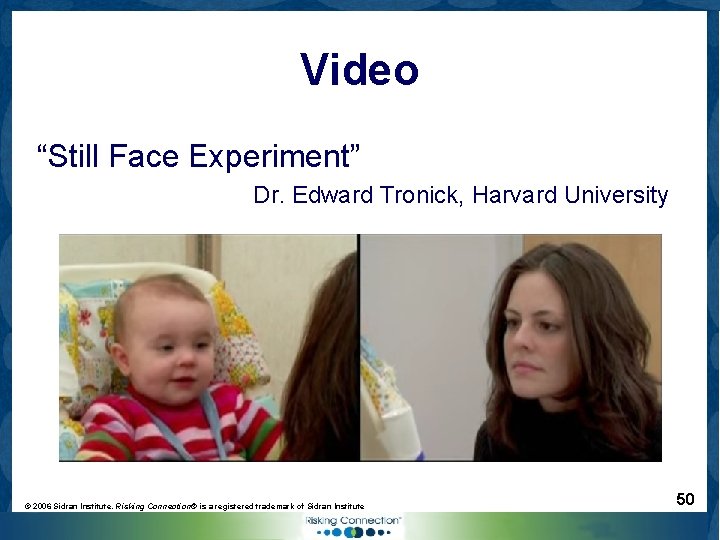
Video “Still Face Experiment” Dr. Edward Tronick, Harvard University © 2006 Sidran Institute. Risking Connection® is a registered trademark of Sidran Institute 50
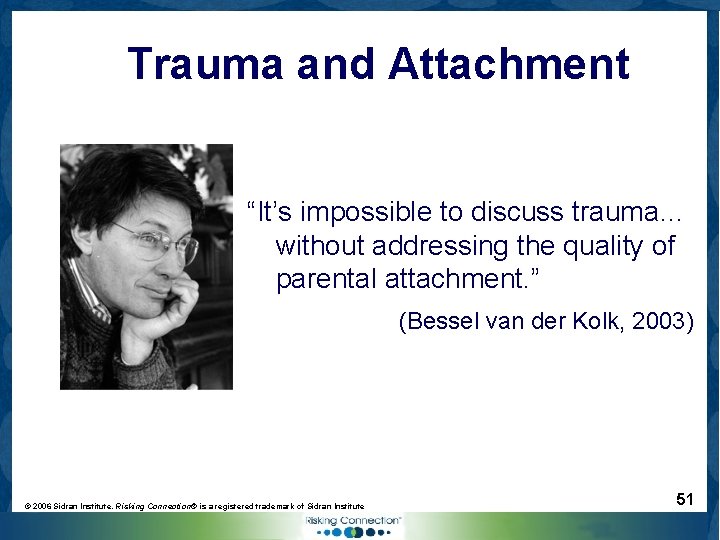
Trauma and Attachment “It’s impossible to discuss trauma… without addressing the quality of parental attachment. ” (Bessel van der Kolk, 2003) © 2006 Sidran Institute. Risking Connection® is a registered trademark of Sidran Institute 51
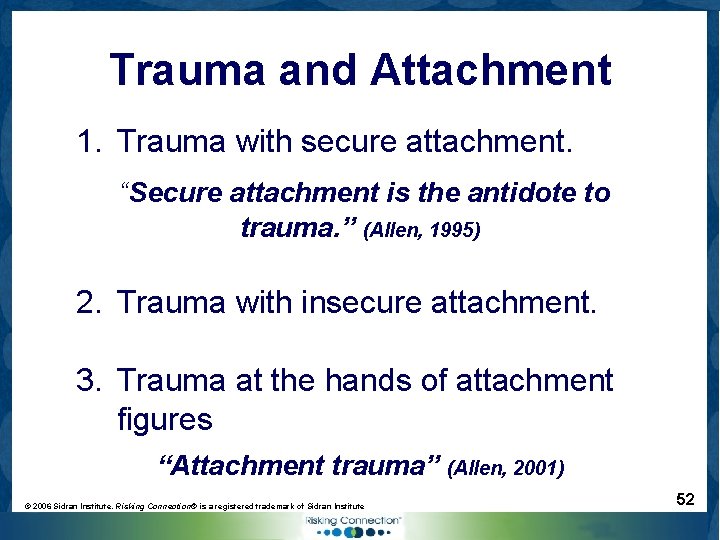
Trauma and Attachment 1. Trauma with secure attachment. “Secure attachment is the antidote to trauma. ” (Allen, 1995) 2. Trauma with insecure attachment. 3. Trauma at the hands of attachment figures “Attachment trauma” (Allen, 2001) © 2006 Sidran Institute. Risking Connection® is a registered trademark of Sidran Institute 52
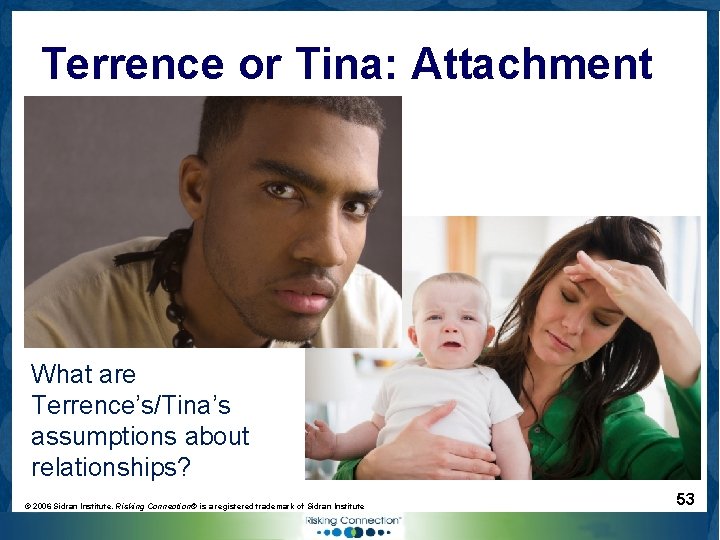
Terrence or Tina: Attachment What are Terrence’s/Tina’s assumptions about relationships? © 2006 Sidran Institute. Risking Connection® is a registered trademark of Sidran Institute 53
The Impact of Trauma on the Body and the Brain © 2006 Sidran Institute. Risking Connection® is a registered trademark of Sidran Institute 54
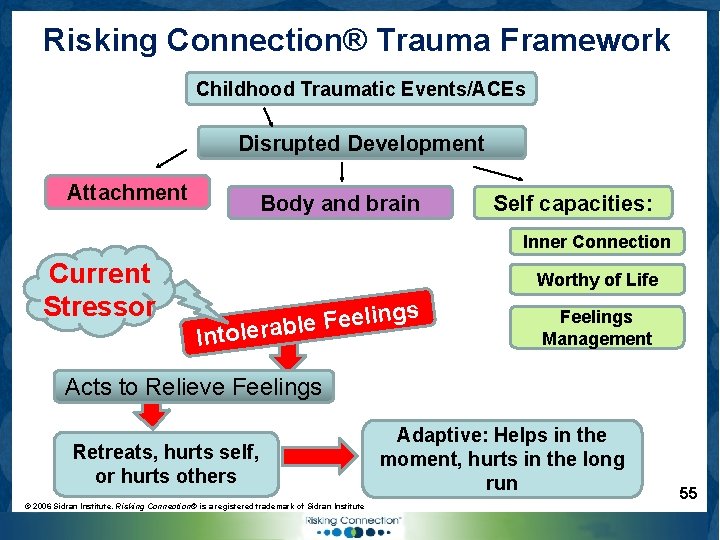
Risking Connection® Trauma Framework Childhood Traumatic Events/ACEs Disrupted Development Attachment Body and brain Self capacities: Inner Connection Current Stressor Worthy of Life gs n i l e e F e tolerabl In Feelings Management Acts to Relieve Feelings Retreats, hurts self, or hurts others © 2006 Sidran Institute. Risking Connection® is a registered trademark of Sidran Institute Adaptive: Helps in the moment, hurts in the long run 55
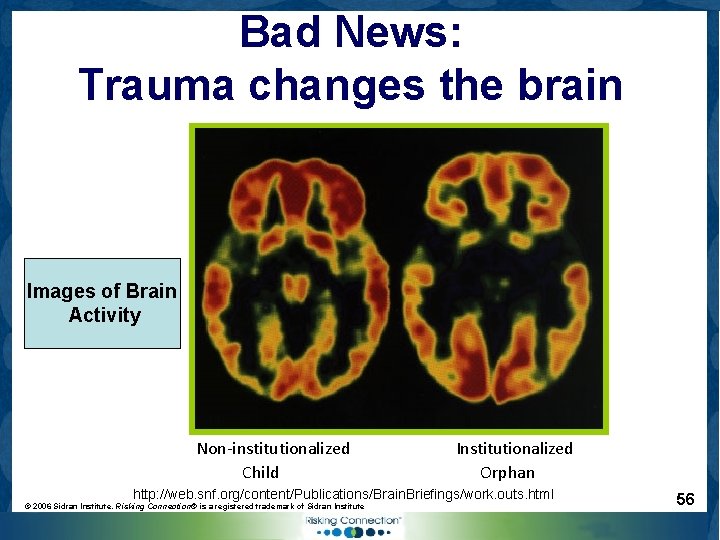
Bad News: Trauma changes the brain Images of Brain Activity Non-institutionalized Child Institutionalized Orphan http: //web. snf. org/content/Publications/Brain. Briefings/work. outs. html © 2006 Sidran Institute. Risking Connection® is a registered trademark of Sidran Institute 56
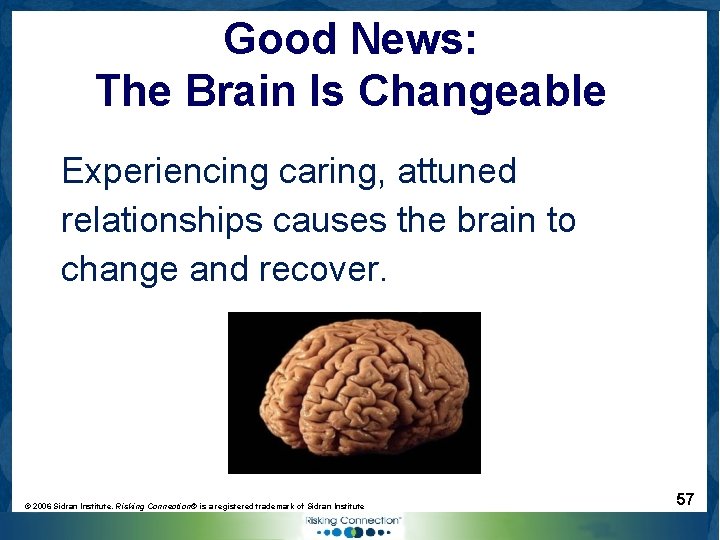
Good News: The Brain Is Changeable Experiencing caring, attuned relationships causes the brain to change and recover. © 2006 Sidran Institute. Risking Connection® is a registered trademark of Sidran Institute 57
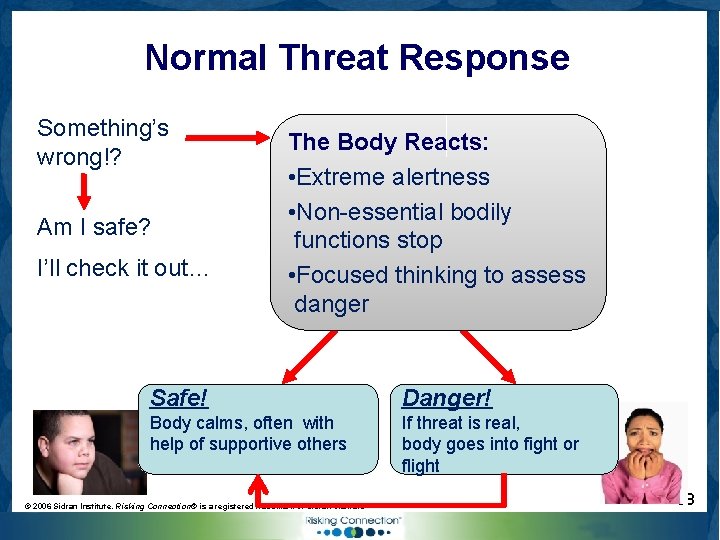
Normal Threat Response Something’s wrong!? Am I safe? I’ll check it out… The Body Reacts: • Extreme alertness • Non-essential bodily functions stop • Focused thinking to assess danger Safe! Danger! Body calms, often with help of supportive others If threat is real, body goes into fight or flight © 2006 Sidran Institute. Risking Connection® is a registered trademark of Sidran Institute 58
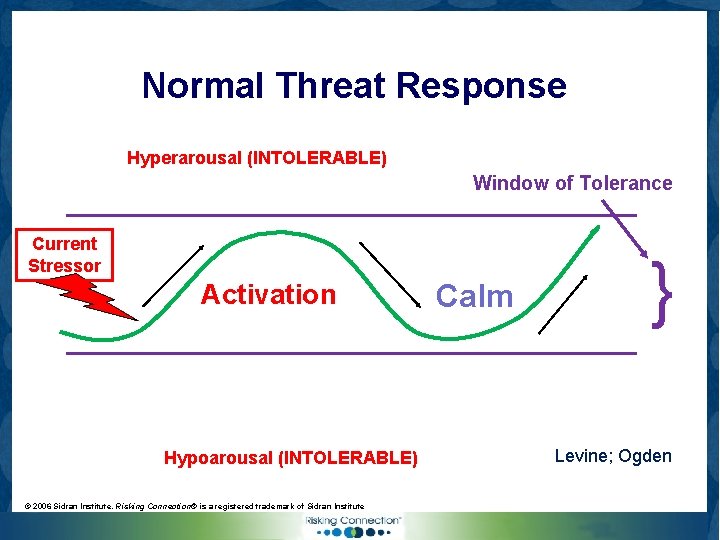
Normal Threat Response Hyperarousal (INTOLERABLE) Window of Tolerance ________________ Current Stressor Calm ________________ Activation Hypoarousal (INTOLERABLE) © 2006 Sidran Institute. Risking Connection® is a registered trademark of Sidran Institute } Levine; Ogden
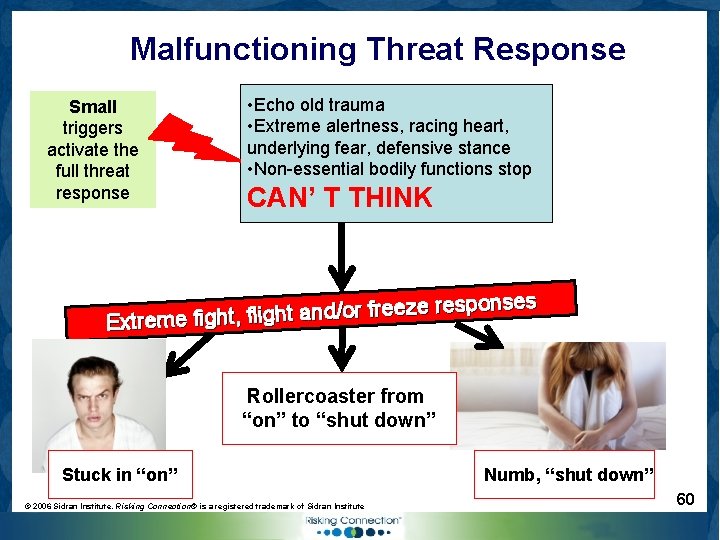
Malfunctioning Threat Response Small triggers activate the full threat response • Echo old trauma • Extreme alertness, racing heart, underlying fear, defensive stance • Non-essential bodily functions stop CAN’ T THINK responses e z e e fr r /o d n a t h ig fl t, Extreme figh Rollercoaster from “on” to “shut down” Stuck in “on” © 2006 Sidran Institute. Risking Connection® is a registered trademark of Sidran Institute Numb, “shut down” 60
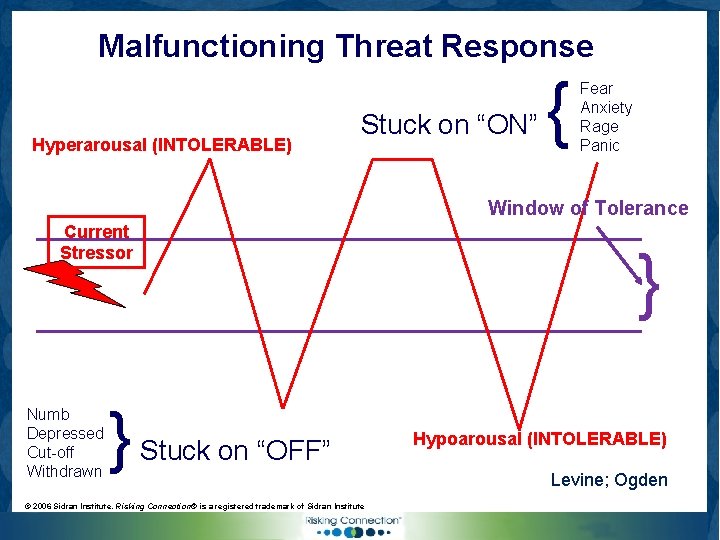
Malfunctioning Threat Response Hyperarousal (INTOLERABLE) Stuck on “ON” { Fear Anxiety Rage Panic Window of Tolerance _________________ Current } _________________ Stressor Numb Depressed Cut-off Withdrawn } Stuck on “OFF” © 2006 Sidran Institute. Risking Connection® is a registered trademark of Sidran Institute Hypoarousal (INTOLERABLE) Levine; Ogden
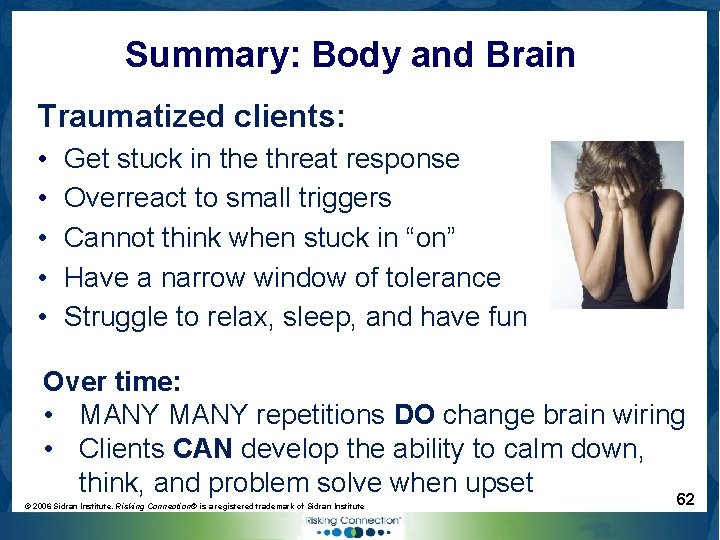
Summary: Body and Brain Traumatized clients: • • • Get stuck in the threat response Overreact to small triggers Cannot think when stuck in “on” Have a narrow window of tolerance Struggle to relax, sleep, and have fun Over time: • MANY repetitions DO change brain wiring • Clients CAN develop the ability to calm down, think, and problem solve when upset 62 © 2006 Sidran Institute. Risking Connection® is a registered trademark of Sidran Institute
Video “How Brains Are Built: The Core Story of Brain Development” Alberta Family Wellness Initiative, Alberta, Canada © 2006 Sidran Institute. Risking Connection® is a registered trademark of Sidran Institute 63
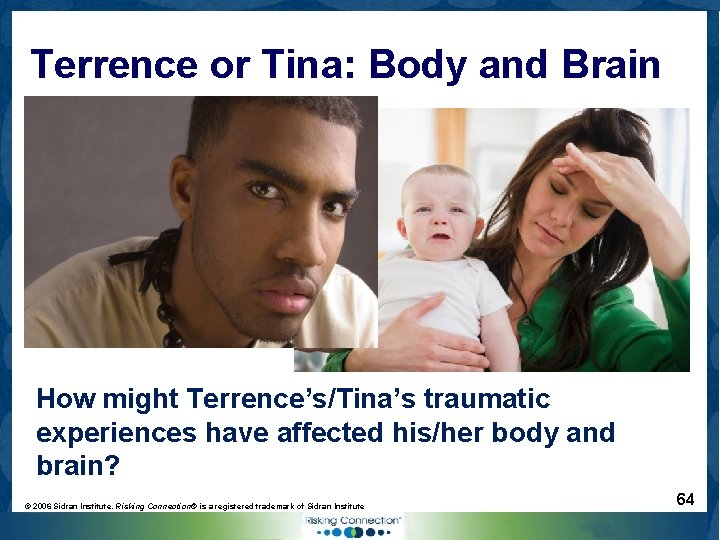
Terrence or Tina: Body and Brain How might Terrence’s/Tina’s traumatic experiences have affected his/her body and brain? © 2006 Sidran Institute. Risking Connection® is a registered trademark of Sidran Institute 64
LUNCH © 2006 Sidran Institute. Risking Connection® is a registered trademark of Sidran Institute 65
The Impact of Trauma on Self-Capacities (Feelings Skills) © 2006 Sidran Institute. Risking Connection® is a registered trademark of Sidran Institute 66
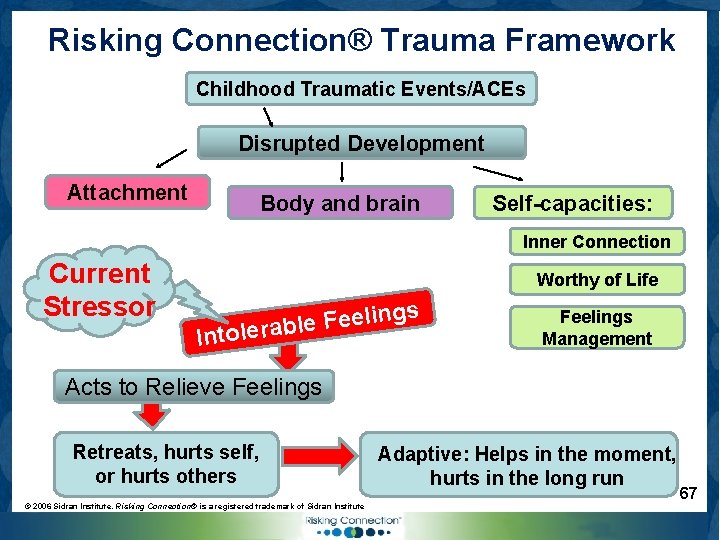
Risking Connection® Trauma Framework Childhood Traumatic Events/ACEs Disrupted Development Attachment Body and brain Self-capacities: Inner Connection Current Stressor Worthy of Life gs n i l e e F e tolerabl In Feelings Management Acts to Relieve Feelings Retreats, hurts self, or hurts others © 2006 Sidran Institute. Risking Connection® is a registered trademark of Sidran Institute Adaptive: Helps in the moment, hurts in the long run 67
Self-Capacities (Feelings Skills) Definition: The ability to stay connected to and grounded in one’s sense of self, even when one is experiencing strong feelings. The fundamental building blocks of the self. © 2006 Sidran Institute. Risking Connection® is a registered trademark of Sidran Institute 68
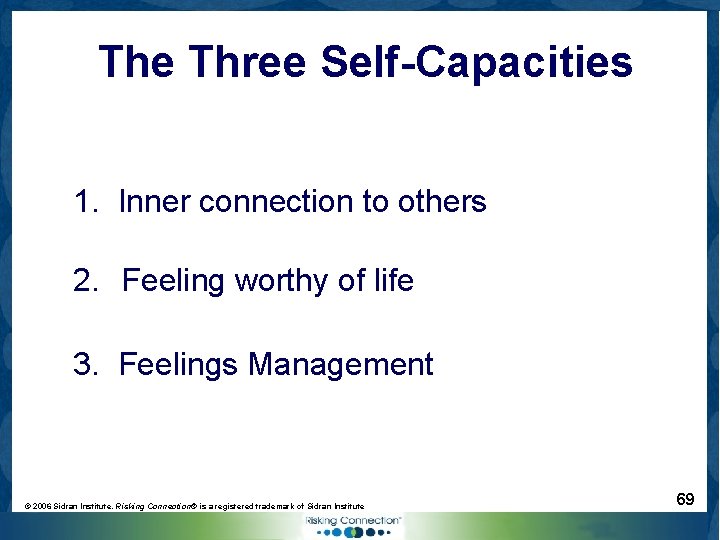
The Three Self-Capacities 1. Inner connection to others 2. Feeling worthy of life 3. Feelings Management © 2006 Sidran Institute. Risking Connection® is a registered trademark of Sidran Institute 69
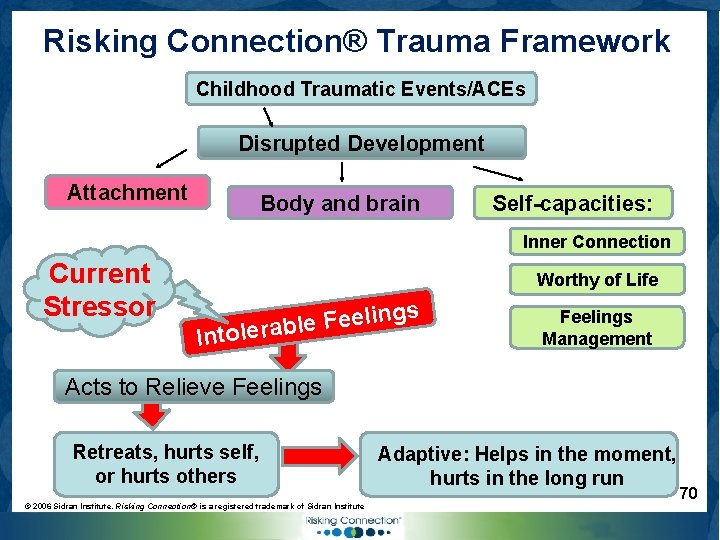
Risking Connection® Trauma Framework Childhood Traumatic Events/ACEs Disrupted Development Attachment Body and brain Self-capacities: Inner Connection Current Stressor Worthy of Life gs n i l e e F e tolerabl In Feelings Management Acts to Relieve Feelings Retreats, hurts self, or hurts others © 2006 Sidran Institute. Risking Connection® is a registered trademark of Sidran Institute Adaptive: Helps in the moment, hurts in the long run 70
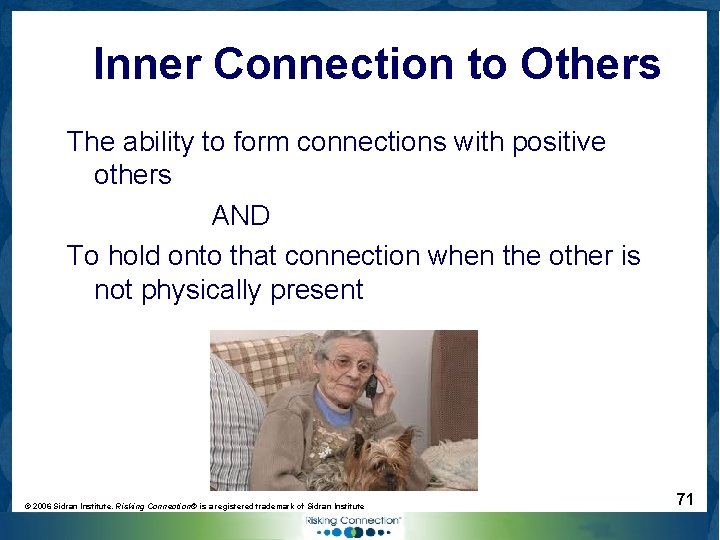
Inner Connection to Others The ability to form connections with positive others AND To hold onto that connection when the other is not physically present © 2006 Sidran Institute. Risking Connection® is a registered trademark of Sidran Institute 71
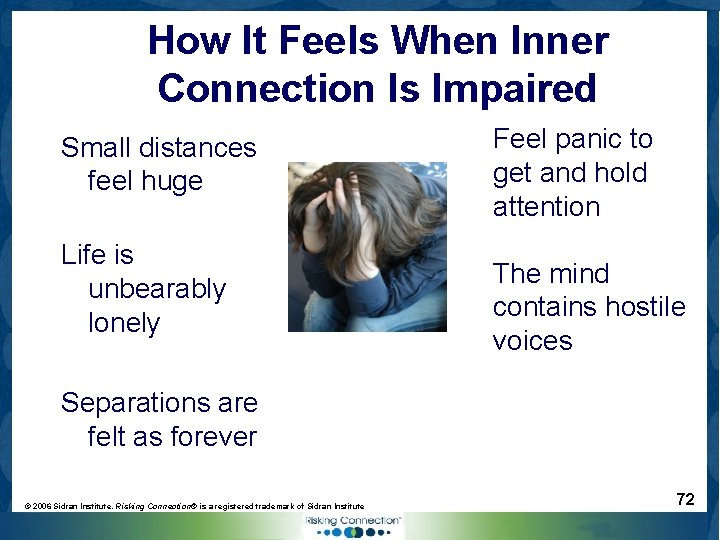
How It Feels When Inner Connection Is Impaired Small distances feel huge Life is unbearably lonely Feel panic to get and hold attention The mind contains hostile voices Separations are felt as forever © 2006 Sidran Institute. Risking Connection® is a registered trademark of Sidran Institute 72
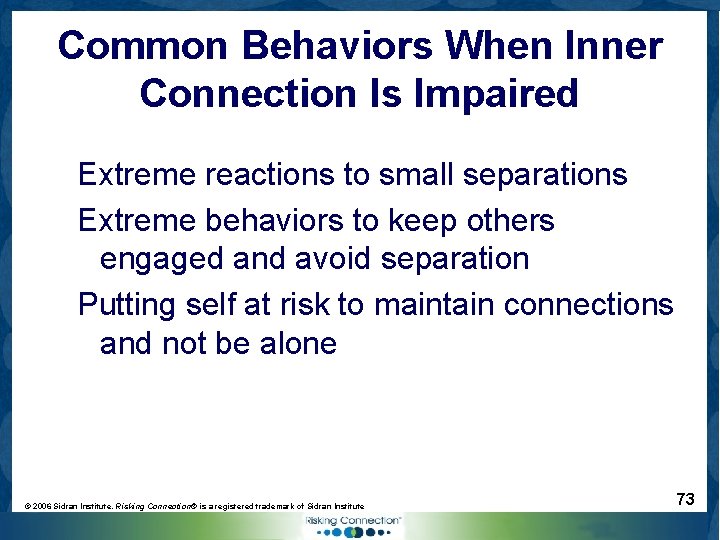
Common Behaviors When Inner Connection Is Impaired Extreme reactions to small separations Extreme behaviors to keep others engaged and avoid separation Putting self at risk to maintain connections and not be alone © 2006 Sidran Institute. Risking Connection® is a registered trademark of Sidran Institute 73
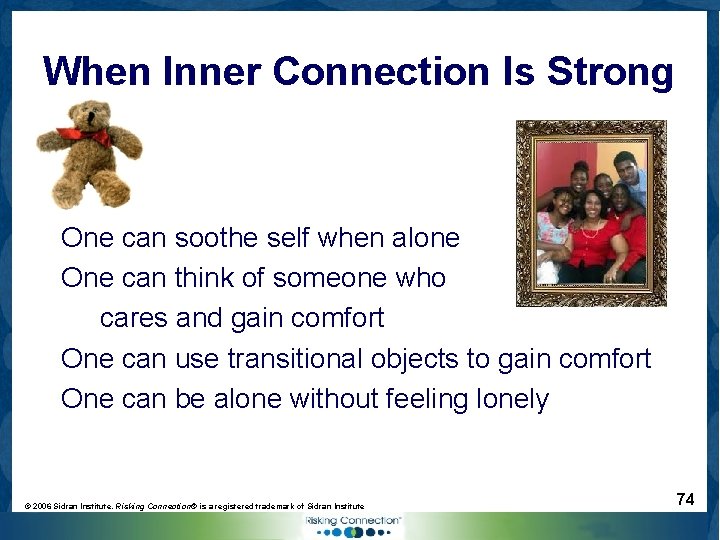
When Inner Connection Is Strong One can soothe self when alone One can think of someone who cares and gain comfort One can use transitional objects to gain comfort One can be alone without feeling lonely © 2006 Sidran Institute. Risking Connection® is a registered trademark of Sidran Institute 74
Video Christian the Lion © 2006 Sidran Institute. Risking Connection® is a registered trademark of Sidran Institute 75
Risking Connection® Trauma Framework Childhood Traumatic Events/ACEs Disrupted Development Attachment Body and brain Self-capacities: Inner Connection Current Stressor Worthy of Life gs n i l e e F e tolerabl In Feelings Management Acts to Relieve Feelings Retreats, hurts self, or hurts others © 2006 Sidran Institute. Risking Connection® is a registered trademark of Sidran Institute Adaptive: Helps in the moment, hurts in the long run 76
Worthy of Life The ability to hold onto a sense of oneself as deserving and worthwhile. © 2006 Sidran Institute. Risking Connection® is a registered trademark of Sidran Institute 77
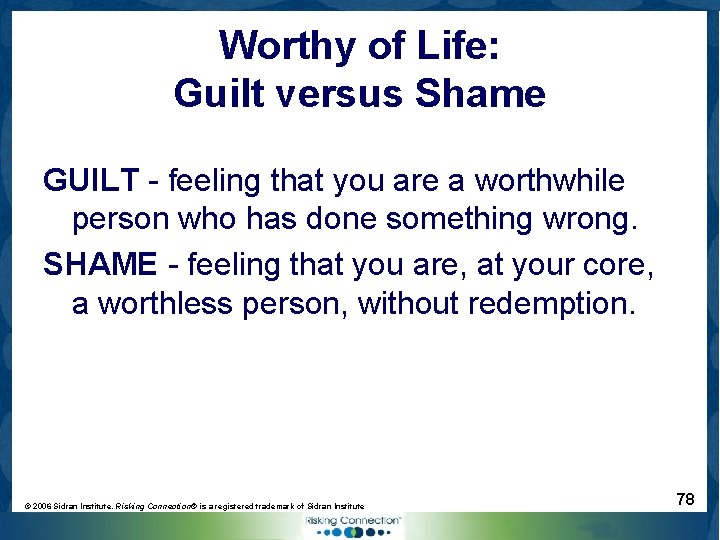
Worthy of Life: Guilt versus Shame GUILT - feeling that you are a worthwhile person who has done something wrong. SHAME - feeling that you are, at your core, a worthless person, without redemption. © 2006 Sidran Institute. Risking Connection® is a registered trademark of Sidran Institute 78
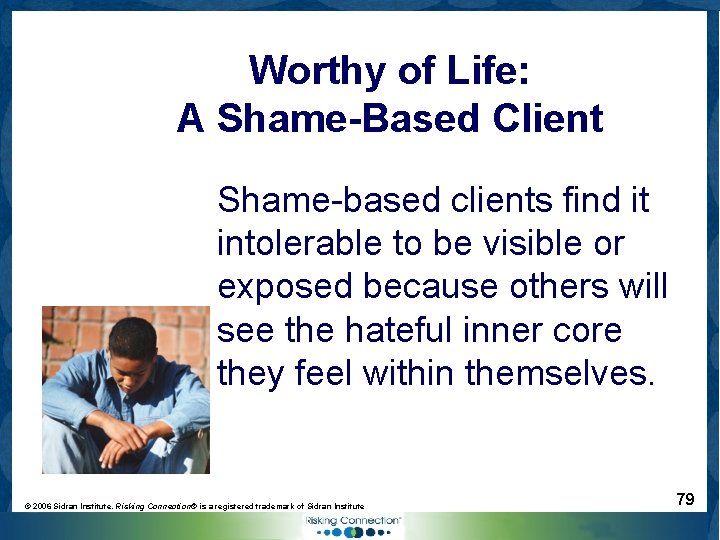
Worthy of Life: A Shame-Based Client Shame-based clients find it intolerable to be visible or exposed because others will see the hateful inner core they feel within themselves. © 2006 Sidran Institute. Risking Connection® is a registered trademark of Sidran Institute 79
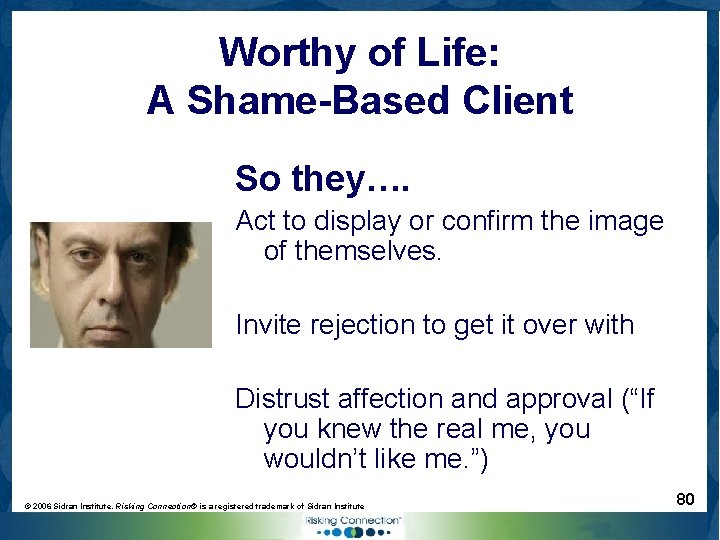
Worthy of Life: A Shame-Based Client So they…. Act to display or confirm the image of themselves. Invite rejection to get it over with Distrust affection and approval (“If you knew the real me, you wouldn’t like me. ”) © 2006 Sidran Institute. Risking Connection® is a registered trademark of Sidran Institute 80
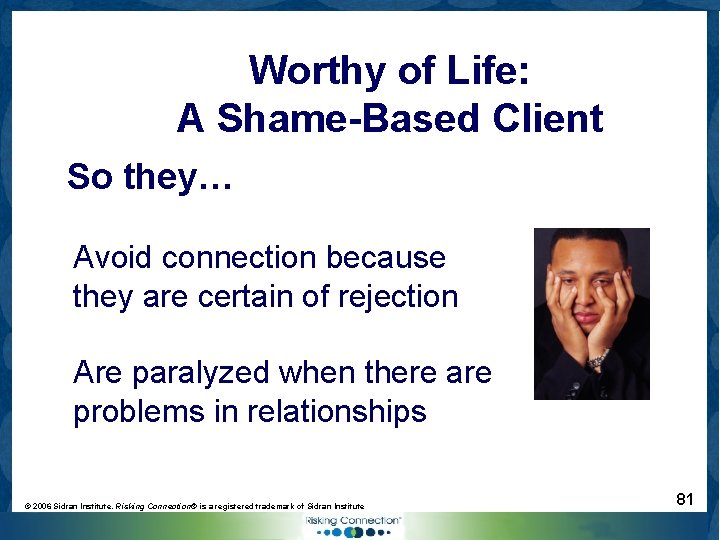
Worthy of Life: A Shame-Based Client So they… Avoid connection because they are certain of rejection Are paralyzed when there are problems in relationships © 2006 Sidran Institute. Risking Connection® is a registered trademark of Sidran Institute 81
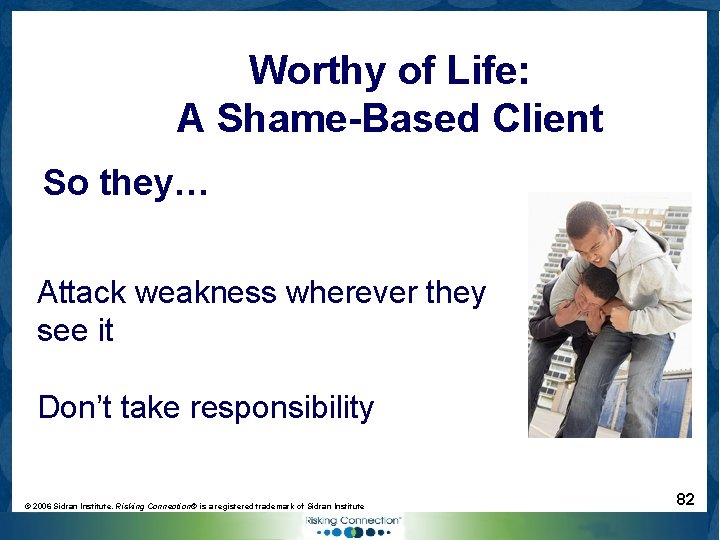
Worthy of Life: A Shame-Based Client So they… Attack weakness wherever they see it Don’t take responsibility © 2006 Sidran Institute. Risking Connection® is a registered trademark of Sidran Institute 82
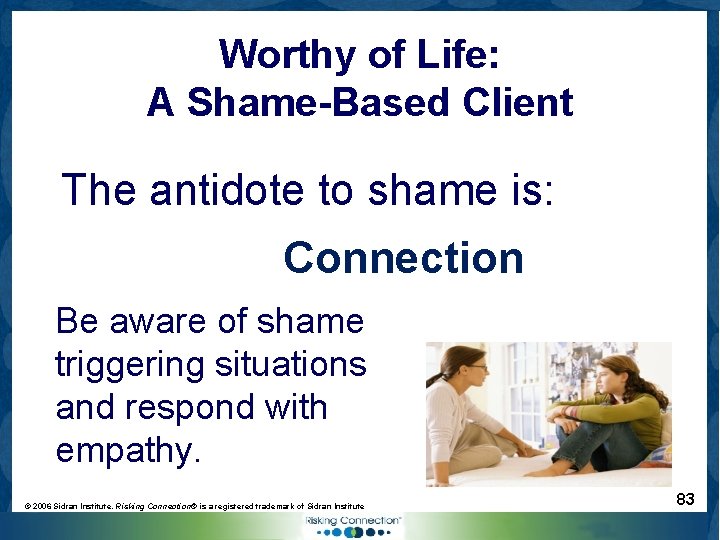
Worthy of Life: A Shame-Based Client The antidote to shame is: Connection Be aware of shame triggering situations and respond with empathy. © 2006 Sidran Institute. Risking Connection® is a registered trademark of Sidran Institute 83
Risking Connection® Trauma Framework Childhood Traumatic Events/ACEs Disrupted Development Attachment Body and brain Self-capacities: Inner Connection Current Stressor Worthy of Life gs n i l e e F e tolerabl In Feelings Management Acts to Relieve Feelings Retreats, hurts self, or hurts others © 2006 Sidran Institute. Risking Connection® is a registered trademark of Sidran Institute Adaptive: Helps in the moment, hurts in the long run 84
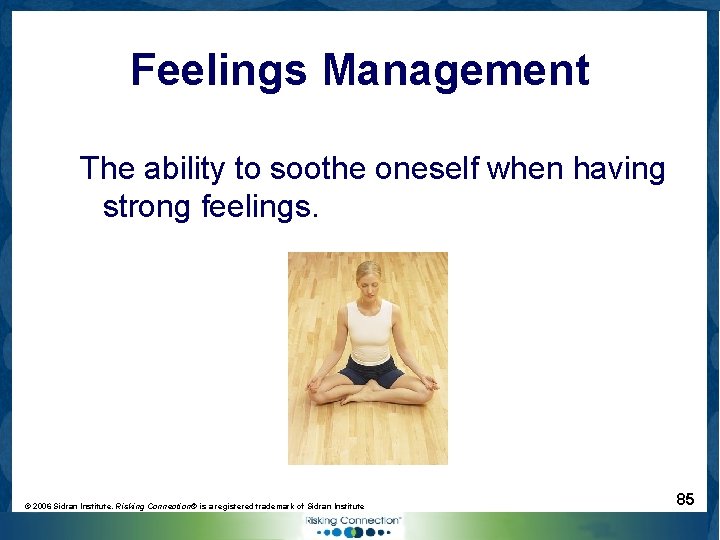
Feelings Management The ability to soothe oneself when having strong feelings. © 2006 Sidran Institute. Risking Connection® is a registered trademark of Sidran Institute 85
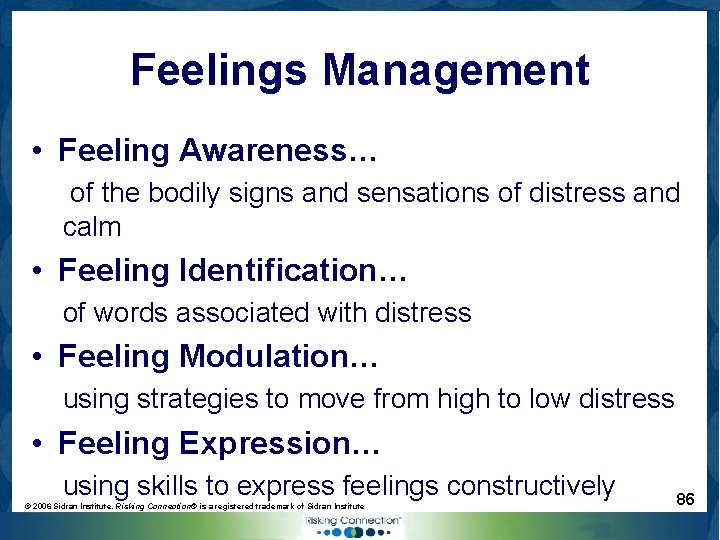
Feelings Management • Feeling Awareness… of the bodily signs and sensations of distress and calm • Feeling Identification… of words associated with distress • Feeling Modulation… using strategies to move from high to low distress • Feeling Expression… using skills to express feelings constructively © 2006 Sidran Institute. Risking Connection® is a registered trademark of Sidran Institute 86
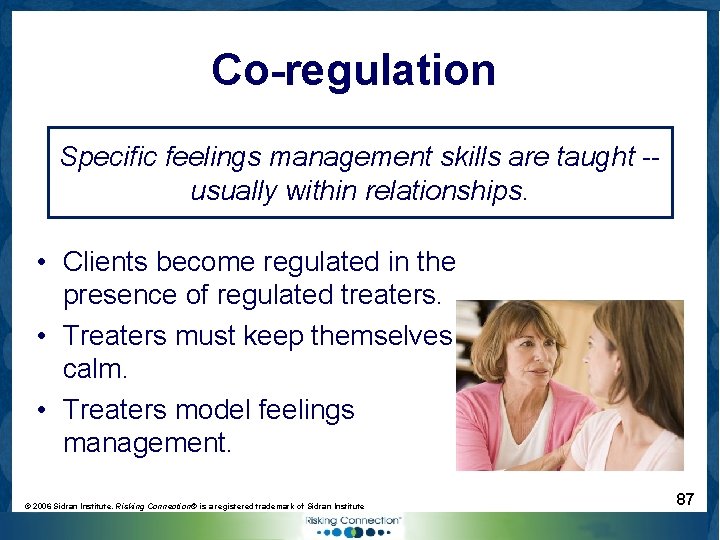
Co-regulation Specific feelings management skills are taught -usually within relationships. • Clients become regulated in the presence of regulated treaters. • Treaters must keep themselves calm. • Treaters model feelings management. © 2006 Sidran Institute. Risking Connection® is a registered trademark of Sidran Institute 87
Exercise If Self-Capacities Could Speak, What Would They Say? © 2006 Sidran Institute. Risking Connection® is a registered trademark of Sidran Institute 88
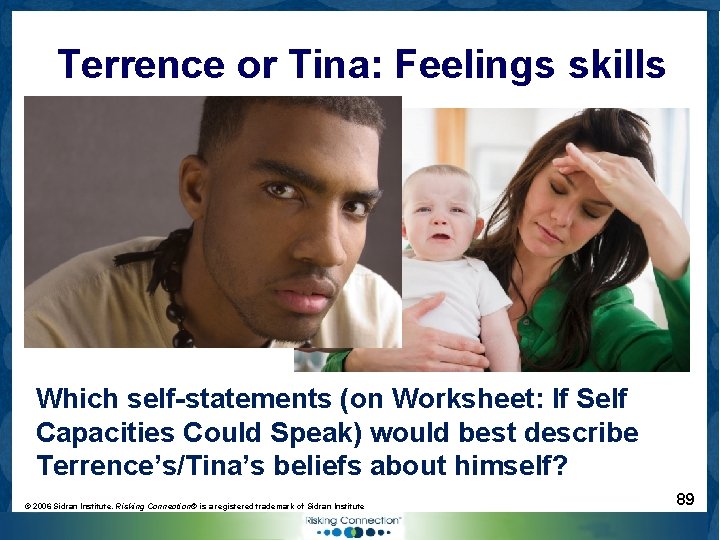
Terrence or Tina: Feelings skills Which self-statements (on Worksheet: If Self Capacities Could Speak) would best describe Terrence’s/Tina’s beliefs about himself? © 2006 Sidran Institute. Risking Connection® is a registered trademark of Sidran Institute 89
Symptoms as Adaptations © 2006 Sidran Institute. Risking Connection® is a registered trademark of Sidran Institute 90
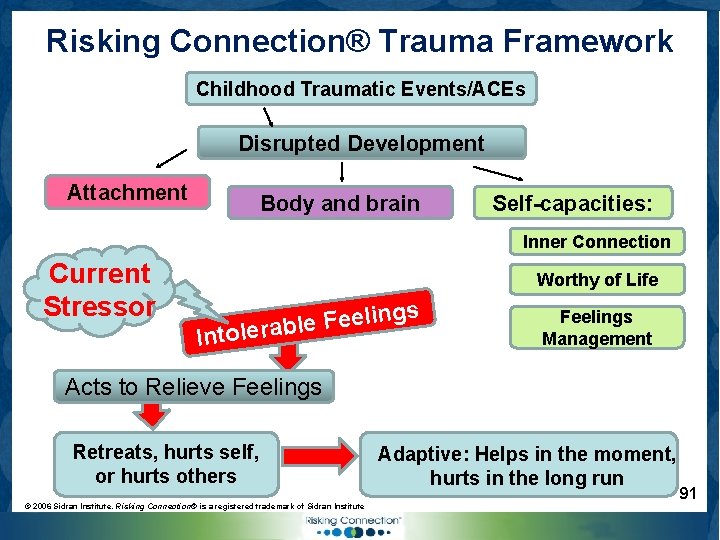
Risking Connection® Trauma Framework Childhood Traumatic Events/ACEs Disrupted Development Attachment Body and brain Self-capacities: Inner Connection Current Stressor Worthy of Life gs n i l e e F e tolerabl In Feelings Management Acts to Relieve Feelings Retreats, hurts self, or hurts others © 2006 Sidran Institute. Risking Connection® is a registered trademark of Sidran Institute Adaptive: Helps in the moment, hurts in the long run 91
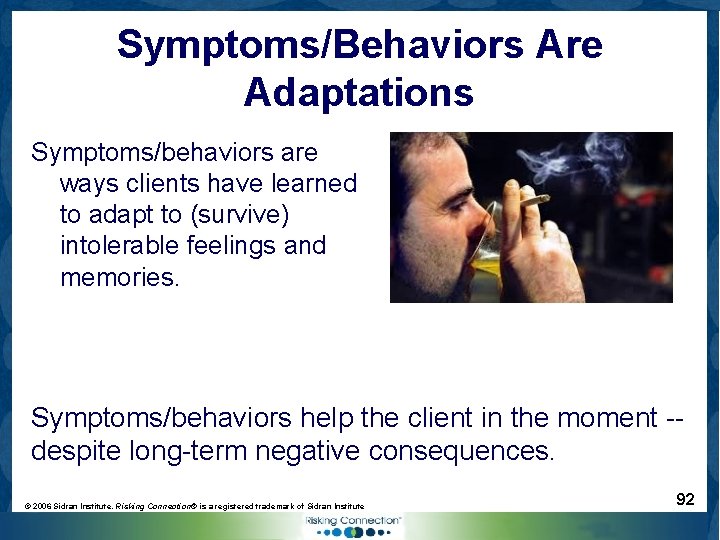
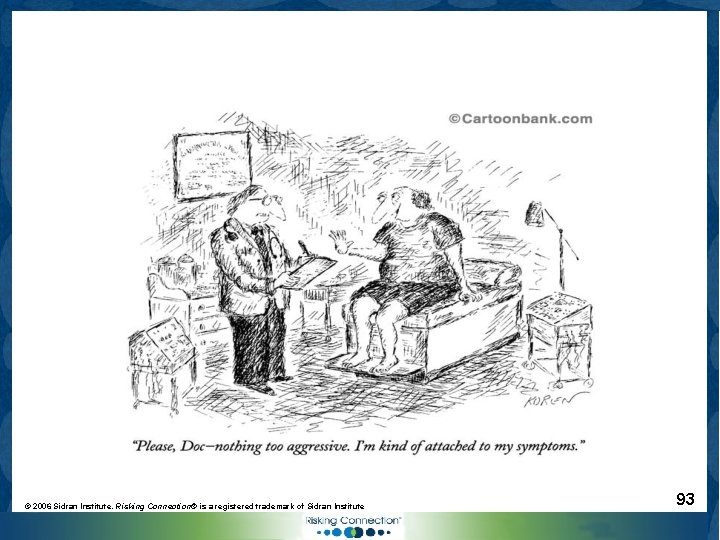
Symptoms/Behaviors Are Adaptations Symptoms/behaviors are ways clients have learned to adapt to (survive) intolerable feelings and memories. Symptoms/behaviors help the client in the moment -despite long-term negative consequences. © 2006 Sidran Institute. Risking Connection® is a registered trademark of Sidran Institute 92
© 2006 Sidran Institute. Risking Connection® is a registered trademark of Sidran Institute 93
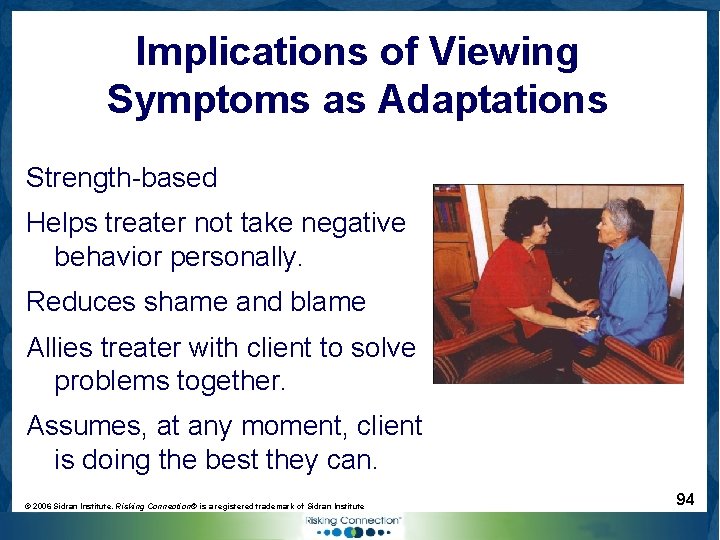
Implications of Viewing Symptoms as Adaptations Strength-based Helps treater not take negative behavior personally. Reduces shame and blame Allies treater with client to solve problems together. Assumes, at any moment, client is doing the best they can. © 2006 Sidran Institute. Risking Connection® is a registered trademark of Sidran Institute 94
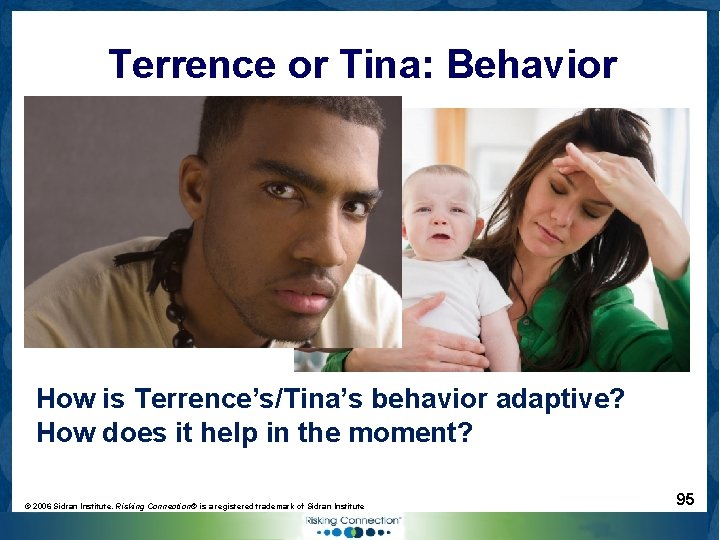
Terrence or Tina: Behavior How is Terrence’s/Tina’s behavior adaptive? How does it help in the moment? © 2006 Sidran Institute. Risking Connection® is a registered trademark of Sidran Institute 95
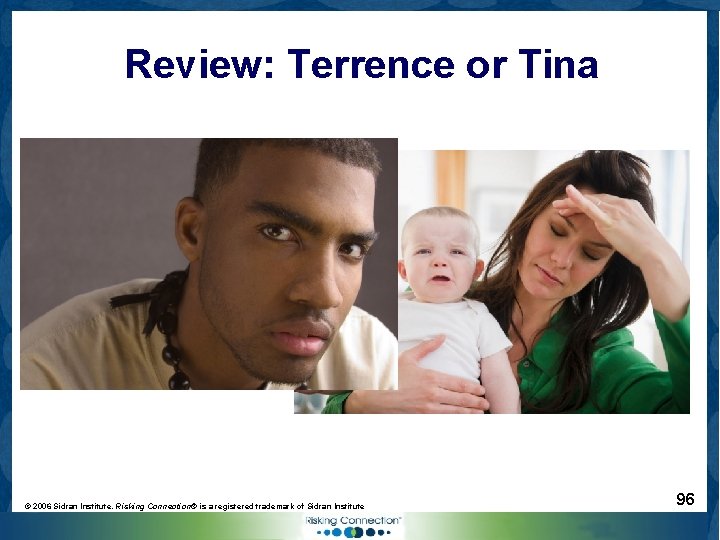
Review: Terrence or Tina © 2006 Sidran Institute. Risking Connection® is a registered trademark of Sidran Institute 96
Exercise Applying the trauma framework © 2006 Sidran Institute. Risking Connection® is a registered trademark of Sidran Institute 97
Break © 2006 Sidran Institute. Risking Connection® is a registered trademark of Sidran Institute 98
Exploring How We Were Parented © 2006 Sidran Institute. Risking Connection® is a registered trademark of Sidran Institute 99
Exercise • List 3 ways you think your parents/guardians did a good job of parenting you. • List 3 ways you parent or would parent differently from how you were parented. • List 2 things you learned growing up about managing problem behavior. • How does management of problem behavior at your agency compare to what you learned growing up? © 2006 Sidran Institute. Risking Connection® is a registered trademark of Sidran Institute 100
Introduction to Vicarious Traumatization © 2006 Sidran Institute. Risking Connection® is a registered trademark of Sidran Institute 101
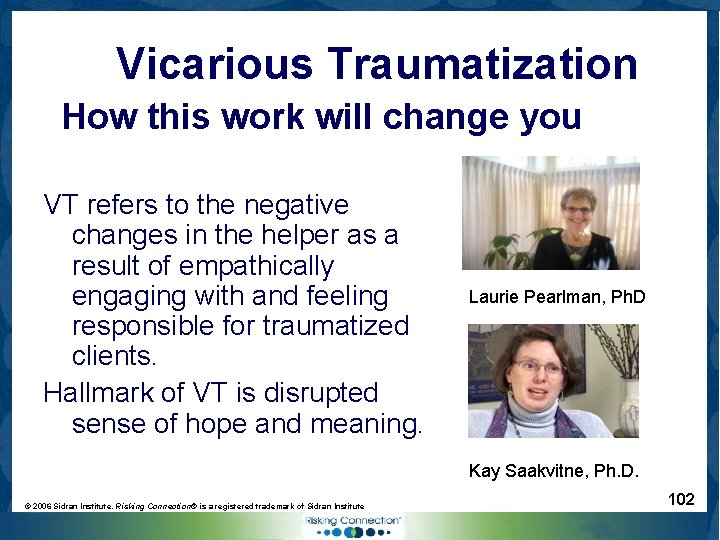
Vicarious Traumatization How this work will change you VT refers to the negative changes in the helper as a result of empathically engaging with and feeling responsible for traumatized clients. Hallmark of VT is disrupted sense of hope and meaning. Laurie Pearlman, Ph. D Kay Saakvitne, Ph. D. © 2006 Sidran Institute. Risking Connection® is a registered trademark of Sidran Institute 102
Vicarious Traumatization VT is an inescapable effect of trauma work -- an occupational hazard. It is neither the fault of the client, nor a result of “weakness” on the part of the treater. VT damages hope and optimism which are essential gifts we bring to our work. © 2006 Sidran Institute. Risking Connection® is a registered trademark of Sidran Institute 103
Vicarious Traumatization (2) The single most important factor in the success or failure of trauma work is the attention paid to the needs of the treater. Addressing VT is an ethical imperative. © 2006 Sidran Institute. Risking Connection® is a registered trademark of Sidran Institute 104
How VT Changes Us VT can impact: Our core sense of meaning and hope Our identity and worldview Our core beliefs about safety, trust, esteem, control, and intimacy © 2006 Sidran Institute. Risking Connection® is a registered trademark of Sidran Institute 105
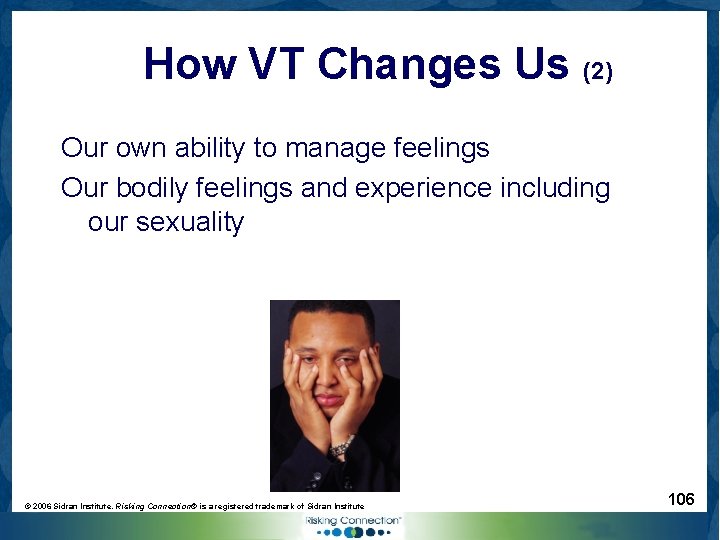
How VT Changes Us (2) Our own ability to manage feelings Our bodily feelings and experience including our sexuality © 2006 Sidran Institute. Risking Connection® is a registered trademark of Sidran Institute 106
Vicarious Traumatization: Exercise Write down 3 signs of vicarious traumatization that you are aware of in yourself. Write down 3 ways in which you are positively impacted by the work you do. What benefits do you experience from the work? © 2006 Sidran Institute. Risking Connection® is a registered trademark of Sidran Institute 107
Vicarious Traumatization Grief wounds more deeply in solitude; tears are less bitter when mingled with other tears. Agememnon Seneca © 2006 Sidran Institute. Risking Connection® is a registered trademark of Sidran Institute 108
Wrap Up and Feedback 1. What worked well about today? What did you like? What kinds of things should we keep? 2. What didn’t work? What kinds of things should we get rid of? 3. What do you need from this training before it ends? © 2006 Sidran Institute. Risking Connection® is a registered trademark of Sidran Institute 109