
Risking Connection 3 Day Basic Training Day 2
Risking Connection: 3 -Day Basic Training Day 2 © 2006 Sidran Institute. Risking Connection® is a registered trademark of Sidran Institute 100
Healing Power of the Therapeutic Alliance © 2006 Sidran Institute. Risking Connection® is a registered trademark of Sidran Institute 101
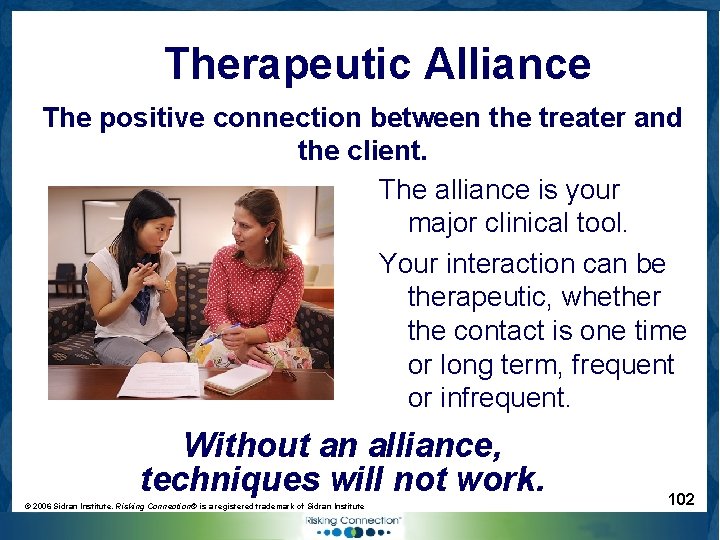
Therapeutic Alliance The positive connection between the treater and the client. The alliance is your major clinical tool. Your interaction can be therapeutic, whether the contact is one time or long term, frequent or infrequent. Without an alliance, techniques will not work. © 2006 Sidran Institute. Risking Connection® is a registered trademark of Sidran Institute 102
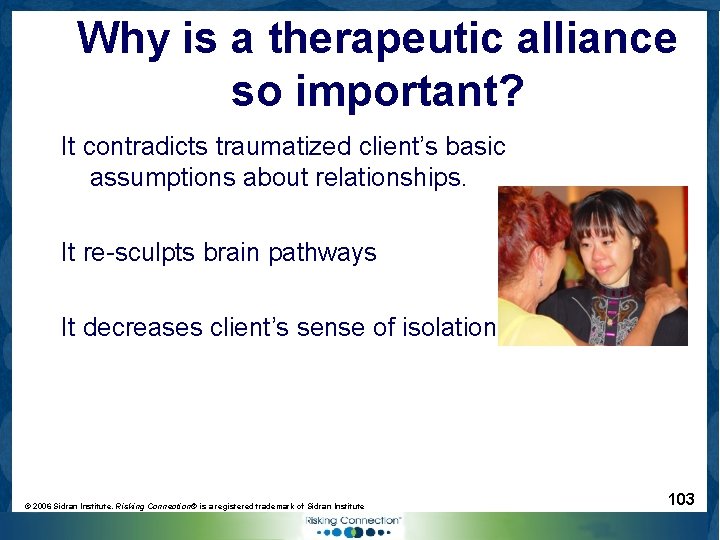
Why is a therapeutic alliance so important? It contradicts traumatized client’s basic assumptions about relationships. It re-sculpts brain pathways It decreases client’s sense of isolation. © 2006 Sidran Institute. Risking Connection® is a registered trademark of Sidran Institute 103
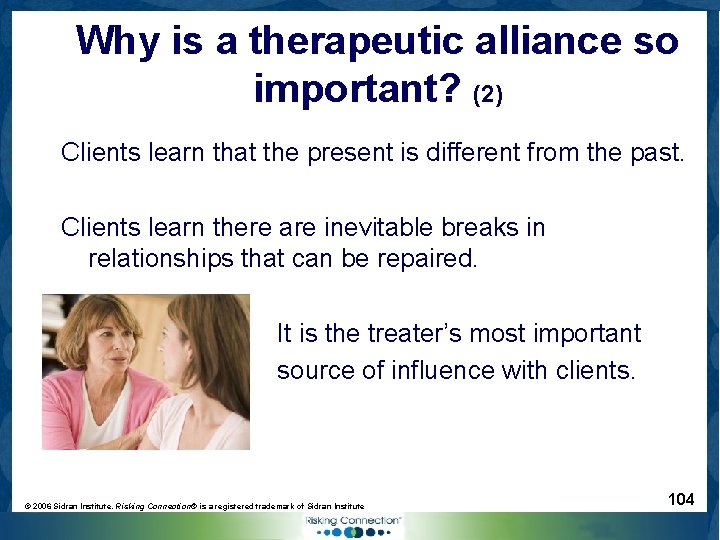
Why is a therapeutic alliance so important? (2) Clients learn that the present is different from the past. Clients learn there are inevitable breaks in relationships that can be repaired. It is the treater’s most important source of influence with clients. © 2006 Sidran Institute. Risking Connection® is a registered trademark of Sidran Institute 104

A RICH relationship: The key to healing and the agent of change ® These four components define a relationship that is therapeutic, whether it lasts five minutes or five years: Respect Information Connection Hope © 2006 Sidran Institute. Risking Connection® is a registered trademark of Sidran Institute 105
Video Christian the Lion © 2006 Sidran Institute. Risking Connection® is a registered trademark of Sidran Institute 106
Exercise RICH relationships © 2006 Sidran Institute. Risking Connection® is a registered trademark of Sidran Institute 107
What makes it hard to own our mistakes? Belief that mistakes imply we are inferior professionals or bad people, or that others will think this of us. Fear of our clients’ anger or our bosses’ censure. Fear of losing face or appearing incompetent. © 2006 Sidran Institute. Risking Connection® is a registered trademark of Sidran Institute 108
What makes it hard to own our mistakes? (2) Belief that we should have known better or been able to avoid mistakes. Lack of support/acknowledgement for the challenge of the work. Acknowledging mistakes actually creates greater respect, safety, and trust, not less. © 2006 Sidran Institute. Risking Connection® is a registered trademark of Sidran Institute 109
Frame and Boundaries © 2006 Sidran Institute. Risking Connection® is a registered trademark of Sidran Institute 110

What is the frame? It includes: The frame describes the conditions within which the helper and client will work together. © 2006 Sidran Institute. Risking Connection® is a registered trademark of Sidran Institute Roles Rules Guidelines Boundaries 111

Frame and Boundaries: Examples • • • Rules of program and daily schedule Policies related to touch Proposed length of stay in program Length and frequency of therapy sessions Disclosure of personal information How information clients disclose gets shared among staff and others (limits of confidentiality) • Giving and receiving gifts • Contact after staff member or client leaves © 2006 Sidran Institute. Risking Connection® is a registered trademark of Sidran Institute 112
Importance of the Frame to Abused Clients The essence of interpersonal abuse is violation of boundaries. Therefore, abused clients often have little sense of what appropriate boundaries are. Abused clients often expect to have their boundaries violated, especially by authority figures. © 2006 Sidran Institute. Risking Connection® is a registered trademark of Sidran Institute 113
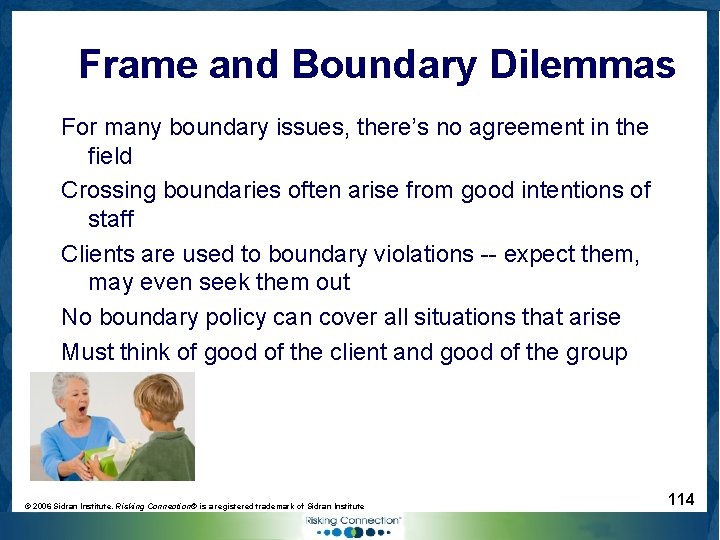
Frame and Boundary Dilemmas For many boundary issues, there’s no agreement in the field Crossing boundaries often arise from good intentions of staff Clients are used to boundary violations -- expect them, may even seek them out No boundary policy can cover all situations that arise Must think of good of the client and good of the group © 2006 Sidran Institute. Risking Connection® is a registered trademark of Sidran Institute 114
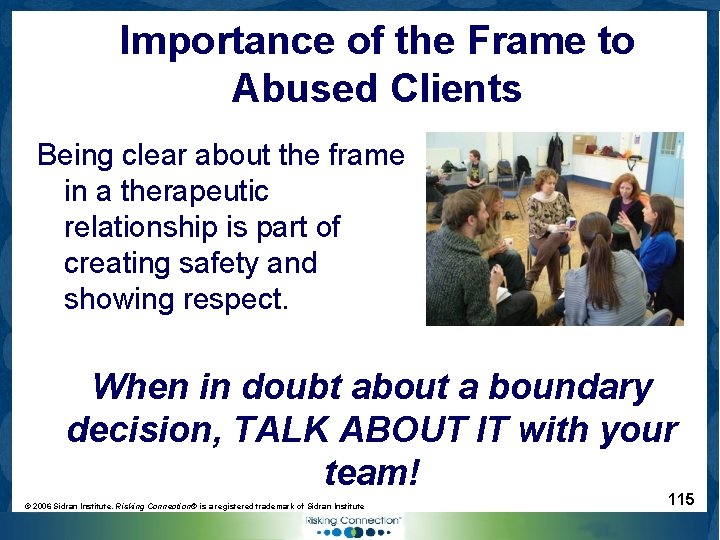
Importance of the Frame to Abused Clients Being clear about the frame in a therapeutic relationship is part of creating safety and showing respect. When in doubt about a boundary decision, TALK ABOUT IT with your team! © 2006 Sidran Institute. Risking Connection® is a registered trademark of Sidran Institute 115
Strengthening Self Capacities or Feelings Skills © 2006 Sidran Institute. Risking Connection® is a registered trademark of Sidran Institute 116
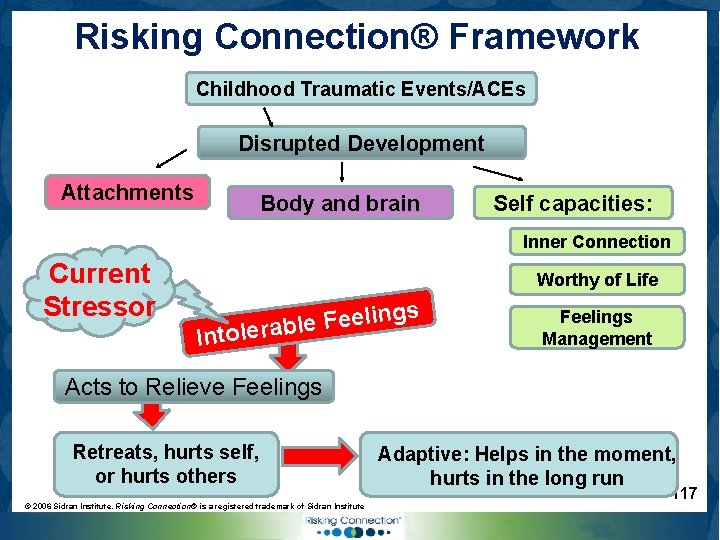
Risking Connection® Framework Childhood Traumatic Events/ACEs Disrupted Development Attachments Body and brain Self capacities: Inner Connection Current Stressor Worthy of Life gs n i l e e F e tolerabl In Feelings Management Acts to Relieve Feelings Retreats, hurts self, or hurts others © 2006 Sidran Institute. Risking Connection® is a registered trademark of Sidran Institute Adaptive: Helps in the moment, hurts in the long run 117
Managing Feelings and Memories Premise: The MORE a client is able to: Feel connected to caring others when they are not present (Inner connection to others) Feel deserving of life, love, and attachment (Worthy of life) Manage his/her seemingly intolerable feelings (Manage feelings) © 2006 Sidran Institute. Risking Connection® is a registered trademark of Sidran Institute 118
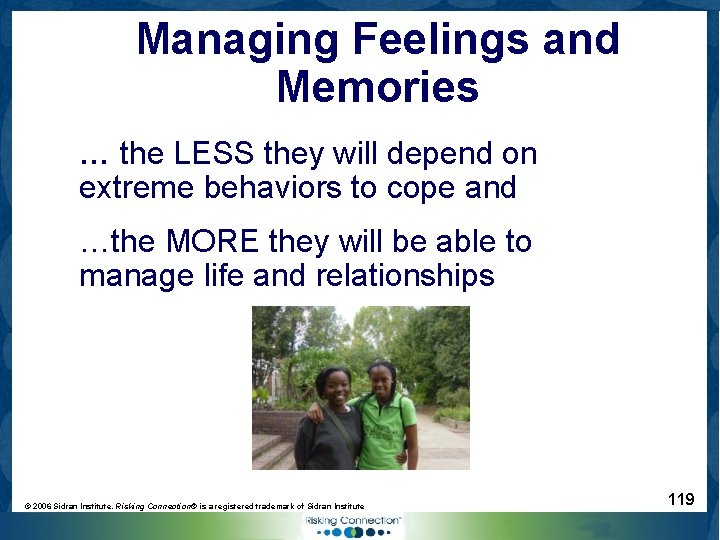
Managing Feelings and Memories … the LESS they will depend on extreme behaviors to cope and …the MORE they will be able to manage life and relationships © 2006 Sidran Institute. Risking Connection® is a registered trademark of Sidran Institute 119
#1: Inner Connection to Positive Others Because: Clients with histories of trauma tend not to have internalized a sense of loving others. And: They often experience separation (even brief) as isolation, desolation, and abandonment. © 2006 Sidran Institute. Risking Connection® is a registered trademark of Sidran Institute 120
Inner Connection to Others (2) Our goals are: To provide a safe therapeutic relationship that the client can internalize over time. To help the client hold onto a feeling of connection with caring others when they are not physically there. To become an inner resource/secure base for the client. © 2006 Sidran Institute. Risking Connection® is a registered trademark of Sidran Institute 121
Strategies to Build Inner Connection to Others Send a quick postcard when on vacation. Hang pictures of loved ones and/or treaters in cleint’s room. Give client a small object (stone, stuffed animal) to hold to help remember you care about her. Tell a client that you will be thinking about him when he faces something difficult. © 2006 Sidran Institute. Risking Connection® is a registered trademark of Sidran Institute 122
Strategies to Build Inner Connection to Others (2) Write a note to a client or create something together that she can keep as a transitional object. Make a tape for client that he can play when distressed. Construct a list of people who care about the client and post it on the wall. © 2006 Sidran Institute. Risking Connection® is a registered trademark of Sidran Institute 123
#2: Feeling Worthy of Life Because: Clients often feel that they are unworthy, unlovable, or untouchable. And: Connection and empathy diminish shame. © 2006 Sidran Institute. Risking Connection® is a registered trademark of Sidran Institute 124
Feeling Worthy of Life (2) Our goals are: To communicate in every way that she is worthy and lovable. To avoid situations the client finds shaming. To encourage sharing what is shameful. To talk directly about the interpersonal relationship between treater and client. To challenge negative self-beliefs. © 2006 Sidran Institute. Risking Connection® is a registered trademark of Sidran Institute 125
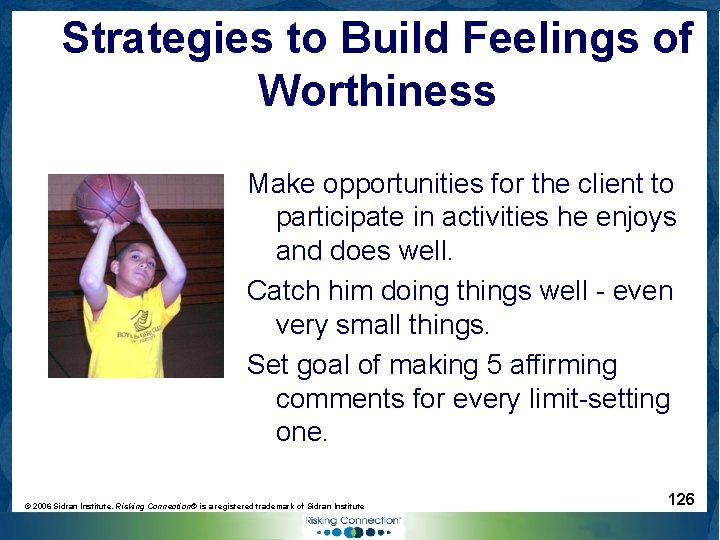
Strategies to Build Feelings of Worthiness Make opportunities for the client to participate in activities he enjoys and does well. Catch him doing things well - even very small things. Set goal of making 5 affirming comments for every limit-setting one. © 2006 Sidran Institute. Risking Connection® is a registered trademark of Sidran Institute 126
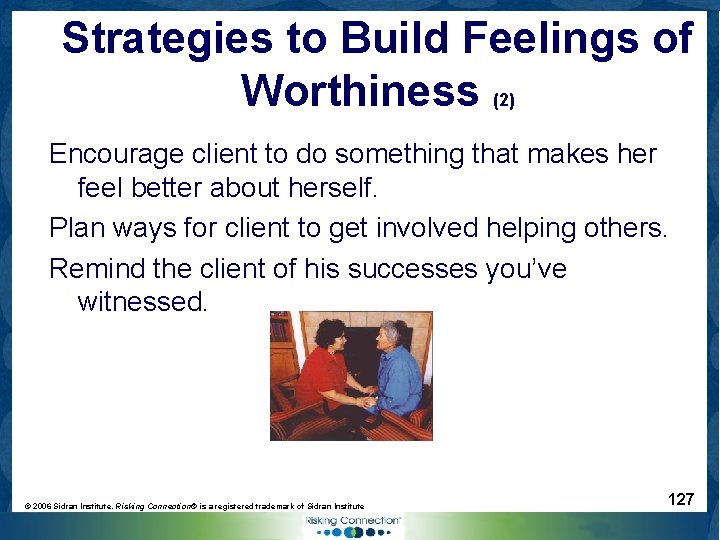
Strategies to Build Feelings of Worthiness (2) Encourage client to do something that makes her feel better about herself. Plan ways for client to get involved helping others. Remind the client of his successes you’ve witnessed. © 2006 Sidran Institute. Risking Connection® is a registered trademark of Sidran Institute 127
#3: Managing Feelings Because: Clients were not taught how to calm down and soothe themselves. They often associate strong feelings with danger. And: Their body’s natural alarm system may be malfunctioning © 2006 Sidran Institute. Risking Connection® is a registered trademark of Sidran Institute 128
Managing Feelings (2) Our goals are: To continually teach them strategies for self soothing -- managing and regulating strong feelings. To model managing our own strong feelings. Clients learn to regulate strong feelings in the presence of regulated others. © 2006 Sidran Institute. Risking Connection® is a registered trademark of Sidran Institute 129
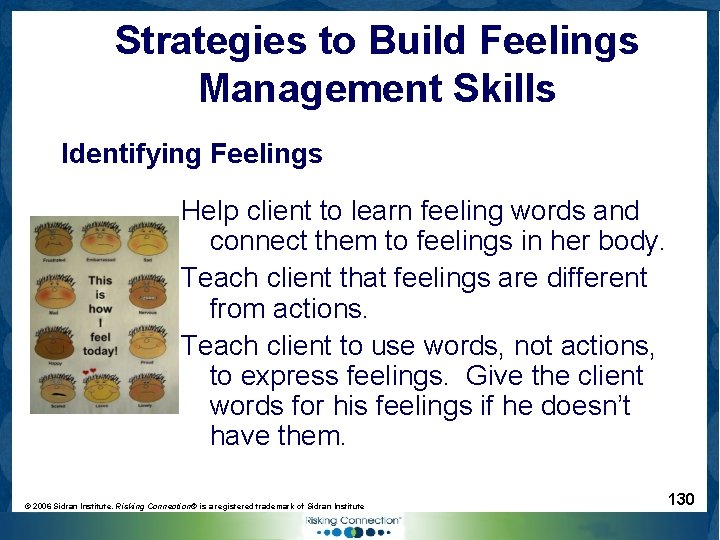
Strategies to Build Feelings Management Skills Identifying Feelings Help client to learn feeling words and connect them to feelings in her body. Teach client that feelings are different from actions. Teach client to use words, not actions, to express feelings. Give the client words for his feelings if he doesn’t have them. © 2006 Sidran Institute. Risking Connection® is a registered trademark of Sidran Institute 130
Strategies to Build Feelings Management Skills (2) Tolerating Feelings: Inviting a client’s verbal expression of negative feelings, especially about you. Teach the client that feelings don’t have to mean danger -- noticing feelings gives useful information. Remind him that he won’t always feel this bad © 2006 Sidran Institute. Risking Connection® is a registered trademark of Sidran Institute 131
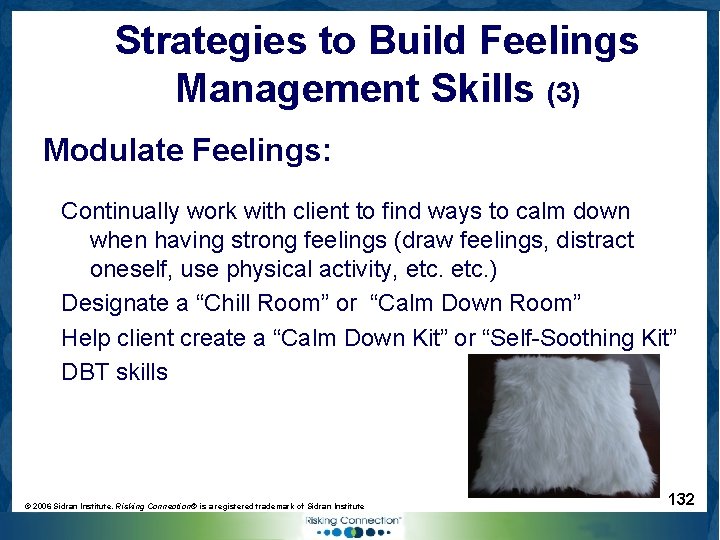
Strategies to Build Feelings Management Skills (3) Modulate Feelings: Continually work with client to find ways to calm down when having strong feelings (draw feelings, distract oneself, use physical activity, etc. ) Designate a “Chill Room” or “Calm Down Room” Help client create a “Calm Down Kit” or “Self-Soothing Kit” DBT skills © 2006 Sidran Institute. Risking Connection® is a registered trademark of Sidran Institute 132
Strategies to Build Feelings Management Skills (4) Integrating Feelings Help client to connect his strong feelings to what may have caused them. Identify patterns -- what kinds of situations trigger strong feelings. © 2006 Sidran Institute. Risking Connection® is a registered trademark of Sidran Institute 133
Exercise Strengthening Self Capacities © 2006 Sidran Institute. Risking Connection® is a registered trademark of Sidran Institute 134
The Client’s Experience of the System -- Video Multiple Transitions: A Young Child’s Point of View on Foster Care and Adoption (The Infant Parent Institute, http: //www. infantparent. com/) Re. Moved © 2006 Sidran Institute. Risking Connection® is a registered trademark of Sidran Institute 135
Principles of Collaborative Crisis Management © 2006 Sidran Institute. Risking Connection® is a registered trademark of Sidran Institute 136
A Collaborative Model for Crisis Management Many of the major failures in treatment of trauma survivors occur in our responses to crises The client’s participation in, and anticipation of, crisis intervention is essential. © 2006 Sidran Institute. Risking Connection® is a registered trademark of Sidran Institute 137
Collaborative Crisis Management What To Do: Before the crisis During the crisis After the crisis Note: The following principles can be integrated into any existing crisis management curriculum, e. g. , TCI, CP/I, etc. © 2006 Sidran Institute. Risking Connection® is a registered trademark of Sidran Institute 138
Collaborative Crisis Management Before The Crisis © 2006 Sidran Institute. Risking Connection® is a registered trademark of Sidran Institute 139
Collaborative Crisis Prevention Before the Crisis: Build Self-Capacities Create Crisis Prevention Plans © 2006 Sidran Institute. Risking Connection® is a registered trademark of Sidran Institute 140
Before the Crisis: Collaborative Crisis Prevention Building Self-Capacities The best long-term way to prevent crises is to seize every opportunity to strengthen and/or teach feeling skills. Inner connection Self-worth Feelings management The stronger the self-capacities, the fewer the crises © 2006 Sidran Institute. Risking Connection® is a registered trademark of Sidran Institute 141
Before the Crisis: Collaborative Crisis Prevention Create Crisis Prevention Plans The more we collaborate with clients to anticipate crises, the less crises take us, and the client, by surprise. © 2006 Sidran Institute. Risking Connection® is a registered trademark of Sidran Institute 142
Before the Crisis: Collaborative Crisis Prevention Plans ask: What upsets you? What are the first signs that you are getting upset? What helps you when you’re upset? What doesn’t help? Crisis Prevention Plans are living documents, continually reviewed and modified with the client. © 2006 Sidran Institute. Risking Connection® is a registered trademark of Sidran Institute 143
Collaborative Crisis Management During the Crisis © 2006 Sidran Institute. Risking Connection® is a registered trademark of Sidran Institute 144
During the Crisis: Four Principles 1. Remember symptoms are adaptations 2. Stay RICH® 3. Stay calm 4. Focus only on resolving the crisis © 2006 Sidran Institute. Risking Connection® is a registered trademark of Sidran Institute 145
During the Crisis 1. Remember Symptoms are Adaptations Keep this mindset If you don’t truly believe that problem behaviors are adaptive, you’re more likely to: Personalize the behavior Engage in an avoidable power struggle © 2006 Sidran Institute. Risking Connection® is a registered trademark of Sidran Institute 146
During the Crisis 2. Stay RICH® Respect: Validate the client’s emotional experience of the situation; watch your tone, inflection, posture, eye contact, etc. Information: Inform the client of what is happening, your intentions, what you need from her, what will happen next; offer choices; offer ideas for self-soothing. © 2006 Sidran Institute. Risking Connection® is a registered trademark of Sidran Institute 147
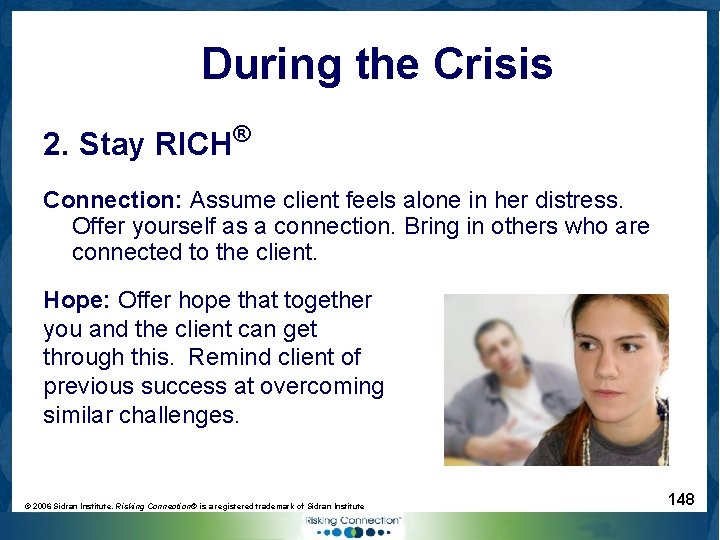
During the Crisis 2. Stay RICH® Connection: Assume client feels alone in her distress. Offer yourself as a connection. Bring in others who are connected to the client. Hope: Offer hope that together you and the client can get through this. Remind client of previous success at overcoming similar challenges. © 2006 Sidran Institute. Risking Connection® is a registered trademark of Sidran Institute 148
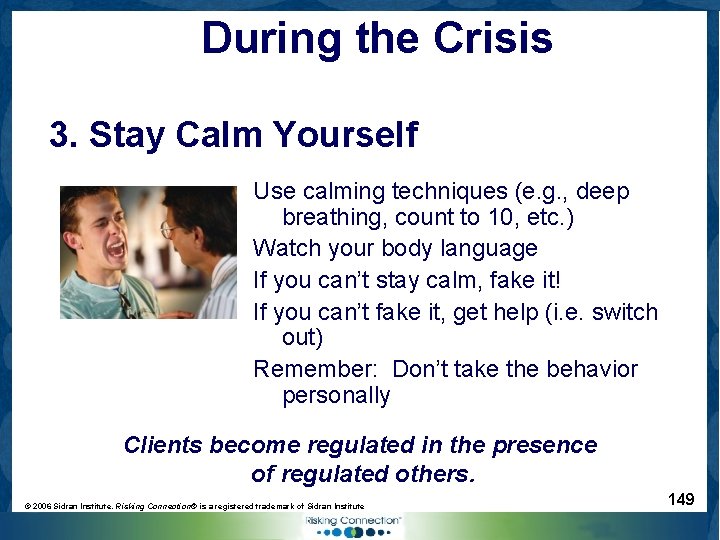
During the Crisis 3. Stay Calm Yourself Use calming techniques (e. g. , deep breathing, count to 10, etc. ) Watch your body language If you can’t stay calm, fake it! If you can’t fake it, get help (i. e. switch out) Remember: Don’t take the behavior personally Clients become regulated in the presence of regulated others. © 2006 Sidran Institute. Risking Connection® is a registered trademark of Sidran Institute 149
During the Crisis 4. Focus Only On Resolving the Crisis If the client is emotionally or behaviorally upset… Focus on helping the client calm down Validate! (Validation doesn’t necessarily mean agreement) Discuss consequences LATER © 2006 Sidran Institute. Risking Connection® is a registered trademark of Sidran Institute 150
During the Crisis 4. Focus Only On Resolving the Crisis If the client is emotionally or behaviorally upset… Offer choices Be as flexible and patient as possible Help client stay connected with positive others © 2006 Sidran Institute. Risking Connection® is a registered trademark of Sidran Institute 151
During the Crisis 4. Focus Only on Resolving the Crisis If the client is having a ‘flashback’ or difficulty staying present with you… Ground the client in the present Use 4 “Ws” Who she is, who you are Where is she now When – day, time, year What is happening now © 2006 Sidran Institute. Risking Connection® is a registered trademark of Sidran Institute 152
During the Crisis 4. Focus Only on Resolving the Crisis If the client is having a ‘flashback’ or difficulty staying present with you… Ground the client in the present Direct client’s attention to immediate physical surroundings, e. g. , Invite client to squeeze arm of chair; rub coarse rug, press feet against ground © 2006 Sidran Institute. Risking Connection® is a registered trademark of Sidran Institute 153
Exercise Practicing principles of crisis management --during the crisis © 2006 Sidran Institute. Risking Connection® is a registered trademark of Sidran Institute 154
Exercise: Role Play To what extent does the treater display these four principles? 1. Remember symptoms are adaptations 2. Stay RICH® 3. Stay calm 4. Focus only on resolving the crisis © 2006 Sidran Institute. Risking Connection® is a registered trademark of Sidran Institute 155
Collaborative Crisis Management After the Crisis © 2006 Sidran Institute. Risking Connection® is a registered trademark of Sidran Institute 156
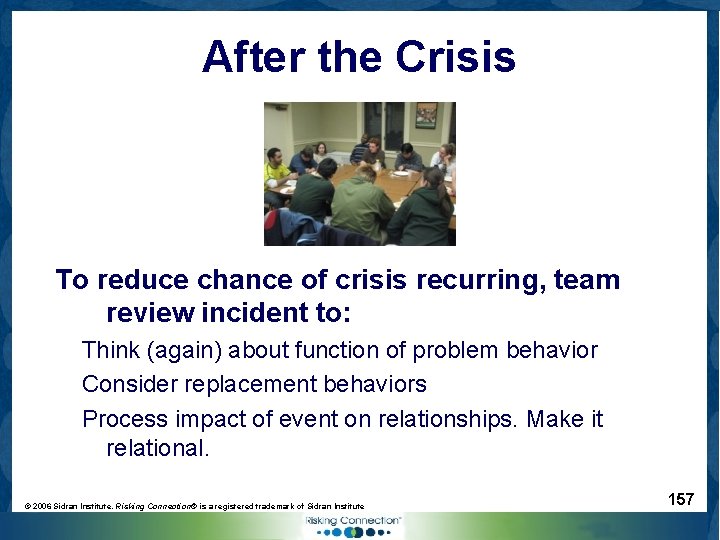
After the Crisis To reduce chance of crisis recurring, team review incident to: Think (again) about function of problem behavior Consider replacement behaviors Process impact of event on relationships. Make it relational. © 2006 Sidran Institute. Risking Connection® is a registered trademark of Sidran Institute 157
After the Crisis To better understand function of the problem behavior, the team consider: What is the function of the behavior? What needs are being met? How does the behavior help the client in the moment? Ask the “why under the why” The reasons clients act out are generally not intentional or conscious © 2006 Sidran Institute. Risking Connection® is a registered trademark of Sidran Institute 158
After the Crisis Consider replacement behaviors that serve similar function with less negative consequences Survivors unlikely to give up a trusted behavior unless believe replacement behavior will work Expect small steps toward use of the replacement behavior -- until the client trusts it will work © 2006 Sidran Institute. Risking Connection® is a registered trademark of Sidran Institute 159
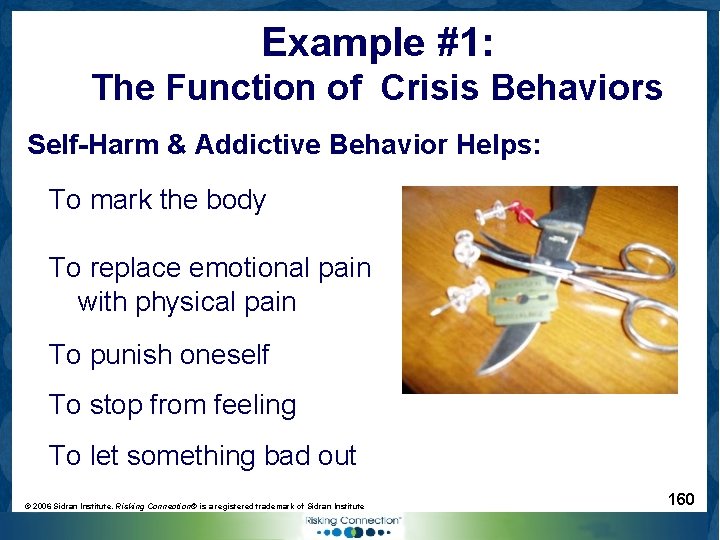
Example #1: The Function of Crisis Behaviors Self-Harm & Addictive Behavior Helps: To mark the body To replace emotional pain with physical pain To punish oneself To stop from feeling To let something bad out © 2006 Sidran Institute. Risking Connection® is a registered trademark of Sidran Institute 160
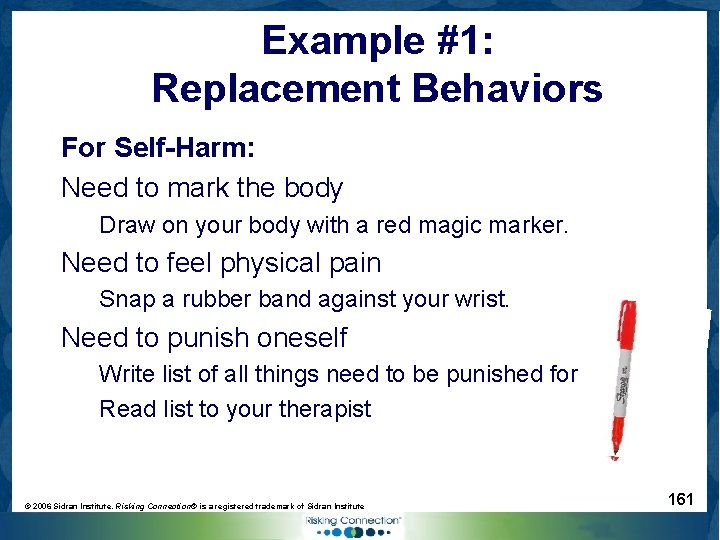
Example #1: Replacement Behaviors For Self-Harm: Need to mark the body Draw on your body with a red magic marker. Need to feel physical pain Snap a rubber band against your wrist. Need to punish oneself Write list of all things need to be punished for Read list to your therapist © 2006 Sidran Institute. Risking Connection® is a registered trademark of Sidran Institute 161
Example #2: The Function of Crisis Behaviors Violent Behavior helps: To feel a sense of power in an otherwise powerless existence. To protect against vulnerable feelings. To discharge anger and anxiety. To cover up or pre-empt exposure of shame © 2006 Sidran Institute. Risking Connection® is a registered trademark of Sidran Institute 162
Example #2: Replacement Behaviors For Violence: Need to feel sense of power and control Provide doable and positive leadership roles for client. Need to protect against vulnerable feelings Normalize vulnerable feelings. Show models of strong people (especially men) showing vulnerable feelings. Need to discharge anger or anxiety Rip pages out of old phone book. Lift weights or use exercise. © 2006 Sidran Institute. Risking Connection® is a registered trademark of Sidran Institute 163
After the Crisis – Work to Repair Relationships Validate their attempt to cope with overwhelming feelings. Acknowledge your feelings in a non-judgmental, nondefensive, and hopeful way. Express your confidence that, despite this rupture, your relationship can be fixed. Use “I” statements © 2006 Sidran Institute. Risking Connection® is a registered trademark of Sidran Institute 164
Exercise -- Role Play Repairing the relationship -after the crisis © 2006 Sidran Institute. Risking Connection® is a registered trademark of Sidran Institute 165
Re-enactment © 2006 Sidran Institute. Risking Connection® is a registered trademark of Sidran Institute 166
Re-enactment: Repeating the Trauma in Relationships Re-enactments are ways that clients unwittingly repeat aspects of their past traumatic relationships in present relationships. © 2006 Sidran Institute. Risking Connection® is a registered trademark of Sidran Institute 167
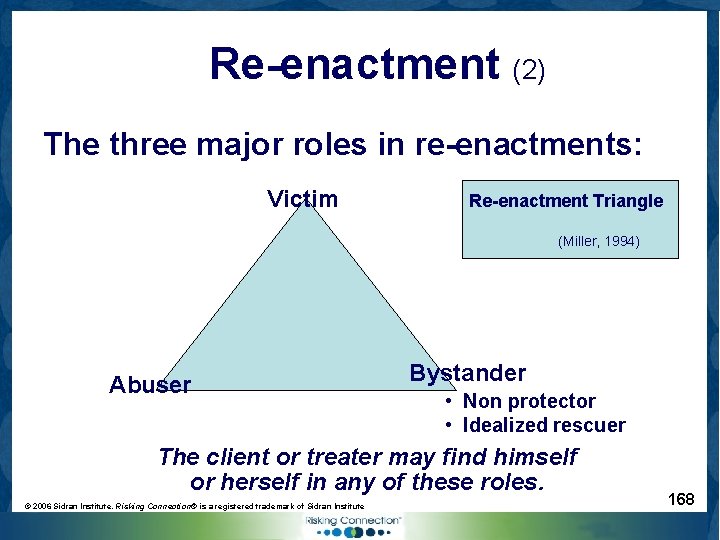
Re-enactment (2) The three major roles in re-enactments: Victim Re-enactment Triangle (Miller, 1994) Abuser Bystander • Non protector • Idealized rescuer The client or treater may find himself or herself in any of these roles. © 2006 Sidran Institute. Risking Connection® is a registered trademark of Sidran Institute 168
Re-enactment (3) Why Do Clients Replay the Past? Some reasons: Reflection of lessons learned in past relationships. Unconscious attempt to master the past. A way of remembering the past without consciously knowing it. © 2006 Sidran Institute. Risking Connection® is a registered trademark of Sidran Institute 169
Manipulation © 2006 Sidran Institute. Risking Connection® is a registered trademark of Sidran Institute 170
Manipulation What is this behavior we call “manipulative”? Trying to get what you want In an indirect, deceitful or dishonest way Without regard for the needs or feelings of the other person. © 2006 Sidran Institute. Risking Connection® is a registered trademark of Sidran Institute 171
Manipulation (2) How do we feel when we have been successfully manipulated- especially if it is public? Angry Stupid Foolish Naïve Never going to let it happen again Who else feels that way much of the time? Who else hardens their hearts so as never to be taken advantage of again? © 2006 Sidran Institute. Risking Connection® is a registered trademark of Sidran Institute 172
Manipulation (3) Why is it difficult for our clients to ask directly for what they want? It hasn’t worked in the past The system- including our programs-often says “no” to direct requests Asking for what you want makes you vulnerable and may feel like weakness To ask for what you want, you have to trust the other person © 2006 Sidran Institute. Risking Connection® is a registered trademark of Sidran Institute 173
Manipulation (4) What can we do when we feel manipulated? Talk over our feelings with another adult. Consider what need the client was trying to meet, what got in the way of him asking directly for what he wanted, and how he could meet his needs without deception. Use RICH® to talk with the client about the relationship effects of direct and indirect communication. © 2006 Sidran Institute. Risking Connection® is a registered trademark of Sidran Institute 174
Exercise Manipulation How did the client’s behavior make you feel? How might the behavior have solved a problem or met a need for the client? How could you use RICH® to talk with the client about direct and indirect communication? © 2006 Sidran Institute. Risking Connection® is a registered trademark of Sidran Institute 175
Case Example: Sarah Since Sarah’s admission you have had trouble connecting with her. You are delighted when she asks to speak with you. She tells you that she has been worried about her mother. Her mother has been sick recently and seems more depressed. Sarah is afraid she’s becoming suicidal again. Although Sarah knows she is not allowed visits at this time, she wonders if she could possibly have just a day visit to see if her mother is okay. You feel uneasy about this. If you help her with this, it may build her trust with you and the team. When you present this idea to your team, they are dubious. However, your passion and faith in her convince the others and Sarah leaves on a day pass on Saturday. You get the call at home. Sarah has left her mother’s house a half an hour after getting there. Then you get a second call. Sarah and her boyfriend Leon have been picked up by the police and Sarah has been returned to your facility. Staff is eager for you to talk to Sarah first thing Monday morning. They are asking you what her consequences are going to be. © 2006 Sidran Institute. Risking Connection® is a registered trademark of Sidran Institute 176
VT: The Impact of Crisis Intervention on the Treater © 2006 Sidran Institute. Risking Connection® is a registered trademark of Sidran Institute 177
The Impact of Crisis Intervention on the Treater Contributing Factors: Listening to life stories of our clients. Managing life-threatening crises Realizing that, at times, the stakes are quite literally life and death. Expectations about our power to control client’s actions (including legal liability). © 2006 Sidran Institute. Risking Connection® is a registered trademark of Sidran Institute 178
VT: What Gives Us Hope A trauma framework Noticing successes Loving your work Reclaiming your body © 2006 Sidran Institute. Risking Connection® is a registered trademark of Sidran Institute 179
Exercise: VT and Crisis Hopes and Challenges List 2 reasons you entered this line of work. List 2 ways in which the work is different from what you expected coming into the field. List 2 things about the work that are most challenging for you. Write briefly about 1 success story you’ve witnessed or encountered. © 2006 Sidran Institute. Risking Connection® is a registered trademark of Sidran Institute 180
- Slides: 81