
RISK2142 The Monte Carlo Method for Modeling Mitigating



- Slides: 46
(RISK-2142) "The Monte Carlo Method for Modeling & Mitigating Systemic Risk" Dr David T. Hulett Ph. D. , FAACE Mr Waylon T Whitehead
PLEASE USE MICROPHONE FOR ALL QUESTIONS AND COMMENTS! 2
BIO of David Hulett • Dr. David Hulett, FAACE, is a frequent contributor to AACE International conferences • He is the principal author of two Recommended Practices and lead articles in Cost Engineering • He has consulted and trained in project risk analysis, particularly quantitative schedule and cost risk analysis, as well as in scheduling, since 1990 • His clients are commercial and government agencies in North America, South America, Asia and Europe • Something You Don’t Know About Him: He loves choral and barbershop singing 3
BIO of Waylon Whitehead • Waylon Whitehead has 15 years of experience on oil, gas, and chemical projects greater than $2 BUSD in value • Experience divided between onshore and offshore, and with EPC and owner organizations • He consults and trains internally with Conoco. Phillips in scheduling and project risk analysis • His clients are commercial and government agencies in North America, South America, Asia and Europe • Something You Don’t Know About Him: Compared to Hulett, pretty much everything! 4
INTRODUCTION 5
The Challenge to Monte Carlo Simulation • Some within AACE have noted a supposed inability of Monte Carlo simulation (MCS) methods to represent systemic risks to project cost and schedule • The claim is that the bottom-up approach of data collection in MCS-based analyses does not incorporate systemic risks • This failing would be problematic given the large overruns in schedule and cost that can occur on megaprojects partially as a result of these risks 6
Response: that MCS can Incorporate Systemic Risk • Systemic risks relate to the overarching issues such as: – – – Level of new technology Degree of project definition Project complexity Project size Organization’s ability to manage large projects • Systemic risks are viewed as different in principal from project-specific risks that are identified during risk data collection based on discussion with project team members and other SMEs • This presentation shows how Monte Carlo simulation methods can incorporate systemic risks as well as uncertainty and project specific risks for an inclusive approach and result 7
Purpose of the Presentation • We present a method of combining: – Typical Monte Carlo Simulation methods – Representing uncertainty and project-specific risks – Including systemic risks – Using the Risk Drivers Methodology • We demonstrate the superiority of that approach for enabling effective mitigation • The method requires: – Use of a rich database of project results on comparable projects – Assessment of the likelihood that the systemic risks will apply to the project being analyzed 8
RECENT DISCUSSIONS ABOUT SYSTEMIC RISK 9
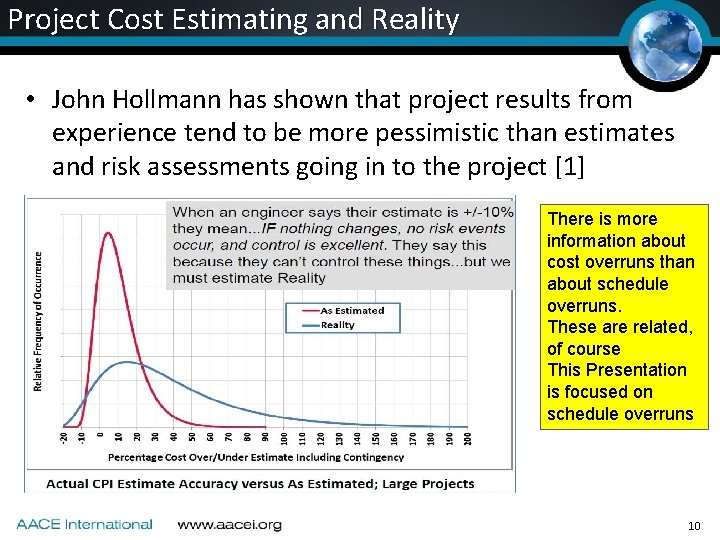
Project Cost Estimating and Reality • John Hollmann has shown that project results from experience tend to be more pessimistic than estimates and risk assessments going in to the project [1] There is more information about cost overruns than about schedule overruns. These are related, of course This Presentation is focused on schedule overruns 10
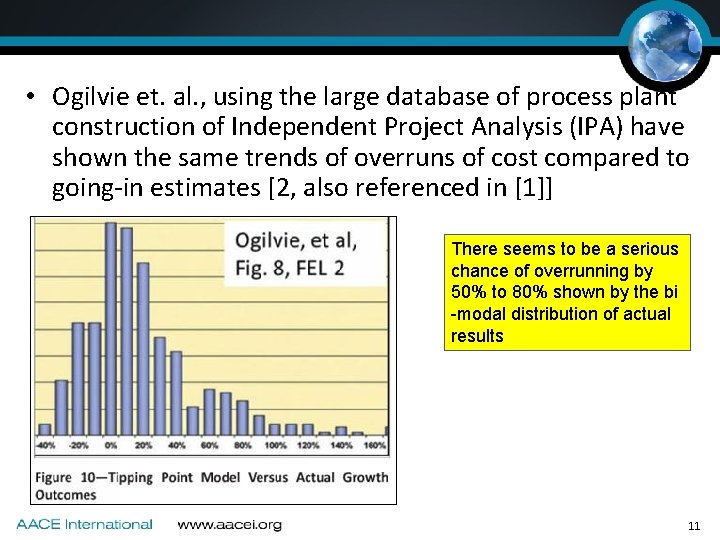
• Ogilvie et. al. , using the large database of process plant construction of Independent Project Analysis (IPA) have shown the same trends of overruns of cost compared to going-in estimates [2, also referenced in [1]] There seems to be a serious chance of overrunning by 50% to 80% shown by the bi -modal distribution of actual results 11
APPROACH TO SCHEDULE RISK ANALYSIS USING MONTE CARLO SIMULATION 12
Components of the MCS Analysis • Variation of project results compared to project plans generally include: – Uncertainty, including inherent variation, estimating error and estimating bias – Project-specific risks – Systemic risks • This paper shows how these three types of risks are handled in a MCS approach to project schedule risk analysis • A recent AACE International Recommended Practice dealt at length with the general method of MCS analysis applied to critical path method (CPM) schedules. [3] 13
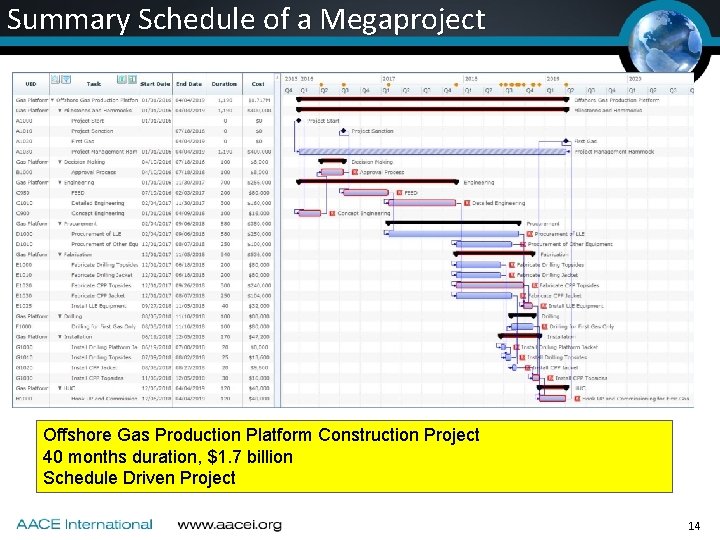
Summary Schedule of a Megaproject Offshore Gas Production Platform Construction Project 40 months duration, $1. 7 billion Schedule Driven Project 14
Add components of Risk - Uncertainty • Uncertainty is akin to “common cause” variation in the six sigma management • “Common cause variability is a source of variation caused by unknown factors that result in a steady but random distribution of output around the average of the data. Common cause variation is a measure of the process’s potential, or how well the process can perform when special cause variation is removed. . Common cause variation is also called random variation, noise, non-controllable variation, within-group variation, or inherent variation. ” [4] 15
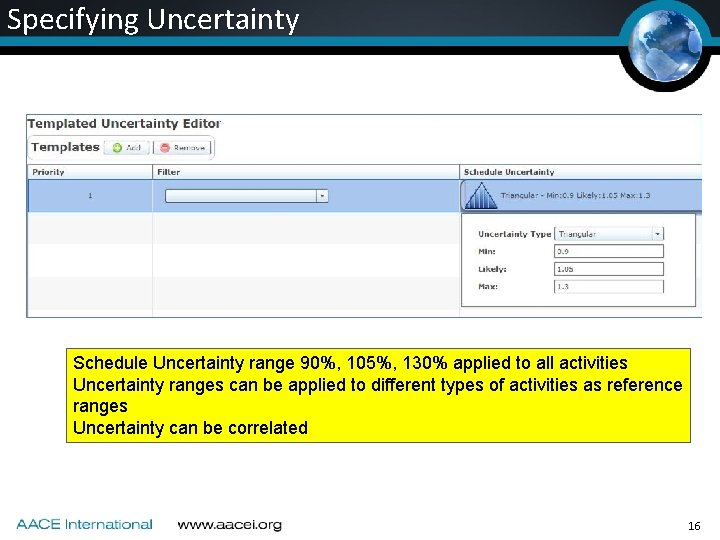
Specifying Uncertainty Schedule Uncertainty range 90%, 105%, 130% applied to all activities Uncertainty ranges can be applied to different types of activities as reference ranges Uncertainty can be correlated 16
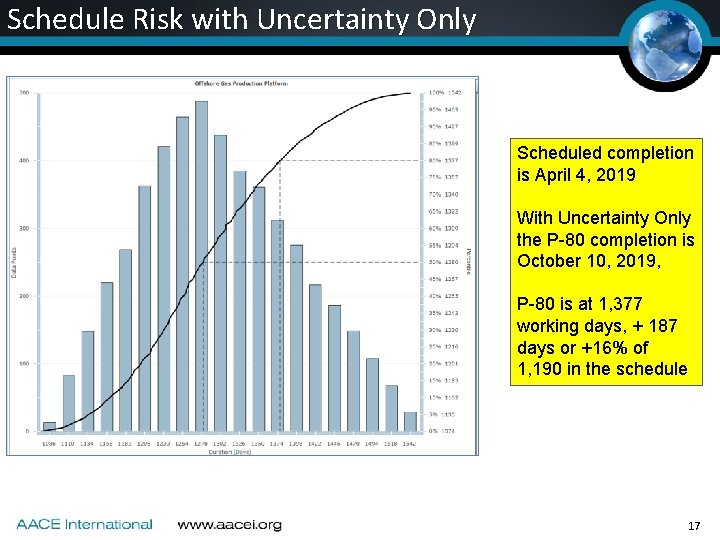
Schedule Risk with Uncertainty Only Scheduled completion is April 4, 2019 With Uncertainty Only the P-80 completion is October 10, 2019, P-80 is at 1, 377 working days, + 187 days or +16% of 1, 190 in the schedule 17
Adding Project-Specific Risks • Project Specific Risks are like special cause risk in the Six Sigma world • “… Special cause variation is caused by known factors that result in a non-random distribution of output…Special cause variation is a shift in output caused by a specific factor such as environmental conditions or process input parameters. It can be accounted for directly and potentially removed. . . ” [5] 18
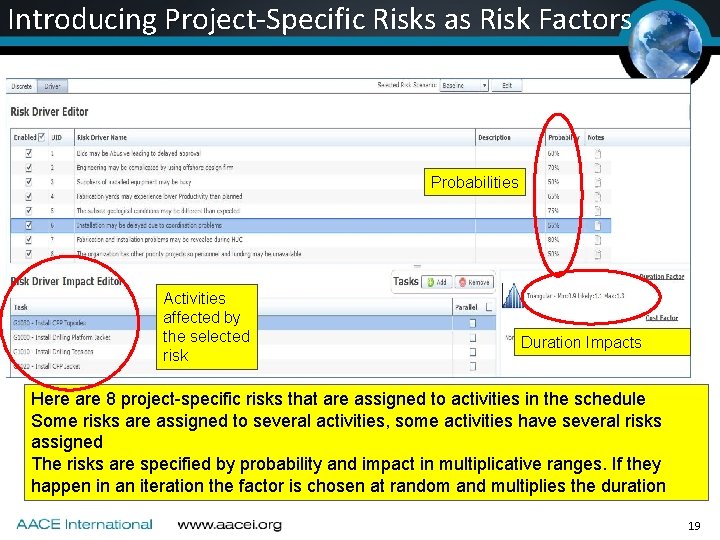
Introducing Project-Specific Risks as Risk Factors Probabilities Activities affected by the selected risk Duration Impacts Here are 8 project-specific risks that are assigned to activities in the schedule Some risks are assigned to several activities, some activities have several risks assigned The risks are specified by probability and impact in multiplicative ranges. If they happen in an iteration the factor is chosen at random and multiplies the duration 19
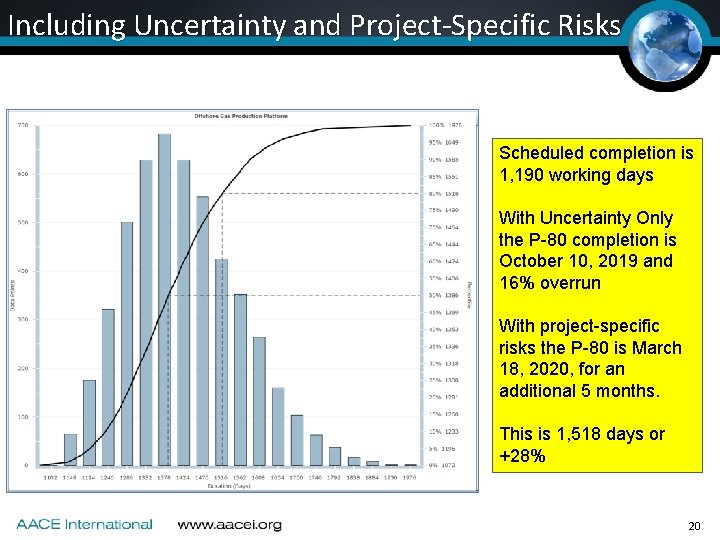
Including Uncertainty and Project-Specific Risks Scheduled completion is 1, 190 working days With Uncertainty Only the P-80 completion is October 10, 2019 and 16% overrun With project-specific risks the P-80 is March 18, 2020, for an additional 5 months. This is 1, 518 days or +28% 20
ADDING SYSTEMIC RISKS 21
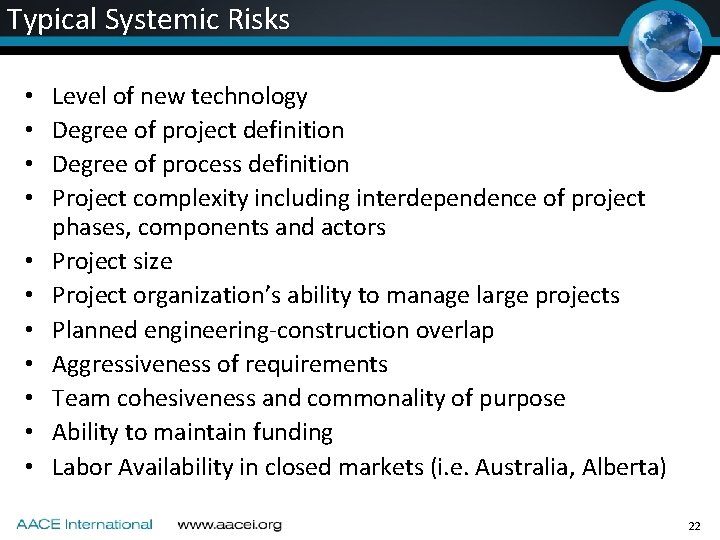
Typical Systemic Risks • • • Level of new technology Degree of project definition Degree of process definition Project complexity including interdependence of project phases, components and actors Project size Project organization’s ability to manage large projects Planned engineering-construction overlap Aggressiveness of requirements Team cohesiveness and commonality of purpose Ability to maintain funding Labor Availability in closed markets (i. e. Australia, Alberta) 22
Factors adding Stress to the Project Success • Some factors can exacerbate the project at a systemic level • One of these is schedule pressure • Ed Merrow: “Schedule pressure dooms more megaprojects than any other single factor. When there is pressure to move a project along quickly from the outset, corners get cut and opportunists have a field day” [6] 23
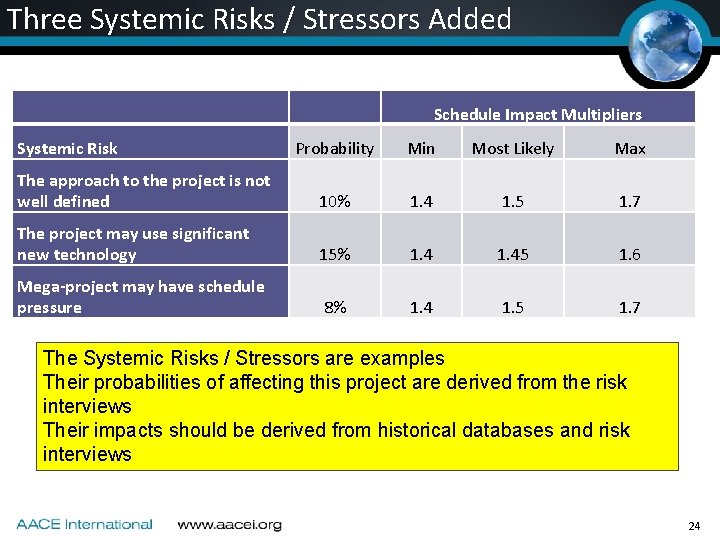
Three Systemic Risks / Stressors Added Schedule Impact Multipliers Systemic Risk Probability Min Most Likely Max The approach to the project is not well defined 10% 1. 4 1. 5 1. 7 The project may use significant new technology 15% 1. 45 1. 6 Mega-project may have schedule pressure 8% 1. 4 1. 5 1. 7 The Systemic Risks / Stressors are examples Their probabilities of affecting this project are derived from the risk interviews Their impacts should be derived from historical databases and risk interviews 24
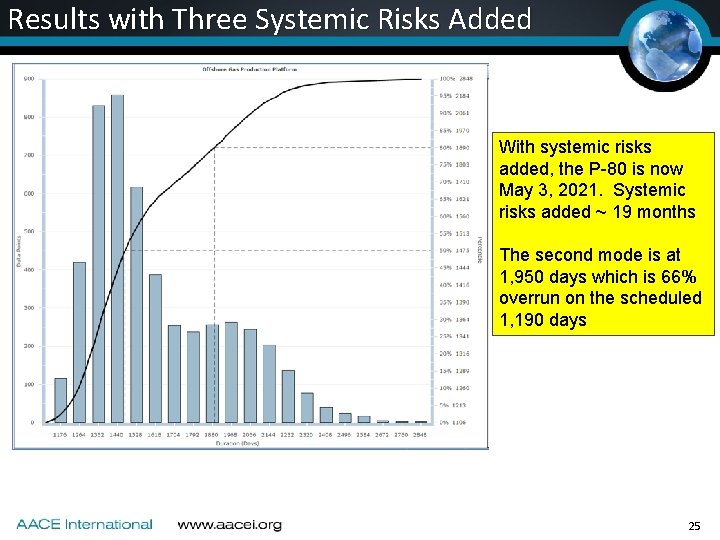
Results with Three Systemic Risks Added With systemic risks added, the P-80 is now May 3, 2021. Systemic risks added ~ 19 months The second mode is at 1, 950 days which is 66% overrun on the scheduled 1, 190 days 25
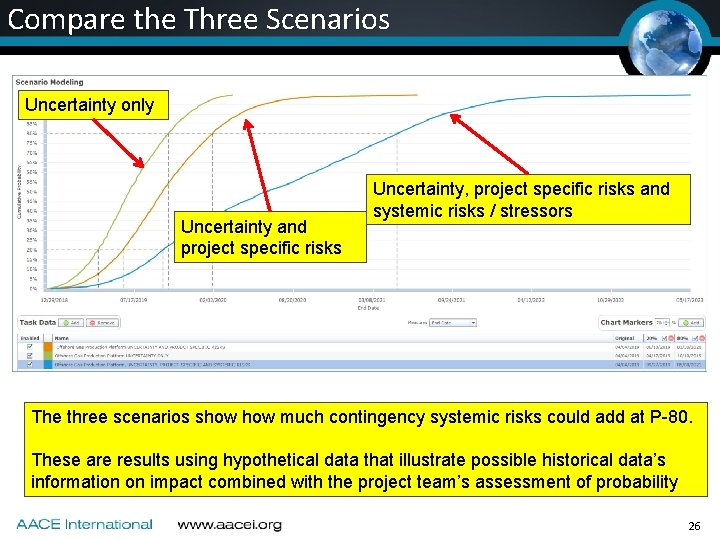
Compare the Three Scenarios Uncertainty only Uncertainty and project specific risks Uncertainty, project specific risks and systemic risks / stressors The three scenarios show much contingency systemic risks could add at P-80. These are results using hypothetical data that illustrate possible historical data’s information on impact combined with the project team’s assessment of probability 26
PRIORITIZING RISKS FOR RISK MITIGATION 27
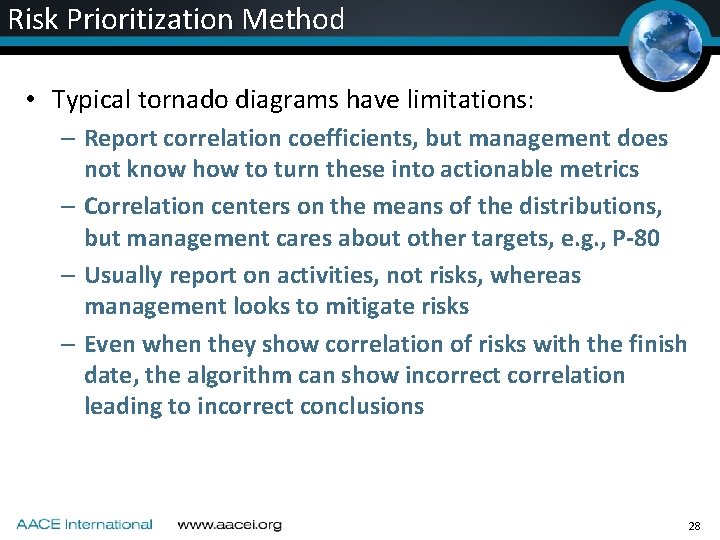
Risk Prioritization Method • Typical tornado diagrams have limitations: – Report correlation coefficients, but management does not know how to turn these into actionable metrics – Correlation centers on the means of the distributions, but management cares about other targets, e. g. , P-80 – Usually report on activities, not risks, whereas management looks to mitigate risks – Even when they show correlation of risks with the finish date, the algorithm can show incorrect correlation leading to incorrect conclusions 28
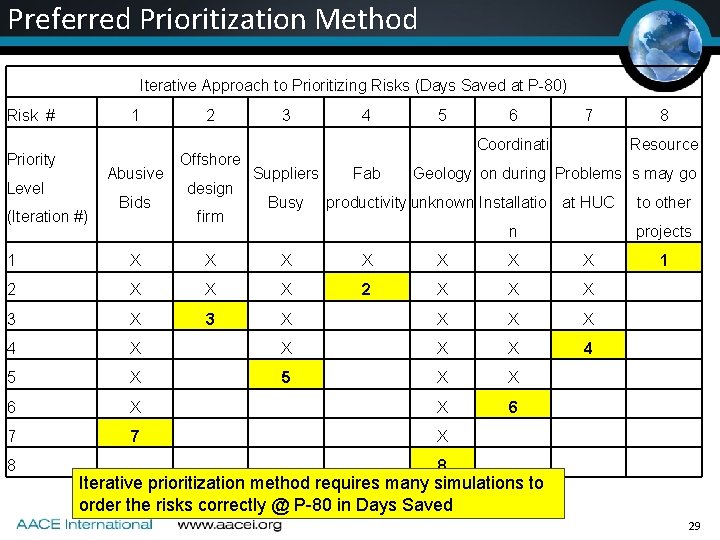
Preferred Prioritization Method Iterative Approach to Prioritizing Risks (Days Saved at P-80) Risk # 1 Priority Abusive Level (Iteration #) Bids 2 Offshore design firm 3 4 5 6 7 Coordinati Suppliers Busy Fab Resource Geology on during Problems s may go productivity unknown Installatio at HUC n to other projects 1 X X X X 2 X X X 3 X X X X 4 5 X X 6 7 7 X 8 8 1 8 Iterative prioritization method requires many simulations to order the risks correctly @ P-80 in Days Saved 29
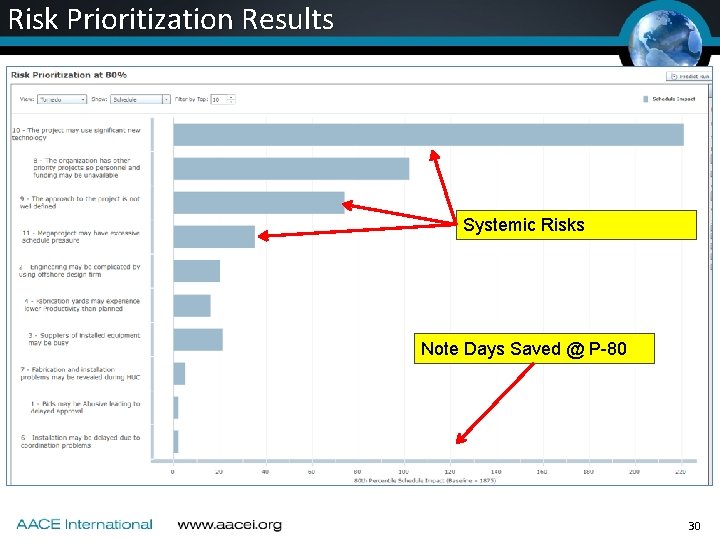
Risk Prioritization Results Systemic Risks Note Days Saved @ P-80 30
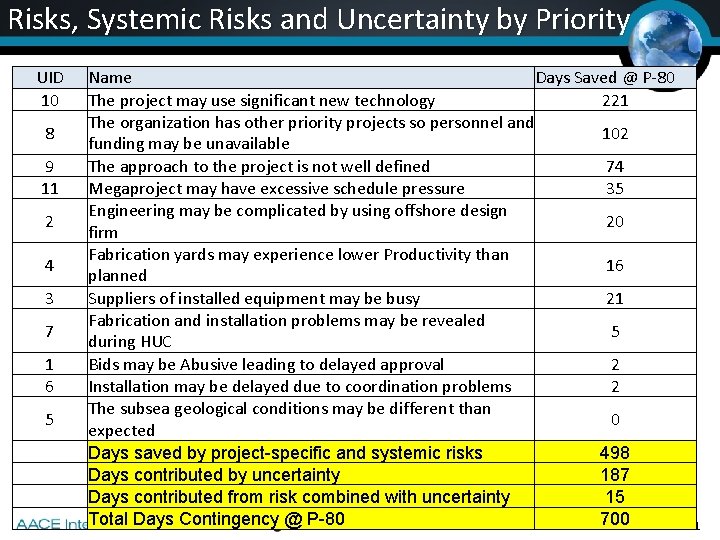
Risks, Systemic Risks and Uncertainty by Priority UID 10 8 9 11 2 4 3 7 1 6 5 Name Days Saved @ P-80 The project may use significant new technology 221 The organization has other priority projects so personnel and 102 funding may be unavailable The approach to the project is not well defined 74 Megaproject may have excessive schedule pressure 35 Engineering may be complicated by using offshore design 20 firm Fabrication yards may experience lower Productivity than 16 planned Suppliers of installed equipment may be busy 21 Fabrication and installation problems may be revealed 5 during HUC Bids may be Abusive leading to delayed approval 2 Installation may be delayed due to coordination problems 2 The subsea geological conditions may be different than 0 expected Days saved by project-specific and systemic risks 498 Days contributed by uncertainty 187 Days contributed from risk combined with uncertainty 15 Total Days Contingency @ P-80 700 31
RISK MITIGATION 32
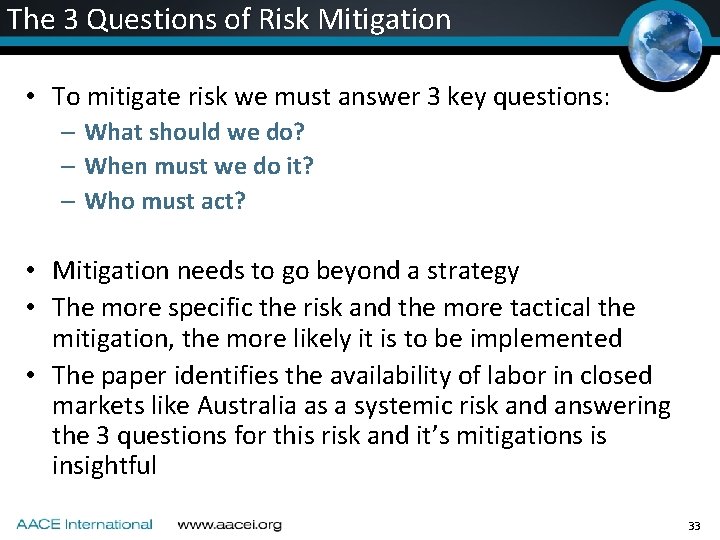
The 3 Questions of Risk Mitigation • To mitigate risk we must answer 3 key questions: – What should we do? – When must we do it? – Who must act? • Mitigation needs to go beyond a strategy • The more specific the risk and the more tactical the mitigation, the more likely it is to be implemented • The paper identifies the availability of labor in closed markets like Australia as a systemic risk and answering the 3 questions for this risk and it’s mitigations is insightful 33
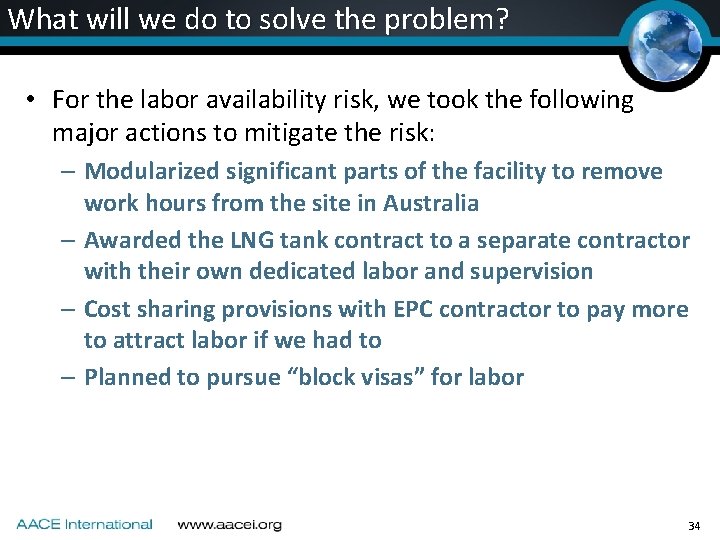
What will we do to solve the problem? • For the labor availability risk, we took the following major actions to mitigate the risk: – Modularized significant parts of the facility to remove work hours from the site in Australia – Awarded the LNG tank contract to a separate contractor with their own dedicated labor and supervision – Cost sharing provisions with EPC contractor to pay more to attract labor if we had to – Planned to pursue “block visas” for labor 34
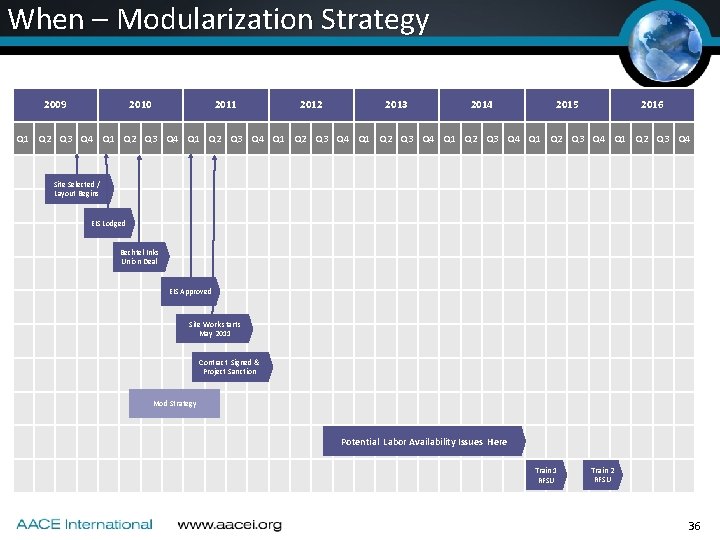
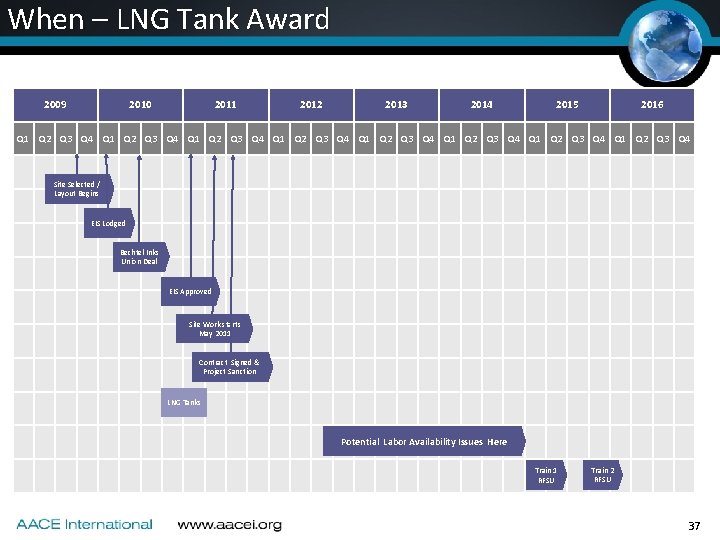
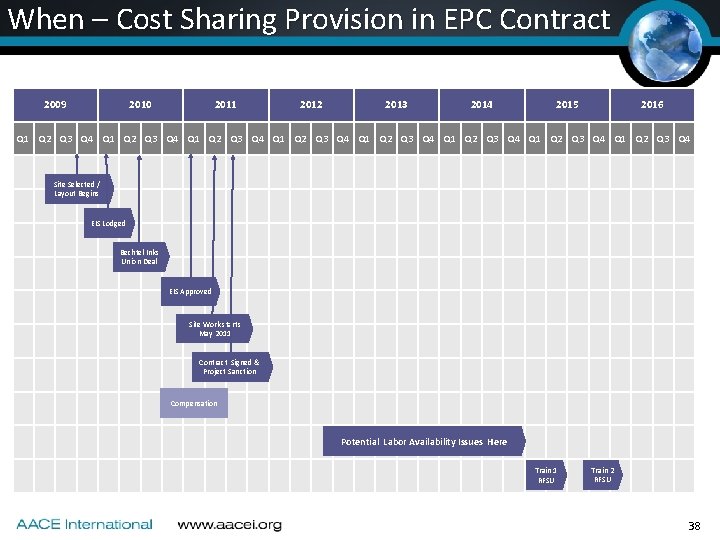
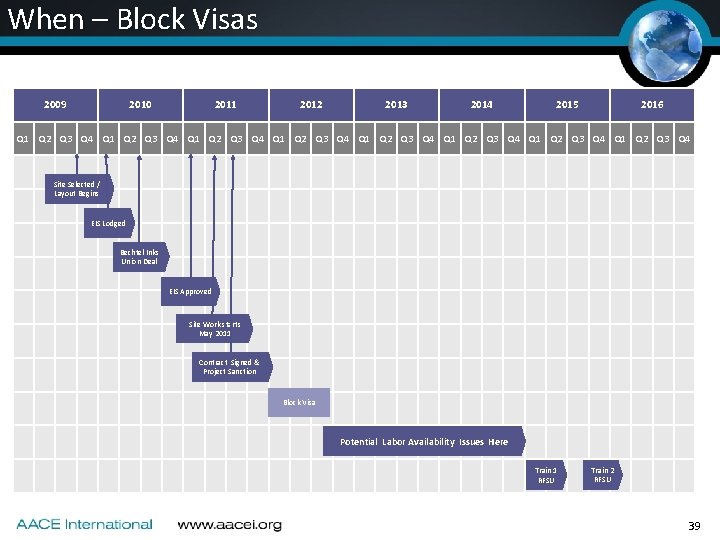
When must we act? • Using the Risk & Mitigation Timeline for the risk and each major mitigation focuses attention on when the risk occurs and when the solution must be in place in order to be effective 35
When – Modularization Strategy 2009 2010 2011 2012 2013 2014 2015 2016 Q 1 Q 2 Q 3 Q 4 Q 1 Q 2 Q 3 Q 4 Site Selected / Layout Begins EIS Lodged Bechtel Inks Union Deal EIS Approved Site Work starts May 2011 Contract Signed & Project Sanction Mod Strategy Potential Labor Availability Issues Here Train 1 RFSU Train 2 RFSU 36
When – LNG Tank Award 2009 2010 2011 2012 2013 2014 2015 2016 Q 1 Q 2 Q 3 Q 4 Q 1 Q 2 Q 3 Q 4 Site Selected / Layout Begins EIS Lodged Bechtel Inks Union Deal EIS Approved Site Work starts May 2011 Contract Signed & Project Sanction LNG Tanks Potential Labor Availability Issues Here Train 1 RFSU Train 2 RFSU 37
When – Cost Sharing Provision in EPC Contract 2009 2010 2011 2012 2013 2014 2015 2016 Q 1 Q 2 Q 3 Q 4 Q 1 Q 2 Q 3 Q 4 Site Selected / Layout Begins EIS Lodged Bechtel Inks Union Deal EIS Approved Site Work starts May 2011 Contract Signed & Project Sanction Compensation Potential Labor Availability Issues Here Train 1 RFSU Train 2 RFSU 38
When – Block Visas 2009 2010 2011 2012 2013 2014 2015 2016 Q 1 Q 2 Q 3 Q 4 Q 1 Q 2 Q 3 Q 4 Site Selected / Layout Begins EIS Lodged Bechtel Inks Union Deal EIS Approved Site Work starts May 2011 Contract Signed & Project Sanction Block Visa Potential Labor Availability Issues Here Train 1 RFSU Train 2 RFSU 39
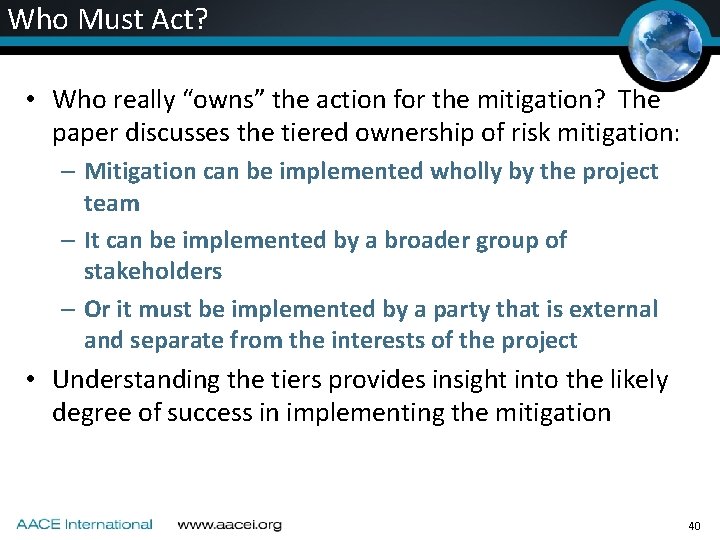
Who Must Act? • Who really “owns” the action for the mitigation? The paper discusses the tiered ownership of risk mitigation: – Mitigation can be implemented wholly by the project team – It can be implemented by a broader group of stakeholders – Or it must be implemented by a party that is external and separate from the interests of the project • Understanding the tiers provides insight into the likely degree of success in implementing the mitigation 40
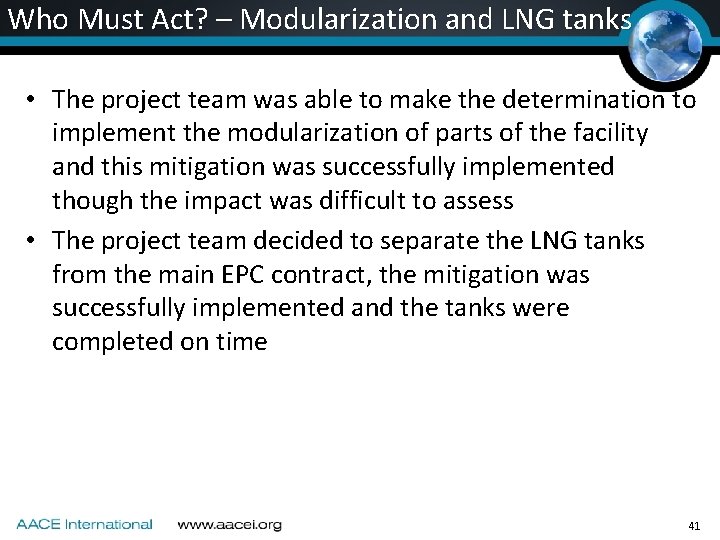
Who Must Act? – Modularization and LNG tanks • The project team was able to make the determination to implement the modularization of parts of the facility and this mitigation was successfully implemented though the impact was difficult to assess • The project team decided to separate the LNG tanks from the main EPC contract, the mitigation was successfully implemented and the tanks were completed on time 41
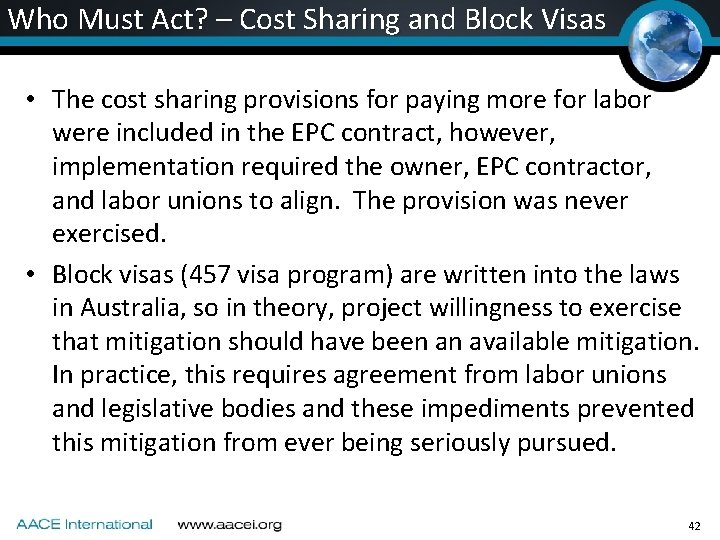
Who Must Act? – Cost Sharing and Block Visas • The cost sharing provisions for paying more for labor were included in the EPC contract, however, implementation required the owner, EPC contractor, and labor unions to align. The provision was never exercised. • Block visas (457 visa program) are written into the laws in Australia, so in theory, project willingness to exercise that mitigation should have been an available mitigation. In practice, this requires agreement from labor unions and legislative bodies and these impediments prevented this mitigation from ever being seriously pursued. 42
Successful Mitigation • Answer the what, when and who of mitigation • Develop the Risk & Mitigation Timelines for major risks and mitigations • Segregate the mitigations into tiers of ownership • Assess alignment of risk mitigation owners with the projects goals • Do not count on success when the mitigation owners are truly external to the project • Reassess periodically or at pre-defined trigger points 43
References (1) 1. Hollmann, John K. 2012, “RISK. 1026 Estimating Accuracy: Dealing with Reality” 2012 AACE International Transactions AACE International, Morgantown, WV 2. Ogilvie, Alexander, Robert A. Brown, Jr. , Fredrick P. Biery and Paul Barshop, “Quantifying Estimate Accuracy for the Process industries, A Review of Industry Data, ” 2012 Cost Engineering Journal, AACE International, Nov/Dec 2012 3. AACE International, Recommended Practice No. 57 R 09, “Integrated Cost and Schedule Risk Analysis Using Monte Carlo Simulation of a CPM Model” May 26, 2011 44
References (2) 4. Six-sigma definition of common cause, http: //www. isixsigma. com/dictionary/common-causevariation/ 5. Six-sigma definition of special cause. http: //www. isixsigma. com/dictionary/variation-specialcause/ 6. Merrow, Edward W. , Industrial Megaprojects, Concepts, Strategies and Practices for Success, 2011, Wiley 7. Quotations from Secretary of Defense Donald Rumsfeld on “unknowns” http: //en. wikipedia. org/wiki/There_are_knowns 45
QUESTIONS/COMMENTS? (PLEASE USE MICROPHONE) 46