
Risk table considerations for BSAI crab stocks Martin
Risk table considerations for BSAI crab stocks Martin Dorn and Stephani Zador Alaska Fisheries Science Center CPT meeting January 11, 2021 Online meeting
BSAI and GOA FMP: Acceptable Biological Catch “Specification of ABC is similar to specification of OFL, in that both involve harvest control rules with six tiers relating to various levels of information availability. However, somewhat more flexibility is allowed in specifying ABC, in that the control rule prescribes only an upper bound. ” The fourth step in specifying ABC: “Determine whether conditions exist that warrant setting ABC at a value lower than the maximum permissible value (such conditions may include—but are not limited to —data uncertainty, recruitment variability, and declining population trend) and, if so: a. document those conditions, b. recommend an ABC lower than the maximum permissible value, and c. explain why the recommended value is appropriate. The above steps are undertaken first by the assessment authors in the individual chapters of the SAFE report. The Plan Team then reviews the SAFE report and makes its own recommendation. The SSC then reviews the SAFE report and Plan Team recommendation, and makes its own recommendation to the Council. The Council then reviews the SAFE report, Plan Team recommendation, and SSC recommendation; then makes its own recommendation to the Secretary, with the constraint that the Council’s recommended ABC cannot exceed the SSC’s recommended ABC. ”
BSAI crab FMP: Acceptable Biological Catch “ABC Control Rule is the specified approach in the five-tier system for setting the maximum permissible ABC for each stock as a function of the scientific uncertainty in the estimate of OFL and any other specified scientific • ABC control rule for tiers 1 -4 is given by ABC≤(1 -by) * OFL • The parameter, by, is the value for the annual buffer calculated from a P* of 0. 49 and a probability distribution for the OFL that accounts for scientific uncertainty in the estimate of OFL. In reviewing the Stock Assessment and Fishery Evaluation Report, the Crab Plan Team and the Scientific and Statistical Committee shall evaluate and make recommendations, as necessary, on: • the assumptions made for stock assessment models and estimation of OFLs; • the specifications of the probability distribution of the OFL; • the methods to appropriately quantify uncertainty in the ABC control rule; and • the factors influencing scientific uncertainty that the State has accounted for and will account for on an annual basis in TAC setting The Scientific and Statistical Committee will then set the final OFLs and ABCs for the upcoming crab fishing year. The Scientific and Statistical Committee may set an ABC lower than the result of the ABC control rule, but it must provide an explanation for setting the ABC less that the maximum ABC. ”

SSC ranges for ABC
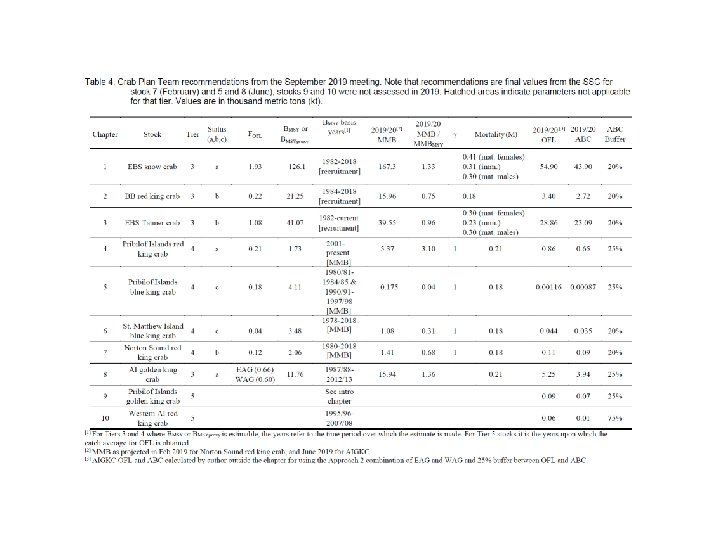
A few observations on crab ABC recommendations • ABC recommendations for crab follow a different framework than for groundfish. • For crab stocks the maximum permissible ABC is specified according to a P* of 0. 49, which results in a small buffer between ABC and OFL. • The SSC/CPT has gradually adopted a convention in which the recommended ABC is always lower than the maximum permissible ABC and linked to tier level of the stock. • For each assessment, CPT recommends whether the ABC buffer should be increased or reduced to account for circumstances associated with the assessment. • The SSC then either accepts the CPT recommendation, or makes its own recommendation.
Design criteria for a risk evaluation framework • The framework should document the criteria that are used making reductions in ABC. • ABC reductions should be calibrated, so that a more extreme situation results in a stronger response. • ABC reductions should be consistent, so that similar situations result in a similar response across different stock assessments. • Framework should provide a set of guidelines or defaults (rather than inflexible rules).
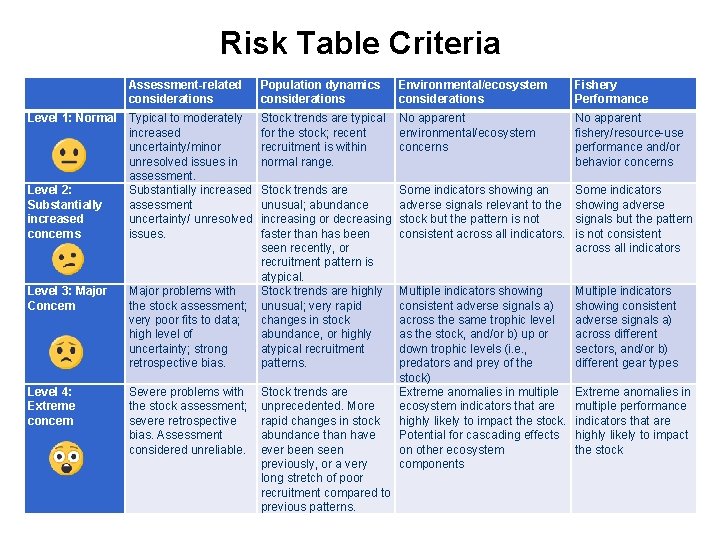
Risk Table Criteria Assessment-related considerations Level 1: Normal Typical to moderately increased uncertainty/minor unresolved issues in assessment. Level 2: Substantially increased Substantially assessment increased uncertainty/ unresolved concerns issues. Level 3: Major Concern Major problems with the stock assessment; very poor fits to data; high level of uncertainty; strong retrospective bias. Level 4: Extreme concern Severe problems with the stock assessment; severe retrospective bias. Assessment considered unreliable. Population dynamics considerations Environmental/ecosystem considerations Fishery Performance Stock trends are typical for the stock; recent recruitment is within normal range. No apparent environmental/ecosystem concerns No apparent fishery/resource-use performance and/or behavior concerns Stock trends are unusual; abundance increasing or decreasing faster than has been seen recently, or recruitment pattern is atypical. Stock trends are highly unusual; very rapid changes in stock abundance, or highly atypical recruitment patterns. Some indicators showing an adverse signals relevant to the stock but the pattern is not consistent across all indicators. Some indicators showing adverse signals but the pattern is not consistent across all indicators Multiple indicators showing consistent adverse signals a) across the same trophic level as the stock, and/or b) up or down trophic levels (i. e. , predators and prey of the stock) Extreme anomalies in multiple ecosystem indicators that are highly likely to impact the stock. Potential for cascading effects on other ecosystem components Multiple indicators showing consistent adverse signals a) across different sectors, and/or b) different gear types Stock trends are unprecedented. More rapid changes in stock abundance than have ever been seen previously, or a very long stretch of poor recruitment compared to previous patterns. Extreme anomalies in multiple performance indicators that are highly likely to impact the stock 8
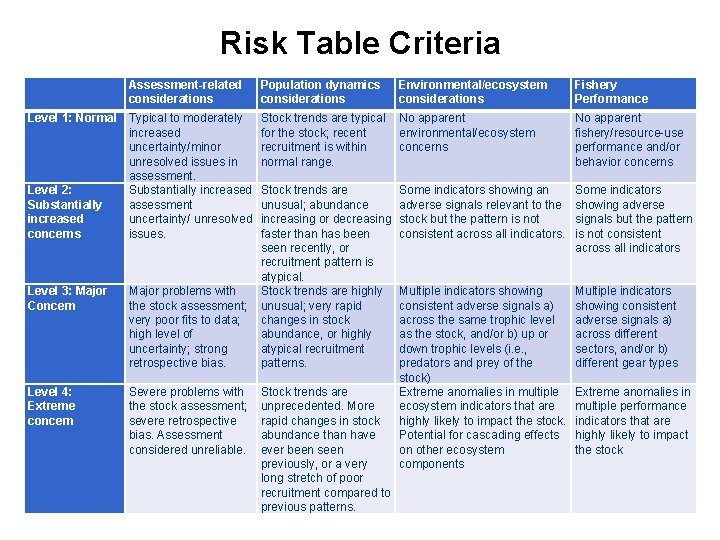
Risk Table Criteria Assessment-related considerations Level 1: Normal Typical to moderately increased uncertainty/minor unresolved issues in assessment. Level 2: Substantially increased Substantially assessment increased uncertainty/ unresolved concerns issues. Level 3: Major Concern Major problems with the stock assessment; very poor fits to data; high level of uncertainty; strong retrospective bias. Level 4: Extreme concern Severe problems with the stock assessment; severe retrospective bias. Assessment considered unreliable. Population dynamics considerations Environmental/ecosystem considerations Fishery Performance Stock trends are typical for the stock; recent recruitment is within normal range. No apparent environmental/ecosystem concerns No apparent fishery/resource-use performance and/or behavior concerns Stock trends are unusual; abundance increasing or decreasing faster than has been seen recently, or recruitment pattern is atypical. Stock trends are highly unusual; very rapid changes in stock abundance, or highly atypical recruitment patterns. Some indicators showing an adverse signals relevant to the stock but the pattern is not consistent across all indicators. Some indicators showing adverse signals but the pattern is not consistent across all indicators Multiple indicators showing consistent adverse signals a) across the same trophic level as the stock, and/or b) up or down trophic levels (i. e. , predators and prey of the stock) Extreme anomalies in multiple ecosystem indicators that are highly likely to impact the stock. Potential for cascading effects on other ecosystem components Multiple indicators showing consistent adverse signals a) across different sectors, and/or b) different gear types Stock trends are unprecedented. More rapid changes in stock abundance than have ever been seen previously, or a very long stretch of poor recruitment compared to previous patterns. Extreme anomalies in multiple performance indicators that are highly likely to impact the stock 9
Application guidelines The table is applied by evaluating the severity of four types of considerations that could be used to support a scientific recommendation to reduce the ABC from the maximum permissible. These considerations are • Stock assessment considerations • Population dynamics considerations • Environmental/ecosystem considerations • Fishery performance
Examples of the types of concern Assessment considerations— Data-inputs: biased ages, skipped surveys, lack of fisheryindependent trend data; model fits: poor fits to fishery or survey data, inability to simultaneously fit multiple data inputs; Model performance: poor model convergence, multiple minima in the likelihood surface, parameters hitting bounds; Estimation uncertainty: poorly-estimated but influential year classes; retrospective bias in biomass estimates. Population dynamics considerations—decreasing biomass trend, poor recent recruitment, inability of the stock to rebuild, abrupt increase or decrease in stock abundance.
Examples of the types of concern Environmental/ecosystem considerations—adverse trends in environmental/ecosystem indicators, ecosystem model results, decreases in ecosystem productivity, decreases in prey abundance or availability, increases or increases in predator abundance or productivity. Fishery performance—fishery CPUE is showing a contrasting pattern from the stock biomass trend, unusual spatial pattern of fishing, changes in the percent of TAC taken, changes in the duration of fishery openings.
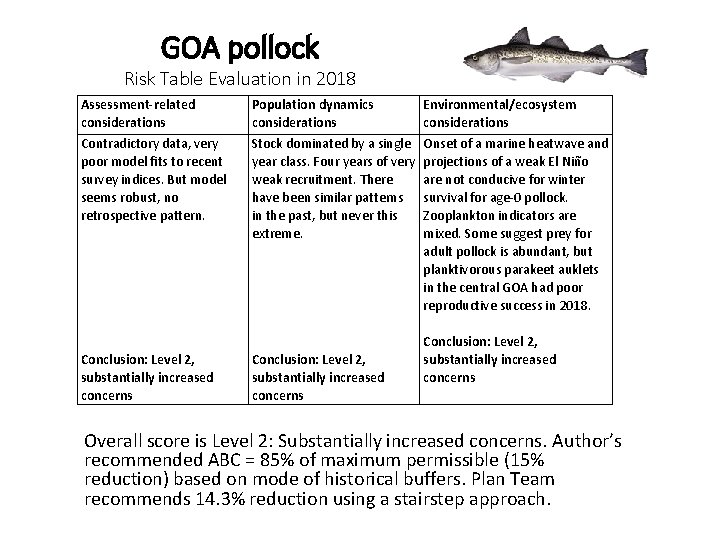
GOA pollock Risk Table Evaluation in 2018 Assessment-related considerations Population dynamics considerations Environmental/ecosystem considerations Contradictory data, very poor model fits to recent survey indices. But model seems robust, no retrospective pattern. Stock dominated by a single year class. Four years of very weak recruitment. There have been similar patterns in the past, but never this extreme. Onset of a marine heatwave and projections of a weak El Niño are not conducive for winter survival for age-0 pollock. Zooplankton indicators are mixed. Some suggest prey for adult pollock is abundant, but planktivorous parakeet auklets in the central GOA had poor reproductive success in 2018. Conclusion: Level 2, substantially increased concerns Overall score is Level 2: Substantially increased concerns. Author’s recommended ABC = 85% of maximum permissible (15% reduction) based on mode of historical buffers. Plan Team recommends 14. 3% reduction using a stairstep approach.
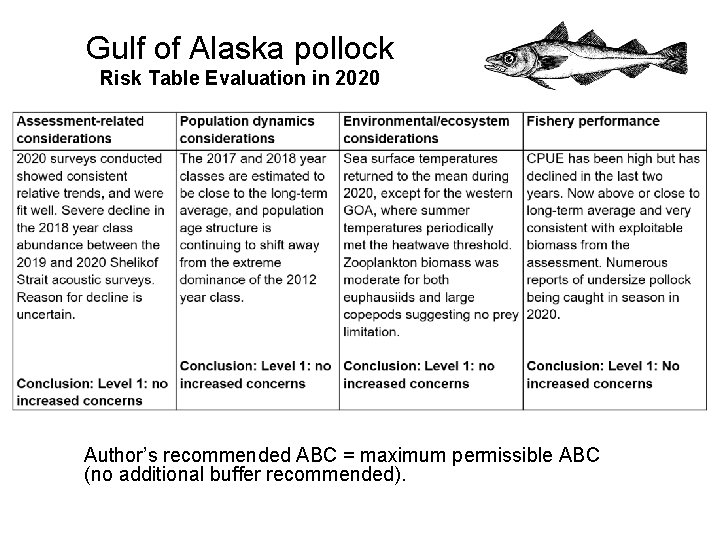
Gulf of Alaska pollock Risk Table Evaluation in 2020 Author’s recommended ABC = maximum permissible ABC (no additional buffer recommended).
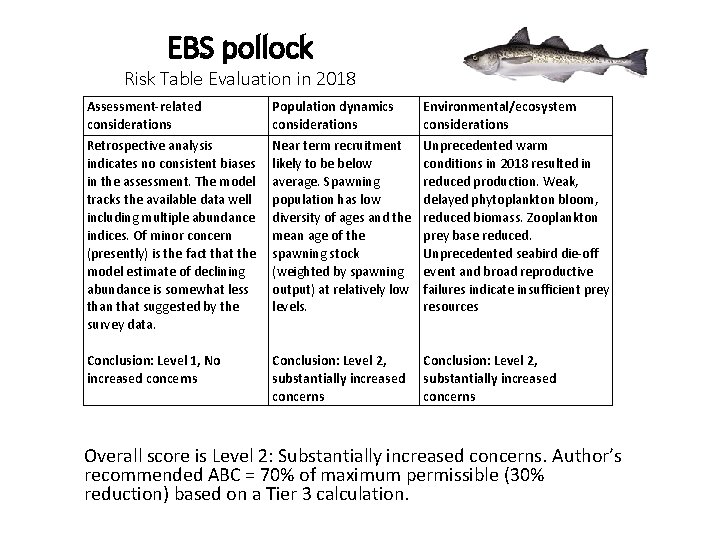
EBS pollock Risk Table Evaluation in 2018 Assessment-related considerations Population dynamics considerations Environmental/ecosystem considerations Retrospective analysis indicates no consistent biases in the assessment. The model tracks the available data well including multiple abundance indices. Of minor concern (presently) is the fact that the model estimate of declining abundance is somewhat less than that suggested by the survey data. Near term recruitment likely to be below average. Spawning population has low diversity of ages and the mean age of the spawning stock (weighted by spawning output) at relatively low levels. Unprecedented warm conditions in 2018 resulted in reduced production. Weak, delayed phytoplankton bloom, reduced biomass. Zooplankton prey base reduced. Unprecedented seabird die-off event and broad reproductive failures indicate insufficient prey resources Conclusion: Level 1, No increased concerns Conclusion: Level 2, substantially increased concerns Overall score is Level 2: Substantially increased concerns. Author’s recommended ABC = 70% of maximum permissible (30% reduction) based on a Tier 3 calculation.
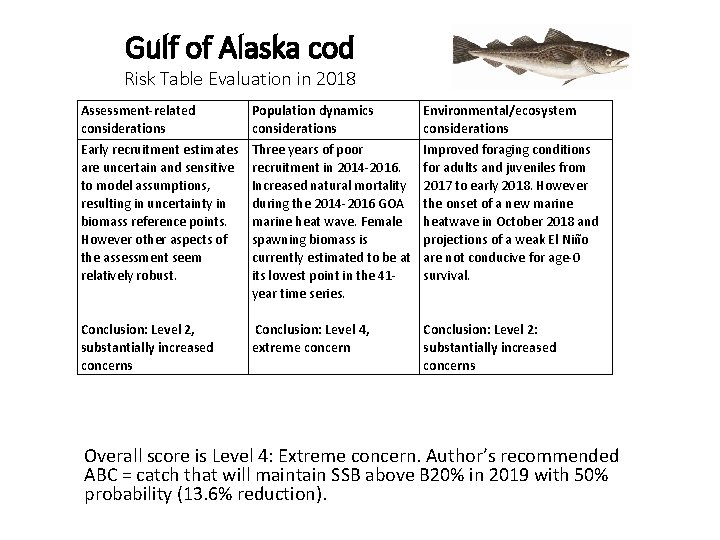
Gulf of Alaska cod Risk Table Evaluation in 2018 Assessment-related considerations Population dynamics considerations Environmental/ecosystem considerations Early recruitment estimates are uncertain and sensitive to model assumptions, resulting in uncertainty in biomass reference points. However other aspects of the assessment seem relatively robust. Three years of poor recruitment in 2014 -2016. Increased natural mortality during the 2014 -2016 GOA marine heat wave. Female spawning biomass is currently estimated to be at its lowest point in the 41 year time series. Improved foraging conditions for adults and juveniles from 2017 to early 2018. However the onset of a new marine heatwave in October 2018 and projections of a weak El Niño are not conducive for age-0 survival. Conclusion: Level 2, substantially increased concerns Conclusion: Level 4, extreme concern Conclusion: Level 2: substantially increased concerns Overall score is Level 4: Extreme concern. Author’s recommended ABC = catch that will maintain SSB above B 20% in 2019 with 50% probability (13. 6% reduction).
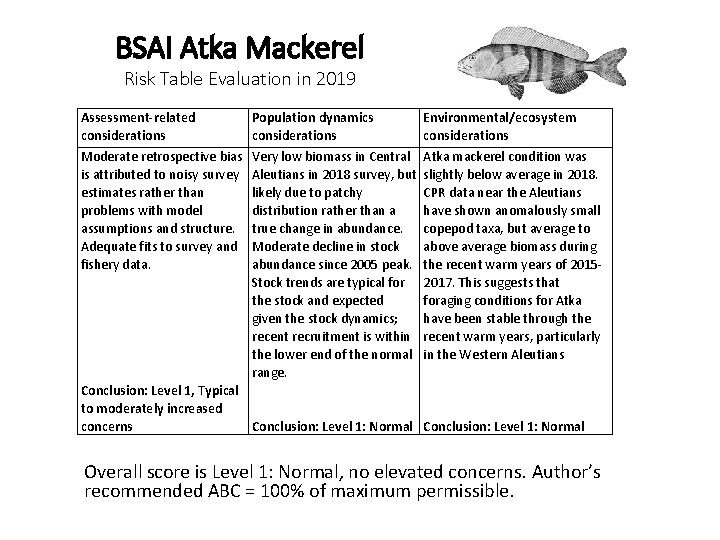
BSAI Atka Mackerel Risk Table Evaluation in 2019 Assessment-related considerations Population dynamics considerations Environmental/ecosystem considerations Moderate retrospective bias is attributed to noisy survey estimates rather than problems with model assumptions and structure. Adequate fits to survey and fishery data. Very low biomass in Central Aleutians in 2018 survey, but likely due to patchy distribution rather than a true change in abundance. Moderate decline in stock abundance since 2005 peak. Stock trends are typical for the stock and expected given the stock dynamics; recent recruitment is within the lower end of the normal range. Atka mackerel condition was slightly below average in 2018. CPR data near the Aleutians have shown anomalously small copepod taxa, but average to above average biomass during the recent warm years of 20152017. This suggests that foraging conditions for Atka have been stable through the recent warm years, particularly in the Western Aleutians Conclusion: Level 1, Typical to moderately increased concerns Conclusion: Level 1: Normal Overall score is Level 1: Normal, no elevated concerns. Author’s recommended ABC = 100% of maximum permissible.
Some comments on implementation • Some subjectivity in assigning the concern level, but usually the debate is over which of two levels to use (rather than a broader range of disagreement). • Application of the risk table seemed useful even when no reduction was recommended. • An unanticipated benefit was improved communication with stakeholders. • Generally a case-by-case approach was used to obtain a percent reduction rather that a single method applied consistently. • In most cases level of concern was not linked to the percent reduction. • Applied to five stocks as test cases in 2018, then for all stocks with new assessments in 2019 and 2020.
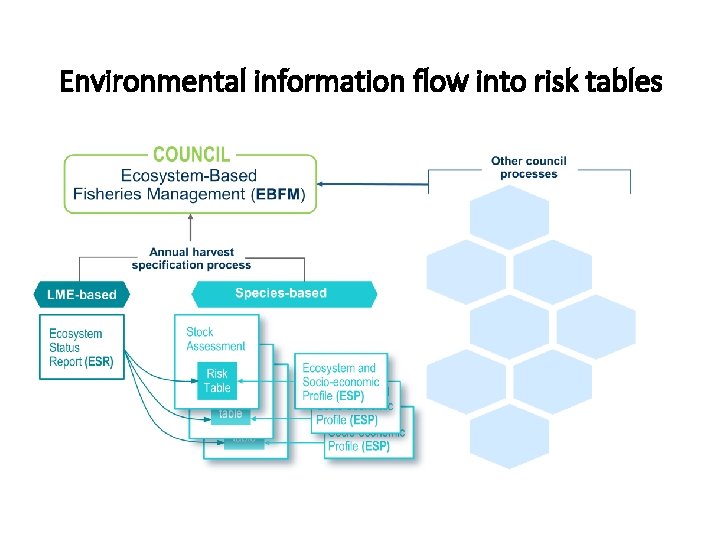
Environmental information flow into risk tables
Applicability for BSAI crab stocks • The risk table seems feasible to apply to BSAI crab stocks. • Its utility would be to provide support and documentation for the recommendation to increase, reduce, or maintain the ABC buffer. • By forcing reconsideration of buffer rationales in every new assessment, it may help address the concern that ABC buffer only gets larger over time. • As we enter a period of rapid environmental change in Alaska marine waters, extreme conditions and assessment surprises are likely to occur more often. • Adjusting ABC buffers should be regarded as a tool for rapid response, rather than a strategic approach to environmental variation (see ACLIM)
- Slides: 20