
Risk Sharing in Drug Development Richard Malcolm Ph


- Slides: 27
Risk Sharing in Drug Development Richard Malcolm, Ph. D. CEO, Acurian September 15, 2011 | BIOCOM
Risk Sharing Defined • A method in which the cost of the consequences of a risk is distributed among several participants (e. g. syndication) • Business management method whereby the financial consequences of a risk are distributed among both vendor and client 2
Objectives of Risk Sharing • Ensure all parties have an aligned interest to the ultimate success of a venture – Shared accountability • Put the vendor(s) “in the boat” with the sponsor 3
General Background • First appeared in centralized patient recruitment in the 1990 s • Soon disappeared due to declining demand • Made a comeback in past several years • Increasingly common requirement in patient recruitment & retention contracts • Applicable to virtually any drug development service, not just patient recruitment 4
Types of Risk Sharing • • None Partial Complete Total 5
Patient Recruitment Example • Phase IIb study of drug X in generalized anxiety disorder • Recruitment vendors receive RFP from drug company to provide recruitment/enrollment services • Services requested include mix of radio/TV ads, internet recruiting & direct mail 6
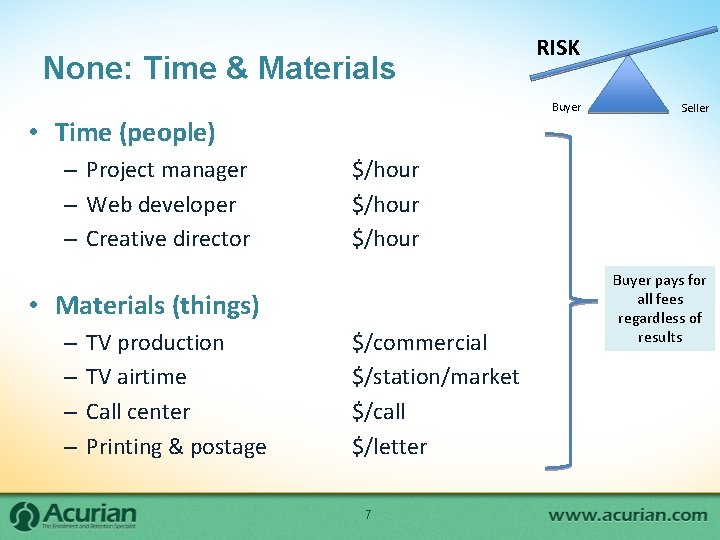
None: Time & Materials RISK Buyer • Time (people) – Project manager – Web developer – Creative director $/hour • Materials (things) – – TV production TV airtime Call center Printing & postage Seller $/commercial $/station/market $/call $/letter 7 Buyer pays for all fees regardless of results
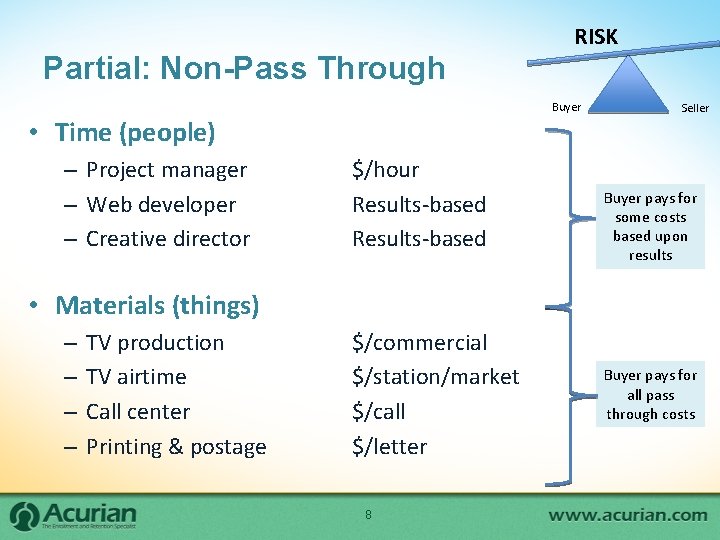
Partial: Non-Pass Through RISK Buyer • Time (people) – Project manager – Web developer – Creative director $/hour Results-based Seller Buyer pays for some costs based upon results • Materials (things) – – TV production TV airtime Call center Printing & postage $/commercial $/station/market $/call $/letter 8 Buyer pays for all pass through costs
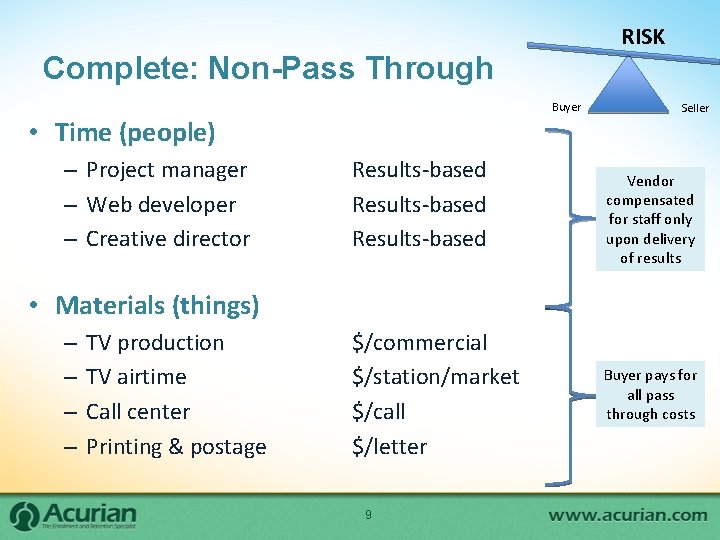
RISK Complete: Non-Pass Through Buyer • Time (people) – Project manager – Web developer – Creative director Results-based Seller Vendor compensated for staff only upon delivery of results • Materials (things) – – TV production TV airtime Call center Printing & postage $/commercial $/station/market $/call $/letter 9 Buyer pays for all pass through costs
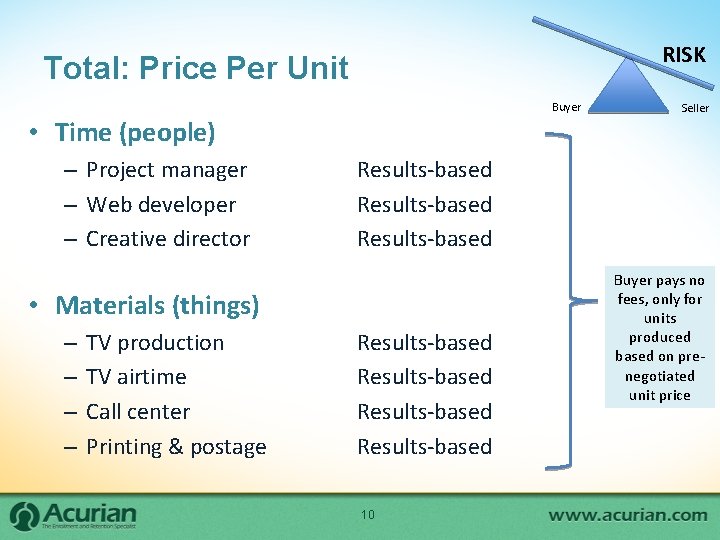
RISK Total: Price Per Unit Buyer • Time (people) – Project manager – Web developer – Creative director Results-based • Materials (things) – – TV production TV airtime Call center Printing & postage Seller Results-based 10 Buyer pays no fees, only for units produced based on prenegotiated unit price
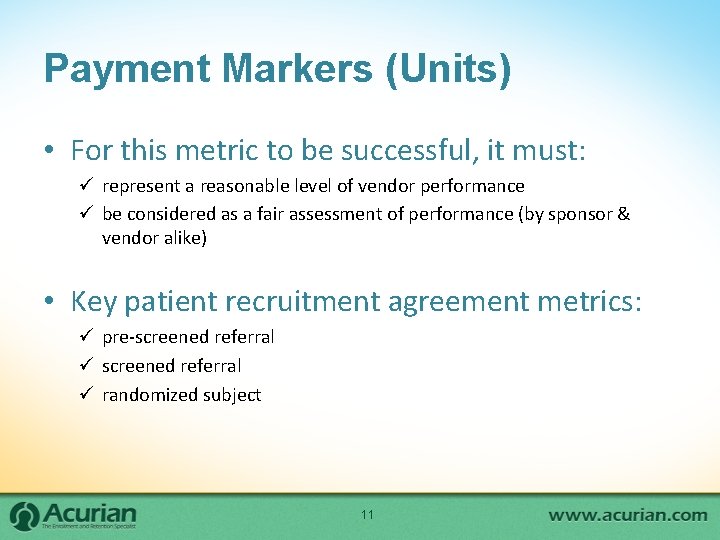
Payment Markers (Units) • For this metric to be successful, it must: ü represent a reasonable level of vendor performance ü be considered as a fair assessment of performance (by sponsor & vendor alike) • Key patient recruitment agreement metrics: ü pre-screened referral ü randomized subject 11
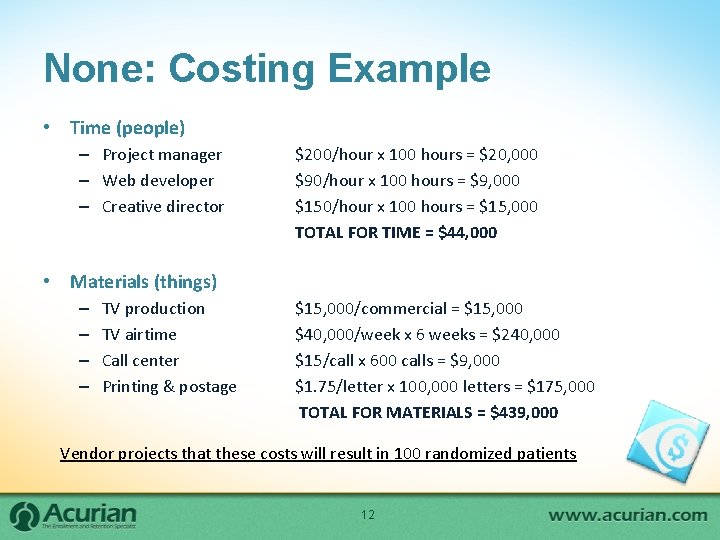
None: Costing Example • Time (people) – Project manager – Web developer – Creative director $200/hour x 100 hours = $20, 000 $90/hour x 100 hours = $9, 000 $150/hour x 100 hours = $15, 000 TOTAL FOR TIME = $44, 000 • Materials (things) – – TV production TV airtime Call center Printing & postage $15, 000/commercial = $15, 000 $40, 000/week x 6 weeks = $240, 000 $15/call x 600 calls = $9, 000 $1. 75/letter x 100, 000 letters = $175, 000 TOTAL FOR MATERIALS = $439, 000 Vendor projects that these costs will result in 100 randomized patients 12
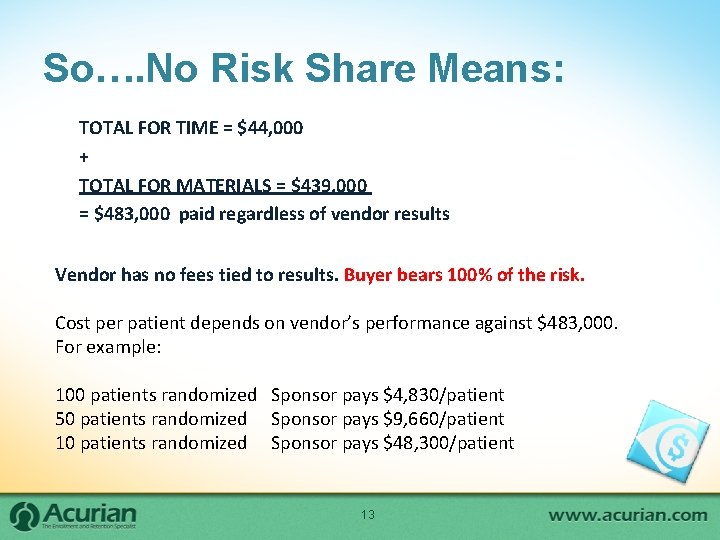
So…. No Risk Share Means: TOTAL FOR TIME = $44, 000 + TOTAL FOR MATERIALS = $439, 000 = $483, 000 paid regardless of vendor results Vendor has no fees tied to results. Buyer bears 100% of the risk. Cost per patient depends on vendor’s performance against $483, 000. For example: 100 patients randomized Sponsor pays $4, 830/patient 50 patients randomized Sponsor pays $9, 660/patient 10 patients randomized Sponsor pays $48, 300/patient 13
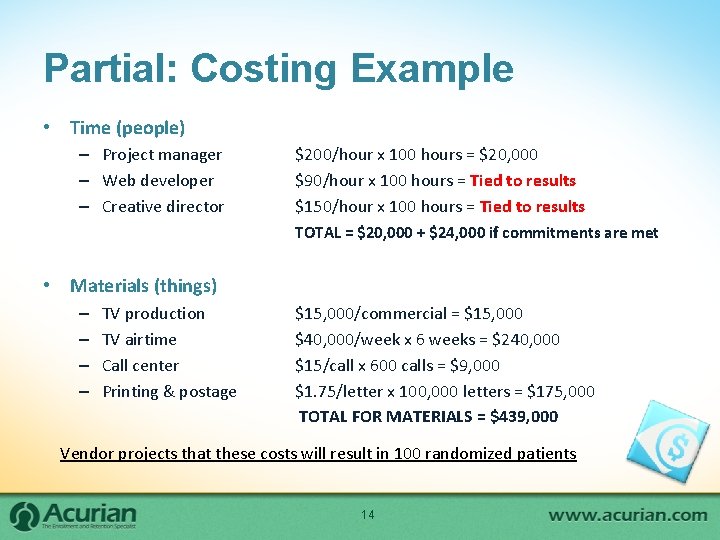
Partial: Costing Example • Time (people) – Project manager – Web developer – Creative director $200/hour x 100 hours = $20, 000 $90/hour x 100 hours = Tied to results $150/hour x 100 hours = Tied to results TOTAL = $20, 000 + $24, 000 if commitments are met • Materials (things) – – TV production TV airtime Call center Printing & postage $15, 000/commercial = $15, 000 $40, 000/week x 6 weeks = $240, 000 $15/call x 600 calls = $9, 000 $1. 75/letter x 100, 000 letters = $175, 000 TOTAL FOR MATERIALS = $439, 000 Vendor projects that these costs will result in 100 randomized patients 14
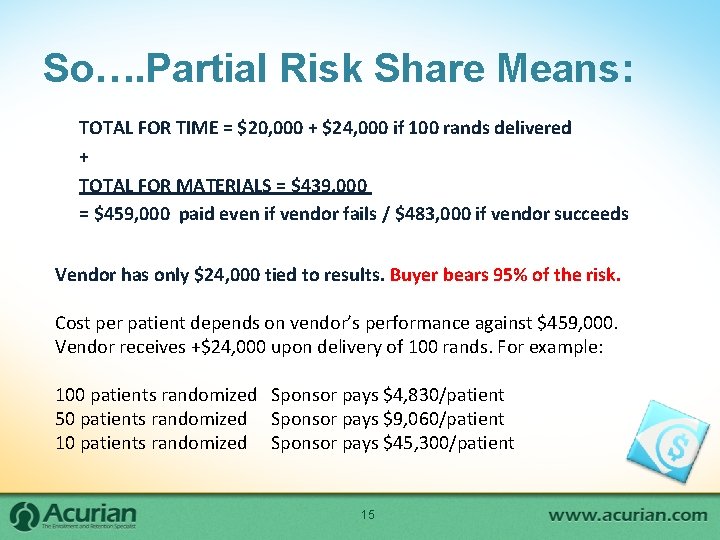
So…. Partial Risk Share Means: TOTAL FOR TIME = $20, 000 + $24, 000 if 100 rands delivered + TOTAL FOR MATERIALS = $439, 000 = $459, 000 paid even if vendor fails / $483, 000 if vendor succeeds Vendor has only $24, 000 tied to results. Buyer bears 95% of the risk. Cost per patient depends on vendor’s performance against $459, 000. Vendor receives +$24, 000 upon delivery of 100 rands. For example: 100 patients randomized Sponsor pays $4, 830/patient 50 patients randomized Sponsor pays $9, 060/patient 10 patients randomized Sponsor pays $45, 300/patient 15
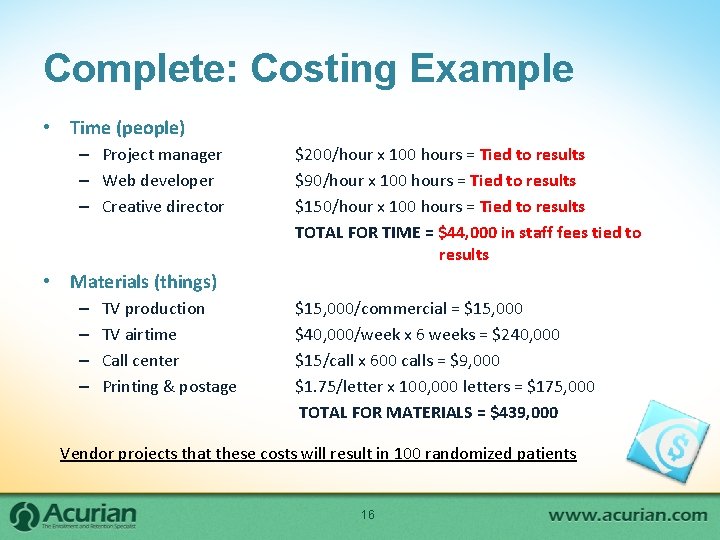
Complete: Costing Example • Time (people) – Project manager – Web developer – Creative director $200/hour x 100 hours = Tied to results $90/hour x 100 hours = Tied to results $150/hour x 100 hours = Tied to results TOTAL FOR TIME = $44, 000 in staff fees tied to results • Materials (things) – – TV production TV airtime Call center Printing & postage $15, 000/commercial = $15, 000 $40, 000/week x 6 weeks = $240, 000 $15/call x 600 calls = $9, 000 $1. 75/letter x 100, 000 letters = $175, 000 TOTAL FOR MATERIALS = $439, 000 Vendor projects that these costs will result in 100 randomized patients 16
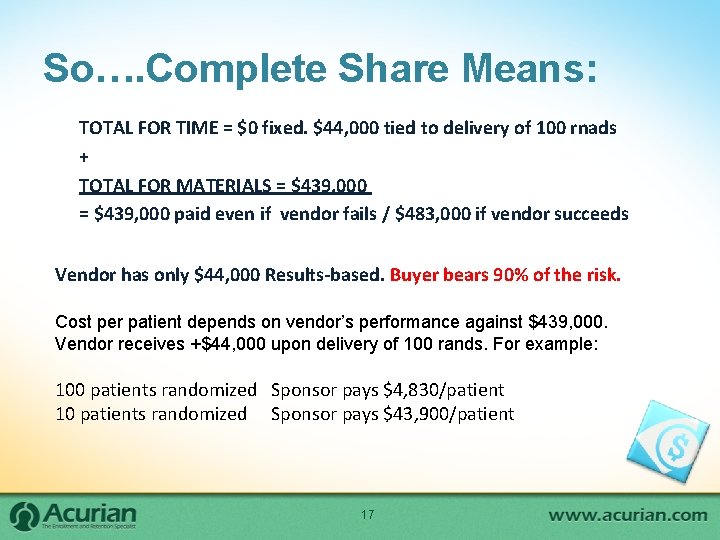
So…. Complete Share Means: TOTAL FOR TIME = $0 fixed. $44, 000 tied to delivery of 100 rnads + TOTAL FOR MATERIALS = $439, 000 paid even if vendor fails / $483, 000 if vendor succeeds Vendor has only $44, 000 Results-based. Buyer bears 90% of the risk. Cost per patient depends on vendor’s performance against $439, 000. Vendor receives +$44, 000 upon delivery of 100 rands. For example: 100 patients randomized Sponsor pays $4, 830/patient 10 patients randomized Sponsor pays $43, 900/patient 17
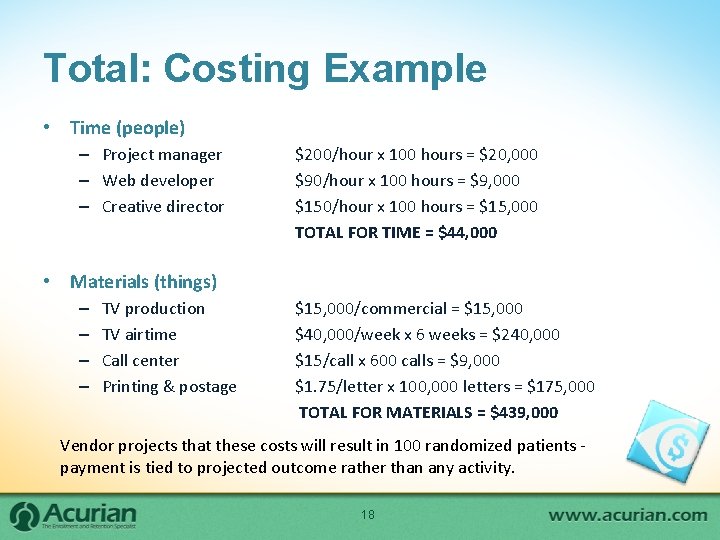
Total: Costing Example • Time (people) – Project manager – Web developer – Creative director $200/hour x 100 hours = $20, 000 $90/hour x 100 hours = $9, 000 $150/hour x 100 hours = $15, 000 TOTAL FOR TIME = $44, 000 • Materials (things) – – TV production TV airtime Call center Printing & postage $15, 000/commercial = $15, 000 $40, 000/week x 6 weeks = $240, 000 $15/call x 600 calls = $9, 000 $1. 75/letter x 100, 000 letters = $175, 000 TOTAL FOR MATERIALS = $439, 000 Vendor projects that these costs will result in 100 randomized patients payment is tied to projected outcome rather than any activity. 18
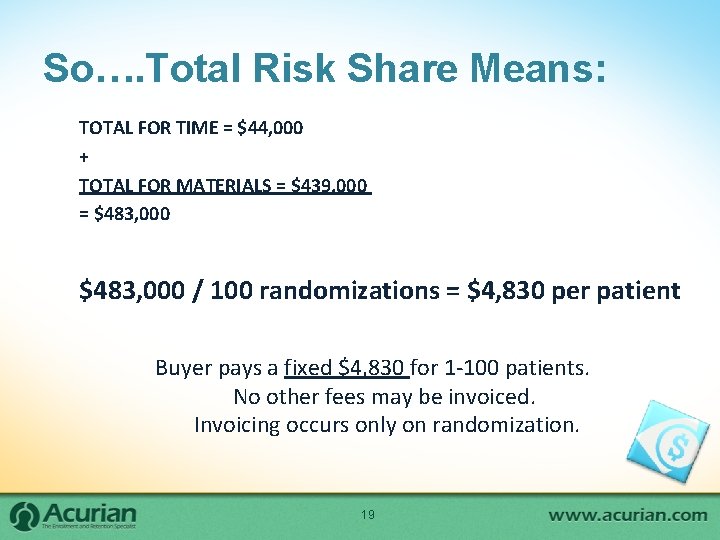
So…. Total Risk Share Means: TOTAL FOR TIME = $44, 000 + TOTAL FOR MATERIALS = $439, 000 = $483, 000 / 100 randomizations = $4, 830 per patient Buyer pays a fixed $4, 830 for 1 -100 patients. No other fees may be invoiced. Invoicing occurs only on randomization. 19
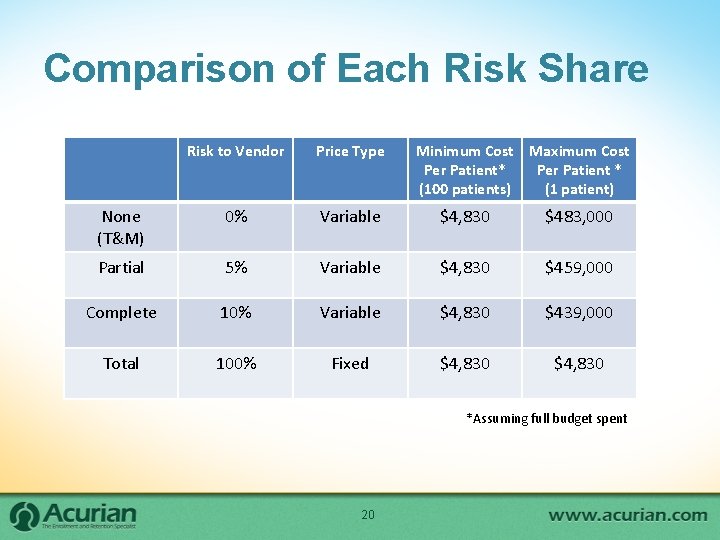
Comparison of Each Risk Share Risk to Vendor Price Type Minimum Cost Maximum Cost Per Patient* Per Patient * (100 patients) (1 patient) None (T&M) 0% Variable $4, 830 $483, 000 Partial 5% Variable $4, 830 $459, 000 Complete 10% Variable $4, 830 $439, 000 Total 100% Fixed $4, 830 *Assuming full budget spent 20
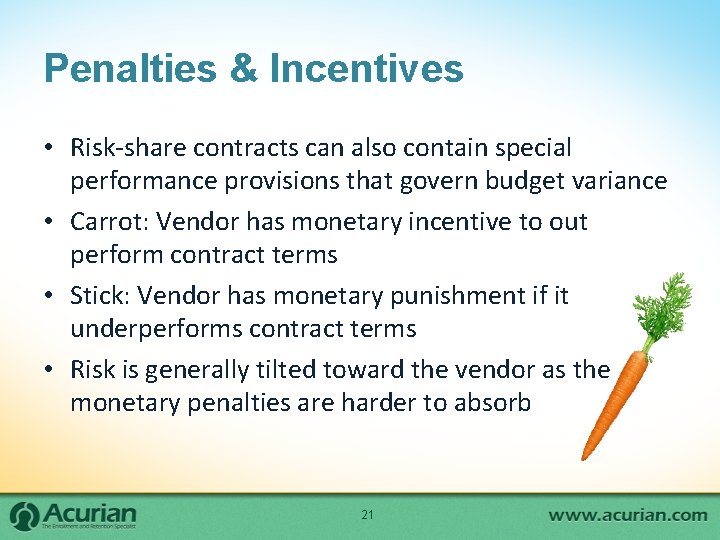
Penalties & Incentives • Risk-share contracts can also contain special performance provisions that govern budget variance • Carrot: Vendor has monetary incentive to out perform contract terms • Stick: Vendor has monetary punishment if it underperforms contract terms • Risk is generally tilted toward the vendor as the monetary penalties are harder to absorb 21
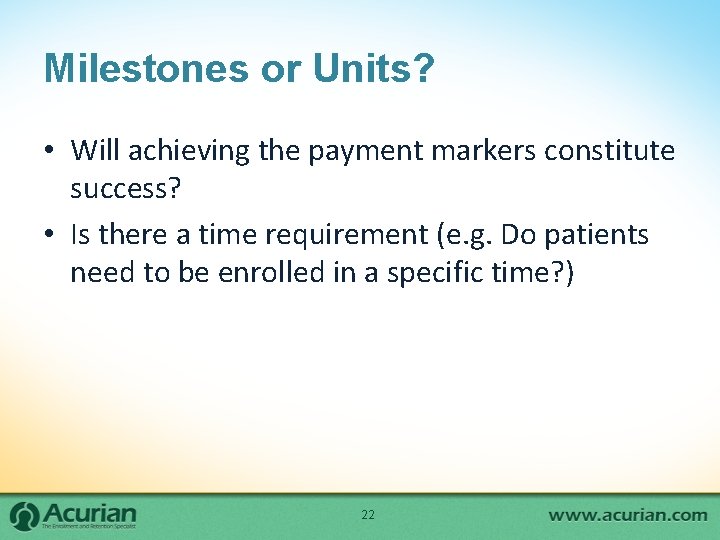
Milestones or Units? • Will achieving the payment markers constitute success? • Is there a time requirement (e. g. Do patients need to be enrolled in a specific time? ) 22
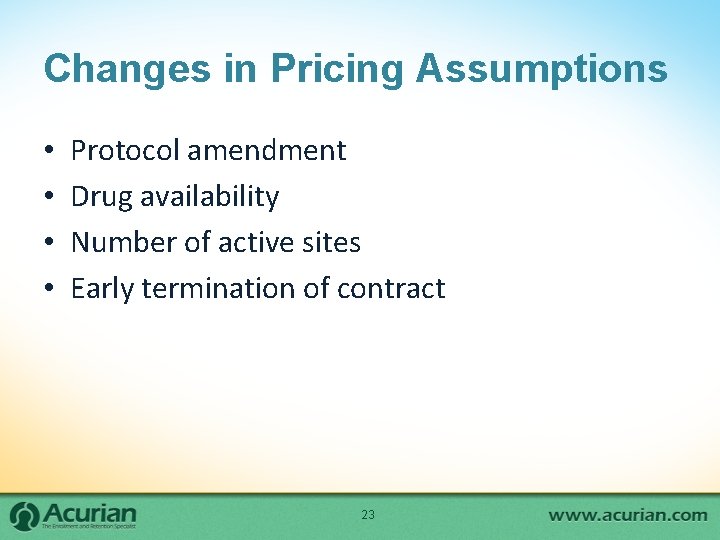
Changes in Pricing Assumptions • • Protocol amendment Drug availability Number of active sites Early termination of contract 23
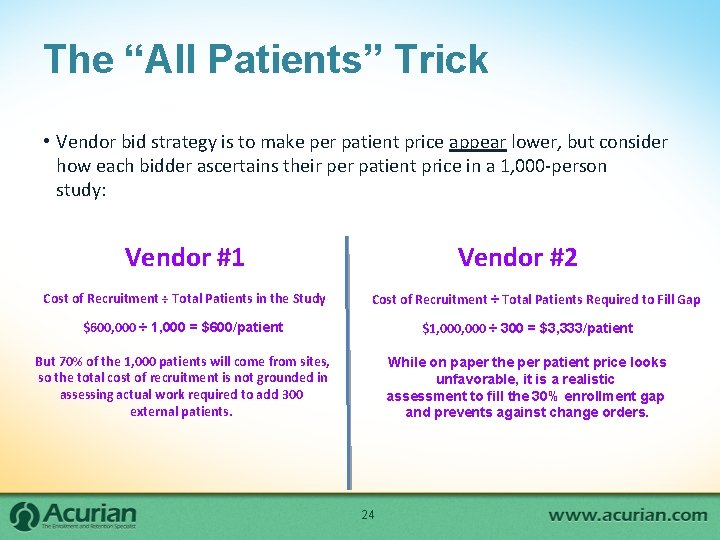
The “All Patients” Trick • Vendor bid strategy is to make per patient price appear lower, but consider how each bidder ascertains their per patient price in a 1, 000 -person study: Vendor #1 Cost of Recruitment ÷ Total Patients in the Study Vendor #2 Cost of Recruitment ÷ Total Patients Required to Fill Gap $600, 000 ÷ 1, 000 = $600/patient $1, 000 ÷ 300 = $3, 333/patient But 70% of the 1, 000 patients will come from sites, so the total cost of recruitment is not grounded in assessing actual work required to add 300 external patients. While on paper the per patient price looks unfavorable, it is a realistic assessment to fill the 30% enrollment gap and prevents against change orders. 24
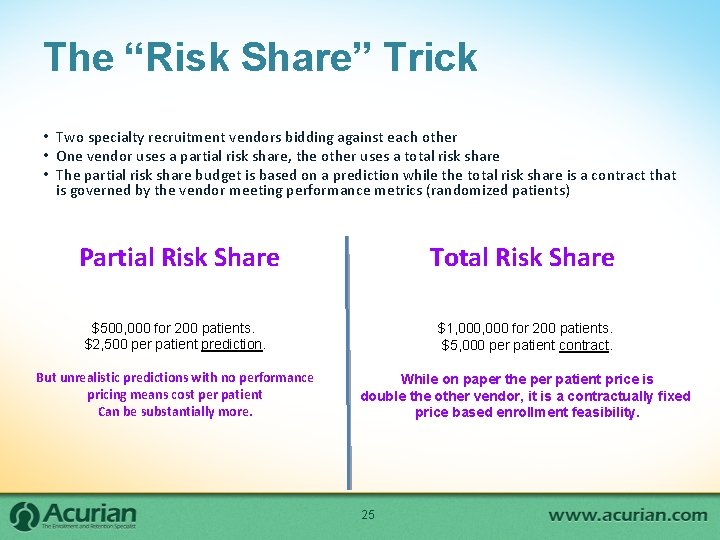
The “Risk Share” Trick • Two specialty recruitment vendors bidding against each other • One vendor uses a partial risk share, the other uses a total risk share • The partial risk share budget is based on a prediction while the total risk share is a contract that is governed by the vendor meeting performance metrics (randomized patients) Partial Risk Share Total Risk Share $500, 000 for 200 patients. $2, 500 per patient prediction. $1, 000 for 200 patients. $5, 000 per patient contract. But unrealistic predictions with no performance pricing means cost per patient Can be substantially more. While on paper the per patient price is double the other vendor, it is a contractually fixed price based enrollment feasibility. 25
Conclusions • Risk sharing can be beneficial to both sponsors & vendors • Terms, conditions & units need to be well thought out • Patient enrollment contracts should consider both vendor costs & pass-through (to be apples-to-apples) • Consideration should be given to impact of changes in conditions or terms • Results-based pricing greatly improves outcomes for sponsors 26
Thank you.