
Risk Perception Disease Reporting and Cooperation with Emergency
- Slides: 44
Risk Perception, Disease Reporting, and Cooperation with Emergency Response: Foundations for Effective Risk Communication Dr. Amy Delgado April 2, 2014 * Any views expressed in this presentation represent the views of the author and not the views of USDA.
Presentation Outline • Risk Perception – Theory and drivers • Risk Perception and Producer Cooperation • Risk Perception and Texas Cattle Producers 2
Risk Perception THEORY AND DRIVERS 3
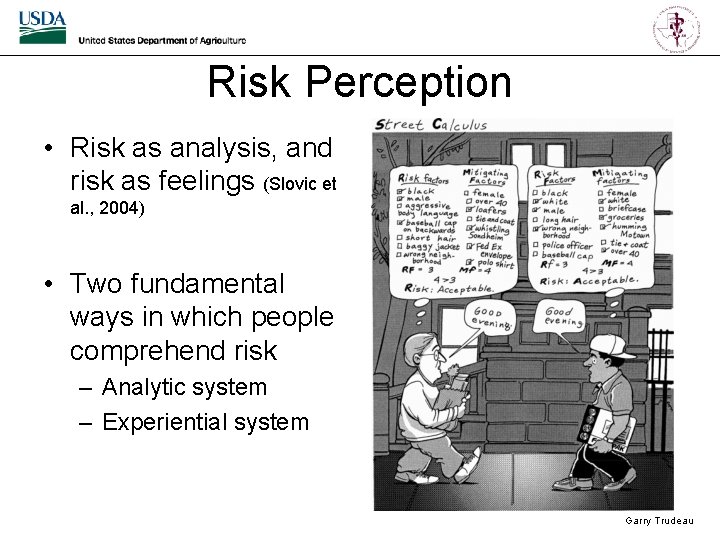
Risk Perception • Risk as analysis, and risk as feelings (Slovic et al. , 2004) • Two fundamental ways in which people comprehend risk – Analytic system – Experiential system Garry Trudeau
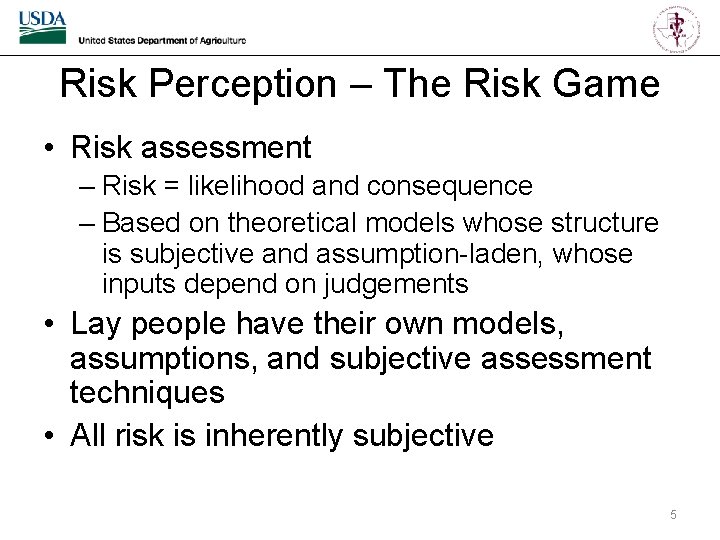
Risk Perception – The Risk Game • Risk assessment – Risk = likelihood and consequence – Based on theoretical models whose structure is subjective and assumption-laden, whose inputs depend on judgements • Lay people have their own models, assumptions, and subjective assessment techniques • All risk is inherently subjective 5
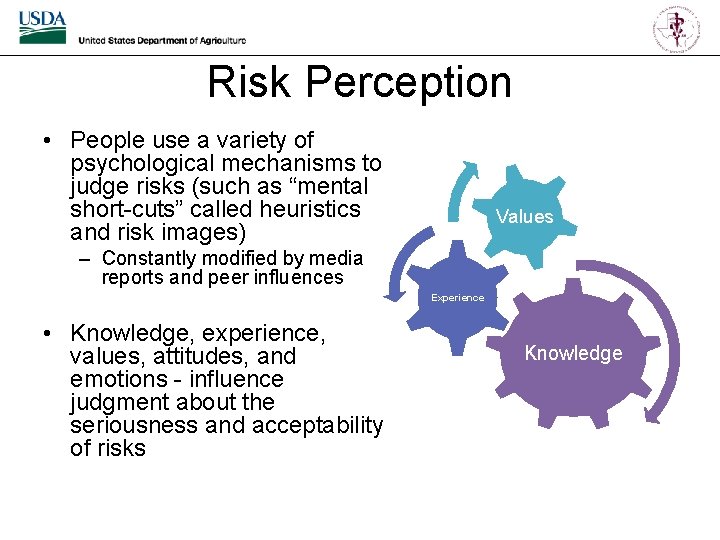
Risk Perception • People use a variety of psychological mechanisms to judge risks (such as “mental short-cuts” called heuristics and risk images) Values – Constantly modified by media reports and peer influences Experience • Knowledge, experience, values, attitudes, and emotions - influence judgment about the seriousness and acceptability of risks Knowledge
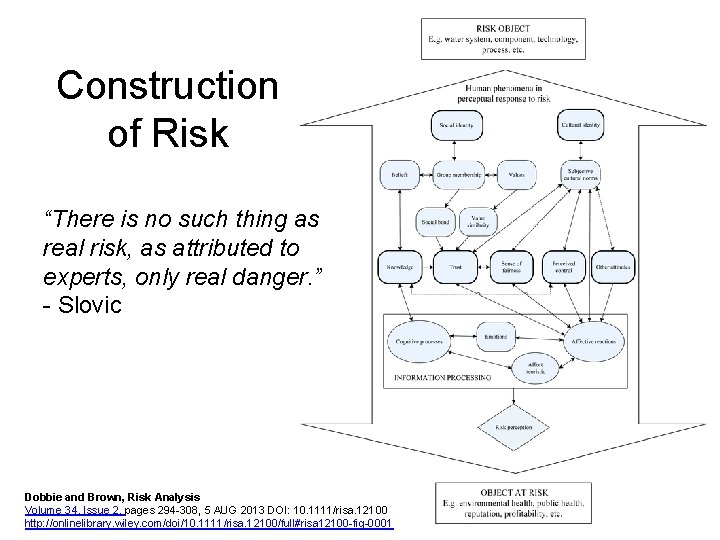
Construction of Risk “There is no such thing as real risk, as attributed to experts, only real danger. ” - Slovic Dobbie and Brown, Risk Analysis Volume 34, Issue 2, pages 294 -308, 5 AUG 2013 DOI: 10. 1111/risa. 12100 http: //onlinelibrary. wiley. com/doi/10. 1111/risa. 12100/full#risa 12100 -fig-0001
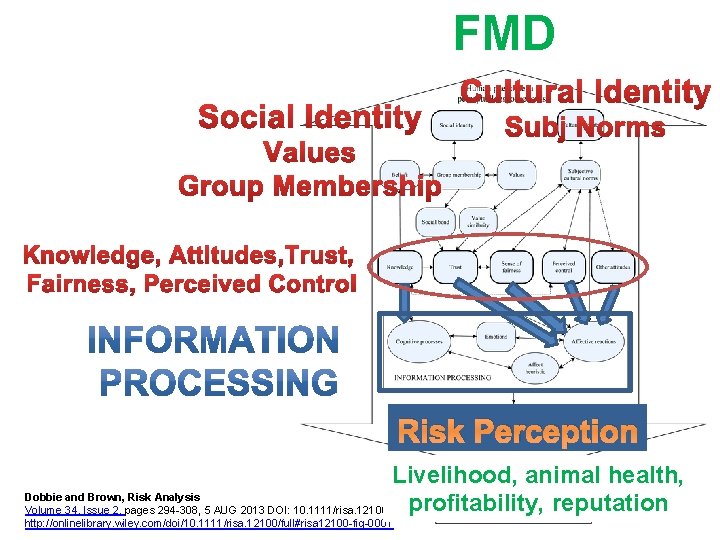
FMD Risk Perception Livelihood, animal health, Dobbie and Brown, Risk Analysis profitability, reputation Volume 34, Issue 2, pages 294 -308, 5 AUG 2013 DOI: 10. 1111/risa. 12100 http: //onlinelibrary. wiley. com/doi/10. 1111/risa. 12100/full#risa 12100 -fig-0001
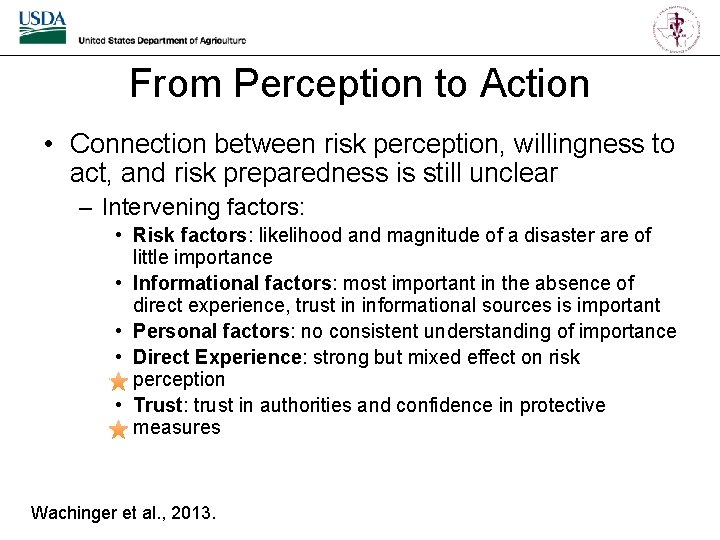
From Perception to Action • Connection between risk perception, willingness to act, and risk preparedness is still unclear – Intervening factors: • Risk factors: likelihood and magnitude of a disaster are of little importance • Informational factors: most important in the absence of direct experience, trust in informational sources is important • Personal factors: no consistent understanding of importance • Direct Experience: strong but mixed effect on risk perception • Trust: trust in authorities and confidence in protective measures Wachinger et al. , 2013.
The Effect of Trust • Second most important factor affecting risk perception • Trust: “Trust is a psychological state comprising the intention to accept vulnerability based upon positive expectations of the intentions or behavior of another. ” • Trust vs confidence (calculative trust) – Trust is resilient – Confidence is fragile Wachinger et al. , 2013.
Risk Perception PRODUCER COOPERATION 11
How much does it matter? • CSF reporting in the Netherlands: – farmers´ negative opinions of disease control measures, negative emotions associated with going through the reporting process such as guilt or shame, and a lack of trust in government bodies (Elbers et al. , 2010)
How much does it matter? • Australian sheep farmers: – found that farmers´ decisions regarding reporting and biosecurity measures were often based on the perceived risk to their operation, and that trust in others contributed significantly to perceived risk (Palmer et al. , 2009) 13
How much does it matter? • UK cattle and sheep farmers´ attitudes and beliefs regarding biosecurity and current/proposed disease prevention and control legislation: – <50% of the farmers indicated that the recommended biosecurity measures were desirable (Heffernan et al. , 2008) • the distrust of government bodies led farmers to perceive government-derived messages as untrustworthy or lacking in credibility • dismissive of biosecurity measures, in part because they felt the blame foreign diseases was largely related to ineffective regulations and inadequate border control, rather than to farm management practices they could actually influence 14
Risk Perception TEXAS CATTLE PRODUCERS 15
Predicting Producer Behavior • The Social Context of FMD control in Texas – Qualitative phase: Delgado, et al. , 2012. – Quantitative phase: • Mail out survey: two separate, disproportionate, stratified random samples of approximately 2000 cowcalf producers were selected based on herd size and NASS district • Analysis of survey results using ordinal logistic regression models to determine factors with the greatest influence on behavior
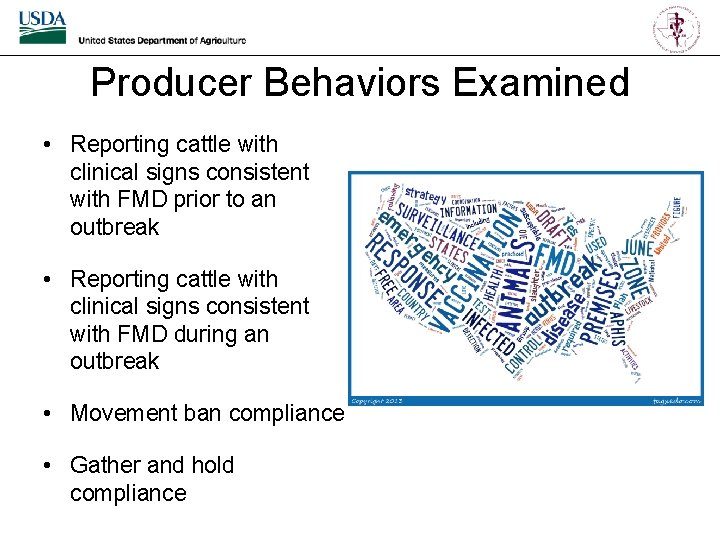
Producer Behaviors Examined • Reporting cattle with clinical signs consistent with FMD prior to an outbreak • Reporting cattle with clinical signs consistent with FMD during an outbreak • Movement ban compliance • Gather and hold compliance
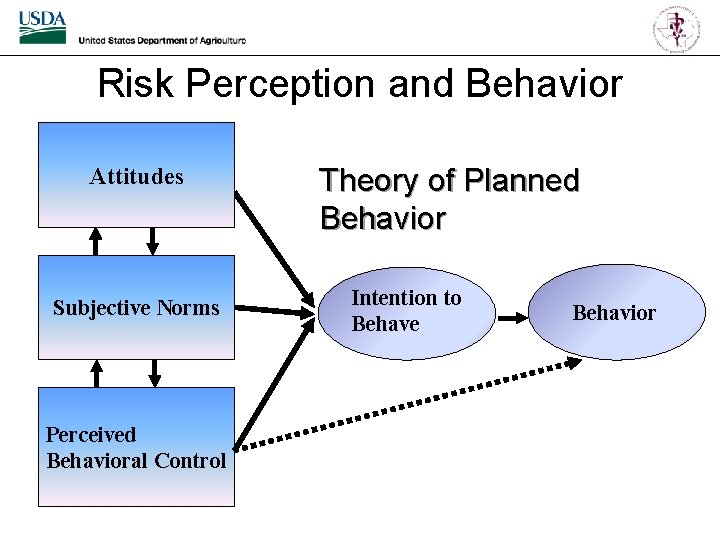
Risk Perception and Behavior Attitudes Subjective Norms Perceived Behavioral Control Theory of Planned Behavior Intention to Behave Behavior
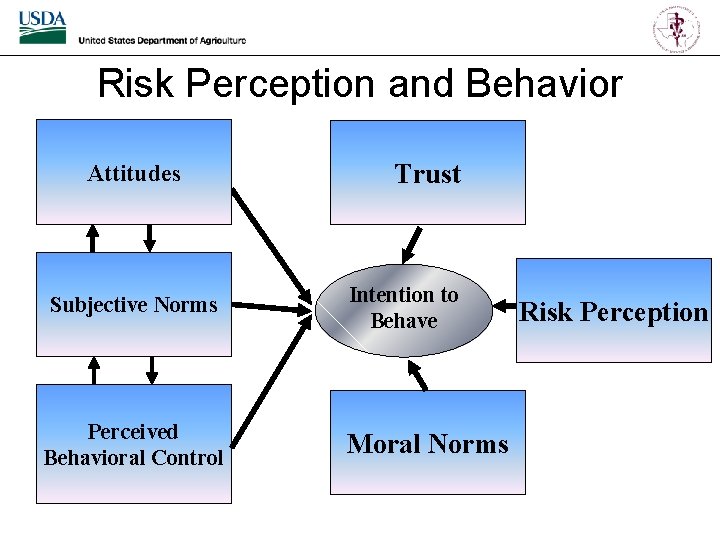
Risk Perception and Behavior Attitudes Subjective Norms Perceived Behavioral Control Trust Intention to Behave Moral Norms Risk Perception
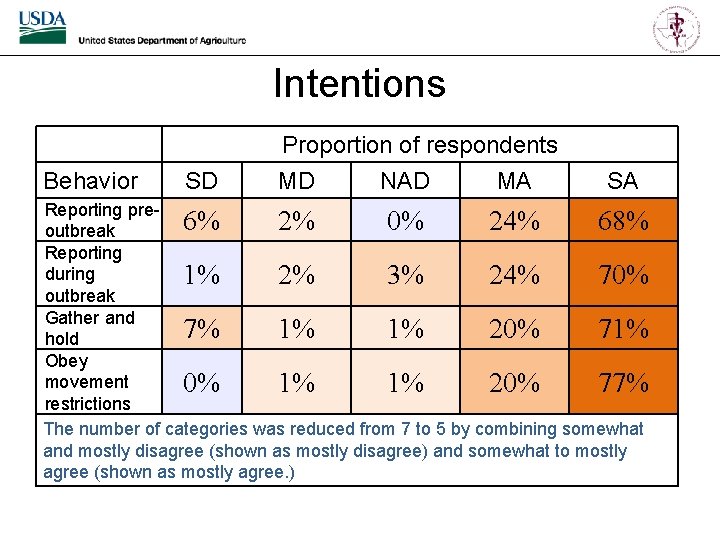
Intentions Behavior SD Proportion of respondents MD NAD MA SA Reporting pre 6% 2% 0% 24% 68% outbreak Reporting during 1% 2% 3% 24% 70% outbreak Gather and 7% 1% 1% 20% 71% hold Obey movement 0% 1% 1% 20% 77% restrictions The number of categories was reduced from 7 to 5 by combining somewhat and mostly disagree (shown as mostly disagree) and somewhat to mostly agree (shown as mostly agree. )
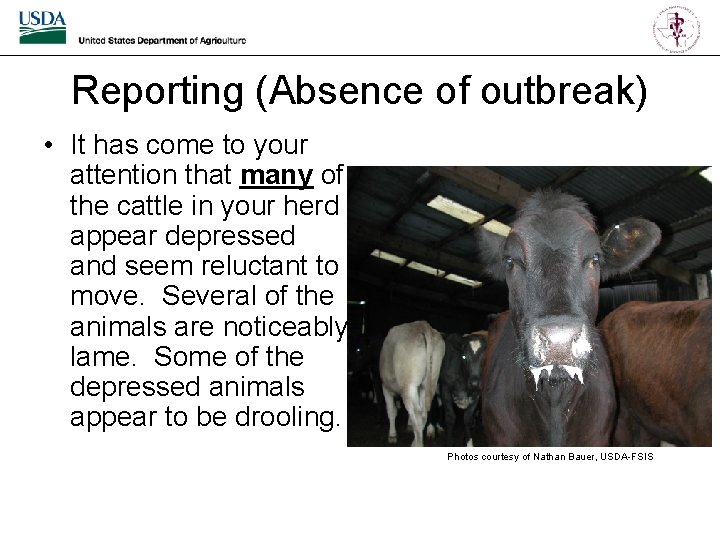
Reporting (Absence of outbreak) • It has come to your attention that many of the cattle in your herd appear depressed and seem reluctant to move. Several of the animals are noticeably lame. Some of the depressed animals appear to be drooling. Photos courtesy of Nathan Bauer, USDA-FSIS
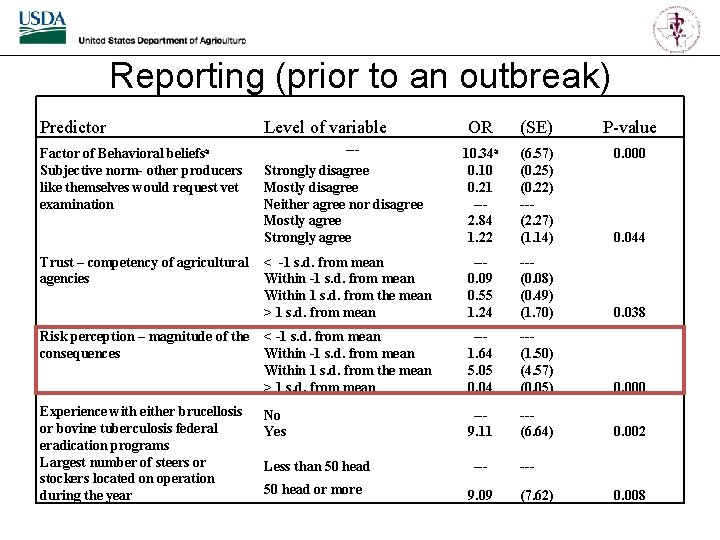
Reporting (prior to an outbreak) Predictor Level of variable OR (SE) P-value Factor of Behavioral beliefsa Subjective norm- other producers like themselves would request vet examination --Strongly disagree Mostly disagree Neither agree nor disagree Mostly agree Strongly agree 10. 34 a 0. 10 0. 21 --2. 84 1. 22 (6. 57) (0. 25) (0. 22) --(2. 27) (1. 14) 0. 000 Trust – competency of agricultural < -1 s. d. from mean Within -1 s. d. from mean agencies Within 1 s. d. from the mean > 1 s. d. from mean --0. 09 0. 55 1. 24 --(0. 08) (0. 49) (1. 70) 0. 038 Risk perception – magnitude of the < -1 s. d. from mean Within -1 s. d. from mean consequences Within 1 s. d. from the mean > 1 s. d. from mean --1. 64 5. 05 0. 04 --(1. 50) (4. 57) (0. 05) 0. 000 Experience with either brucellosis or bovine tuberculosis federal eradication programs Largest number of steers or stockers located on operation during the year --9. 11 --(6. 64) 0. 002 No Yes Less than 50 head or more --9. 09 0. 044 --(7. 62) 0. 008
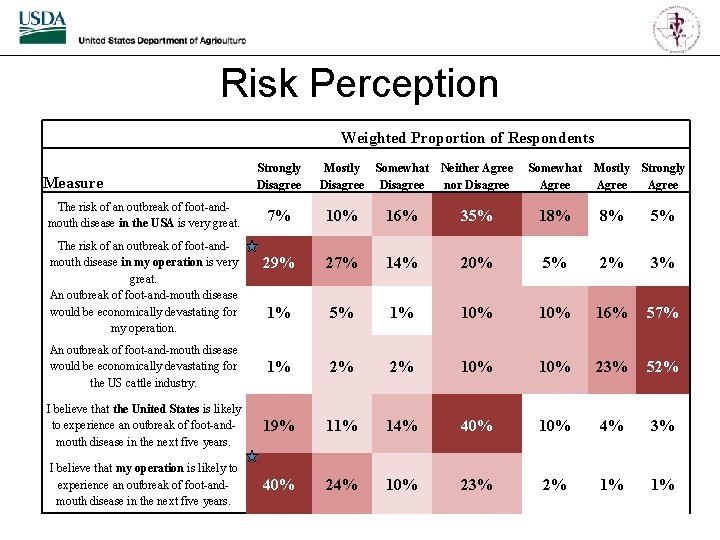
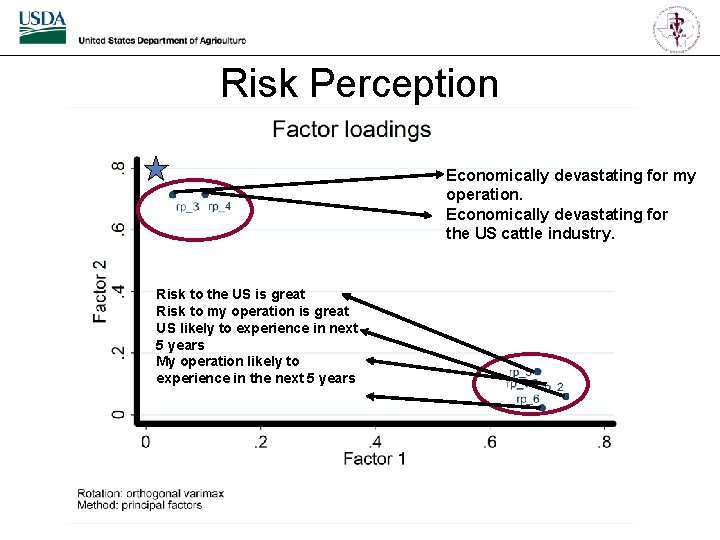
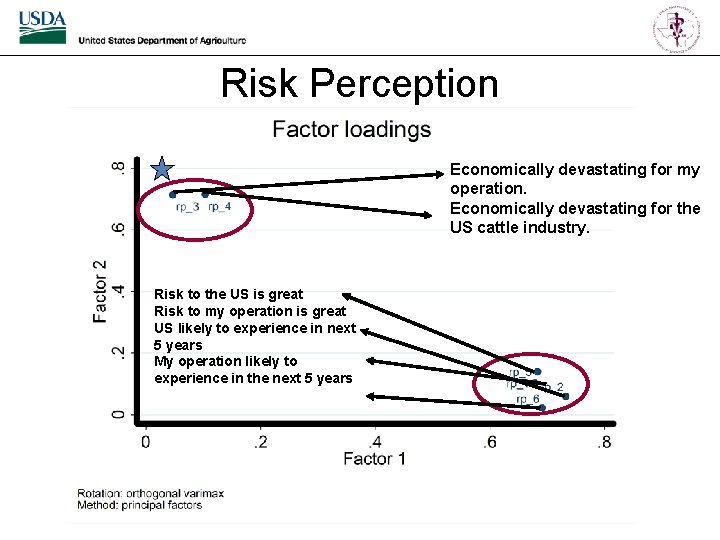
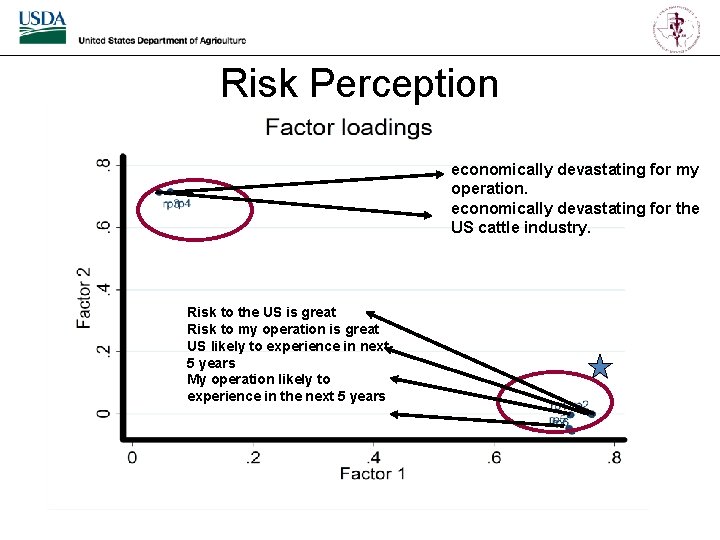
Risk Perception Measure The risk of an outbreak of foot-andmouth disease in the USA is very great. Weighted Proportion of Respondents Strongly Disagree Mostly Somewhat Neither Agree Disagree nor Disagree Somewhat Mostly Strongly Agree 7% 10% 16% 35% 18% 8% 5% 29% 27% 14% 20% 5% 2% 3% 1% 5% 1% 10% 16% 57% An outbreak of foot-and-mouth disease would be economically devastating for the US cattle industry. 1% 2% 2% 10% 23% 52% I believe that the United States is likely to experience an outbreak of foot-andmouth disease in the next five years. 19% 11% 14% 40% 10% 4% 3% I believe that my operation is likely to experience an outbreak of foot-andmouth disease in the next five years. 40% 24% 10% 23% 2% 1% 1% The risk of an outbreak of foot-andmouth disease in my operation is very great. An outbreak of foot-and-mouth disease would be economically devastating for my operation.
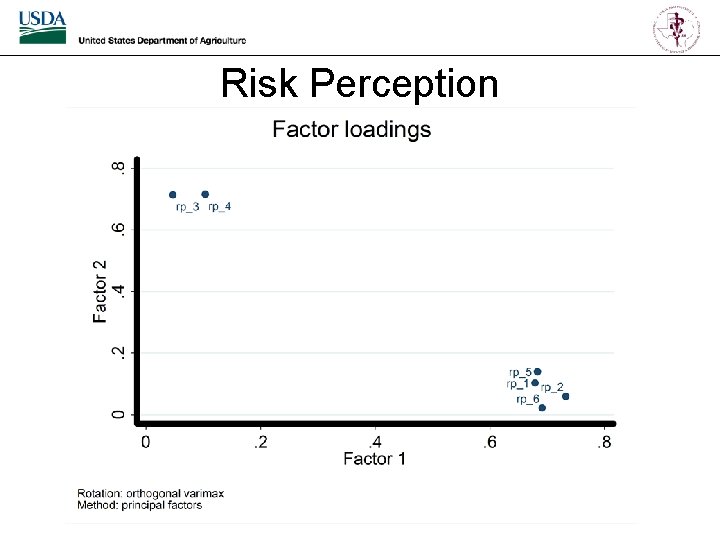
Risk Perception
Risk Perception Economically devastating for my operation. Economically devastating for the US cattle industry. Risk to the US is great Risk to my operation is great US likely to experience in next 5 years My operation likely to experience in the next 5 years
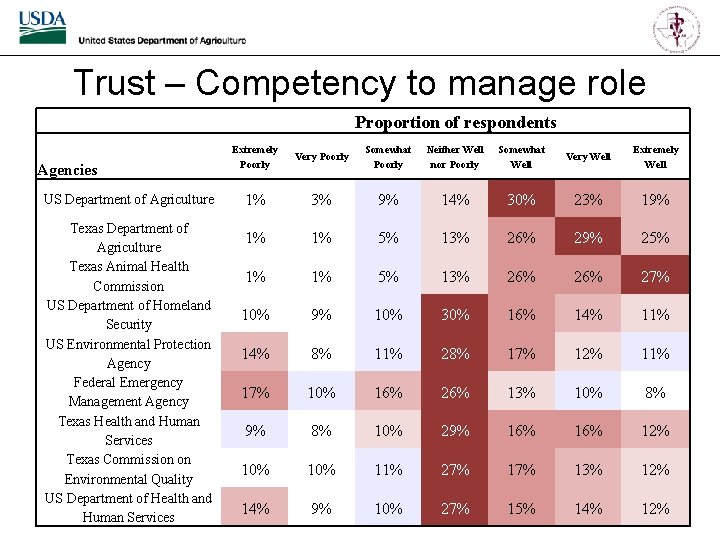
Trust – Competency to manage role Proportion of respondents Agencies US Department of Agriculture Texas Animal Health Commission US Department of Homeland Security US Environmental Protection Agency Federal Emergency Management Agency Texas Health and Human Services Texas Commission on Environmental Quality US Department of Health and Human Services Extremely Poorly Very Poorly Somewhat Poorly Neither Well nor Poorly Somewhat Well Very Well Extremely Well 1% 3% 9% 14% 30% 23% 19% 1% 1% 5% 13% 26% 29% 25% 1% 1% 5% 13% 26% 27% 10% 9% 10% 30% 16% 14% 11% 14% 8% 11% 28% 17% 12% 11% 17% 10% 16% 26% 13% 10% 8% 9% 8% 10% 29% 16% 12% 10% 11% 27% 13% 12% 14% 9% 10% 27% 15% 14% 12%
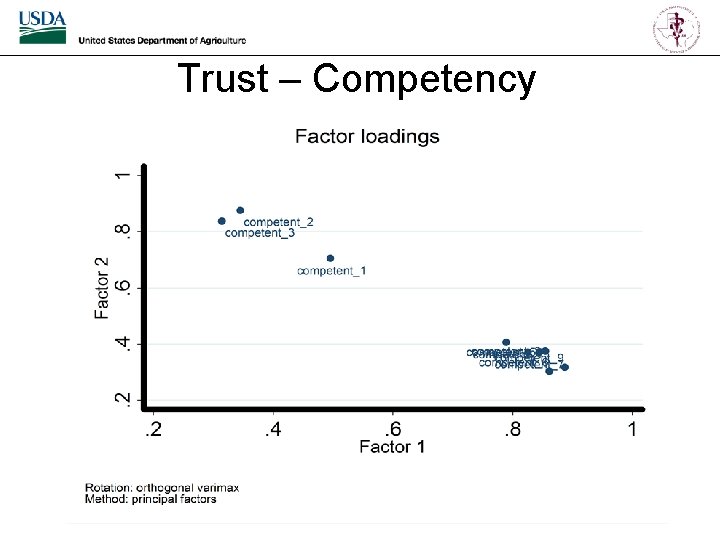
Trust – Competency
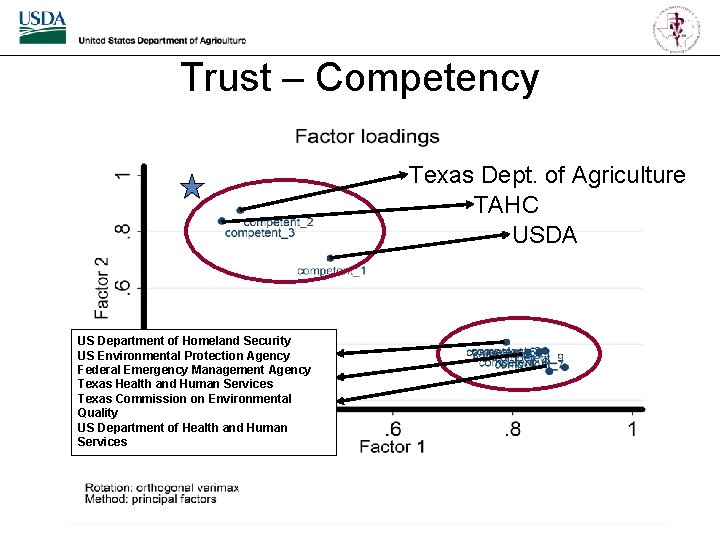
Trust – Competency Texas Dept. of Agriculture TAHC USDA US Department of Homeland Security US Environmental Protection Agency Federal Emergency Management Agency Texas Health and Human Services Texas Commission on Environmental Quality US Department of Health and Human Services
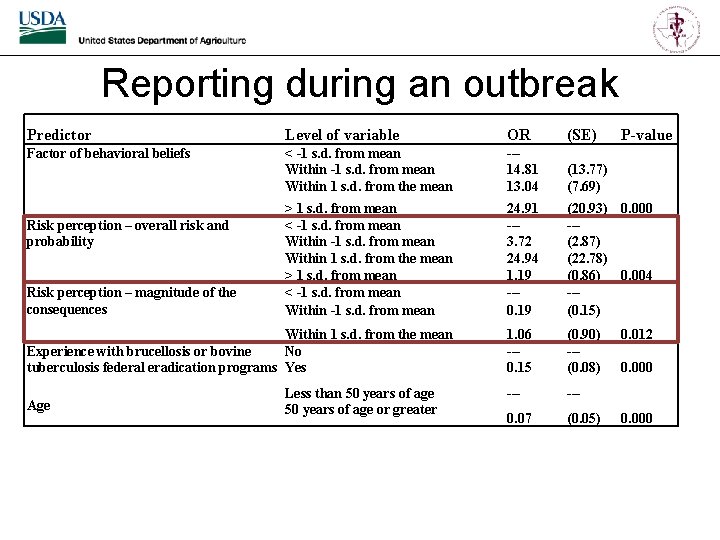
Reporting during an outbreak Predictor Level of variable OR (SE) Factor of behavioral beliefs < -1 s. d. from mean Within 1 s. d. from the mean --14. 81 13. 04 (13. 77) (7. 69) > 1 s. d. from mean < -1 s. d. from mean Within 1 s. d. from the mean > 1 s. d. from mean < -1 s. d. from mean Within -1 s. d. from mean 24. 91 --3. 72 24. 94 1. 19 --0. 19 (20. 93) 0. 000 --(2. 87) (22. 78) (0. 86) 0. 004 --(0. 15) 1. 06 --0. 15 (0. 90) --(0. 08) --- 0. 07 (0. 05) Risk perception – overall risk and probability Risk perception – magnitude of the consequences Within 1 s. d. from the mean Experience with brucellosis or bovine No tuberculosis federal eradication programs Yes Age Less than 50 years of age or greater P-value 0. 012 0. 000
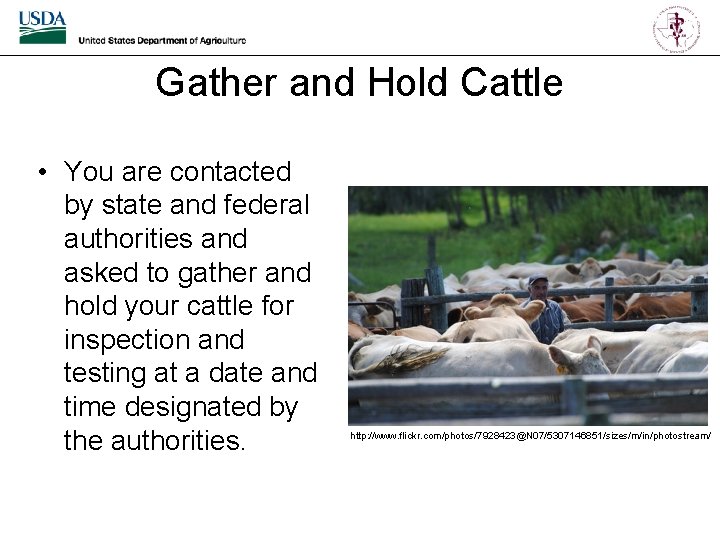
Gather and Hold Cattle • You are contacted by state and federal authorities and asked to gather and hold your cattle for inspection and testing at a date and time designated by the authorities. http: //www. flickr. com/photos/7928423@N 07/5307146851/sizes/m/in/photostream/
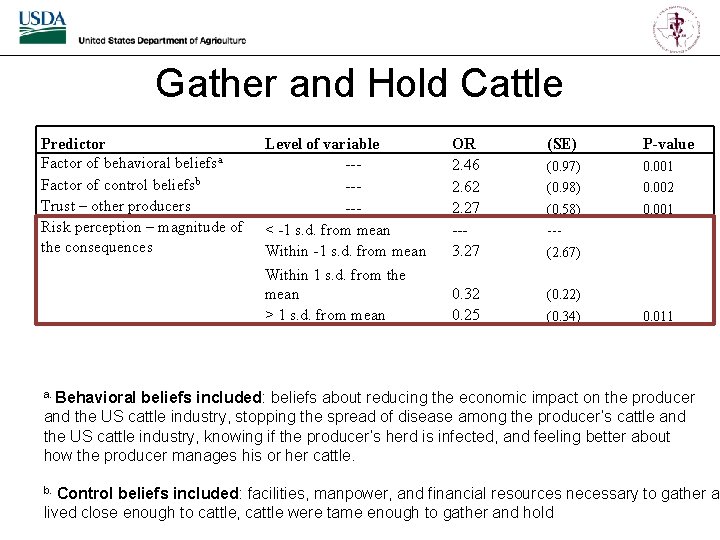
Gather and Hold Cattle Predictor Factor of behavioral beliefsa Factor of control beliefsb Trust – other producers Risk perception – magnitude of the consequences Level of variable ------< -1 s. d. from mean Within 1 s. d. from the mean > 1 s. d. from mean OR 2. 46 2. 62 2. 27 --3. 27 (SE) P-value (0. 97) 0. 001 (0. 98) 0. 002 (0. 58) 0. 001 0. 32 0. 25 (0. 22) --(2. 67) (0. 34) 0. 011 a. Behavioral beliefs included: beliefs about reducing the economic impact on the producer and the US cattle industry, stopping the spread of disease among the producer’s cattle and the US cattle industry, knowing if the producer’s herd is infected, and feeling better about how the producer manages his or her cattle. Control beliefs included: facilities, manpower, and financial resources necessary to gather an lived close enough to cattle, cattle were tame enough to gather and hold b.
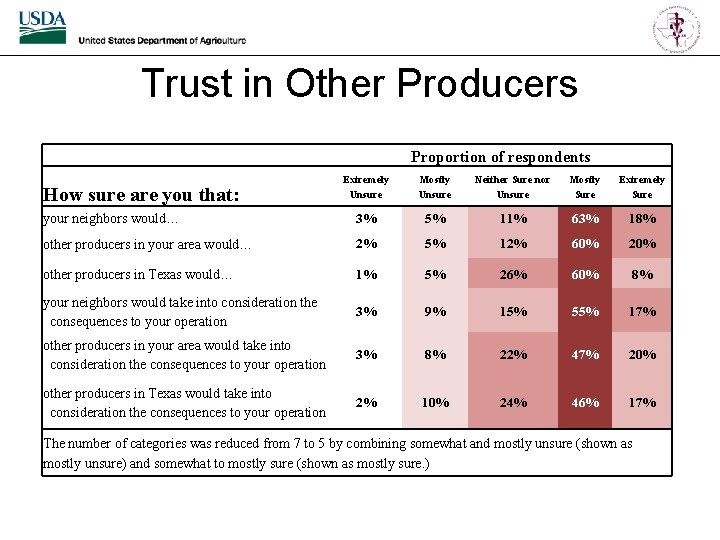
Trust in Other Producers Proportion of respondents Extremely Unsure Mostly Unsure Neither Sure nor Unsure your neighbors would… 3% 5% 11% 63% 18% other producers in your area would… 2% 5% 12% 60% 20% other producers in Texas would… 1% 5% 26% 60% 8% your neighbors would take into consideration the consequences to your operation 3% 9% 15% 55% 17% other producers in your area would take into consideration the consequences to your operation 3% 8% 22% 47% 20% other producers in Texas would take into consideration the consequences to your operation 2% 10% 24% 46% 17% How sure are you that: Mostly Extremely Sure The number of categories was reduced from 7 to 5 by combining somewhat and mostly unsure (shown as mostly unsure) and somewhat to mostly sure (shown as mostly sure. )
Risk Perception Economically devastating for my operation. Economically devastating for the US cattle industry. Risk to the US is great Risk to my operation is great US likely to experience in next 5 years My operation likely to experience in the next 5 years
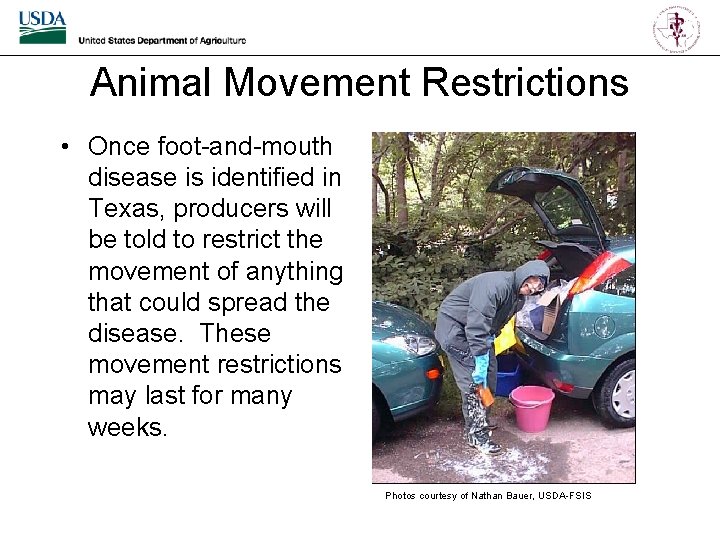
Animal Movement Restrictions • Once foot-and-mouth disease is identified in Texas, producers will be told to restrict the movement of anything that could spread the disease. These movement restrictions may last for many weeks. Photos courtesy of Nathan Bauer, USDA-FSIS
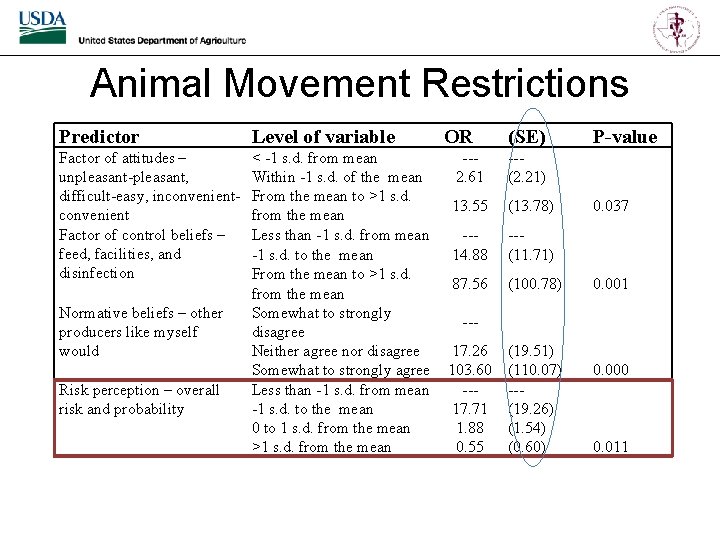
Animal Movement Restrictions Predictor Level of variable Factor of attitudes – unpleasant-pleasant, difficult-easy, inconvenient Factor of control beliefs – feed, facilities, and disinfection < -1 s. d. from mean Within -1 s. d. of the mean From the mean to >1 s. d. from the mean Less than -1 s. d. from mean -1 s. d. to the mean From the mean to >1 s. d. from the mean Somewhat to strongly disagree Neither agree nor disagree Somewhat to strongly agree Less than -1 s. d. from mean -1 s. d. to the mean 0 to 1 s. d. from the mean >1 s. d. from the mean Normative beliefs – other producers like myself would Risk perception – overall risk and probability OR (SE) --2. 61 --(2. 21) 13. 55 (13. 78) --14. 88 --(11. 71) 87. 56 (100. 78) P-value 0. 037 0. 001 --17. 26 103. 60 --17. 71 1. 88 0. 55 (19. 51) (110. 07) --(19. 26) (1. 54) (0. 60) 0. 000 0. 011
Risk Perception economically devastating for my operation. economically devastating for the US cattle industry. Risk to the US is great Risk to my operation is great US likely to experience in next 5 years My operation likely to experience in the next 5 years
Conclusions Related to Risk Perception • Increasing producers’ perception of the risk of FMD may not always lead to enhanced cooperation – Producers who view economic devastation as a potential outcome of an outbreak of FMD are more likely to report clinically suspect cattle. – However, if economic devastation is seen as a certainty, producers are less likely to report. Once an outbreak has been identified, increased risk perception related to overall risk, probability, and consequences, leads to increased reporting. – Increase risk perception results in decreased cooperation with requests to gather and hold cattle as well as movement restrictions.
Conclusions Related to Risk Perception “While fear may be the emotion most conducive to action, hopelessness can lead to inaction. ” – Peter Sandman 38
References • • Slovic et al. , 2004. Risk as analysis and risk as feelings: some thoughts about affect, reason, risk and rationality. Risk Analysis 24: 2, 311 -322. Dobbie and Brown, 2014. A framework for understanding risk perception, explored from the perspective of the water practitioner. Risk Analysis 34: 2, 294 -308. Wachinger et al. , 2013. The risk perception paradox – Implications for governance and communication of natural hazards. Risk Analysis 33: 6, 1049 -1065. Elbers et al. , 2010. A socio-psychological investigation into limitations and incentives concerning reporting a clinically suspect situation aimed at improving early detection of classical swine fever outbreaks. Vet Microbiol 142, 108 -118. Palmer et al. , 2009. The Effect of Trust on West Australian Farmers' Responses to Infectious Livestock Diseases. Sociol Ruralis 49, 360 -374. Heffernan et al. , 2008. An exploration of the drivers to bio-security collective action among a sample of UK cattle and sheep farmers. Prev Vet Med 87, 358 -372. Delgado et al. , 2012. Utilizing qualitative methods in survey design: examining Texas cattle producers’ intent to participate in foot-and-mouth disease control. Prev Vet Med 103: 120 -135.
Questions? Acknowledgements • Funding for this project was provided by a grant from the USDA - Cooperative State Research Extension and Education Service (CSREES). Award number: (2007 -5520417755) • Research Team: Bo Norby, H. Morgan Scott, Alex Mc. Intosh, Wesley Dean, Jenny Davis • Study Participants
Extra slides
Conclusions • Improving Reporting of Suspect Cases of FMD – Tailor risk communication messages and strategies to the specific situation. – Address beliefs about the consequences of reporting. – Raise awareness of the community consequences of FMD and the effects of disease outbreaks on “the average operation” in order to augment perceived pressure from the surrounding community and other producers for reporting of suspect cases of FMD. – Plan for and communicate plans for business continuity during an outbreak. Make information about compensation for herds widely available in order to reduce the perception that an outbreak is economically devastating for an operation.
Conclusions • Improving gathering and holding of cattle – Devote time and resources to communicating about the consequences (positive and negative) of gathering and holding cattle during an outbreak of FMD. – Openly acknowledge and sympathize with the negative consequences of gathering and holding cattle – Plan for and communicate the availability of resources to help with shortages of manpower, financial resources, and facilities to gather cattle. – Plan for and communicate plans for business continuity during an outbreak in order to inform producers´ perception of the risk. Make information about compensation widely available in order to reduce the perception that an outbreak is economically devastating for an operation. – On a local level, ask that high-trust, unbiased partners help to foster and maintain communication among the agricultural community.
Conclusions • Improving movement ban compliance – Help producers prepare for the consequences of movement restrictions in the early stages of an outbreak. – On a local level, ask that high-trust, unbiased partners help to foster and maintain communication among the agricultural community. – Plan for and communicate plans to help distribute feeds, maintain the availability of basic veterinary care, and allow for the movement of animals due to crowding or feed shortages, while avoiding the spread of the disease.