
Risk of bolus thrombolytics Shamir Mehta MD Director

Risk of bolus thrombolytics Shamir Mehta, MD Director, Coronary Care Unit Mc. Master University Medical Center Hamilton, Ontario Paul Armstrong, MD Professor of Medicine University of Alberta Hospital Edmonton, Alberta
Risk of bolus lytics Background Despite promising phase II studies, no bolus thrombolytic agent has demonstrated superior efficacy (reduced death/MI) compared with either TPA or SK These agents have been aggressively marketed as being “more convenient, ” despite no data showing that this impacts on clinical outcomes In the absence of efficacy, safety becomes critically important because there is no risk/benefit ratio to consider -Mehta
Risk of bolus lytics Intracranial hemorrhage Most feared complication of thrombolytic therapy A complication of treatment rather than of the underlying disease process Usually a risk-benefit tradeoff (TPA vs SK in GUSTO 1) No single bolus thrombolytic trial was adequately powered to detect a 30% excess in ICH. -Mehta

Risk of bolus lytics Power to detect ICH To detect a 30% excess in ICH: Assume ICH rate of 1% 2 groups, 1: 1 randomization, 90% power More than 50, 000 patients would be required in a single trial to reliably detect a 30% excess in ICH -Mehta
Risk of bolus lytics Plasma concentration (ng/ml) Increased peak blood levels of bolus agents Time (Minutes) Cannon et al. Circulation 1998; 98: 2805 -14
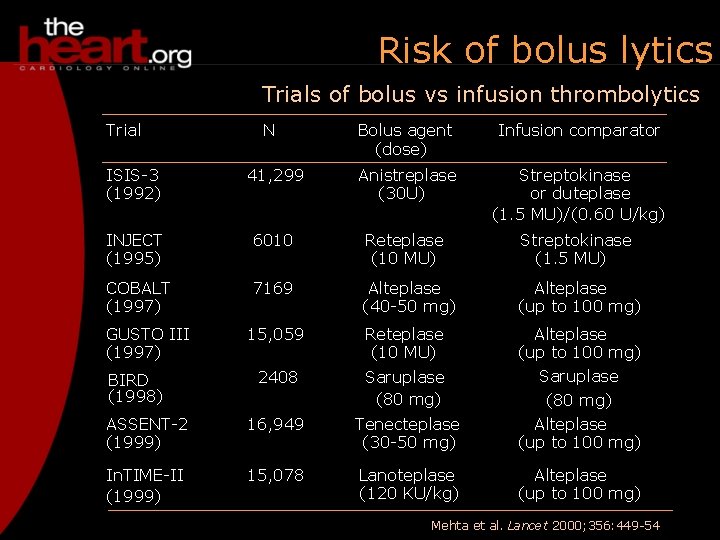
Risk of bolus lytics Trials of bolus vs infusion thrombolytics Trial N Bolus agent (dose) Infusion comparator ISIS-3 (1992) 41, 299 Anistreplase (30 U) Streptokinase or duteplase (1. 5 MU)/(0. 60 U/kg) INJECT (1995) 6010 Reteplase (10 MU) Streptokinase (1. 5 MU) COBALT (1997) 7169 Alteplase (40 -50 mg) Alteplase (up to 100 mg) 15, 059 Reteplase (10 MU) Alteplase (up to 100 mg) 2408 Saruplase (80 mg) ASSENT-2 (1999) 16, 949 Tenecteplase (30 -50 mg) Alteplase (up to 100 mg) In. TIME-II (1999) 15, 078 Lanoteplase (120 KU/kg) Alteplase (up to 100 mg) GUSTO III (1997) BIRD (1998) Mehta et al. Lancet 2000; 356: 449 -54

Risk of bolus lytics Bolus vs infusion: overall results N=103, 972 Outcome OR 95% CI P ICH 1. 25 1. 08 -1. 45 0. 003 Other stroke 0. 94 0. 81 -1. 09 0. 4 Death 1. 01 0. 97 -1. 06 0. 6 Re-infarction 1. 04 0. 97 -1. 11 0. 3 0. 5 Bolus better 1. 0 1. 5 Infusion better Mehta et al. Lancet 2000; 356: 449 -54

Risk of bolus lytics ICH: bolus vs infusion N=103, 972 Study OR 95% CI ISIS-3 INJECT COBALT 1. 25 2. 03 1. 38 1. 04 1. 01 0. 99 1. 72 - 1. 68 - 3. 99 - 2. 22 - 1. 49 - 3. 23 - 1. 35 - 2. 44 1. 25 1. 08 - 1. 45 GUSTO-III BIRD ASSENT-2 In. TIME-II Total* 0. 01. 0 2. 0 Odds Ratio Bolus better 3. 0 0. 93 1. 04 0. 86 0. 72 0. 50 0. 72 1. 22 4. 0 Infusion better Mehta et al. Lancet 2000; 356: 449 -54
Risk of bolus lytics Conclusions: Mehta Bolus thrombolytic agents are not associated with an efficacy advantage in terms of reduced death or reinfarction, but are associated with an increase in intracranial hemorrhage Physicians and policy makers should be informed about this excess risk when making therapeutic decisions regarding choice of thrombolytic agent
Risk of bolus lytics False alarm “Dr Mehta and his colleagues. . . have raised a false alarm about the use of bolus fibrinolysis based on what appears to be a statistical collage that obscures some facts. ” Paul Armstrong Professor of Medicine University of Alberta Hospital Edmonton, Alberta
Risk of bolus lytics Questions for debate Why would one move to bolus thrombolysis? Are the properties of the fibrinolytics relevant? Is the dose relevant? Is the adjunctive therapy relevant? -Armstrong
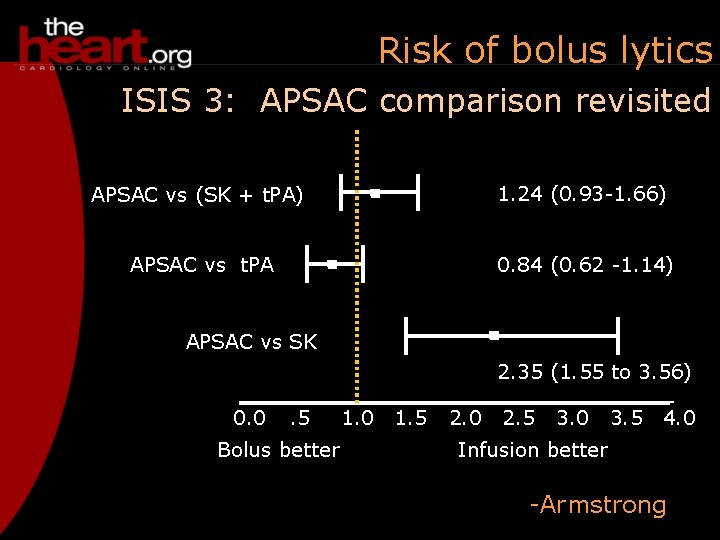
Risk of bolus lytics ISIS 3: APSAC comparison revisited APSAC vs (SK + t. PA) 1. 24 (0. 93 -1. 66) APSAC vs t. PA 0. 84 (0. 62 -1. 14) APSAC vs SK 2. 35 (1. 55 to 3. 56) 0. 0 . 5 Bolus better 1. 0 1. 5 2. 0 2. 5 3. 0 3. 5 4. 0 Infusion better -Armstrong
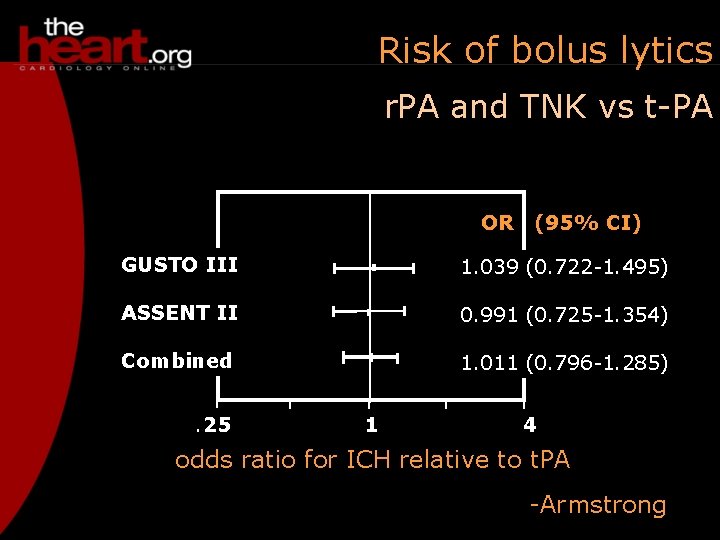
Risk of bolus lytics r. PA and TNK vs t-PA OR (95% CI) GUSTO III 1. 039 (0. 722 -1. 495) ASSENT II 0. 991 (0. 725 -1. 354) Combined 1. 011 (0. 796 -1. 285) . 25 1 4 odds ratio for ICH relative to t. PA -Armstrong

Risk of bolus lytics Conclusions: Armstrong r. PA and TNK vs TPA: Frequency or likelihood of an ICH is essentially identical r. PA and TNK, which are in general use, are safe, effective, and provide important advantages
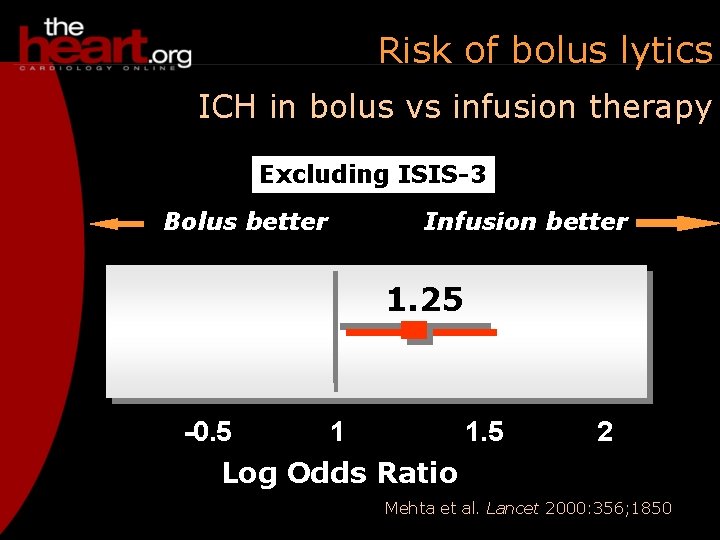
Risk of bolus lytics ICH in bolus vs infusion therapy Excluding ISIS-3 Bolus better Infusion better 1. 25 -0. 5 1 1. 5 Log Odds Ratio 2 Mehta et al. Lancet 2000: 356; 1850
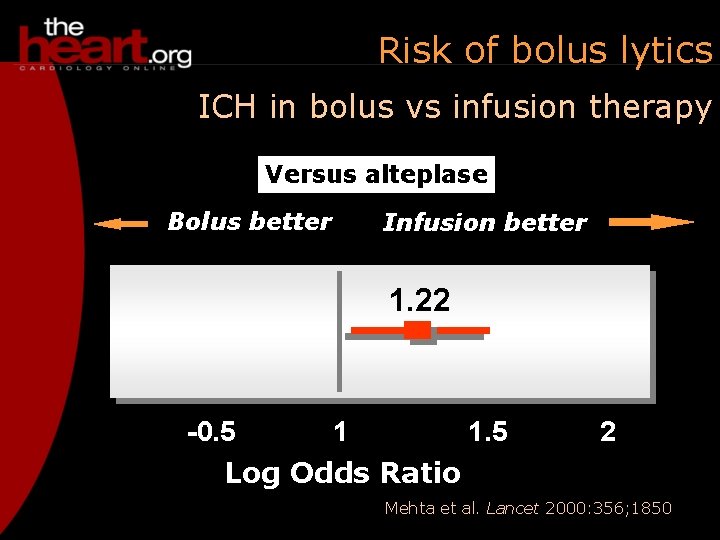
Risk of bolus lytics ICH in bolus vs infusion therapy Versus alteplase Bolus better Infusion better 1. 22 -0. 5 1 1. 5 Log Odds Ratio 2 Mehta et al. Lancet 2000: 356; 1850

Risk of bolus lytics ICH in bolus vs infusion therapy Versus streptokinase Bolus better Infusion better 2. 19 -0. 5 1 1. 5 Log Odds Ratio 2 3 Mehta et al. Lancet 2000: 356; 1850
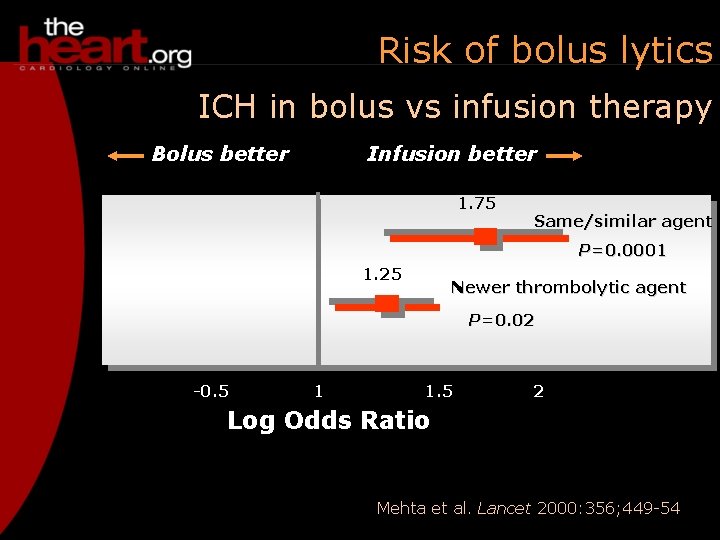
Risk of bolus lytics ICH in bolus vs infusion therapy Bolus better Infusion better 1. 75 Same/similar agent P=0. 0001 1. 25 Newer thrombolytic agent P=0. 02 -0. 5 1 1. 5 2 Log Odds Ratio Mehta et al. Lancet 2000: 356; 449 -54
Risk of bolus lytics Heparin dosing The same doses of UFH were included in the 2 groups in all 7 trials in the meta-analysis Any reduction in ICH would be observed in both groups, and the relative difference is likely to be maintained There is little randomized data confirming that efficacy is maintained with lower heparin dosing Clinical implications of medication errors have not been adequately addressed -Mehta
Risk of bolus lytics In. TIME-II The study was overdosed (120 KU. kg-1) There is a drug-drug interaction with a clear and excess partial thromboplastin time for 6 hrs after therapy Lowering heparin lowered ICH rate in both arms -Armstrong
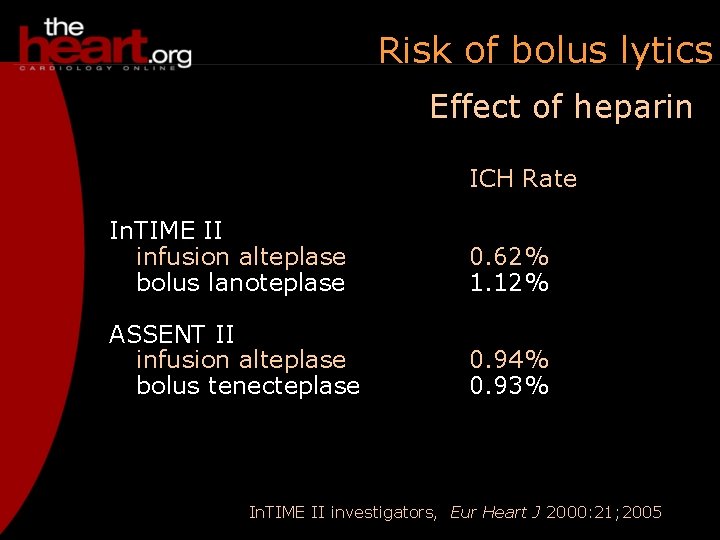
Risk of bolus lytics Effect of heparin ICH Rate In. TIME II infusion alteplase bolus lanoteplase 0. 62% 1. 12% ASSENT II infusion alteplase bolus tenecteplase 0. 94% 0. 93% In. TIME II investigators, Eur Heart J 2000: 21; 2005
Risk of bolus lytics Perseveration on statistics “The perseveration around the statistics without consideration of the unique aspects of the components of dose and adjunctive therapy and how modifications in that therapy modify the result fails to take into account the realities. ” Paul Armstrong Professor of Medicine University of Alberta Hospital Edmonton, Alberta
Risk of bolus lytics Fibrin specificity In GUSTO I, ISIS-3, and INJECT the agent with the greater higher specificity was associated with higher intracranial hemorrhage No reason to believe different in In. TIME-II -Mehta
Risk of bolus lytics Recommendations for practice The meta-analysis was designed to inform clinicians, not to dictate clinical practice Physicians must know the data in order to weigh risk/benefits and make reasonable clinical decisions that benefit patients -Mehta
Risk of bolus lytics Final comments: Armstrong Must look on both sides of the confidence limits Bolus agents are different and influenced by adjunctive therapy. Bolus agents have helped move to earlier therapy and improved time to treatment Awaiting results from studies of bolus therapy in conjunction with GP IIb/IIIa inhibitors

Risk of bolus lytics Final comments: Mehta Looking forward to the results of pre-hospital treatment of AMI Also awaiting GP IIb/IIIa inhibitors plus reduced dose bolus thrombolytics Despite the money and effort, bolus thrombolytics have not yet shown a clear superiority
- Slides: 26