
Risk Management Monitoring and Verification in CCS WBCSD
Risk Management, Monitoring and Verification in CCS WBCSD / IETA Side Event at UNFCCC SBSTA 23 Pathways to the future: The case for carbon capture and storage Dr. Ståle Selmer-Olsen Bonn, Germany, 19 May 2006
Content 1. Reflections on risk in different parts of CCS value chain 2. Acceptance – stakeholders and issues 3. Verification as a tool for risk management and stakeholders assurance 08/06/2021
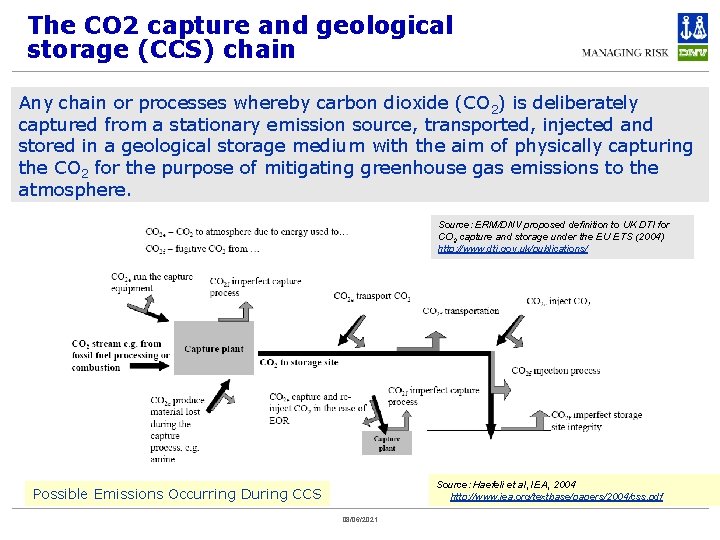
The CO 2 capture and geological storage (CCS) chain Any chain or processes whereby carbon dioxide (CO 2) is deliberately captured from a stationary emission source, transported, injected and stored in a geological storage medium with the aim of physically capturing the CO 2 for the purpose of mitigating greenhouse gas emissions to the atmosphere. Source: ERM/DNV proposed definition to UK DTI for CO 2 capture and storage under the EU ETS (2004) http: //www. dti. gov. uk/publications/ Source: Haefeli et al, IEA, 2004 http: //www. iea. org/textbase/papers/2004/css. pdf Possible Emissions Occurring During CCS 08/06/2021
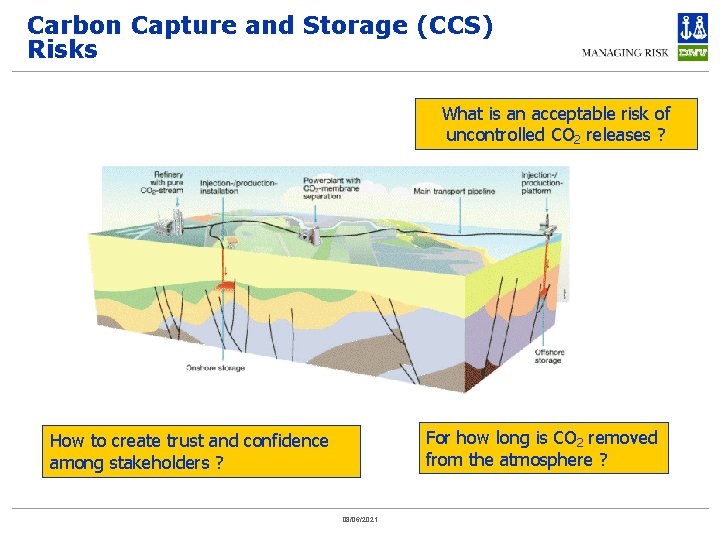
Carbon Capture and Storage (CCS) Risks What is an acceptable risk of uncontrolled CO 2 releases ? For how long is CO 2 removed from the atmosphere ? How to create trust and confidence among stakeholders ? 08/06/2021
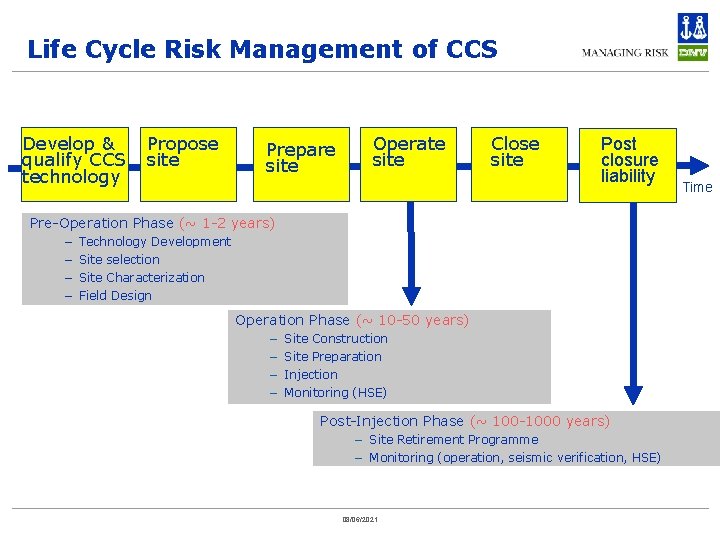
Life Cycle Risk Management of CCS Develop & qualify CCS technology Propose site Prepare site Operate site Close site Post closure liability Pre-Operation Phase (~ 1 -2 years) – – Technology Development Site selection Site Characterization Field Design Operation Phase (~ 10 -50 years) – – Site Construction Site Preparation Injection Monitoring (HSE) Post-Injection Phase (~ 100 -1000 years) – Site Retirement Programme – Monitoring (operation, seismic verification, HSE) 08/06/2021 Time
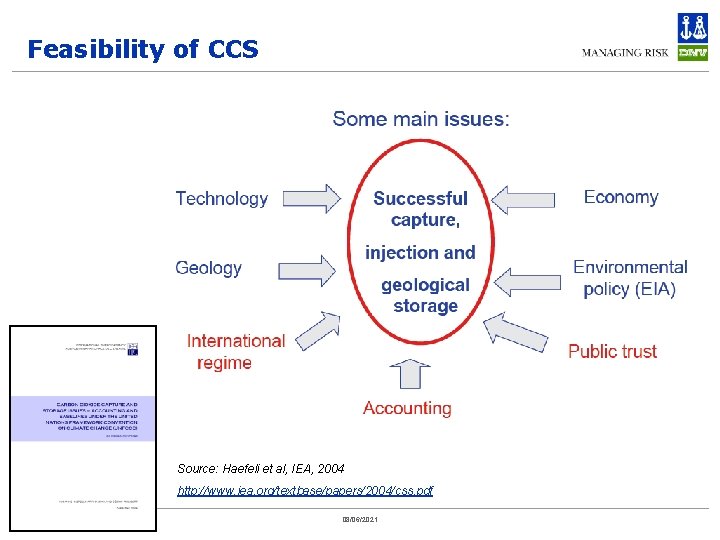
Feasibility of CCS Source: Haefeli et al, IEA, 2004 http: //www. iea. org/textbase/papers/2004/css. pdf 08/06/2021
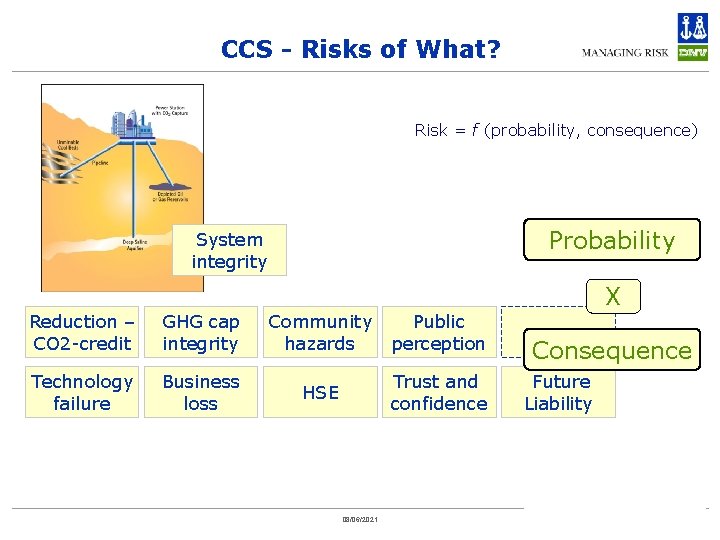
CCS - Risks of What? Risk = f (probability, consequence) Probability System integrity Reduction – CO 2 -credit GHG cap integrity Community hazards Public perception Technology failure Business loss HSE Trust and confidence 08/06/2021 X Consequence Future Liability
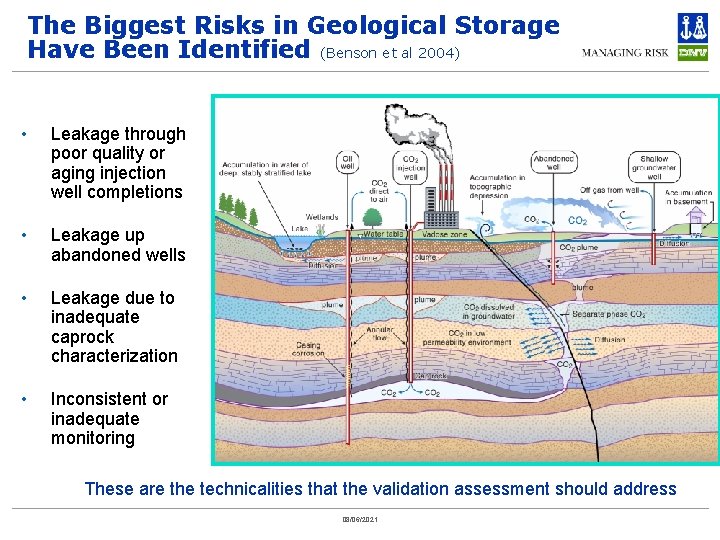
The Biggest Risks in Geological Storage Have Been Identified (Benson et al 2004) • Leakage through poor quality or aging injection well completions • Leakage up abandoned wells • Leakage due to inadequate caprock characterization • Inconsistent or inadequate monitoring These are the technicalities that the validation assessment should address 08/06/2021
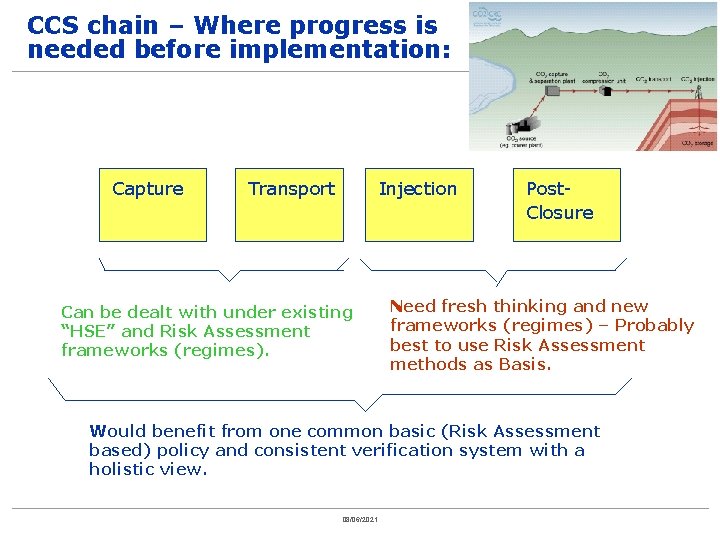
CCS chain – Where progress is needed before implementation: Capture Transport Injection Can be dealt with under existing “HSE” and Risk Assessment frameworks (regimes). Post. Closure Need fresh thinking and new frameworks (regimes) – Probably best to use Risk Assessment methods as Basis. Would benefit from one common basic (Risk Assessment based) policy and consistent verification system with a holistic view. 08/06/2021
Content 1. Reflections on risk in different parts of CCS value chain 2. Acceptance – stakeholders and issues 3. Verification as a tool for risk management and stakeholders assurance 08/06/2021
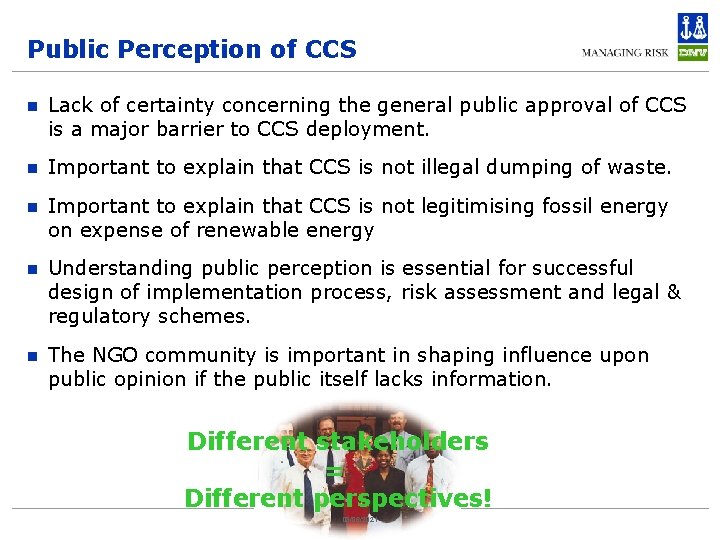
Public Perception of CCS n Lack of certainty concerning the general public approval of CCS is a major barrier to CCS deployment. n Important to explain that CCS is not illegal dumping of waste. n Important to explain that CCS is not legitimising fossil energy on expense of renewable energy n Understanding public perception is essential for successful design of implementation process, risk assessment and legal & regulatory schemes. n The NGO community is important in shaping influence upon public opinion if the public itself lacks information. Different stakeholders = Different perspectives! 08/06/2021
Public Acceptance: ACCSEPT *(EU 6 th FP) EU 6 th FP SSP Call Text 3. 2 task 9: n To address social, economic, legal and regulatory implications of implementing CO 2 capture and storage technology in the EU and at the world level n To measure the social acceptance of CO 2 capture and storage n To assess the costs of CO 2 capture and storage at the EU and world level n To help establish guidelines and recommendations on CO 2 capture and storage in the context of the EU Emission Trading Scheme and in the framework of the Carbon Sequestration Leadership Forum – CSLF. - http: //europa. eu. int/comm/environment/climat/emission. htm - http: //www. cslforum. org/ n A 5 partners consortium will address these issues during a 2 years contract with the EC. Started 1 January 2006. - DNV (Norway) Baker & Mc. Kenzie (UK) ECN (The Netherlands) IEEP (Belgium) Tyndall Centre, Manchester and Cambridge (UK) *ACCSEPT: Acceptance of CO 2 Capture and Storage Economics, Policy and Technology 08/06/2021
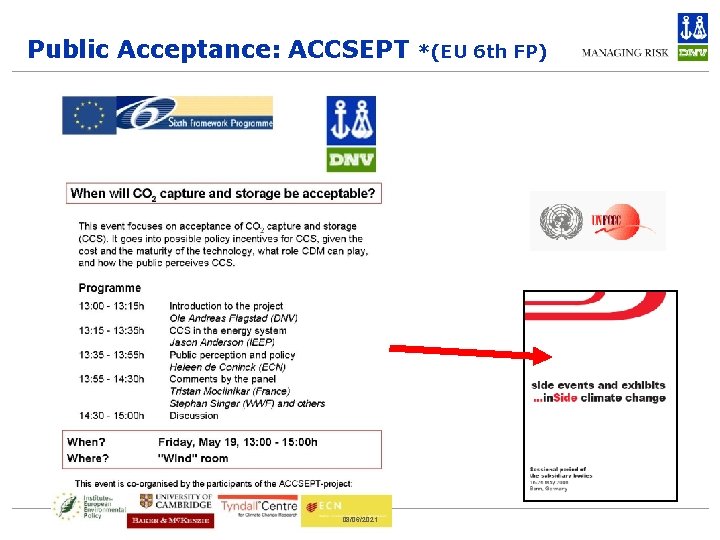
Public Acceptance: ACCSEPT 08/06/2021 *(EU 6 th FP)
Content 1. Reflections on risk in different parts of CCS value chain 2. Acceptance – stakeholders and issues 3. Verification as a tool for risk management and stakeholders assurance 08/06/2021
CCS in Existing Frameworks n The regulatory frameworks for CCS are in their infancy. - On all levels, it is unclear whether CCS is a part of the climate change mitigation measure portfolio. n The UNFCCC recognizes CCS in its Kyoto Protocol, but not yet in its mechanisms, however: - The IPCC Special Report on CCS (issued in 2005 after approval by governments) provides information for policymakers, scientists and engineers. - The Report prepares the basis for the National Inventories Guidelines to be revised and proposed to the COP (Conference of the Parties to the UNFCCC) in 2006. - Method(s) for CCS in CDM in preparation. Submitted to the CDM EB (UNFCCC) for approval. - A JI supervisory committee (eq. to CDM EB) set up in Dec 2005. n A provision opening for a future option of CCS is made in the relevant EU ETS Directive n On a national level, different policy instruments are in place: - A tax on CO 2 emissions (Norway) - A subsidy on climate-neutral fossil energy carriers (Netherlands) n The North Sea Basin Task Force will develop principles for CO 2 storage (UK & Norway) n Specific research projects are going on, financed by the EC and by national governments worldwide. n Several major pilot projects both in operation and in pipeline that await clarification from authorities regarding legal/regulatory issues, incentives and cost/funding issues. 08/06/2021
![GHG emissions [t CO 2 -eq] CO 2 validation, verification & monitoring – Uncertainties](http://slidetodoc.com/presentation_image_h2/5c93ec0fc8eeb6f10ee58862c0af5880/image-16.jpg "GHG emissions [t CO 2 -eq] CO 2 validation, verification & monitoring – Uncertainties")
GHG emissions [t CO 2 -eq] CO 2 validation, verification & monitoring – Uncertainties and Risks Validation of CCS project baseline, design, and monitoring plan Exististing emissions CCS project implementatio n Stored CO 2 Year 08/06/2021 Emission baseline without storage (CCS) Verification of CO 2 storage and monitoring Remaining emissions with storage of CO 2
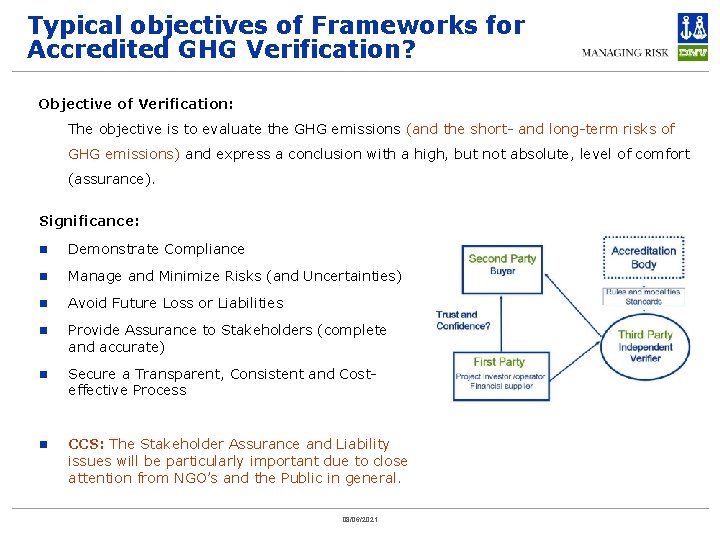
Typical objectives of Frameworks for Accredited GHG Verification? Objective of Verification: The objective is to evaluate the GHG emissions (and the short- and long-term risks of GHG emissions) and express a conclusion with a high, but not absolute, level of comfort (assurance). Significance: n Demonstrate Compliance n Manage and Minimize Risks (and Uncertainties) n Avoid Future Loss or Liabilities n Provide Assurance to Stakeholders (complete and accurate) n Secure a Transparent, Consistent and Costeffective Process n CCS: The Stakeholder Assurance and Liability issues will be particularly important due to close attention from NGO’s and the Public in general. 08/06/2021
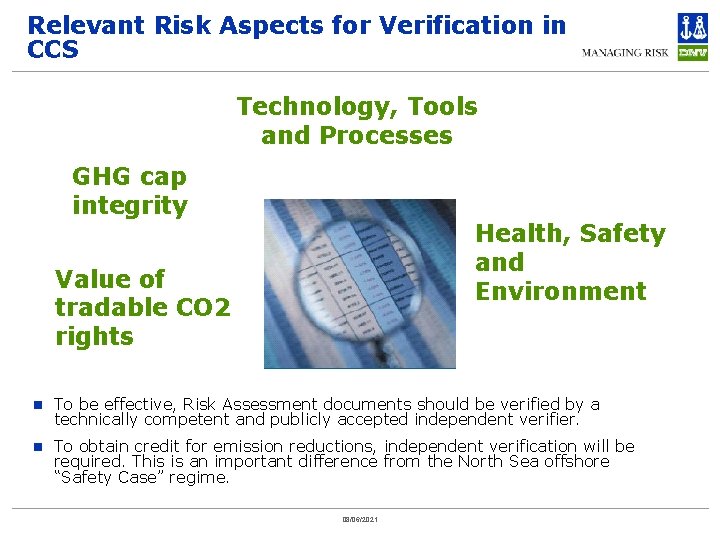
Relevant Risk Aspects for Verification in CCS Technology, Tools and Processes GHG cap integrity Health, Safety and Environment Value of tradable CO 2 rights n To be effective, Risk Assessment documents should be verified by a technically competent and publicly accepted independent verifier. n To obtain credit for emission reductions, independent verification will be required. This is an important difference from the North Sea offshore “Safety Case” regime. 08/06/2021
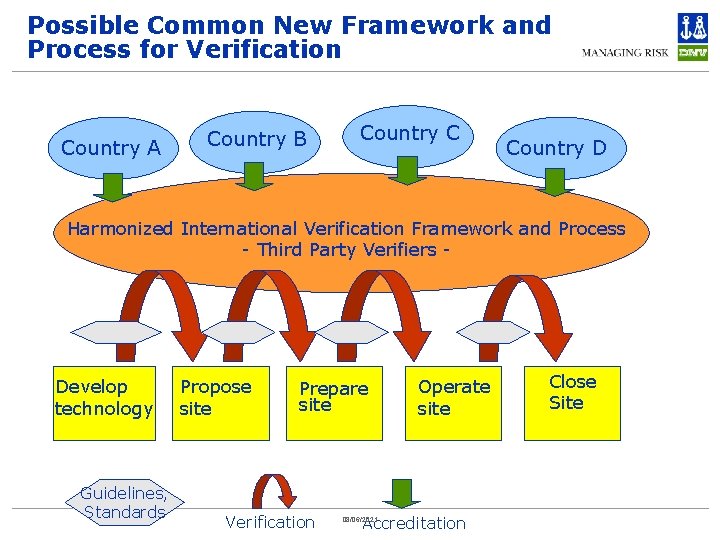
Possible Common New Framework and Process for Verification Country A Country B Country C Country D Harmonized International Verification Framework and Process - Third Party Verifiers - Develop technology Guidelines, Standards Propose site Prepare site Verification Operate site Accreditation 08/06/2021 Close Site
Build Acceptance for CCS as a Safe and Reliable Approach Two well coordinated multi stakeholder development processes needed: 1. An overall framework for Accredited Verification providing all stakeholders with reassurance in CCS as a safe and reliable. 2. Guidelines and standards for each part of the overall process. Includes Best Practices and Risk Assessment Criteria - against which Verification would be made. 08/06/2021
Contact: Ståle Selmer-Olsen, DNV Research Staale. Selmer-Olsen@dnv. com Tlph. : +47 67579481 Gudmundur Sigurthorsson, DNV Certification Gudmundur. Sigurthorsson@dnv. com Tlph. : +31 102922749 08/06/2021
08/06/2021
- Slides: 22