
Risk Management Insurance CHAPTER 4 FUNDAMENTALS OF INSURANCE

- Slides: 40
Risk Management & Insurance CHAPTER 4 FUNDAMENTALS OF INSURANCE CONTRACTS
Chapter 4: Agenda 2 Chapter four: Fundamentals of Insurance contracts 4. 1. Legal principles of insurance contract. 4. 2. Requirements of an insurance contract. 4. 3. Unique characteristics of insurance.
After studying this chapter you should be able to: 3 1. Describe the legal principles of insurance contract. 2. Appreciate the purposes of each legal principles of insurance 3. Realize the legal requirements of insurance contract. 4. List and explain the unique characteristics of insurance
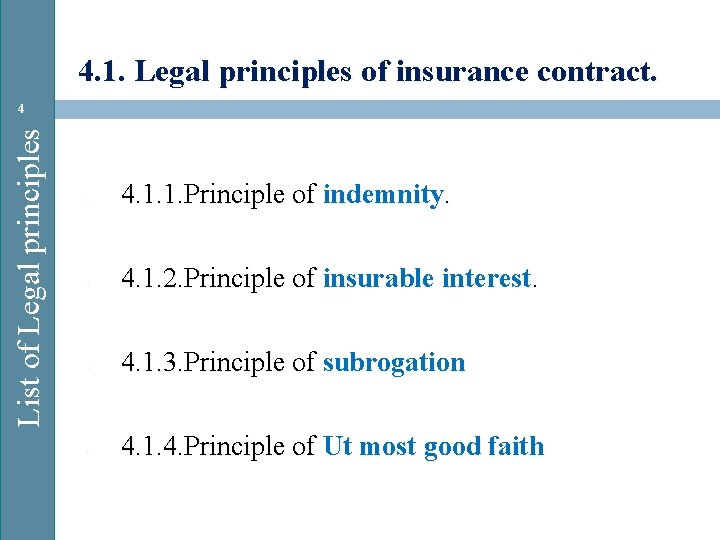
4. 1. Legal principles of insurance contract. List of Legal principles 4 1. 2. 3. 4. 1. 1. Principle of indemnity. 4. 1. 2. Principle of insurable interest. 4. 1. 3. Principle of subrogation 4. 1. 4. Principle of Ut most good faith
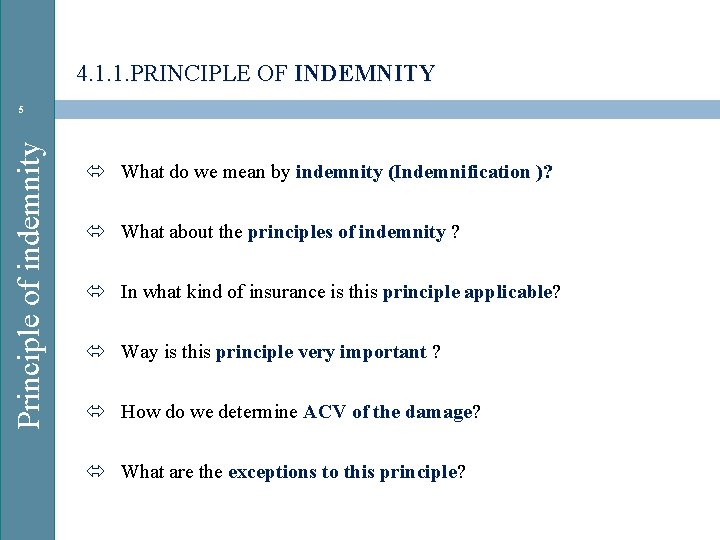
4. 1. 1. PRINCIPLE OF INDEMNITY Principle of indemnity 5 ó What do we mean by indemnity (Indemnification )? ó What about the principles of indemnity ? ó In what kind of insurance is this principle applicable? ó Way is this principle very important ? ó How do we determine ACV of the damage? ó What are the exceptions to this principle?
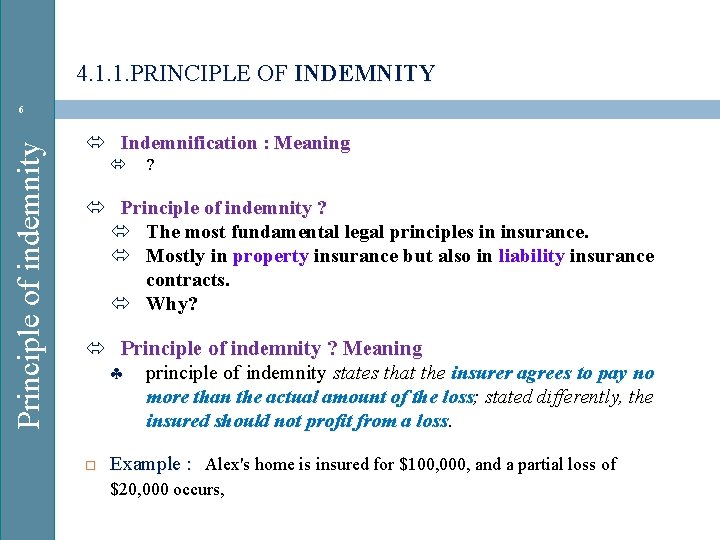
4. 1. 1. PRINCIPLE OF INDEMNITY Principle of indemnity 6 ó Indemnification : Meaning ó ? ó Principle of indemnity ? ó The most fundamental legal principles in insurance. ó Mostly in property insurance but also in liability insurance contracts. ó Why? ó Principle of indemnity ? Meaning § principle of indemnity states that the insurer agrees to pay no more than the actual amount of the loss; stated differently, the insured should not profit from a loss. Example : Alex's home is insured for $100, 000, and a partial loss of $20, 000 occurs,
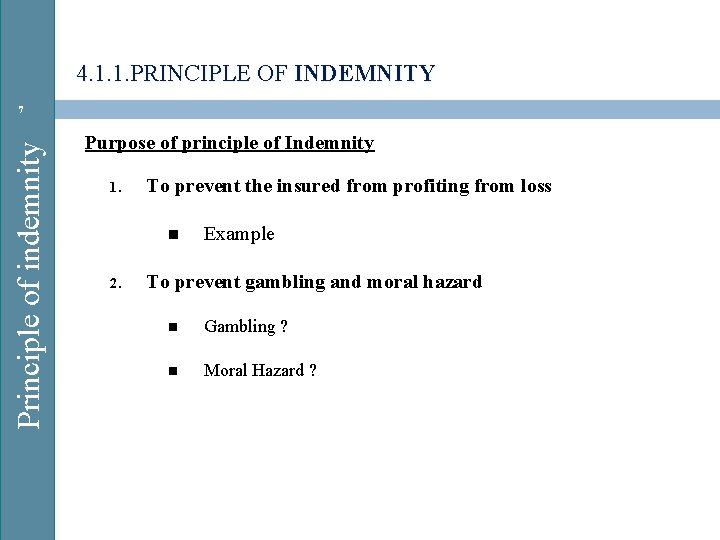
4. 1. 1. PRINCIPLE OF INDEMNITY Principle of indemnity 7 Purpose of principle of Indemnity 1. To prevent the insured from profiting from loss 2. Example To prevent gambling and moral hazard Gambling ? Moral Hazard ?
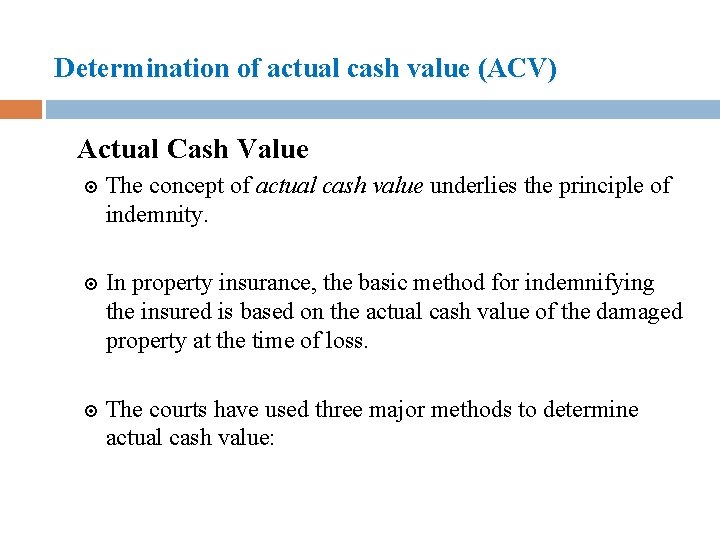
Determination of actual cash value (ACV) Actual Cash Value The concept of actual cash value underlies the principle of indemnity. In property insurance, the basic method for indemnifying the insured is based on the actual cash value of the damaged property at the time of loss. The courts have used three major methods to determine actual cash value:
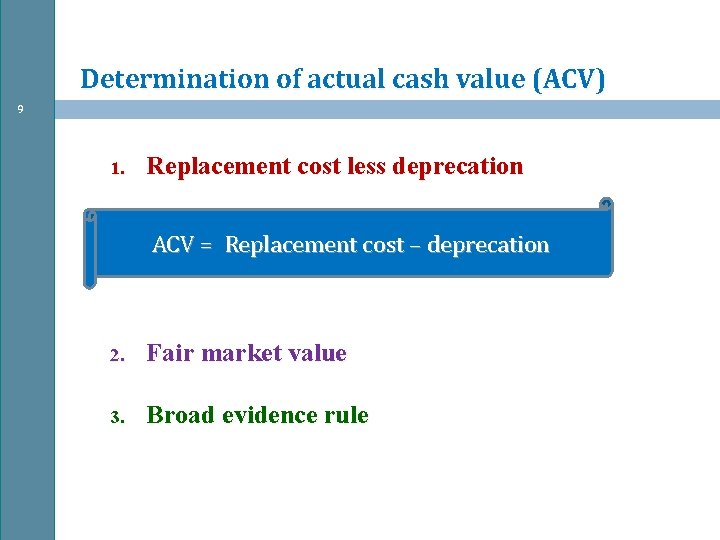
Determination of actual cash value (ACV) 9 1. Replacement cost less deprecation ACV = Replacement cost – deprecation 2. Fair market value 3. Broad evidence rule
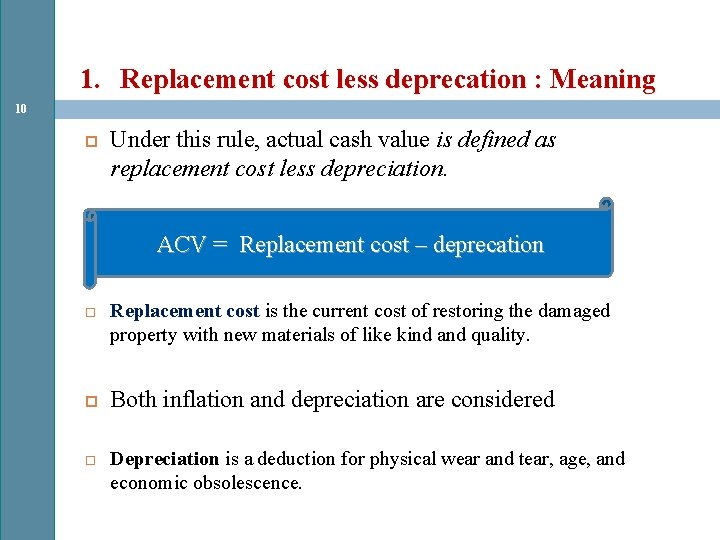
1. Replacement cost less deprecation : Meaning 10 Under this rule, actual cash value is defined as replacement cost less depreciation. ACV = Replacement cost – deprecation Replacement cost is the current cost of restoring the damaged property with new materials of like kind and quality. Both inflation and depreciation are considered Depreciation is a deduction for physical wear and tear, age, and economic obsolescence.
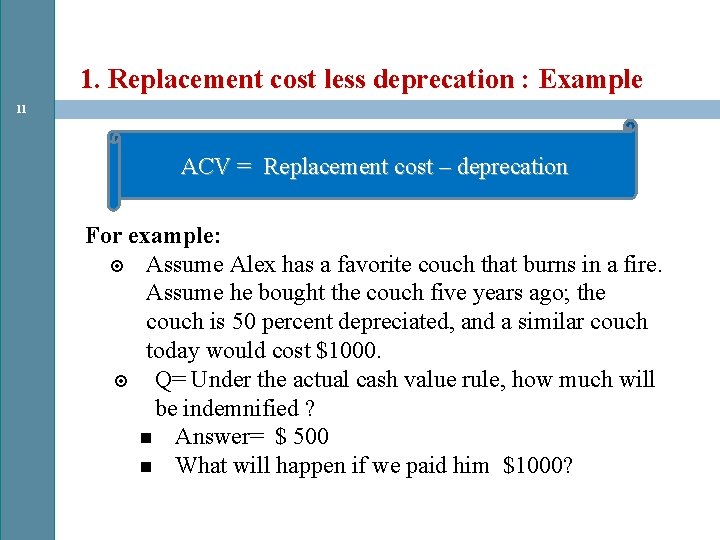
1. Replacement cost less deprecation : Example 11 ACV = Replacement cost – deprecation For example: Assume Alex has a favorite couch that burns in a fire. Assume he bought the couch five years ago; the couch is 50 percent depreciated, and a similar couch today would cost $1000. Q= Under the actual cash value rule, how much will be indemnified ? Answer= $ 500 What will happen if we paid him $1000?
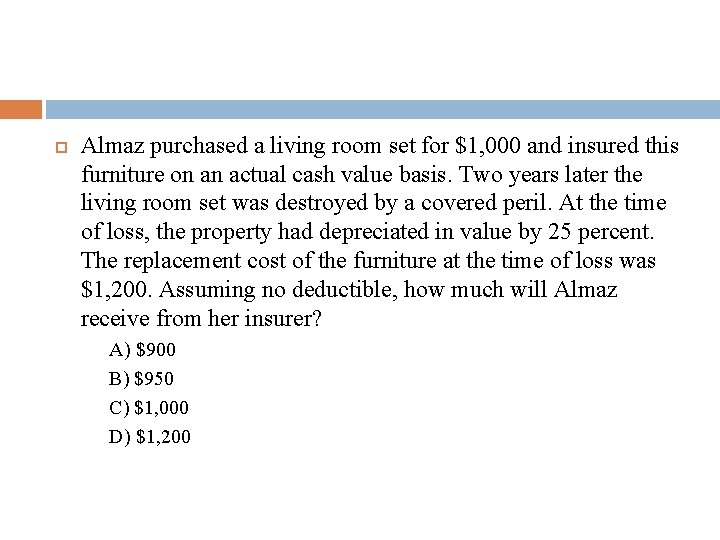
Almaz purchased a living room set for $1, 000 and insured this furniture on an actual cash value basis. Two years later the living room set was destroyed by a covered peril. At the time of loss, the property had depreciated in value by 25 percent. The replacement cost of the furniture at the time of loss was $1, 200. Assuming no deductible, how much will Almaz receive from her insurer? A) $900 B) $950 C) $1, 000 D) $1, 200
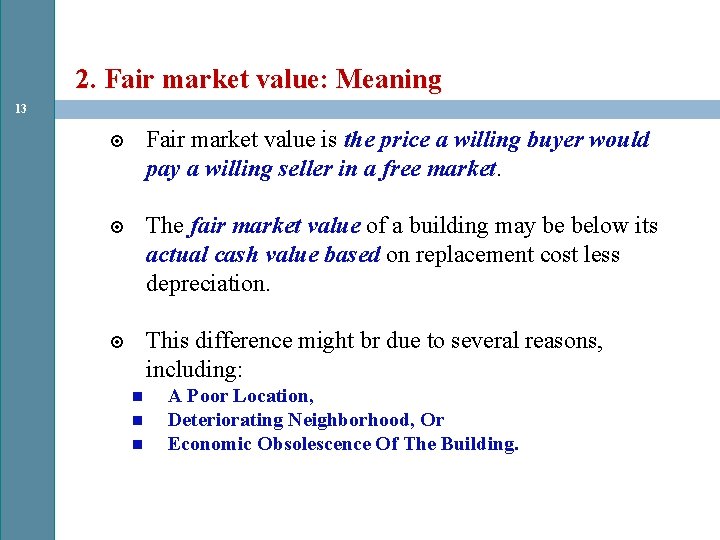
2. Fair market value: Meaning 13 Fair market value is the price a willing buyer would pay a willing seller in a free market. The fair market value of a building may be below its actual cash value based on replacement cost less depreciation. This difference might br due to several reasons, including: A Poor Location, Deteriorating Neighborhood, Or Economic Obsolescence Of The Building.
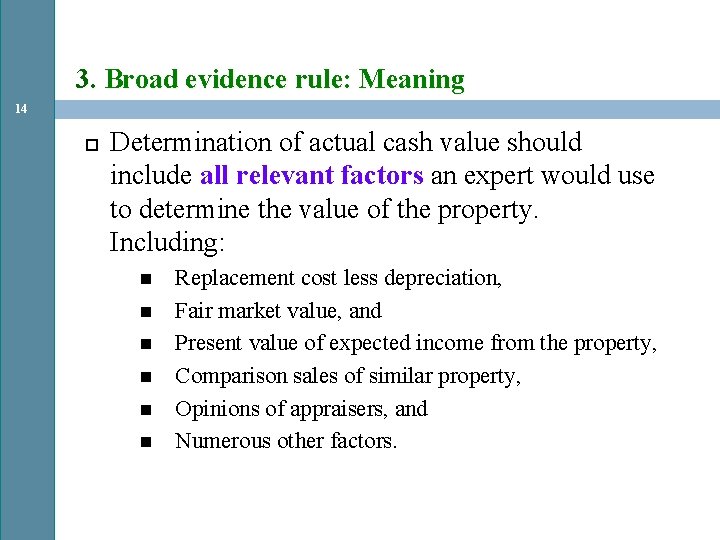
3. Broad evidence rule: Meaning 14 Determination of actual cash value should include all relevant factors an expert would use to determine the value of the property. Including: Replacement cost less depreciation, Fair market value, and Present value of expected income from the property, Comparison sales of similar property, Opinions of appraisers, and Numerous other factors.
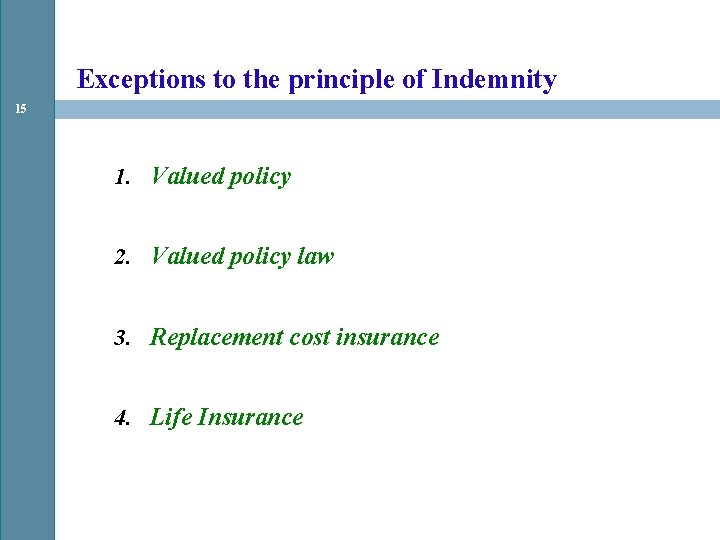
Exceptions to the principle of Indemnity 15 1. Valued policy 2. Valued policy law 3. Replacement cost insurance 4. Life Insurance
4. 1. 1. PRINCIPLE OF INDEMNITY Principle of indemnity 16 ó What do we mean by indemnity (Indemnification )? ó What about the principles of indemnity ? ó In what kind of insurance is this principle applicable? ó Way is this principle very important ? ó How do we determine ACV of the damage? ó What are the exceptions to this principle?
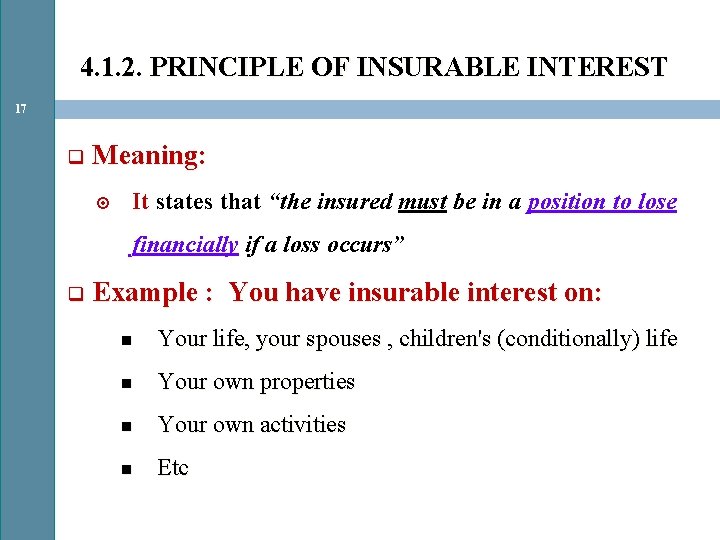
4. 1. 2. PRINCIPLE OF INSURABLE INTEREST 17 q Meaning: It states that “the insured must be in a position to lose financially if a loss occurs” q Example : You have insurable interest on: Your life, your spouses , children's (conditionally) life Your own properties Your own activities Etc
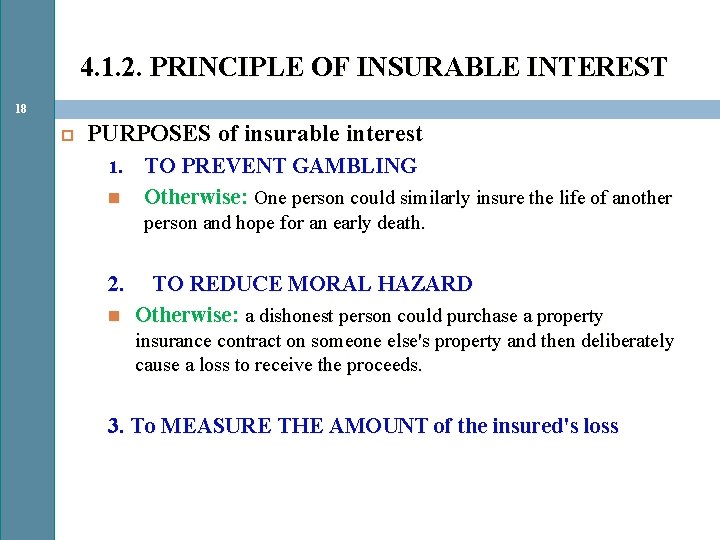
4. 1. 2. PRINCIPLE OF INSURABLE INTEREST 18 PURPOSES of insurable interest 1. TO PREVENT GAMBLING Otherwise: One person could similarly insure the life of another person and hope for an early death. 2. TO REDUCE MORAL HAZARD Otherwise: a dishonest person could purchase a property insurance contract on someone else's property and then deliberately cause a loss to receive the proceeds. 3. To MEASURE THE AMOUNT of the insured's loss
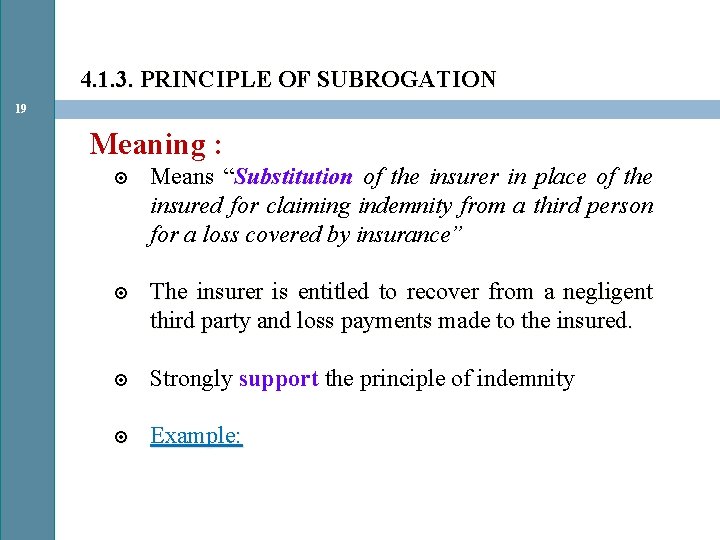
4. 1. 3. PRINCIPLE OF SUBROGATION 19 Meaning : Means “Substitution of the insurer in place of the insured for claiming indemnity from a third person for a loss covered by insurance” The insurer is entitled to recover from a negligent third party and loss payments made to the insured. Strongly support the principle of indemnity Example:
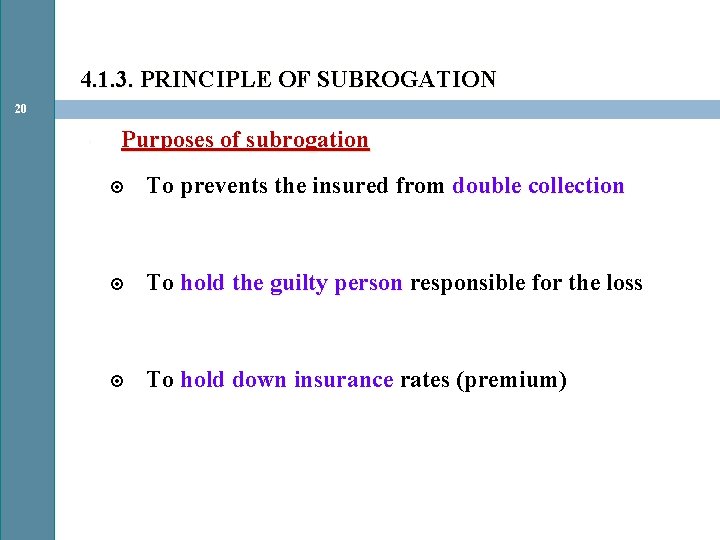
4. 1. 3. PRINCIPLE OF SUBROGATION 20 • Purposes of subrogation To prevents the insured from double collection To hold the guilty person responsible for the loss To hold down insurance rates (premium)
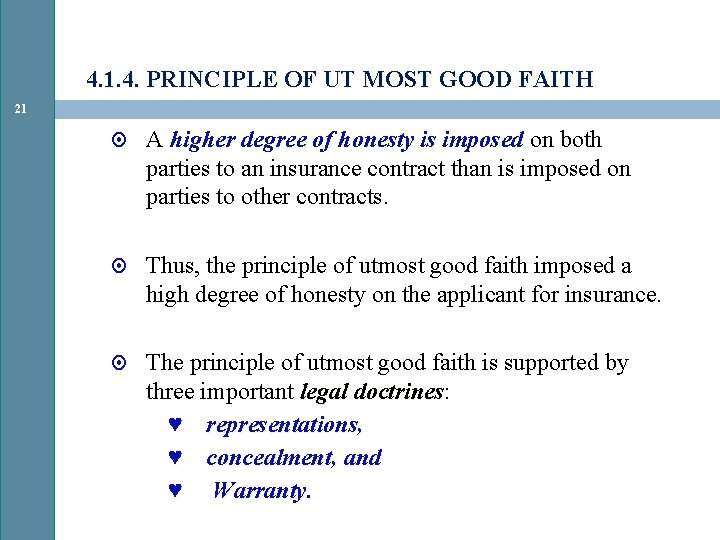
4. 1. 4. PRINCIPLE OF UT MOST GOOD FAITH 21 A higher degree of honesty is imposed on both parties to an insurance contract than is imposed on parties to other contracts. Thus, the principle of utmost good faith imposed a high degree of honesty on the applicant for insurance. The principle of utmost good faith is supported by three important legal doctrines: doctrines ♥ representations, ♥ concealment, and ♥ Warranty.
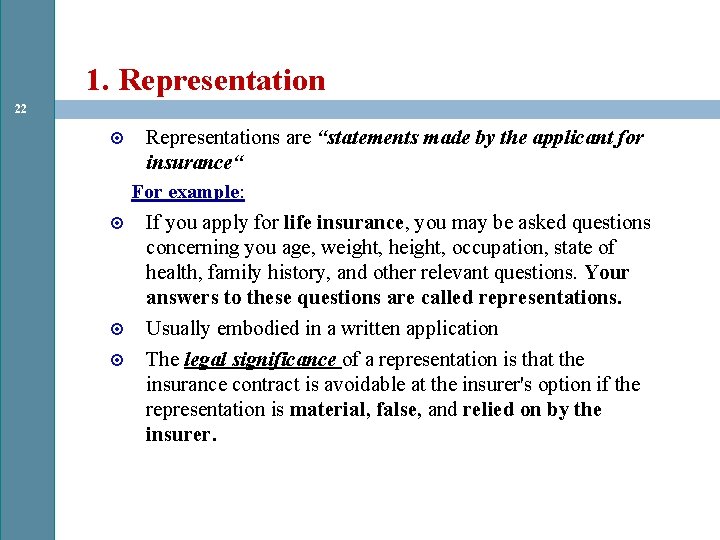
1. Representation 22 Representations are “statements made by the applicant for insurance“ For example: If you apply for life insurance, you may be asked questions concerning you age, weight, height, occupation, state of health, family history, and other relevant questions. Your answers to these questions are called representations. Usually embodied in a written application The legal significance of a representation is that the insurance contract is avoidable at the insurer's option if the representation is material, false, and relied on by the insurer.
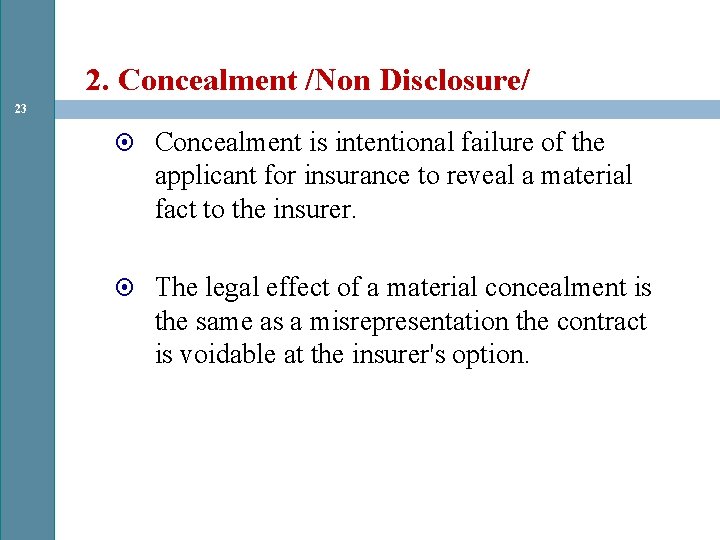
2. Concealment /Non Disclosure/ 23 Concealment is intentional failure of the applicant for insurance to reveal a material fact to the insurer. The legal effect of a material concealment is the same as a misrepresentation the contract is voidable at the insurer's option.
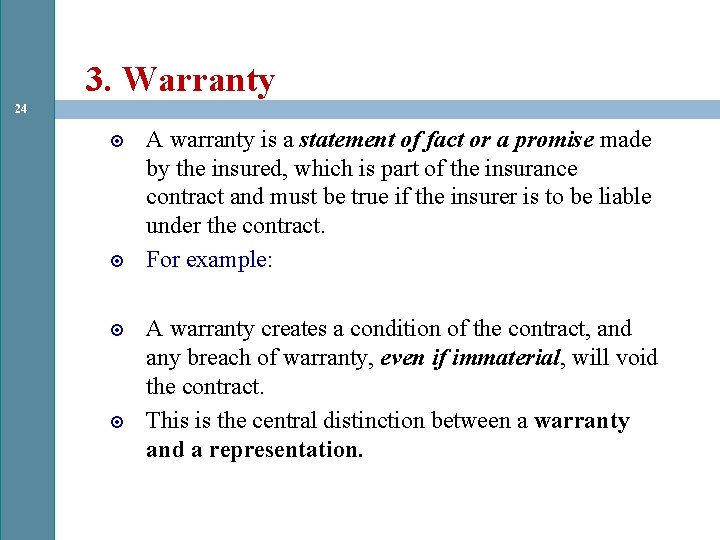
3. Warranty 24 A warranty is a statement of fact or a promise made by the insured, which is part of the insurance contract and must be true if the insurer is to be liable under the contract. For example: A warranty creates a condition of the contract, and any breach of warranty, even if immaterial, will void the contract. This is the central distinction between a warranty and a representation.
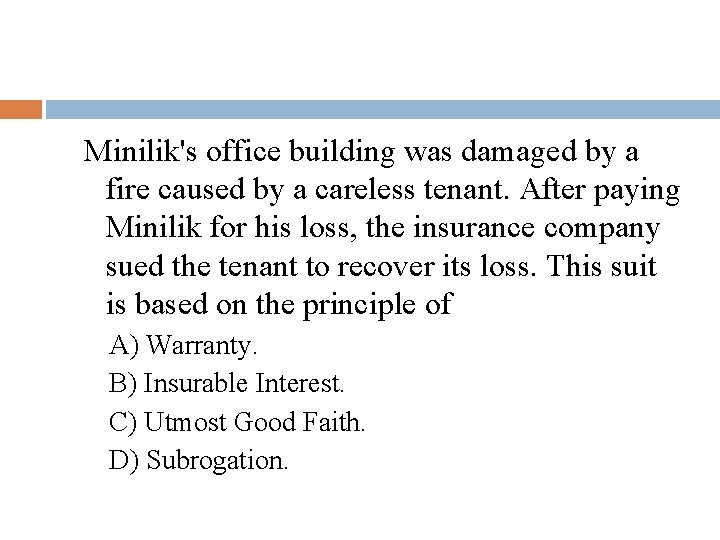
Minilik's office building was damaged by a fire caused by a careless tenant. After paying Minilik for his loss, the insurance company sued the tenant to recover its loss. This suit is based on the principle of A) Warranty. B) Insurable Interest. C) Utmost Good Faith. D) Subrogation.
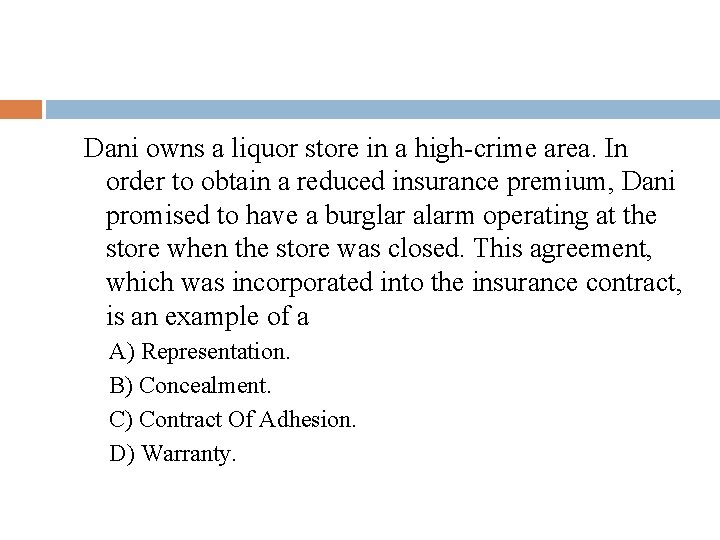
Dani owns a liquor store in a high-crime area. In order to obtain a reduced insurance premium, Dani promised to have a burglar alarm operating at the store when the store was closed. This agreement, which was incorporated into the insurance contract, is an example of a A) Representation. B) Concealment. C) Contract Of Adhesion. D) Warranty.
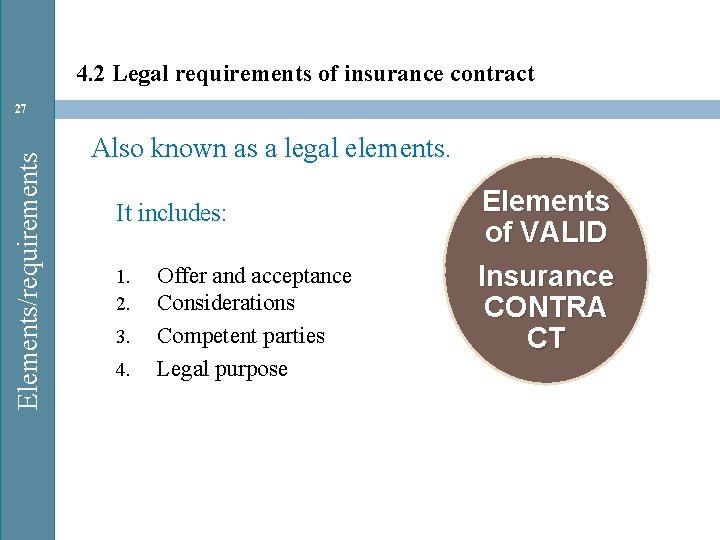
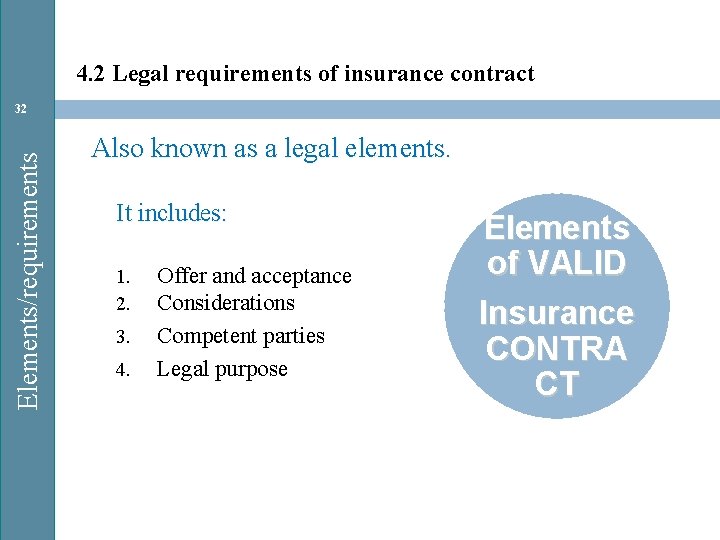
4. 2 Legal requirements of insurance contract Elements/requirements 27 Also known as a legal elements. It includes: 1. 2. 3. 4. Offer and acceptance Considerations Competent parties Legal purpose URPOSE Elements of VALID Insurance CONTRA CT
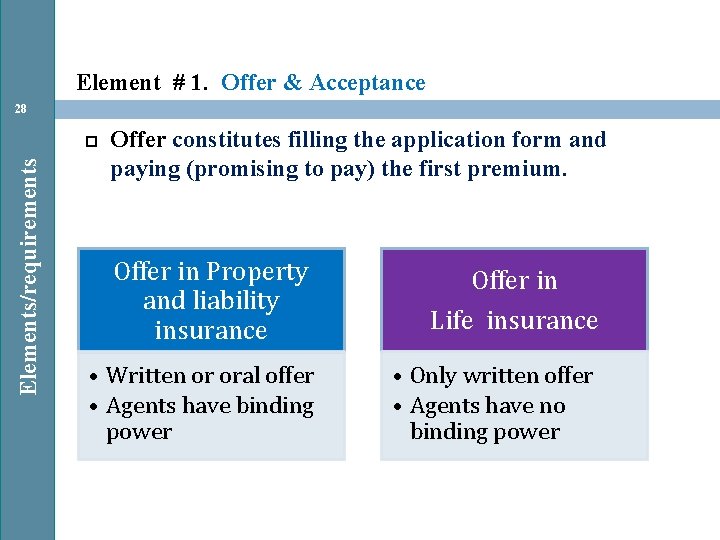
Element # 1. Offer & Acceptance 28 Elements/requirements Offer constitutes filling the application form and paying (promising to pay) the first premium. Offer in Property and liability insurance Offer in Life insurance • Written or oral offer • Agents have binding power • Only written offer • Agents have no binding power
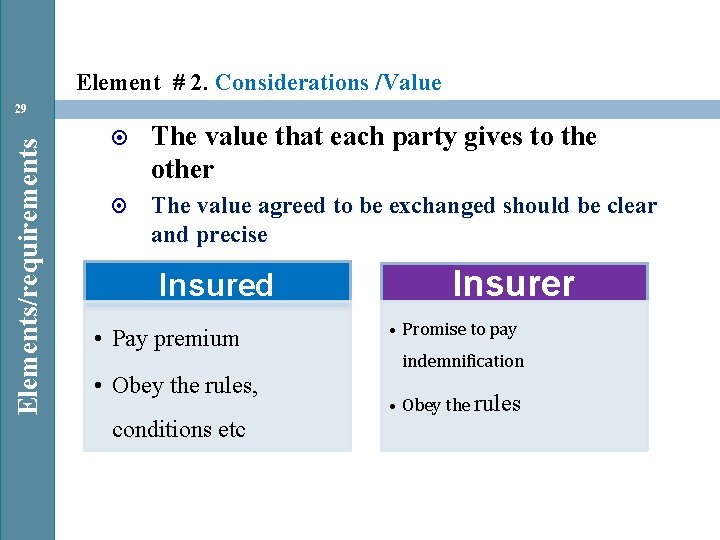
Element # 2. Considerations /Value Elements/requirements 29 The value that each party gives to the other The value agreed to be exchanged should be clear and precise Insured • Pay premium • Obey the rules, conditions etc Insurer • Promise to pay indemnification • Obey the rules
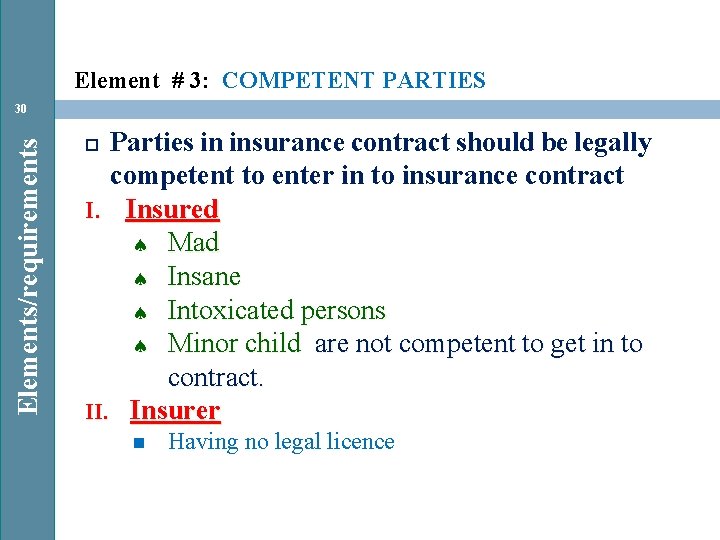
Element # 3: COMPETENT PARTIES Elements/requirements 30 Parties in insurance contract should be legally competent to enter in to insurance contract I. Insured Mad Insane Intoxicated persons Minor child are not competent to get in to contract. II. Insurer Having no legal licence
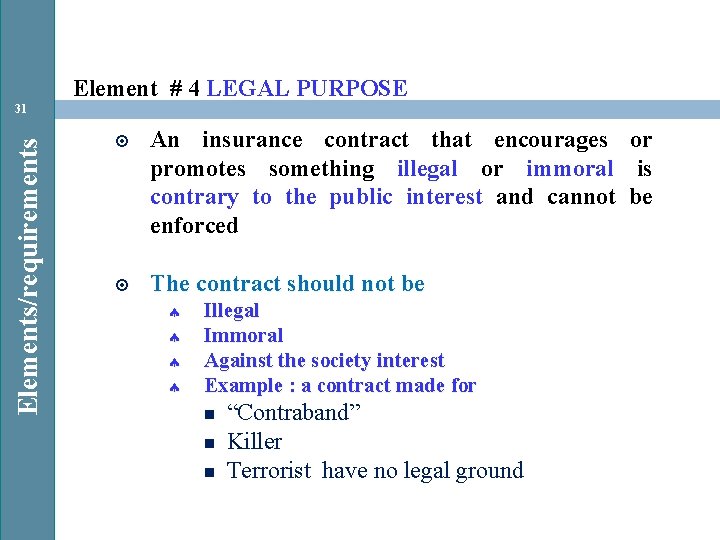
Element # 4 LEGAL PURPOSE Elements/requirements 31 An insurance contract that encourages or promotes something illegal or immoral is contrary to the public interest and cannot be enforced The contract should not be Illegal Immoral Against the society interest Example : a contract made for “Contraband” Killer Terrorist have no legal ground
4. 2 Legal requirements of insurance contract Elements/requirements 32 Also known as a legal elements. It includes: 1. 2. 3. 4. Offer and acceptance Considerations Competent parties Legal purpose URPOSE Elements of VALID Insurance CONTRA CT
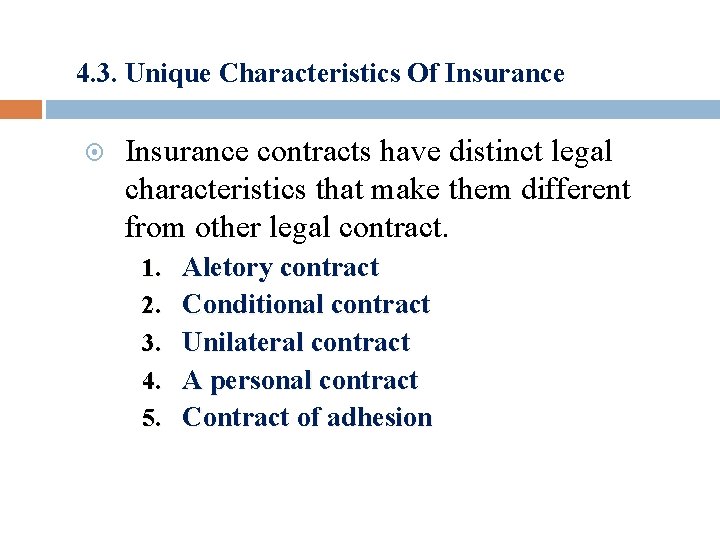
4. 3. Unique Characteristics Of Insurance contracts have distinct legal characteristics that make them different from other legal contract. 1. 2. 3. 4. 5. Aletory contract Conditional contract Unilateral contract A personal contract Contract of adhesion
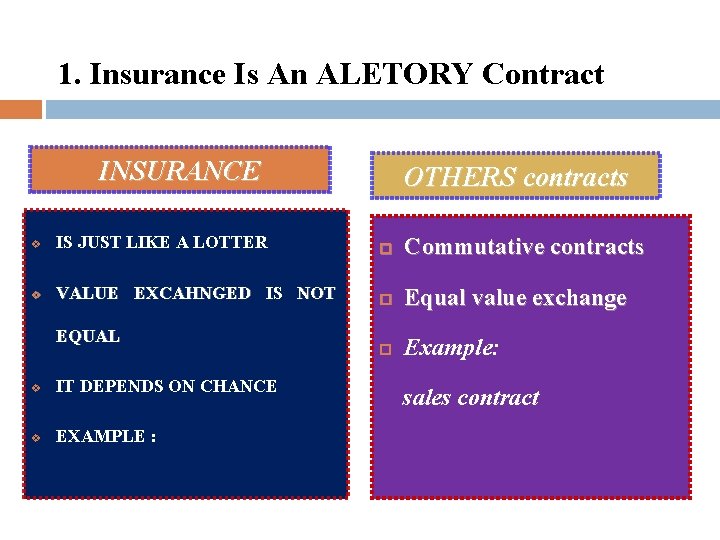
1. Insurance Is An ALETORY Contract INSURANCE OTHERS contracts v IS JUST LIKE A LOTTER Commutative contracts v VALUE EXCAHNGED IS NOT Equal value exchange Example: EQUAL v IT DEPENDS ON CHANCE v EXAMPLE : sales contract
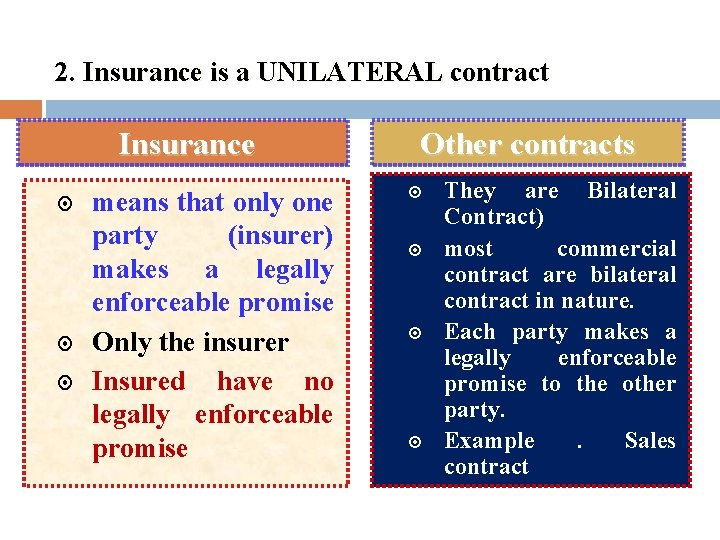
2. Insurance is a UNILATERAL contract Insurance means that only one party (insurer) makes a legally enforceable promise Only the insurer Insured have no legally enforceable promise Other contracts They are Bilateral Contract) most commercial contract are bilateral contract in nature. Each party makes a legally enforceable promise to the other party. Example. Sales contract
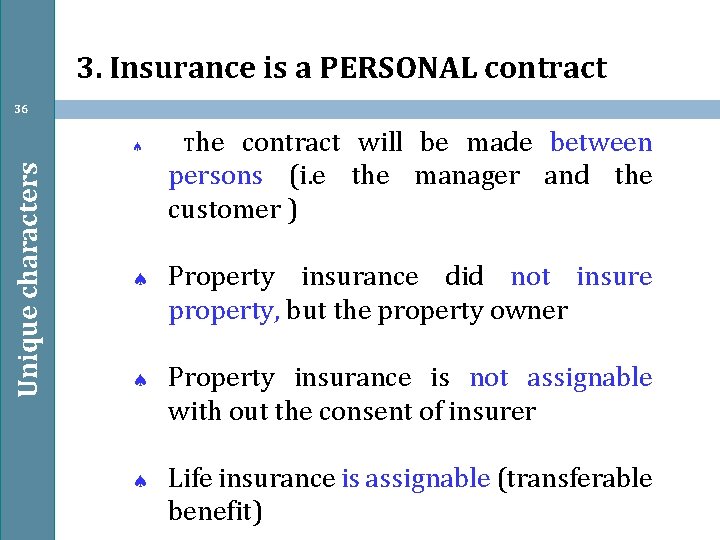
3. Insurance is a PERSONAL contract 36 Unique characters The contract will be made between persons (i. e the manager and the customer ) Property insurance did not insure property, but the property owner Property insurance is not assignable with out the consent of insurer Life insurance is assignable (transferable benefit)
4. Insurance is a CONDITIONAL contract 37 Unique characters Conditions are provisions which makes the insurers obligation to pay insured qualified or disqualified, Payment of premium is not a guarantee for insured to insure indemnification Insurers obligation to pay the insured depends on weather the insured discharges his duties or not Common conditions of property insurance To protect damaged property from further damage To file a proof of loss with in due time Co work with insurer while determining the amount of loss and legal low suit
5. Insurance is a contract of ADHESION Unique characters 38 The contract made on mutual trust ad agreement The insured must accept the entire contract, with all its terms and conditions. If there is any doubt or ambiguity on the contract the advantage will go to the insured Under a clear contract the legal effete is as it is written on the contract.
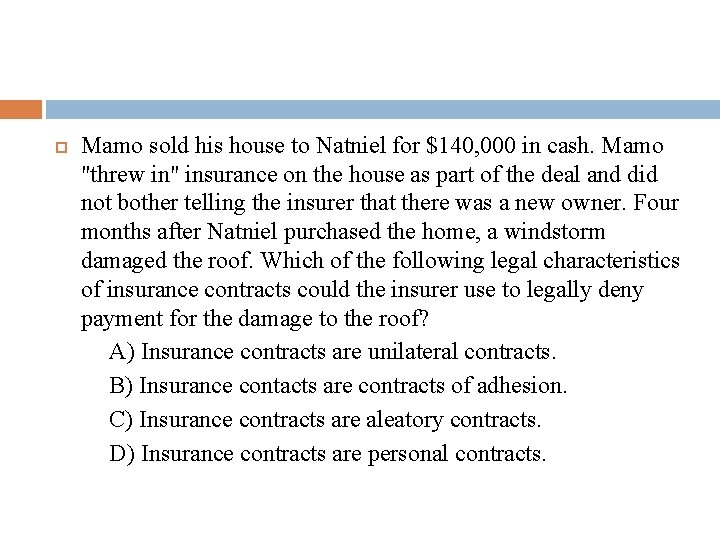
Mamo sold his house to Natniel for $140, 000 in cash. Mamo "threw in" insurance on the house as part of the deal and did not bother telling the insurer that there was a new owner. Four months after Natniel purchased the home, a windstorm damaged the roof. Which of the following legal characteristics of insurance contracts could the insurer use to legally deny payment for the damage to the roof? A) Insurance contracts are unilateral contracts. B) Insurance contacts are contracts of adhesion. C) Insurance contracts are aleatory contracts. D) Insurance contracts are personal contracts.
End ! Do Good, Do It Well, Do It Your Way!