
Risk Management Insurance CHAPTER 3 INSURANCE AN INTRODUCTION
- Slides: 30
Risk Management & Insurance CHAPTER 3 INSURANCE: AN INTRODUCTION
Chapter 1: Agenda 2 1. 1. Definition of Risk 1. 2. Risk Vs Uncertainty, and chance of loss 1. 3. Risk, peril and hazard 1. 4. Classes of Risk 1. 5. Types of pure risk 1. 5. 1. Personal pure risks 1. 5. 2. Property pure risks 1. 5. 3. Liability pure risks
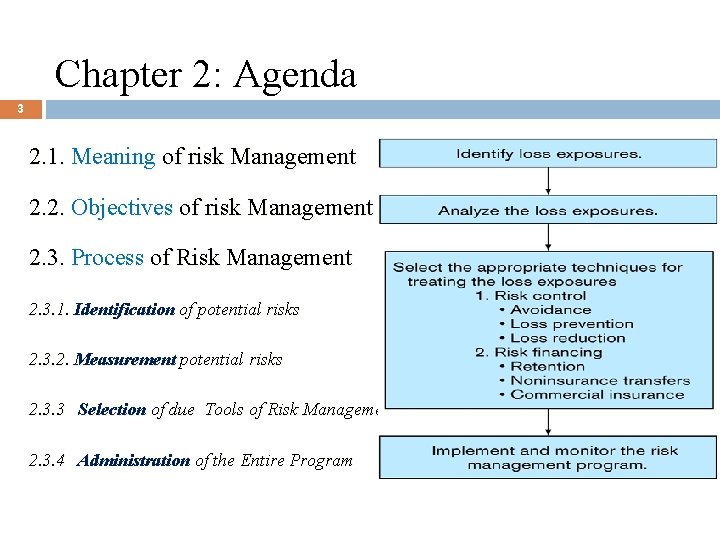
Chapter 2: Agenda 3 2. 1. Meaning of risk Management 2. 2. Objectives of risk Management 2. 3. Process of Risk Management 2. 3. 1. Identification of potential risks 2. 3. 2. Measurement potential risks 2. 3. 3 Selection of due Tools of Risk Management 2. 3. 4 Administration of the Entire Program
Chapter 3: Agenda 4 1. 2. Chapter 3: INSURANCE: An Introduction 1. 2. 3. 4. 5. 3. 1. Definition & function of insurance. 3. 2. Basic Characteristics of Insurance 3. 3. Requirement of insurable risk 3. 4. Insurance Vs (gambling, Speculation) 3. 5. Social and Economic Value of Insurance.
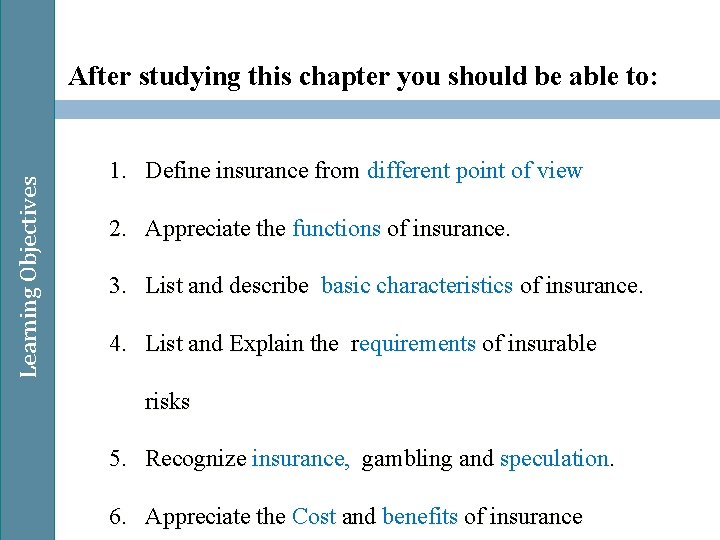
After studying this chapter you should be able to: Learning Objectives 5 1. Define insurance from different point of view 2. Appreciate the functions of insurance. 3. List and describe basic characteristics of insurance. 4. List and Explain the requirements of insurable risks 5. Recognize insurance, gambling and speculation. 6. Appreciate the Cost and benefits of insurance
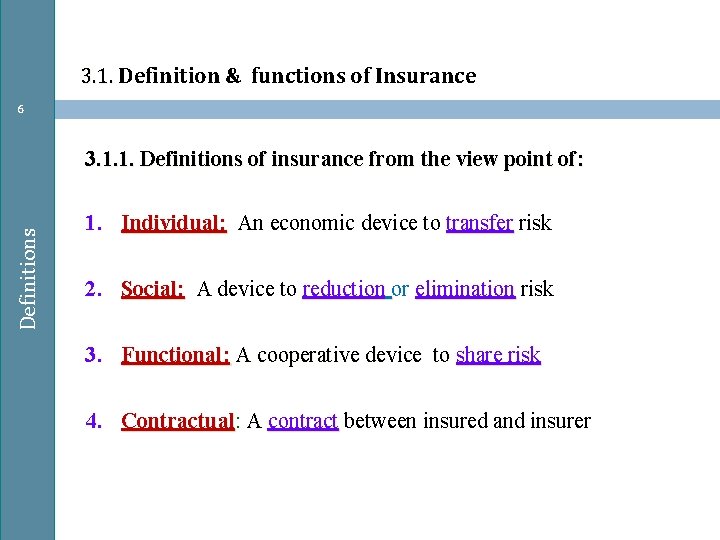
3. 1. Definition & functions of Insurance 6 Definitions 3. 1. 1. Definitions of insurance from the view point of: 1. Individual: An economic device to transfer risk 2. Social: A device to reduction or elimination risk 3. Functional: A cooperative device to share risk 4. Contractual: A contract between insured and insurer
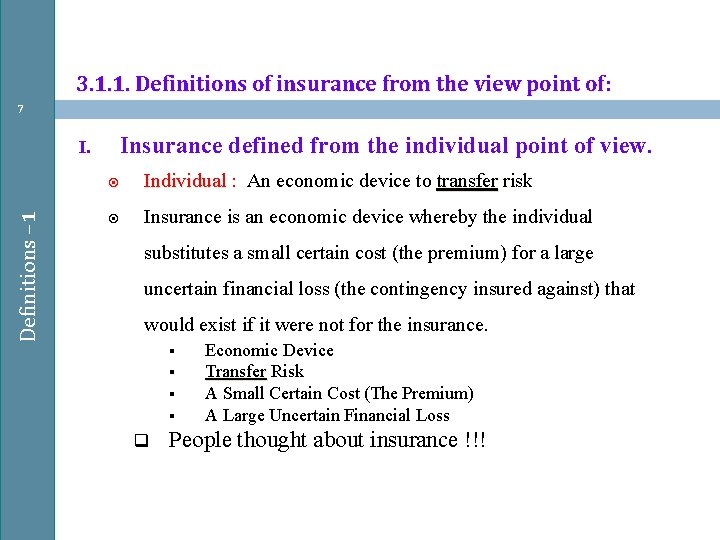
3. 1. 1. Definitions of insurance from the view point of: 7 Definitions – 1 I. Insurance defined from the individual point of view. Individual : An economic device to transfer risk Insurance is an economic device whereby the individual substitutes a small certain cost (the premium) for a large uncertain financial loss (the contingency insured against) that would exist if it were not for the insurance. § § q Economic Device Transfer Risk A Small Certain Cost (The Premium) A Large Uncertain Financial Loss People thought about insurance !!!
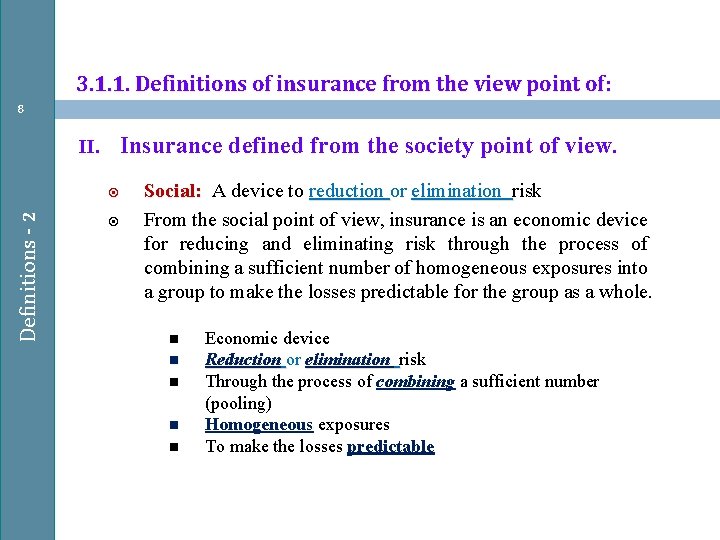
3. 1. 1. Definitions of insurance from the view point of: 8 II. Insurance defined from the society point of view. Definitions - 2 Social: A device to reduction or elimination risk From the social point of view, insurance is an economic device for reducing and eliminating risk through the process of combining a sufficient number of homogeneous exposures into a group to make the losses predictable for the group as a whole. Economic device Reduction or elimination risk Through the process of combining a sufficient number (pooling) Homogeneous exposures To make the losses predictable
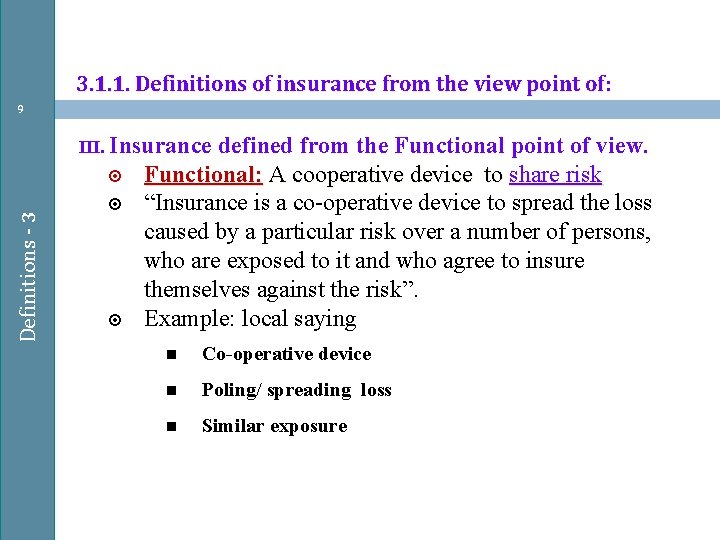
3. 1. 1. Definitions of insurance from the view point of: 9 III. Insurance Definitions - 3 defined from the Functional point of view. Functional: A cooperative device to share risk “Insurance is a co-operative device to spread the loss caused by a particular risk over a number of persons, who are exposed to it and who agree to insure themselves against the risk”. Example: local saying Co-operative device Poling/ spreading loss Similar exposure
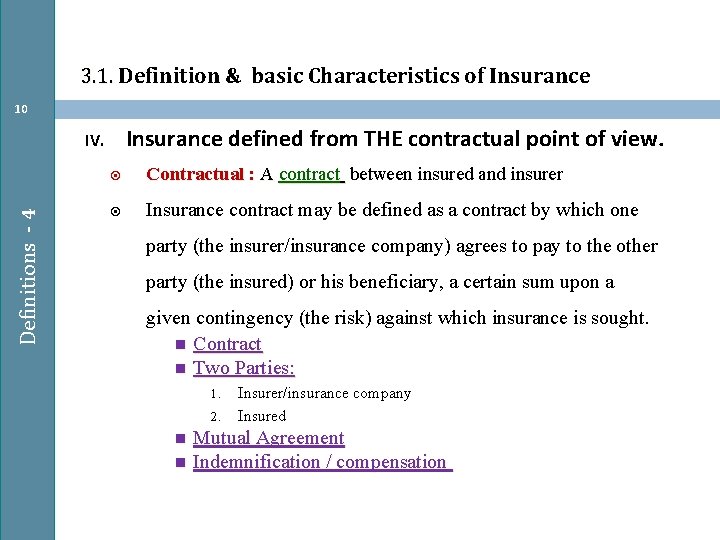
3. 1. Definition & basic Characteristics of Insurance 10 Insurance defined from THE contractual point of view. Definitions - 4 IV. Contractual : A contract between insured and insurer Insurance contract may be defined as a contract by which one party (the insurer/insurance company) agrees to pay to the other party (the insured) or his beneficiary, a certain sum upon a given contingency (the risk) against which insurance is sought. Contract Two Parties: 1. 2. Insurer/insurance company Insured Mutual Agreement Indemnification / compensation
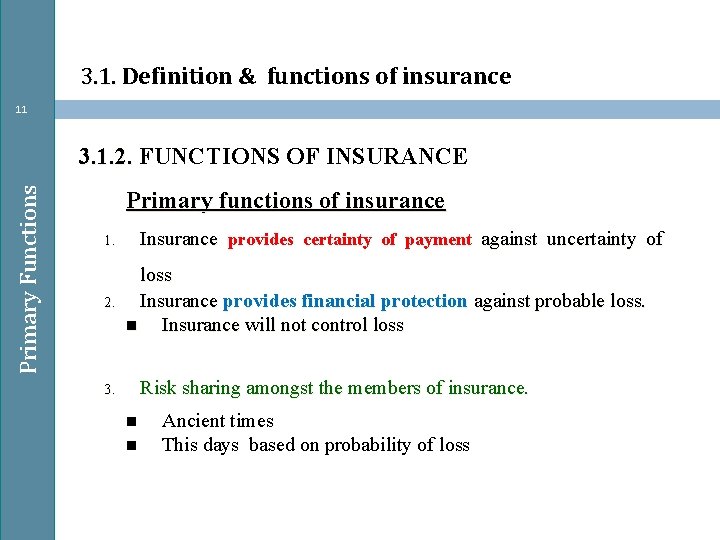
3. 1. Definition & functions of insurance 11 Primary Functions 3. 1. 2. FUNCTIONS OF INSURANCE Primary functions of insurance Insurance provides certainty of payment against uncertainty of 1. 2. loss Insurance provides financial protection against probable loss. Insurance will not control loss Risk sharing amongst the members of insurance. 3. Ancient times This days based on probability of loss
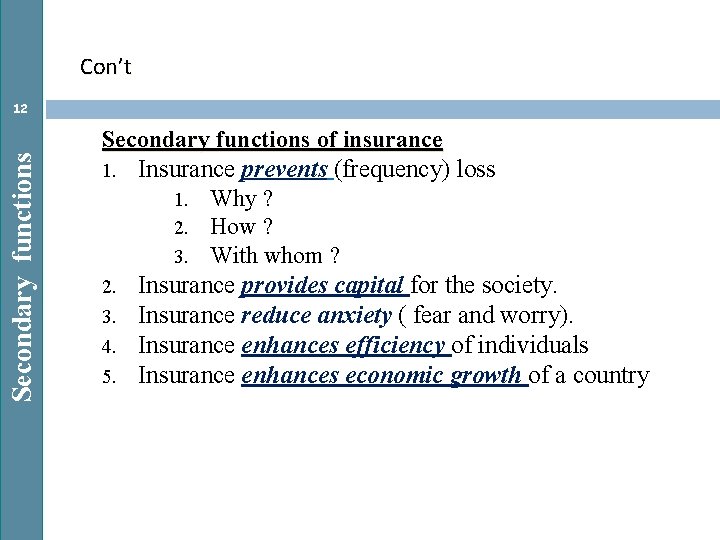
Con’t Secondary functions 12 Secondary functions of insurance 1. Insurance prevents (frequency) loss 1. Why ? 2. How ? 3. With whom ? 2. Insurance provides capital for the society. 3. Insurance reduce anxiety ( fear and worry). 4. Insurance enhances efficiency of individuals 5. Insurance enhances economic growth of a country
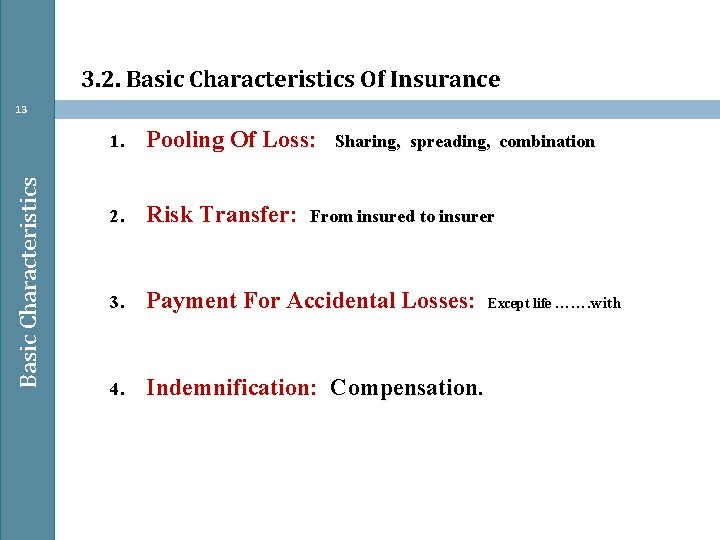
3. 2. Basic Characteristics Of Insurance Basic Characteristics 13 1. Pooling Of Loss: 2. Risk Transfer: 3. Payment For Accidental Losses: 4. Indemnification: Compensation. Sharing, spreading, combination From insured to insurer Except life ……. with
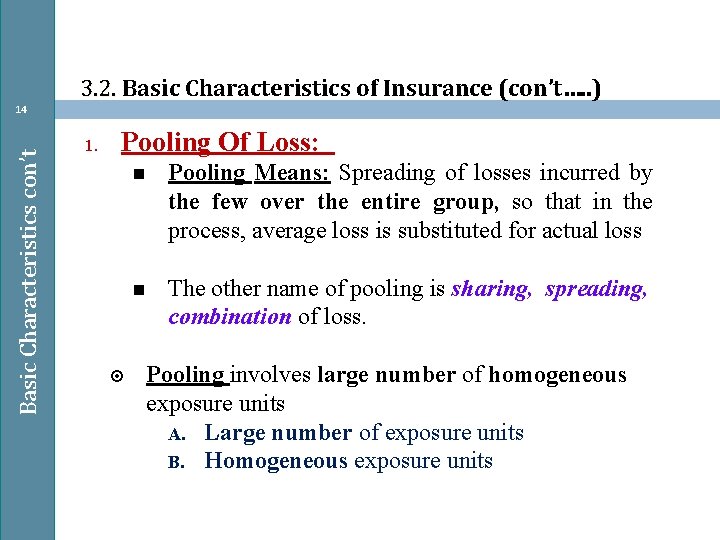
3. 2. Basic Characteristics of Insurance (con’t…. . ) Basic Characteristics con’t 14 1. Pooling Of Loss: Pooling Means: Spreading of losses incurred by the few over the entire group, so that in the process, average loss is substituted for actual loss The other name of pooling is sharing, spreading, combination of loss. Pooling involves large number of homogeneous exposure units A. Large number of exposure units B. Homogeneous exposure units
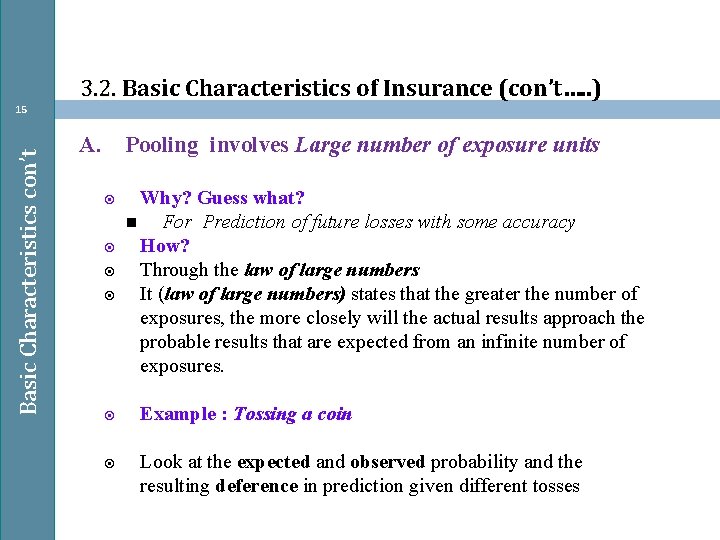
3. 2. Basic Characteristics of Insurance (con’t…. . ) Basic Characteristics con’t 15 A. Pooling involves Large number of exposure units Why? Guess what? For Prediction of future losses with some accuracy How? Through the law of large numbers It (law of large numbers) states that the greater the number of exposures, the more closely will the actual results approach the probable results that are expected from an infinite number of exposures. Example : Tossing a coin Look at the expected and observed probability and the resulting deference in prediction given different tosses
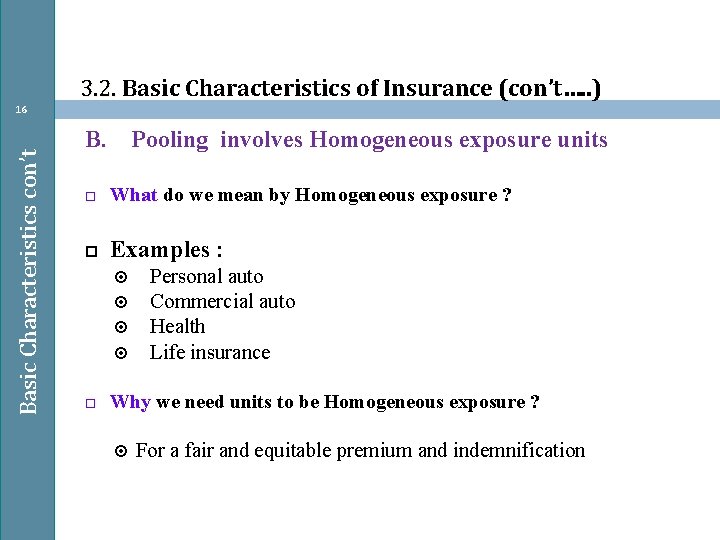
3. 2. Basic Characteristics of Insurance (con’t…. . ) Basic Characteristics con’t 16 B. Pooling involves Homogeneous exposure units What do we mean by Homogeneous exposure ? Examples : Personal auto Commercial auto Health Life insurance Why we need units to be Homogeneous exposure ? For a fair and equitable premium and indemnification
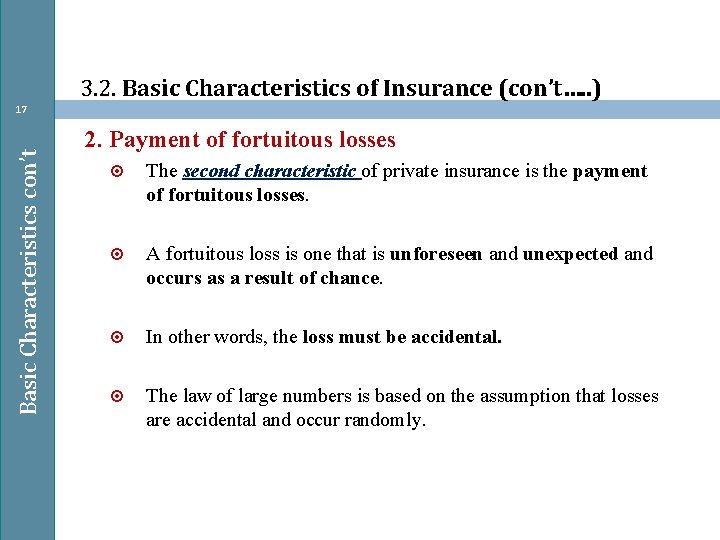
3. 2. Basic Characteristics of Insurance (con’t…. . ) Basic Characteristics con’t 17 2. Payment of fortuitous losses The second characteristic of private insurance is the payment of fortuitous losses. A fortuitous loss is one that is unforeseen and unexpected and occurs as a result of chance. In other words, the loss must be accidental. The law of large numbers is based on the assumption that losses are accidental and occur randomly.
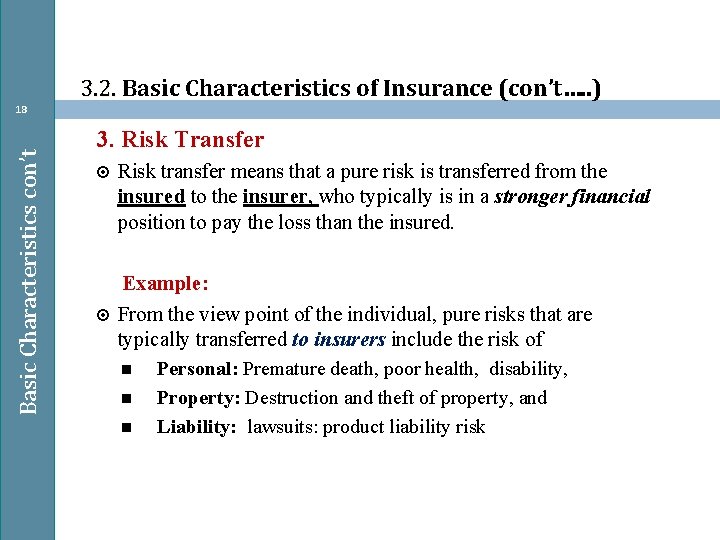
3. 2. Basic Characteristics of Insurance (con’t…. . ) Basic Characteristics con’t 18 3. Risk Transfer Risk transfer means that a pure risk is transferred from the insured to the insurer, who typically is in a stronger financial position to pay the loss than the insured. Example: From the view point of the individual, pure risks that are typically transferred to insurers include the risk of Personal: Premature death, poor health, disability, Property: Destruction and theft of property, and Liability: lawsuits: product liability risk
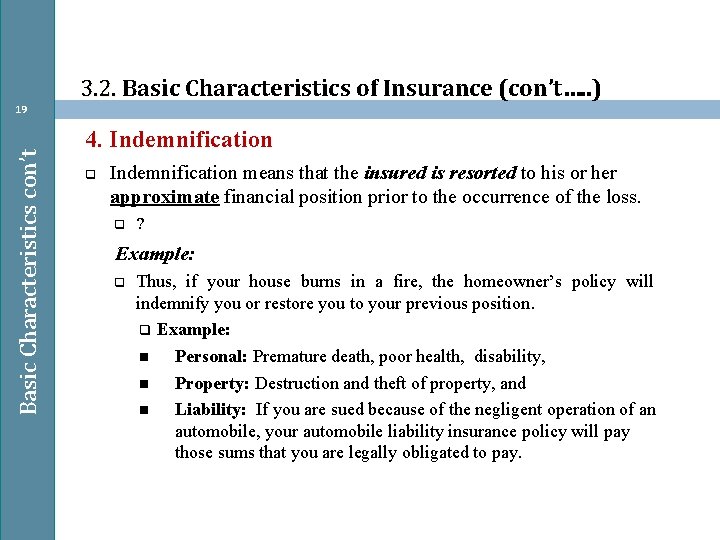
3. 2. Basic Characteristics of Insurance (con’t…. . ) Basic Characteristics con’t 19 4. Indemnification q Indemnification means that the insured is resorted to his or her approximate financial position prior to the occurrence of the loss. q ? Example: q Thus, if your house burns in a fire, the homeowner’s policy will indemnify you or restore you to your previous position. q Example: Personal: Premature death, poor health, disability, Property: Destruction and theft of property, and Liability: If you are sued because of the negligent operation of an automobile, your automobile liability insurance policy will pay those sums that you are legally obligated to pay.
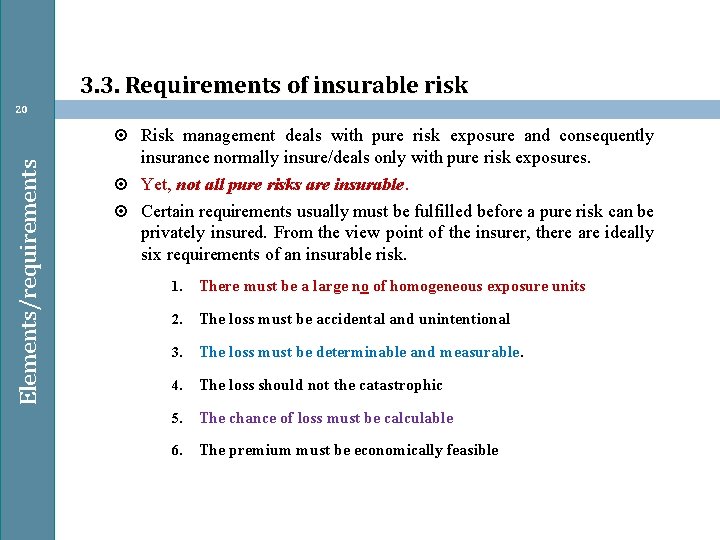
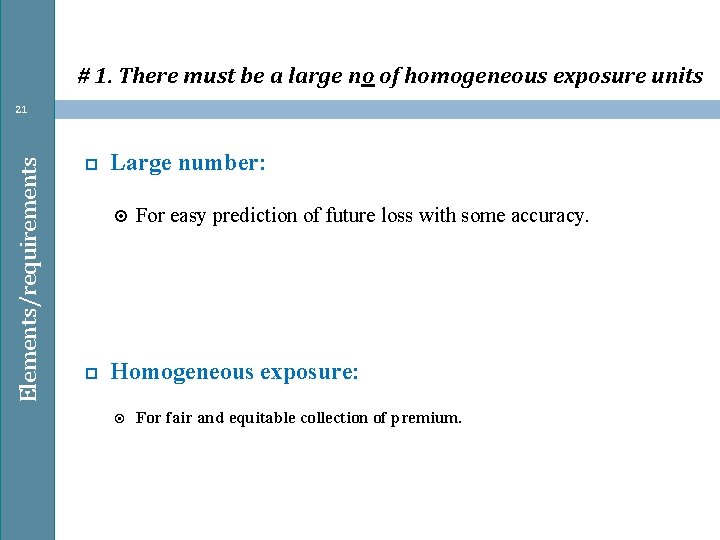
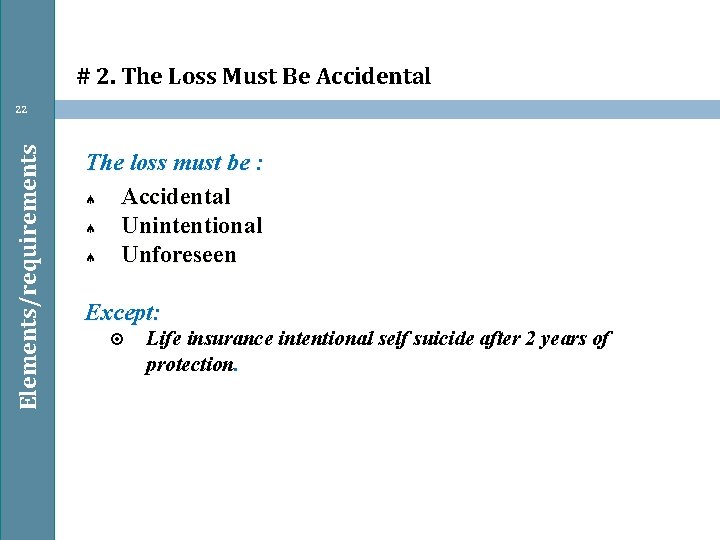
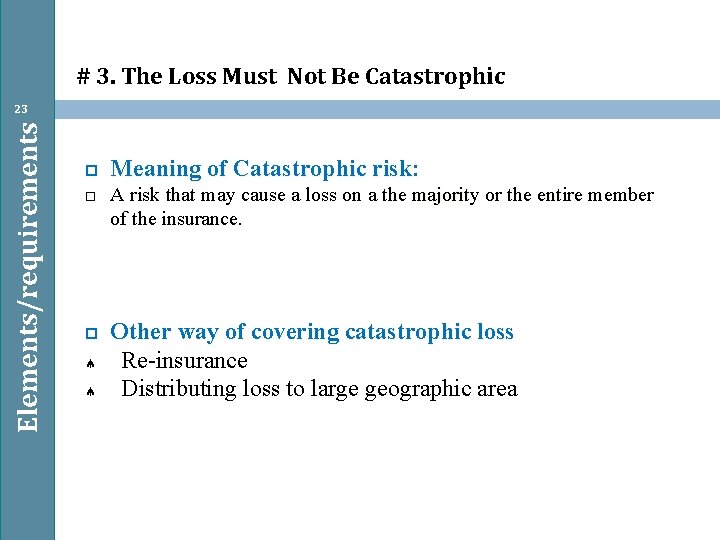
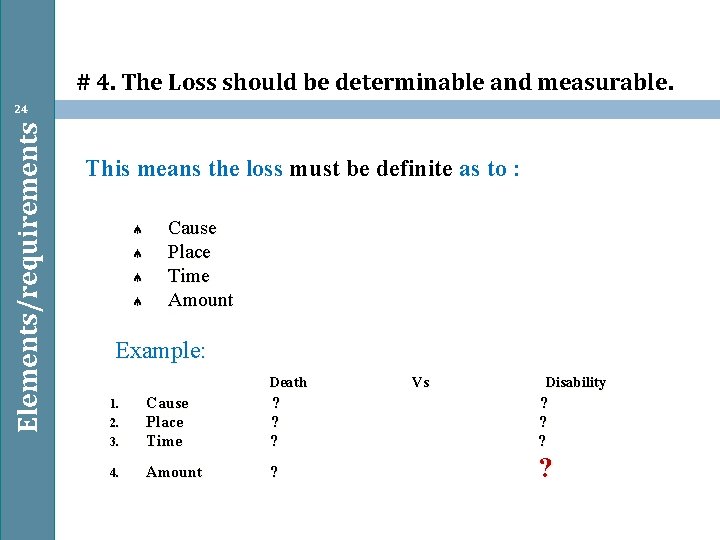
3. 3. Requirements of insurable risk 20 Elements/requirements Risk management deals with pure risk exposure and consequently insurance normally insure/deals only with pure risk exposures. Yet, not all pure risks are insurable. Certain requirements usually must be fulfilled before a pure risk can be privately insured. From the view point of the insurer, there are ideally six requirements of an insurable risk. 1. There must be a large no of homogeneous exposure units 2. The loss must be accidental and unintentional 3. The loss must be determinable and measurable. 4. The loss should not the catastrophic 5. The chance of loss must be calculable 6. The premium must be economically feasible
# 1. There must be a large no of homogeneous exposure units Elements/requirements 21 Large number: For easy prediction of future loss with some accuracy. Homogeneous exposure: For fair and equitable collection of premium.
# 2. The Loss Must Be Accidental Elements/requirements 22 The loss must be : ª Accidental ª Unintentional ª Unforeseen Except: Life insurance intentional self suicide after 2 years of protection.
# 3. The Loss Must Not Be Catastrophic Elements/requirements 23 ª ª Meaning of Catastrophic risk: A risk that may cause a loss on a the majority or the entire member of the insurance. Other way of covering catastrophic loss Re-insurance Distributing loss to large geographic area
# 4. The Loss should be determinable and measurable. Elements/requirements 24 This means the loss must be definite as to : ª ª Cause Place Time Amount Example: Death Vs Disability 3. Cause Place Time ? ? ? 4. Amount ? ? 1. 2.
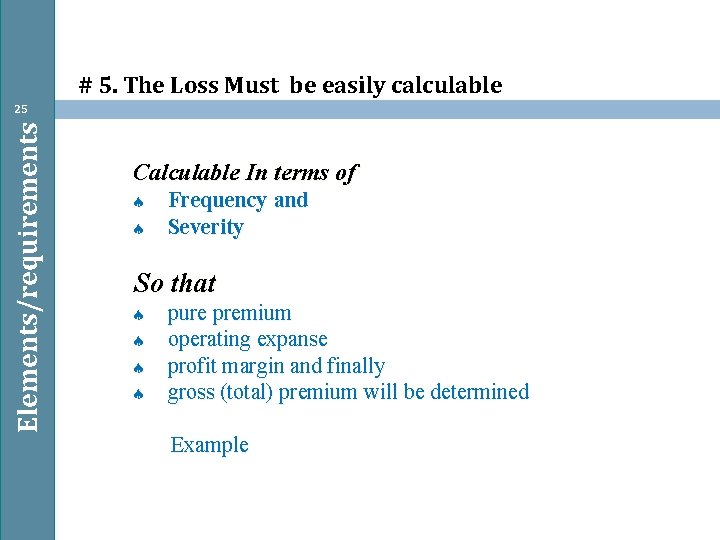
# 5. The Loss Must be easily calculable Elements/requirements 25 Calculable In terms of ª ª Frequency and Severity So that ª ª pure premium operating expanse profit margin and finally gross (total) premium will be determined Example
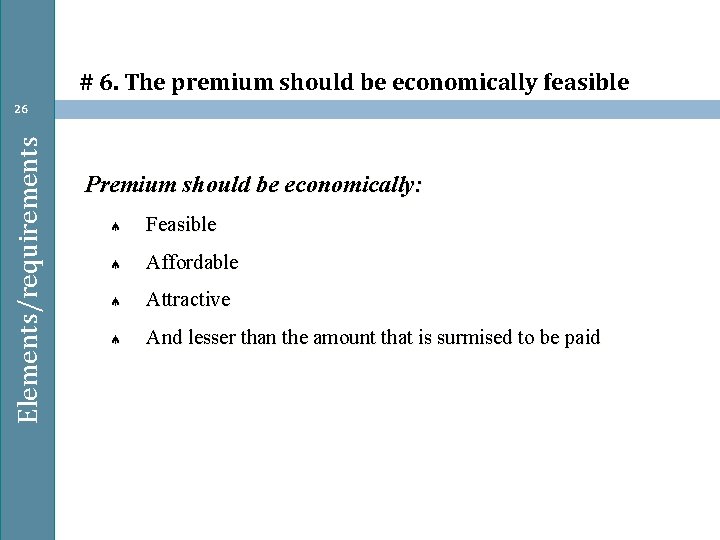
# 6. The premium should be economically feasible Elements/requirements 26 Premium should be economically: ª Feasible ª Affordable ª Attractive ª And lesser than the amount that is surmised to be paid
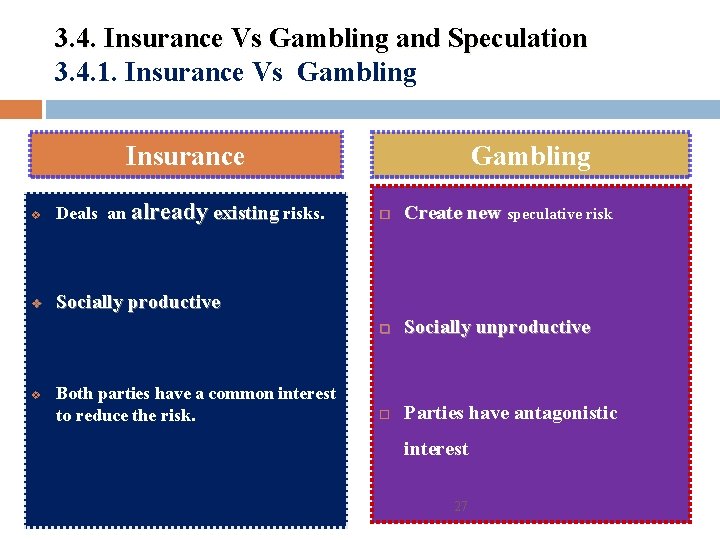
3. 4. Insurance Vs Gambling and Speculation 3. 4. 1. Insurance Vs Gambling Insurance v Deals an already existing risks. v Socially productive v Both parties have a common interest to reduce the risk. Gambling Create new speculative risk Socially unproductive Parties have antagonistic interest 27
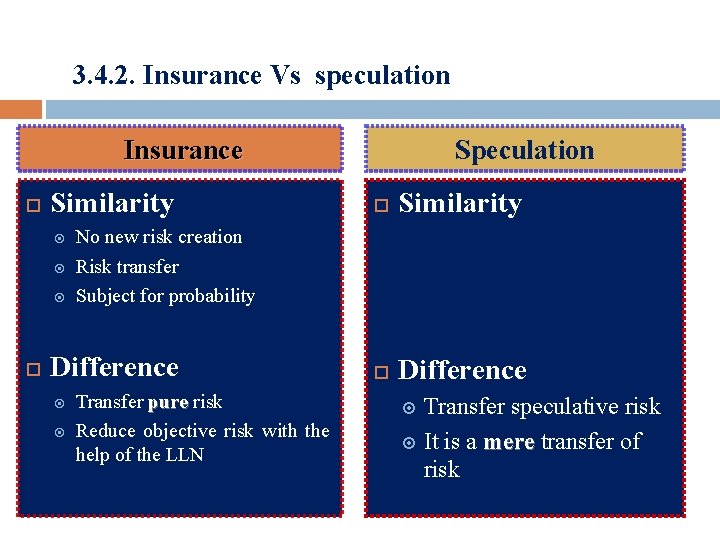
3. 4. 2. Insurance Vs speculation Insurance Similarity Difference No new risk creation Risk transfer Subject for probability Difference Speculation Transfer pure risk Reduce objective risk with the help of the LLN Transfer speculative risk It is a mere transfer of risk
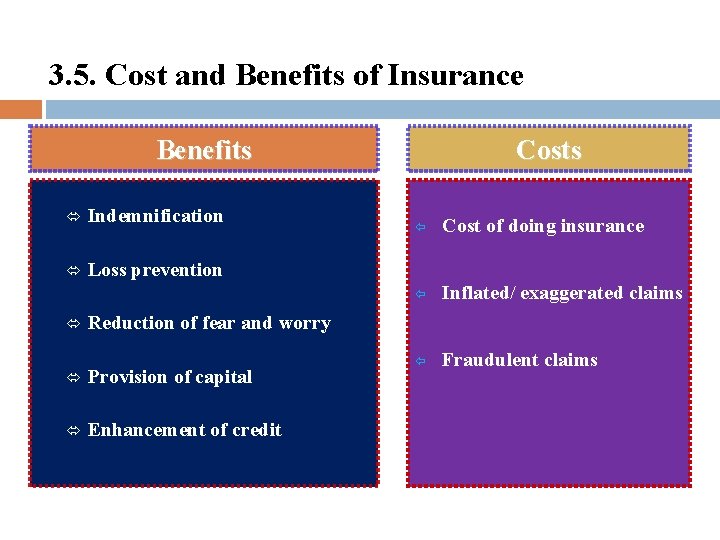
3. 5. Cost and Benefits of Insurance Benefits ó Indemnification ó Loss prevention ó Costs ï Cost of doing insurance ï Inflated/ exaggerated claims ï Fraudulent claims Reduction of fear and worry ó Provision of capital ó Enhancement of credit
End!