
Risk Management in Statistical Organizations Module 1 The



- Slides: 19
Risk Management in Statistical Organizations
Module 1: The Concept of Risk Management 1) an unwanted event which may or may not occur. 2) the cause of an unwanted event which may or may not occur. 3) the probability of an unwanted event which may or may not occur’
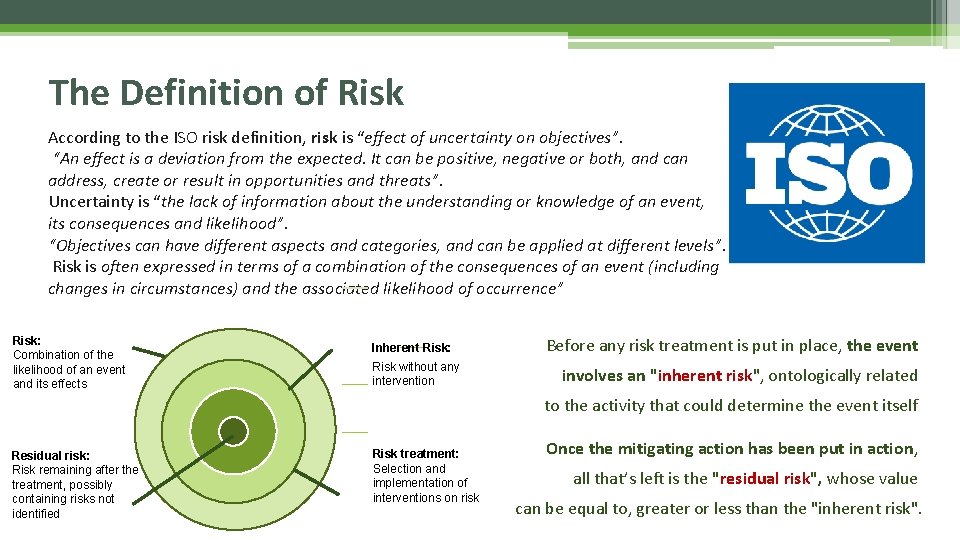
The Definition of Risk According to the ISO risk definition, risk is “effect of uncertainty on objectives”. “An effect is a deviation from the expected. It can be positive, negative or both, and can address, create or result in opportunities and threats”. Uncertainty is “the lack of information about the understanding or knowledge of an event, its consequences and likelihood”. “Objectives can have different aspects and categories, and can be applied at different levels”. Risk is often expressed in terms of a combination of the consequences of an event (including changes in circumstances) and the associated likelihood of occurrence” Risk: Combination of the likelihood of an event and its effects Residual risk: Risk remaining after the treatment, possibly containing risks not identified a Inherent Risk: ccc Risk without any intervention Risk treatment: Selection and implementation of interventions on risk Before any risk treatment is put in place, the event involves an "inherent risk", ontologically related to the activity that could determine the event itself Once the mitigating action has been put in action, all that’s left is the "residual risk", whose value can be equal to, greater or less than the "inherent risk".
The Definition of Risk When defining a risk, some issues should be taken into consideration: • A risk statement should be a clear, meaningful and concise statement that describes the risk. Example: “Increased difficulties in reaching household survey respondents could adversely impact the quality of our data”. • The statement should describe the event, and the potential impact of that event on the achievement of the organization’s objectives. Example: There is a risk that (event). . and the consequences are (impact). . . • A good risk statement should also include the possible causes (drivers). Examples: There is a risk that (event). . . because of (cause). . . and the consequences would be (impact). . . ; Given that. . . there is a risk that. . . with the potential impact of. .
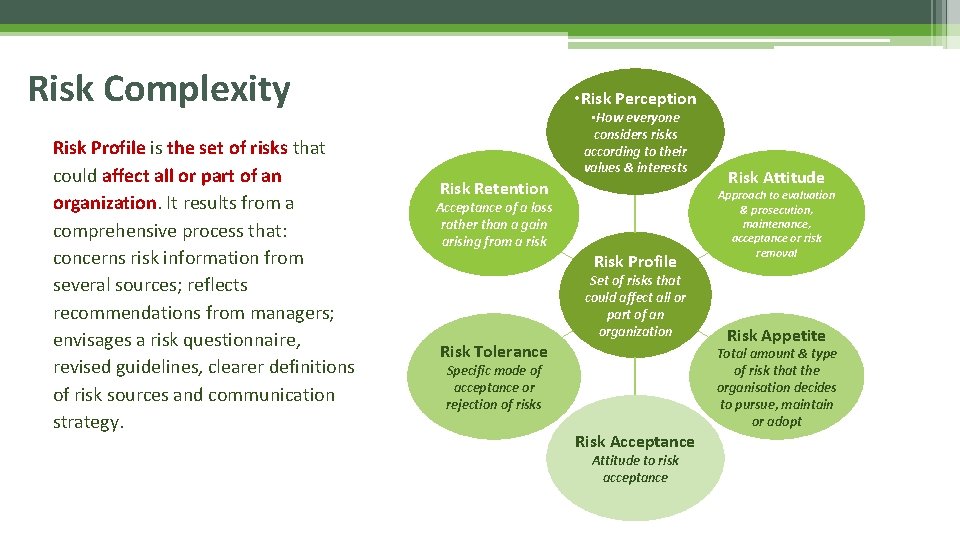
Risk Complexity Risk Profile is the set of risks that could affect all or part of an organization. It results from a comprehensive process that: concerns risk information from several sources; reflects recommendations from managers; envisages a risk questionnaire, revised guidelines, clearer definitions of risk sources and communication strategy. • Risk Perception • How everyone considers risks according to their values & interests Risk Retention Acceptance of a loss rather than a gain arising from a risk Risk Profile Set of risks that could affect all or part of an organization Risk Tolerance Risk Attitude Approach to evaluation & prosecution, maintenance, acceptance or risk removal Risk Appetite Total amount & type of risk that the organisation decides to pursue, maintain or adopt Specific mode of acceptance or rejection of risks Risk Acceptance Attitude to risk acceptance
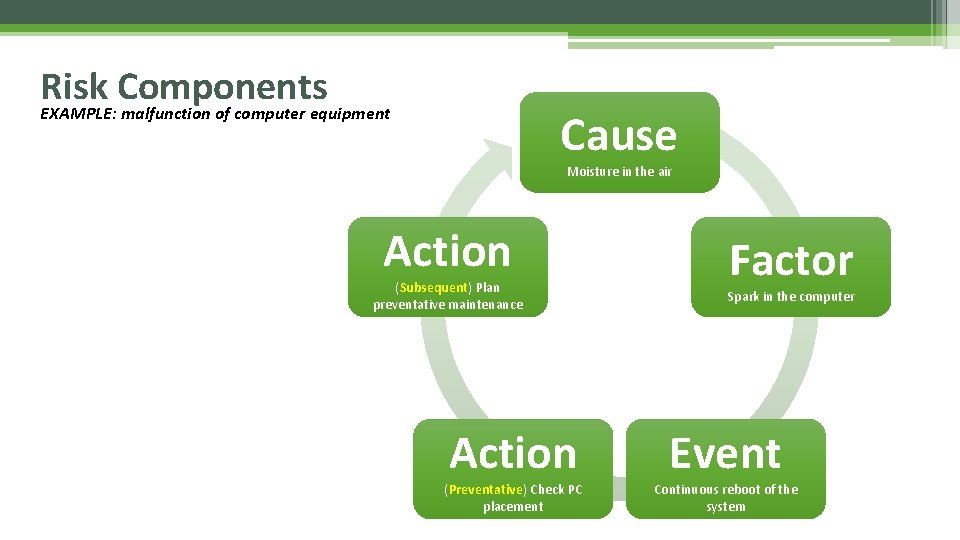
Risk Components EXAMPLE: malfunction of computer equipment Cause Moisture in the air Action (Subsequent) Plan preventative maintenance Action (Preventative) Check PC placement Factor Spark in the computer Event Continuous reboot of the system
What is or isn’t a Risk? o The risks must be linked to the objectives o You must pay attention to the risks with generic impact on the objectives, but not relevant for the results o In identifying the risks, you should not confuse them with the impacts o You must avoid defining risks with assertions that are only the opposite of the objectives o The definition of a risk should understand the cause and consequence Objective: Travelling by train from A to B to arrive on time for a meeting Not being able to get from A to B in time for the meeting Be late & miss the meeting There isn’t a dining car so I’m hungry I miss the train (so I’m late & I cannot attend the meeting) The bad weather conditions prevent the train from leaving the station . This is only the opposite of the objective This is the impact of the risk not the risk itself This does not impact on the objective This is a risk that I can control making sure that I will arrive early This is a risk that I cannot control but I can manage with an emergency plan
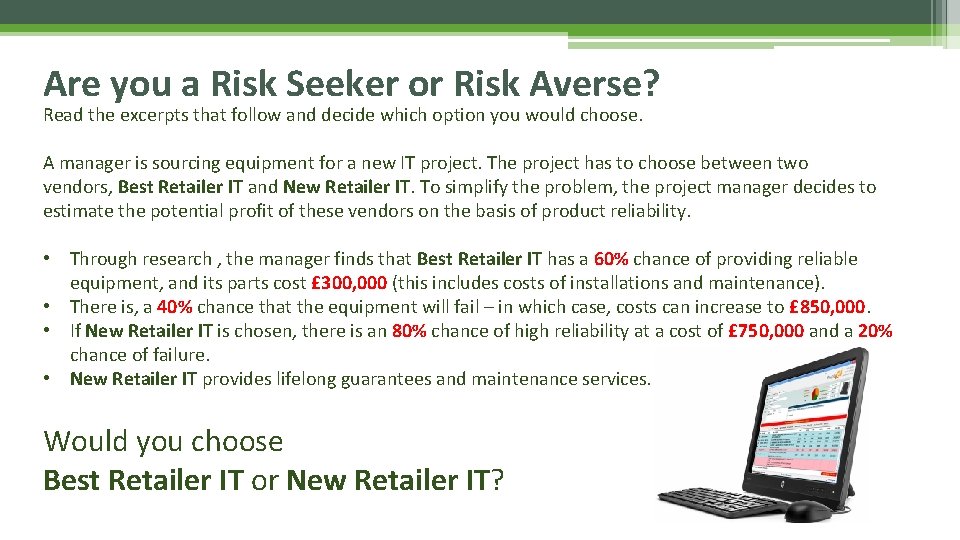
Are you a Risk Seeker or Risk Averse? Read the excerpts that follow and decide which option you would choose. A manager is sourcing equipment for a new IT project. The project has to choose between two vendors, Best Retailer IT and New Retailer IT. To simplify the problem, the project manager decides to estimate the potential profit of these vendors on the basis of product reliability. • Through research , the manager finds that Best Retailer IT has a 60% chance of providing reliable equipment, and its parts cost £ 300, 000 (this includes costs of installations and maintenance). • There is, a 40% chance that the equipment will fail – in which case, costs can increase to £ 850, 000. • If New Retailer IT is chosen, there is an 80% chance of high reliability at a cost of £ 750, 000 and a 20% chance of failure. • New Retailer IT provides lifelong guarantees and maintenance services. Would you choose Best Retailer IT or New Retailer IT?
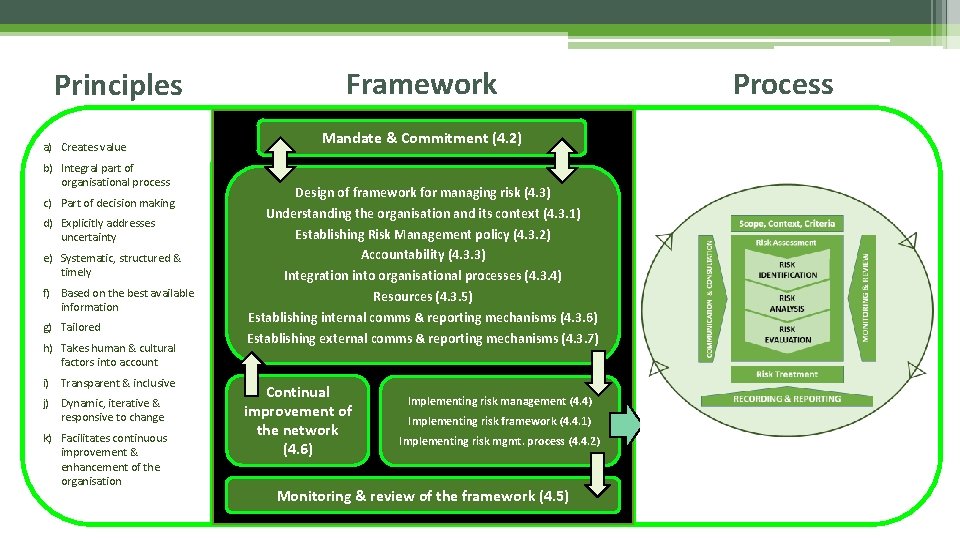
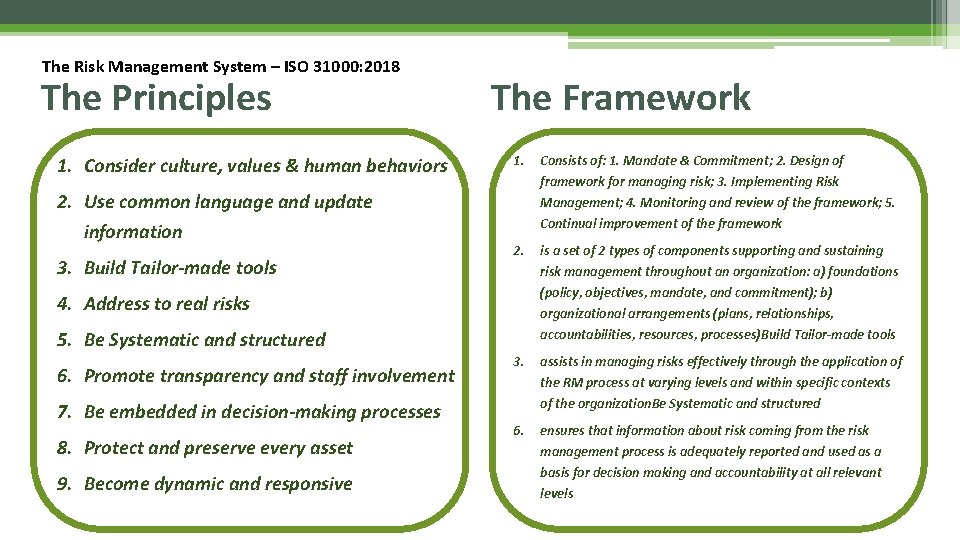
The Risk Management System According to the ISO 31000: 2018, Risk Management refers to the architecture used to manage risks. This architecture includes Principles, Framework, and Process.
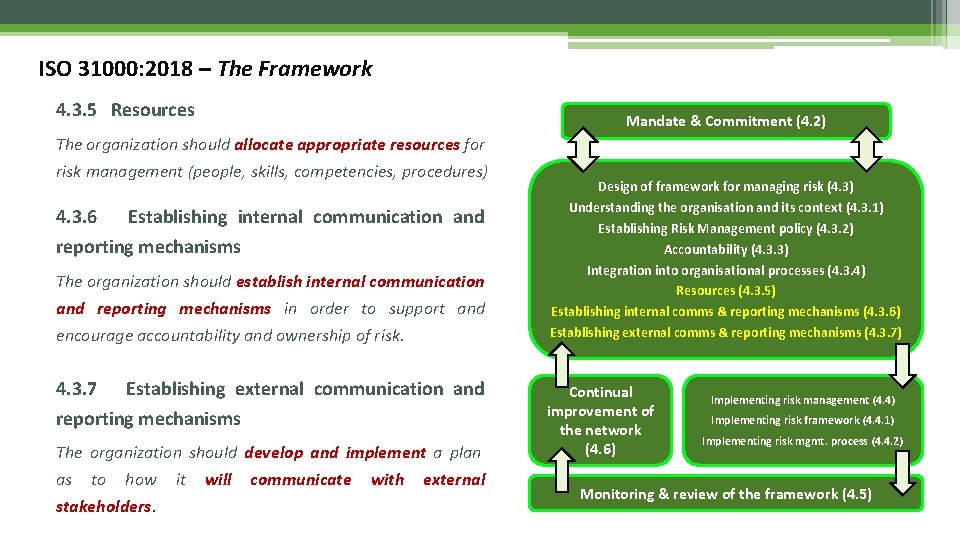
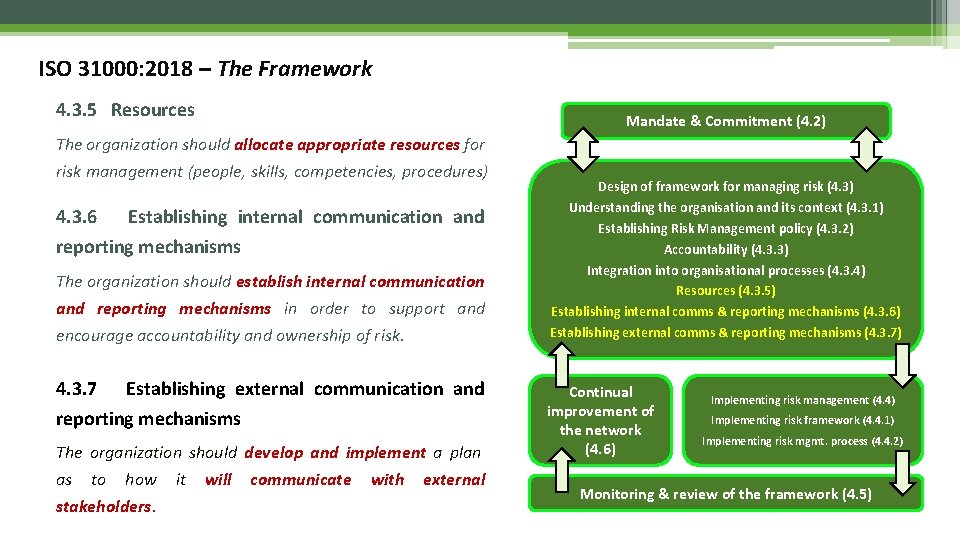
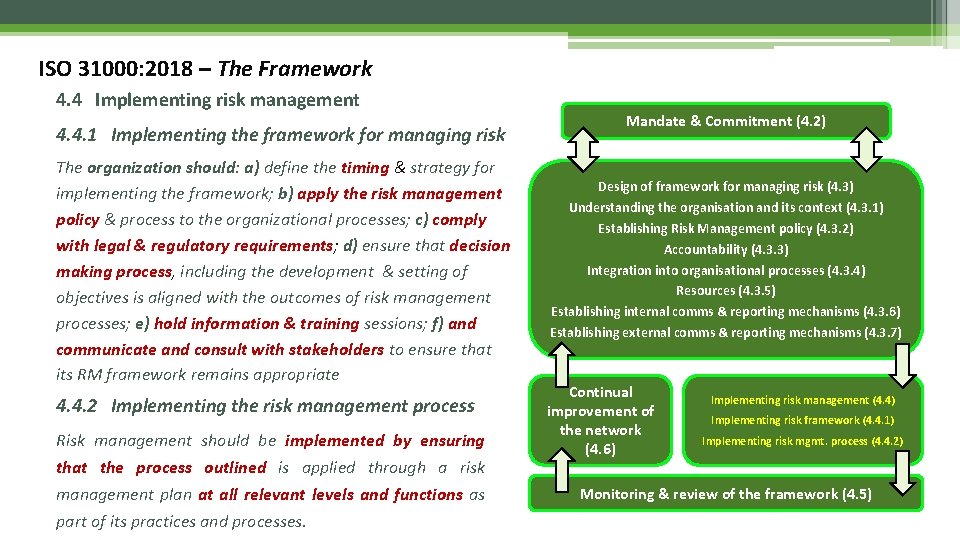
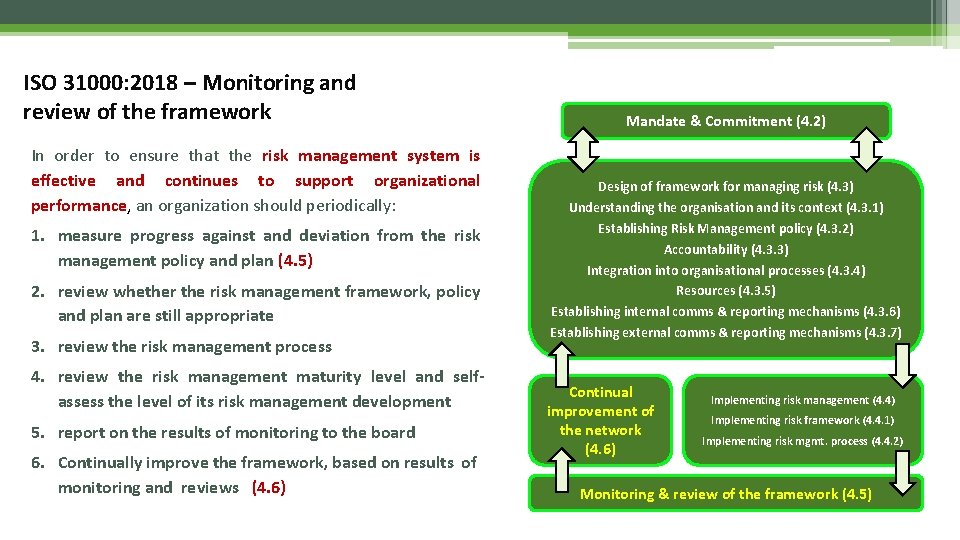
Principles a) Creates value b) Integral part of organisational process c) Part of decision making d) Explicitly addresses uncertainty e) Systematic, structured & timely f) Based on the best available information g) Tailored h) Takes human & cultural factors into account i) Transparent & inclusive j) Dynamic, iterative & responsive to change k) Facilitates continuous improvement & enhancement of the organisation Framework Mandate & Commitment (4. 2) Design of framework for managing risk (4. 3) Understanding the organisation and its context (4. 3. 1) Establishing Risk Management policy (4. 3. 2) Accountability (4. 3. 3) Integration into organisational processes (4. 3. 4) Resources (4. 3. 5) Establishing internal comms & reporting mechanisms (4. 3. 6) Establishing external comms & reporting mechanisms (4. 3. 7) Continual improvement of the network (4. 6) Implementing risk management (4. 4) Implementing risk framework (4. 4. 1) Implementing risk mgmt. process (4. 4. 2) Monitoring & review of the framework (4. 5) Process
The Risk Management System – ISO 31000: 2018 The Principles 1. Consider culture, values & human behaviors 2. Use common language and update information 3. Build Tailor-made tools The Framework 1. framework for managing risk; 3. Implementing Risk Management; 4. Monitoring and review of the framework; 5. Continual improvement of the framework 2. is a set of 2 types of components supporting and sustaining risk management throughout an organization: a) foundations (policy, objectives, mandate, and commitment); b) organizational arrangements (plans, relationships, accountabilities, resources, processes)Build Tailor-made tools 3. assists in managing risks effectively through the application of the RM process at varying levels and within specific contexts of the organization. Be Systematic and structured 6. ensures that information about risk coming from the risk management process is adequately reported and used as a basis for decision making and accountability at all relevant levels 4. Address to real risks 5. Be Systematic and structured 6. Promote transparency and staff involvement 7. Be embedded in decision-making processes 8. Protect and preserve every asset 9. Become dynamic and responsive Consists of: 1. Mandate & Commitment; 2. Design of
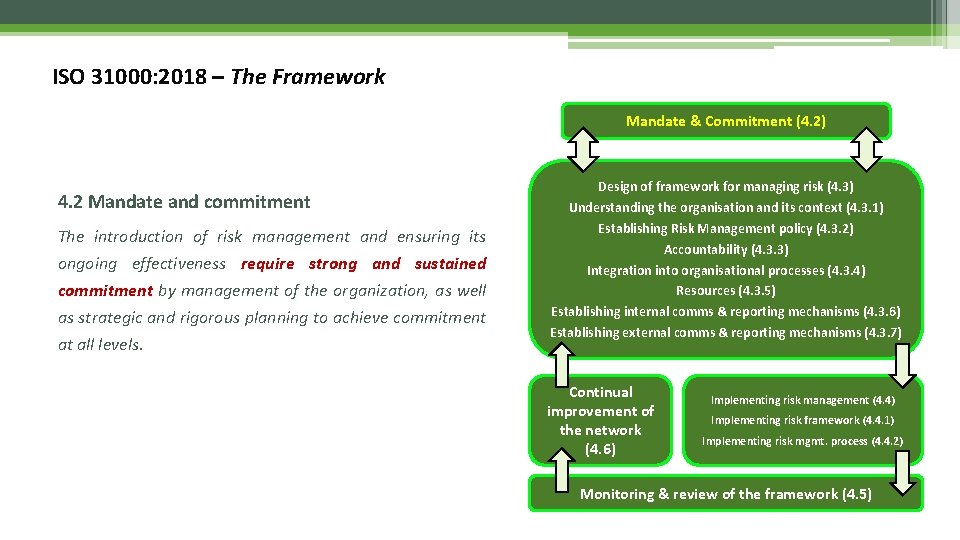
ISO 31000: 2018 – The Framework Mandate & Commitment (4. 2) 4. 2 Mandate and commitment The introduction of risk management and ensuring its ongoing effectiveness require strong and sustained commitment by management of the organization, as well as strategic and rigorous planning to achieve commitment at all levels. Design of framework for managing risk (4. 3) Understanding the organisation and its context (4. 3. 1) Establishing Risk Management policy (4. 3. 2) Accountability (4. 3. 3) Integration into organisational processes (4. 3. 4) Resources (4. 3. 5) Establishing internal comms & reporting mechanisms (4. 3. 6) Establishing external comms & reporting mechanisms (4. 3. 7) Continual improvement of the network (4. 6) Implementing risk management (4. 4) Implementing risk framework (4. 4. 1) Implementing risk mgmt. process (4. 4. 2) Monitoring & review of the framework (4. 5)
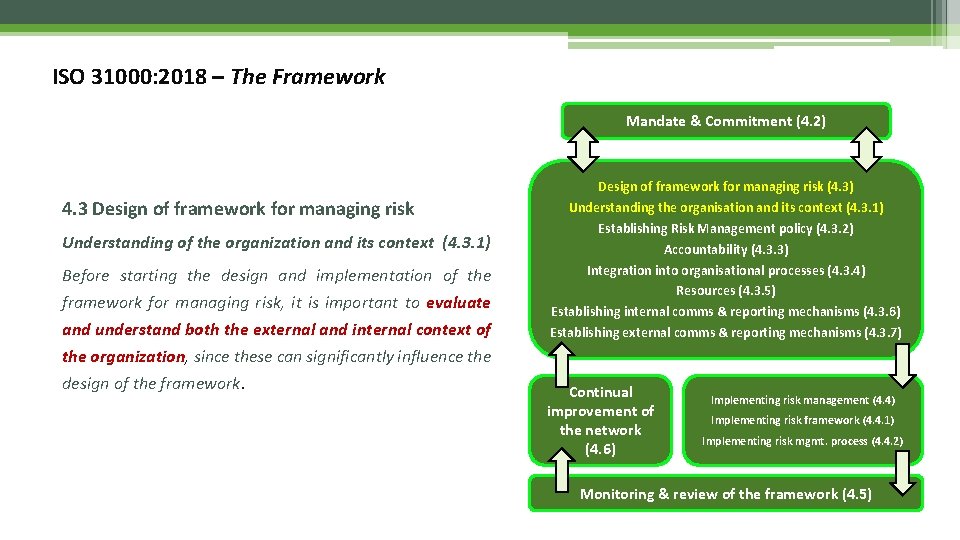
ISO 31000: 2018 – The Framework Mandate & Commitment (4. 2) 4. 3 Design of framework for managing risk Understanding of the organization and its context (4. 3. 1) Before starting the design and implementation of the framework for managing risk, it is important to evaluate and understand both the external and internal context of the organization, since these can significantly influence the design of the framework. Design of framework for managing risk (4. 3) Understanding the organisation and its context (4. 3. 1) Establishing Risk Management policy (4. 3. 2) Accountability (4. 3. 3) Integration into organisational processes (4. 3. 4) Resources (4. 3. 5) Establishing internal comms & reporting mechanisms (4. 3. 6) Establishing external comms & reporting mechanisms (4. 3. 7) Continual improvement of the network (4. 6) Implementing risk management (4. 4) Implementing risk framework (4. 4. 1) Implementing risk mgmt. process (4. 4. 2) Monitoring & review of the framework (4. 5)
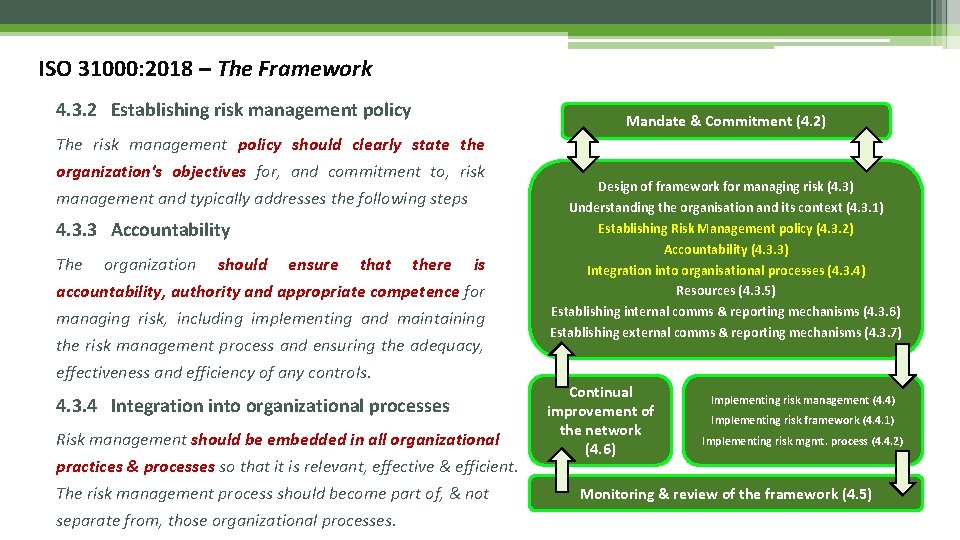
ISO 31000: 2018 – The Framework 4. 3. 2 Establishing risk management policy The risk management policy should clearly state the organization's objectives for, and commitment to, risk management and typically addresses the following steps 4. 3. 3 Accountability The organization should ensure that there is accountability, authority and appropriate competence for managing risk, including implementing and maintaining the risk management process and ensuring the adequacy, effectiveness and efficiency of any controls. 4. 3. 4 Integration into organizational processes Risk management should be embedded in all organizational practices & processes so that it is relevant, effective & efficient. The risk management process should become part of, & not separate from, those organizational processes. Mandate & Commitment (4. 2) Design of framework for managing risk (4. 3) Understanding the organisation and its context (4. 3. 1) Establishing Risk Management policy (4. 3. 2) Accountability (4. 3. 3) Integration into organisational processes (4. 3. 4) Resources (4. 3. 5) Establishing internal comms & reporting mechanisms (4. 3. 6) Establishing external comms & reporting mechanisms (4. 3. 7) Continual improvement of the network (4. 6) Implementing risk management (4. 4) Implementing risk framework (4. 4. 1) Implementing risk mgmt. process (4. 4. 2) Monitoring & review of the framework (4. 5)
ISO 31000: 2018 – The Framework 4. 3. 5 Resources The organization should allocate appropriate resources for risk management (people, skills, competencies, procedures) 4. 3. 6 Establishing internal communication and reporting mechanisms The organization should establish internal communication and reporting mechanisms in order to support and encourage accountability and ownership of risk. 4. 3. 7 Establishing external communication and reporting mechanisms The organization should develop and implement a plan as to how it will communicate with external stakeholders. Mandate & Commitment (4. 2) Design of framework for managing risk (4. 3) Understanding the organisation and its context (4. 3. 1) Establishing Risk Management policy (4. 3. 2) Accountability (4. 3. 3) Integration into organisational processes (4. 3. 4) Resources (4. 3. 5) Establishing internal comms & reporting mechanisms (4. 3. 6) Establishing external comms & reporting mechanisms (4. 3. 7) Continual improvement of the network (4. 6) Implementing risk management (4. 4) Implementing risk framework (4. 4. 1) Implementing risk mgmt. process (4. 4. 2) Monitoring & review of the framework (4. 5)
ISO 31000: 2018 – The Framework 4. 3. 5 Resources The organization should allocate appropriate resources for risk management (people, skills, competencies, procedures) 4. 3. 6 Establishing internal communication and reporting mechanisms The organization should establish internal communication and reporting mechanisms in order to support and encourage accountability and ownership of risk. 4. 3. 7 Establishing external communication and reporting mechanisms The organization should develop and implement a plan as to how it will communicate with external stakeholders. Mandate & Commitment (4. 2) Design of framework for managing risk (4. 3) Understanding the organisation and its context (4. 3. 1) Establishing Risk Management policy (4. 3. 2) Accountability (4. 3. 3) Integration into organisational processes (4. 3. 4) Resources (4. 3. 5) Establishing internal comms & reporting mechanisms (4. 3. 6) Establishing external comms & reporting mechanisms (4. 3. 7) Continual improvement of the network (4. 6) Implementing risk management (4. 4) Implementing risk framework (4. 4. 1) Implementing risk mgmt. process (4. 4. 2) Monitoring & review of the framework (4. 5)
ISO 31000: 2018 – The Framework 4. 4 Implementing risk management 4. 4. 1 Implementing the framework for managing risk The organization should: a) define the timing & strategy for implementing the framework; b) apply the risk management policy & process to the organizational processes; c) comply with legal & regulatory requirements; d) ensure that decision making process, including the development & setting of objectives is aligned with the outcomes of risk management processes; e) hold information & training sessions; f) and communicate and consult with stakeholders to ensure that its RM framework remains appropriate 4. 4. 2 Implementing the risk management process Risk management should be implemented by ensuring that the process outlined is applied through a risk management plan at all relevant levels and functions as part of its practices and processes. Mandate & Commitment (4. 2) Design of framework for managing risk (4. 3) Understanding the organisation and its context (4. 3. 1) Establishing Risk Management policy (4. 3. 2) Accountability (4. 3. 3) Integration into organisational processes (4. 3. 4) Resources (4. 3. 5) Establishing internal comms & reporting mechanisms (4. 3. 6) Establishing external comms & reporting mechanisms (4. 3. 7) Continual improvement of the network (4. 6) Implementing risk management (4. 4) Implementing risk framework (4. 4. 1) Implementing risk mgmt. process (4. 4. 2) Monitoring & review of the framework (4. 5)
ISO 31000: 2018 – Monitoring and review of the framework In order to ensure that the risk management system is effective and continues to support organizational performance, an organization should periodically: 1. measure progress against and deviation from the risk management policy and plan (4. 5) 2. review whether the risk management framework, policy and plan are still appropriate 3. review the risk management process 4. review the risk management maturity level and selfassess the level of its risk management development 5. report on the results of monitoring to the board 6. Continually improve the framework, based on results of monitoring and reviews (4. 6) Mandate & Commitment (4. 2) Design of framework for managing risk (4. 3) Understanding the organisation and its context (4. 3. 1) Establishing Risk Management policy (4. 3. 2) Accountability (4. 3. 3) Integration into organisational processes (4. 3. 4) Resources (4. 3. 5) Establishing internal comms & reporting mechanisms (4. 3. 6) Establishing external comms & reporting mechanisms (4. 3. 7) Continual improvement of the network (4. 6) Implementing risk management (4. 4) Implementing risk framework (4. 4. 1) Implementing risk mgmt. process (4. 4. 2) Monitoring & review of the framework (4. 5)