
Risk management Dr Asmaa Mohamed Wahba Chapter One
Risk management Dr. Asmaa Mohamed Wahba
Chapter One: Risk Slide 2 from 25
What Is Risk? �A number of definitions have been proposed for the term “Risk”. Slide 3 from 25
Definitions of Risk: �Def. 1: Risk is the possibility of a loss. �Def. 2: Risk is the chance (Likelihood) of an undesirable outcome (consequence). �Def. 3: Risk is the possibility of an outcome being different from the expectation. �Def. 4: Risk is uncertainty concerning the occurrences of a loss. Slide 4 from 25
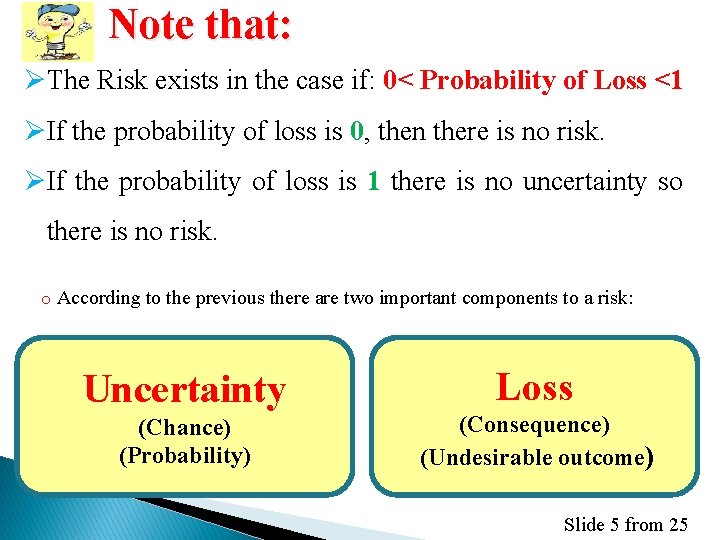
Note that: ØThe Risk exists in the case if: 0< Probability of Loss <1 ØIf the probability of loss is 0, then there is no risk. ØIf the probability of loss is 1 there is no uncertainty so there is no risk. o According to the previous there are two important components to a risk: Uncertainty Loss (Chance) (Probability) (Consequence) (Undesirable outcome) Slide 5 from 25
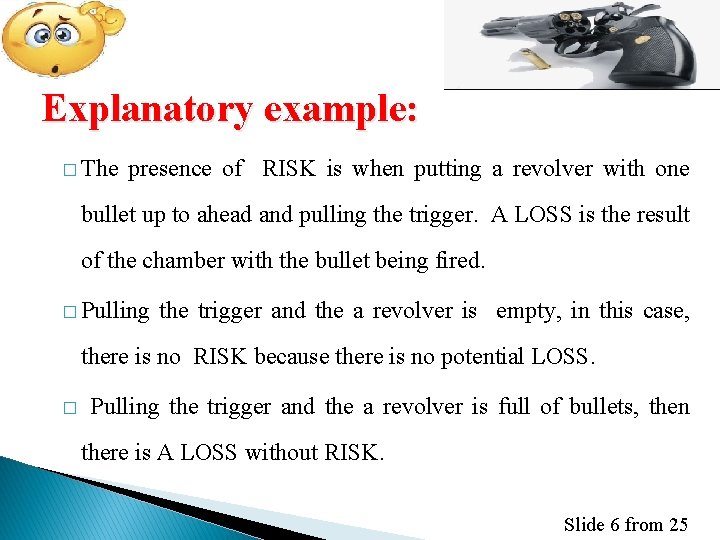
Explanatory example: � The presence of RISK is when putting a revolver with one bullet up to ahead and pulling the trigger. A LOSS is the result of the chamber with the bullet being fired. � Pulling the trigger and the a revolver is empty, in this case, there is no RISK because there is no potential LOSS. � Pulling the trigger and the a revolver is full of bullets, then there is A LOSS without RISK. Slide 6 from 25

Note the difference between Risk & Loss & Peril & Hazard Example: A clothing store was burned because of leakage of gas from a nearby factory for chemicals, the damages were estimated at about 50000 pounds. Loss is: 50000 pounds. Peril is : Fire Hazard: is a nearby factory for chemicals. � Loss: is the undesirable outcome. � Peril: is a cause of loss. � Hazard: is a condition that creates or increases the chance of loss. Slide 7 from 25

Classification of Risk � Risk can be classified in a number of ways: Risk Financial Risk Pure Risk Personal Risk Non-Financial Risk Speculative Risk Property Risk Liability Risk Slide 8 from 25
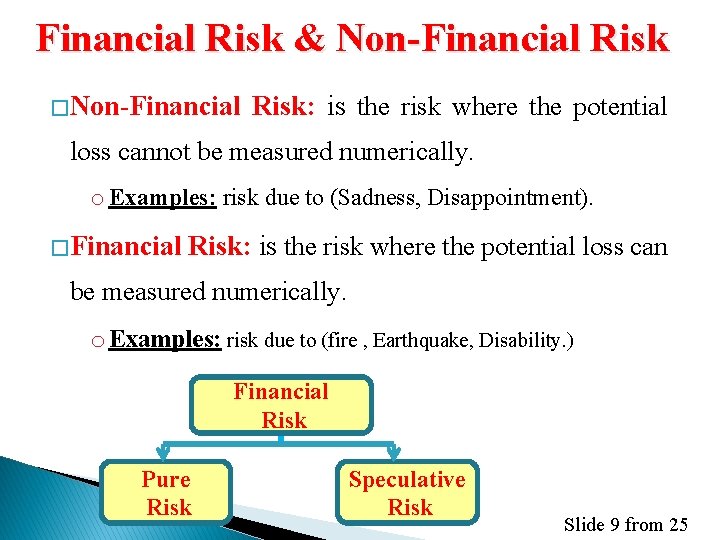
Financial Risk & Non-Financial Risk � Non-Financial Risk: is the risk where the potential loss cannot be measured numerically. o Examples: risk due to (Sadness, Disappointment). � Financial Risk: is the risk where the potential loss can be measured numerically. o Examples: risk due to (fire , Earthquake, Disability. ) Financial Risk Pure Risk Speculative Risk Slide 9 from 25
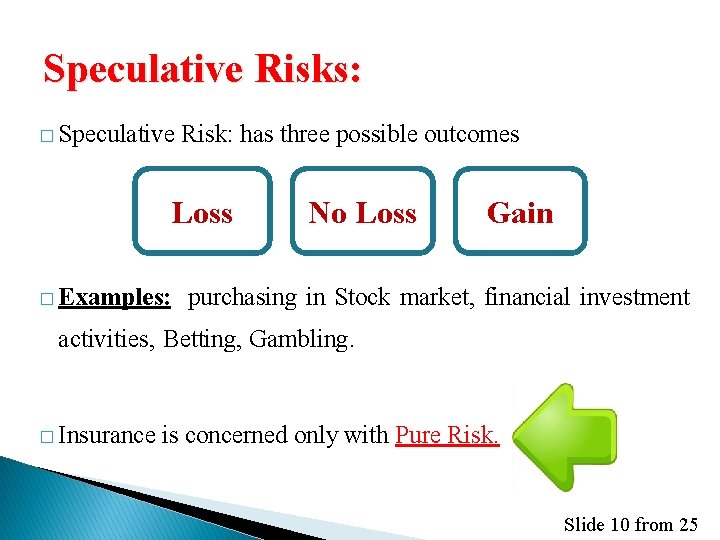
Speculative Risks: � Speculative Risk: has three possible outcomes Loss No Loss Gain � Examples: purchasing in Stock market, financial investment activities, Betting, Gambling. � Insurance is concerned only with Pure Risk. Slide 10 from 25

Pure Risk: � Pure Risk (it is also known as absolute risk) : has only two possible outcomes Loss No Loss � Examples: risk due to (premature death, theft, career- ending, disabilities, fire, accident). Slide 11 from 25

Types of Pure risk � Pure risk could be classified according to risk Exposures to three major types as follows: Pure Risk Personal Risk Property Risk Liability Risk Slide 12 from 25

Personal Risk: � Personal risk is the risks correlated to the ability to earn income. � In general, earning power is subject to such perils: ◦ Premature death. ◦ Old age. ◦ Sickness. ◦ Disability. ◦ Unemployment. Slide 13 from 25
Property Risk: � Property risks: are the risks of property damages. �Property risks embrace two types of loss: direct loss and indirect or “consequential” loss. • Direct loss is the loss of the property itself, and is measured by the value of the property or the cost of repairing the property. • Indirect loss results from the loss of use of the asset that is damaged or destroyed, for the period required to repair or replace the property. o Example: the losses due to a car accident • Direct loss : the cost of repairing the damages. • Indirect loss: the cost of renting a car. o Example: If a house is destroyed by fire, • Direct loss : the lose of the value of the house. • Indirect loss: the expenses for living somewhere else by paying, a rent for other flat. This loss of use of the destroyed house is indirect loss. Slide 14 from 25

Liability Risks Ø Liability risks involve the possibility of loss as a result of legal liability. Ø Example: o Premise Liability. o Risks to a company arising from the possibility of damages resulting from buying or use of a good or service offered by that company. Ø Liability risk can be identified and reduces through careful product design, follow the standard and testing. Slide 15 from 25

Another classification of Pure risk � Pure risk could be classified according to the number of individuals that may affected by risk as follows: Pure Risk Fundamental (Catastrophic) Risk Particular (Accidental) Risk Slide 16 from 25

Fundamental Risk: � Fundamental Risk is a risk that affected the national economy or too many properties or people in the economy. � Examples: o Risk due to Natural disasters (Floods, Earthquake, Hurricanes). o Risk due to Economic problem such as rapid inflation. o Risk due to Society problems such as wear. Slide 17 from 25

Particular Risk � Particular Risk is the risk that affected individuals or limited number of people or properties. � Example: o Risk due to stealing. o Risk due to car accident. o Risk due to house Fire. Slide 18 from 25
Remember What is the difference between Peril & Hazard? Slide 19 from 25

Peril: ØPeril: is the cause of loss. Ø Example: o Fire. o theft o Earthquake. o Disability. Slide 20 from 25

Hazard �Hazard: is a condition that creates or increases the chance of loss. Hazard Physical Hazard Morale Hazard Legal Hazard Slide 21 from 25
Physical Hazard Ø Physical conditions of the environment that increases the frequency or severity of loss. Ø Example: o. Age. o. Job. o. Location of the building. ofirm activity. Slide 22 from 25
Moral hazard Ø Moral hazard is dishonesty or character defects in an individual that increase the frequency or severity of loss. Ø Generally, moral hazard exists when a person can gain from occurrence of a loss. Ø Example: o Creating an accident for a car to collect indemnity from insurance company. o Intended delay in fire fighters' request when fire occurs. Slide 23 from 25

Morale hazard Ø Morale Hazard: is carelessness or indifference to a loss because of existence of insurance, which increases the frequency or severity of a loss. Ø Example: o. Lack of regular car maintenance. o Lack in installing a fire alarm. o Careless cigarette smoking that increases the probability of loss by fire. Slide 24 from 25

Legal hazard Ø Legal hazard: is the characteristics of the legal system that increase the frequency or severity of losses. Ø Example: o A company in a country that has a legal system force large damage awards. o A company in a country that is activating consumer protection laws. Slide 25 from 25
- Slides: 25