
Risk Management By Niken Iwani Surya Putri S
Risk Management By Niken Iwani Surya Putri. S. E. MSc.
Agenda For Today • • 1. Introduction 2. chairman, class rules 3. expectation 4. Introduction to subjects (14 class), – Textbook: (Kit Sadgrove) • 5. Meeting 1: – Introduction (Scale and Scope of Risk Management)
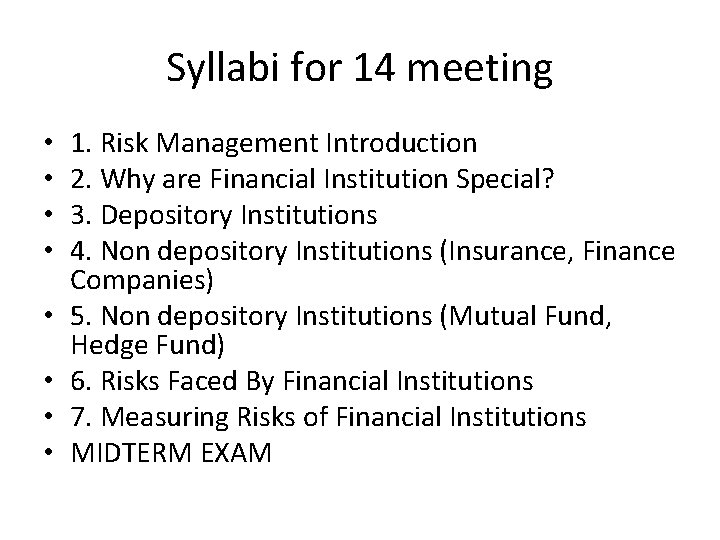
Syllabi for 14 meeting • • 1. Risk Management Introduction 2. Why are Financial Institution Special? 3. Depository Institutions 4. Non depository Institutions (Insurance, Finance Companies) 5. Non depository Institutions (Mutual Fund, Hedge Fund) 6. Risks Faced By Financial Institutions 7. Measuring Risks of Financial Institutions MIDTERM EXAM
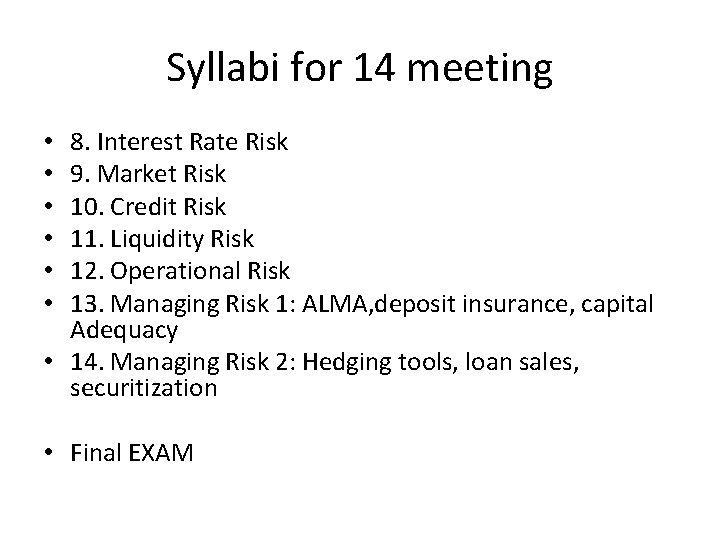
Syllabi for 14 meeting 8. Interest Rate Risk 9. Market Risk 10. Credit Risk 11. Liquidity Risk 12. Operational Risk 13. Managing Risk 1: ALMA, deposit insurance, capital Adequacy • 14. Managing Risk 2: Hedging tools, loan sales, securitization • • Final EXAM
What is Risk? • Risk definition The Australian Standard 4360 on Risk Management : “… the chance of something happening that will have an impact upon objectives. It is measured in terms of likelihood and consequences”
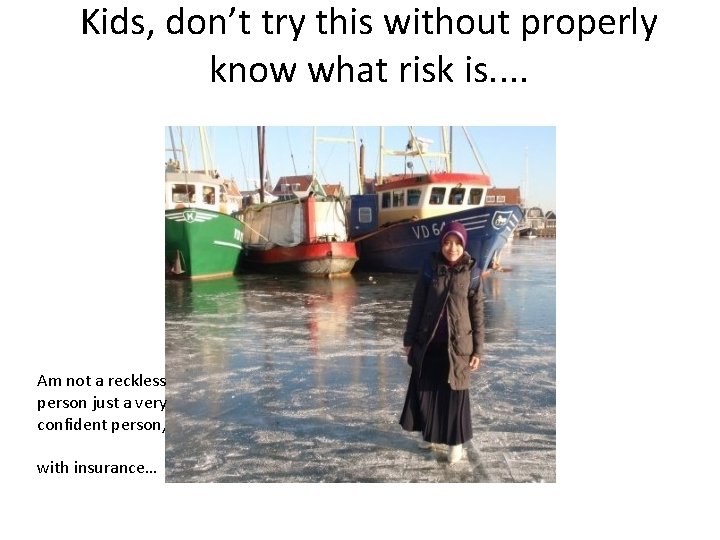
Kids, don’t try this without properly know what risk is. . Am not a reckless person just a very confident person, with insurance…
What is risk Management? 1) A logical and systematic step 2) Steps in decision making, comprehensive 3) Opportunity Identification 4) Avoiding or Minimizingloss 5) Good management practice
What is Risk. Management? A logical and systematic method in to identify, analyze, treat, and monitoring potential risk in every business activities.
What is risk management? A method for managers in using the best possible source to manage resources.
How to handle risk Risk management develop responses from any identified events such below: – – Prevention Impact mitigation Risk transfer Risk acceptance
What are the benefits? “Assist company in identifying potential risk that might threat the company, by analyzing its type, source, occurrence, and severity levels. Management may act promptly in order to minimize the risks”
The user? • Finance and Investment • Insurance • Health Care • Public Institutions • Governments • International Corporation/MNC
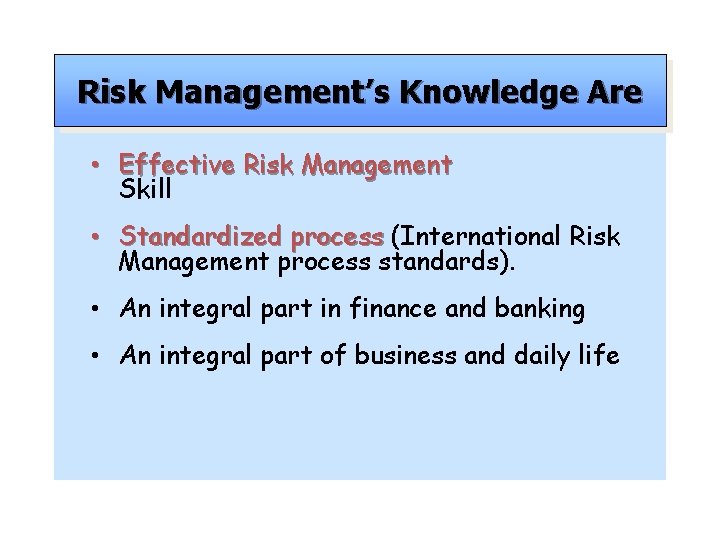
Risk Management’s Knowledge Are • Effective Risk Management Skill • Standardized process (International Risk Management process standards). • An integral part in finance and banking • An integral part of business and daily life
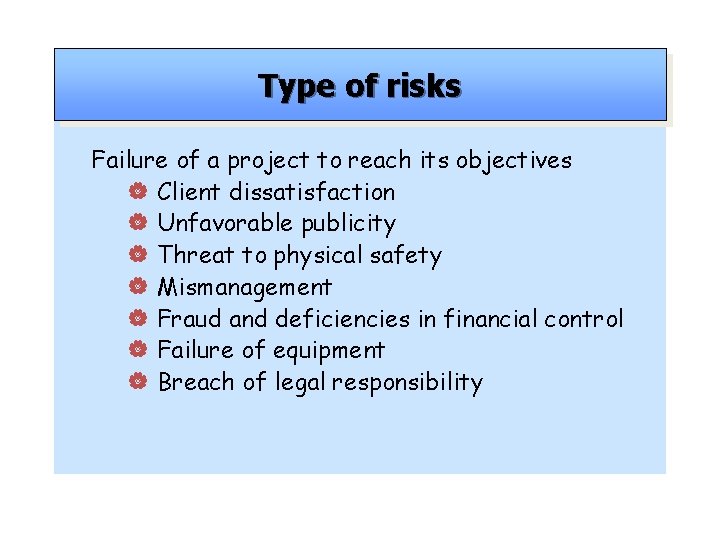
Type of risks Failure of a project to reach its objectives | Client dissatisfaction | Unfavorable publicity | Threat to physical safety | Mismanagement | Fraud and deficiencies in financial control | Failure of equipment | Breach of legal responsibility

Risk Management Models 1. Determine Strategic Elements 2. Determine Exposure 3. Determine Risks & Apply Techniques { { { Establish Board’s Philosophy on Risk Management Determine Key Risk Areas Stakeholder’s Risk Acceptance Expectations What Events can Create Unfavourable Consequences in Key Risk Areas What Unfavourable Consequences can Occur What are the Impacts of these Assess Risk Determine & Apply Risk Management Techniques Monitor & Adapt Continuously
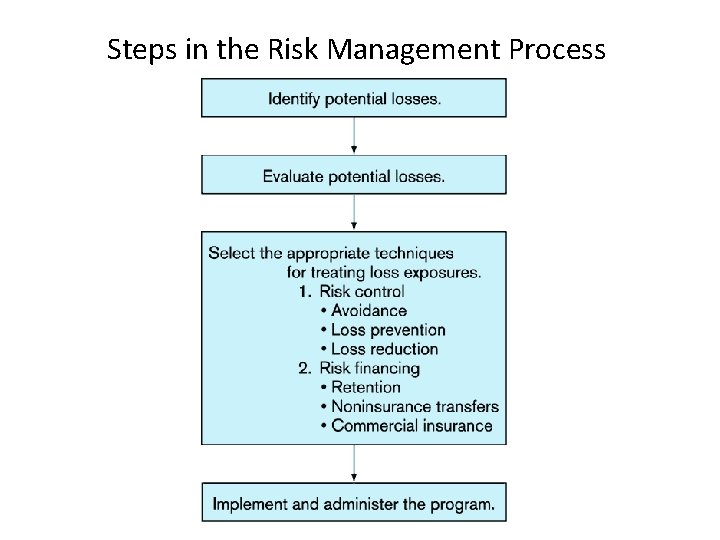
Steps in the Risk Management Process
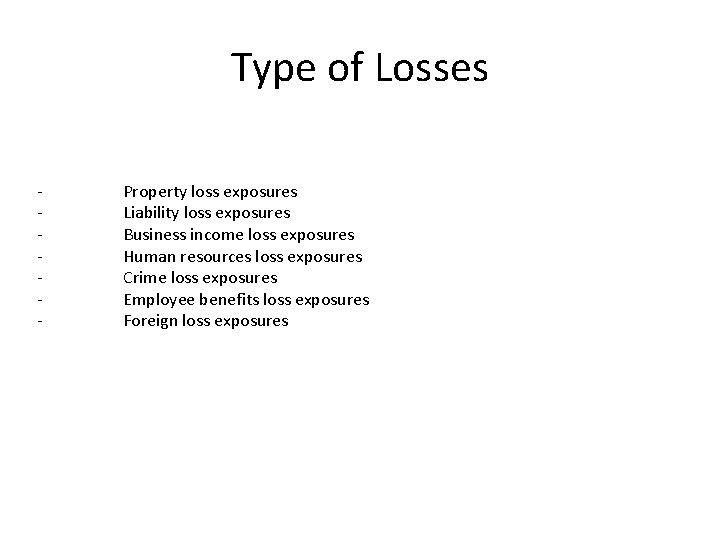
Type of Losses - Property loss exposures Liability loss exposures Business income loss exposures Human resources loss exposures Crime loss exposures Employee benefits loss exposures Foreign loss exposures
Major loss exposures and techniques for handling the loss exposure include the following:
Physical damage to a bus in an accident (can be handled by a commercial auto policy, by retention of part of all of the loss exposure, and by loss control activities to reduce the possibility of an accident)
Sues arising out of injuries to children in a bus accident loss control such as a defensive driving course, and by avoiding hiring (can be handled by a commercial auto policy, by drivers with poor driving records)
Suits arising out of bodily injury or property damage to other motorists or pedestrians (can be handled by a commercial auto policy, by loss control such as a defensive driving course, and by avoiding hiring drivers with poor driving records)
Physical damage losses to the three garages from natural disasters or other perils (can be handled by a commercial property insurance policy and by retention of part of the exposure by a sizable deductible)
Loss of business income if the firm is unable to operate (can be handled by business income insurance that covers the loss of business income by loss control activities to reduce the possibility of a loss) and extra expenses that continue during the shutdown period and
Workers compensation claims if a bus driver or other employees are injured in a workrelated accident (can be handled by workers compensation insurance and by self-insurance)
Death or disability of a key executive (can be handled by loss control, such as an annual physical exam, and by having other employees trained to take over the duties of the key executive)
Tools for recognizing loss exposures:
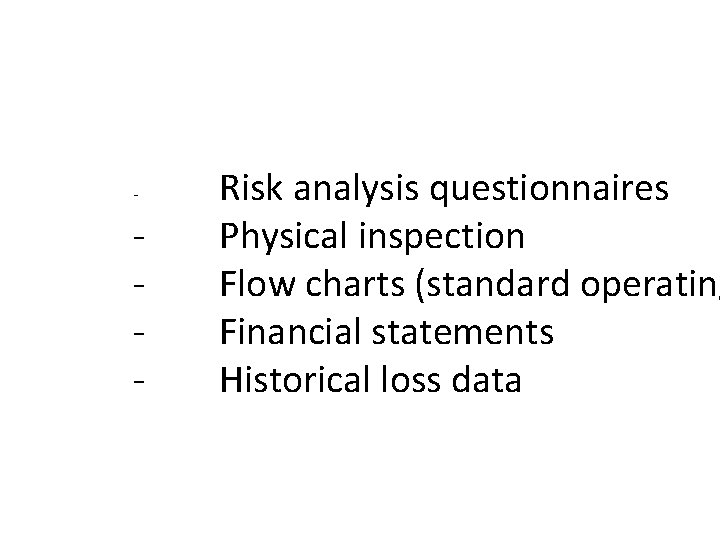
- - Risk analysis questionnaires Physical inspection Flow charts (standard operating Financial statements Historical loss data
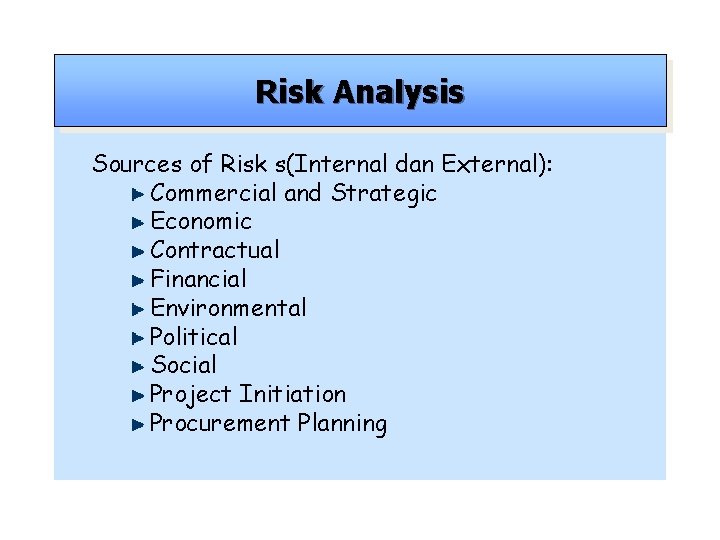
Risk Analysis Sources of Risk s(Internal dan External): Commercial and Strategic Economic Contractual Financial Environmental Political Social Project Initiation Procurement Planning
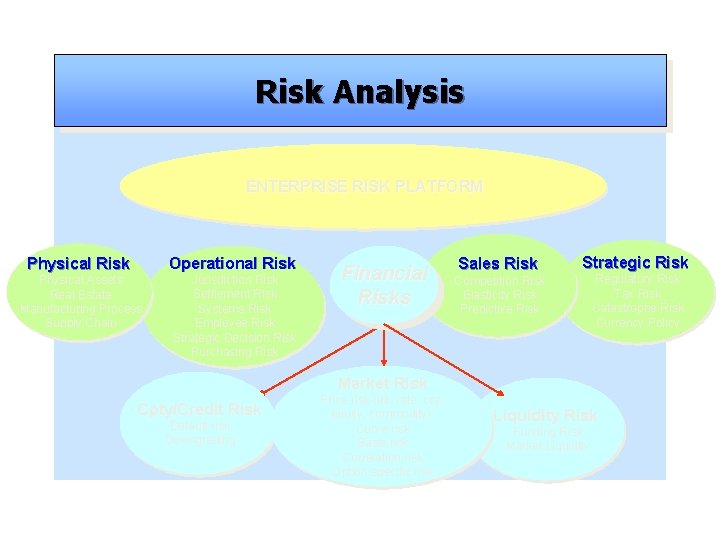
Risk Analysis ENTERPRISE RISK PLATFORM Physical Risk Operational Risk Physical Assets Real Estate Manufacturing Process Supply Chain Jurisdiction Risk Settlement Risk Systems Risk Employee Risk Strategic Decision Risk Purchasing Risk Financial Risks Sales Risk Strategic Risk Competition Risk Elasticity Risk Predictive Risk Regulatory Risk Tax Risk Catastrophe Risk Currency Policy Market Risk Cpty/Credit Risk Default risk Downgrading Price risk (int. rate, ccy, equity, commodity) Curve risk Basis risk Correlation risk Option specific risk Liquidity Risk Funding Risk Market Liquidity
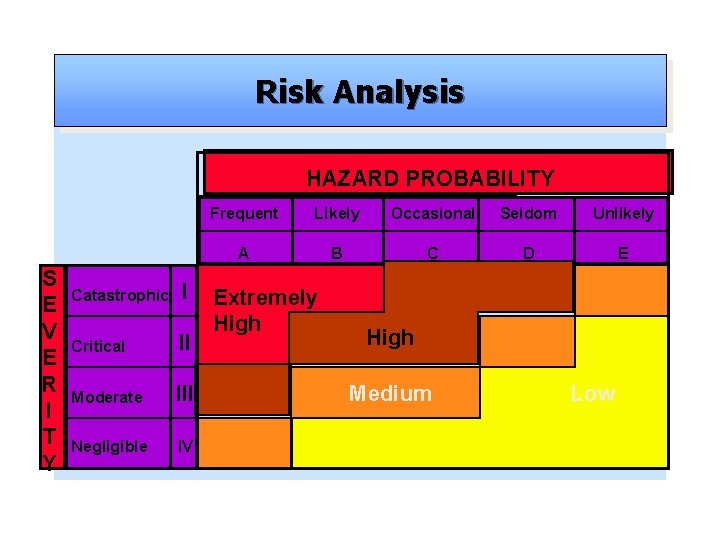
Risk Analysis HAZARD PROBABILITY S E V E R I T Y Catastrophic I Critical II Moderate III Negligible IV Frequent Likely Occasional Seldom Unlikely A B C D E Extremely High Medium Low
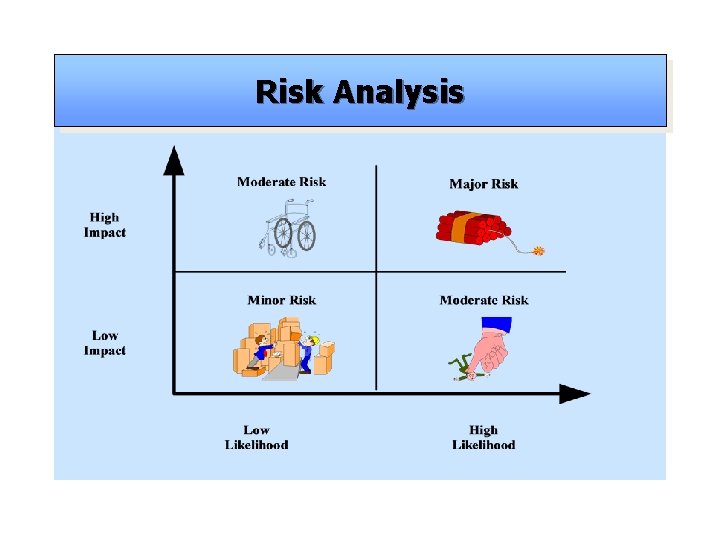
Risk Analysis
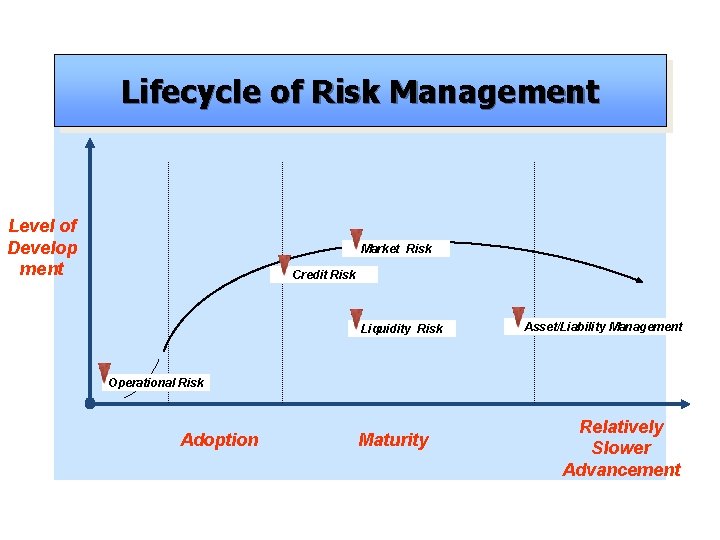
Lifecycle of Risk Management Level of Develop ment Market Risk Credit Risk Liquidity Risk Asset/Liability Management Operational Risk Adoption Maturity Relatively Slower Advancement
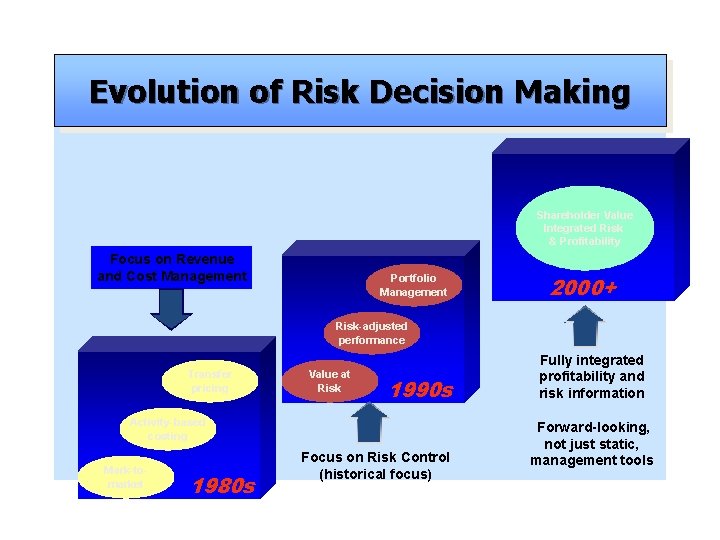
Evolution of Risk Decision Making Shareholder Value Integrated Risk & Profitability Focus on Revenue and Cost Management Portfolio Management 2000+ Risk-adjusted performance Transfer pricing Value at Risk 1990 s Activity-based costing Mark-tomarket 1980 s Focus on Risk Control (historical focus) Fully integrated profitability and risk information Forward-looking, not just static, management tools
, s k s i d r R a f o w o e t r a a i w b e o B h p e b t ’ n … s o k d s Ri but
Career choice Competency needed: | Business Risk Modelling | Risk Analysis tools such as: Value at Risk (Va. R), Risk Simulation, RAROC.
Risk Management in Finance and Banking This is it, class. . For those who love math and stat.
You’ll be watching clip movie Inside Job (10 min) • This movie is about the subprime mortgage (credit default swap) • In risk management perspective, what might go wrong?
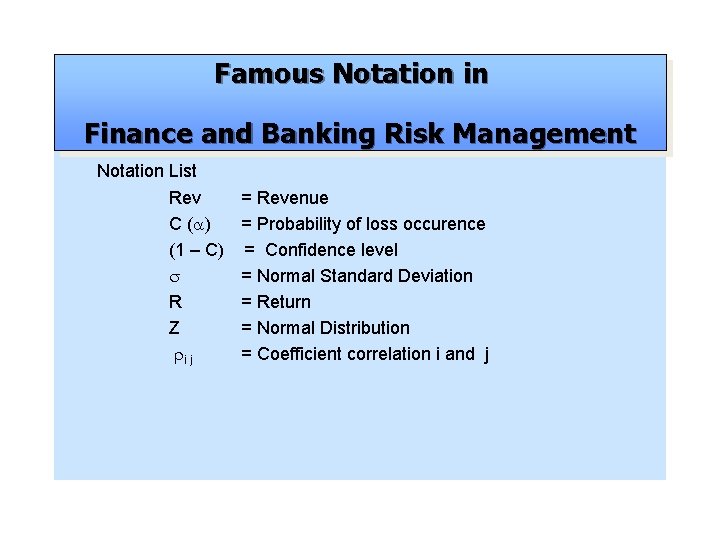
Famous Notation in Finance and Banking Risk Management Notation List Rev C ( ) (1 – C) R Z i j = Revenue = Probability of loss occurence = Confidence level = Normal Standard Deviation = Return = Normal Distribution = Coefficient correlation i and j
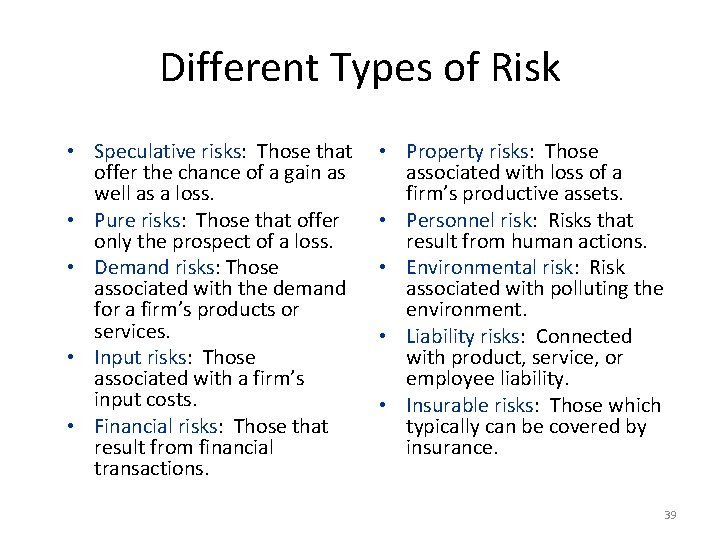
Different Types of Risk • Speculative risks: Those that offer the chance of a gain as well as a loss. • Pure risks: Those that offer only the prospect of a loss. • Demand risks: Those associated with the demand for a firm’s products or services. • Input risks: Those associated with a firm’s input costs. • Financial risks: Those that result from financial transactions. • Property risks: Those associated with loss of a firm’s productive assets. • Personnel risk: Risks that result from human actions. • Environmental risk: Risk associated with polluting the environment. • Liability risks: Connected with product, service, or employee liability. • Insurable risks: Those which typically can be covered by insurance. 39
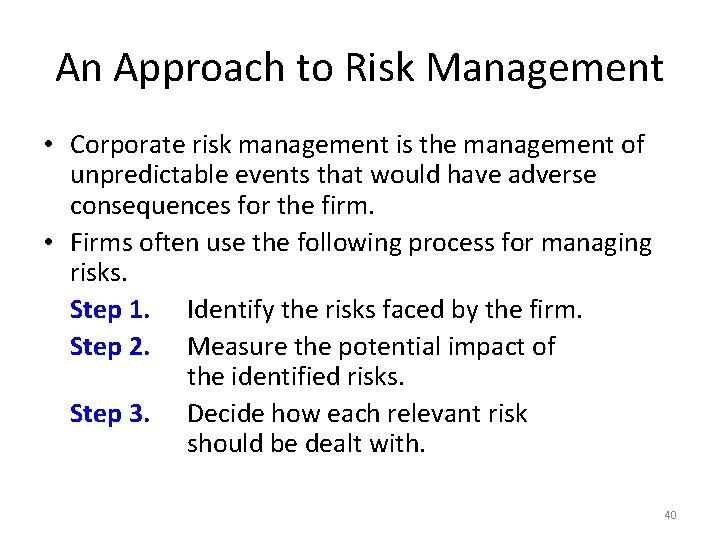
An Approach to Risk Management • Corporate risk management is the management of unpredictable events that would have adverse consequences for the firm. • Firms often use the following process for managing risks. Step 1. Identify the risks faced by the firm. Step 2. Measure the potential impact of the identified risks. Step 3. Decide how each relevant risk should be dealt with. 40
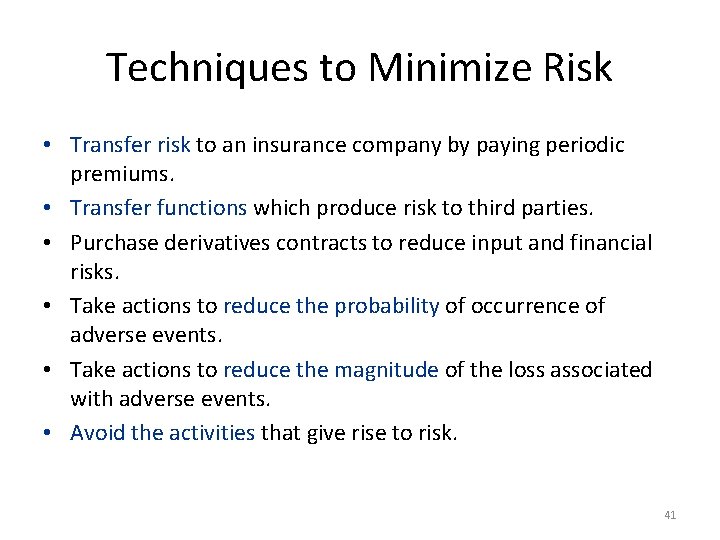
Techniques to Minimize Risk • Transfer risk to an insurance company by paying periodic premiums. • Transfer functions which produce risk to third parties. • Purchase derivatives contracts to reduce input and financial risks. • Take actions to reduce the probability of occurrence of adverse events. • Take actions to reduce the magnitude of the loss associated with adverse events. • Avoid the activities that give rise to risk. 41
Nature and Purpose of Trading in Financial Derivatives • Financial risk exposure refers to the risk inherent in the financial markets due to price fluctuations. • Hedging – Protect Value of Securities Held – Protect the Rate of Return on a Security Investment – Reduce Risk of Fluctuations in Borrowed Costs • Speculating 42
Using Derivatives to Reduce Risk • Commodity Price Exposure – The purchase of a commodity futures contract will allow a firm to make a future purchase of the input at today’s price, even if the market price on the item has risen substantially in the interim. • Security Price Exposure – The purchase of a financial futures contract will allow a firm to make a future purchase of the security at today’s price, even if the market price on the asset has risen substantially in the interim. 43
Using Derivatives to Reduce Risk • Foreign Exchange Exposure – The purchase of a currency futures or options contract will allow a firm to make a future purchase of the currency at today’s price, even if the market price on the currency has risen substantially in the interim. 44
Risks to Corporations from Financial Derivatives • Increases financial leverage • Derivative instruments are too complex • Risk of financial distress 45
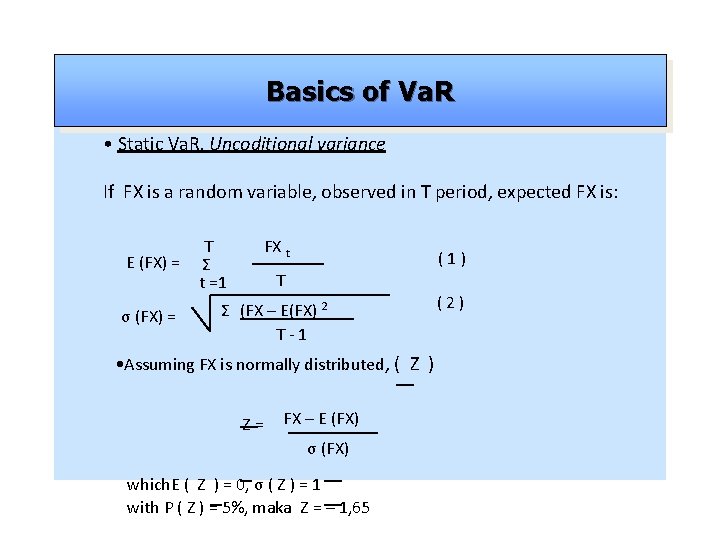
Basics of Va. R • Static Va. R, Uncoditional variance If FX is a random variable, observed in T period, expected FX is: E (FX) = σ (FX) = T Σ t =1 FX t (1) T Σ (FX – E(FX) 2 T-1 • Assuming FX is normally distributed, ( Z ) Z= FX – E (FX) σ (FX) which. E ( Z ) = 0, σ ( Z ) = 1 with P ( Z ) = 5%, maka Z = – 1, 65 (2)
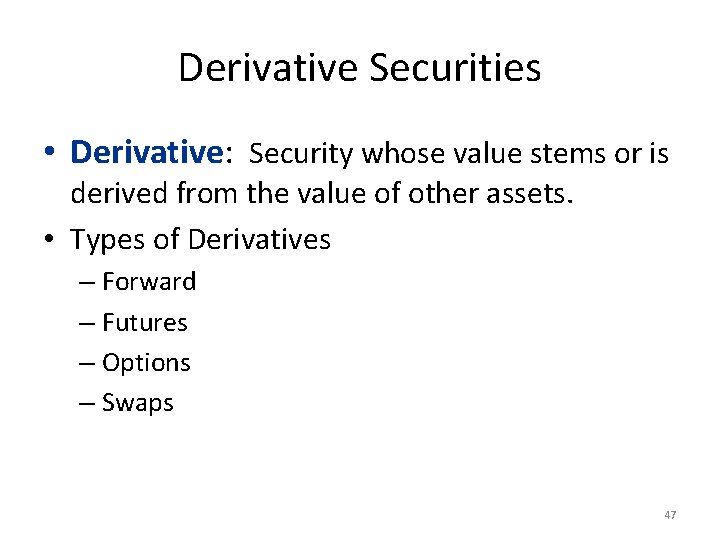
Derivative Securities • Derivative: Security whose value stems or is derived from the value of other assets. • Types of Derivatives – Forward – Futures – Options – Swaps 47
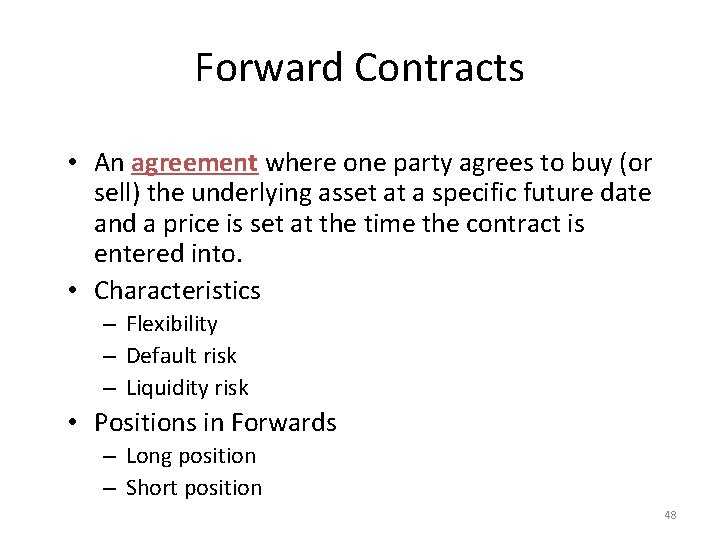
Forward Contracts • An agreement where one party agrees to buy (or sell) the underlying asset at a specific future date and a price is set at the time the contract is entered into. • Characteristics – Flexibility – Default risk – Liquidity risk • Positions in Forwards – Long position – Short position 48
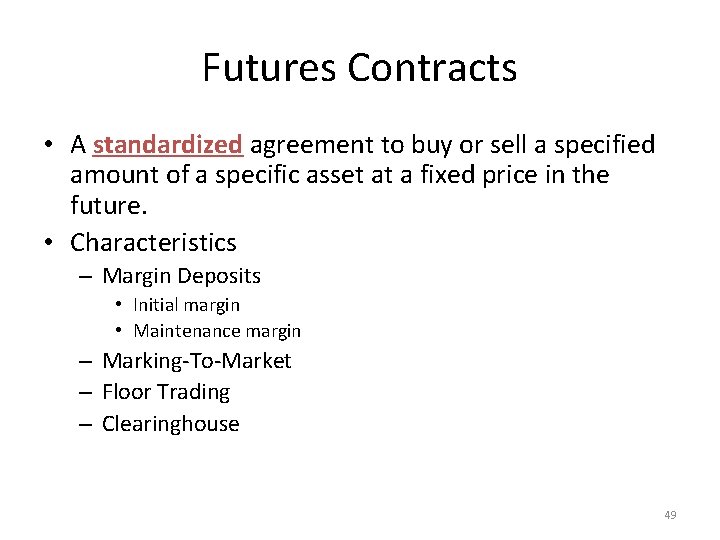
Futures Contracts • A standardized agreement to buy or sell a specified amount of a specific asset at a fixed price in the future. • Characteristics – Margin Deposits • Initial margin • Maintenance margin – Marking-To-Market – Floor Trading – Clearinghouse 49
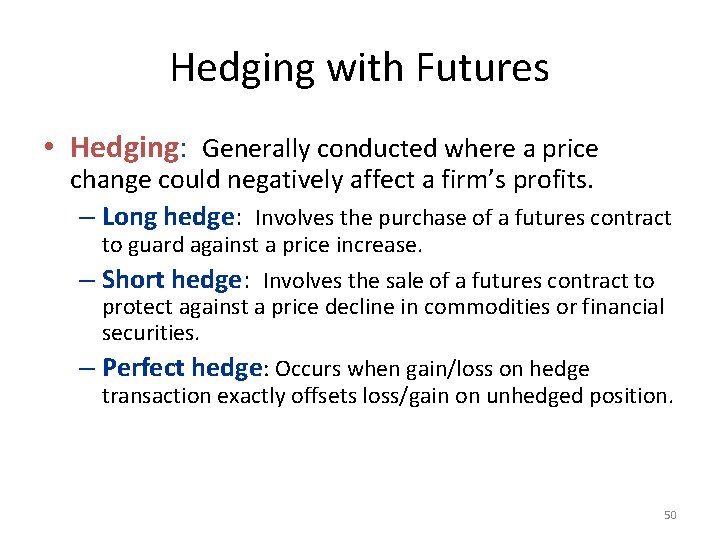
Hedging with Futures • Hedging: Generally conducted where a price change could negatively affect a firm’s profits. – Long hedge: Involves the purchase of a futures contract to guard against a price increase. – Short hedge: Involves the sale of a futures contract to protect against a price decline in commodities or financial securities. – Perfect hedge: Occurs when gain/loss on hedge transaction exactly offsets loss/gain on unhedged position. 50
Option Contracts • The right, but not the obligation, to buy or sell a specified asset at a specified price within a specified period of time. • Option Terminology – – – Call option versus put option Holder versus writer or grantor Exercise or strike price Option premium American versus European option • Market Arrangements 51
Swap Contracts • Financial contracts obligating one party to exchange a set of payments it owns for another set of payments owed by another party. – Currency swaps – Interest rate swaps • Usually used because each party prefers the terms of the other’s debt contract. • Reduces interest rate risk or currency risk for both parties involved. 52
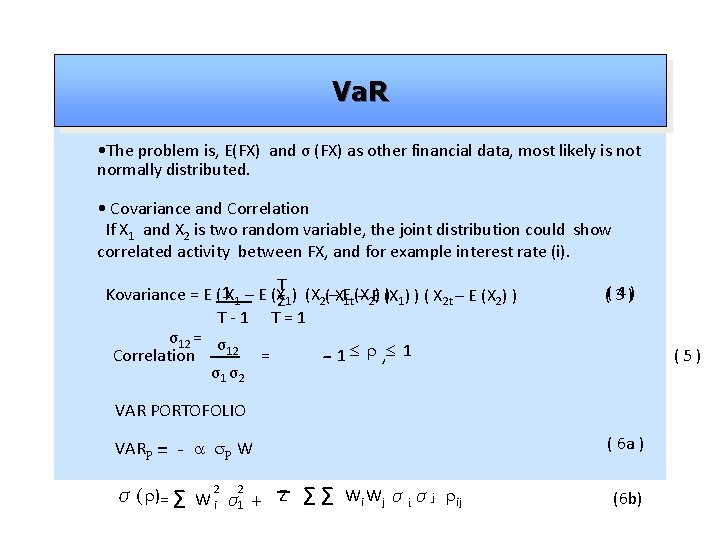
Va. R • The problem is, E(FX) and σ (FX) as other financial data, most likely is not normally distributed. • Covariance and Correlation If X 1 and X 2 is two random variable, the joint distribution could show correlated activity between FX, and for example interest rate (i). T Kovariance = E ( 1 X 1 – E (XΣ 1) (X 2(–XE 1 t(X ) 1) ) ( X 2 t – E (X 2) ) – 2 E) (X T-1 T=1 σ12 = σ 12 Correlation = 1 , 1 σ1 σ2 (( 34 )) (5) VAR PORTOFOLIO ( 6 a ) VARP = - P W σ( )= Σ W 2 i σ21 + Z ΣΣ Wi Wj σiσj ij (6 b)
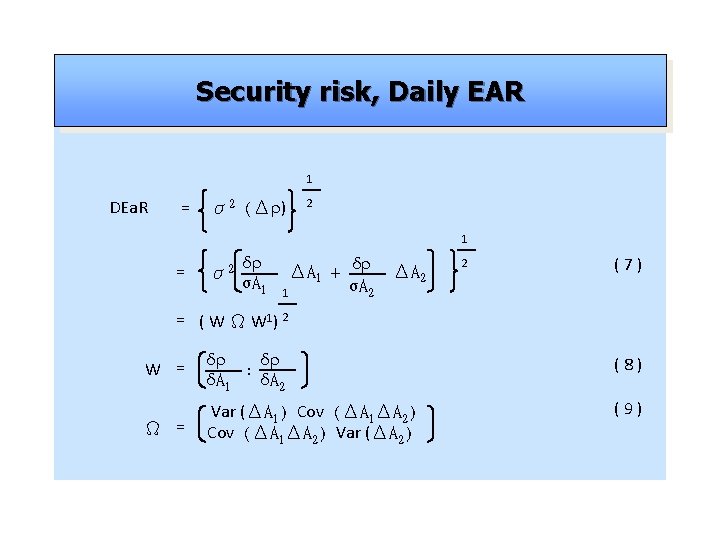
Security risk, Daily EAR 1 DEa. R = σ2 (Δ ) 2 1 = σ2 δ σA 1 ΔA 1 + δ σA 2 1 ΔA 2 2 (7) = ( W Ω W 1) 2 δ δA 2 W = δ δA 1 Ω = Var (ΔA 1) Cov (ΔA 1ΔA 2) Var (ΔA 2) : (8) (9)
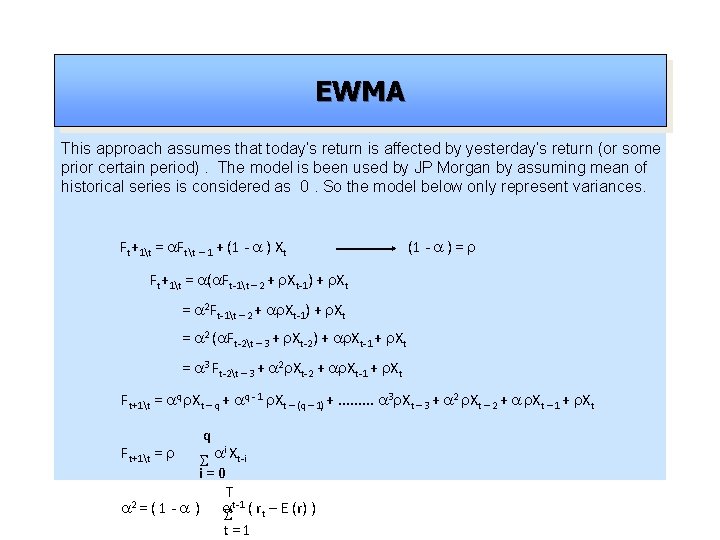
EWMA This approach assumes that today’s return is affected by yesterday’s return (or some prior certain period). The model is been used by JP Morgan by assuming mean of historical series is considered as 0. So the model below only represent variances. Ft+1t = Ftt – 1 + (1 - ) Xt (1 - ) = Ft+1t = ( Ft-1t – 2 + Xt-1) + Xt = 2 Ft-1t – 2 + Xt-1) + Xt = 2 ( Ft-2t – 3 + Xt-2) + Xt-1 + Xt = 3 Ft-2t – 3 + 2 Xt-2 + Xt-1 + Xt Ft+1t = q Xt – q + q - 1 Xt – (q – 1) +. . 3 Xt – 3 + 2 Xt – 2 + Xt – 1 + Xt Ft+1t = q Xt-i i=0 T 2 t-1 =(1 - ) ( rt – E (r) ) t=1 i
"It is not the strongest species that survive, nor the most intelligent, but the ones most responsive to change…" Charles Darwin Terima Kasih
- Slides: 56