
Risk Management Approaches to Hydrogen Safety Risk Assessment


- Slides: 13
Risk Management Approaches to Hydrogen Safety
Risk Assessment, Limbo Dancing, and ALARP Les Shirvill
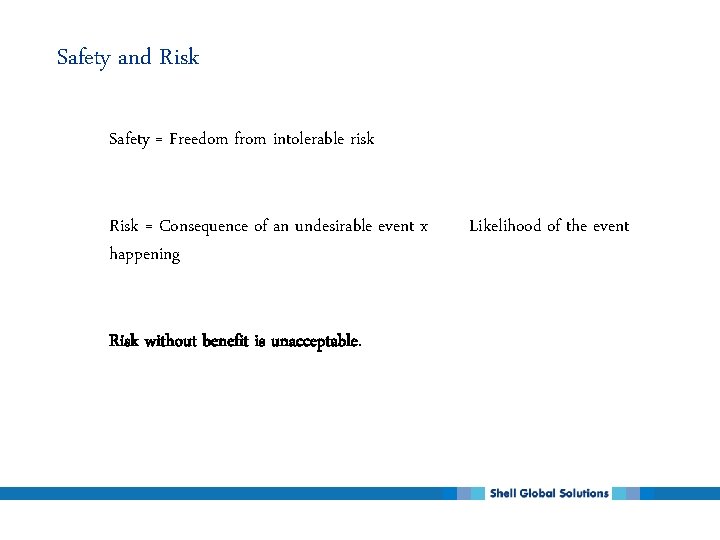
Safety and Risk Safety = Freedom from intolerable risk Risk = Consequence of an undesirable event x happening Risk without benefit is unacceptable. Likelihood of the event
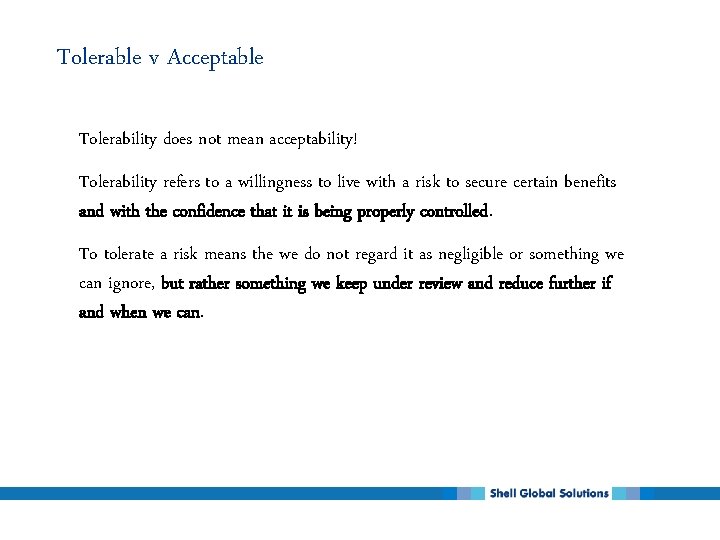
Tolerable v Acceptable Tolerability does not mean acceptability! Tolerability refers to a willingness to live with a risk to secure certain benefits and with the confidence that it is being properly controlled. To tolerate a risk means the we do not regard it as negligible or something we can ignore, but rather something we keep under review and reduce further if and when we can.
Managing Hydrogen Safety Managing hydrogen hazards and risks is a challenge! Not because hydrogen is inherently more hazardous than conventional fuels – although the hazards and consequences may be different, but a challenge because this is an emerging technology and thus we don’t have historical data on which to base our assessments of the risks.
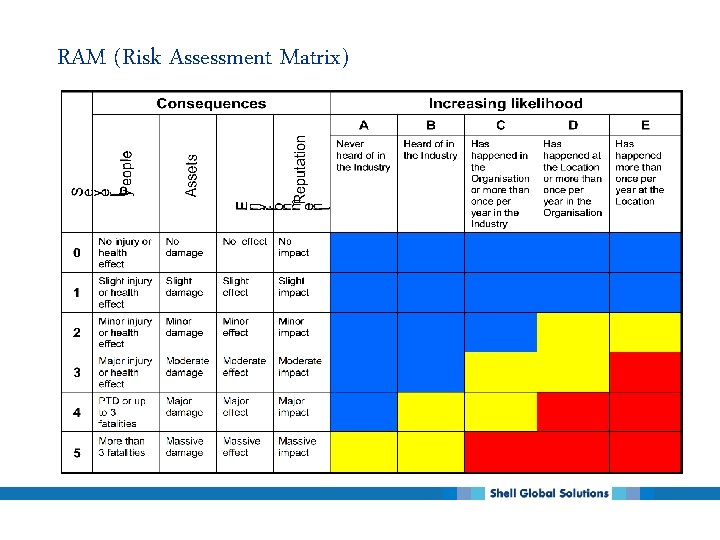
Risk Management Identify the hazards • Where possible eliminate the hazards • Assess the residual risks • Manage the residual risks • The risk assessment may be quantitative (RAM) or qualitative (QRA) as appropriate.
RAM (Risk Assessment Matrix)
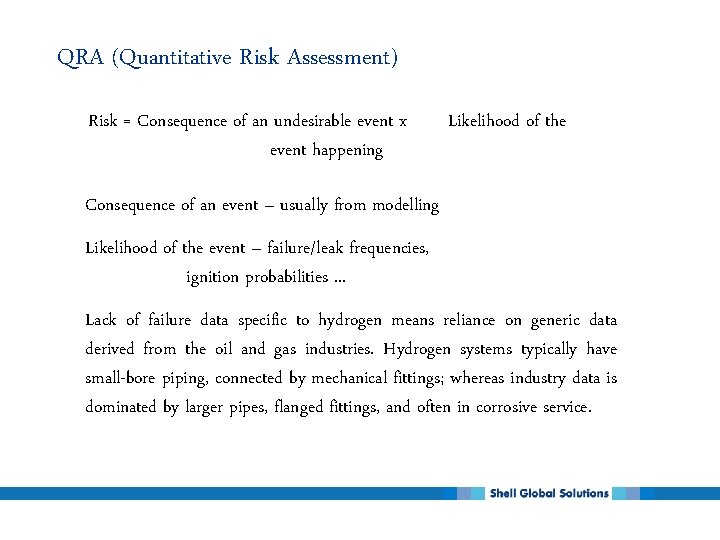
QRA (Quantitative Risk Assessment) Risk = Consequence of an undesirable event x event happening Likelihood of the Consequence of an event – usually from modelling Likelihood of the event – failure/leak frequencies, ignition probabilities. . . Lack of failure data specific to hydrogen means reliance on generic data derived from the oil and gas industries. Hydrogen systems typically have small-bore piping, connected by mechanical fittings; whereas industry data is dominated by larger pipes, flanged fittings, and often in corrosive service.
Limbo Dancing
Limbo Dancing Set the bar (tolerance criteria) first and then quantify the risks (QRA). If the quantified risks don’t get you below the bar, don’t bend over backwards (fiddle the inputs to the QRA) to get beneath the bar! That’s Limbo Dancing!
ALARP (As low as reasonably practicable) ALARP assumes that there is a balance between risk and benefit – Risk without benefit is unacceptable. ALARP is taking measures to progressively reduce risk until the cost of any further risk reduction is grossly disproportionate to the risk reduction thereby obtained.
ALARP On the 14 th June 2007 the European Court of Justice held in Commission v UK C-127/05 that the UK’s use of the expression “so far as is reasonably practicable”, where it appears in UK Health and Safety Law, was not inconsistent with the UK’s obligations under the Framework Directive 89/331.