
Risk Management and Types of Risks By Tony
Risk Management and Types of Risks By Tony Collins Edited by Memory Reed Georgia CTAE Resource Network 2010
Lesson Objectives n Define Risk and Risk Management n List and Describe 3 Types of Risks n Know and Understand 4 Basic Ways to Handle and Control these Risks n List 3 types of Ways to Transfer Risks n Know the Difference Between Risk Avoidance and Risk Acceptance

What is Risk Management? Risk - The possibility of financial loss Management - The business function used to plan, organize, and control all available resources to reach company goals Risk Management - The systematic process of managing an organization’s risk exposure to achieve objectives in a manner consistent with public interest, human safety, environmental factors, and the law.
Kinds of Risks 3 Types Economic Natural Human
Economic Risks – These risks occur from changes in overall business conditions. – This can include: § amount or type of competitor(s) § changing consumer lifestyle § population changes § government regulations § inflation § recession

Natural Risks Natural risks are result from natural disasters or disruptions § floods § tornadoes § hurricanes § fires § droughts § lightning § earthquakes § even sudden abnormal weather conditions
Human Risks These are caused by human mistakes and errors, as well as the unpredictability of customers, employees, or the work environment This could include: § § § § Theft injury on the job bad checks employee error Negligence Incompetence etc.
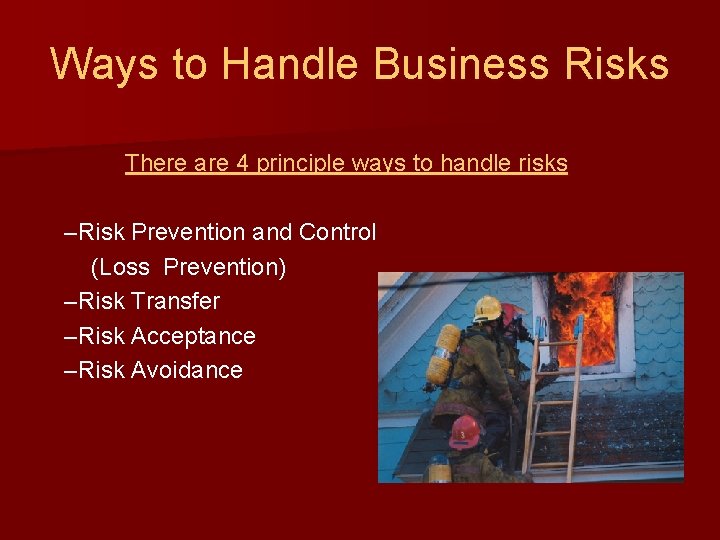
Ways to Handle Business Risks There are 4 principle ways to handle risks –Risk Prevention and Control (Loss Prevention) –Risk Transfer –Risk Acceptance –Risk Avoidance
Risk Prevention and Control – Screening and Training Employees – Providing Safe Conditions – Providing Safety Instruction – Preventing External Theft – Deterring Employee Theft – This is often called “Loss Prevention” in the business world

Risk Transfer 3 Common Risk Transfers – insurance – product/service warranties – transference through business ownership
Insurance – Insurance policy - contract that covers a business with a specific type of insurance reducing risks – Business liability - insurance protects a business against damages for which it may be held legally liable, usually up to only $1 million. – Personal liability - covers damages by customer and/or employees – Product liability - protects from personal injury caused by product manufactured or sold by the business
Product/Service Warranties n Warranties are simply promises made by the seller or manufacturer with respect to the performance and quality of a product and protection against loss
Transference Through Ownership n The total amount of risk the business must handle depends in part on the type of business ownership – For example, a entrepreneur who owns a sole -proprietorship assumes all the risk as where a stockholder in a corporation assumes only his percentage of the risk.
Risk Acceptance n When the business assumes the loss responsibility into the upkeep of the company n Most companies pull out a certain percentage of their revenue for damages, loss to theft, and unsold items.
Risk Avoidance Risks can be avoided by advance anticipation n Following market research can assist a business in making the decision on whether or not to invest in a product. n To determine whether the product is a low risk you must weigh the potential benefits against the potential risks n
Risk Management Plan n Develop an overall Risk Management Plan for the business n Develop a specific Risk Management Plan for specific events that occur within the business n Revisit the plan regularly to update
What We Have Learned n The three types of risks: economic, natural, human n The terms important to Risk Management: – risk - the possibility of financial loss – risk management - the process of how a business controls the risk of financial loss while staying consistent with the public’s interest, safety, environmental factors, and the law n There are more ways than one to handle risks effectively. – – Loss prevention risk transfer - insurance, warranties, and transferring ownership risk acceptance - assume responsibility of loss risk avoidance - anticipating product failure and not investing in product/service
- Slides: 17