
Risk Management and the Precautionary Principle Matching the
- Slides: 58
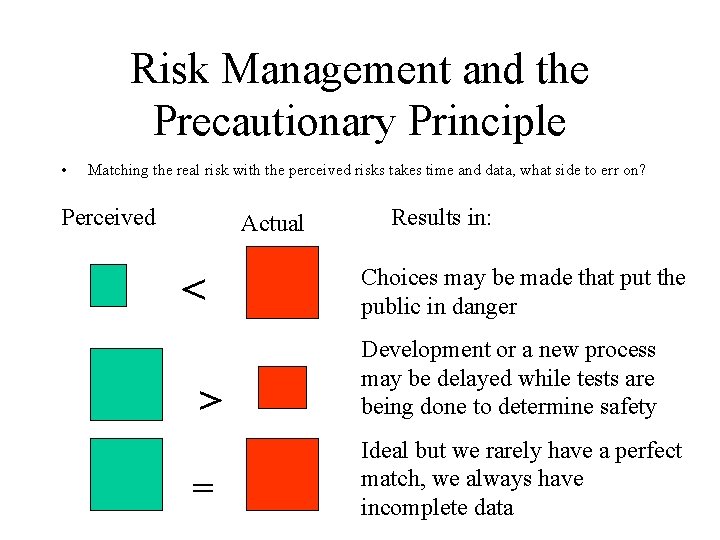
Risk Management and the Precautionary Principle • Matching the real risk with the perceived risks takes time and data, what side to err on? Perceived Actual < > = Results in: Choices may be made that put the public in danger Development or a new process may be delayed while tests are being done to determine safety Ideal but we rarely have a perfect match, we always have incomplete data
Ecosystem Services • A service that is provided for “free” if the ecosystem is protected • The value of this service needs to be considered as part of the value of maintaining an intact ecosystem • Examples: Marshes and flood control, or forests and water quality
Full Cost Accounting when doing a cost/benefit ratio • Traditional economic costs already in the equation (jobs, tax credits, growth, etc) • Ecosystem Service cost • Must include the costs of human lives, but what is a life worth? What is the cost of an asthma attack, the hard costs of the medical care, but what about the emotional costs and long term consequences on growth and development
When making public policy choices we need to examine the full costs of our choices • Short term direct costs to humans and ecosystem • Long term costs to humans and the ecosystem • Irreversible losses like genetic biodiversity • Costs that you can not but a value on like fertility, human suffering, risk of war or ethnic conflict due to resource inequity
Water Ecosystems and Human Health Think about whole cost accounting Public policy Risks
Key functions of water • Support of humans and land based wild life for drinking and indirect consumption • Support of aquatic life ecosystems • Supports irrigation for food production, food supplies are highly dependant on artificial irrigation for crop support • Contiguous support of flow between rivers, ponds, estuaries, lakes, and oceans
Why is water so important for human health and ecosystem health? • Humans deprived of access to water will typically die in 3 days • Our ecosystems depend on water to survive and changes in these levels and flows will alter all life systems • Our global food supplies are heavily dependant on water utilization for growth
How do we keep water for humans safe and accessible? • It takes an infrastructure to deliver clean water to large population of people • Much of the world can not go to the tap and have access to clean safe water • The poor tend to have the least access to public water, and bear the heaviest burden of water pollution and the most complications from supply fecal contamination
Safety of Drinking Water in U. S. National Resources Defense Council reports on the drinking water systems of 19 cities We often take the purity of our tap water for granted -- and we shouldn't. NRDC's What's on Tap? , a carefully researched, documented and peerreviewed study of the drinking water systems of 19 U. S. cities, found that pollution and deteriorating, out-of-date plumbing are sometimes delivering drinking water that might pose health risks to some residents.
Tap water: Many cities around the country rely on pre-World War I-era water delivery systems and treatment technology. Aging pipes can break, leach contaminants into the water they carry and breed bacteria -- all potential prescriptions for illness. And old-fashioned water treatment -- built to filter out particles in the water and kill some parasites and bacteria -- generally fails to remove 21 stcentury contaminants like pesticides, industrial chemicals and arsenic.
Your Right to Know What's in Your Tap Water • "How do I find out what's in my water glass? " And according to U. S. law, every citizen is entitled to a straight answer. Every city is required to publish reports about the safety and quality of its drinking water system.
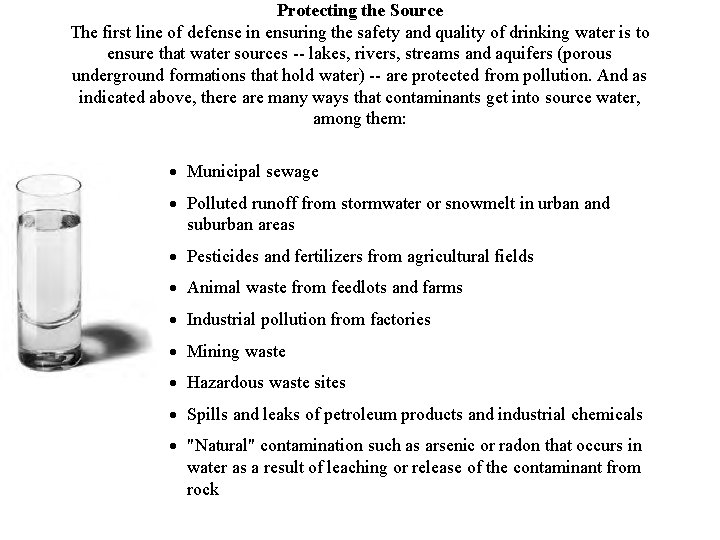
Protecting the Source The first line of defense in ensuring the safety and quality of drinking water is to ensure that water sources -- lakes, rivers, streams and aquifers (porous underground formations that hold water) -- are protected from pollution. And as indicated above, there are many ways that contaminants get into source water, among them: · Municipal sewage · Polluted runoff from stormwater or snowmelt in urban and suburban areas · Pesticides and fertilizers from agricultural fields · Animal waste from feedlots and farms · Industrial pollution from factories · Mining waste · Hazardous waste sites · Spills and leaks of petroleum products and industrial chemicals · "Natural" contamination such as arsenic or radon that occurs in water as a result of leaching or release of the contaminant from rock
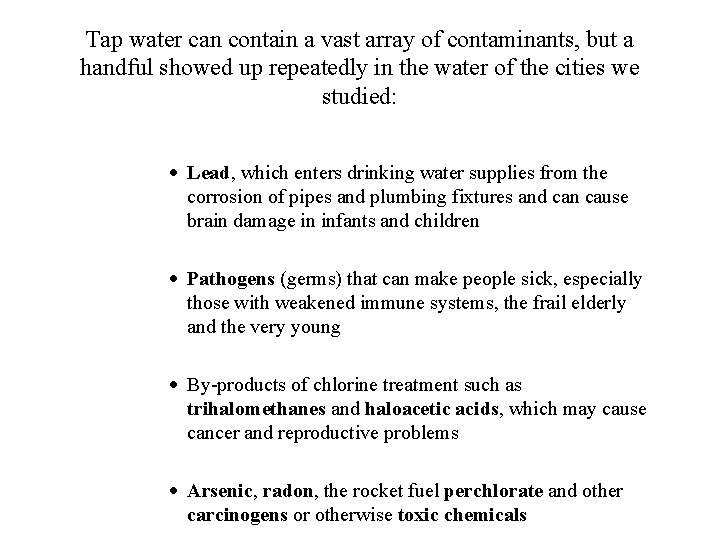
Tap water can contain a vast array of contaminants, but a handful showed up repeatedly in the water of the cities we studied: · Lead, which enters drinking water supplies from the corrosion of pipes and plumbing fixtures and can cause brain damage in infants and children · Pathogens (germs) that can make people sick, especially those with weakened immune systems, the frail elderly and the very young · By-products of chlorine treatment such as trihalomethanes and haloacetic acids, which may cause cancer and reproductive problems · Arsenic, radon, the rocket fuel perchlorate and other carcinogens or otherwise toxic chemicals
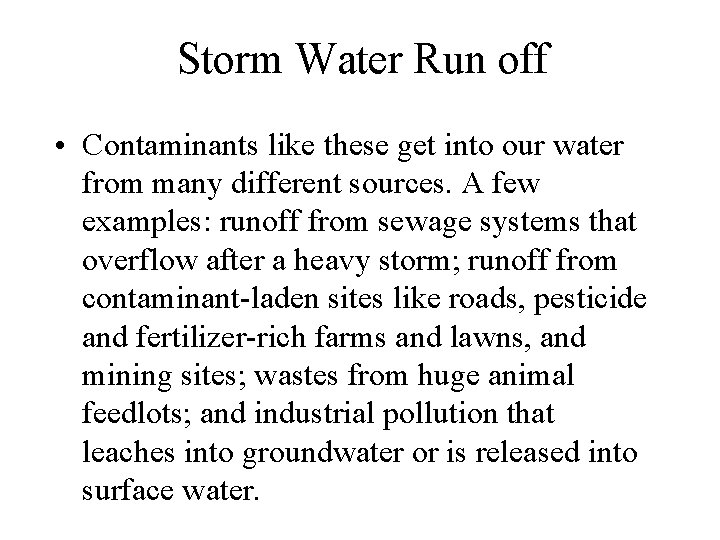
Storm Water Run off • Contaminants like these get into our water from many different sources. A few examples: runoff from sewage systems that overflow after a heavy storm; runoff from contaminant-laden sites like roads, pesticide and fertilizer-rich farms and lawns, and mining sites; wastes from huge animal feedlots; and industrial pollution that leaches into groundwater or is released into surface water.
Storm water Run off • • What is it? Why is it? What can be done about it? What had UVM done about?
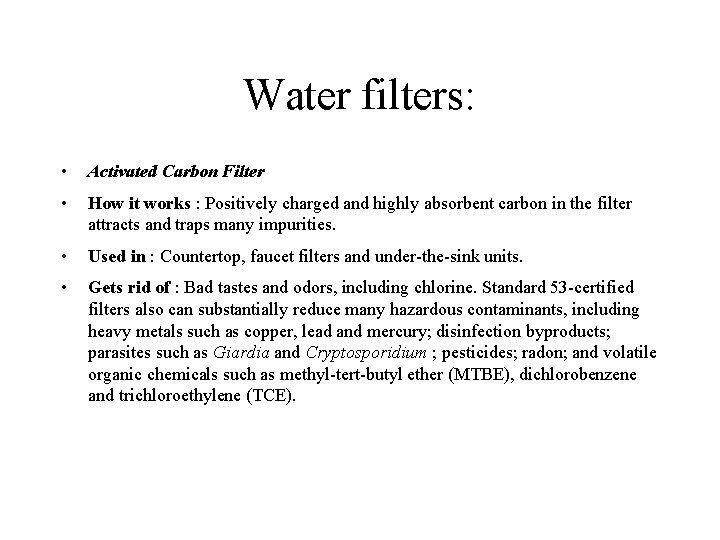
Water filters: • Activated Carbon Filter • How it works : Positively charged and highly absorbent carbon in the filter attracts and traps many impurities. • Used in : Countertop, faucet filters and under-the-sink units. • Gets rid of : Bad tastes and odors, including chlorine. Standard 53 -certified filters also can substantially reduce many hazardous contaminants, including heavy metals such as copper, lead and mercury; disinfection byproducts; parasites such as Giardia and Cryptosporidium ; pesticides; radon; and volatile organic chemicals such as methyl-tert-butyl ether (MTBE), dichlorobenzene and trichloroethylene (TCE).
Water filters: • Cation Exchange Softener • How it works : "Softens" hard water by trading minerals with a strong positive charge for one with less of a charge. • Used in : Whole-house, point-of-entry units. • Gets rid of: Calcium and magnesium, which form mineral deposits in plumbing and fixtures, as well as barium and some other ions that can create health hazards.
Water filters: • Distiller • How it works : Boils water and recondenses the purified steam. • Used in : Countertop or whole house point-of-entry units; can be combined with a carbon filter. • Gets rid of : Heavy metals such as cadmium, chromium, copper, lead and mercury, as well as arsenic, barium, fluoride, selenium and sodium.
Water Filters: • Reverse Osmosis • How it works: A semipermeable membrane separates impurities from water. (Note: This filtration technique wastes a substantial amount of water during the treatment process. ) • Used in: Under-the-sink units; often in combination with a carbon filter or UV disinfection unit. • Gets rid of: Most contaminants, including certain parasites such as Cryptosporidium and Giardia; heavy metals such as cadmium, copper, lead and mercury; and other pollutants, including arsenic, barium, nitrate/nitrite, perchlorate and selenium.
Water filters · Ultraviolet Disinfection – How it works: Ultraviolet light kills bacteria and other microorganisms. – Used in: Under-the-sink units, often in combination with a carbon filter and sediment screen. – Gets rid of : Bacteria and parasites; class A systems protect against harmful bacteria and viruses, including Cryptosporidium and Giardia , while class B systems are designed to make non-disease-causing bacteria inactive.
Radon In Water Risks and Results
What is radon? • Radon is a naturally occurring radioactive breakdown product of uranium. • It dissolves and accumulates in ground water. • Most of the risk from radon in drinking water (nearly 90 percent) comes from breathing radon released to indoor air from household water uses. • Radon is tasteless, odorless and occurs worldwide.
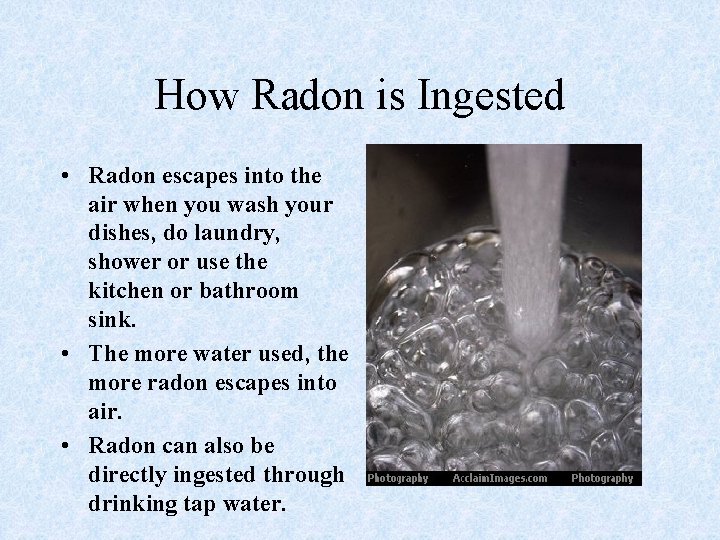
How Radon is Ingested • Radon escapes into the air when you wash your dishes, do laundry, shower or use the kitchen or bathroom sink. • The more water used, the more radon escapes into air. • Radon can also be directly ingested through drinking tap water.
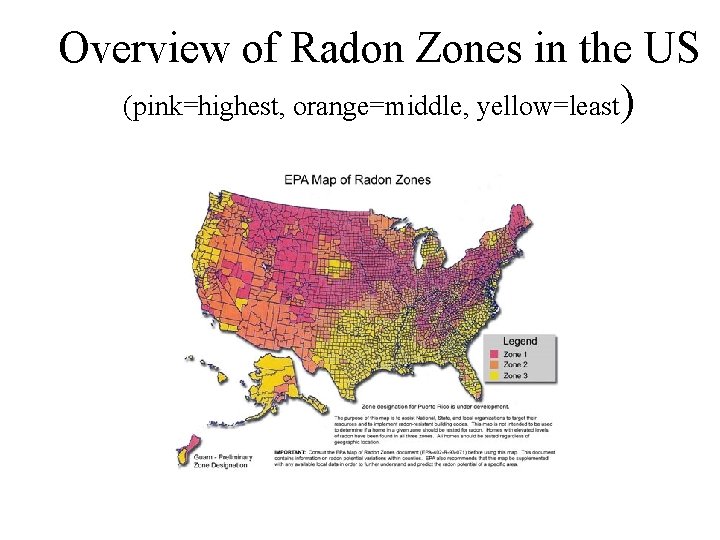
Overview of Radon Zones in the US (pink=highest, orange=middle, yellow=least)
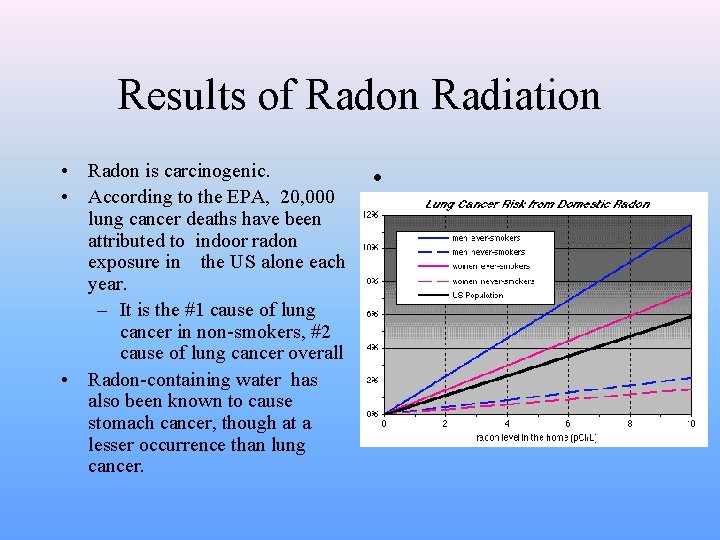
Results of Radon Radiation • Radon is carcinogenic. • According to the EPA, 20, 000 lung cancer deaths have been attributed to indoor radon exposure in the US alone each year. – It is the #1 cause of lung cancer in non-smokers, #2 cause of lung cancer overall • Radon-containing water has also been known to cause stomach cancer, though at a lesser occurrence than lung cancer. •
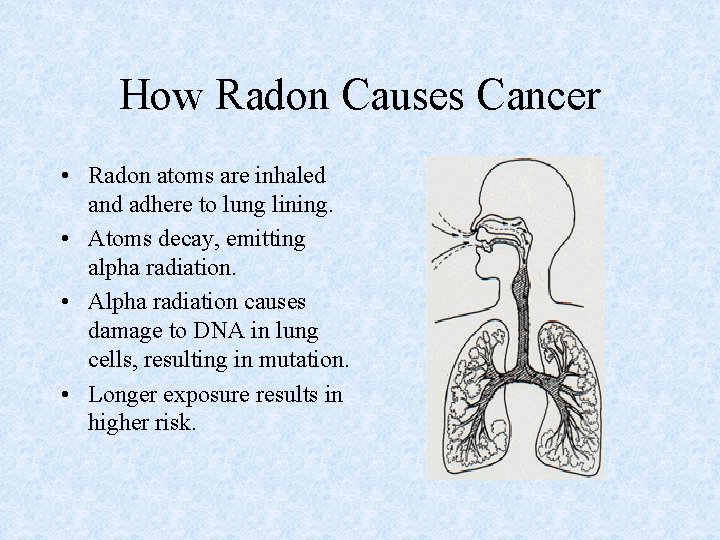
How Radon Causes Cancer • Radon atoms are inhaled and adhere to lung lining. • Atoms decay, emitting alpha radiation. • Alpha radiation causes damage to DNA in lung cells, resulting in mutation. • Longer exposure results in higher risk.
Policies to Address the Radon Issue • EPA proposed new standards for radon in drinking water • States can choose to develop enhanced programs addressing radon in indoor air in conjunction with individual water systems meeting a drinking water standard of 4, 000 pico. Curies per liter of water • Or: individual water systems in that state would either reduce radon in their system's drinking water to 300 p. Ci/L or develop individual indoor air radon programs and reduce levels in drinking water to 4, 000 p. Ci/L.
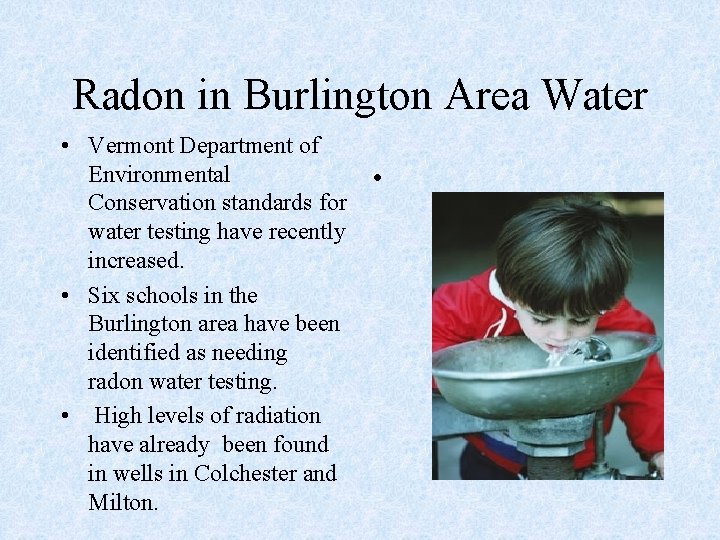
Radon in Burlington Area Water • Vermont Department of Environmental Conservation standards for water testing have recently increased. • Six schools in the Burlington area have been identified as needing radon water testing. • High levels of radiation have already been found in wells in Colchester and Milton. •
Where and how does radon get into drinking water? • While most radon-related deaths are due to radon gas accumulated in houses from seepage through cracks in the foundation, 30 to 1, 800 deaths per year are attributed to radon from household water. Showering, washing dishes, and laundering can disturb the water and release radon gas into the air you breathe.
What is the treatment for radon exposure? • For waterborne radon, a simple step is to make sure your bathroom, laundry room, and kitchen are well ventilated. If your well water only has moderate levels of radon, this may adequately reduce your exposure to waterborne radon. However, if your well has high levels of radon, you may need to use water treatment devices such as granular activated carbon (GAC) units and home aerators.
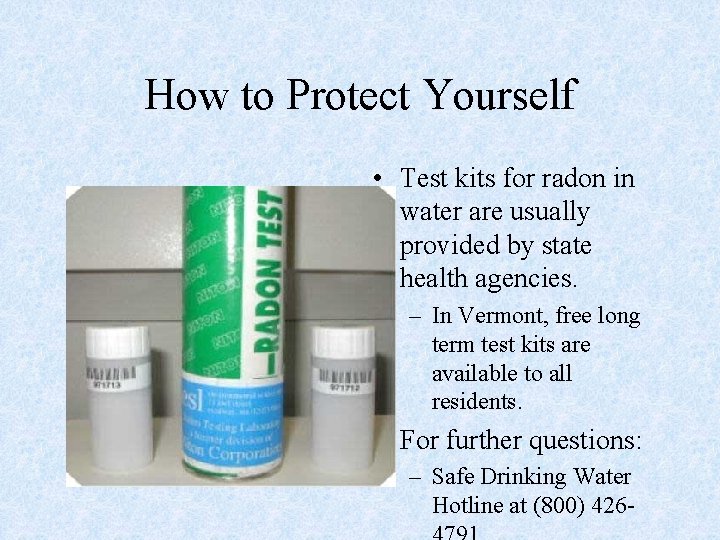
How to Protect Yourself • Test kits for radon in water are usually provided by state health agencies. – In Vermont, free long term test kits are available to all residents. • For further questions: – Safe Drinking Water Hotline at (800) 426 -
Maintain your Water filter • No filter will give you good performance over the long term unless it receives regular maintenance. • As contaminants build up, a filter can not only become less effective, but actually can make your water worse, by starting to release harmful bacteria or chemicals back into your filtered water. • Before buying any water treatment system, compare not only filter prices, but also operating and maintenance costs for the different units.
How many of you use Bottled Water? • • Why? How much do you pay for your water? Why are the good and bad parts of bottled water on UVM campus? • How about in other countries or other situations?
The FDA also classifies some bottled water according to its origin. · Artesian well water. Water from a well that taps an aquifer--layers of porous rock, sand earth that contain water--which is under pressure from surrounding upper layers of rock or clay. When tapped, the pressure in the aquifer, commonly called artesian pressure, pushes the water above the level of the aquifer, sometimes to the surface. Other means may be used to help bring the water to the surface. According to the EPA, water from artesian aquifers often is more pure because the confining layers of rock and clay impede the movement of contamination. However, despite the claims of some bottlers, there is no guarantee that artesian waters are any cleaner than ground water from an unconfined aquifer, the EPA says.
Different “types” of water · Mineral water. Water from an underground source that contains at least 250 parts per million total dissolved solids. Minerals and trace elements must come from the source of the underground water. They cannot be added later. · Spring water. Derived from an underground formation from which water flows naturally to the earth's surface. Spring water must be collected only at the spring or through a borehole tapping the underground formation feeding the spring. If some external force is used to collect the water through a borehole, the water must have the same composition and quality as the water that naturally flows to the surface. · Well water. Water from a hole bored or drilled into the ground, which taps into an aquifer.
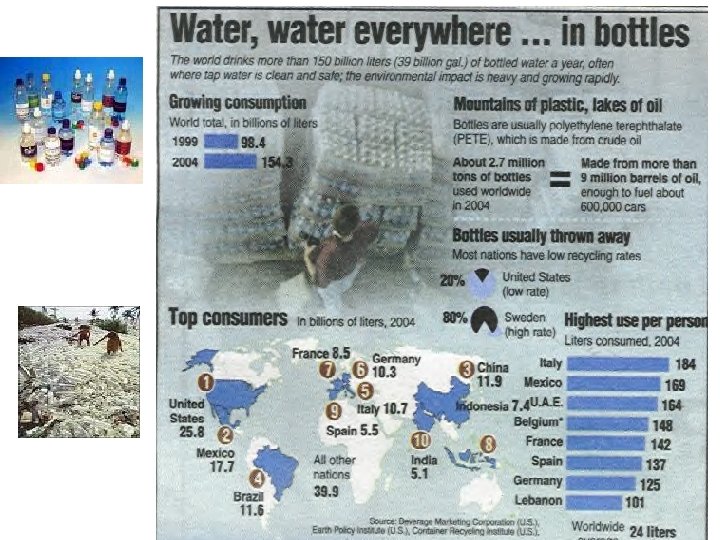
• A new report warns that people's thirst for bottled water is producing unnecessary garbage and consuming vast quantities of energy, even in areas where perfectly good drinking water is available on tap. • The report, released earlier this month by the Earth Policy Institute (EPI), says global consumption of bottled water doubled between 1999 and 2004, reaching 41 billion gallons (154 billion liters) annually.
• Bottled water is often no healthier than tap water, but it can be 10, 000 times more expensive, says Emily Arnold, a researcher with the Washington D. C. -based nonprofit. • "At as much as $2. 50 [U. S. ] per liter [$10 U. S. a gallon], bottled water costs more than gasoline, " • Most of this extra cost is driven by transportation and packaging. • "Nearly a quarter of all bottled water crosses national borders to reach consumers, "
“bottled water, helpful or hype” • In Great Britain the Chartered Institution of Water and Environmental Management recently published a report questioning the quality, labeling, and environmental cost of bottled water. • "Branding and bottling of water where there already exists a wholesome and safe supply of … drinking water cannot be seen as a sustainable use of natural resources, " said Nick Reeves, the institution's executive director. • He says the perception that the bottled product is purer than tap water is unfounded. • "For example, " he said, "the high mineral content of some bottled waters makes them unsuitable for feeding babies and young children. "
• Even when bottled water is safer to drink, campaigners say that the packaging is threatening environmental health. • Worldwide some 2. 7 million tons (2. 4 million metric tons) of plastic are used to bottle water each year, according to EPI. • The plastic most commonly used is polyethylene terepthalate (PET), which is derived from crude oil. • "Making bottles to meet Americans' demand for bottled water requires more than 1. 5 million barrels of oil annually, enough to fuel some 100, 000 U. S. cars for a year, " EPI's Arnold said. • About 86 percent of plastic water bottles in the U. S. become garbage or litter, according to the Container Recycling Institute in Washington, D. C. • Plastic debris in the environment can take between 400 and 1, 000 years to degrade.
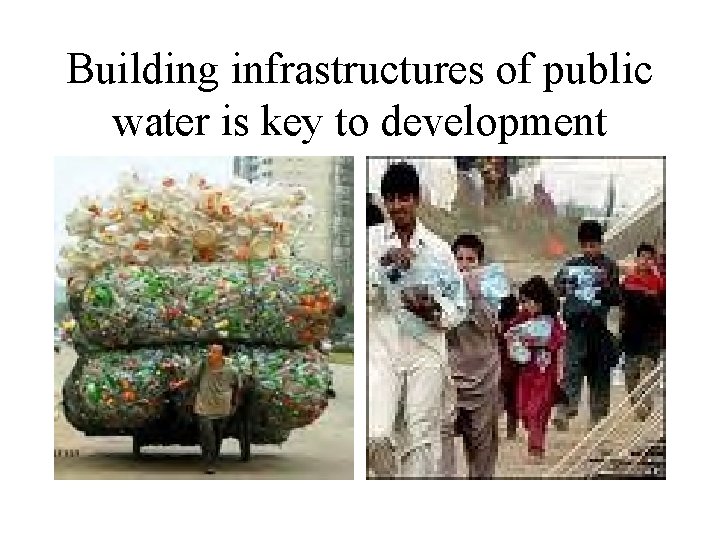
Building infrastructures of public water is key to development
Hype or Help? • Watching bottled water ads, you'd think that tap water might not be healthy. But it's not true. • "20/20" took five bottles of national brands of bottled water and a sample of tap water from a drinking fountain in the middle of New York City and sent them to microbiologist Aaron Margolin of the University of New Hampshire to test for bacteria that can make you sick, like e. coli. • "There was actually no difference between the New York City tap water and the bottled waters that we evaluated, " he said.
It's Time To Invest in the Ultimate Liquid Asset. . . Here's Why "Blue Gold" is the Most Profitable Investment for the 21 st Century • As soon as you sign up to begin receiving the Investment U e. Letter, we'll send you Investing in Water: The Most Profitable Investment of the 21 st Century. It will arrive in your e-mail inbox in no more than 10 minutes. • In our new Investing in Water Report, you’ll discover: · The 2 worldwide factors creating enormous prospects in the water industry. . . · Why 85% of the nation’s 55, 000 municipal water systems will provide long-term profits to large-scale water infrastructure companies… · The “ 2%” shortage that has created a tremendous economic opportunity for companies that build and operate desalination operations and effective water treatment plants.
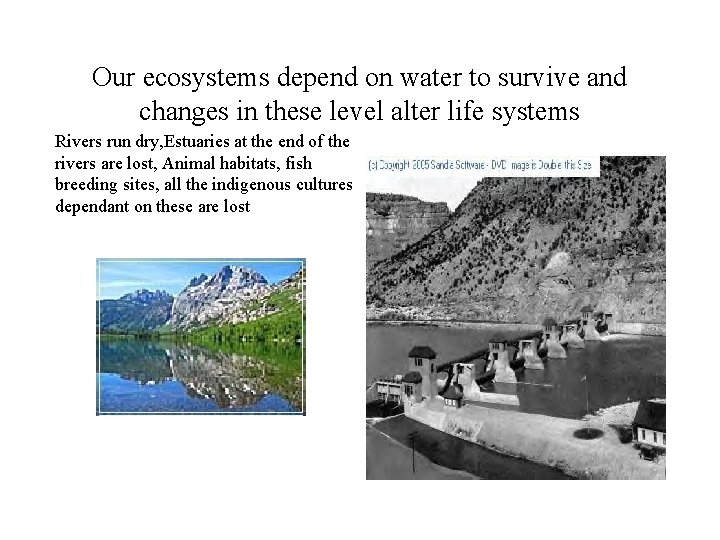
Our ecosystems depend on water to survive and changes in these level alter life systems Rivers run dry, Estuaries at the end of the rivers are lost, Animal habitats, fish breeding sites, all the indigenous cultures dependant on these are lost
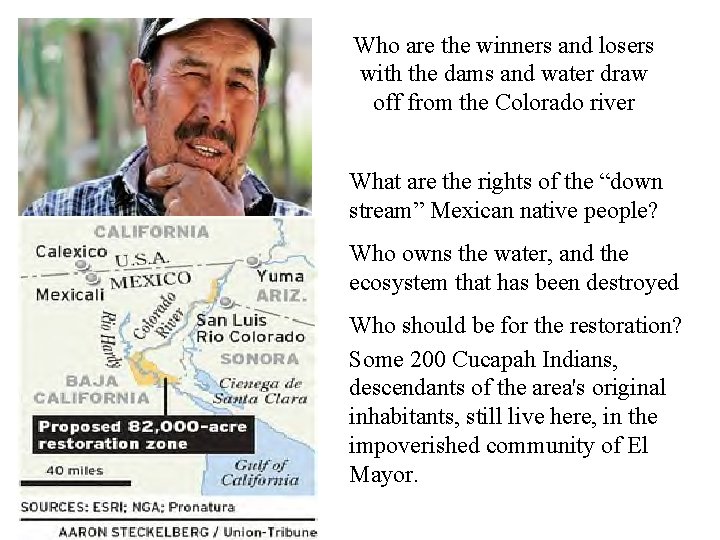
Who are the winners and losers with the dams and water draw off from the Colorado river What are the rights of the “down stream” Mexican native people? Who owns the water, and the ecosystem that has been destroyed Who should be for the restoration? Some 200 Cucapah Indians, descendants of the area's original inhabitants, still live here, in the impoverished community of El Mayor.
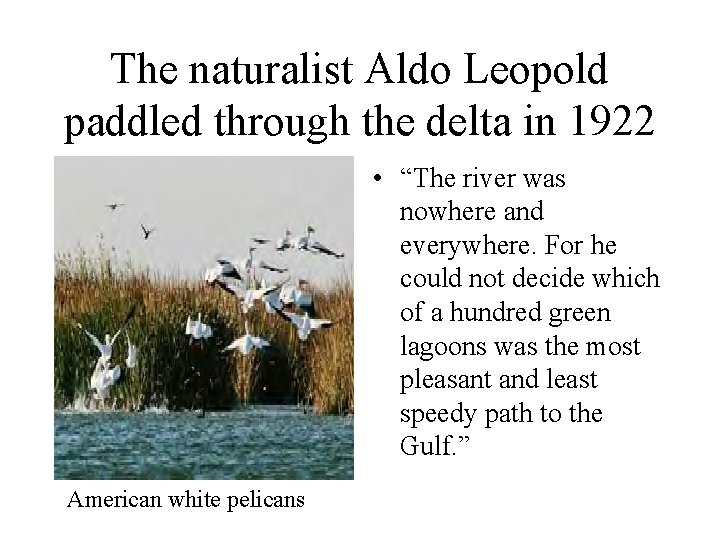
The naturalist Aldo Leopold paddled through the delta in 1922 • “The river was nowhere and everywhere. For he could not decide which of a hundred green lagoons was the most pleasant and least speedy path to the Gulf. ” American white pelicans
The Irrigation Revolution: • 1850 -1950 water was removed from rivers and governments focused on dam building • By 1950 100 million hectares globally • By 1995 250 million hectares globally • Large hydroelectric dams changed river flows but also allowed rural farmers to use power to pump out the underground water • China 1960 110, 000 to 2. 4 million wells by 1980; Pakistan 1964 25, 000 to 360, 000
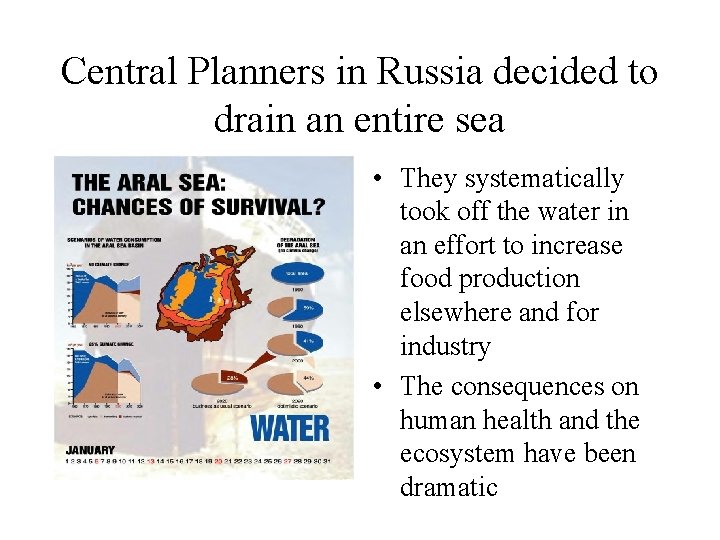
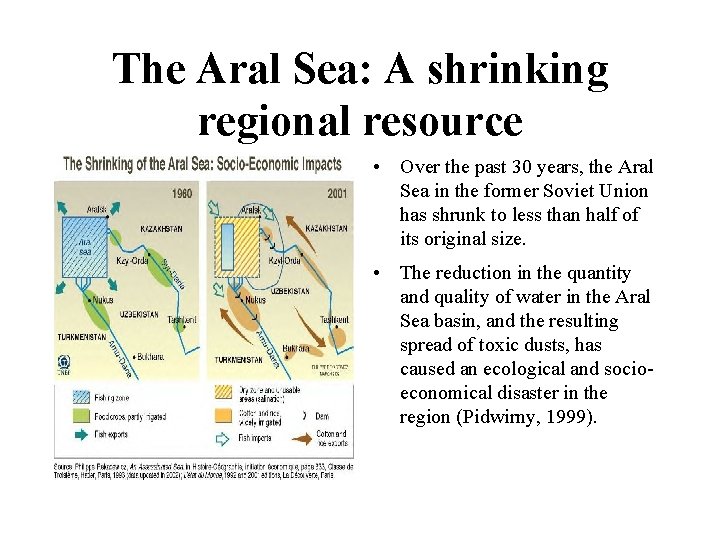
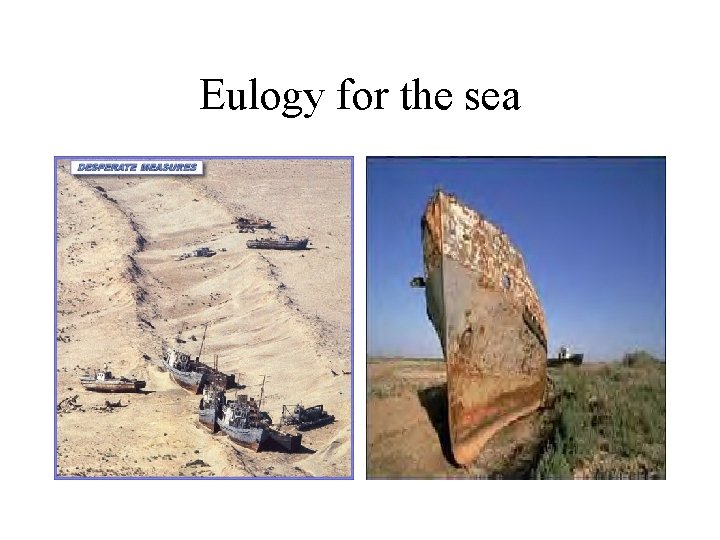
Central Planners in Russia decided to drain an entire sea • They systematically took off the water in an effort to increase food production elsewhere and for industry • The consequences on human health and the ecosystem have been dramatic
The Aral Sea: A shrinking regional resource • Over the past 30 years, the Aral Sea in the former Soviet Union has shrunk to less than half of its original size. • The reduction in the quantity and quality of water in the Aral Sea basin, and the resulting spread of toxic dusts, has caused an ecological and socioeconomical disaster in the region (Pidwirny, 1999).
Eulogy for the sea
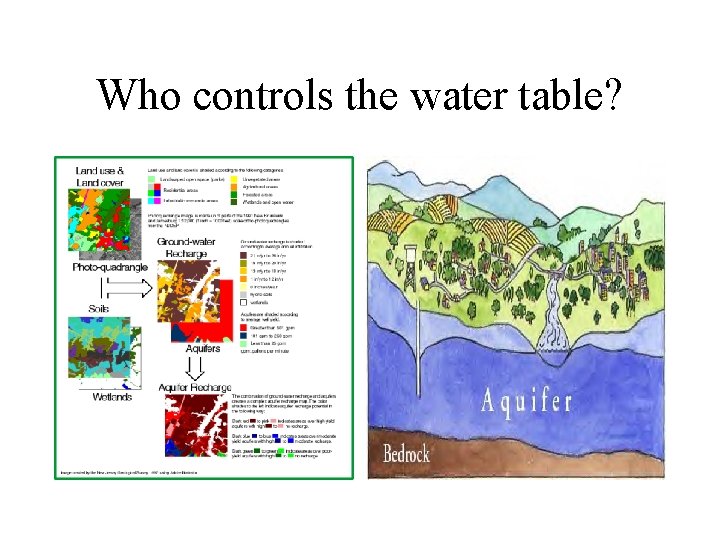
Are we running out of Water? it is a limited resource “reusable” • Water aquifers, and underground water reserves are “going dry” • Water tables around the world are dropping • “over drafting” for crop production exceeds the natural rate of recharge in USA, China, North Africa, Middle East, and Arabian Peninsula
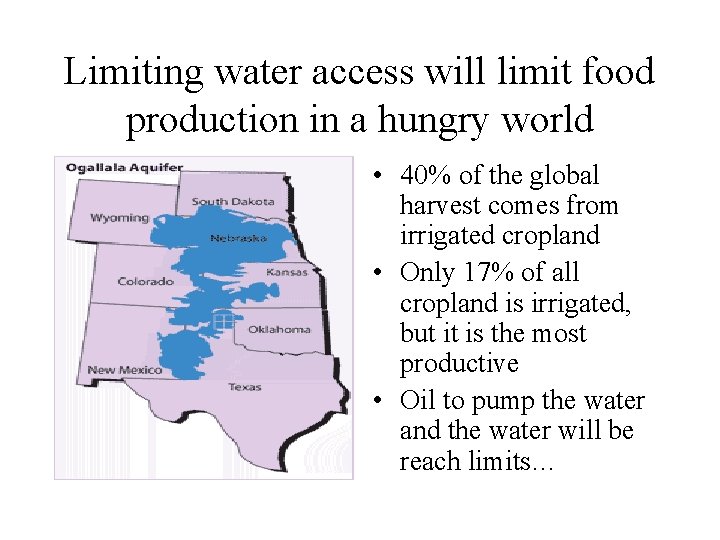
Limiting water access will limit food production in a hungry world • 40% of the global harvest comes from irrigated cropland • Only 17% of all cropland is irrigated, but it is the most productive • Oil to pump the water and the water will be reach limits…
Who controls the water table?
Can we keep food production up with less water? • Present systems waste more than 40% • Simply adding surge valves to control the rate of flow will increase efficiency of gravity flow by 80% and pay for itself in 2 years • LEPA (low energy precision application) which deliver controlled drips increases the efficiency by 95%, pays off in 2 years
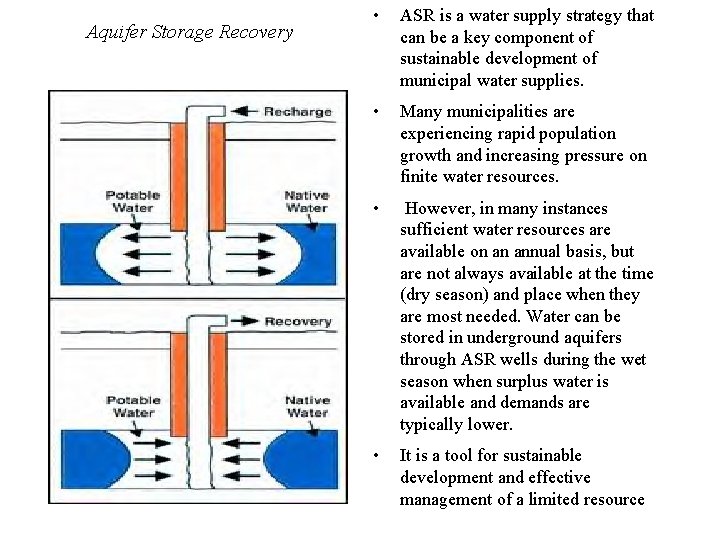
Aquifer Storage Recovery • ASR is a water supply strategy that can be a key component of sustainable development of municipal water supplies. • Many municipalities are experiencing rapid population growth and increasing pressure on finite water resources. • However, in many instances sufficient water resources are available on an annual basis, but are not always available at the time (dry season) and place when they are most needed. Water can be stored in underground aquifers through ASR wells during the wet season when surplus water is available and demands are typically lower. • It is a tool for sustainable development and effective management of a limited resource
Public Policy to protect water food production and ecosystems • Presently most government polices actually encourage water waste, not promote investment in efficiency technology • Texas irrigators get a subsidy for over drafting the aquifer as a “depletion allowance” • We should TAX groundwater depletion • Water dependant crops should reflect ecosystem costs (beef steaks and cotton are essentially subsidized crops that tax the ecosystem)
Tragedy of the Commons How do we regulate sharing? • How do we limit the number of users of this resource? (locally, and globally) • How do we limit what each user can remove at what rate? (laws and standards) • How do we regulate this between countries, between watersheds, between ecosystems? • We must protect the quality of the water and the volume of the water reserves • What is the method of remediation? Can we share water better than we have oil?
Will future wars be about water? • Countries living downstream that depend on water food irrigation and basic sanitation need a healthy river • What happens if upstream countries build dams, take water off for irrigation, pollute the water • Who regulates river flow, water tables, aquifer use, and lake levels?