
Risk management and the Board September 2010 Anton
Risk management and the Board September 2010 (Anton van Wyk – anton. b. van. wyk@za. pwc. com – +27 11 797 5338) Pw. C September 2010 Pricewaterhouse. Coopers
Global highlights • • • Stakeholder pressure to sharpen risk focus Governance no longer mindless compliance Information required to predict the future “One view – one risk aggregation” – Combined Assurance Assessing the cost and effectiveness of risk management Risks happening simultaneously Risk models and internal audit functionality must be able to cope with complexity of factors impacting business Risk Governance needs to link to strategy, risk management & risk bearing capacity Human capital remains scarce Governments intervention Risk process should be focussed, not complex Every entity exists to provide value for its stakeholders. All entities face uncertainty, and the challenge for management is to determine how much uncertainty to accept as it strives to grow stakeholder value Pricewaterhouse. Coopers September 2010 Slide 2
A view from the top • Global economy the no. 1 item on the agenda – recovery or double dip? • Key is understanding lead demand indicators, particularly China and other developing nations • Cost is still a key differentiator – but replaced at the top of the agenda • Investment in human capital critical • Diplomacy to face political challenges a prerequisite of today’s CEO Pricewaterhouse. Coopers September 2010 Slide 3
Board and Directors • • • The focal point for and custodian of corporate governance Strategy, risk, performance and sustainability are inseparable The organisation to have an effective and independent audit committee Responsible for the governance of risk Responsible for IT governance An effective risk-based internal audit The Board and Management must exercise and show leadership to prevent risk management from becoming a series of activities that are detached from the realities of the business Pricewaterhouse. Coopers September 2010 Slide 4
Challenges facing Board’s today • How do we integrate risk management with the organisation’s strategic direction and plan? • What are our principal business risks? • Are we taking the right amount of risk? • How effective are our processes for identifying, assessing and managing business risks? • How is risk coordinated across the organisation? • How do we ensure that the organisation is performing according to the business plan and within appropriate risk tolerances? • How does the Board help establish the “tone at the top” that reinforces the organisation’s values and promotes a “risk aware culture”? Pricewaterhouse. Coopers September 2010 Page 5
Audit committee • The organisation has an effective and independent audit committee • Audit committee members should be suitably skilled and experienced independent nonexecutive directors • Chaired by an independent non-executive director • The audit committee should oversee integrated reporting • A combined assurance model should be applied to provide a coordinated approach to all assurance activities • Responsible for the oversight of internal audit • An integral part of the risk management process • Report to the board and shareholders on how it has discharged its duties Pricewaterhouse. Coopers September 2010 Slide 6
Audit Committees Setting Higher Performance Standards What audit committees value most : • Assurance on the effectiveness of internal controls • Internal audit as an intellectual exercise • Effectiveness of communication • Ability of the business to address financial and operational risks • Quality of assurance and their skill sets • No surprises • Assurance on the effectiveness of the enterprises’ risk management process • Prevention and detection of fraud September 2010 Pricewaterhouse. Coopers
Risk – the cornerstone of governance • Determine the levels of risk appetite, tolerance and resilience • The risk committee or audit committee should assist the board in carrying out its risk responsibilities • Management has the responsibility to design, implement and monitor the risk management plan • Risk assessments and risk management is a continuous cycle • Framework and methodologies are implemented to increase the probability of anticipating unpredictable risks • Management considers and implements appropriate risk responses • Continuous risk monitoring by management and the Board • The board should receive combined assurance regarding the effectiveness of the risk management process Pricewaterhouse. Coopers September 2010 Slide 9
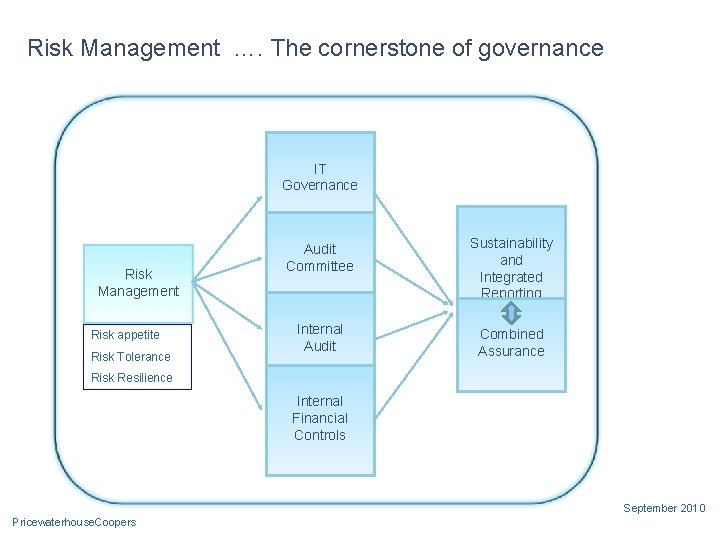
Risk Management …. The cornerstone of governance IT Governance Risk Management Risk appetite Risk Tolerance Audit Committee Sustainability and Integrated Reporting Internal Audit Combined Assurance Risk Resilience Internal Financial Controls September 2010 Pricewaterhouse. Coopers
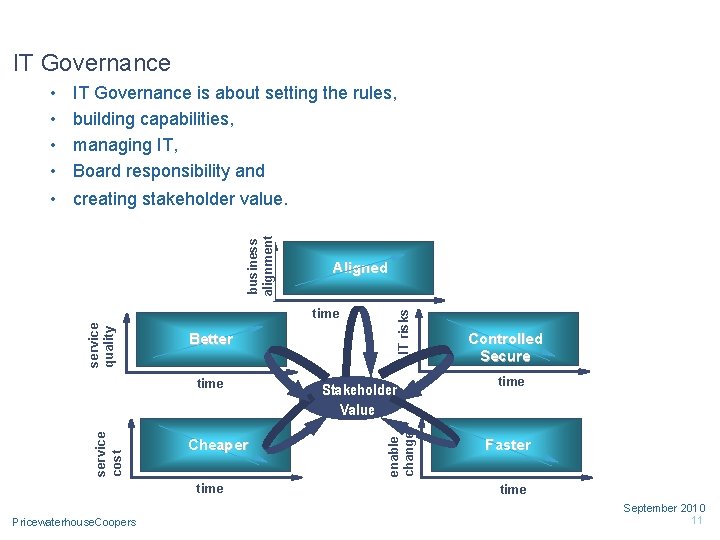
IT Governance • • IT Governance is about setting the rules, building capabilities, managing IT, Board responsibility and service quality time Better service cost time Cheaper time Pricewaterhouse. Coopers IT risks Aligned Stakeholder Value enable change business alignment • creating stakeholder value. Controlled Secure time Faster time September 2010 11
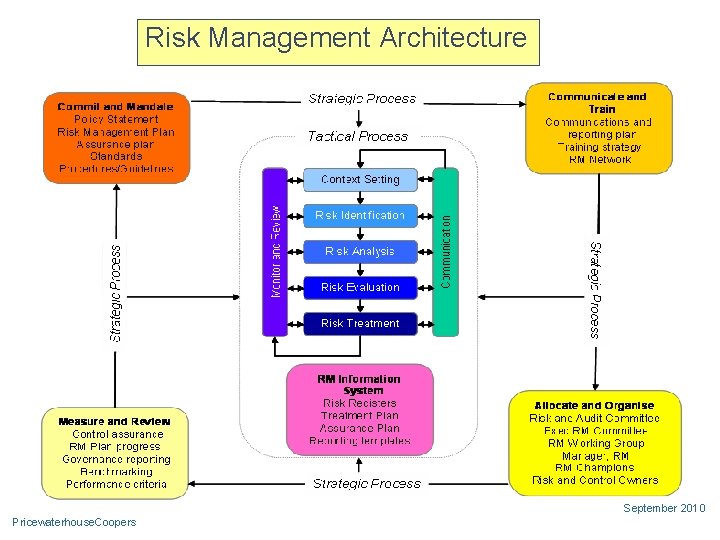
Risk Management Architecture September 2010 Pricewaterhouse. Coopers
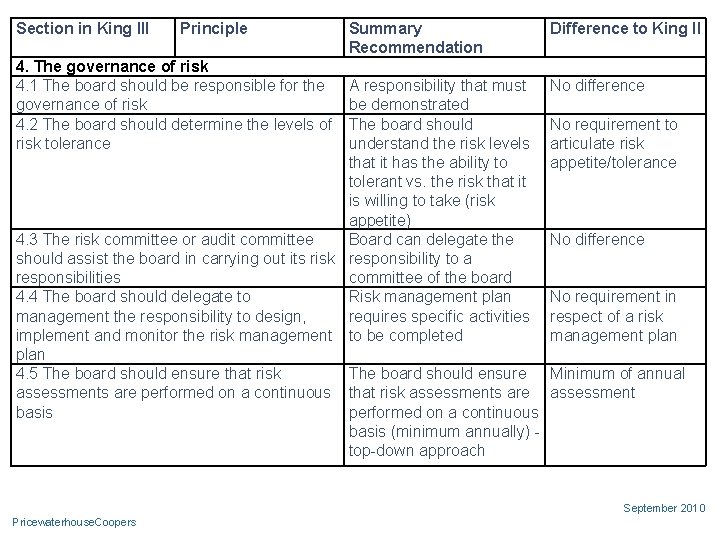
Section in King III Principle 4. The governance of risk 4. 1 The board should be responsible for the governance of risk 4. 2 The board should determine the levels of risk tolerance Summary Recommendation A responsibility that must be demonstrated The board should understand the risk levels that it has the ability to tolerant vs. the risk that it is willing to take (risk appetite) 4. 3 The risk committee or audit committee Board can delegate the should assist the board in carrying out its risk responsibility to a responsibilities committee of the board 4. 4 The board should delegate to Risk management plan management the responsibility to design, requires specific activities implement and monitor the risk management to be completed plan 4. 5 The board should ensure that risk The board should ensure assessments are performed on a continuous that risk assessments are basis performed on a continuous basis (minimum annually) top-down approach Difference to King II No difference No requirement to articulate risk appetite/tolerance No difference No requirement in respect of a risk management plan Minimum of annual assessment September 2010 Pricewaterhouse. Coopers
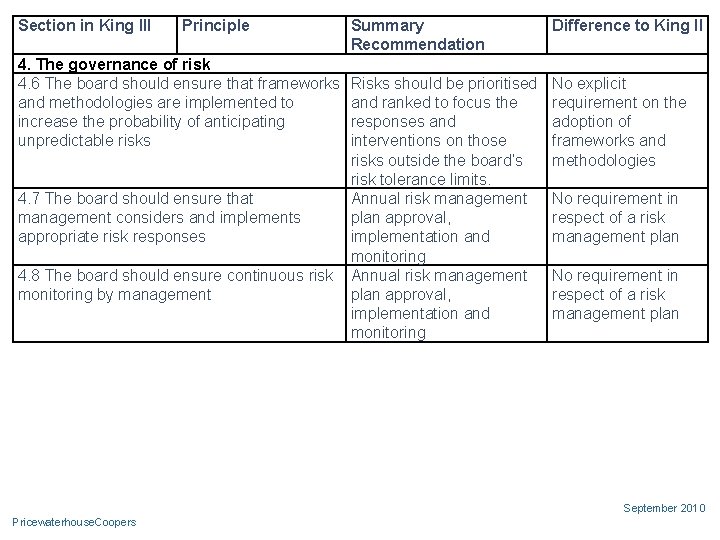
Section in King III Principle 4. The governance of risk 4. 6 The board should ensure that frameworks and methodologies are implemented to increase the probability of anticipating unpredictable risks 4. 7 The board should ensure that management considers and implements appropriate risk responses 4. 8 The board should ensure continuous risk monitoring by management Summary Recommendation Difference to King II Risks should be prioritised and ranked to focus the responses and interventions on those risks outside the board’s risk tolerance limits. Annual risk management plan approval, implementation and monitoring No explicit requirement on the adoption of frameworks and methodologies No requirement in respect of a risk management plan September 2010 Pricewaterhouse. Coopers
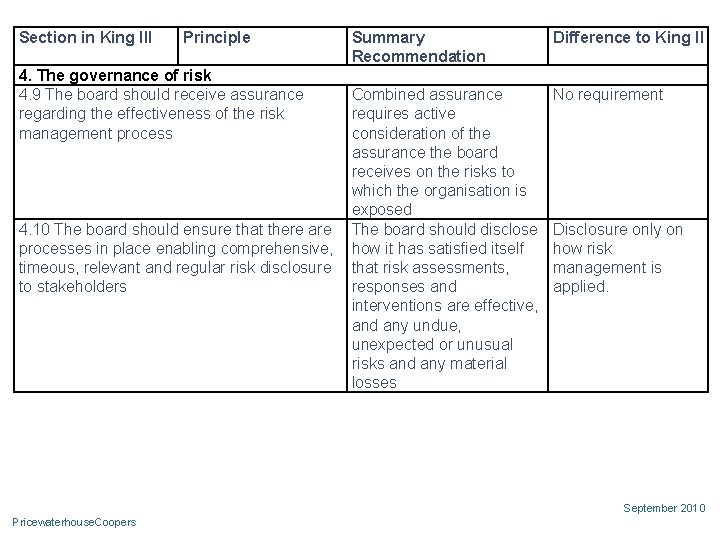
Section in King III Principle 4. The governance of risk 4. 9 The board should receive assurance regarding the effectiveness of the risk management process 4. 10 The board should ensure that there are processes in place enabling comprehensive, timeous, relevant and regular risk disclosure to stakeholders Summary Recommendation Difference to King II Combined assurance requires active consideration of the assurance the board receives on the risks to which the organisation is exposed The board should disclose how it has satisfied itself that risk assessments, responses and interventions are effective, and any undue, unexpected or unusual risks and any material losses No requirement Disclosure only on how risk management is applied. September 2010 Pricewaterhouse. Coopers
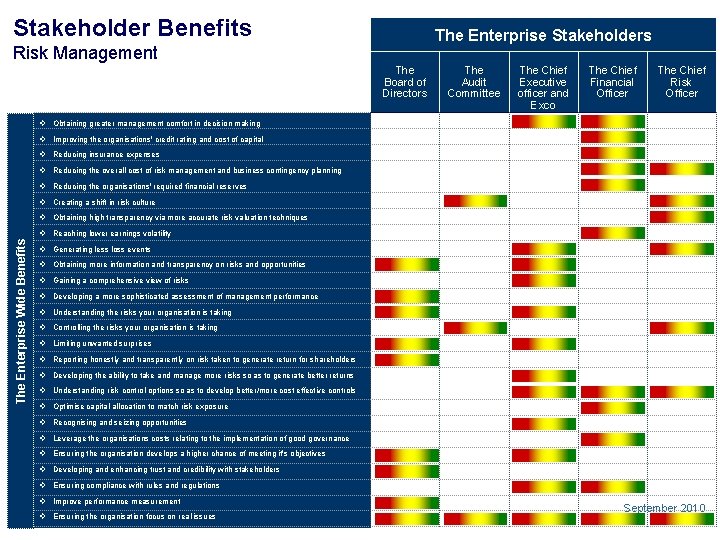
Stakeholder Benefits The Enterprise Stakeholders Risk Management The Board of Directors The Audit Committee The Chief Executive officer and Exco The Chief Financial Officer The Chief Risk Officer v Obtaining greater management comfort in decision making v Improving the organisations' credit rating and cost of capital v Reducing insurance expenses v Reducing the overall cost of risk management and business contingency planning v Reducing the organisations' required financial reserves v Creating a shift in risk culture v Obtaining high transparency via more accurate risk valuation techniques The Enterprise Wide Benefits v Reaching lower earnings volatility v Generating less loss events v Obtaining more information and transparency on risks and opportunities v Gaining a comprehensive view of risks v Developing a more sophisticated assessment of management performance v Understanding the risks your organisation is taking v Controlling the risks your organisation is taking v Limiting unwanted surprises v Reporting honestly and transparently on risk taken to generate return for shareholders v Developing the ability to take and manage more risks so as to generate better returns v Understanding risk control options so as to develop better/more cost effective controls v Optimise capital allocation to match risk exposure v Recognising and seizing opportunities v Leverage the organisations costs relating to the implementation of good governance v Ensuring the organisation develops a higher chance of meeting it's objectives v Developing and enhancing trust and credibility with stakeholders v Ensuring compliance with rules and regulations Developed by Jan Nigel Bladen MBA v Improve performance measurement Swiss Mobile Dubai Mobile v Ensuring the organisation focus on real issues Pricewaterhouse. Coopers : : 00. 41. 79 250 5746 00. 971. 50 55 04602 September 2010
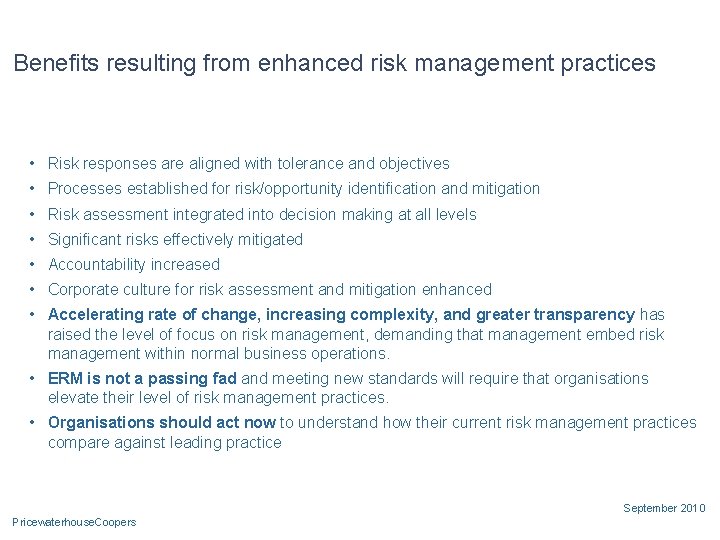
Benefits resulting from enhanced risk management practices • Risk responses are aligned with tolerance and objectives • Processes established for risk/opportunity identification and mitigation • Risk assessment integrated into decision making at all levels • Significant risks effectively mitigated • Accountability increased • Corporate culture for risk assessment and mitigation enhanced • Accelerating rate of change, increasing complexity, and greater transparency has raised the level of focus on risk management, demanding that management embed risk management within normal business operations. • ERM is not a passing fad and meeting new standards will require that organisations elevate their level of risk management practices. • Organisations should act now to understand how their current risk management practices compare against leading practice September 2010 Pricewaterhouse. Coopers
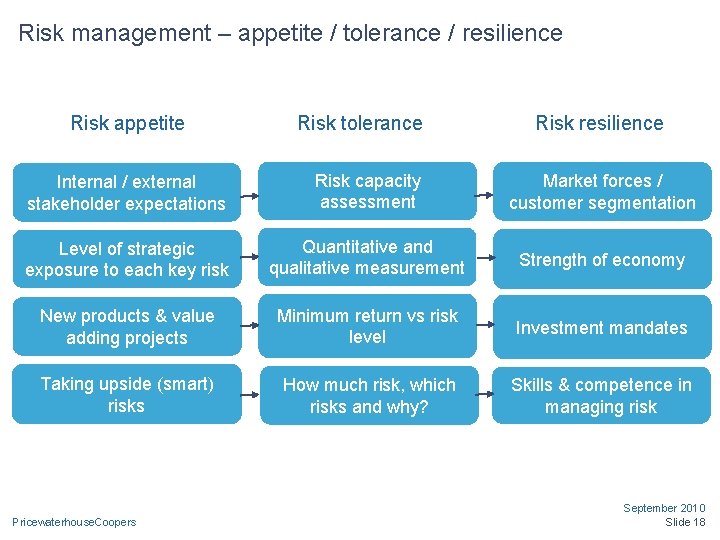
Risk management – appetite / tolerance / resilience Risk appetite Risk tolerance Risk resilience Internal / external stakeholder expectations Risk capacity assessment Market forces / customer segmentation Level of strategic exposure to each key risk Quantitative and qualitative measurement Strength of economy New products & value adding projects Minimum return vs risk level Investment mandates Taking upside (smart) risks How much risk, which risks and why? Skills & competence in managing risk Pricewaterhouse. Coopers September 2010 Slide 18
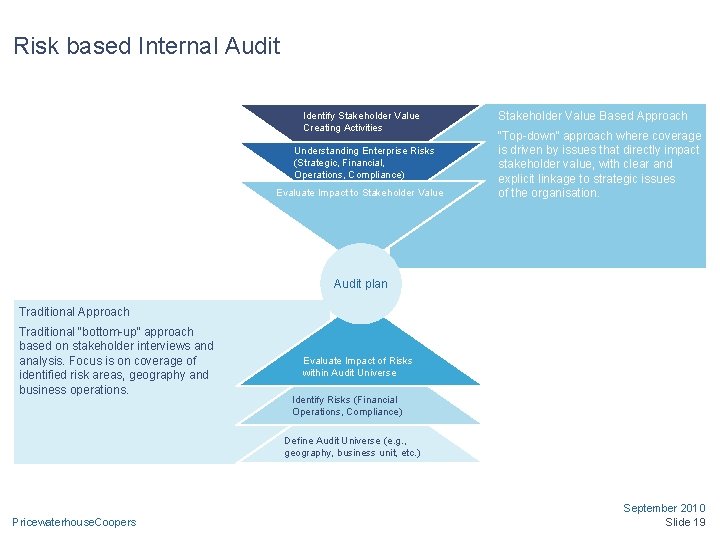
Risk based Internal Audit Identify Stakeholder Value Creating Activities Understanding Enterprise Risks (Strategic, Financial, Operations, Compliance) Evaluate Impact to Stakeholder Value Based Approach “Top-down” approach where coverage is driven by issues that directly impact stakeholder value, with clear and explicit linkage to strategic issues of the organisation. Audit plan Traditional Approach Traditional “bottom-up” approach based on stakeholder interviews and analysis. Focus is on coverage of identified risk areas, geography and business operations. Evaluate Impact of Risks within Audit Universe Identify Risks (Financial Operations, Compliance) Define Audit Universe (e. g. , geography, business unit, etc. ) Pricewaterhouse. Coopers September 2010 Slide 19
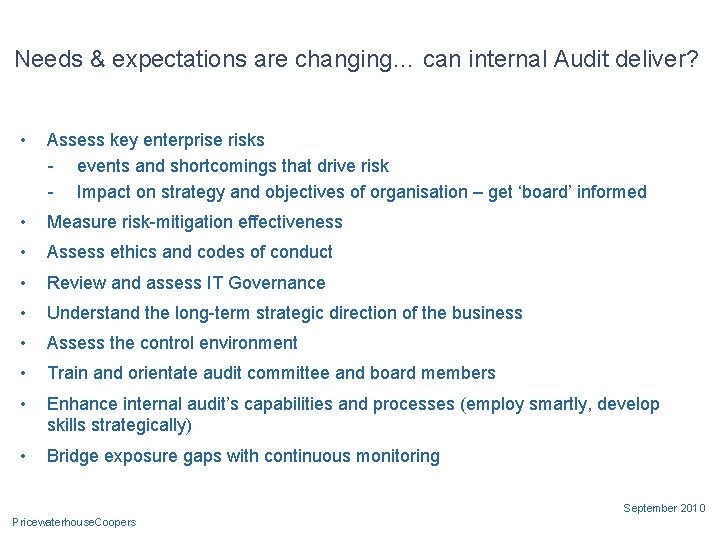
Needs & expectations are changing… can internal Audit deliver? • Assess key enterprise risks - events and shortcomings that drive risk - Impact on strategy and objectives of organisation – get ‘board’ informed • Measure risk-mitigation effectiveness • Assess ethics and codes of conduct • Review and assess IT Governance • Understand the long-term strategic direction of the business • Assess the control environment • Train and orientate audit committee and board members • Enhance internal audit’s capabilities and processes (employ smartly, develop skills strategically) • Bridge exposure gaps with continuous monitoring September 2010 Pricewaterhouse. Coopers
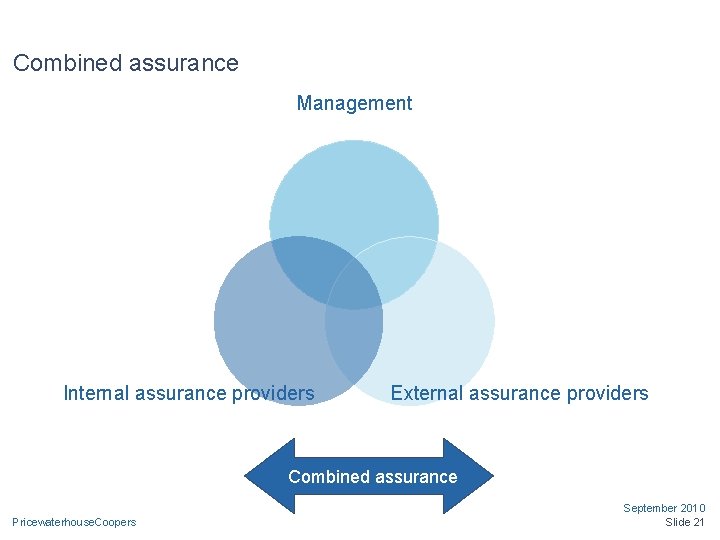
Combined assurance Management Internal assurance providers External assurance providers Combined assurance Pricewaterhouse. Coopers September 2010 Slide 21
What is Combined Assurance? • Definition: “Integrating, coordinating, and aligning the risk management and assurance processes within an organisation to optimise and maximise the level of risk, governance, and control oversight over the organisation’s risk landscape. ” • Combined Assurance is about assurance providers working more closely together to ensure: • - the right amount of assurance - in the right areas - from people with the best and most relevant skills - as cost effectively as possible - Obtaining trust of management and the audit/risk committees The “right amount of assurance” depends on the risk appetite of the company. Guidance on risk appetite is sought from the Board through the Audit and Risk Committee. Pricewaterhouse. Coopers September 2010 Slide 22
Key questions – Risk • Do we understand how risk appetite and tolerance is applied in our organisation? • How do we know that the biggest risk exposures to our organisation are being adequately managed? • When last did we participate in a risk assessment activity? • How often have we considered the same risk-related issue in the various management and governance meetings? • Is IT governance risk actively considered in our risk management process? • Do we specifically consider compliance risk and, if so, how satisfied are we that it is effectively covered? • Are risks prioritised and ranked to focus the responses and interventions on those risks outside the board’s risk tolerance limits? Pricewaterhouse. Coopers September 2010 Slide 23
Key questions – Risk (cont. ) • Do we have an approved annual risk management plan? • Who assures non financial risks, such as plant availability, staff capacity and competency, the impact of legislative changes on the business/organisation etc? And to which management or board committee is the assurance provided? Are we satisfied that this assurance is reliable? • Do we have a fraud risk plan to consider our fraud exposure and prevention? • Does our disclosure on the effectiveness of risk management reflect the actual position of our business/organisation? • Have we aligned risk appetite reporting with performance reporting? • Do we integrate loss reporting into ERM? • Have we considered the implementation of a combined assurance model? • Are our strategic imperatives aligned with our risk management priorities? • Are risk and control owner responsibilities included in performance contracts? Pricewaterhouse. Coopers September 2010 Slide 24
- Slides: 23