
RISK MANAGEMENT AND INSURANCE 12292021 By YT 1
RISK MANAGEMENT AND INSURANCE 12/29/2021 By: YT 1
CONTENTS: PART-ONE Unit-1: Risks and Related Concepts Unit-2: Risk Management PART-TWO Unit-3: Introduction to Insurance Unit-4: Kinds of Insurance Unit-5: Functions of Insurance 12/29/2021 By: YT 2
COURSE DESCRIPTION: v Risk affects every aspect of an organization. v The effects of risk are not confined within any predictable boundaries; a single event can easily influence several areas of an organization at once, producing consequences far beyond the immediate impact. v The pervasiveness and complexity of risk presents strong challenges to managers, one of the most important being the coordination of risk management across areas within the organization. v It deals with: the nature and management of pure risks, insurance and reinsurance; risk concepts, classification of risks, management of pure risks through various risk handling tools, industrial safety, general principles of insurance and major classes of insurance, reinsurance and development & regulation of the insurance industry in Ethiopia. 12/29/2021 By: YT 3
COURSE OBJECTIVE: After the completion this course the students will be able to: �Know basic concepts of risk �Explain the basic classification of risk �Understand insurance Industry in Ethiopia �Explain the nature and application of reinsurance �The course is intended to enable students to identify and measure business loss exposures. �It also discusses how to select among the major tools of risk management and quip students with ways of measuring, if not eliminating, exposures to loss or risk and the ability to analyze various class of insurance contracts 12/29/2021 By: YT 4
Unit-1 RISK AND RELATED CONCEPTS 12/29/2021 By: YT 5
1. 1: INTRODUCTION q Due to imperfect knowledge about the future, our activities are likely to result in outcomes, which are different from our expectations. These deviations are not desirable. q Risk is undesirable outcome that exists due to imperfect foresight about the future. The future is always uncertain and no one can be perfect about the future. q The more knowledgeable the person is, the more certain it will be concerning the future events. However, perfect foresight about the future is something impossible. 12/29/2021 By: YT 6
1. 2: DEFINITION OF RISK There is no one universal and comprehensive definition of risk that exists so far. It is defined in different forms by several authors with some differences in the wordings used. Their essence, however, is very similar. Some of the definitions are shown below: Ø Risk is a condition in which there is a possibility of an adverse deviation from a desired outcome that is expected or hoped for. Risk is uncertainty regarding loss. Ø Risk is the objectified uncertainty as to the occurrences of an undesired event. Ø Risk is the possibility of an unfavorable deviation from expectations. Ø Risk is the dispersion/variation of actual from expected 7 12/29/2021 By: YT
1. 2: DEFINITION OF RISK (Cont…) From the above definitions of risk, we can infer that risk is undesired outcome or it is the possibility of loss. There should be more than one outcome for the risk to happen, i. e. there will be no risk if there is only one outcome. Risk is potential variation in outcomes. 12/29/2021 By: YT 8
1. 3: RISK Vs UNCERTAINTY Many textbooks use the terms risk and uncertainty interchangeably. However, the distinction between the two must be noted. Uncertainty: q Uncertainty refers to the doubt as to the occurrence of a certain desired outcome. It is more of subjective belief. i. e. it is based on the knowledge and attitudes of the person viewing the situation. It is immeasurable. q. Uncertainty is simply a psychological reaction to the absence of knowledge about the future. q “Uncertainty is measured by the degree of belief. It is the state of mind. ” (Preffer) 12/29/2021 By: YT 9
1. 3: RISK Vs UNCERTAINTY (Cont…) Risk: q “Risk can be defined as a measurable uncertainty that can be determined by objective analysis based on prior experience or via calculation. ” (Knight) q “Risk is a combination of hazards and is measured by probability. It is a state of the world. ” (Preffer) 12/29/2021 By: YT 10
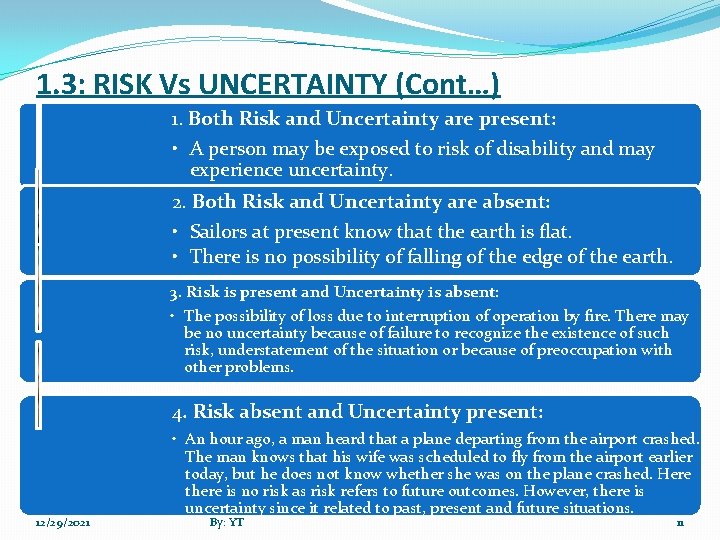
1. 3: RISK Vs UNCERTAINTY (Cont…) 1. Both Risk and Uncertainty are present: • A person may be exposed to risk of disability and may experience uncertainty. 2. Both Risk and Uncertainty are absent: • Sailors at present know that the earth is flat. • There is no possibility of falling of the edge of the earth. 3. Risk is present and Uncertainty is absent: • The possibility of loss due to interruption of operation by fire. There may be no uncertainty because of failure to recognize the existence of such risk, understatement of the situation or because of preoccupation with other problems. 4. Risk absent and Uncertainty present: 12/29/2021 • An hour ago, a man heard that a plane departing from the airport crashed. The man knows that his wife was scheduled to fly from the airport earlier today, but he does not know whether she was on the plane crashed. Here there is no risk as risk refers to future outcomes. However, there is uncertainty since it related to past, present and future situations. By: YT 11

1. 4: RISK Vs PROBABILITY Probability It refers to the long-run chance of occurrence, or relative frequency of some event. The distinction between Risk and Probability. The probability associated with a certain outcome is the relative likelihood that outcome will occur. Risk It is a concept in relative variation. (objective risk) It refers to the variation in the possible outcomes. This means that risk depends on the entire probability distribution. It indicates the concept of variability. Probability varies between 0 and 1. if the probability is 0, that outcome will not occur, if the probability is 1, that outcome will occur. 12/29/2021 By: YT 12
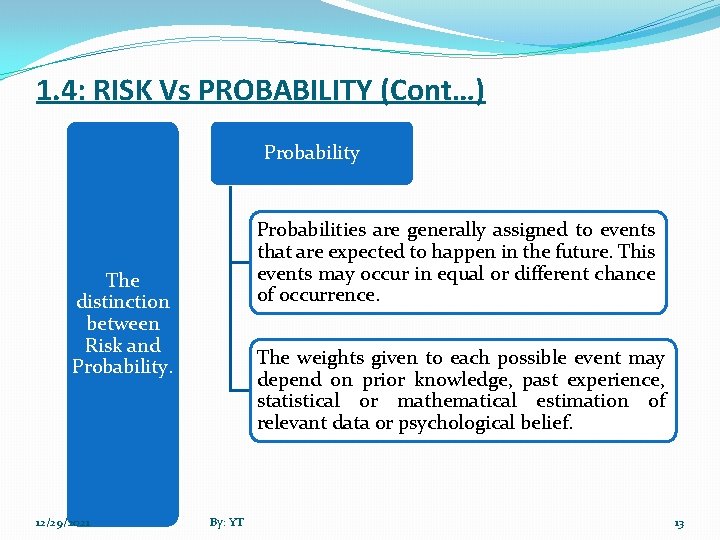
1. 4: RISK Vs PROBABILITY (Cont…) Probability Probabilities are generally assigned to events that are expected to happen in the future. This events may occur in equal or different chance of occurrence. The distinction between Risk and Probability. 12/29/2021 The weights given to each possible event may depend on prior knowledge, past experience, statistical or mathematical estimation of relevant data or psychological belief. By: YT 13
Example Suppose the occurrence of a particular event is to be considered. One extreme is that this event is certainly to take place. Thus, the probability that this event will take place is 1. there is certainty as to the occurrence of this event perfect foresight in this regard. Accordingly, there is no risk. The other extreme is that the event will not take place at all. Hence, the probability of occurrence is zero. Here, too, there is certainty and therefore, there is no risk. In between these two extremes there could be several occurrences of the events with the corresponding probabilities of occurrence. It is therefore; risk and probability are different but related concepts. 12/29/2021 By: YT 14
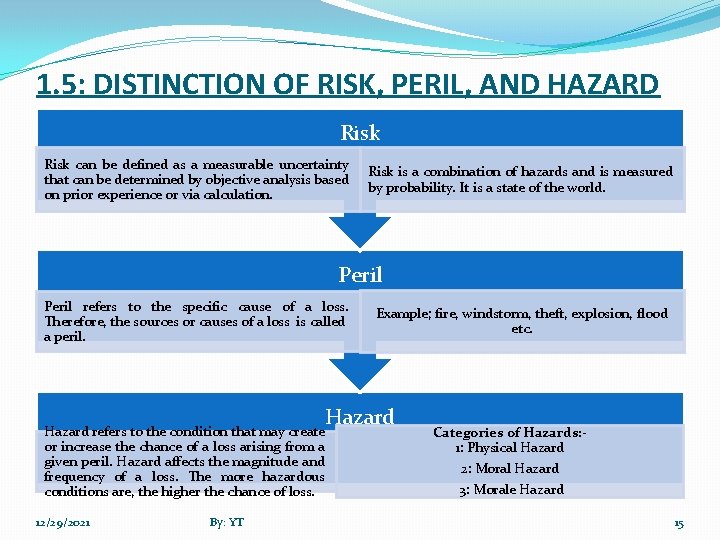
1. 5: DISTINCTION OF RISK, PERIL, AND HAZARD Risk can be defined as a measurable uncertainty that can be determined by objective analysis based on prior experience or via calculation. Risk is a combination of hazards and is measured by probability. It is a state of the world. Peril refers to the specific cause of a loss. Therefore, the sources or causes of a loss is called a peril. Hazard refers to the condition that may create or increase the chance of a loss arising from a given peril. Hazard affects the magnitude and frequency of a loss. The more hazardous conditions are, the higher the chance of loss. 12/29/2021 By: YT Example; fire, windstorm, theft, explosion, flood etc. Hazard Categories of Hazards: 1: Physical Hazard 2: Moral Hazard 3: Morale Hazard 15
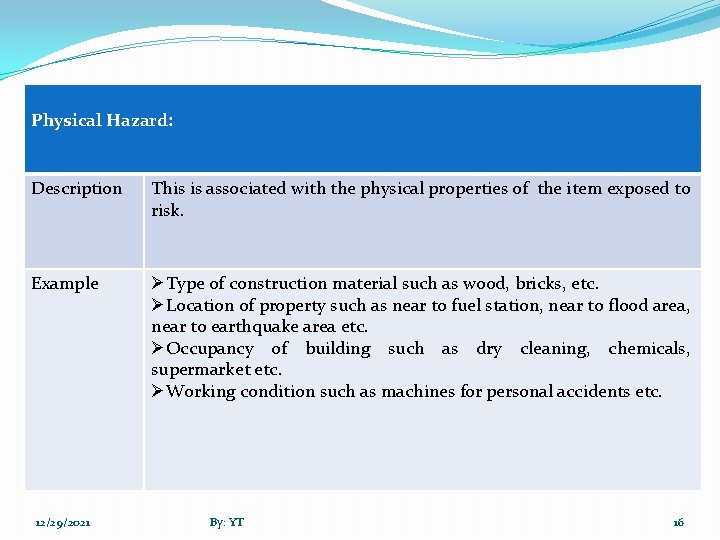
Physical Hazard: Description This is associated with the physical properties of the item exposed to risk. Example ØType of construction material such as wood, bricks, etc. ØLocation of property such as near to fuel station, near to flood area, near to earthquake area etc. ØOccupancy of building such as dry cleaning, chemicals, supermarket etc. ØWorking condition such as machines for personal accidents etc. 12/29/2021 By: YT 16
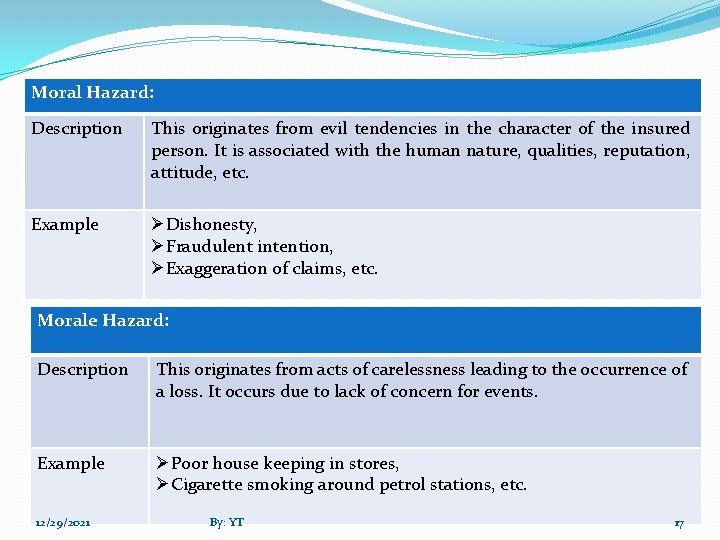
Moral Hazard: Description This originates from evil tendencies in the character of the insured person. It is associated with the human nature, qualities, reputation, attitude, etc. Example ØDishonesty, ØFraudulent intention, ØExaggeration of claims, etc. Morale Hazard: Description This originates from acts of carelessness leading to the occurrence of a loss. It occurs due to lack of concern for events. Example ØPoor house keeping in stores, ØCigarette smoking around petrol stations, etc. 12/29/2021 By: YT 17
In some situations, however, it is difficult to distinguish between a peril and a hazard. For example, a fire in general may be regarded as a peril concerning the loss of physical property. It may also be regarded as a hazard concerning auto collisions created by the confusion in the vicinity of the fire (around the fire). 12/29/2021 By: YT 18
1. 6: CLASSIFICATION OF RISK Risk can be classified in several ways according to the cause, their economic effect, or some other dimensions. The following summarizes the different ways of classifying risks. 12/29/2021 By: YT 19
1: Financial Vs Non-financial Risks Financial Risks: it result in losses that can be expresses in financial terms. Example: Loss of cars (Property) is a financial risk. Non-financial Risk: it does not have financial implication. Example: Death of relatives is a non-financial risk. 12/29/2021 By: YT 20
2: Static Vs Dynamic Risks: Static Risks: It originate from changes in the over all economy which are associated with such as human wants, improvements in technology and organization (price changes, consumer taste changes, income distribution, political changes, etc. ). They are less predictable and hence beyond the control of risk managers some times. 12/29/2021 By: YT It refers to those losses that can take place even though there were no changes in the over all economy. They are losses arising from causes other than changes in the overall economy. They are predictable and could be controlled to some extent by taking loss prevention measures. 21
3: Fundamental Vs Particular Risks Fundamental Risks: q. Fundamental risks are essentially group risks; the conditions, which cause them, have no relation to any particular individual. Most fundamental risks are economic, political or social. q. It affects the entire society or a large group of the population. They are usually beyond the control of individuals. q. They are the responsibility of the society itself. q. Example: Unemployment, famine, flood, inflation, war, etc. 12/29/2021 By: YT 22
3: Fundamental Vs Particular Risks (Cont’…) Particular Risks: q. Particular risks are those due to particular and specific conditions, which obtain in particular cases. They affect each individual separately. They are usually personal in cause, almost always personal in their application. q. They are the responsibility of individuals. They can be controlled by purchasing Insurance Policies and other risk handling tools. q. Example: Property Losses, Death, Disability, etc. 12/29/2021 By: YT 23
4: Objective Vs Subjective Risks: Objective/Measurable Risks: Ø It is “the variation that exists in nature and is the same for all persons facing the same situation”. It is the state of nature(world). Ø The characteristics of objective risk is that it is measurable. it can be quantified using statistical or mathematical techniques. 12/29/2021 By: YT Subjective /Non. Measurable Risks: Ø This is the estimate of the objective risk which depends on the person’s psychological belief is the subjective risk. It is difficult to obtain the true objective risk in in most business situation. Ø The characteristics of subjective risk is that it is non-measurable. it can not be quantified using statistical or mathematical techniques. 24
5: Pure Vs Speculative Risks: The distinction between pure and speculative risks rests on primarily on profit/loss structure of the underlying situation in which the event occurs. Pure Risks: Pure risks refers to the situation in which only a loss or no loss would occur. There are only two distinct outcomes: Loss or No Loss. They are always undesirable and hence people take steps to avoid such risks. Most pure risks are insurable. They classified in to three categories. 12/29/2021 By: YT 25
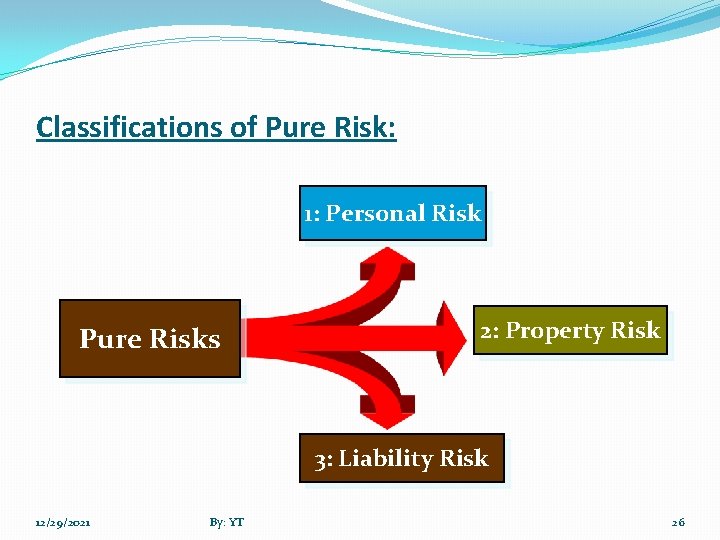
Classifications of Pure Risk: 1: Personal Risk Pure Risks 2: Property Risk 3: Liability Risk 12/29/2021 By: YT 26
Classifications of Pure Risk (Cont’…. ): Personal Risks: Personal risk refers to the possibility of loss to a person such as death, disability, loss of earning power, etc. There are losses to a firm regarding its employees and there families. Personal risks may arise due to accidents while off duty, industrial accidents, occupational disease, retirement, sickness, etc. Generally, financial losses caused by the death, poor health, retirement, or unemployment of people are considered as personal losses. Either the workers and there families or their employers may suffer such losses. Property Risks: Property risk refers to losses associated with ownership of property such as destruction of property by fire. Ownership of property puts a person or a firm to property exposure, i. e. the property will be exposed to a wide range of perils. 12/29/2021 By: YT 27
Classifications of Pure Risk (Cont’…. ): Liability Risks: The term liability is used in various ways in our present language. In general usage, the term has become synonymous with “responsibility” and involves the concept of penalty when a responsibility may not have been met. A person may be generally obligated to another, because of moral or other reasons, to do or not to do something; the law, however, does not recognize moral responsibility alone as legally enforceable. One would be legally obliged to pay for the damage he/she inflict upon other persons or their property. 12/29/2021 By: YT 28
Speculative Risks: Speculative risks provide favorable or unfavorable consequences. The situation is characterized by a possibility of either a loss or a gain. People are more adverse to pure risks as compared to speculative risks. In speculative risk situation, people may deliberately create the risk when they realize that the favorable outcome is so promising. Speculative risks are generally uninsurable. For example, expansion of plant, introduction of new product to the market, lottery, and gambling. Both pure and speculative risks commonly exist at the same time. For instance, accidental damage to a building (Pure Risk) and rise or fall in property values caused by general economic conditions (Speculative Risk). Risk managers are concerned with most but not all pure risks. 12/29/2021 By: YT 29
1. 7: RISKS RELATED TO BUSINESS ACTIVITIES Most risks in business environment are speculative in nature. The finance literature considers five types of risks that business organizations face in the course of their normal operations: this are stated as follows: 1. 2. 3. 4. 5. 12/29/2021 Business Risks, Interest Rate Risks, Financial Risks, Purchasing Power Risks, and Market Risks. By: YT 30
1. 7: RISKS RELATED TO BUSINESS ACTIVITIES (cont’…) 1: Business Risk: Business risk is associated with the physical operation of the firm. Variations in the level of sales, costs, profits, are likely to occur due to a number of factors inherent in the economic environment. Business risk is independent of the company’s financial risks. 2: Interest Rate Risk: This is a risk resulting from changes in interest rates. Changes in interest rates affect the price of financial securities such as the price of bonds, stocks, etc. 12/29/2021 By: YT 31
1. 7: RISKS RELATED TO BUSINESS ACTIVITIES (cont’…) 3: Financial Risk: This is associated with debt financing. Borrowing results in the payment of periodic interest charge and the payment of the principal upon maturity. There is a risk of default by the company if operations are not profitable. Other financial risks include: Bankruptcy, � Stock price decline, � Insolvency, etc. � Bond holders are less exposed to financial risk than common stock holders because they have a priority claim against the assets of an insolvent firm. 12/29/2021 By: YT 32
1. 7: RISKS RELATED TO BUSINESS ACTIVITIES (cont’…) 4: Purchasing Power Risk: This risk arises under inflationary situations (general price rise of goods and services) leading to a decline in the purchasing power of the asset held. Financial assets lose purchasing power if increased inflationary tendencies prevail in the economy. 12/29/2021 By: YT 33
1. 7: RISKS RELATED TO BUSINESS ACTIVITIES (cont’…) 5: Market Risk: Market risk is related to stock market. It refers to stock price variability caused by market forces. It is the result of investors reactions to real or psychological expectations. The market in many cases, is also affected by such events like presidential election, trade balances, wars, new inventories, etc. market risk is also called systematic or non diversifiable risk. All investors are subject to this risk. It is the result of the workings of the economy; and can not be eliminated through portfolio diversification. 12/29/2021 By: YT 34
The End…. !!! 12/29/2021 By: YT 35
- Slides: 35