
Risk for violence directed towards self Suicide Lina




- Slides: 58
Risk for violence directed towards self/ Suicide Lina Wardam. RN. PNS
Suicide
Suicide • At the end of this lecture the student nurse will be able to: • What do we mean by suicide? • What are my beliefs about suicide? • How my beliefs about suicide will impact my working with patient? • What are the myths and facts about suicide? • How to assess the suicidal lethality and immanence? • what is the nursing management of patients with suicidal attempts?
Dealing with your own Feelings as a nurse • How do you feel about suicide? • Do you feel it’s sign of weakness? • Do you think that suicidal patients are trapped in circumstances that are beyond their control? • Do not let either view affect the quality of your care.
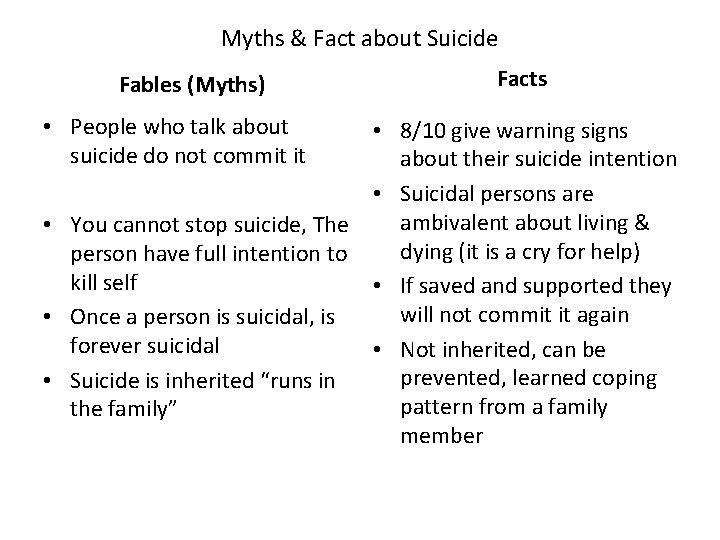
Myths & Fact about Suicide Fables (Myths) • People who talk about suicide do not commit it Facts • 8/10 give warning signs about their suicide intention • Suicidal persons are ambivalent about living & • You cannot stop suicide, The dying (it is a cry for help) person have full intention to kill self • If saved and supported they will not commit it again • Once a person is suicidal, is forever suicidal • Not inherited, can be prevented, learned coping • Suicide is inherited “runs in pattern from a family the family” member
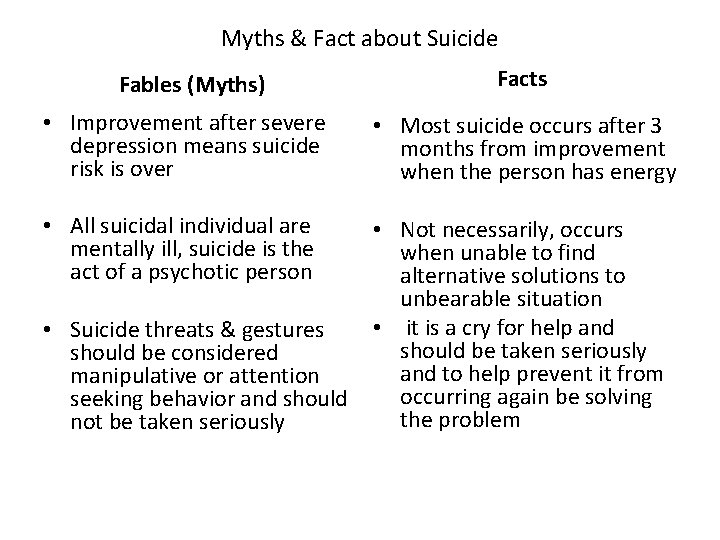
Myths & Fact about Suicide Fables (Myths) Facts • Improvement after severe depression means suicide risk is over • Most suicide occurs after 3 months from improvement when the person has energy • All suicidal individual are mentally ill, suicide is the act of a psychotic person • Not necessarily, occurs when unable to find alternative solutions to unbearable situation • it is a cry for help and should be taken seriously and to help prevent it from occurring again be solving the problem • Suicide threats & gestures should be considered manipulative or attention seeking behavior and should not be taken seriously
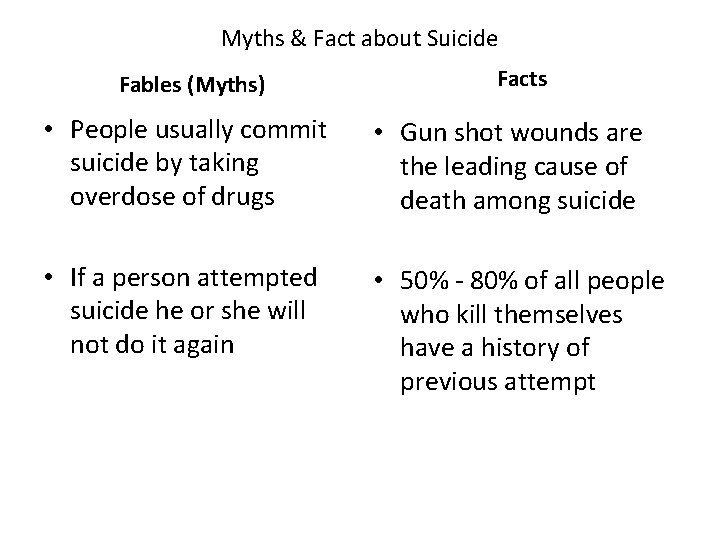
Myths & Fact about Suicide Fables (Myths) Facts • People usually commit suicide by taking overdose of drugs • Gun shot wounds are the leading cause of death among suicide • If a person attempted suicide he or she will not do it again • 50% - 80% of all people who kill themselves have a history of previous attempt
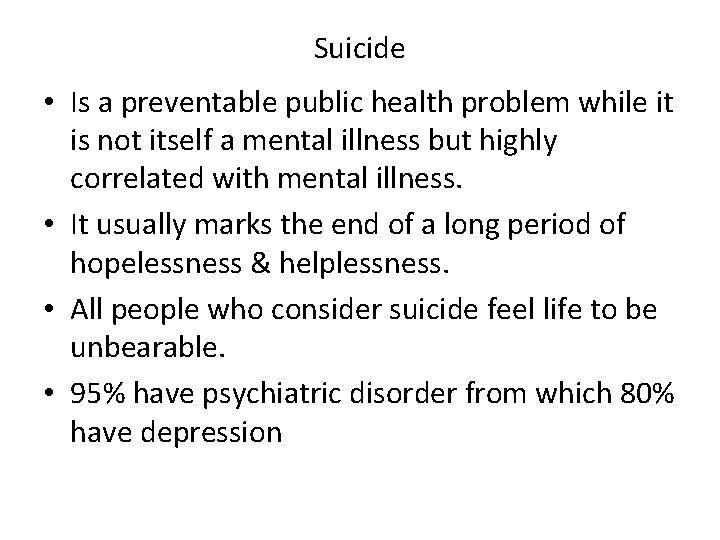
Suicide • Is a preventable public health problem while it is not itself a mental illness but highly correlated with mental illness. • It usually marks the end of a long period of hopelessness & helplessness. • All people who consider suicide feel life to be unbearable. • 95% have psychiatric disorder from which 80% have depression
Risk for violence directed towards self/Suicide • Related to: Inward repression anger; Negative thinking/ misinterpretation of reality; feelings of hopelessness & worthlessness; Isolation; Serotonin disturbances; Failure in achievement; failure to meet needs of affiliation, autonomy • Evidenced by: Suicidal ideation - Suicidal gestures - Suicidal attempt - or aborted or completed (successful attempt )
Continuum of suicidal behavior severity • Suicidal Ideation: having thoughts of harming or killing self • Suicide threat: is more serious than a casual statement of suicidal intent and that is accompanied by other behavior changes. Such as mood swings, decline in work or school performance • Para suicide (gesture): attempt to harm self with no intention of dying (the method is not lethal and in context of time & place where discovery is high) –to seek attention or make a significant person feel guilty-
Continuum of suicidal behavior • Suicide attempt: A non fatal, self inflicted destructive act with intent to die whether they succeed or not. Survival of attempt depends on lethality of method and rescue possibilities (which is high lethal and they elude others not to be detected) • Aborted suicide: The person has the intent to kill oneself, a change of mind immediately before the actual attempt, the absence of injury (52. 6% at least one in life time, 24. 4% made one aborted attempt and 28. 1% several attempts) • Suicide: a fatal successful attempt
Continuum of suicidal behavior • Aborted suicide: The person has the intent to kill oneself, a change of mind immediately before the actual attempt, the absence of injury (52. 6% at least one in life time, 24. 4% made one aborted attempt and 28. 1% several attempts)
Assessment • SAD PERSON (risk factors assessment) • Suicidal plan: – Suicidal plan – Suicidal clues – verbal/nonverbal, behavioral, emotional, somatic – • Interpersonal support • Coping strategies
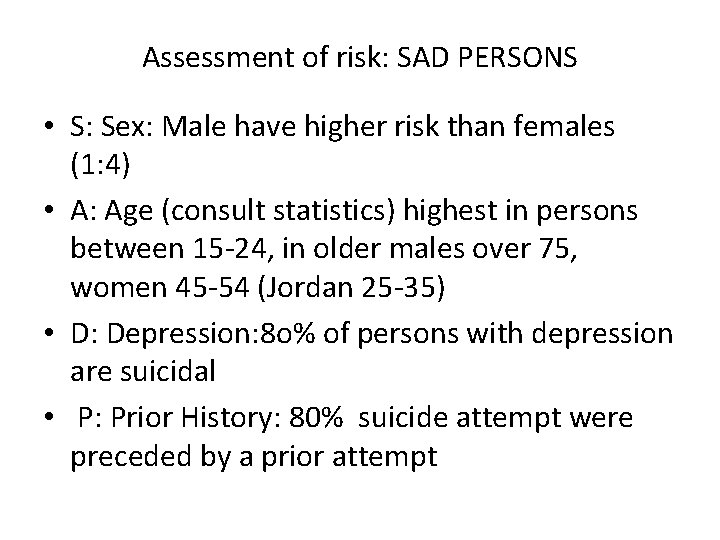
Assessment of risk: SAD PERSONS • S: Sex: Male have higher risk than females (1: 4) • A: Age (consult statistics) highest in persons between 15 -24, in older males over 75, women 45 -54 (Jordan 25 -35) • D: Depression: 8 o% of persons with depression are suicidal • P: Prior History: 80% suicide attempt were preceded by a prior attempt
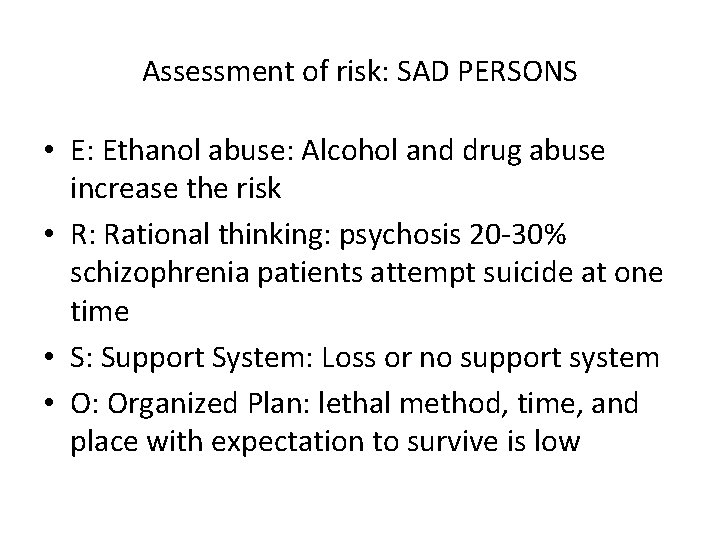
Assessment of risk: SAD PERSONS • E: Ethanol abuse: Alcohol and drug abuse increase the risk • R: Rational thinking: psychosis 20 -30% schizophrenia patients attempt suicide at one time • S: Support System: Loss or no support system • O: Organized Plan: lethal method, time, and place with expectation to survive is low
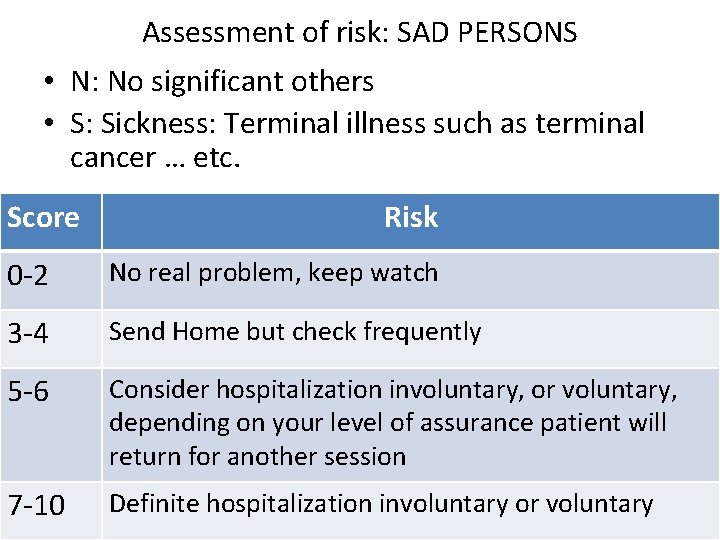
Assessment of risk: SAD PERSONS • N: No significant others • S: Sickness: Terminal illness such as terminal cancer … etc. Score Risk 0 -2 No real problem, keep watch 3 -4 Send Home but check frequently 5 -6 Consider hospitalization involuntary, or voluntary, depending on your level of assurance patient will return for another session 7 -10 Definite hospitalization involuntary or voluntary
Other demographics • Ethnicity: white more • Marital status: widowed, divorced, single men, married women, single women, married men • Socioeconomic status: lower and higher social class more than middle • Occupation: professionals health care, business men, attorneys and mechanics • Religion: protestant, less in catholic & Jews (Islam? ? ? ) • Family history: high risk if past family history
Assessment • SAD PERSON (risk factors assessment) • Suicidal clues – verbal/nonverbal, behavioral, emotional, somatic • Suicidal plan: • Interpersonal support • Coping strategies
Suicidal clues • Verbal • Non verbal – Behavioral – Emotional – Somatic
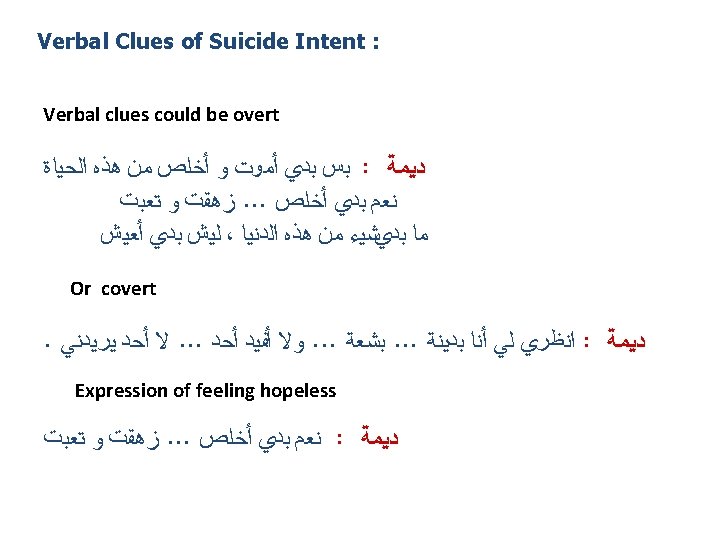
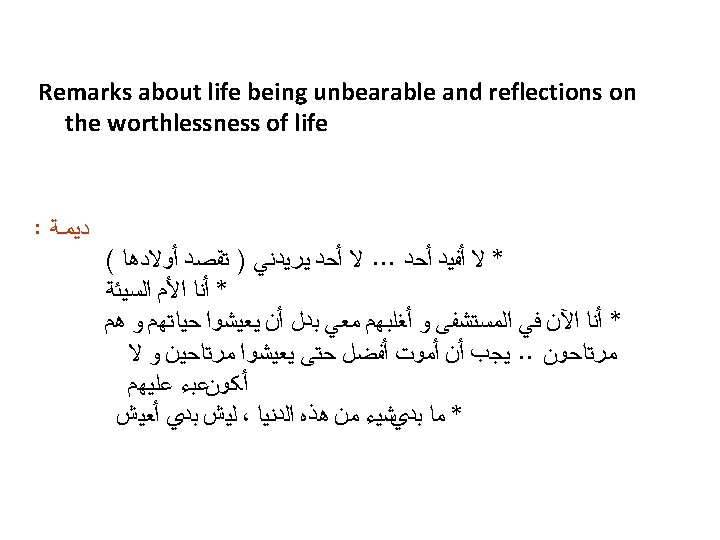
Verbal Clues of Suicide Intent • Verbal clues could be overt statement ( ﺃﻨﺎ ﻣﺶ ﻗﺎﺩﺭ )ﺃﺘﺤﻤﻞ ﻫﺬﻩ ﺍﻟﺤﻴﺎﺓ ﺍﻟﻤﻮﺕ ﺃﺤﺴﻦ. • Or overt statement (Pretty soon you won’t have to worry about me ; • I would be better off dead; I don’t want to be a burden to others). • Expressions of feeling hopeless. • Remarks about life being unbearable. • Reflections on the worthlessness of life.
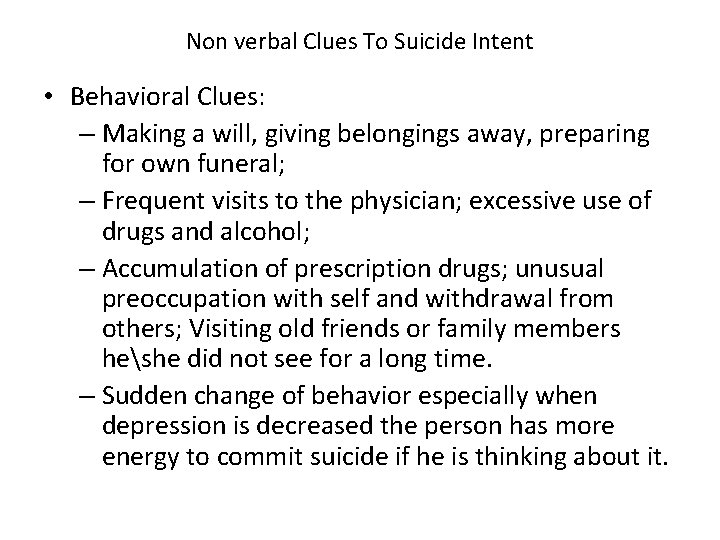
Non verbal Clues To Suicide Intent • Behavioral Clues: – Making a will, giving belongings away, preparing for own funeral; – Frequent visits to the physician; excessive use of drugs and alcohol; – Accumulation of prescription drugs; unusual preoccupation with self and withdrawal from others; Visiting old friends or family members heshe did not see for a long time. – Sudden change of behavior especially when depression is decreased the person has more energy to commit suicide if he is thinking about it.
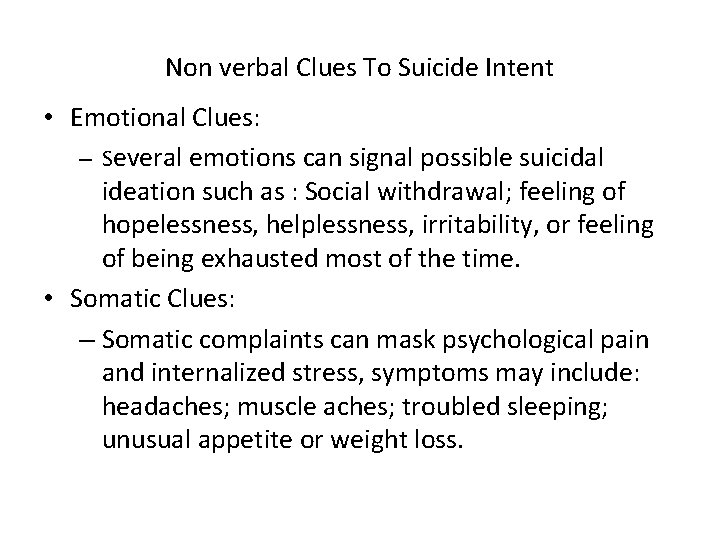
Non verbal Clues To Suicide Intent • Emotional Clues: – Several emotions can signal possible suicidal ideation such as : Social withdrawal; feeling of hopelessness, helplessness, irritability, or feeling of being exhausted most of the time. • Somatic Clues: – Somatic complaints can mask psychological pain and internalized stress, symptoms may include: headaches; muscle aches; troubled sleeping; unusual appetite or weight loss.
Assessment • SAD PERSON (risk factors assessment) • Suicidal clues – verbal/nonverbal, behavioral, emotional, somatic • Suicidal plan: • Interpersonal support • Coping strategies
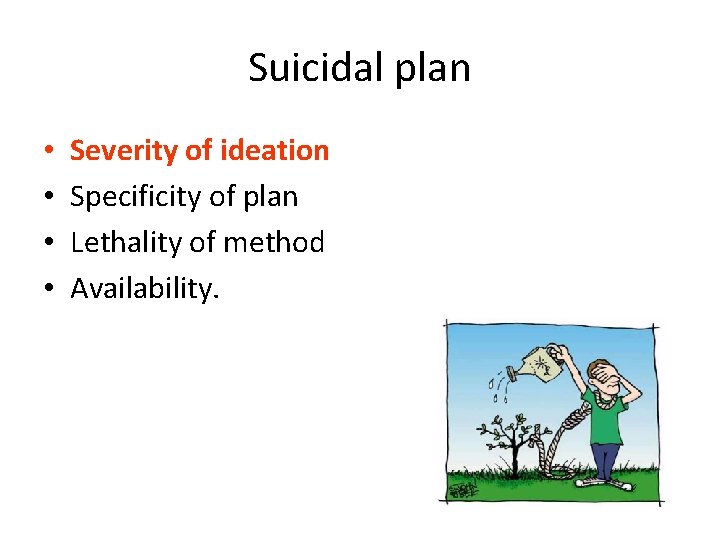
Suicidal plan • • Severity of ideation Specificity of plan Lethality of method Availability.
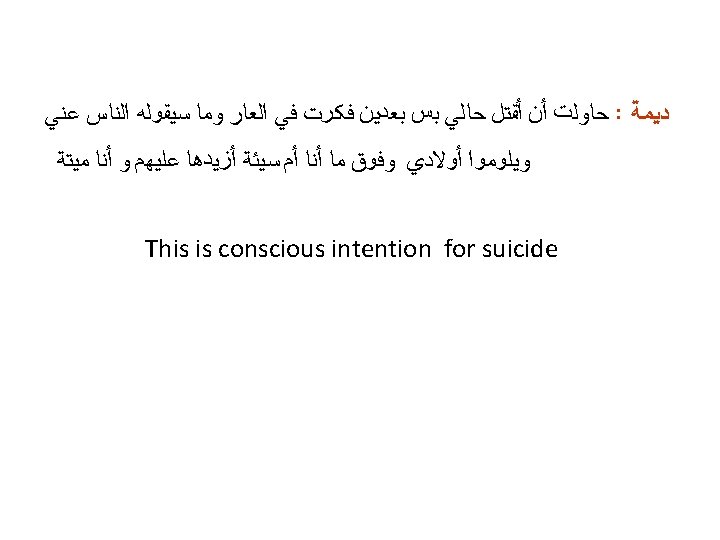
Severity of ideation • Ideation Versus Intent: Suicidal thoughts accompanied with intent puts the person at a higher risk for attempting to carry it out – Conscious intent: aware about the act, its consequences, others reactions, rescue possibility and lethality – Unconscious intent: • depression, guilt, anxiety, hostility, dependency, failure and hopelessness,
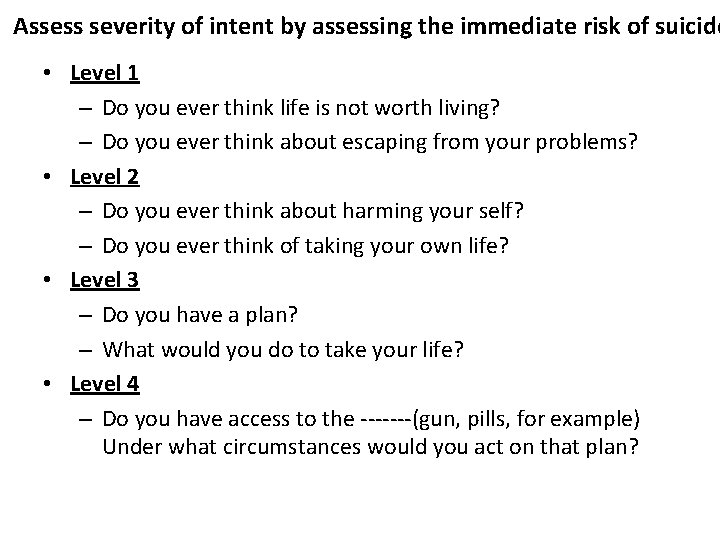
Assess severity of intent by assessing the immediate risk of suicide • Level 1 – Do you ever think life is not worth living? – Do you ever think about escaping from your problems? • Level 2 – Do you ever think about harming your self? – Do you ever think of taking your own life? • Level 3 – Do you have a plan? – What would you do to take your life? • Level 4 – Do you have access to the -------(gun, pills, for example) Under what circumstances would you act on that plan?
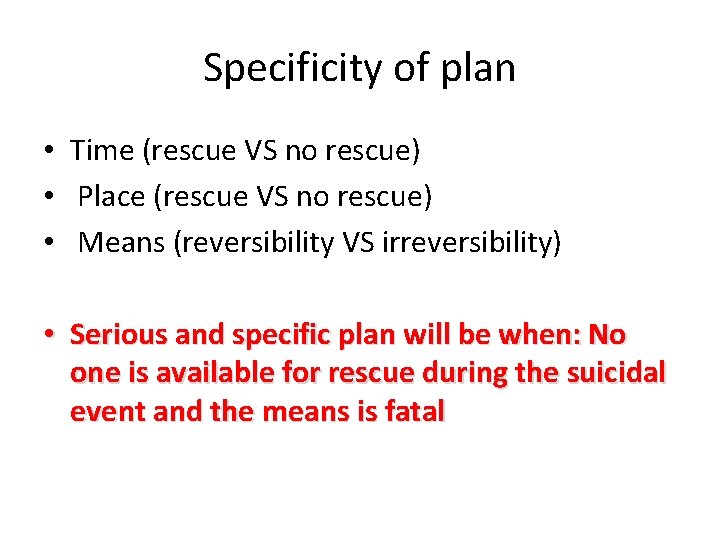
Specificity of plan • Time (rescue VS no rescue) • Place (rescue VS no rescue) • Means (reversibility VS irreversibility) • Serious and specific plan will be when: No one is available for rescue during the suicidal event and the means is fatal
Lethality
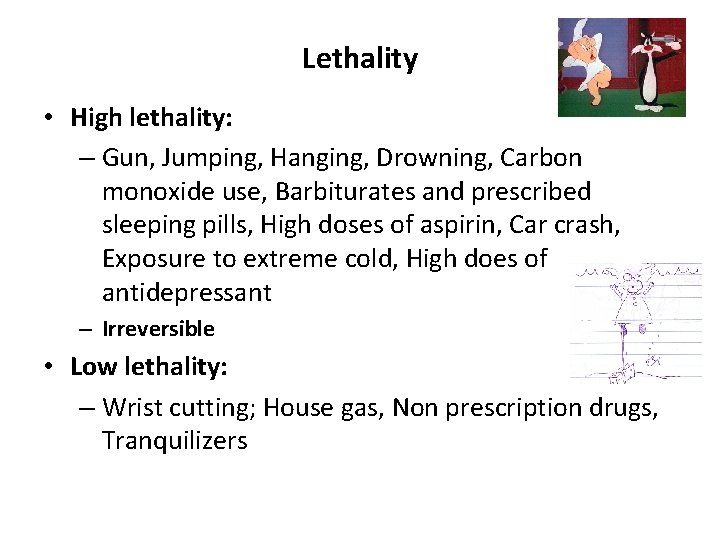
Lethality • High lethality: – Gun, Jumping, Hanging, Drowning, Carbon monoxide use, Barbiturates and prescribed sleeping pills, High doses of aspirin, Car crash, Exposure to extreme cold, High does of antidepressant – Irreversible • Low lethality: – Wrist cutting; House gas, Non prescription drugs, Tranquilizers
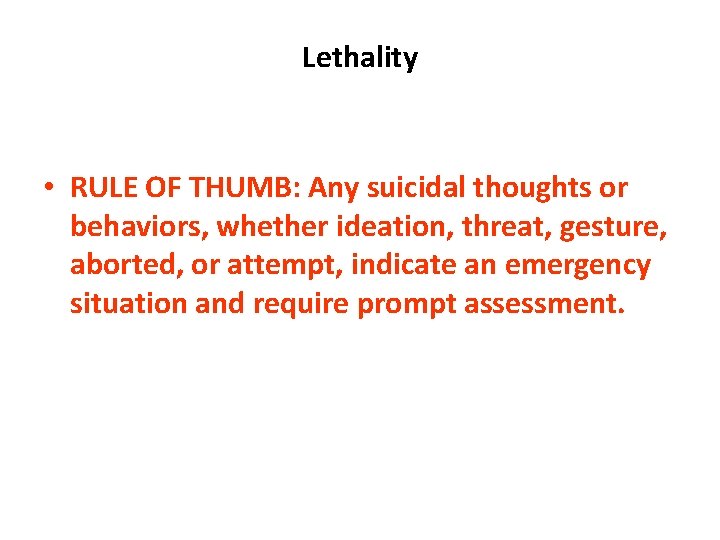
Lethality • RULE OF THUMB: Any suicidal thoughts or behaviors, whether ideation, threat, gesture, aborted, or attempt, indicate an emergency situation and require prompt assessment.
Assessment • SAD PERSON (risk factors assessment) • Suicidal clues – verbal/nonverbal, behavioral, emotional, somatic • Suicidal plan: • Interpersonal support • Coping strategies
Assessment • Interpersonal support: – Does the person has a support system to rely on at time of crisis? • Coping strategies: – How did the person deal with past crisis? – How does this situation differ from past situations? – What is the coping style usually the person uses
Nursing Management
• Suicide is a psychiatric emergency • Safety is number one priority
Nursing Management • Develop a trust relationship • Ask the client directly about any suicidal ideation or plan • Put limits to confidentiality by not concealing suicidal ideations or plans from the multidisciplinary team • Explain the importance of patient’s life to us as a health caregivers
Nursing Management : Promoting Safe Environment • Promote safe environment by: – Remove any harmful objects from environment such as ; sharp objects , glass , matches , knives. – Examine any thing a patient’s visitors bring it – Provide meals on a tray that contains no metal and no glass items. (pay attention if it may take from the others patients)
Nursing Management : Promoting Safe Environment – Removing all plastic bags from units – Replacing drop ceilings so that the plumbing/ventilation above is not accessible; enclosing the plumbing under bathroom sinks; – Shortening television cables and nursing call button cables – Locking tub rooms when not in use – Removing hanger bars from wardrobes and closets
Nursing Management : Promoting Safe Environment – Installing push button on/off shower valves, and shower heads that will not support a ligature – Attaching emergency number stickers to all phones in patient care areas – Discontinuing the use of pajamas with ties or draw strings – using a weekly or semi-weekly Environmental Risk Assessment Tool. – Permitting the use of night lights or red-filter flashlights to facilitate nighttime checks
Nursing Management : Promoting Safe Environment – Requiring staff to make verbal contact with and a response from individuals in the shower area during rounds – Explain to the client that the removal of these items and equipments is for his/her own protection. – Place the client in a room in which the staffs well able to observe the patient for 24 hours in a manner of one-to-one monitoring. (also be aware to the patient during shift change, meal time, visiting hours
Nursing Management : Promoting Safe Environment – Check on the client every 15 minutes and Record the observation – Consider having the patient take responsibility to check in at designated times during the shift. • Decrease the observation as patient risk improves. • Secure a promise that the client will ask for help from a certain staff assigned to him, when ever suicidal ideation occurs.
Formulate a NO-Suicide Contract • Written or verbal agreement between health care professional and the patient • States that patient will not engage in suicidal behavior for a specific period of time • Patient must be competent to enter a contract
Formulate a NO-Suicide Contract • Formulate With a Client a Short Term Verbal NO-suicide Contract (although there is no evidence based research on the effect of this intervention but it is used by professionals) • “I will not harm my self in the coming 8 hours, and if I feel the urge to heart my self I will tell the nurse directly” • Contract renewed according to unit policy (every 8 hours or every shift)
Nursing Management: Promoting Expressing Feelings • Promote expressing feelings by: – Communicating acceptance, respect and treat the client equally as other clients – Focus on strengths rather than weaknesses – Encourage patient to verbalize feelings of anger – Avoid imposing your own values feelings • Take any suicide threat seriously ( Eg. ; ct : life will be better for every one if I kill my self”. Nurse : You seem hopeless, what is making you feel this way).
Nursing Management : Promoting Expressing Feelings • Encourage client to identify a light of hope in hisher life (a cause for living) • Help the client to express hisher thoughts and feelings about suicidal attempt by asking such questions as : What led you to try to kill your self? ; who was there? ; what was said? ; Is it worth it? ; how do you feel about what you did now? ; Would you kill your self again?
Nursing Management : Promoting Expressing Feelings • Understanding the meaning of client’s suicidal thoughts and behavior is a good beginning point to planning ongoing care. • As you listen to the client determine whether the behavior “a cry for help” or is it “part of depression”, “substance abuse”, “social or family stressor” or all of these • Recognize that the client is experiencing guilt, shame, and emotional pain; try to understand the experience through the client’s perspective
Nursing Management : Promoting Expressing Feelings • Do not use cheerful approach. • Convey messages that having bad thoughts and making mistakes does not mean the person is a “ bad person”. • As you discuss suicide • DO NOT : – Judge the Client – Encourage Self Blame – Pity – Belittle The Client’s Feelings
Nursing Management : Promoting developing new coping strategies • Develop New Coping Pattern to Deal With Stress and decrease for Suicide through helping the client to: – Identify times when he is angry (ask about what happened, when, where, who, and how it affected self and others) – Source of anger – Identify what the patient believes is helpful and ways to channel anger – Assist the patient to identify anxiety. – Teach the patient strategies for controlling self such as walking, resting in bed, carrying certain activity.
Nursing Management : Promoting developing new coping strategies • Help the family and client accept and deal with the anger and shame. • Role play alternative when possible. • Teach assertiveness so others feedback and behaviors will not prevent one from accomplishing the set goals. • Focus on positive not negative thoughts. • Affirm rational decisions that is based on accurate judgment
Nursing Management : Promoting developing new coping strategies • Reinforce attempts to make independent decision making • Acknowledge willingness to demonstrate effective coping behaviors such as assertive communication • Respond to delusional thinking by stating reality. • Enhance family and social support systems
Nursing Management : Promoting developing new coping strategies • Identify community resources (support system). • Help the client to identify persons whom heshe can contact upon discharge from the hospital and especially if suicidal ideas comes back.
Nursing Management : Promoting the development of problem solving skills • Teach the patient decision making by going through the problems solving skills: – Explore the present situation. – Identify problems – Prioritize problems from most to least urgent – Recognize that each day is an opportunity to increase self confidence and achieve a set of goals. – Identify potential solutions according to priority, individual control, help needed, need to delegate.
Nursing Management : Promoting developing new coping strategies – Develop alternative solutions – Evaluate consequences of each alternative
Nurse’s self awareness • Dealing with your own Feelings: – How do you feel about suicide? – Do you feel it’s sign of weakness? – Do you think that suicidal patients are trapped in circumstances that are beyond their control? – Do not let either view affect the quality of your care.