
Risk factors of overweight and obesity in childhood
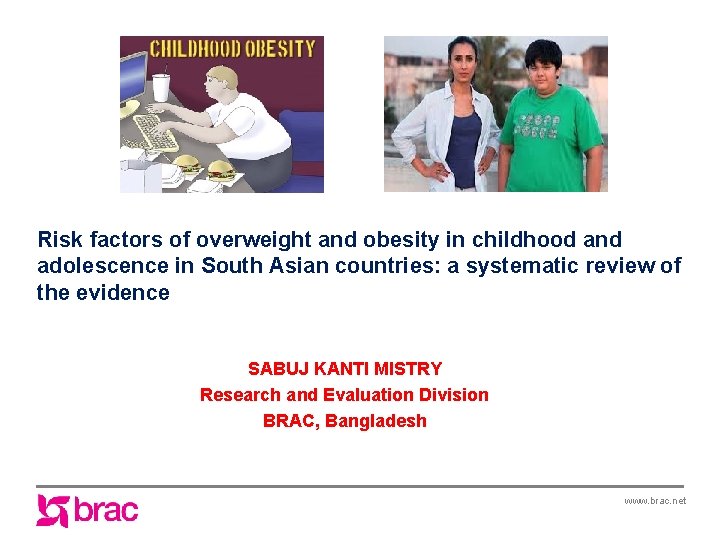
Risk factors of overweight and obesity in childhood and adolescence in South Asian countries: a systematic review of the evidence SABUJ KANTI MISTRY Research and Evaluation Division BRAC, Bangladesh www. brac. net
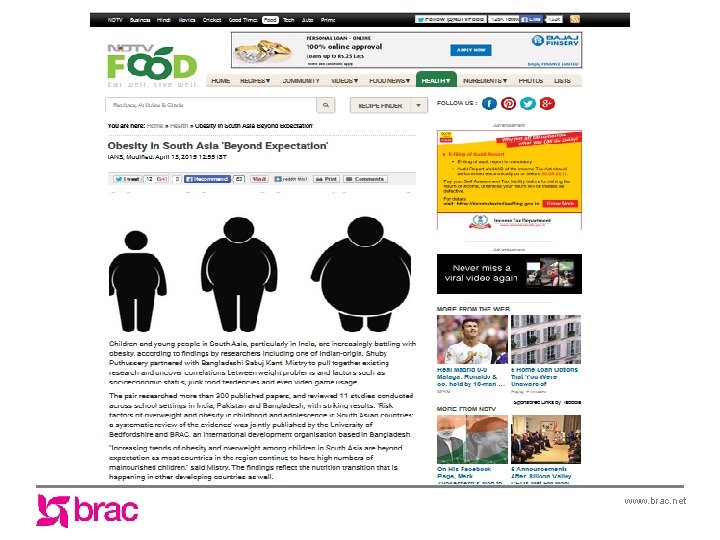
Background • Obesity invaded heavily among south Asian children and adolescents, particularly of India • Obesity prevalence increased among children from 9. 8% to 11. 7% between 2006 to 2009 in India • This is ‘beyond expectation’, as under-nutrition has always been the concern, posing a dual burden of malnutrition • Reflects a ‘nutritional transition’, also happening in other developing countries • Obesity in childhood often runs into adulthood and act as a potent risk factor of several chronic diseases www. brac. net

Objective and Rationale • Individual studies do not provide sufficient evidence on their own to warrant appropriate action • This review systematically synthesizes the factors of overweight and obesity among children and adolescents in South Asian countries to inform policy, practice and future research www. brac. net
Methods • Study Design: Systematic Literature Review • Searched databases included: Pub. Med, Pub. Med central, EMBASE, MEDLINE, Bio. Med central, Directory of Open Access Journals (DOAJ) and the electronic libraries of the authors’ institutions • Text words and Me. SH terms were used such as ‘obesity’, ‘childhood’, ‘overweight’, ‘determinants’, ‘factors’, ‘risk factors’, ‘South Asian countries’, ‘India’, ‘Pakistan’, ‘Nepal’, ‘Bangladesh’, ‘Sri Lanka’, ‘Bhutan’, ‘Maldives’ etc. • Boolean search was done using ‘AND’, ‘OR’ and ‘NOT’ to unite and filter the search terms www. brac. net
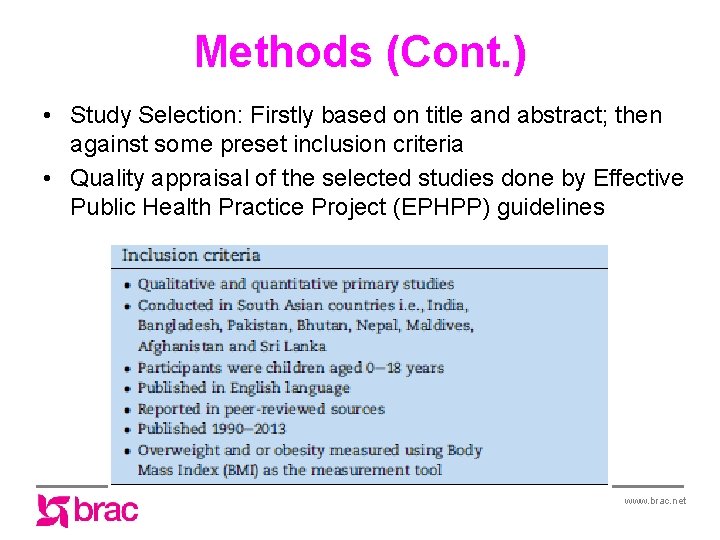
Methods (Cont. ) • Study Selection: Firstly based on title and abstract; then against some preset inclusion criteria • Quality appraisal of the selected studies done by Effective Public Health Practice Project (EPHPP) guidelines www. brac. net
Findings www. brac. net
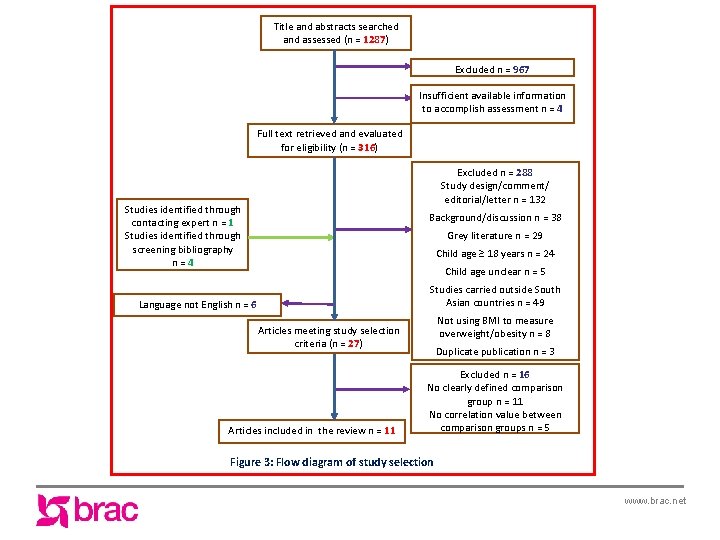
Title and abstracts searched and assessed (n = 1287) Excluded n = 967 Insufficient available information to accomplish assessment n = 4 Full text retrieved and evaluated for eligibility (n = 316) Excluded n = 288 Study design/comment/ editorial/letter n = 132 Studies identified through contacting expert n = 1 Studies identified through screening bibliography n=4 Background/discussion n = 38 Grey literature n = 29 Child age ≥ 18 years n = 24 Child age unclear n = 5 Studies carried outside South Asian countries n = 49 Language not English n = 6 Not using BMI to measure overweight/obesity n = 8 Articles meeting study selection criteria (n = 27) Articles included in the review n = 11 Duplicate publication n = 3 Excluded n = 16 No clearly defined comparison group n = 11 No correlation value between comparison groups n = 5 Figure 3: Flow diagram of study selection www. brac. net
Findings. . • Studies were done in India (7), followed by Pakistan (3) and Bangladesh (1); between 2000 and 2013 • Nine uses cross-sectional design, others case-control • Prevalence of overweight ranged from 3. 1% to 19. 7% and obesity ranged between 1. 2% to 14. 5% • Though not statistically significant obesity prevalence is higher among boys than girls www. brac. net
Findings. . • Lack of physical activities positively associated with overweight and obesity in childhood and adolescence • Regular exercise for 30 minutes/day as a protective factor against overweight/obesity • Long hours (2 -4 h/d) of TV watching/video games is a potent risk factor (OR: 5. 4 -7. 3) • Frequent consumption of fast food/junk food has a significant positive correlation with risk of overweight and obesity in childhood and adolescence www. brac. net
Findings. . • Participants with at least one overweight parent were nearly three times more likely to become overweight or obese • Obese children were nearly 50 times more likely to have a family history of obesity • Four of six studies reported a significant positive association between higher SES and higher overweight/obesity prevalence among chilgren www. brac. net
Conclusion • There is increasing burden of obesity and overweight among children and adolescents in South Asia • Unhealthy energy-rich foods and sedentary lifestyle contribute to increasing prevalence of childhood and adolescent overweight and obesity • Important for planners, policymakers, academics and researchers in public health and health policy at national, regional, and international levels www. brac. net
Recommendations • Need for a cross-sectoral approach involving interventions at various levels such as home, school and the community • Require nationally representative data to inform concerted action to tackle the issue • In-depth understanding of the associated cultural, social and environmental factors, including drivers for causative dietary and behavioural factors through qualitative studies • Focused intervention to tackle the problem www. brac. net
www. brac. net

Thank You www. brac. net
- Slides: 14