
Risk Compensation Learning Lite 1 What is it
- Slides: 8
Risk Compensation Learning Lite 1
What is it? • Theory of Risk Compensation has been around since seat belts, simply put it suggests that a perception of safety or of less risk results in not understanding the risk is still there • People can have a false sense of security • It’s relevant to Behaviour Based Safety because we continuously weigh Time vs. . Risk when we make decisions • If we think we are safer because of safety precautions then we can make decisions that can still expose us to harm • Understanding how we manage risk and work to protect ourselves can remove this false sense of security and help us make better decisions 2
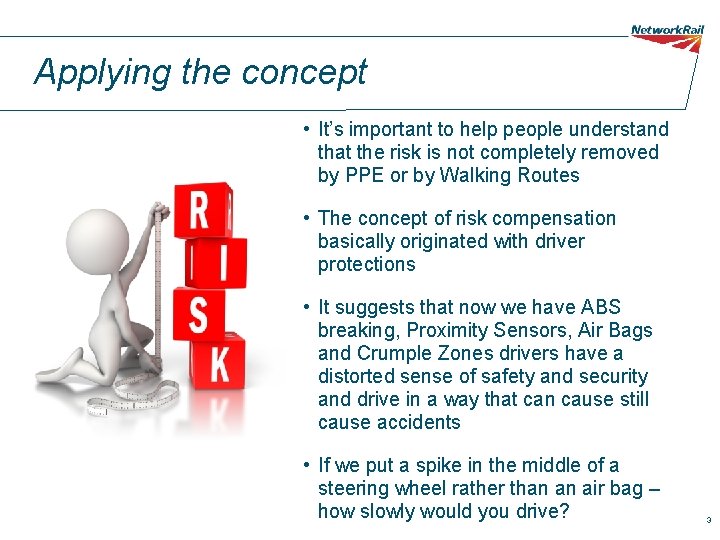
Applying the concept • It’s important to help people understand that the risk is not completely removed by PPE or by Walking Routes • The concept of risk compensation basically originated with driver protections • It suggests that now we have ABS breaking, Proximity Sensors, Air Bags and Crumple Zones drivers have a distorted sense of safety and security and drive in a way that can cause still cause accidents • If we put a spike in the middle of a steering wheel rather than an air bag – how slowly would you drive? 3
Some examples 1 • Think about the PPE we wear or the safe walking routes we use – if people don’t understand why we wear it or walk it (for example) they can presume they are completely safe • The difference may be that we have a close call or a near miss instead of an injury • The concept of Risk Compensation is both simple and plausible. Think about sports; the data shows the more "protection" is worn, the more violent the action • Hundreds of similar and equally plausible examples can be found • Data from the HSE shows that drivers behave more cautiously around cyclists that are not wearing their helmets than those that do! 4
Some examples 2 • Hundreds of similar and equally plausible examples can be found • Data from the HSE shows that drivers behave more cautiously around cyclists that are not wearing their helmets than those that do! • It has been demonstrated that improved parachute rip cords do not reduce the number of sky diving accidents, since it frequently leads to overconfidence and activating the chutes too late 5
What can we do? • Understanding that people constantly weigh Time vs. Risk and that part of this decision making is based on a perception of risk helps us; – Plan work – Look out for each other – Make better decisions 6
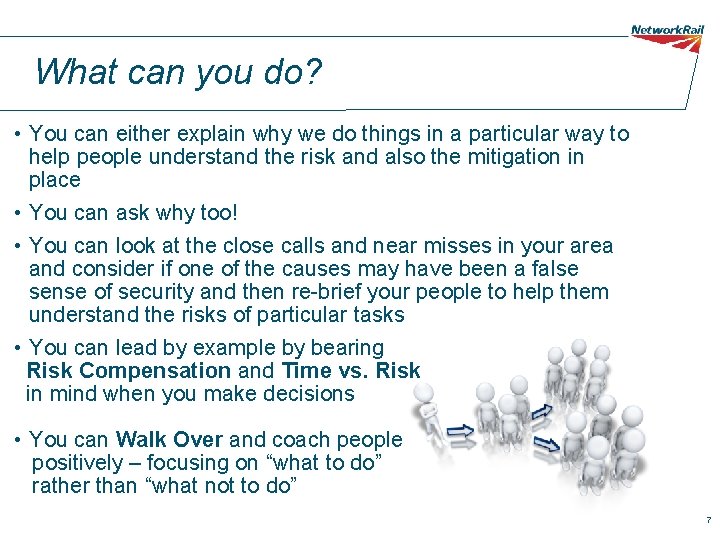
What can you do? • You can either explain why we do things in a particular way to help people understand the risk and also the mitigation in place • You can ask why too! • You can look at the close calls and near misses in your area and consider if one of the causes may have been a false sense of security and then re-brief your people to help them understand the risks of particular tasks • You can lead by example by bearing Risk Compensation and Time vs. Risk in mind when you make decisions • You can Walk Over and coach people positively – focusing on “what to do” rather than “what not to do” 7
What did we learn? • Theory of Risk Compensation has been around since seat belts, simply put it suggests that a perception of safety or of less risk results in not understanding the risk is still there • It’s important to help people understand that the risk is not completely removed by PPE or by Walking Routes • Understanding that people constantly weigh Time vs. . Risk and that part of this decision making is based on a perception of risk • You can lead by example by bearing Risk Compensation and Time vs. . Risk in mind when you make decisions • You can Walk Over and coach people positively – focusing on “what to do” rather than “what not to do” 8