
Risk Communication Principles Tools Techniques Dr Vincent T
- Slides: 70
Risk Communication – Principles, Tools, & Techniques Dr. Vincent T. Covello Center for Risk Communication Patricia A. Milligan Office of Nuclear Security & Incident Response April 1, 2010 1
“The problem with communication is the illusion it has occurred. ” George Bernard Shaw
Radiological Risk and Emergency Communications Draft NUREG/CR-XXXX Copyright Dr. V. Covello, Center for Change/Risk Communication 3
Project Objective NRC, EP and Communications • 10 CFR 50. 47(b)(7) • 10 CFR 50 Appendix E • NUREG-0654/FEMA REP-1 Copyright, Dr. V Covello, Center for Change/Risk Communication
“…Dose rates of radiation equivalent to one mammogram per hour have been measured at a location approximately one mile southwest of the plant. ” Press Release # 3, 2008 Bi-Annual Full Participation Nuclear Power Plant Emergency Preparedness Exercise Copyright, Dr. V Covello, Center for Change/Risk Communication
Project Objective • To compile information on best practices and knowledge on risk communication before, during, and after a radiological emergency at a nuclear power plant. • To provide this information to nuclear power plant licensees and local emergency responders. (Note: This project is not regulation or evaluation criteria. ) Copyright, Dr. V Covello, Center for Change/Risk Communication
• Compilation of best practice in risk and crisis communication. • Should not be seen at all as a new requirement. • Use of these tools should help make your life easier.
Risk Communication Research and Practitioner Literature • Over 8000 Articles in Peer Reviewed Scientific Journals • Over 2000 Books by Scientific Publishers Copyright, Dr. V Covello, Center for Change/Risk Communication
Agenda Part I: Core Concepts Part 2: Templates Part 3: Case Studies and Discussion Copyright, Dr. V Covello, Center for Change/Risk Communication
Definition Risk: “a threat of loss, real or perceived, to that which we value. ” Copyright, Dr. V Covello, Center for Change/Risk Communication
Definition Risk: “a threat of loss, real or perceived, to that which we value. ” Risk Communication: “the exchange of information about risks. ” Copyright, Dr. V Covello, Center for Change/Risk Communication
Risk Communication: Definition • Is an interactive process of exchange of information and opinion among individuals, groups, and institutions • Involves multiple messages about the nature of risk • Involves messages not strictly about risk, such as legal and institutional arrangements for risk management Source: “Improving Risk Communication, ” National 1 -12 Academy of Sciences, 1989 Copyright, Dr. V Covello, Center for Change/Risk Communication
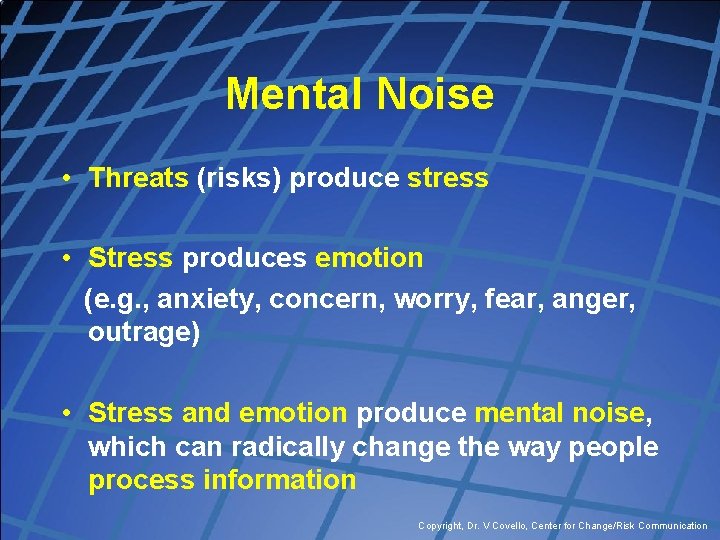
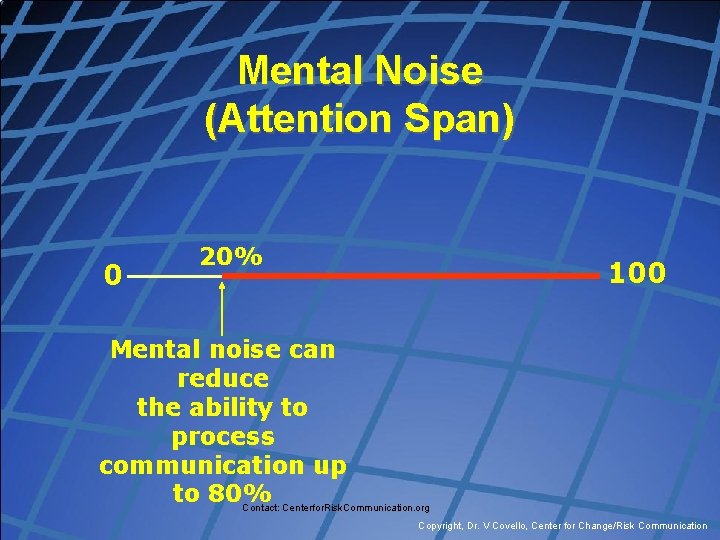
Mental Noise • Threats (risks) produce stress • Stress produces emotion (e. g. , anxiety, concern, worry, fear, anger, outrage) • Stress and emotion produce mental noise, which can radically change the way people process information Copyright, Dr. V Covello, Center for Change/Risk Communication
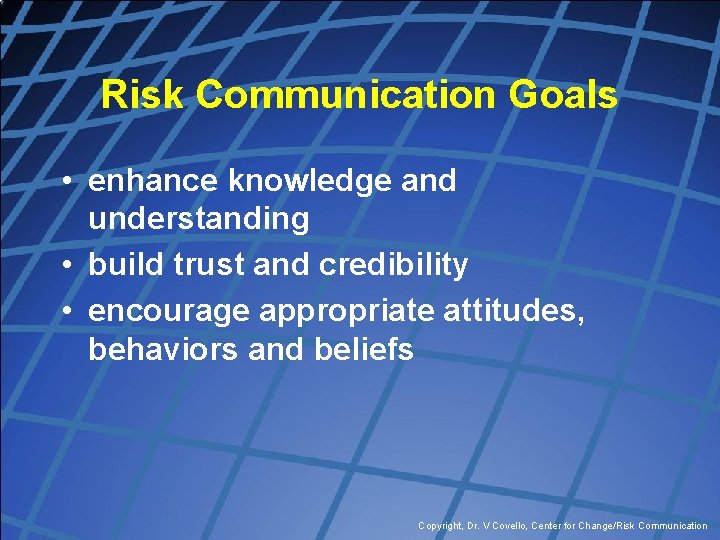
Risk Communication Goals • enhance knowledge and understanding • build trust and credibility • encourage appropriate attitudes, behaviors and beliefs Copyright, Dr. V Covello, Center for Change/Risk Communication
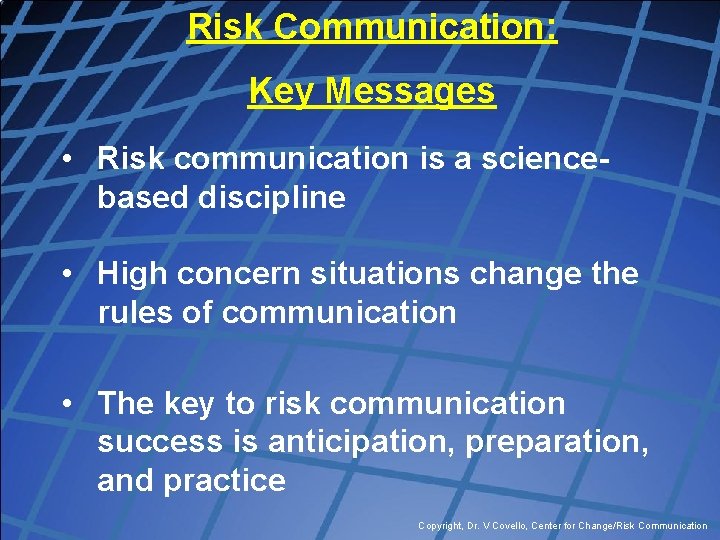
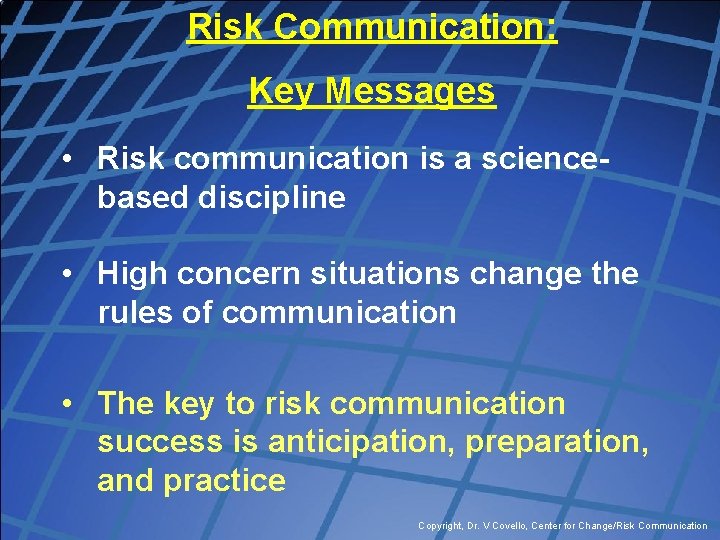
Risk Communication: Key Messages • Risk communication is a sciencebased discipline • High concern situations change the rules of communication • The key to risk communication success is anticipation, preparation, and practice Copyright, Dr. V Covello, Center for Change/Risk Communication
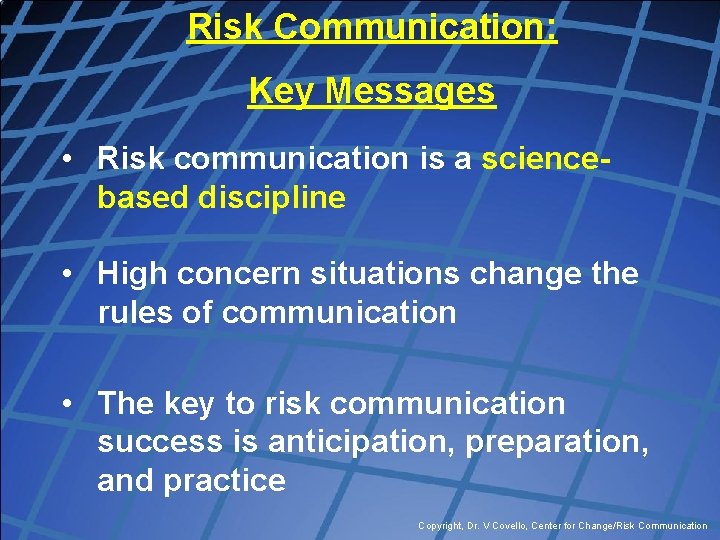
Risk Communication: Key Messages • Risk communication is a sciencebased discipline • High concern situations change the rules of communication • The key to risk communication success is anticipation, preparation, and practice Copyright, Dr. V Covello, Center for Change/Risk Communication
Risk Communication Literature • Over 8000 Articles in Peer Reviewed Scientific Journals • 2000 Books Copyright, Dr. V Covello, Center for Change/Risk Communication
Risk Communication Literature: Example Dr. R. Hyer and Dr. V. Covello “Effective Media Communication During Public Health Emergencies: A World Health Organization Handbook” World Health Organization, United Nations: Geneva, April 2007 (www. amazon. com or www. who. int/bookorders) Copyright, Dr. V Covello, Center for Change/Risk Communication
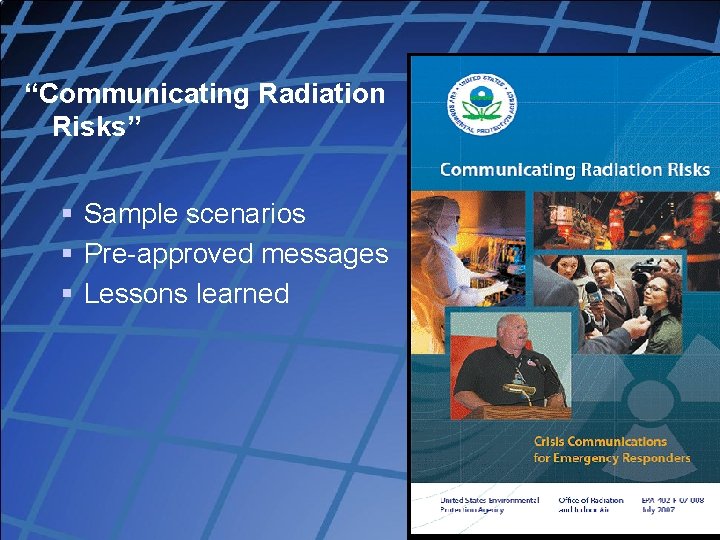
“Communicating Radiation Risks” § Sample scenarios § Pre-approved messages § Lessons learned Copyright, Dr. V Covello, Center for Change/Risk Communication
Risk Communication Literature: Example “Five Essential Elements of Immediate and Mid. Term Mass Trauma Intervention: Empirical Evidence, ” Psychiatry, 70(4): 2007 Authors: Steven Hobfoll et. al. Conclusion of Research Provide people a sense of: • • • Hope Self- and community efficacy Safety Calm Connectedness HERC v 3. 1 Copyright, Dr. V Covello, Center for Change/Risk Communication
Risk Communication: Resources • • J. Lehrer, “How We Decide M. Gladwell, “Blink” R. Fisher, “Getting to Yes” D. Morris, “Body Talk: A Dictionary of Human Gestures” • E. Tufte, “Visual Explanations” Copyright, Dr. V Covello, Center for Change/Risk Communication
Risk Communication Literature: Example “The Magic Number Seven, Plus or Minus Two: Some Limits on Our Capacity for Processing Information” George A. Miller (Department of Psychology, Princeton University) The Psychological Review, 1956, vol. 63, pp. 81 -97 Copyright, Dr. V Covello, Center for Change/Risk Communication
Risk Communication: Key Messages • Risk communication is a sciencebased discipline • High concern situations change the rules of communication • The key to risk communication success is anticipation, preparation, and practice Copyright, Dr. V Covello, Center for Change/Risk Communication
Risk Communication: Core Concepts When people are stressed or concerned, they typically: • …have difficulty, hearing, understanding, and remembering information • …want to know that you care before they care what you know. • …focus most on what they hear first and last. Copyright, Dr. V Covello, Center for Change/Risk Communication
Risk Communication: Core Concepts - continued When people are stressed or concerned: • …the gap between reason and emotion (risk perceptions) often becomes wider. • …they typically focus much more on negative information than positive information. • …they typically process information at four grades below their education level. • …they typically seek out additional third party sources of credible information. Copyright, Dr. V Covello, Center for Change/Risk Communication
Risk Communication: Key Messages • Risk communication is a sciencebased discipline • High concern situations change the rules of communication • The key to risk communication success is anticipation, preparation, and practice Copyright, Dr. V Covello, Center for Change/Risk Communication
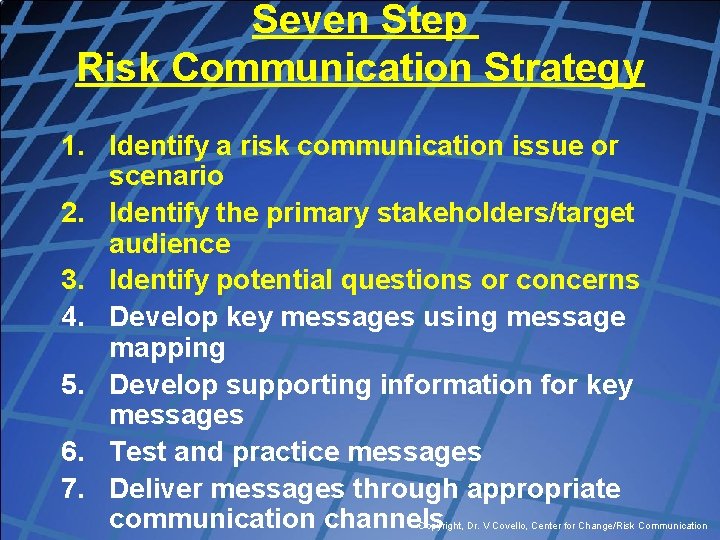
Seven Step Risk Communication Strategy 1. Identify a risk communication issue or scenario 2. Identify the primary stakeholders/target audience 3. Identify potential questions or concerns 4. Develop key messages using message mapping 5. Develop supporting information for key messages 6. Test and practice messages 7. Deliver messages through appropriate communication channels Copyright, Dr. V Covello, Center for Change/Risk Communication
Risk Communication: Core Principles “Most of the concerns and questions of upset or concerned people can be predicted and prepared for in advance. ” Copyright, Dr. V Covello, Center for Change/Risk Communication
Mark Twain “It takes me an average of two weeks to prepare an impromptu speech. ” Mark Twain Copyright, Dr. V Covello, Center for Change/Risk Copyright, Communication Dr. V Covello,
Stakeholder Predictability “ 50 Most Frequently Asked Questions by Terminally Ill Patients” Copyright, Dr. V Covello, Center for Change/Risk Communication
Stakeholder Predictability • “ 77 Most Frequently Asked Questions by Journalists in a Disaster” (handout) Copyright, Dr. V Covello, Center for Change/Risk Communication
Stakeholder Predictability “ 65 Most Frequently Asked Questions about Pandemic Influenza” (www. pandemicflu. gov) “ 205 Most Frequently Asked Questions Following a Water Security or Water Contamination Event” (USEPA, Effective Risk Communication during Water Security Emergencies” EPA/600/R-07/027) Copyright, Dr. V Covello, Center for Change/Risk Communication
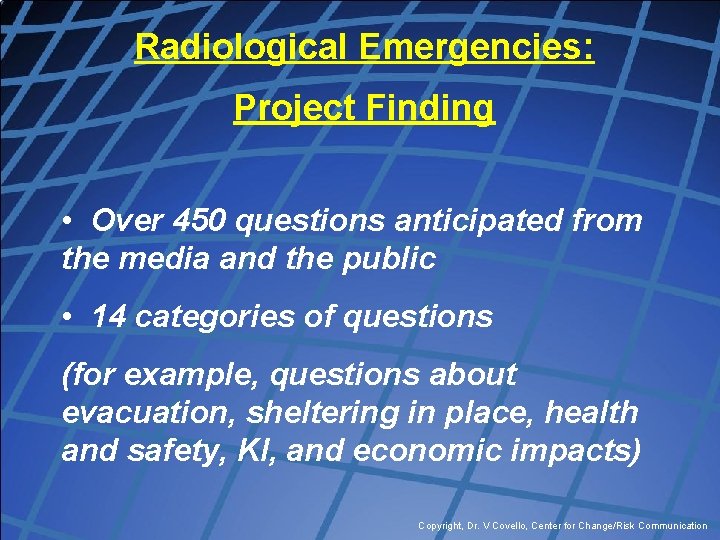
Radiological Emergencies: Project Finding • Over 450 questions anticipated from the media and the public • 14 categories of questions (for example, questions about evacuation, sheltering in place, health and safety, KI, and economic impacts) Copyright, Dr. V Covello, Center for Change/Risk Communication
Risk Communication: Key Messages • Risk communication is a sciencebased discipline • High concern situations change the rules of communication • The key to risk communication success is anticipation, preparation, and practice Copyright, Dr. V Covello, Center for Change/Risk Communication
Risk Communication Literature: Example “The Magic Number Seven, Plus or Minus Two: Some Limits on Our Capacity for Processing Information” George A. Miller (Department of Psychology, Princeton University) The Psychological Review, 1956, vol. 63, pp. 81 -97 Copyright, Dr. V Covello, Center for Change/Risk Communication
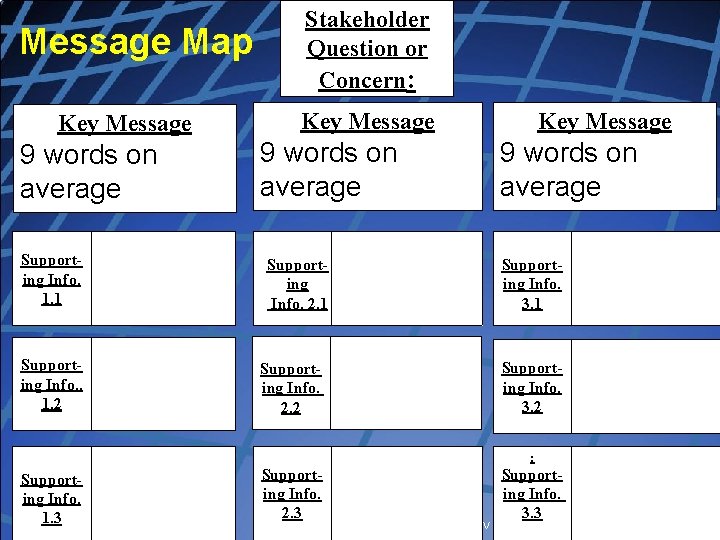
Message Map Key Message 9 words on average Supporting Info. 1. 1 Supporting Info. . 1. 2 Stakeholder Question or Concern: Key Message 9 words on average Supporting Info. 2. 1 Supporting Info. 2. 2 Key Message 9 words on average Supporting Info. 3. 1 Supporting Info. 3. 2 : Supporting Info. 1. 3 Supporting Info. 2. 3 Supporting Info. 3. 3 Copyright, Dr. V Covello, Center for Change/Risk Communication
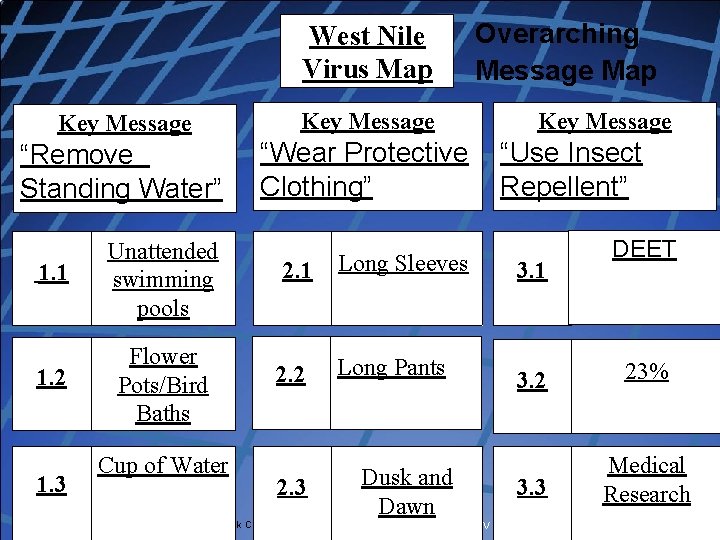
West Nile Virus Map Key Message “Remove Standing Water” “Wear Protective Clothing” 1. 1 Unattended swimming pools 2. 1 Long Sleeves 1. 2 Flower Pots/Bird Baths 2. 2 Long Pants 2. 3 Dusk and Dawn 1. 3 Cup of Water Copyright Dr. V. Covello, Center for Change/Risk Communication Overarching Message Map Key Message “Use Insect Repellent” 3. 1 DEET 3. 2 23% 3. 3 Medical Research 37 HERC v 3. 1 Copyright, Dr. V Covello, Center for Change/Risk Communication
Agenda Part I: Core Concepts Part 2: Templates Part 3: Special Topics Copyright, Dr. V Covello, Center for Change/Risk Communication
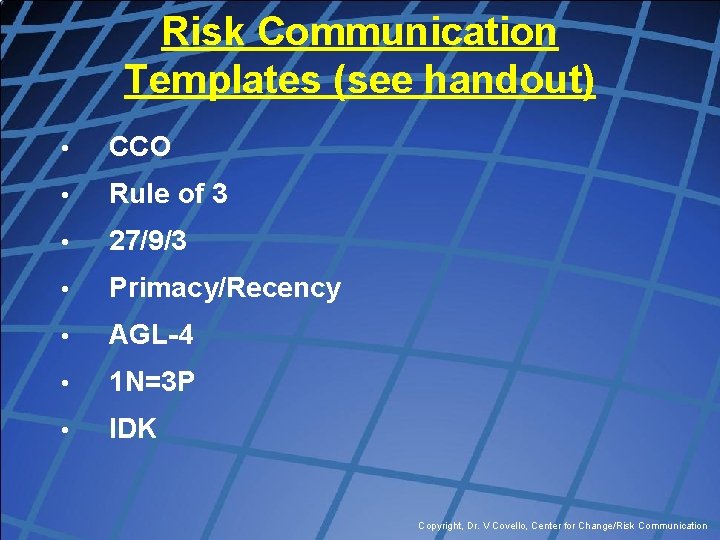
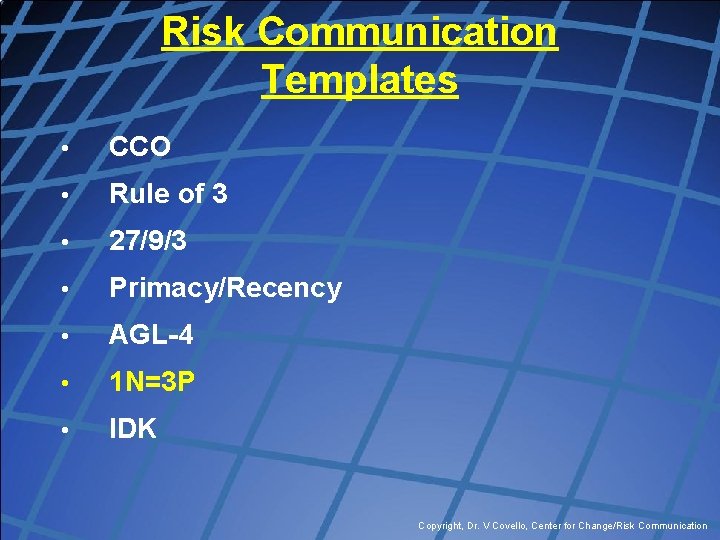
Risk Communication Templates (see handout) • CCO • Rule of 3 • 27/9/3 • Primacy/Recency • AGL-4 • 1 N=3 P • IDK Copyright, Dr. V Covello, Center for Change/Risk Communication
Risk Communication/Message Mapping Templates • CCO Copyright, Dr. V Covello, Center for Change/Risk Communication
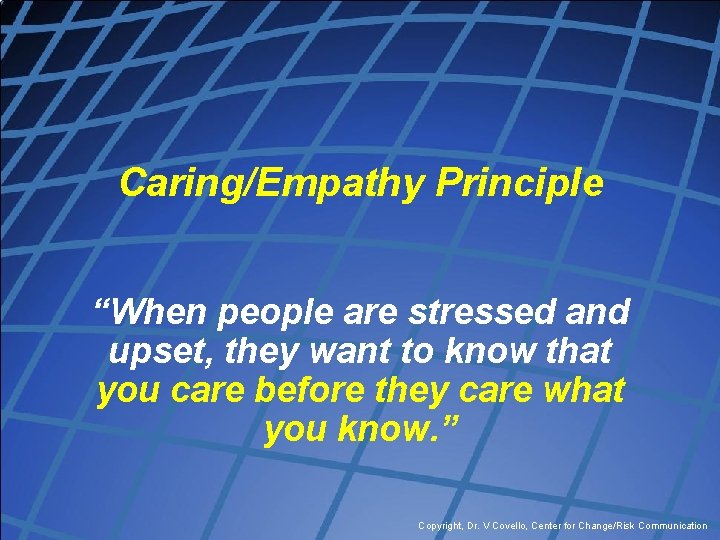
Caring/Empathy Principle “When people are stressed and upset, they want to know that you care before they care what you know. ” Copyright, Dr. V Covello, Center for Change/Risk Communication
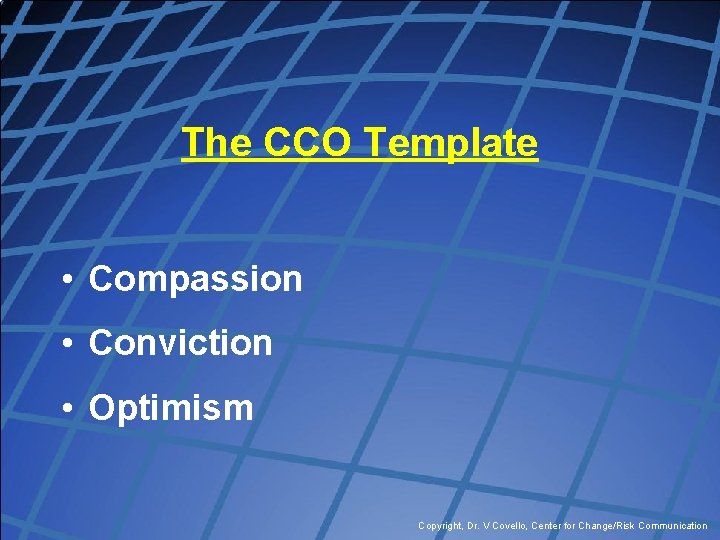
The CCO Template • Compassion • Conviction • Optimism Copyright, Dr. V Covello, Center for Change/Risk Communication
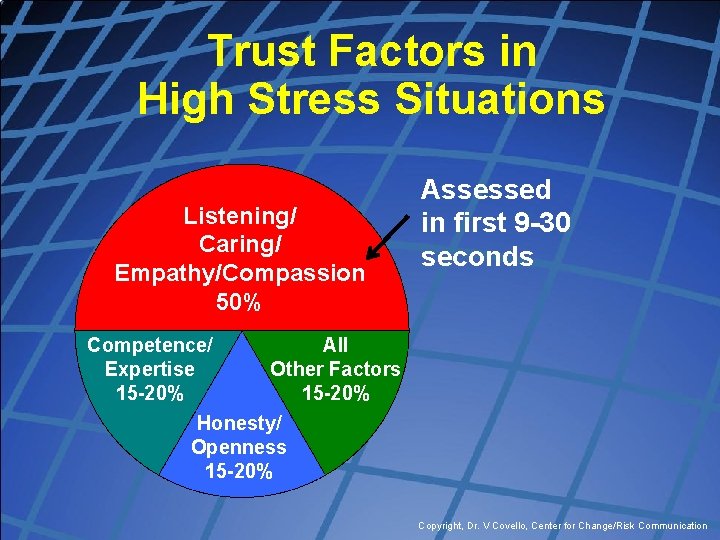
Trust Factors in High Stress Situations Listening/ Caring/ Empathy/Compassion 50% Assessed in first 9 -30 seconds Competence/ All Expertise Other Factors 15 -20% Honesty/ Openness 15 -20% Copyright, Dr. V Covello, Center for Change/Risk Communication
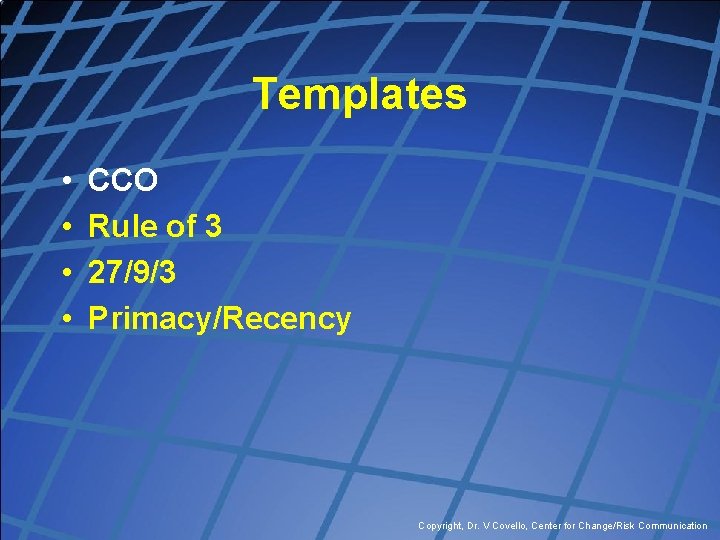
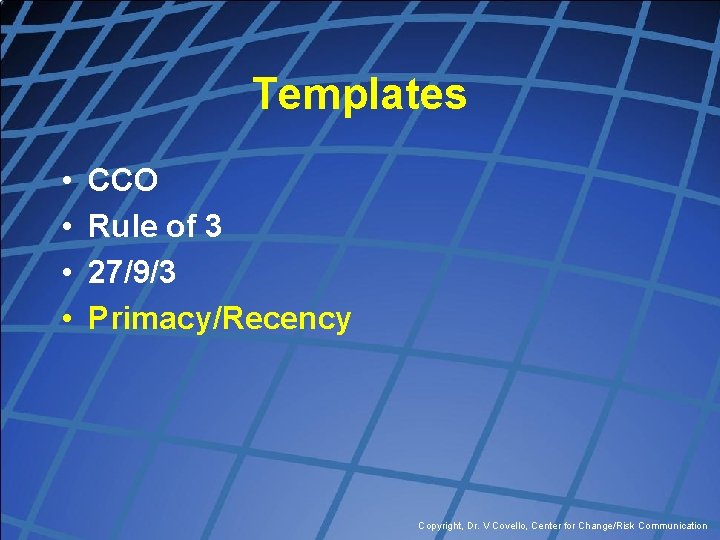
Templates • • CCO Rule of 3 27/9/3 Primacy/Recency Copyright, Dr. V Covello, Center for Change/Risk Communication
Mental Noise (Attention Span) 0 20% 100 Mental noise can reduce the ability to process communication up to 80% Contact: Centerfor. Risk. Communication. org Copyright, Dr. V Covello, Center for Change/Risk Communication
Templates • Rule of 3 • 27/9/3 • Primacy/Recency Copyright, Dr. V Covello, Center for Change/Risk Communication
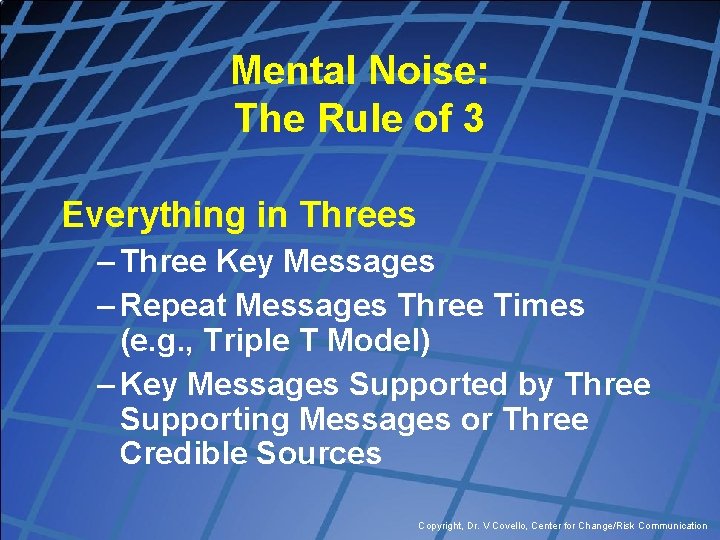
Mental Noise: The Rule of 3 Everything in Threes – Three Key Messages – Repeat Messages Three Times (e. g. , Triple T Model) – Key Messages Supported by Three Supporting Messages or Three Credible Sources Copyright, Dr. V Covello, Center for Change/Risk Communication
Templates • • CCO Rule of 3 27/9/3 Primacy/Recency Copyright, Dr. V Covello, Center for Change/Risk Communication
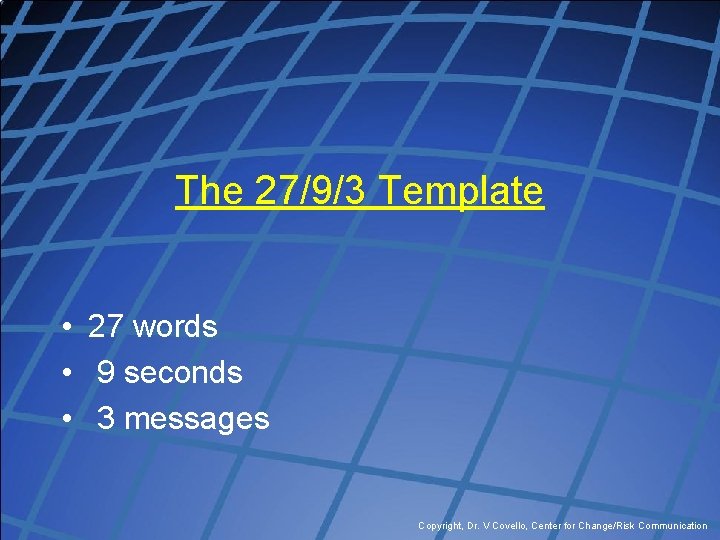
The 27/9/3 Template • 27 words • 9 seconds • 3 messages Copyright, Dr. V Covello, Center for Change/Risk Communication
Templates • • CCO Rule of 3 27/9/3 Primacy/Recency Copyright, Dr. V Covello, Center for Change/Risk Communication
Primacy/Recency Copyright, Dr. V Covello, Center for Change/Risk Communication
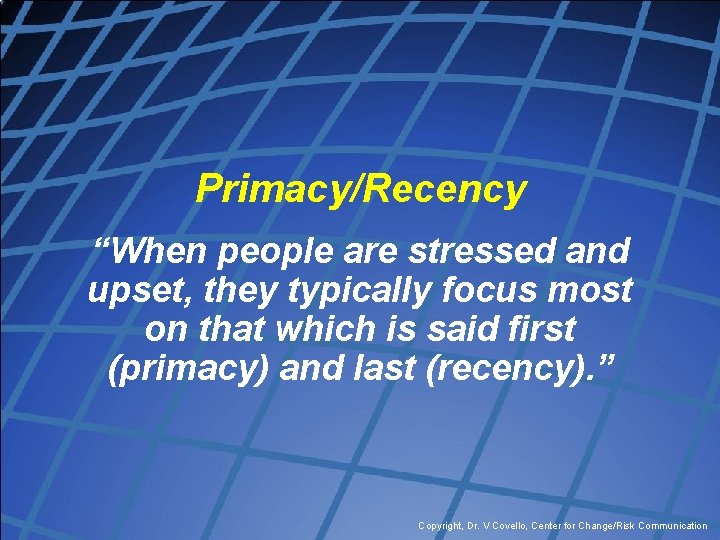
Primacy/Recency “When people are stressed and upset, they typically focus most on that which is said first (primacy) and last (recency). ” Copyright, Dr. V Covello, Center for Change/Risk Communication
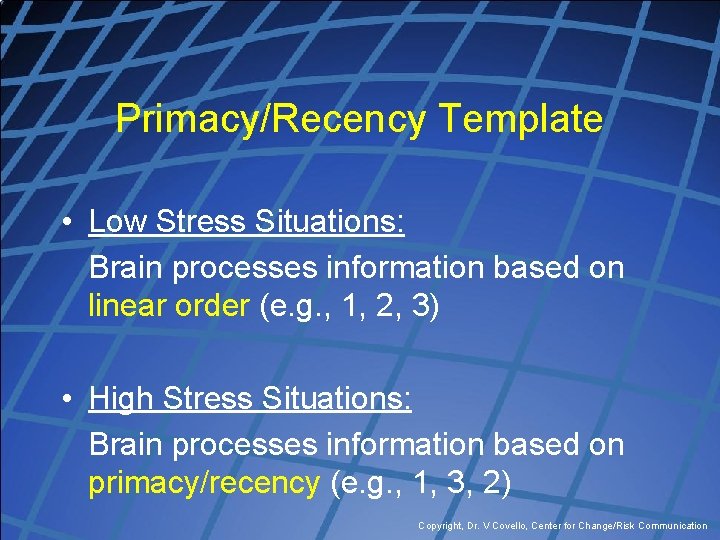
Primacy/Recency Template • Low Stress Situations: Brain processes information based on linear order (e. g. , 1, 2, 3) • High Stress Situations: Brain processes information based on primacy/recency (e. g. , 1, 3, 2) Copyright, Dr. V Covello, Center for Change/Risk Communication
Risk Communication Templates • CCO • Rule of 3 • 27/9/3 • Primacy/Recency • AGL-4 • 1 N=3 P • IDK Copyright, Dr. V Covello, Center for Change/Risk Communication
Risk Communication Templates • CCO • Rule of 3 • 27/9/3 • Primacy/Recency • AGL-4 • 1 N=3 P • IDK Copyright, Dr. V Covello, Center for Change/Risk Communication
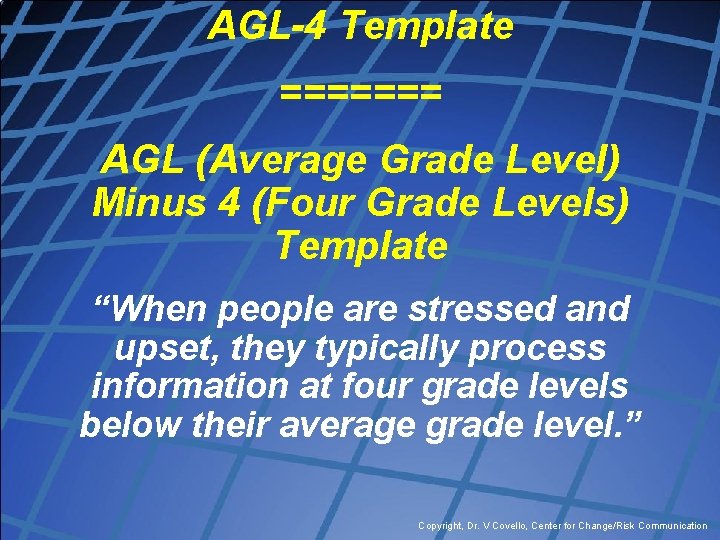
AGL-4 Template ======= AGL (Average Grade Level) Minus 4 (Four Grade Levels) Template “When people are stressed and upset, they typically process information at four grade levels below their average grade level. ” Copyright, Dr. V Covello, Center for Change/Risk Communication
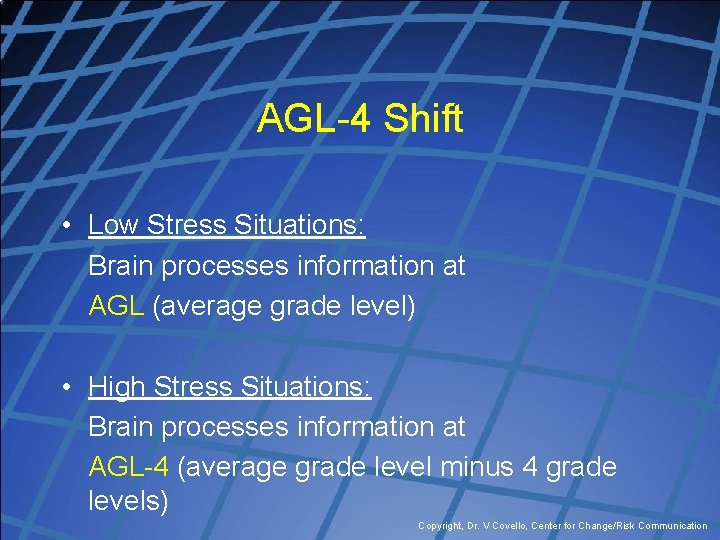
AGL-4 Shift • Low Stress Situations: Brain processes information at AGL (average grade level) • High Stress Situations: Brain processes information at AGL-4 (average grade level minus 4 grade levels) Copyright, Dr. V Covello, Center for Change/Risk Communication
Notification of Unusual Event “Under this category, events are in process or have occurred which indicate potential degradation in the level of safety of the plant. No release of radioactive material requiring offsite response or monitoring is expected unless further degradation occurs. ” Source: NRC Web Site Copyright Dr. V. Covello, Center for Change/Risk Communication 58
Message Maps • Used to respond to high concern questions • Contain clear, concise, layered information • Contain vetted or screened messages for anticipated questions Copyright Dr. V. Covello, Center for Change/Risk Communication 59
Message Mapping Goals • Enhance knowledge and understanding • Build trust and credibility • Encourage appropriate attitudes, behaviors and beliefs Copyright Dr. V. Covello, Center for Change/Risk Communication 60
Risk Communication Templates • CCO • Rule of 3 • 27/9/3 • Primacy/Recency • AGL-4 • 1 N=3 P • IDK Copyright, Dr. V Covello, Center for Change/Risk Communication
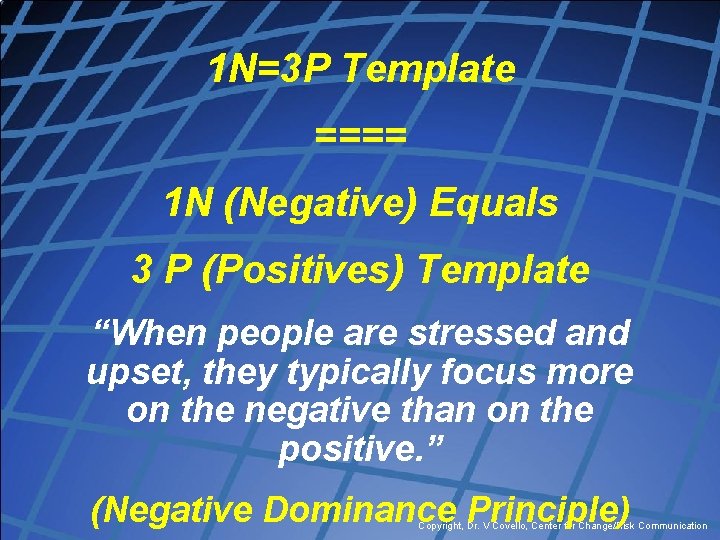
1 N=3 P Template ==== 1 N (Negative) Equals 3 P (Positives) Template “When people are stressed and upset, they typically focus more on the negative than on the positive. ” (Negative Dominance Principle) Copyright, Dr. V Covello, Center for Change/Risk Communication
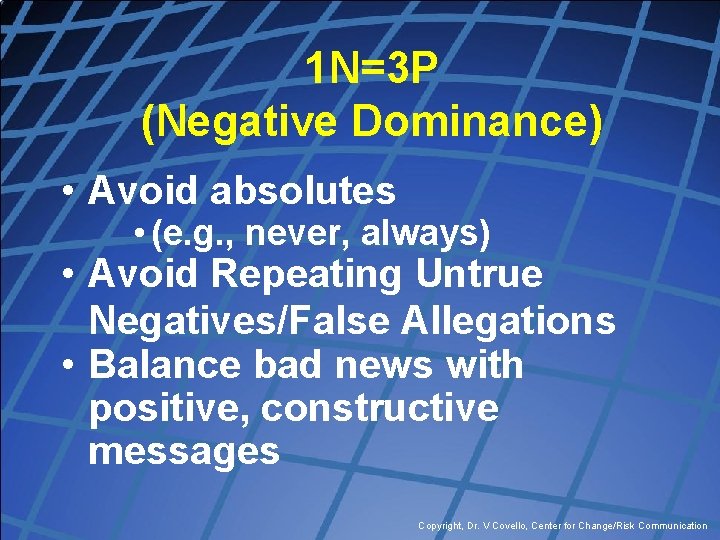
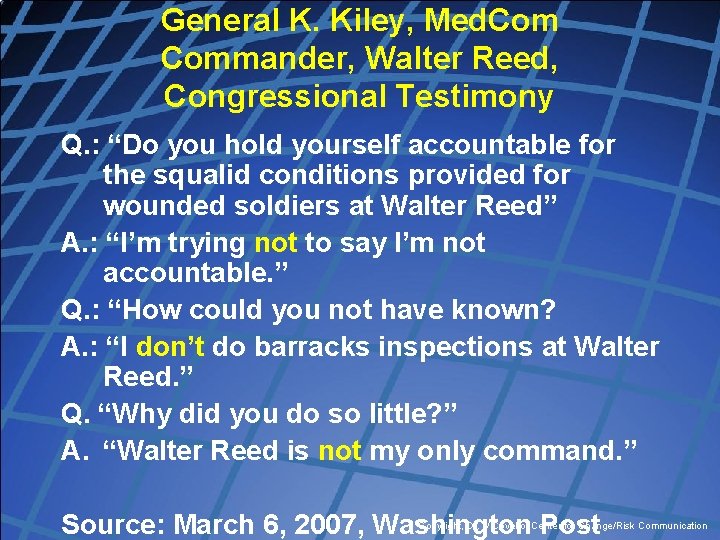
1 N=3 P (Negative Dominance) • Avoid absolutes • (e. g. , never, always) • Avoid Repeating Untrue Negatives/False Allegations • Balance bad news with positive, constructive messages Copyright, Dr. V Covello, Center for Change/Risk Communication
Negatives ==== No, Not, Never, Nothing, None Copyright, Dr. V Covello, Center for Change/Risk Communication
General K. Kiley, Med. Commander, Walter Reed, Congressional Testimony Q. : “Do you hold yourself accountable for the squalid conditions provided for wounded soldiers at Walter Reed” A. : “I’m trying not to say I’m not accountable. ” Q. : “How could you not have known? A. : “I don’t do barracks inspections at Walter Reed. ” Q. “Why did you do so little? ” A. “Walter Reed is not my only command. ” Source: March 6, 2007, Washington Post Copyright, Dr. V Covello, Center for Change/Risk Communication
Risk Communication Templates • CCO • Rule of 3 • 27/9/3 • Primacy/Recency • AGL-4 • 1 N=3 P • IDK Copyright, Dr. V Covello, Center for Change/Risk Communication
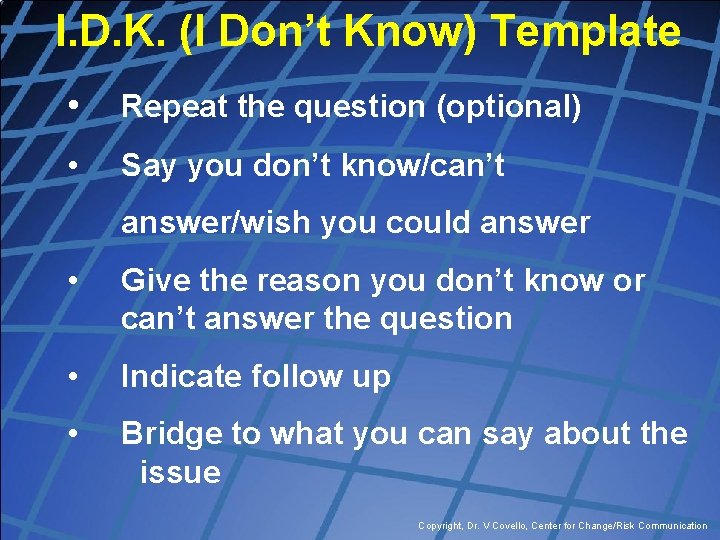
I. D. K. (I Don’t Know) Template • Repeat the question (optional) • Say you don’t know/can’t answer/wish you could answer • Give the reason you don’t know or can’t answer the question • Indicate follow up • Bridge to what you can say about the issue Copyright, Dr. V Covello, Center for Change/Risk Communication
“If I had all day to cut a large tree, I would spend most of the day sharpening my axe. ” - Abraham Lincoln Copyright Dr. V. Covello, Center for Change/Risk Communication 68
Risk Communication: Key Messages • Risk communication is a sciencebased discipline • High concern situations change the rules of communication • The key to risk communication success is anticipation, preparation, and practice Copyright, Dr. V Covello, Center for Change/Risk Communication
“It takes me an average of two weeks to prepare an impromptu speech. ” - Mark Twain Copyright Dr. V. Covello, Center for Change/Risk Communication 70