
RISK COMMUNICATION Module 13 Approaches to changing behavior
RISK COMMUNICATION Module 13 Approaches to changing behavior
In this module… § Approaches to behavior change § Regulatory policy § Persuasion § Nudging § The limitations and ethical implications of each
Let’s begin by choosing a behavior § In groups of 3 or 4… § Your team is a task force in your country’s governmental branch overseeing the state of the environment, public health, and safety § Choose a risk-related behavior that you would like to change § The goal of your task force today is to change people’s behavior
REGULATORY POLICY
Regulation § Defined as an “intervention in the private domain” implemented through “a binding legal norm created by a state organ that intends to shape the conduct of individuals and firms” (Orbach, 2012, p. 6) § Regulations limit the range of choices available to individuals to induce desirable behavior or deter undesirable behavior.
Develop regulatory policies § Develop up to 3 regulatory policies that will address your behavior
Develop regulatory policies § Now, discuss how the public will react to these regulatory policies § Discuss how the government will enforce those policies
Self-determination theory § Deci and Ryan, 1985 § Two types of motivations § Intrinsic motivation § Doing something because it is inherently satisfactory, interesting or enjoyable rather than for some separable outcome § Extrinsic motivation § Doing something because it leads to a separable outcome
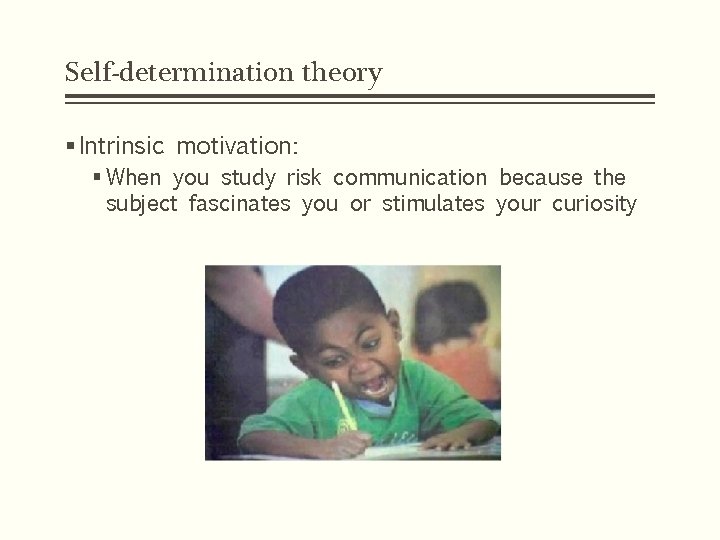
Self-determination theory § Intrinsic motivation: § When you study risk communication because the subject fascinates you or stimulates your curiosity
Self-determination theory § Extrinsic motivation: § When you study risk communication to earn a grade that will make your transcript look better in the job market § To avoid shame from your friends or family § Exams scare you no matter what § You made a bet with your friend on who gets a better grade
Self-determination theory § Would it be better to induce behavior change with intrinsic motivation or extrinsic motivation? § Why?
Self-determination theory § Intrinsic motivation leads to… § Greater maintained health behavior change § Better conceptual understanding and deeper learning § Greater job satisfaction and performance § Higher creativity § Better psychological health
Psychological reactance § Individuals experiencing threats to their behavioral freedom become aroused into a motivational state where they attempt to restore threatened freedom, often leading to outcomes opposite to what communicators intended (J. W. Brehm, 1966) § e. g. , college students engaging in more binge drinking after interventions from universities against alcohol
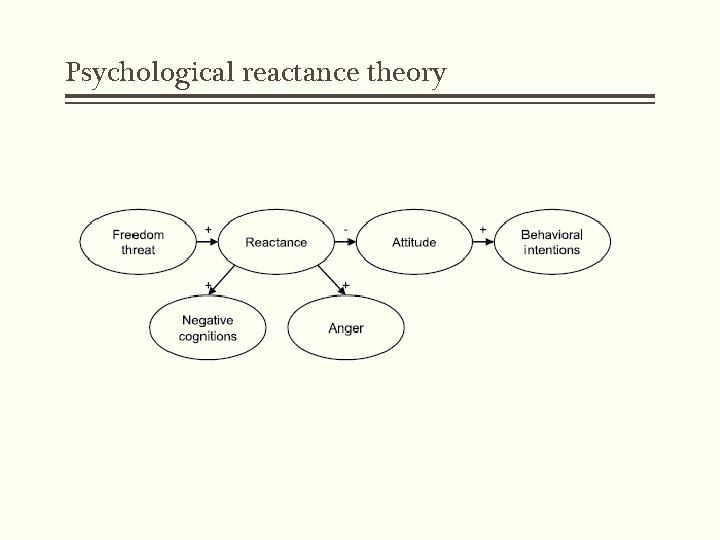
Psychological reactance theory
PERSUASION
Persuading the public § Now let’s design a public campaign to persuade the public to adopt the behavior you are promoting § Consider the following: § What argument would you use? § Who would you choose as the spokesperson? § (Optional) Are there any clever persuasion tactics that you can think of?
Two paths to persuasion § Elaboration Likelihood Model (ELM; Petty & Cacioppo, 1986) § Central route (similar to System 2) § Result of careful and thoughtful consideration of the true merits of the information presented in support of an advocacy § Peripheral route (similar to System 1) § Result of some simple cue in the persuasion context (e. g. , an attractive source) that induced change without necessitating scrutiny of the true merits of the information
Central route processing § When people take the central route to persuasion, they focus on the quality of the argument by considering the merits of the message § For central route processing to occur, the message receiver needs to have: § High motivation: otherwise, one does not invest the necessary mental resources § High ability: otherwise, one cannot evaluate the quality of the message § e. g. , “We must reduce carbon emissions because climate change unfairly burdens future generations”
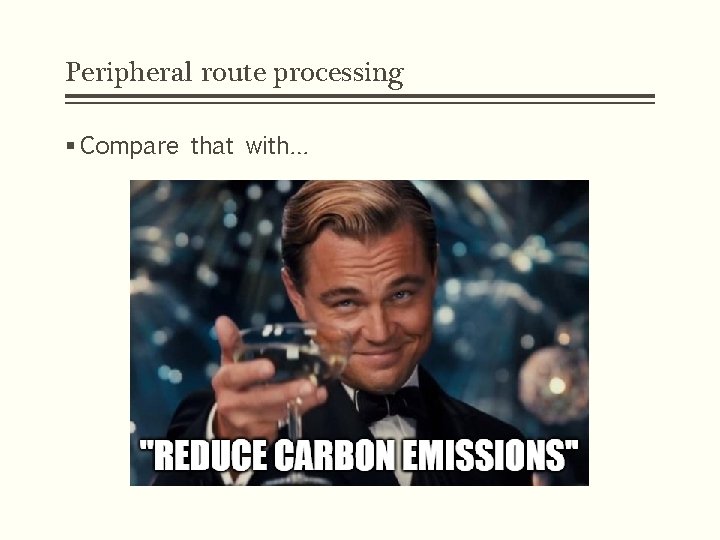
Peripheral route processing § Compare that with…
Peripheral route processing § When people rely on cues irrelevant to the argument quality (e. g. , source’s attractiveness, expertise, loudness of voice, confidence; number —not quality—of arguments) § Happens when motivation or ability to process information is low
Go back to your persuasion plan § Do your approaches appeal to central or peripheral route? § When the public reads your message, are they likely to take the central or peripheral route? § To better meet the public’s state in terms of ability or motivation, what would you change?
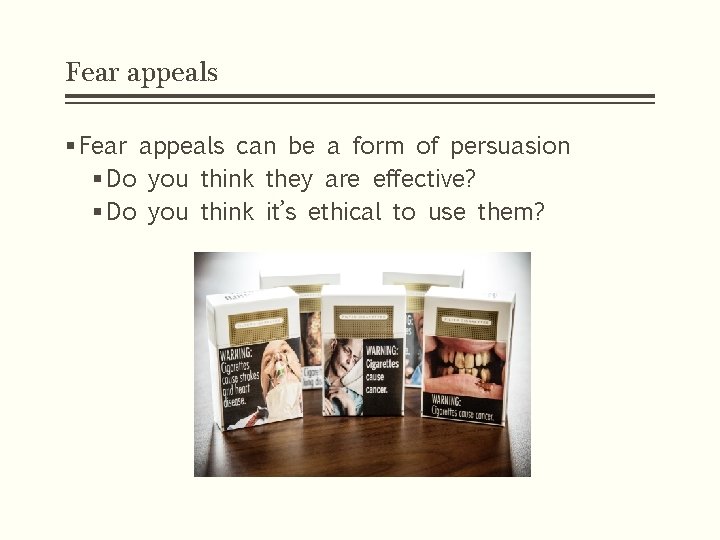
Fear appeals § Fear appeals can be a form of persuasion § Do you think they are effective? § Do you think it’s ethical to use them?
Fear appeals § Effective? § Ethical? § Texting and Driving § https: //www. youtube. com/watch? v=R 0 LCm. St. Iw 9 E&t =29 s
Some negative effects of fear appeals 1. Deliberately foster anxiety. 2. Can cause their targeted audience to see the brand or cause negatively. 3. Can diminish free choice by compromising the individual’s ability to make a rational choice. 4. Expose audiences unwillingly to graphically upsetting images. 5. Often reach and annoy unintended audiences. 6. Demonize the featured subgroups and scare parents into a too-protective mode of parenting. 7. Can evoke maladaptive responses that end up not controlling or removing the danger addressed in the ad. 8. May encourage health fatalism – “there’s nothing I can do about it. ” Hastings, Stead, and Webb (2004)
The motives color the means § Gass and Seiter (2013) argue that. . § Persuasion is a tool. Tools can be misused. § In such cases, however, one should blame the tool's user, not the tool. § Granted, some persuasive tools, such as fear appeals, hold greater potential for abuse, in the same way that a saw is more dangerous than a tape measure. § The means of persuasion are ethically neutral § Moral quality of an influence attempt is derived primarily from the motives or ends of the persuader
The motives color the means § For example, § Using fear appeals to convince a child to reject a ride from a stranger would be a good motive § https: //www. youtube. com/watch? v=k. N 29 b 1 -hh. Z 0
The motives color the means § However, if a boss is threatening to demote an employee after failed attempts to make sexual advances… § So some persuasive approaches have more potential to become unethical than others, § But in the end, it is the motives of the people using them that primarily matters.

NUDGING
Nudging § Proposed by Thaler and Sunstein (2009) § Nudge: § “Any aspect of the choice architecture that alters people’s behavior in a predictable way without forbidding any options or significantly changing their economic incentives. ” § In public policy, nudges should be used to influence choices in a way that will make choosers better off
Choice architecture § Carolyn, a director of food services for school cafeterias has learned over time that § Without changing any menus, § Simply rearranging healthy items (e. g. , carrots sticks, salad) by making them more visible (e. g. , center of cafeteria, eye level) § Increased their chance of selection over unhealthy items (e. g. , French fries, sweet desserts) § Carolyn is a choice architect: § Organizes the context in which people make decisions
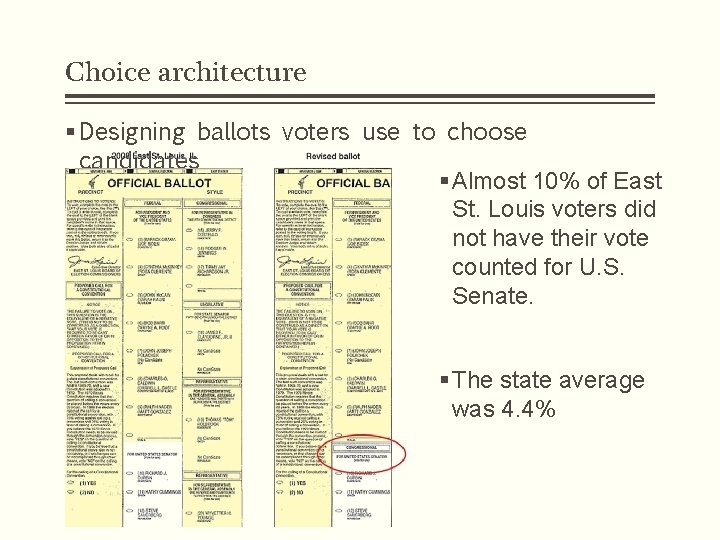
Choice architecture § Designing ballots voters use to choose candidates § Almost 10% of East St. Louis voters did not have their vote counted for U. S. Senate. § The state average was 4. 4%
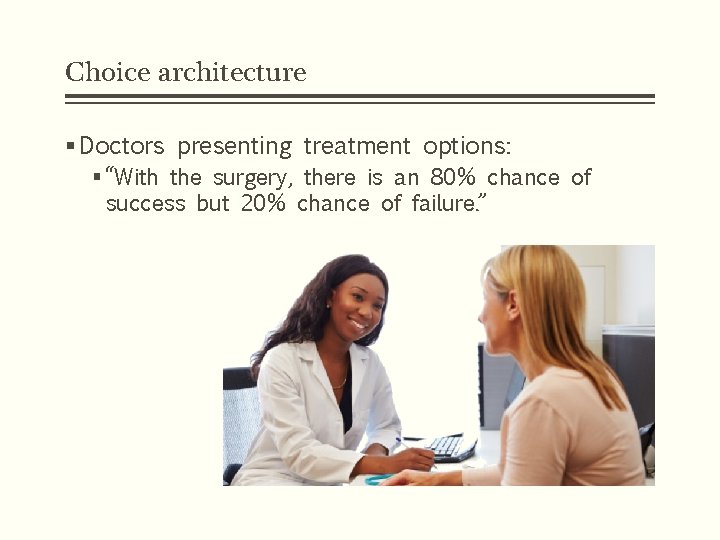
Choice architecture § Doctors presenting treatment options: § “With the surgery, there is an 80% chance of success but 20% chance of failure. ”
Choice architecture § So what should Carolyn do? 1. Arrange the food to make the students best off, all things considered 2. Choose the food order at random 3. Try to arrange the food to get the kids to pick the same foods they would choose on their own 4. Maximize the sales of the items from the suppliers that are willing to offer the largest bribes 5. Maximize profits
Choice architecture § “There is no such thing as a neutral design” § Choice architects “nudge” for the public good when they structure people’s choices to make their lives longer, healthier and better § This does not remove any choice options § But weakly, softly, and non-intrusively influence people so that they are more likely to make choices that make them better off
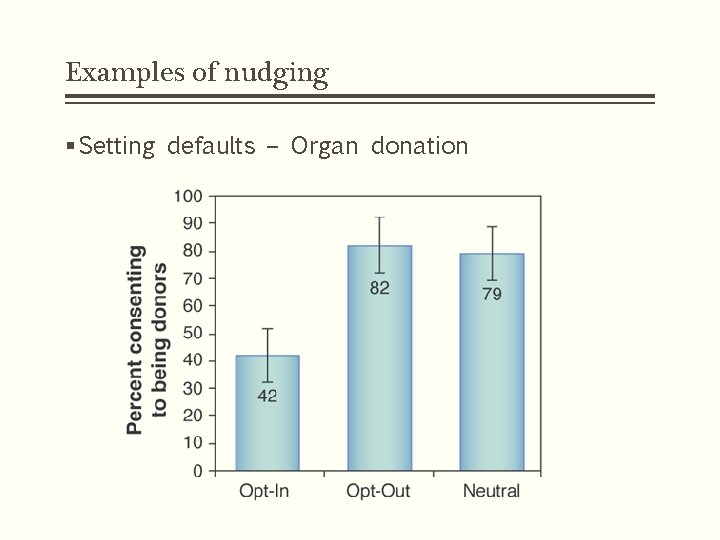
Examples of nudging § Setting defaults – Organ donation
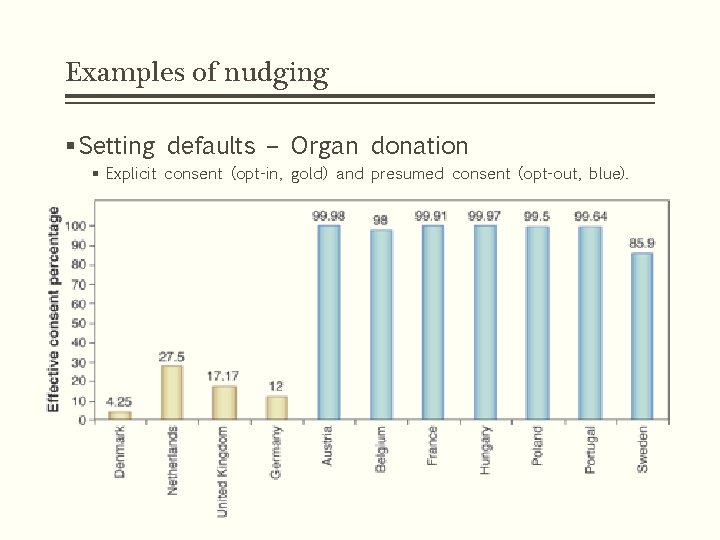
Examples of nudging § Setting defaults – Organ donation § Explicit consent (opt-in, gold) and presumed consent (opt-out, blue).
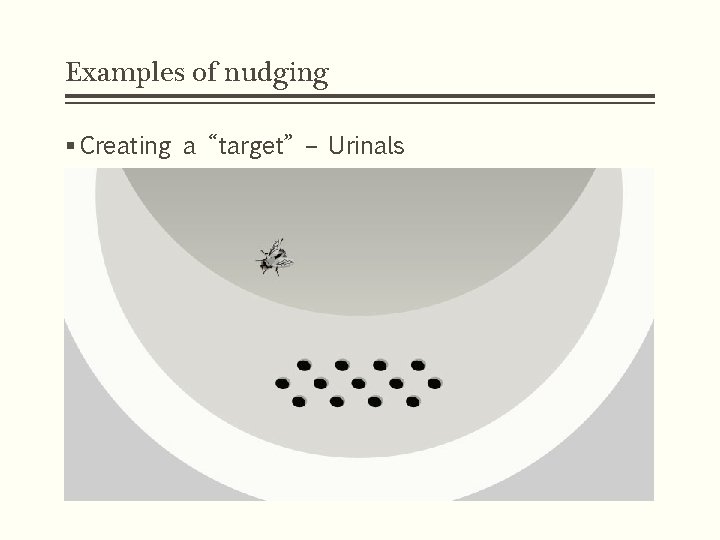
Examples of nudging § Creating a “target” – Urinals
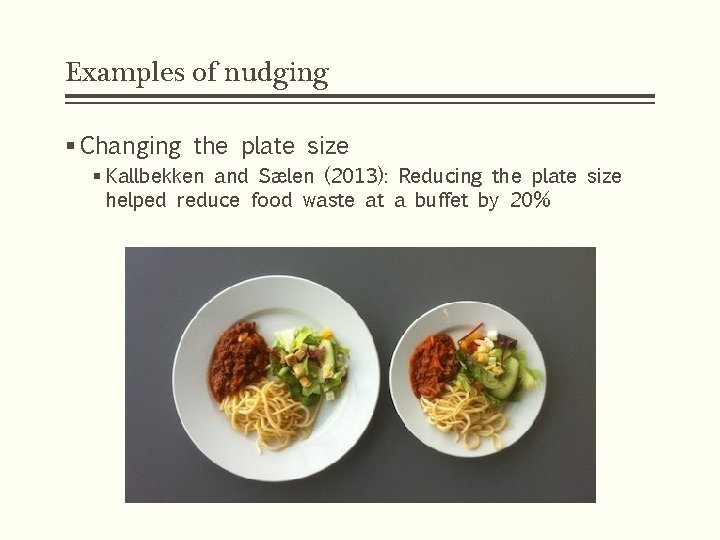
Examples of nudging § Changing the plate size § Kallbekken and Sælen (2013): Reducing the plate size helped reduce food waste at a buffet by 20%
Nudging the public § How would you nudge the public to comply with the behavioral change you are targeting? § And how you could use nudging to accomplish that § Changing the structure / context of the choice § Without removing choice options § Without impacting the economic incentives significantly
Nudges are not without critics § Nudges may compromise people’s autonomy § Even provoke reactance or public resentment when people feel that they are manipulated § “Who are you to know what I’d prefer? ” § Nudges may compromise people’s ability to form/learn preferences § Relieve the need to use System 2 to form thoughtful judgments about what they should do and how to use self-control § Nudges are not transparent § Unlike regulatory mandates discussed in legislature § Nudges may be deployed covertly without awareness
- Slides: 40