
Risk Benefit Risk Management Purpose Introduce the concept


Risk Benefit Risk Management
Purpose Introduce the concept of risk management References: • FM 101 -5, Appendix J • http: //safety. army. mil/
Task, Conditions, Standards Task: Verify the implementation of the risk management process at company level. Conditions: Given a scenario, with a complete risk management worksheet, in a classroom environment and student handouts. Standards: Make a written report that correctly identifies the hazards associated with the mission or task, the level of risk for each identified hazard, and the initial overall level of risk.

Outline • • • What Risk Management Why Risk Management Definitions The Risk Management process Risk Management Integration Risk Management Matrix Video/Scenario Summary conclusion
What is Risk Management? • Risk management is the best process for protecting the force. It provides a systematic, logical approach to identifying and controlling hazards that endanger our resources. Risk management supports and encourages initiative allowing flexibility, adaptability and eagerness to act. It is not just related to safety; it applies to all elements or force protection in all situations and environments
Why Risk Management? • Preserve combat power • Because it works! - Dramatic decrease in accidents Army-wide • FY 96 Accident Rates Total Accident Rate 4. 22 per 1000 soldiers record low according to Army Safety Center, Jan 97
Key Definitions • Hazard – A condition with potential of causing injury to personnel, damage to equipment. • Risk – An expression of possible loss over a specific period of time or number of operational cycles. • Risk Assessment – The process of detecting hazards systematically assessing their overall risk • Gambling – The process of making risk decisions without apply the risk management process
Key Definitions • Tactical Risk: Risk associated with hazards that exist because of the presence of the enemy or an adversary. • Accident Risk: Includes all operation risk considerations other than tactical risk, and can include activities associated with hazards concerning friendly personnel, equipment readiness, and environment conditions.
Risk Management Process • IDENTIFY HAZARDS • ASSESS HAZARDS • MAKE RISK DECISION/DEVELOP CONTROLS • IMPLEMENT CONTROLS • SUPERVISE
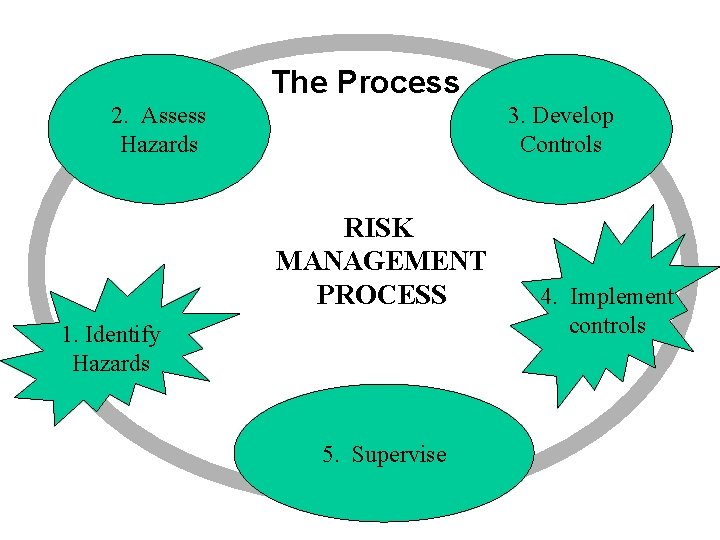
The Process 2. Assess Hazards 3. Develop Controls RISK MANAGEMENT PROCESS 1. Identify Hazards 5. Supervise 4. Implement controls
The Process • Step 1 - Identify Hazards: Consider all aspects of current and future situations, environment, and know historical problem areas. • Example of some Hazards: Time for mission prep & execution Terrain(rough, hills, swamp, etc Transportation to and from the operation site Skill level of personnel Intensity of operation(probability of taking shortcuts
The Process • Step 2 – Assess Hazards: Assess hazards to determine their level of risk on the mission/task. Determine the initial overall level of risk. • • Mission – routine, complex, “ no sweat” Enemy – combat or training Terrain – water, cliffs, swamps mountains Troops – training, physical condition, sleep plans, morale • Time – adequate for planning, for the mission • Hill vs Mountain
The Process • Step 3 – Develop controls: Decide what controls are needed to reduce the hazards. There will always be some element of risk; we can never completely eliminate it, but we must minimize risk by controlling all the elements that we can. • • • Reduce Risks Modify plan Modify Training Inform the troops Do mission benefits outweigh the risk The senior leader makes the final decision on risk acceptance
The Process • Step 4 – Implement Controls: Decide how each control will be put into effect or communicated. Implementing controls includes coordination and communication with superiors, subordinates, and individuals executing the mission/task. • Plans • SOPs • Standards • Rehearsals • Ensure all know the risk and how to avoid or reduce
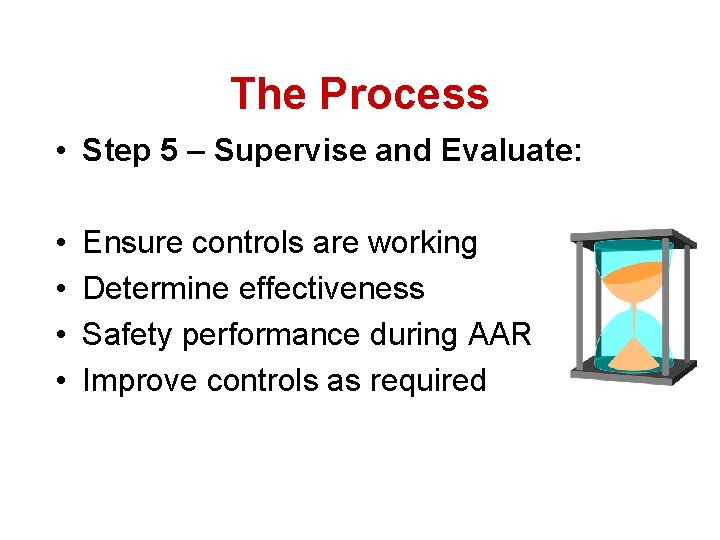
The Process • Step 5 – Supervise and Evaluate: • • Ensure controls are working Determine effectiveness Safety performance during AAR Improve controls as required
Risk Management Integration The Next Generation • Embed RM in all Army does • Incorporates AAR – Were controls communicated? – Were controls implemented? – Was Risk Management effective? • Risk Management Integration Plan – Draft dated 24 Dec 97
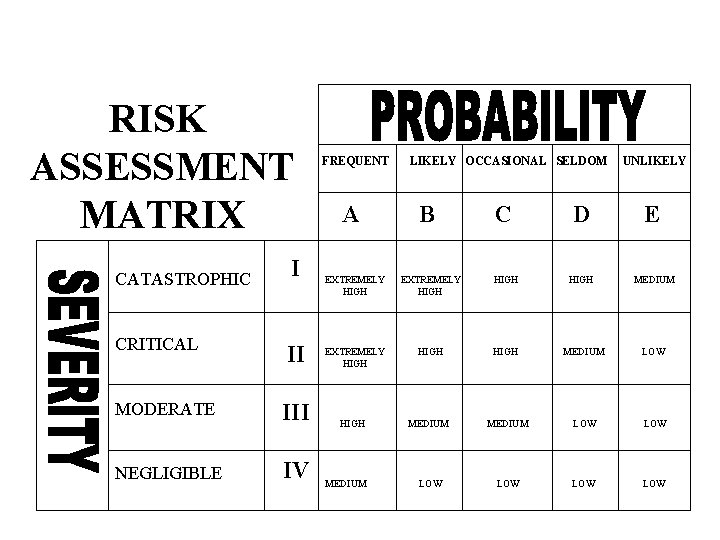
RISK ASSESSMENT MATRIX CATASTROPHIC I FREQUENT A LIKELY OCCASIONAL SELDOM B UNLIKELY C D E EXTREMELY HIGH MEDIUM CRITICAL II EXTREMELY HIGH MEDIUM LOW MODERATE III HIGH MEDIUM LOW NEGLIGIBLE IV LOW LOW MEDIUM
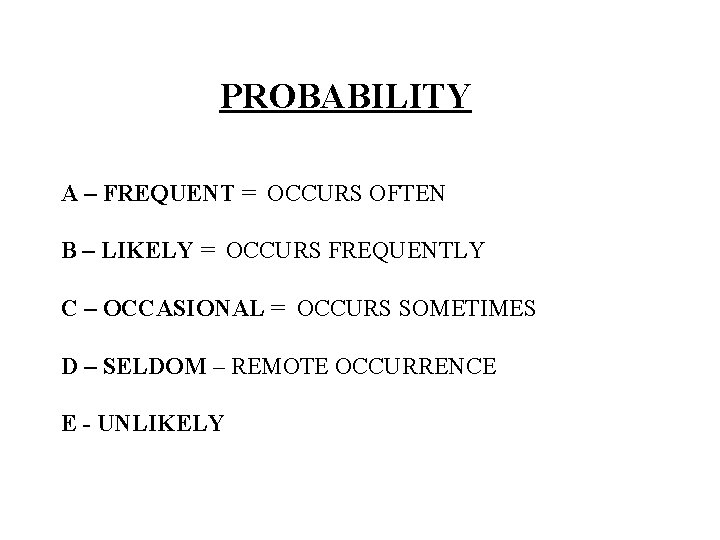
PROBABILITY A – FREQUENT = OCCURS OFTEN B – LIKELY = OCCURS FREQUENTLY C – OCCASIONAL = OCCURS SOMETIMES D – SELDOM – REMOTE OCCURRENCE E - UNLIKELY
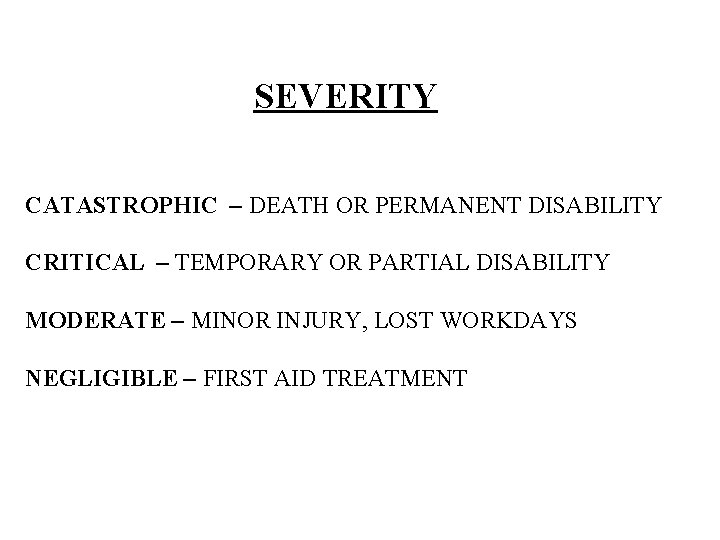
SEVERITY CATASTROPHIC – DEATH OR PERMANENT DISABILITY CRITICAL – TEMPORARY OR PARTIAL DISABILITY MODERATE – MINOR INJURY, LOST WORKDAYS NEGLIGIBLE – FIRST AID TREATMENT
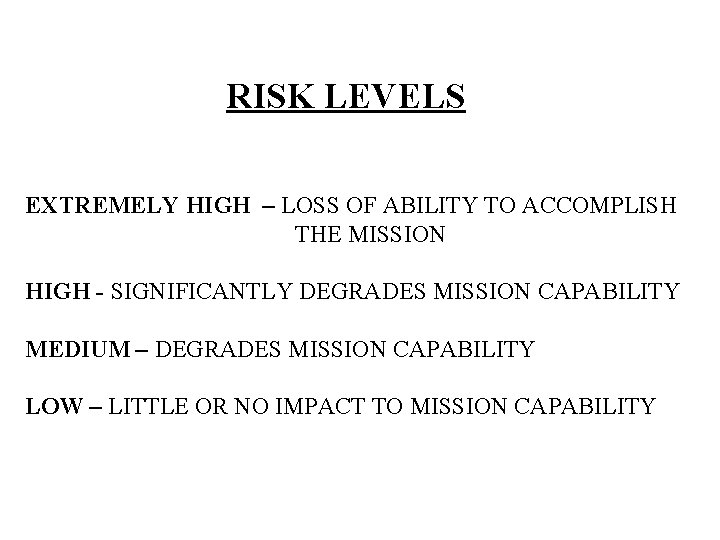
RISK LEVELS EXTREMELY HIGH – LOSS OF ABILITY TO ACCOMPLISH THE MISSION HIGH - SIGNIFICANTLY DEGRADES MISSION CAPABILITY MEDIUM – DEGRADES MISSION CAPABILITY LOW – LITTLE OR NO IMPACT TO MISSION CAPABILITY
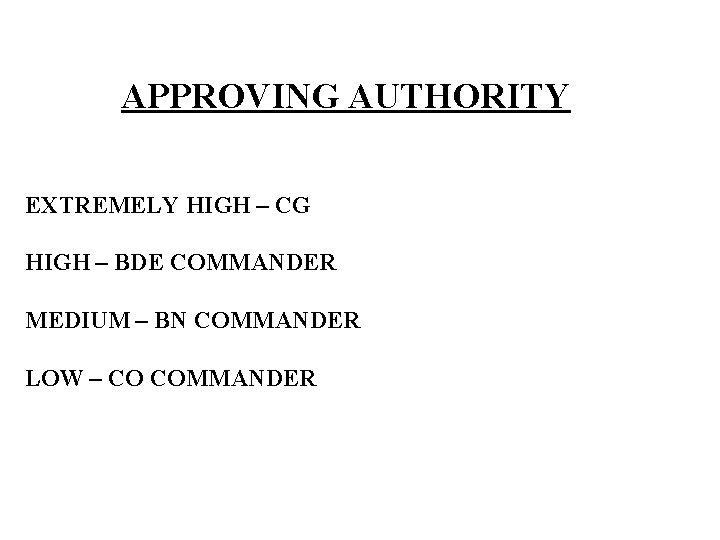
APPROVING AUTHORITY EXTREMELY HIGH – CG HIGH – BDE COMMANDER MEDIUM – BN COMMANDER LOW – CO COMMANDER
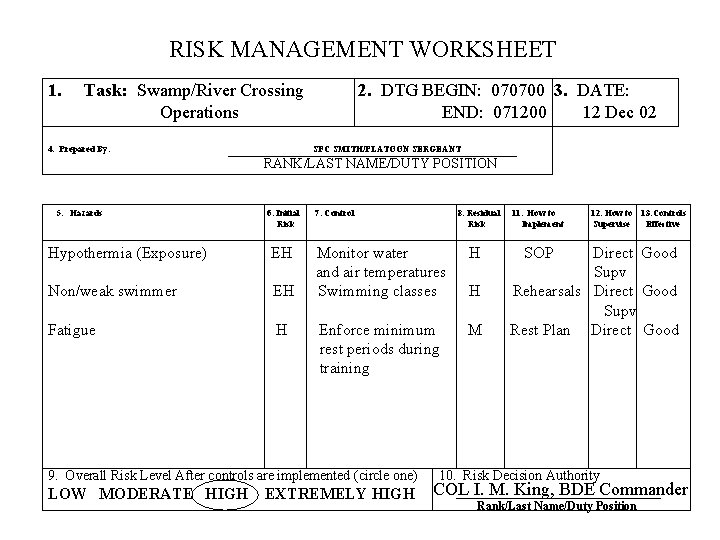
RISK MANAGEMENT WORKSHEET 1. Task: Swamp/River Crossing Operations 4. Prepared By: 2. DTG BEGIN: 070700 3. DATE: END: 071200 12 Dec 02 SFC SMITH/PLATOON SERGEANT RANK/LAST NAME/DUTY POSITION 5. Hazards 6. Initial Risk Hypothermia (Exposure) EH Non/weak swimmer EH Fatigue H 7. Control Monitor water and air temperatures Swimming classes H Enforce minimum rest periods during training M 9. Overall Risk Level After controls are implemented (circle one) LOW MODERATE HIGH 8. Residual Risk EXTREMELY HIGH H 11. How to Implement 12. How to Supervise 13. Controls Effective SOP Direct Good Supv Rehearsals Direct Good Supv Rest Plan Direct Good 10. Risk Decision Authority COL I. M. King, BDE Commander Rank/Last Name/Duty Position
SCENARIO Reducing the Risk in Training NOBODY’S FAULT VIDEO
Summary • • What Risk Management is Why Risk Management is important Definitions The Risk Management process Risk Management Integration Risk Management Matrix Video/Scenario Questions?
Conclusion “Risk management helps us preserve combat power and retain the flexibility for bold and decisive action. Proper risk management is a combat multiplier that we can ill afford to squander…. ” General Reimer
- Slides: 26