
Risk Assessment Process for Biohazardous Agents and Materials
Risk Assessment Process for Bio-hazardous Agents and Materials
Laboratory Risk Assessment Process • Reduces the worker’s and environment’s risk of exposure. • The Risk is never zero • Also call a “Hazard Assessment. ”
Lab Bio-hazard Risk Assessment A biohazard risk assessment is a process which: • Performs a site-specific evaluation • Evaluates risk posed by the: – Agent – Activities/Procedure(s) – Worker – Environment – Community • Numerous ways to perform this process.
Risk Assessment • Is a critical and productive exercise, for identifying potential hazardous laboratory activities involving infectious materials or lab exercises. • The risk assessment process is the basis for assigning the Biosafety Levels (facilities, equipment, practices, & Occ. Health program). – Goal to minimize worker's and the environment's risk of exposure to the an agent.
Risk Assessment BMBL 5 th edition • There are may ways to perform a Hazard Risk Assessment • This presentation uses a 5 -step process outlined in the US publication entitled: – CDC/NIH Microbiology in Biomedical Laboratories (BMBL), 5 th ed.
Risk Assessment BMBL 5 th edition 5 -Step Biosafety Risk Assessment: 1. Identify – Agent hazards (biological properties) 2. Identify – Work Activity hazards (associated with lab work) 3. Determine - Preliminary Biosafety Level • Facilities, Equipment, Occupational Health Programs, Practices
Risk Assessment BMBL 5 th edition Continued 4. Evaluate Worker • Training & Experience • Occupational Health Programs. 5. Review the Risk Assessment with: • Biosafety Professional or Biosafety Committee • Investigator / Researcher/ Subject-Matter-Expert • Attending Occupational Health Physician.
Step 1: Risk Assessment Process Agent Based - Risk Assessment
Evaluate – Agent’s Basic Properties • Origin • • Pathogenicity Route of transmission Infectious dose Agent stability Concentration Animal study data Prophylaxis available (Pre/Post).
Biosafety Level vs. Risk Groups
• Risk Groups & Biosafety Levels – NOT THE SAME • Risk Group 1 -4 ≠ BSL 1 -4 • Risk-Group profile is a component of determining the Biosafety Level.
WHO Risk Groups 1 -4: Considers Biological Properties of the Organism • • • Pathogenicity / Severity of disease Mode of transmission and host range Availability of preventive measures (Ex. vaccines) Availability of effective treatment (Ex. antibiotics) Other factors.
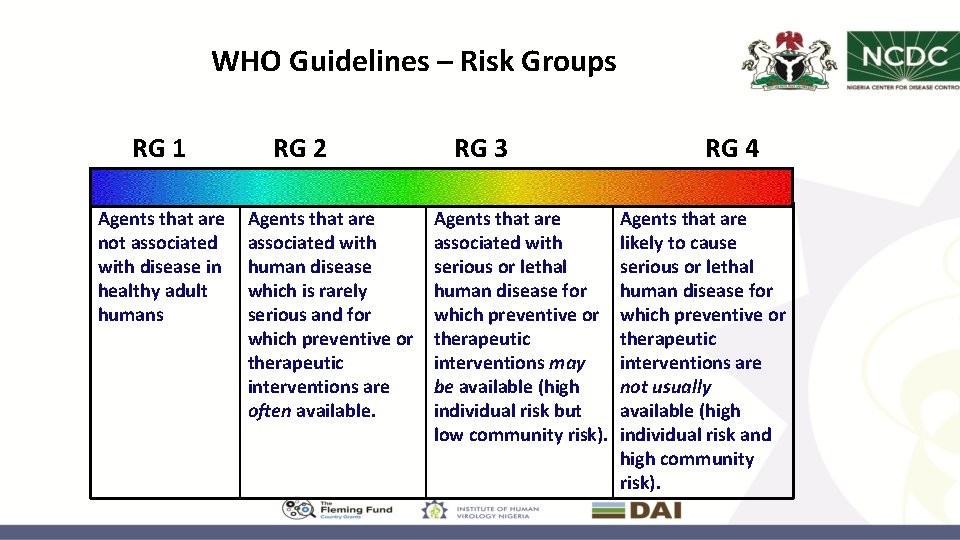
WHO Guidelines – Risk Groups RG 1 Agents that are not associated with disease in healthy adult humans RG 2 Agents that are associated with human disease which is rarely serious and for which preventive or therapeutic interventions are often available. RG 3 Agents that are associated with serious or lethal human disease for which preventive or therapeutic interventions may be available (high individual risk but low community risk). RG 4 Agents that are likely to cause serious or lethal human disease for which preventive or therapeutic interventions are not usually available (high individual risk and high community risk).
Criteria For Laboratory Biosafety Level (BSL) & Animal Biosafety Levels (ABSLs)
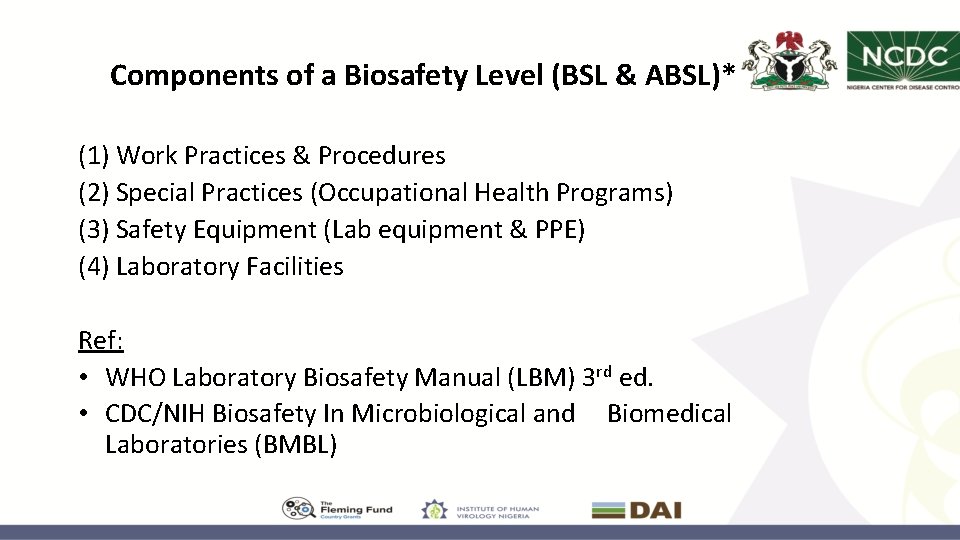
Components of a Biosafety Level (BSL & ABSL)* (1) Work Practices & Procedures (2) Special Practices (Occupational Health Programs) (3) Safety Equipment (Lab equipment & PPE) (4) Laboratory Facilities Ref: • WHO Laboratory Biosafety Manual (LBM) 3 rd ed. • CDC/NIH Biosafety In Microbiological and Biomedical Laboratories (BMBL)
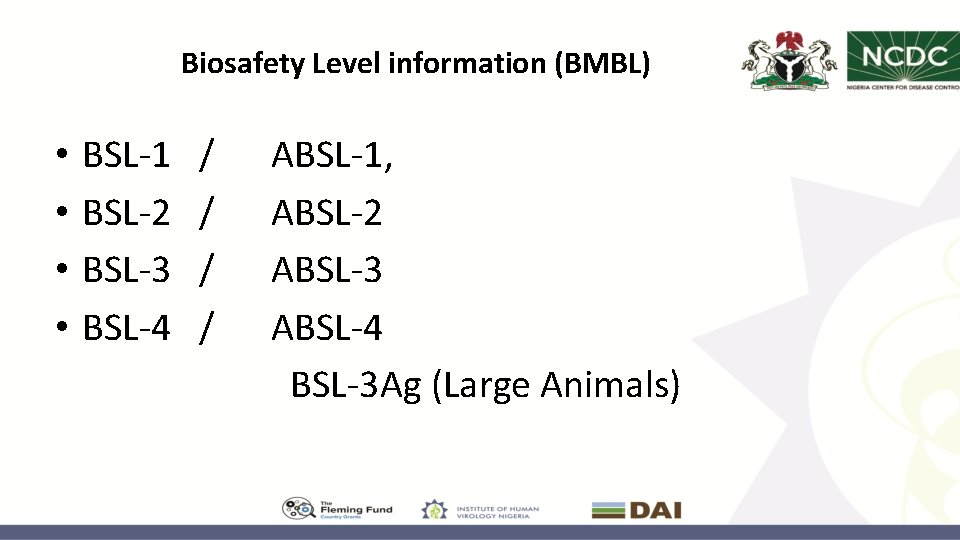
Biosafety Level information (BMBL) • • BSL-1 BSL-2 BSL-3 BSL-4 / / ABSL-1, ABSL-2 ABSL-3 ABSL-4 BSL-3 Ag (Large Animals)
Biosafety Level information (LBM & BMBL) • BSL-1: Absence of disease in immuno-competent adult humans (health adults). • BSL-2: Low to high severity of disease, and low transmissibility – Low to moderate infectivity (high infectious dose).
Biosafety Level Information (LBM & BMBL) • BSL-3: Moderate to high severity of disease, moderate to high transmissibility by infectious aerosols, and indigenous or exotic origin. Medical treatments usually available. – Moderate to high infectivity (low infectious dose) • BSL-4: Severe life-threatening disease, moderate to high transmissibility by infectious aerosols, and usually exotic origin. Medical treatments may not be available. – Moderate to high infectivity (low infectious dose)
The Risk Assessment Process • Institutions must perform a site-specific risk assessments for both agents and procedures within their institutions. – No two institutions or laboratories are alike. – Every lab is unique. • May be necessary to use several scientific references / publications to assist in performing the risk assessment, evaluating the agent, and activities.
Example Reference Materials • Ref: BMBL - Agent Summary Statements are broken down into the following categories: – Introduction – Occupational Infections – Natural Modes of Infection – Laboratory Safety – Containment Recommendations – Special Issues – Vaccines – Transfer of Agent
Step 2: Risk Assessment Process Evaluate Work Activities & Laboratory Procedures (for potential safety hazards) • Next slides provide examples of various work activities
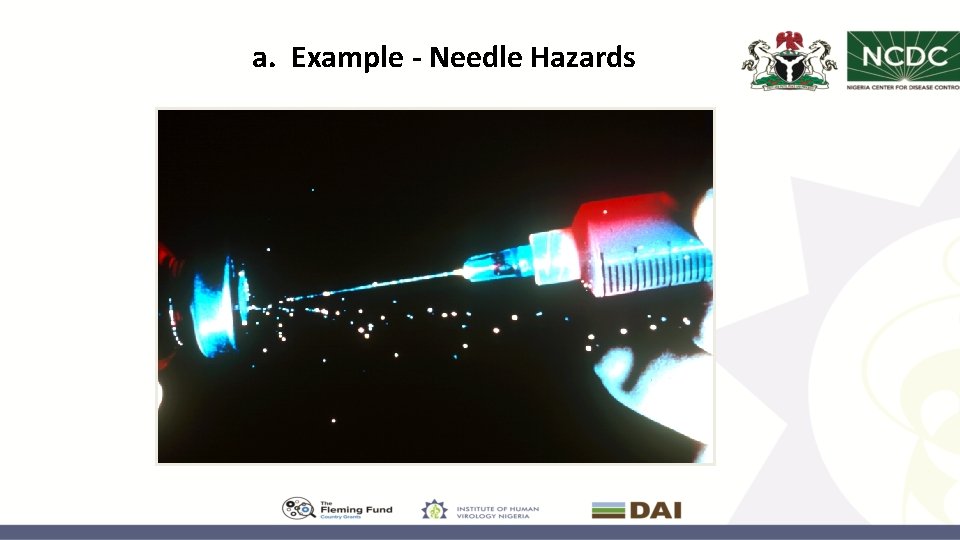
a. Example - Needle Hazards
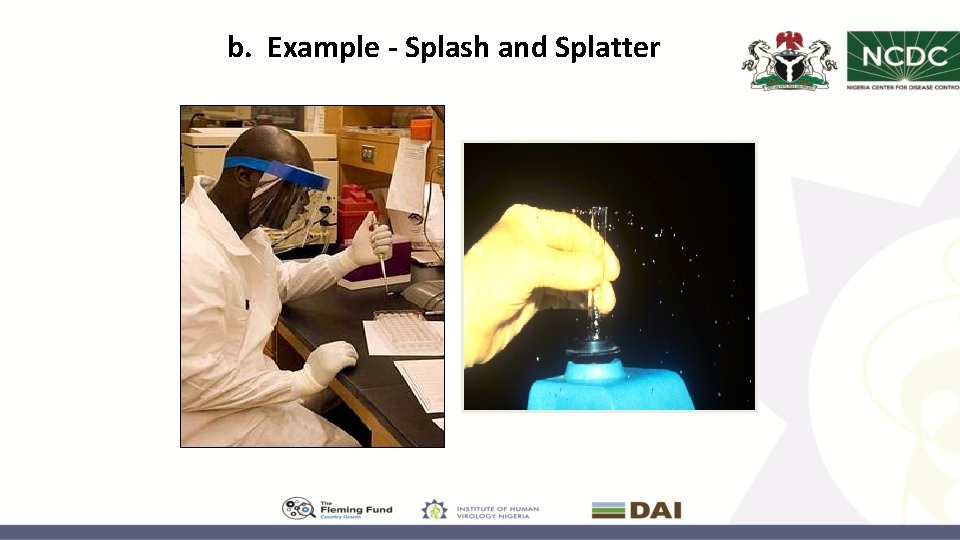
b. Example - Splash and Splatter
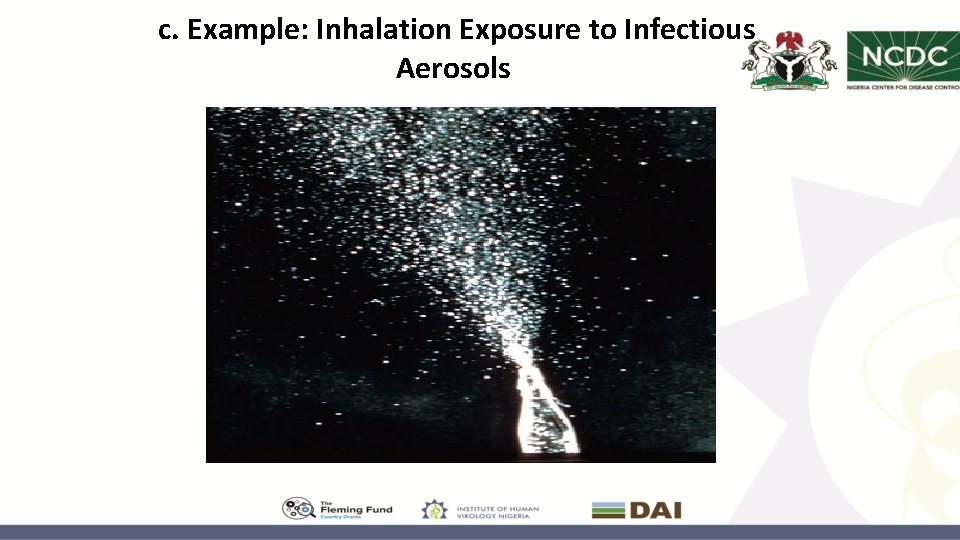
c. Example: Inhalation Exposure to Infectious Aerosols
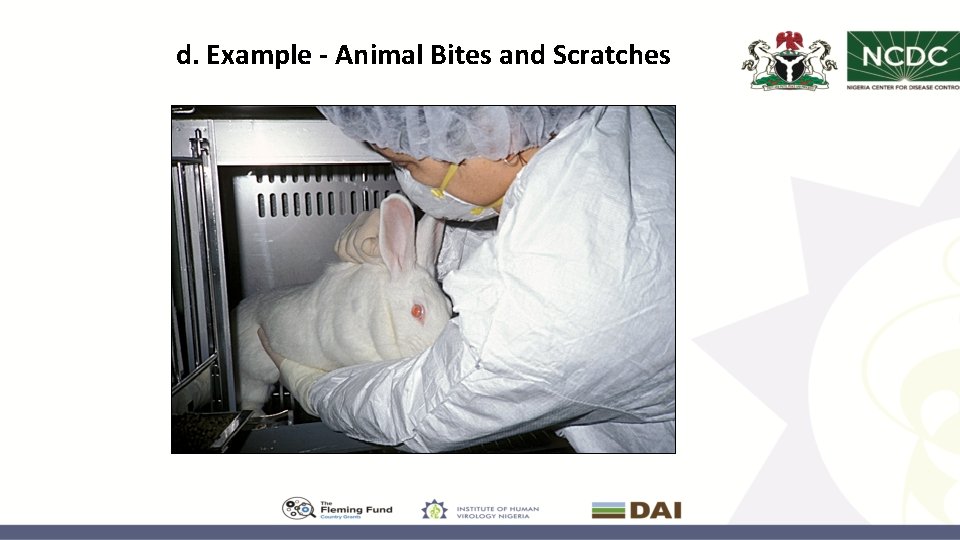
d. Example - Animal Bites and Scratches
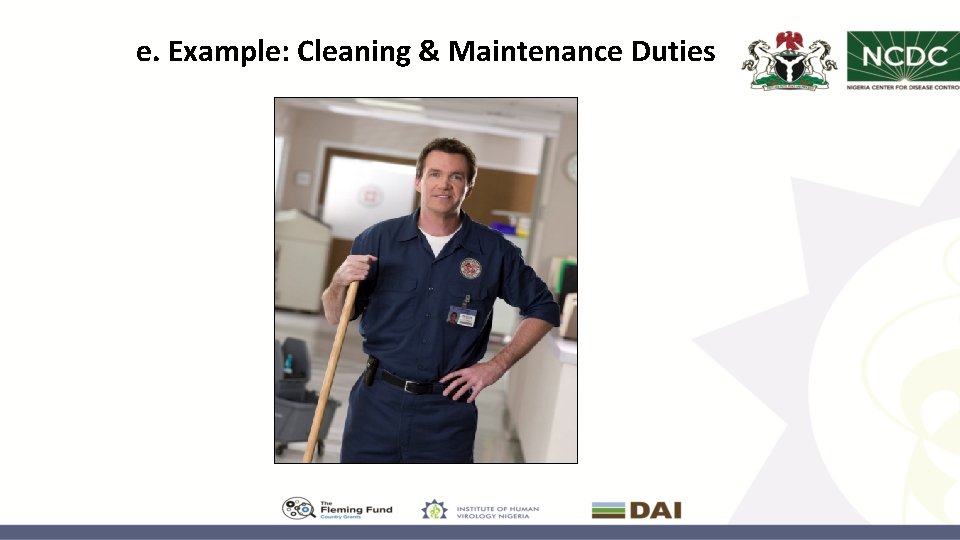
e. Example: Cleaning & Maintenance Duties
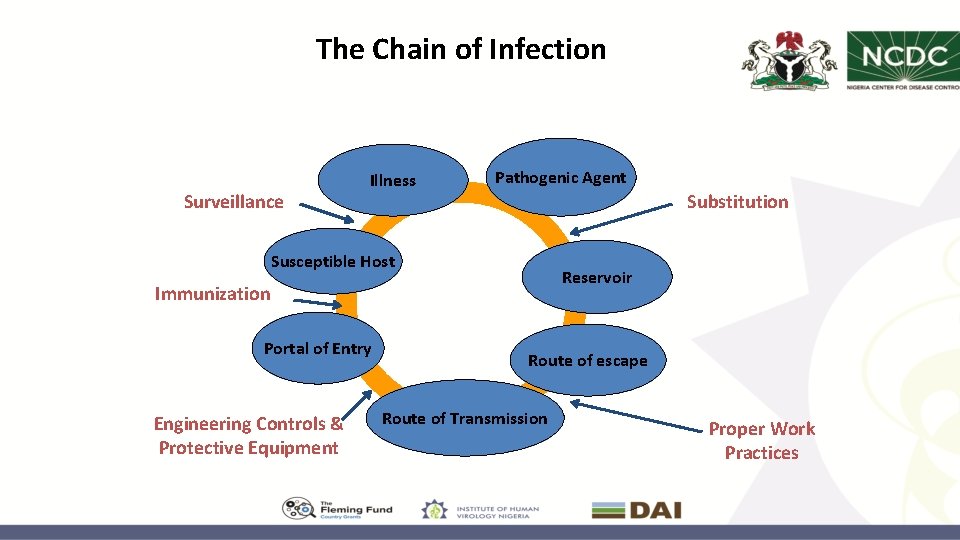
The Chain of Infection Surveillance Illness Pathogenic Agent Substitution Susceptible Host Reservoir Immunization Portal of Entry Engineering Controls & Protective Equipment Route of escape Route of Transmission Proper Work Practices
Procedures that Increase Risk • Non routine activities that require new skills • Extremely repetitive or boring activities • Larger scale work, scale up from pilot plant to production; larger volume adds to risk • Higher concentration of agent adds to risk
Biohazard Risk Assessment • Exposure to infectious droplets requires as much attention as does the respirable component of aerosols. • Infectious droplets can contaminate gloves, surfaces and mucous membranes resulting in LAIs without associated incidents.
Step 3: Risk Assessment Process Preliminary Determination of Biosafety Level and/or ABSL and Additional Precautions
Biohazard Risk Assessment • Preliminary biosafety level and additional precautions. – Facilities – Equipment – Work practices - Work activities – Employee occupational health programs • Note – This evaluation require comprehensive understanding of the practices, safety equipment, and laboratory facility safeguards.
Biohazard Risk Assessment • Intended use of an agent may require greater precautions than those outlined in the agent’s summary statement • Careful selection of additional precautions is often warranted
Recap: Step-3: Determine Preliminary Biosafety Level • Preliminary biosafety level will provide necessary: 1. Facilities 2. Equipment 3. Work practices - Work activities 4. Employee occupational health programs
Step 4: Risk Assessment Process Worker Assessment • Training & Experience • Occupational Health Needs
Worker Assessment • Focus on identifying gaps: • Worker Training & Experience – Working with delegated agent – Working at Biosafety Level (or ABSL) • Worker Occupational Health Programs – Includes medical surveillance – Respiratory Protection programs – Pre & Post exposure programs
Worker Training Experience: • • • Previous training and experience Expertise in specific protocols Work experience at delegated Biosafety Level (or ABSL) Good microbiological practices Attitude toward use of safe practices, PPE Occupational Health concerns & needs
Worker Assessment Employee Occupational Health Program – Also called: – Medical Surveillance Program
Medial Surveillance Program Occurs before Work Begins Consider need for: • Pre-placement medical history • Medical assessments and interventions • Training and Education enhance self-surveillance efforts: – Work-specific – Species-specific – Agent-specific – Method-specific
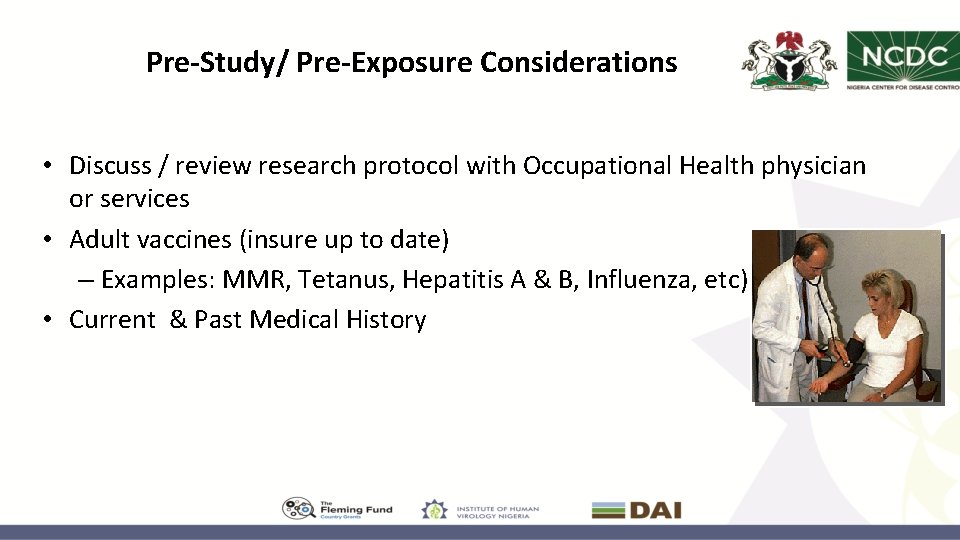
Pre-Study/ Pre-Exposure Considerations • Discuss / review research protocol with Occupational Health physician or services • Adult vaccines (insure up to date) – Examples: MMR, Tetanus, Hepatitis A & B, Influenza, etc) • Current & Past Medical History
Pre-Study/Pre-Exposure Considerations • Discuss additional Occupational Health Program needs – Determined by risk assessment – Respiratory Protection Program – Vaccinations or titers • Rabies vaccine (is this standard for your animal facility) – Discuss need for serum storage – Pre-exposure prophylaxis or medications • Procure / purchase necessary post-exposure prophylaxis & medications • Doctors Examinations (Immediate care, Follow-up care, Long term care)
First Aid Interventions & Follow-up Care Develop exposure control plan (post-exposure plan) • First-aid protocols – Location of first-aid kit; stocking & rotating of content • Assure awareness of first-aid and decontamination activities • Assure availability of prompt medical evaluation and follow-up as necessary • Pre-plan for consultations with experts if needed • Plan for “observation” needs of workers • Assure timely incident investigation and remediation if required
Step 5: Risk Assessment Process Review – Results of Risk Assessment
Review the Risk Assessment with: • Biosafety Professional or Biosafety Committee • Investigator / Researcher/ Subject-Matter-Expert • Attending Occupational Health Physician • Review is often required by regulatory or funding agencies such as the case outlined in the NIH Guidelines
Assessing Biosafety Risks and Selecting Safeguards • Re-evaluate and modify: – Biosafety risk assessment – Biosafety program / plan • Reinforce: – Implementation, training, and reevaluation of the biosafety program ANNUALLY and AFTER any biosafety related incident
Key Points • A Risk Group is not the same as a Biosafety Level • Containment conditions do not have to follow a single biosafety level. • An agent classified in a particular risk group may need to be handled at either a higher or a lower biosafety level.
Key Points Risk assessment needs and containment decisions require information about: • Agent • Worker • Activities • Facilities
Key Points • There will never be a complete list of all etiologic agents classified according to Risk nor BSL. • The risk classification of all agents in other countries will never be the same as in the USA. -Do you know why? -
Additional Safety Considerations • • • Waste Management Chemical Hygiene Electrical Safety Fire Safety Radiation Safety Emergency Preparedness & Response Programs
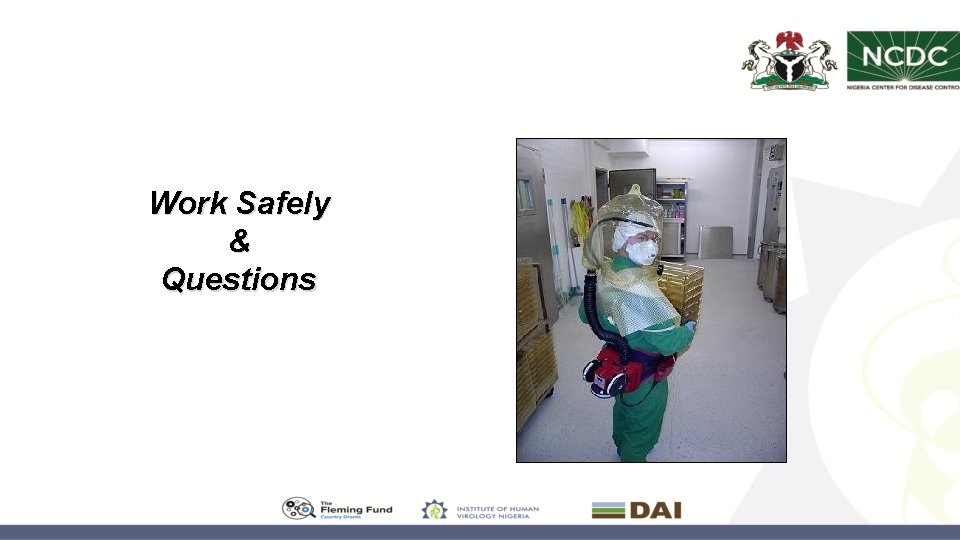
Work Safely & Questions
Acknowledgements • Elsie van Schalkwyk • CDC/NIH Biosafety In Microbiological and Biomedical Laboratories (BMBL)
- Slides: 50