
RISK ASSESSMENT MODEL FOR BALLAST WATER EXCHANGE OVERVIEW
RISK ASSESSMENT MODEL FOR BALLAST WATER EXCHANGE: OVERVIEW
Outline • Objective of this talk is to provide basic details of a ballast water risk assessment model that predicts the lowest risk BW exchange segment along a vessel track • Model was developed for application to Atlantic Canadian waters, so this talk will be based on this region. • NB: model has been applied elsewhere (Arctic).
The Problem – in Atlantic Canada • Hundreds of vessels (300 -500 per year) perform mid-ocean exchange (MOE) of ballast water on the Scotian Shelf/Gulf of Maine/Georges Bank regions of Atlantic Canada and the U. S. • Why? – likely relates to IMO regulation (B-4 #3) regarding trip diversions for ballast water exchange. • ~ 80% of these vessels follow a trade route to and from the eastern U. S.
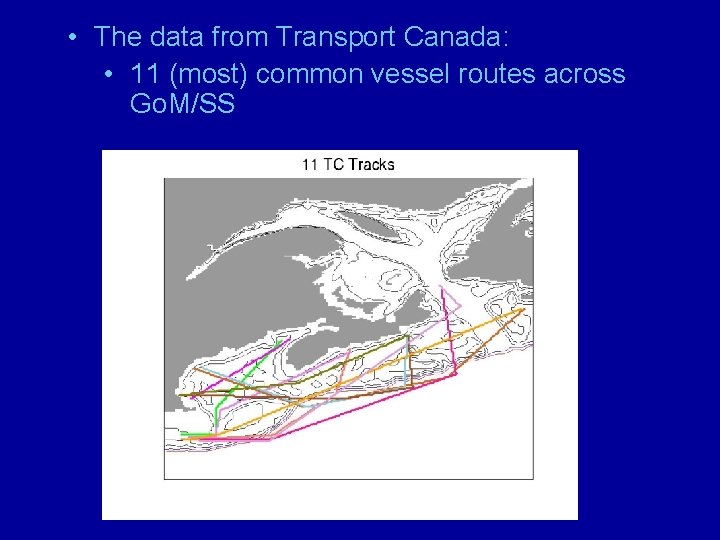
• The data from Transport Canada: • 11 (most) common vessel routes across Go. M/SS
QUESTION • Can we minimize the risk associated with this process? ANSWER

• While it is still not possible to express the risk in absolute terms (Probability of an event) X (consequence) it is possible to identify risk indicators and calculate a Relative Overall Risk associated with possible exchange events. a semi-quantitative risk assessment model for the exchange of ballast water along a vessel track (on a trip-by-trip basis) Results are summarized in two papers: –Brickman, 2006. CJFAS (63) 2748 -2759; • doi: 10. 1139/F 06 -158 –Brickman and Smith, 2007. MPB 54, 863 -874; • doi: 10. 1016/j. marpolbul. 2007. 03. 015
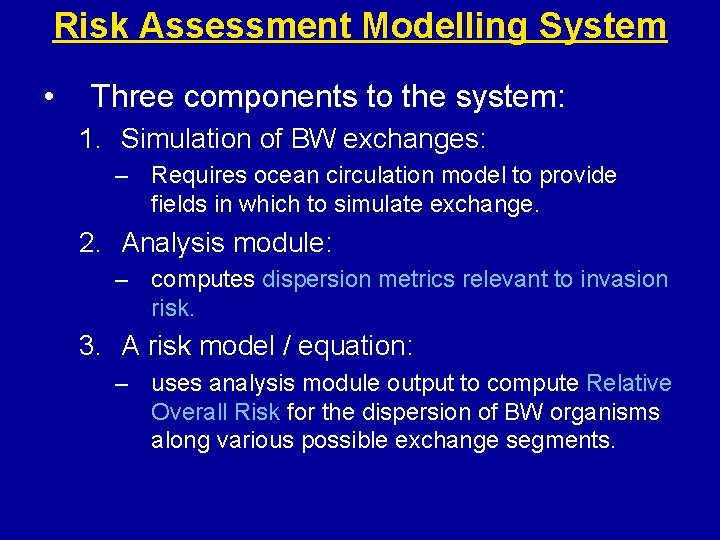
Risk Assessment Modelling System • Three components to the system: 1. Simulation of BW exchanges: – Requires ocean circulation model to provide fields in which to simulate exchange. 2. Analysis module: – computes dispersion metrics relevant to invasion risk. 3. A risk model / equation: – uses analysis module output to compute Relative Overall Risk for the dispersion of BW organisms along various possible exchange segments.
1. Simulating BW Releases • Complicated suite of organisms in BW tank model exchange as simple release (& subsequent dispersion) of tracer into surface layer of ocean. – NB: if sufficient organism-specific information exists, this model can be much more complicated.
2. Dispersion metrics related to Invasion Risk • The following metrics are considered relevant to the potential risk of invasion by BW organisms. • Invasion Time: the time it takes for dispersion into a “sensitive” area. – Because the abundance of released organisms typically decreases with time, a given BW exchange segment is potentially riskier if it disperses organisms into a sensitive region faster than a different one.
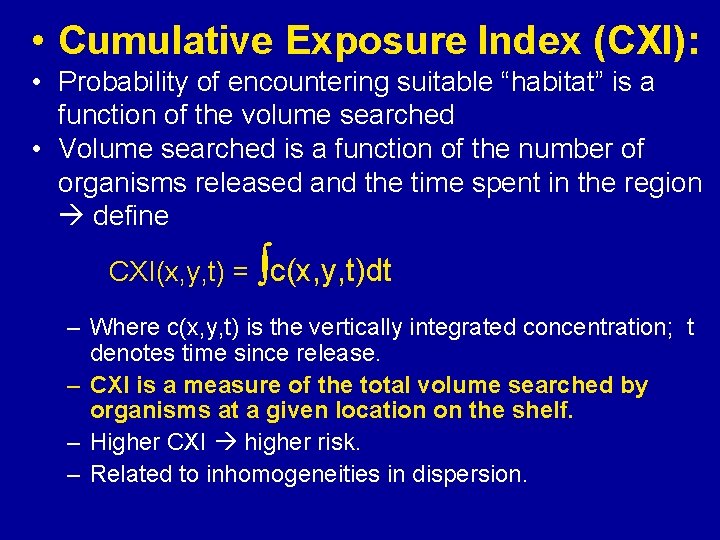
• Cumulative Exposure Index (CXI): • Probability of encountering suitable “habitat” is a function of the volume searched • Volume searched is a function of the number of organisms released and the time spent in the region define CXI(x, y, t) = ∫c(x, y, t)dt – Where c(x, y, t) is the vertically integrated concentration; t denotes time since release. – CXI is a measure of the total volume searched by organisms at a given location on the shelf. – Higher CXI higher risk. – Related to inhomogeneities in dispersion.
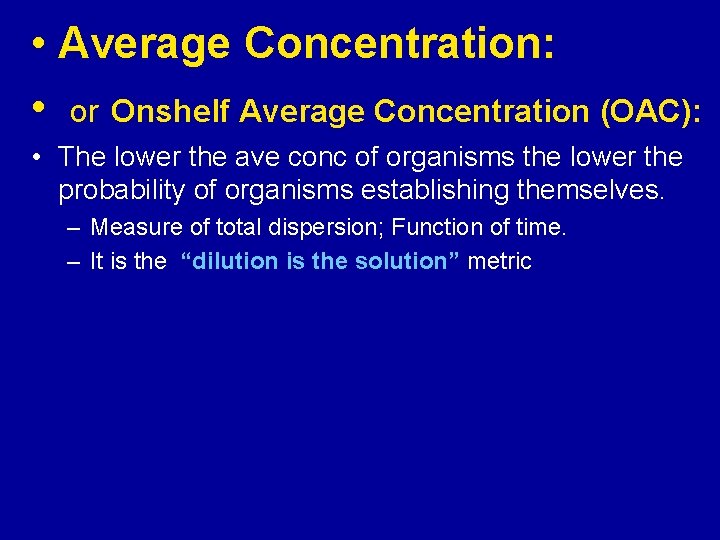
• Average Concentration: • or Onshelf Average Concentration (OAC): • The lower the ave conc of organisms the lower the probability of organisms establishing themselves. – Measure of total dispersion; Function of time. – It is the “dilution is the solution” metric
3. Risk Model • The risk model is the application of various risk metrics to areas in the domain of interest. • Idea behind risk equation is that it should reflect the various “interests” that different groups have w. r. t. potential areas of invasion and relevant metrics.
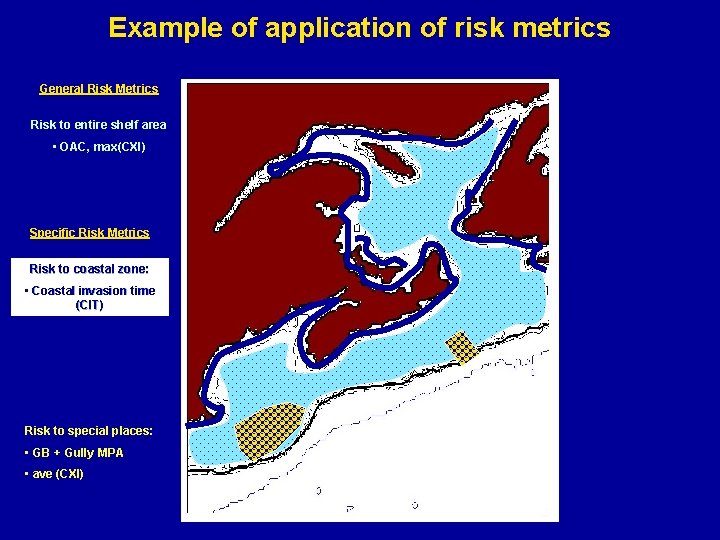
Example of application of risk metrics General Risk Metrics Risk to entire shelf area • OAC, max(CXI) Specific Risk Metrics Risk to coastal zone: • Coastal invasion time (CIT) Risk to special places: • GB + Gully MPA • ave (CXI)
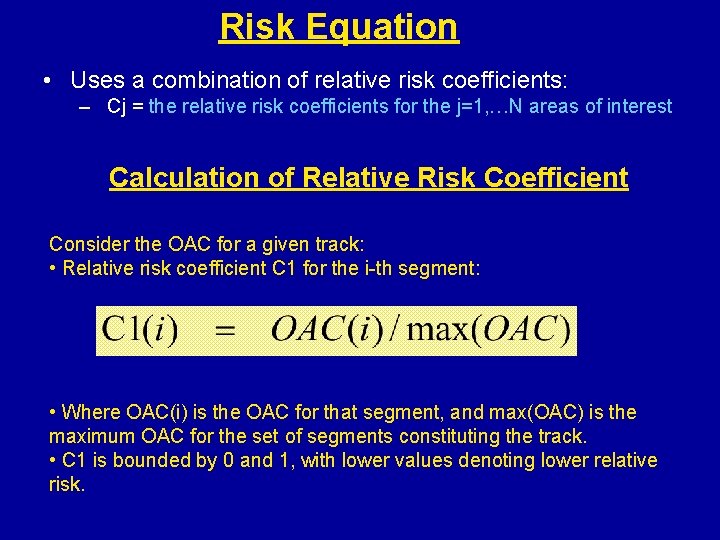
Risk Equation • Uses a combination of relative risk coefficients: – Cj = the relative risk coefficients for the j=1, …N areas of interest Calculation of Relative Risk Coefficient Consider the OAC for a given track: • Relative risk coefficient C 1 for the i-th segment: • Where OAC(i) is the OAC for that segment, and max(OAC) is the maximum OAC for the set of segments constituting the track. • C 1 is bounded by 0 and 1, with lower values denoting lower relative risk.
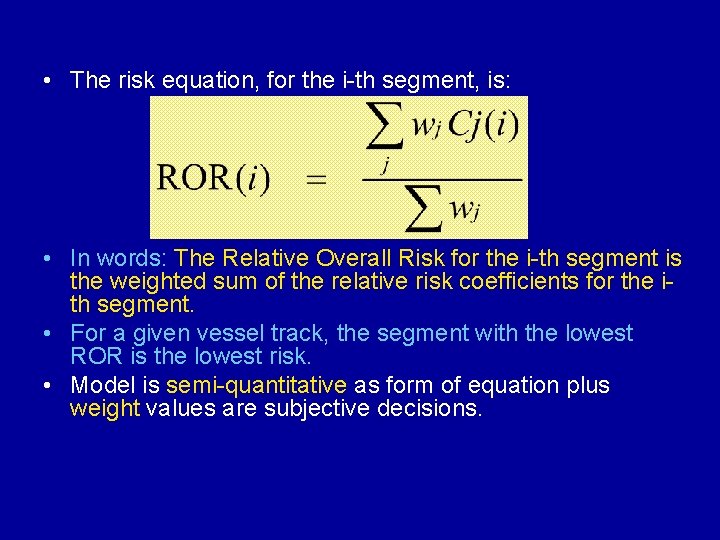
• The risk equation, for the i-th segment, is: • In words: The Relative Overall Risk for the i-th segment is the weighted sum of the relative risk coefficients for the ith segment. • For a given vessel track, the segment with the lowest ROR is the lowest risk. • Model is semi-quantitative as form of equation plus weight values are subjective decisions.
ASIDE: In Maritime Canada Offshelf area is the best place for BW exchange (by a factor ~10)
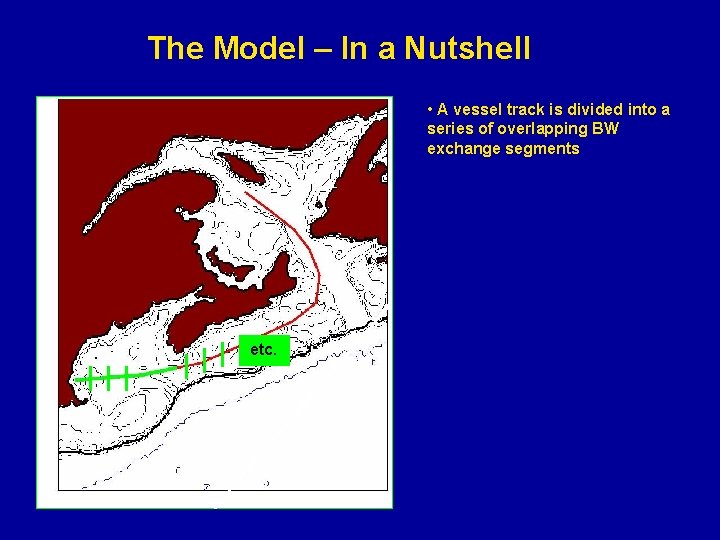
The Model – In a Nutshell • A vessel track is divided into a series of overlapping BW exchange segments etc.

For each segment a simulation of BW exchange is performed The Model: From properties of the dispersion field – determines the lowest risk segment in which to exchange BW along a vessel track
The risk assessment modelling system has been “operationalized” to provide realtime advice on the best area to exchange ballast water
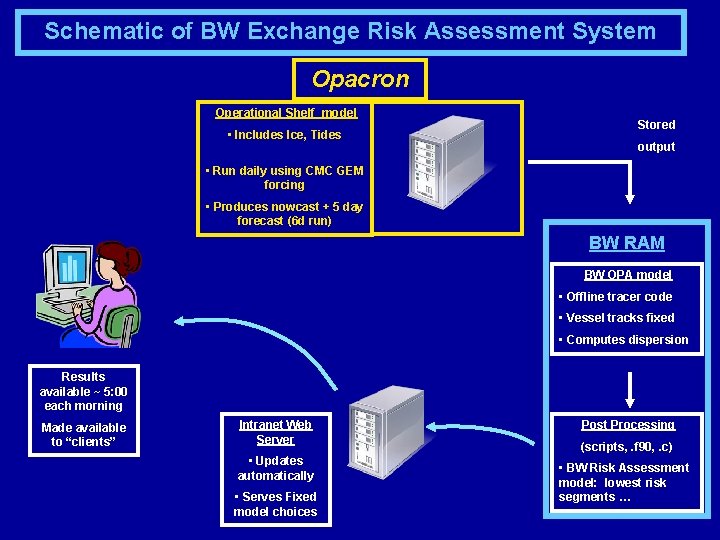
Schematic of BW Exchange Risk Assessment System Opacron Operational Shelf model • Includes Ice, Tides Stored output • Run daily using CMC GEM forcing • Produces nowcast + 5 day forecast (6 d run) BW RAM BW OPA model • Offline tracer code • Vessel tracks fixed • Computes dispersion Results available ~ 5: 00 each morning Made available to “clients” Intranet Web Server • Updates automatically • Serves Fixed model choices Post Processing (scripts, . f 90, . c) • BW Risk Assessment model: lowest risk segments …
Two main components • Opacron • BW RAM system
OPACRON • A “cron” job that runs (NEMO-)Opa = Opacron • Use GEM global forecast (automatic download): wind, air temperature, humidity, precipitation, cloud cover and pressure to create NEMO forcing for a 6 day ocean forecast • System designed to continue to operate in the event of “mishaps” but it is • NOT an OFFICIAL OPERATIONAL OCEAN MODEL • i. e. there is no 24/7 imperative • System has been used for police work, whale carcass tracking, SAR, … • We also run a demonstration BGCM on a daily basis

BW RAM System • Runs as a cron job after Opacron finishes • BW RAM = • offline tracer version of NEMO-OPA • uses a fixed set of vessel tracks • RAM is a post-processing script that computes lowest risk segment in which to exchange ballast water • Default model = segment with lowest OAC • Creates plots etc for website • Prepares results for “users”
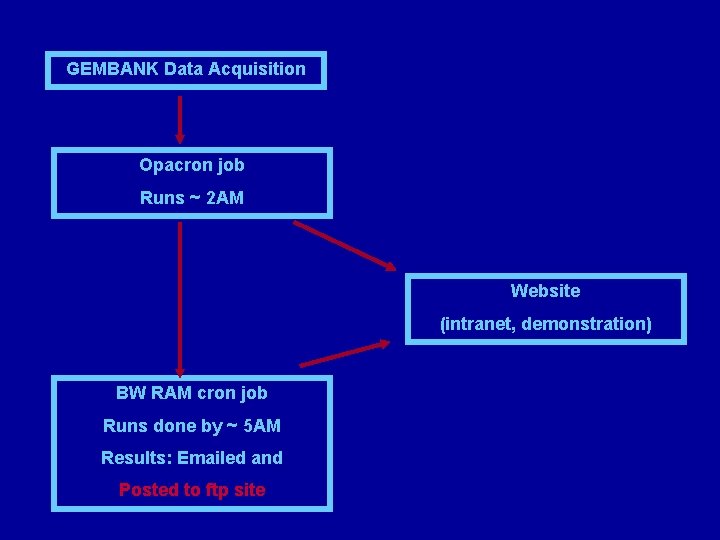
GEMBANK Data Acquisition Opacron job Runs ~ 2 AM Website (intranet, demonstration) BW RAM cron job Runs done by ~ 5 AM Results: Emailed and Posted to ftp site
ftp: //starfish. mar. dfo-mpo. gc. ca/pub/ocean/ballast_water NB: Works on your smartphone
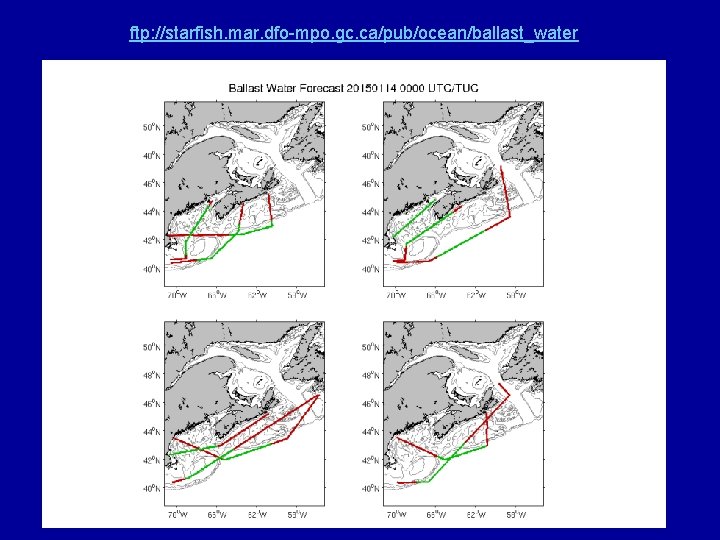
ftp: //starfish. mar. dfo-mpo. gc. ca/pub/ocean/ballast_water
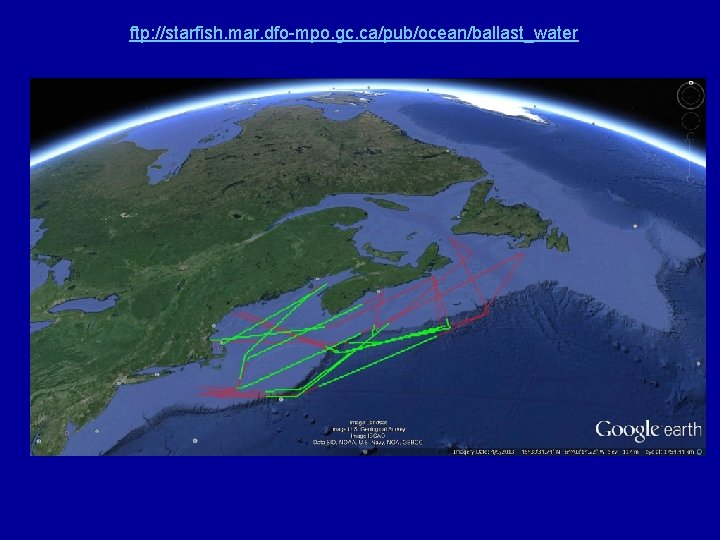
ftp: //starfish. mar. dfo-mpo. gc. ca/pub/ocean/ballast_water
END
Example of vessel traffic analysis
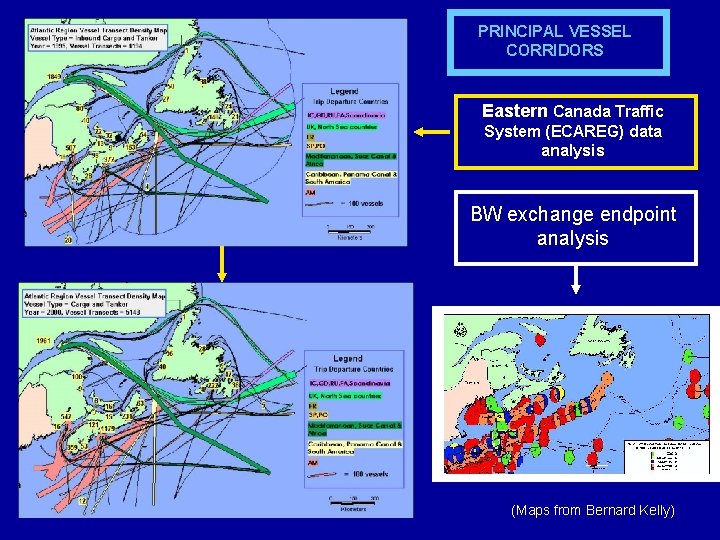
PRINCIPAL VESSEL CORRIDORS Eastern Canada Traffic System (ECAREG) data analysis BW exchange endpoint analysis (Maps from Bernard Kelly)
- Slides: 30