
Risk assessment is the process of evaluating a


- Slides: 17
Risk assessment is the process of evaluating a hazard to determine the level of action required to reduce a risk to an acceptable level. When evaluating the risks imposed by a hazard one should consider both the
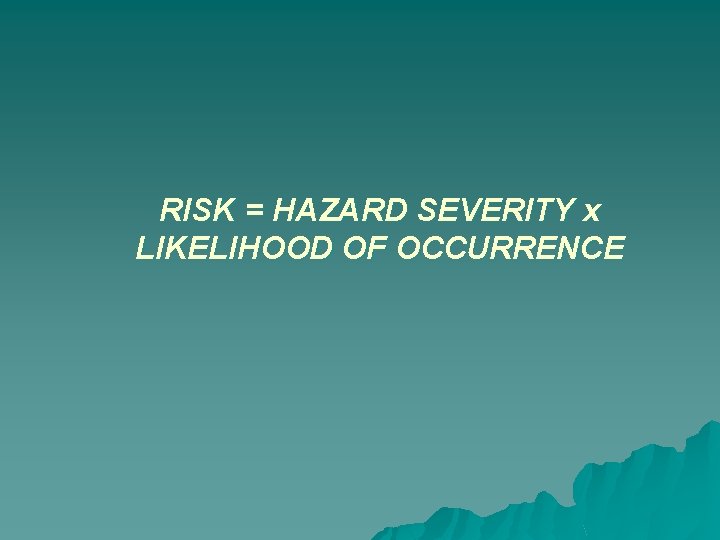
RISK = HAZARD SEVERITY x LIKELIHOOD OF OCCURRENCE
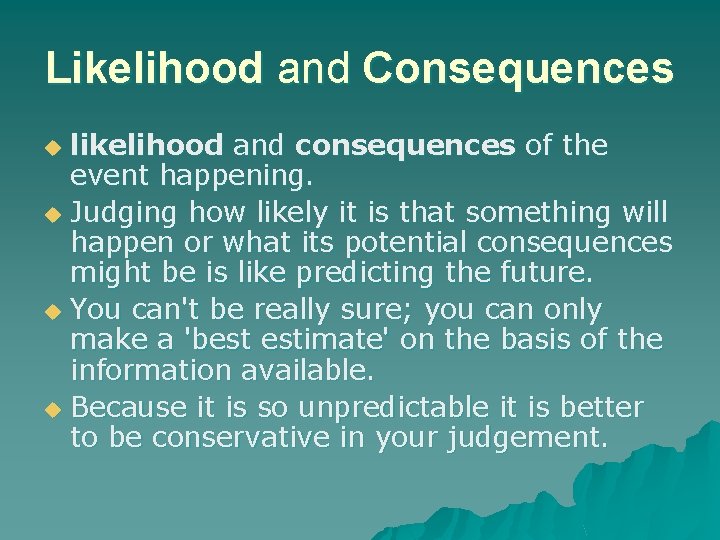
Likelihood and Consequences likelihood and consequences of the event happening. u Judging how likely it is that something will happen or what its potential consequences might be is like predicting the future. u You can't be really sure; you can only make a 'best estimate' on the basis of the information available. u Because it is so unpredictable it is better to be conservative in your judgement. u
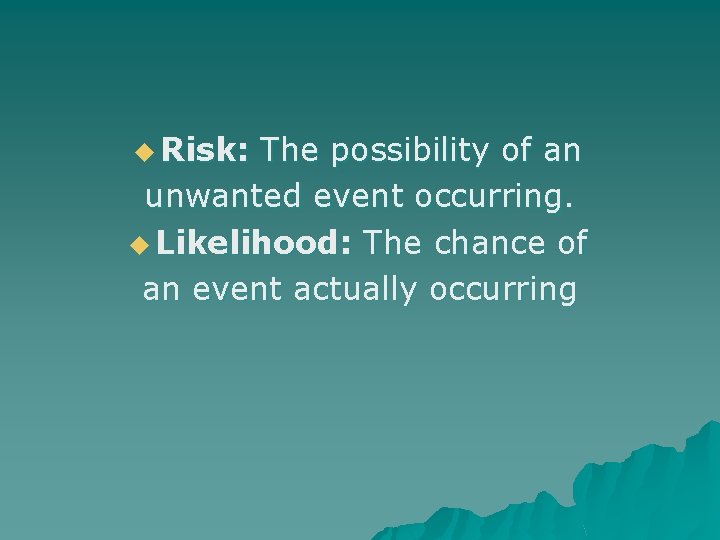
u Risk: The possibility of an unwanted event occurring. u Likelihood: The chance of an event actually occurring
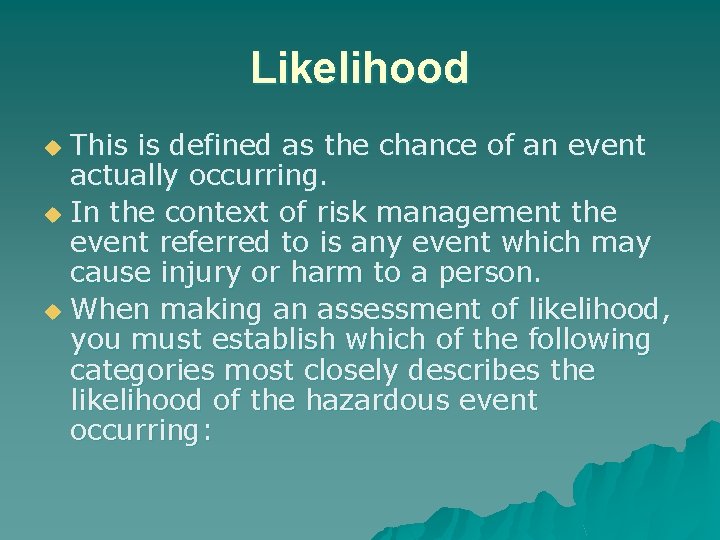
Likelihood This is defined as the chance of an event actually occurring. u In the context of risk management the event referred to is any event which may cause injury or harm to a person. u When making an assessment of likelihood, you must establish which of the following categories most closely describes the likelihood of the hazardous event occurring: u
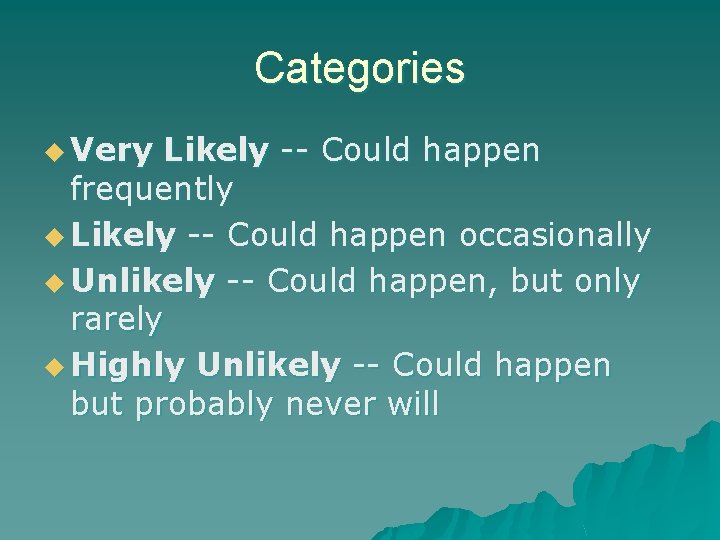
Categories u Very Likely -- Could happen frequently u Likely -- Could happen occasionally u Unlikely -- Could happen, but only rarely u Highly Unlikely -- Could happen but probably never will
Likelihood u When evaluating the likelihood of an accident, a factor that will modify the likelihood category, is exposure. u Exposure is a measure of how often or how long a person is actually exposed to a hazard. u Some examples are:
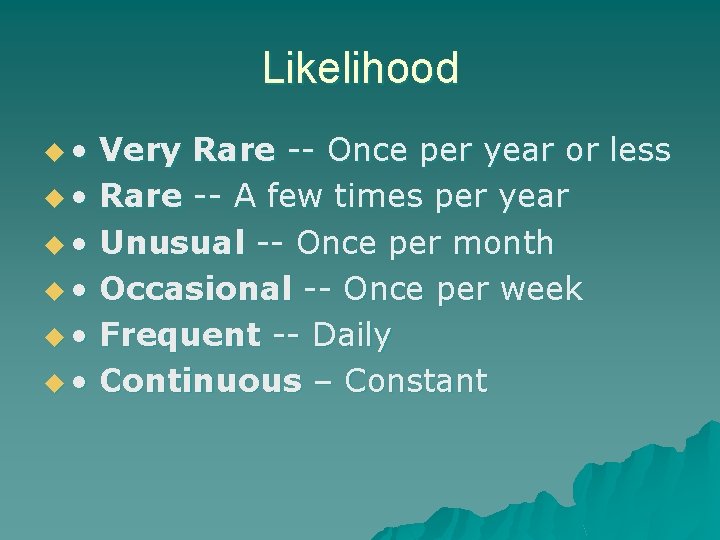
Likelihood u • u • u • Very Rare -- Once per year or less Rare -- A few times per year Unusual -- Once per month Occasional -- Once per week Frequent -- Daily Continuous – Constant
Common Mistake It is a common mistake to place too much emphasis on the mitigating effects of a low exposure level. u Just because a person is not exposed to a hazard very often, does not always mean we can take fewer precautions. u The certainty or likelihood of an accident happening is more important than how often a person is exposed to a hazard. u
Consequences u Consequence is a measure of the expected severity should an accident occur. u When assessing the consequences of an accident, the most severe category one could reasonably expect to result from that accident should be selected.
Categories The consequences of an event can be categorised as follows: u Major Injuries Normally irreversible injury or damage to health requiring extended time off work to effect best recovery. u Minor Injuries Typically a reversible injury or damage to health needing several days away from work to recover. u Recovery would be full and permanent. u Negligible Injuries
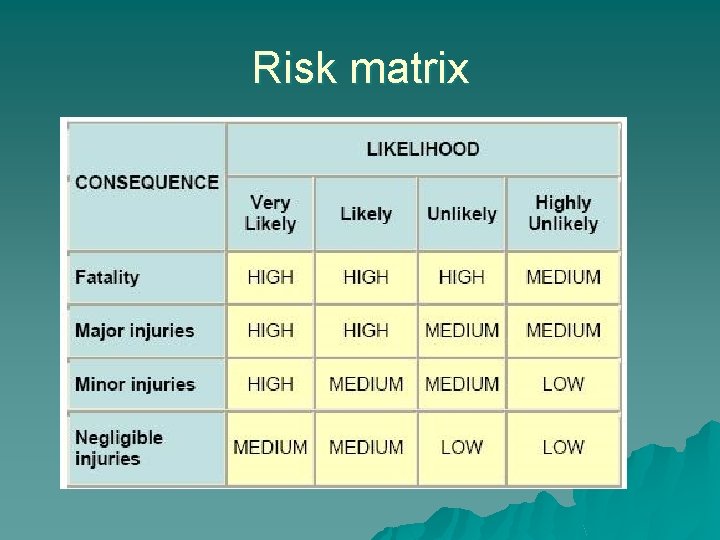
Negligible Injuries u u Negligible Injuries Would require first aid and may need the remainder of the work period or shift off before being able to return to work. If the position of the danger adds to the consequences in the event of an accident happening then the added consequences must be taken into consideration and the consequence rating increased. When making a risk assessment all aspects of likelihood and consequences should be taken into consideration. The interrelated parameters of likelihood and consequences can easily be presented on the simple matrix shown below.
3 Basic Risk Assessment If we consider the likelihood of an accident whilst driving a car and the consequences, statistically it is highly unlikely that we will have an accident and the worst consequence would be a fatality. u From the matrix below we can see that the risk is in the medium range which means that we make efforts to reduce the risk of an accident by such means as driver training, road management and vehicle design. u
Risk matrix
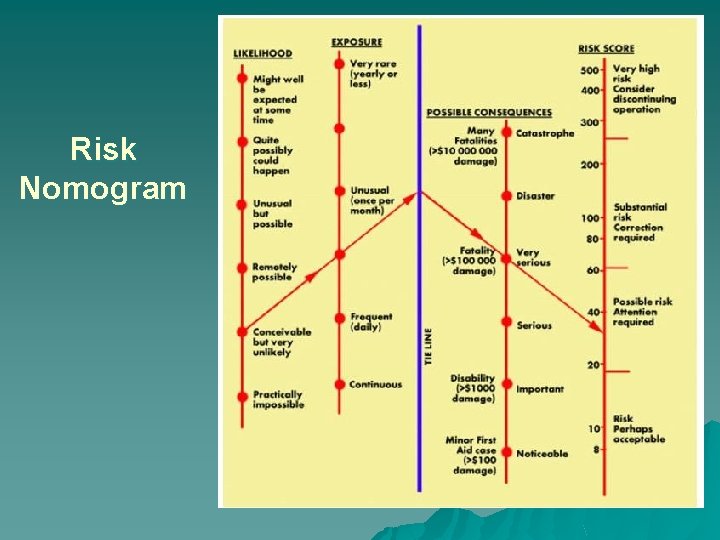
Risk Nomogram u 5. 4 A more complex nomogram for analysing risk and cost justifications was developed by the American Military and is shown below.
Risk Nomogram