
Risk Assessment in The Italian System for the
- Slides: 21
Risk Assessment in The Italian System for the Prevention of Corruption Laura Valli ANAC
The Anticorruption Law No 190/2012 § Article 6 of the United Nations Convention against Corruption: Ratified in 2009 and implemented it in 2012. In 2014 ANAC has been accredited in the Directory of the United Nations Office on Drugs and Crime (UNODC) as an independent national authority for the prevention of corruption. § Establishment of the National Anti-Corruption Authority (ANAC) Ø Political independence: ANAC’s president and board are appointed with a nonrenewable mandate of six years (not coinciding with the term of the legislature). The proposed nominations are approved by the Council of Ministers and the candidates are appointed by the President of the Republic Ø Financial independence: ANAC is funded with the contributions from the contracting authorities, the economic operators (national and foreign) and the Companies Certification Entities (SOA) for the verification of the general requirements of economic operators. ANAC’s mission is the prevention of corruption in public administrations, subsidiaries and state-controlled companies through the implementation of transparency, the supervision of public procurement and the orientation of the public employees’ behaviors by means of advisory, regulatory, monitoring and sanctioning powers
ANAC’s Mandate • Draft and implementation of the National Anticorruption Plan • Supervision on the adoption of the three-year Anticorruption Plans and Codes of Conduct by public administrations and state-controlled enterprises • Supervision on the appointment of the Officer for the Prevention of Corruption and Transparency by each public administration • Definition of publication standards for transparency purposes • Reception and management of whistleblowers’ reports • Sanction of entities in the event of failure to adopt the three -year plans and / or the Codes of Conduct
ANAC’s Functions § Monitoring power on the anti-corruption system, including through inspections that can be delegated to the financial police § Regulatory power through soft laws § Sanctioning power for failure to comply with obligations by public administrations § Supervisory power over public procurement
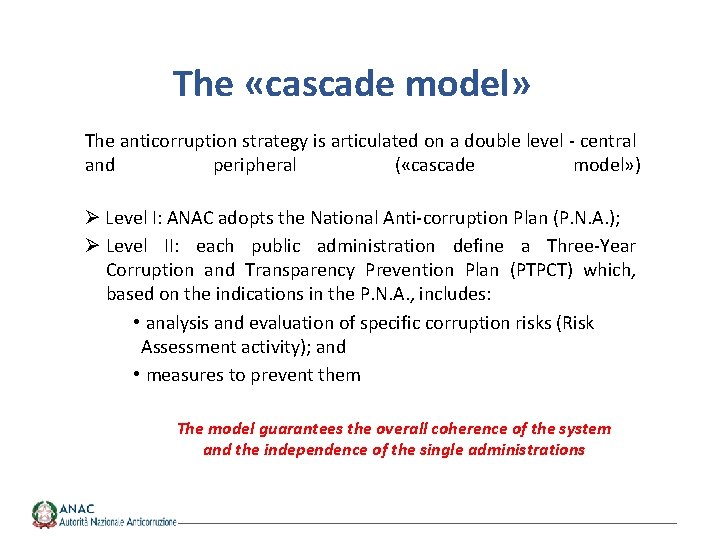
The «cascade model» The anticorruption strategy is articulated on a double level - central and peripheral ( «cascade model» ) Ø Level I: ANAC adopts the National Anti-corruption Plan (P. N. A. ); Ø Level II: each public administration define a Three-Year Corruption and Transparency Prevention Plan (PTPCT) which, based on the indications in the P. N. A. , includes: • analysis and evaluation of specific corruption risks (Risk Assessment activity); and • measures to prevent them The model guarantees the overall coherence of the system and the independence of the single administrations
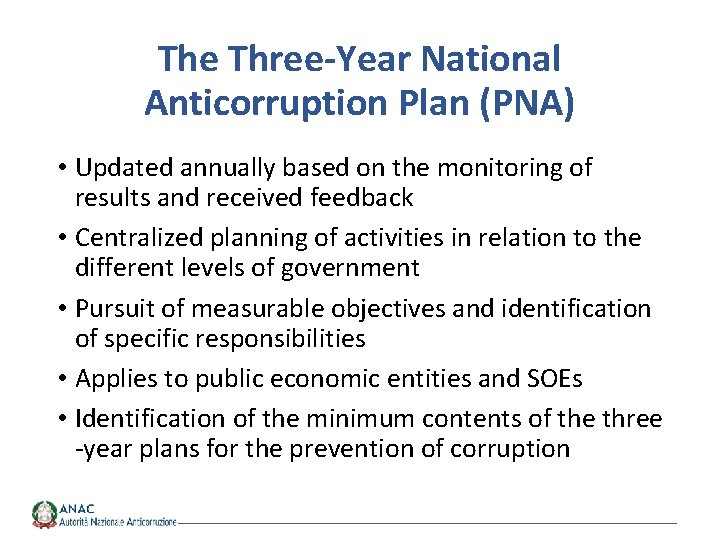
The Three-Year National Anticorruption Plan (PNA) • Updated annually based on the monitoring of results and received feedback • Centralized planning of activities in relation to the different levels of government • Pursuit of measurable objectives and identification of specific responsibilities • Applies to public economic entities and SOEs • Identification of the minimum contents of the three -year plans for the prevention of corruption
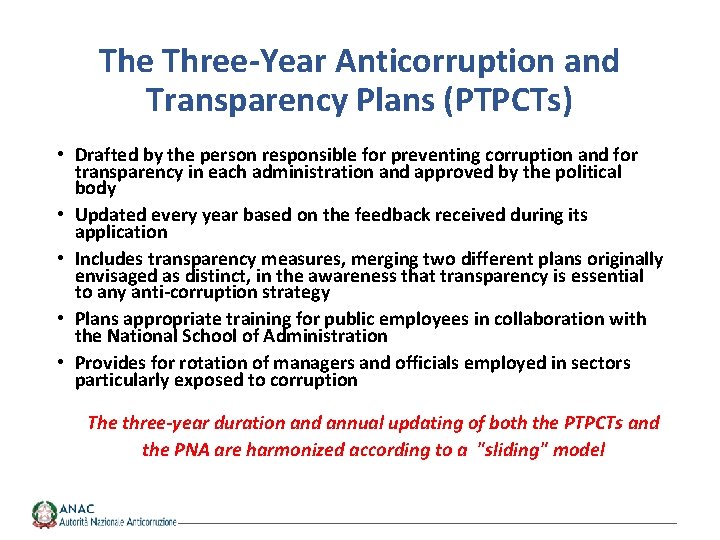
The Three-Year Anticorruption and Transparency Plans (PTPCTs) • Drafted by the person responsible for preventing corruption and for transparency in each administration and approved by the political body • Updated every year based on the feedback received during its application • Includes transparency measures, merging two different plans originally envisaged as distinct, in the awareness that transparency is essential to any anti-corruption strategy • Plans appropriate training for public employees in collaboration with the National School of Administration • Provides for rotation of managers and officials employed in sectors particularly exposed to corruption The three-year duration and annual updating of both the PTPCTs and the PNA are harmonized according to a "sliding" model
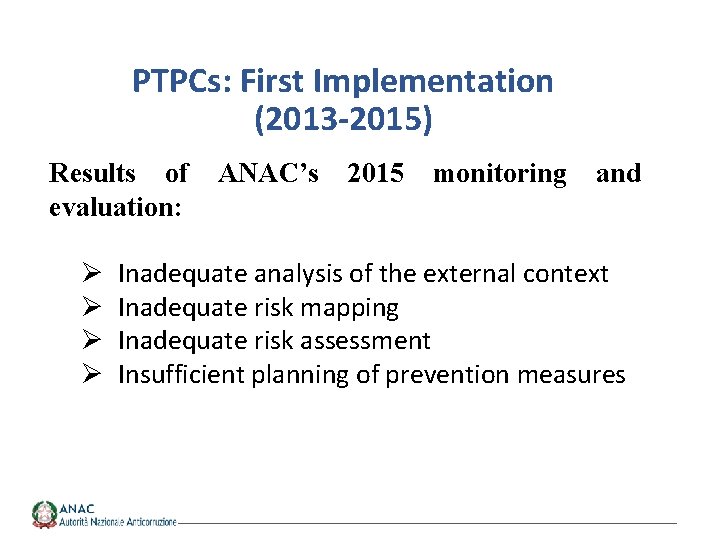
PTPCs: First Implementation (2013 -2015) Results of ANAC’s 2015 monitoring and evaluation: Ø Ø Inadequate analysis of the external context Inadequate risk mapping Inadequate risk assessment Insufficient planning of prevention measures
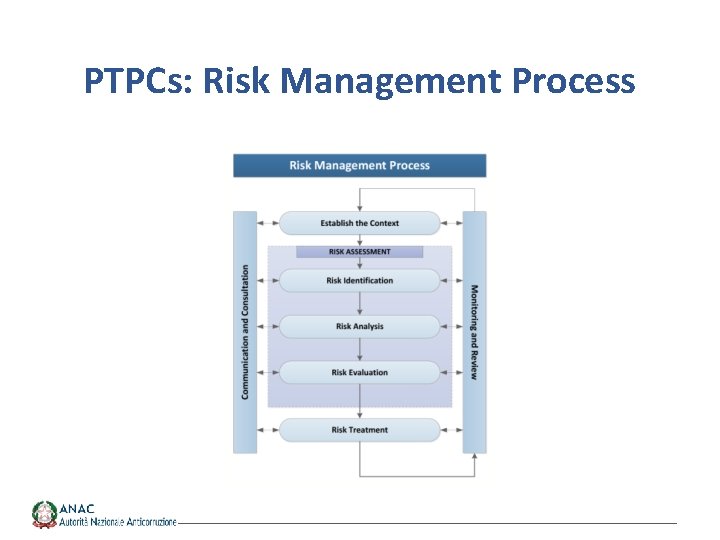
PTPCs: Risk Management Process
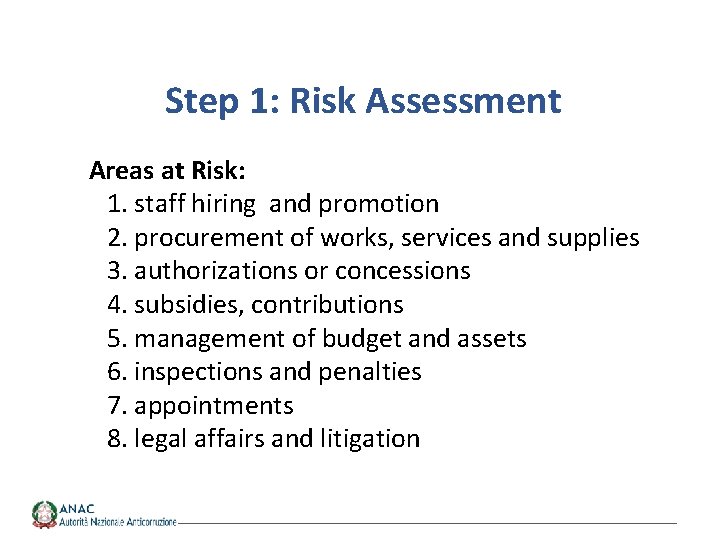
Step 1: Risk Assessment Areas at Risk: 1. staff hiring and promotion 2. procurement of works, services and supplies 3. authorizations or concessions 4. subsidies, contributions 5. management of budget and assets 6. inspections and penalties 7. appointments 8. legal affairs and litigation
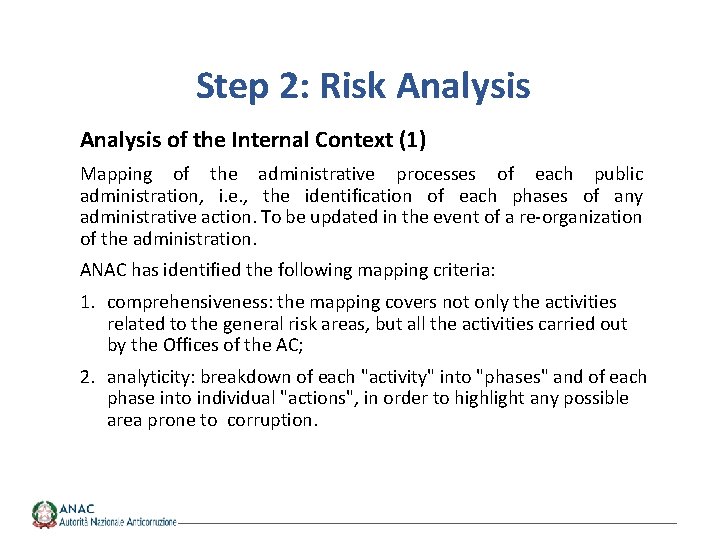
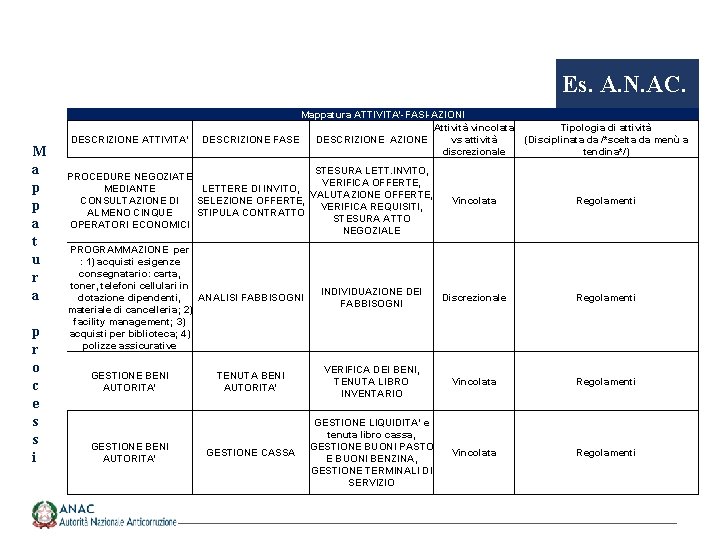
Step 2: Risk Analysis of the Internal Context (1) Mapping of the administrative processes of each public administration, i. e. , the identification of each phases of any administrative action. To be updated in the event of a re-organization of the administration. ANAC has identified the following mapping criteria: 1. comprehensiveness: the mapping covers not only the activities related to the general risk areas, but all the activities carried out by the Offices of the AC; 2. analyticity: breakdown of each "activity" into "phases" and of each phase into individual "actions", in order to highlight any possible area prone to corruption.
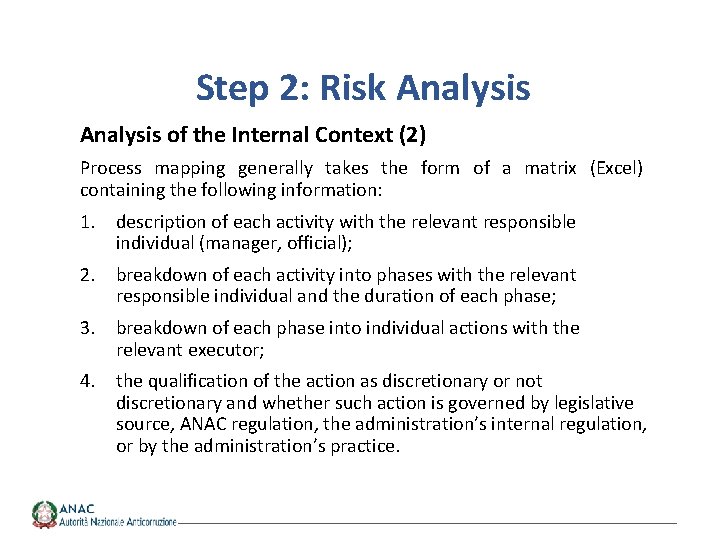
Step 2: Risk Analysis of the Internal Context (2) Process mapping generally takes the form of a matrix (Excel) containing the following information: 1. description of each activity with the relevant responsible individual (manager, official); 2. breakdown of each activity into phases with the relevant responsible individual and the duration of each phase; 3. breakdown of each phase into individual actions with the relevant executor; 4. the qualification of the action as discretionary or not discretionary and whether such action is governed by legislative source, ANAC regulation, the administration’s internal regulation, or by the administration’s practice.
Es. A. N. AC. M a p p a t u r a p r o c e s s i DESCRIZIONE ATTIVITA' Mappatura ATTIVITA'-FASI-AZIONI Attività vincolata DESCRIZIONE FASE DESCRIZIONE AZIONE vs attività discrezionale STESURA LETT. INVITO, PROCEDURE NEGOZIATE VERIFICA OFFERTE, MEDIANTE LETTERE DI INVITO, VALUTAZIONE OFFERTE, CONSULTAZIONE DI SELEZIONE OFFERTE, VERIFICA REQUISITI, ALMENO CINQUE STIPULA CONTRATTO STESURA ATTO OPERATORI ECONOMICI NEGOZIALE Vincolata Regolamenti INDIVIDUAZIONE DEI FABBISOGNI Discrezionale Regolamenti TENUTA BENI AUTORITA' VERIFICA DEI BENI, TENUTA LIBRO INVENTARIO Vincolata Regolamenti GESTIONE CASSA GESTIONE LIQUIDITA' e tenuta libro cassa, GESTIONE BUONI PASTO E BUONI BENZINA, GESTIONE TERMINALI DI SERVIZIO Vincolata Regolamenti PROGRAMMAZIONE per : 1) acquisti esigenze consegnatario: carta, toner, telefoni cellulari in dotazione dipendenti, ANALISI FABBISOGNI materiale di cancelleria; 2) facility management; 3) acquisti per biblioteca; 4) polizze assicurative GESTIONE BENI AUTORITA' Tipologia di attività (Disciplinata da /*scelta da menù a tendina*/)
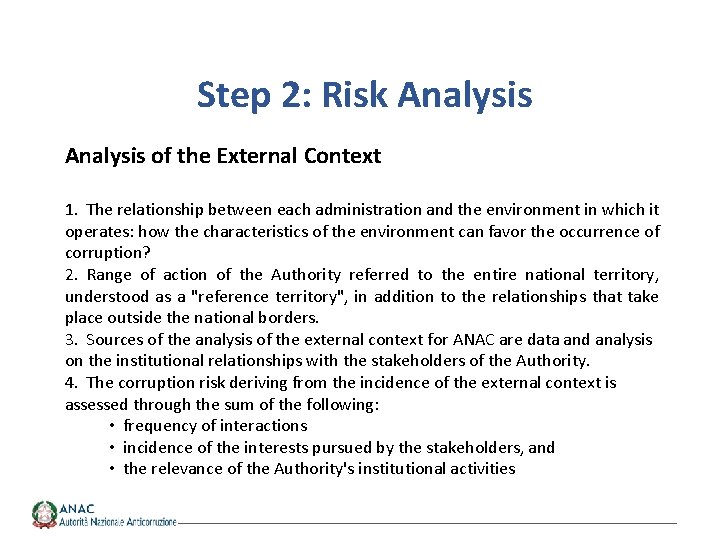
Step 2: Risk Analysis of the External Context 1. The relationship between each administration and the environment in which it operates: how the characteristics of the environment can favor the occurrence of corruption? 2. Range of action of the Authority referred to the entire national territory, understood as a "reference territory", in addition to the relationships that take place outside the national borders. 3. Sources of the analysis of the external context for ANAC are data and analysis on the institutional relationships with the stakeholders of the Authority. 4. The corruption risk deriving from the incidence of the external context is assessed through the sum of the following: • frequency of interactions • incidence of the interests pursued by the stakeholders, and • the relevance of the Authority's institutional activities
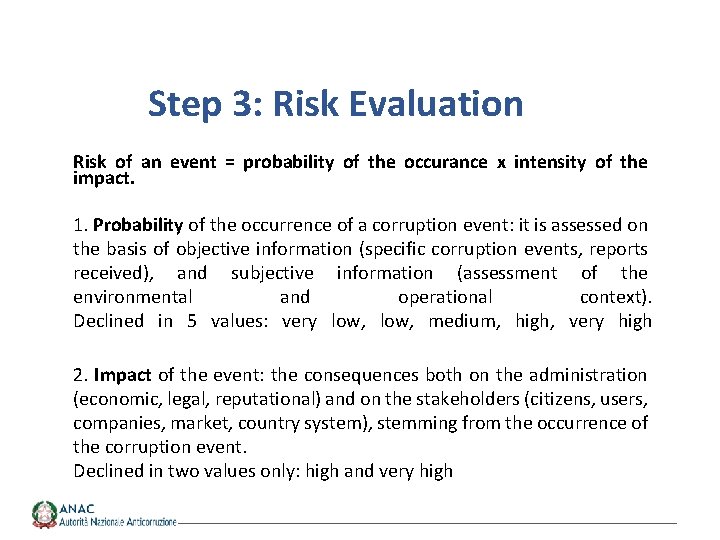
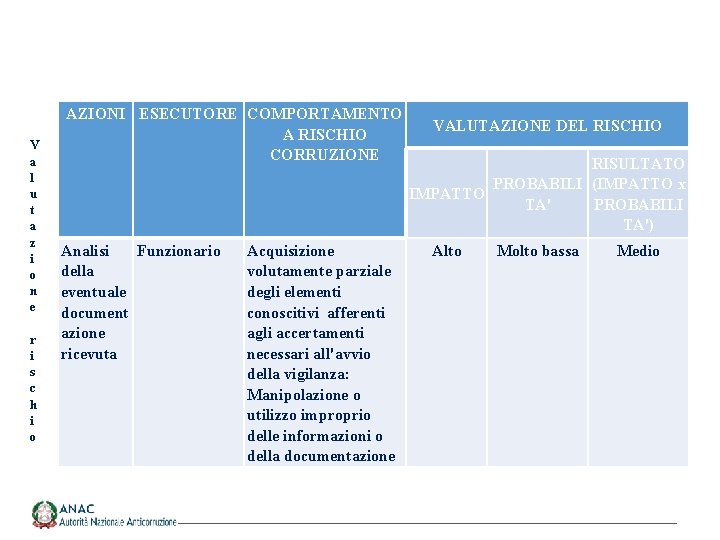
Step 3: Risk Evaluation Risk of an event = probability of the occurance x intensity of the impact. 1. Probability of the occurrence of a corruption event: it is assessed on the basis of objective information (specific corruption events, reports received), and subjective information (assessment of the environmental and operational context). Declined in 5 values: very low, medium, high, very high 2. Impact of the event: the consequences both on the administration (economic, legal, reputational) and on the stakeholders (citizens, users, companies, market, country system), stemming from the occurrence of the corruption event. Declined in two values only: high and very high
V a l u t a z i o n e r i s c h i o AZIONI ESECUTORE COMPORTAMENTO A RISCHIO CORRUZIONE Analisi Funzionario della eventuale document azione ricevuta Acquisizione volutamente parziale degli elementi conoscitivi afferenti agli accertamenti necessari all'avvio della vigilanza: Manipolazione o utilizzo improprio delle informazioni o della documentazione VALUTAZIONE DEL RISCHIO RISULTATO PROBABILI (IMPATTO x IMPATTO PROBABILI TA') Alto Molto bassa Medio
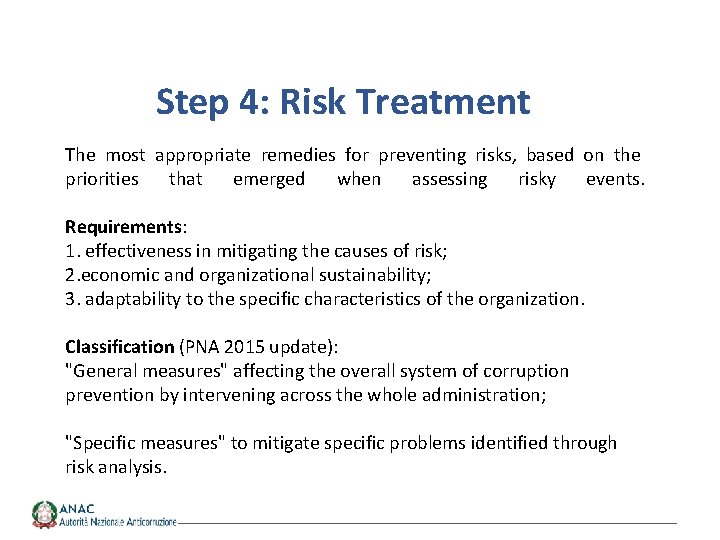
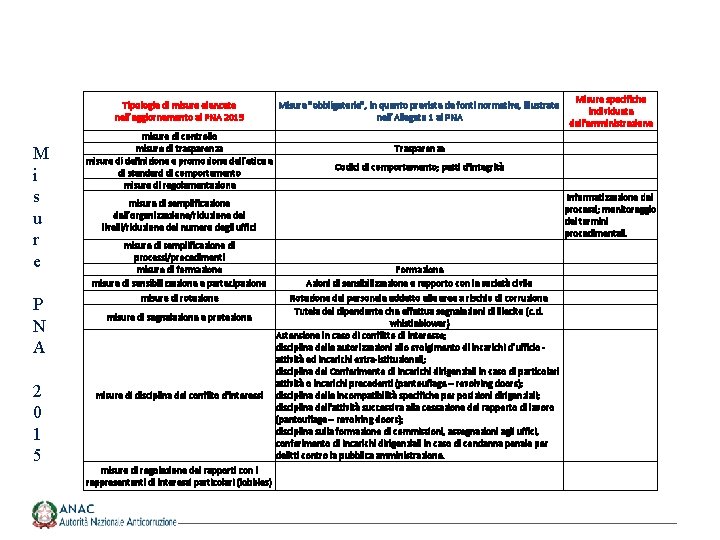
Step 4: Risk Treatment The most appropriate remedies for preventing risks, based on the priorities that emerged when assessing risky events. Requirements: 1. effectiveness in mitigating the causes of risk; 2. economic and organizational sustainability; 3. adaptability to the specific characteristics of the organization. Classification (PNA 2015 update): "General measures" affecting the overall system of corruption prevention by intervening across the whole administration; "Specific measures" to mitigate specific problems identified through risk analysis.
M i s u r e P N A 2 0 1 5 Tipologie di misure elencate nell’aggiornamento al PNA 2015 Misure "obbligatorie", in quanto previste da fonti normative, illustrate nell’Allegato 1 al PNA misure di controllo misure di trasparenza misure di definizione e promozione dell’etica e di standard di comportamento misure di regolamentazione Trasparenza misure di semplificazione dell’organizzazione/riduzione dei livelli/riduzione del numero degli uffici misure di semplificazione di processi/procedimenti misure di formazione misure di sensibilizzazione e partecipazione misure di rotazione misure di segnalazione e protezione misure di disciplina del conflito d'interessi misure di regolazione dei rapporti con i rappresentanti di interessi particolari (lobbies) Codici di comportamento; patti d'integrità Formazione Azioni di sensibilizzazione e rapporto con la società civile Rotazione del personale addetto alle aree a rischio di corruzione Tutela del dipendente che effettua segnalazioni di illecito (c. d. whistleblower) Astensione in caso di conflitto di interesse; disciplina delle autorizzazioni allo svolgimento di incarichi d’ufficio - attività ed incarichi extra-istituzionali; disciplina del Conferimento di incarichi dirigenziali in caso di particolari attività o incarichi precedenti (pantouflage – revolving doors); disciplina delle incompatibilità specifiche per posizioni dirigenziali; disciplina dell'attività successiva alla cessazione del rapporto di lavoro (pantouflage – revolving doors); disciplina sulla formazione di commissioni, assegnazioni agli uffici, conferimento di incarichi dirigenziali in caso di condanna penale per delitti contro la pubblica amministrazione. Misure specifiche individuate dall'amministrazione Informatizzazione dei processi; monitoraggio dei termini procedimentali.
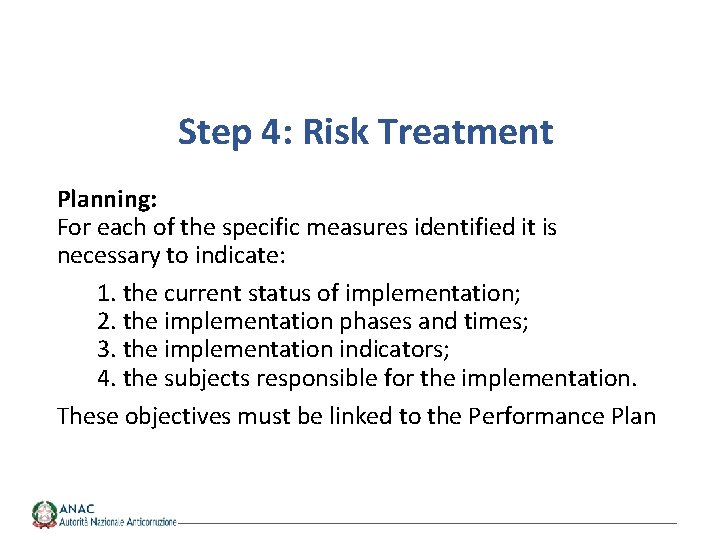
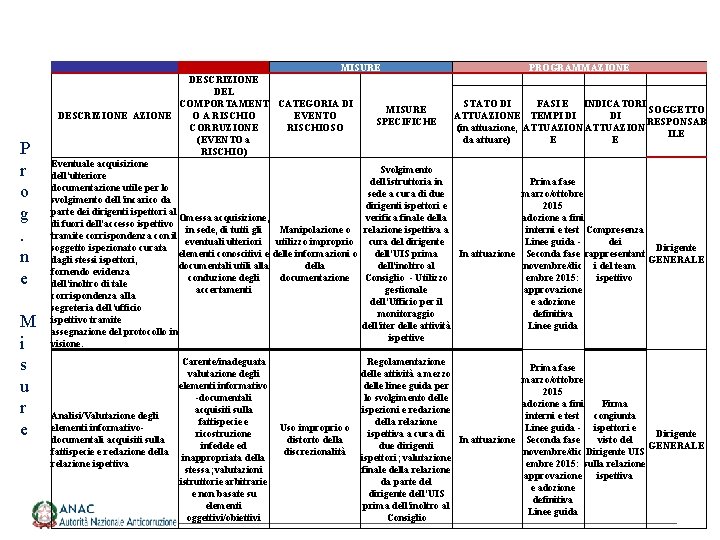
Step 4: Risk Treatment Planning: For each of the specific measures identified it is necessary to indicate: 1. the current status of implementation; 2. the implementation phases and times; 3. the implementation indicators; 4. the subjects responsible for the implementation. These objectives must be linked to the Performance Plan
P r o g. n e M i s u r e MISURE PROGRAMMAZIONE DESCRIZIONE DEL COMPORTAMENT CATEGORIA DI STATO DI FASI E INDICATORI MISURE SOGGETTO DESCRIZIONE AZIONE O A RISCHIO EVENTO ATTUAZIONE TEMPI DI DI SPECIFICHE RESPONSAB CORRUZIONE RISCHIOSO (in attuazione, ATTUAZION ILE (EVENTO a da attuare) E E RISCHIO) Eventuale acquisizione Svolgimento dell'ulteriore dell'istruttoria in Prima fase documentazione utile per lo sede a cura di due marzo/ottobre svolgimento dell’incarico da dirigenti ispettori e 2015 parte dei dirigenti ispettori al Omessa acquisizione, verifica finale della adozione a fini di fuori dell'accesso ispettivo in sede, di tutti gli Manipolazione o relazione ispettiva a interni e test Compresenza tramite corrispondenza con il eventuali ulteriori utilizzo improprio cura del dirigente Linee guida - dei soggetto ispezionato curata Dirigente elementi conoscitivi e delle informazioni o dell'UIS prima In attuazione Seconda fase rappresentant dagli stessi ispettori, GENERALE documentali utili alla dell'inoltro al novembre/dic i del team fornendo evidenza conduzione degli documentazione Consiglio - Utilizzo embre 2015: ispettivo dell'inoltro di tale accertamenti gestionale approvazione corrispondenza alla dell'Ufficio per il e adozione segreteria dell’ufficio monitoraggio definitiva ispettivo tramite dell'iter delle attività Linee guida assegnazione del protocollo in ispettive visione. Carente/inadeguata valutazione degli elementi informativo -documentali acquisiti sulla Analisi/Valutazione degli fattispecie e elementi informativoricostruzione documentali acquisiti sulla infedele ed fattispecie e redazione della inappropriata della relazione ispettiva stessa; valutazioni istruttorie arbitrarie e non basate su elementi oggettivi/obiettivi Regolamentazione Prima fase delle attività a mezzo marzo/ottobre delle linee guida per 2015 lo svolgimento delle adozione a fini Firma ispezioni e redazione interni e test congiunta della relazione Uso improprio o Linee guida - ispettori e ispettiva a cura di Dirigente distorto della In attuazione Seconda fase visto del due dirigenti GENERALE discrezionalità novembre/dic Dirigente UIS ispettori; valutazione embre 2015: sulla relazione finale della relazione approvazione ispettiva da parte del e adozione dirigente dell'UIS definitiva prima dell'inoltro al Linee guida Consiglio
Monitoring involves understanding the impact of the control mechanisms developed on the identified risks. Periodic monitoring must not be limited to the check on the correct implementation of a measure within the pre-established time frame. 1. recognition of all the specific measures indicated by the offices, in order to correct any inconsistencies in the application of some measures; 2. identification for each mitigating measures in the matrix of the implementation indicator and the status of implementation according to schedule. 3. reformulation of implementation indicators, in order to make them more consistent with the used methodology.