
Risk Assessment in Life Insurance Tel Aviv November
Risk Assessment in Life Insurance Tel Aviv, November 23 rd, 2010 Thorsten Keil

Contents Risks in Life Insurance What is the Best Estimate? Use of the Best Estimate under Solvency II Requirements on Best Estimate calculation How to derive Best Estimate assumptions Personal risk factors Product related risk factors Calculation of Best Estimate Obstacles on the way to Best Estimate Diversification of life risks under Solvency II Conclusion Risk Assessment in Life Insurance November 23 rd, 2010, Thorsten Keil 2

Risks in Life Insurance
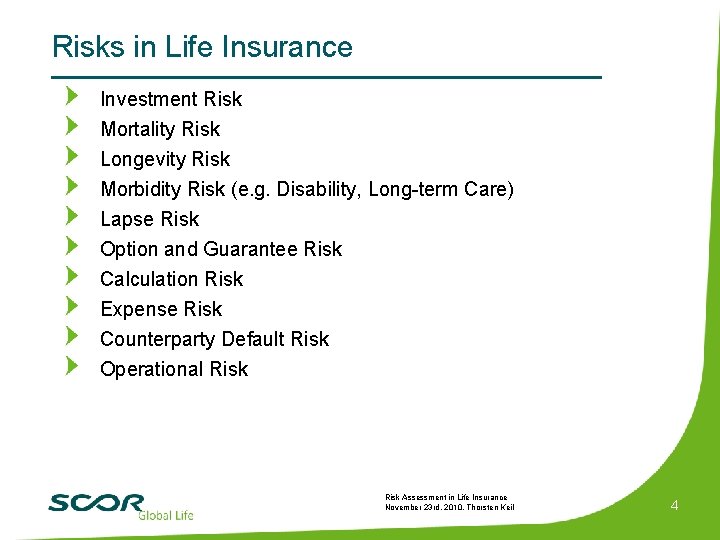
Risks in Life Insurance Investment Risk Mortality Risk Longevity Risk Morbidity Risk (e. g. Disability, Long-term Care) Lapse Risk Option and Guarantee Risk Calculation Risk Expense Risk Counterparty Default Risk Operational Risk Assessment in Life Insurance November 23 rd, 2010, Thorsten Keil 4

Risks in Life Insurance Results of QIS 4: According to QIS 4 technical specifications the market risk (resp. equity and interest risk) dominate by far the Basic Solvency Capital Required (BSCR) of European Life insurance companies Source: CEIOPS Risk Assessment in Life Insurance November 23 rd, 2010, Thorsten Keil 5
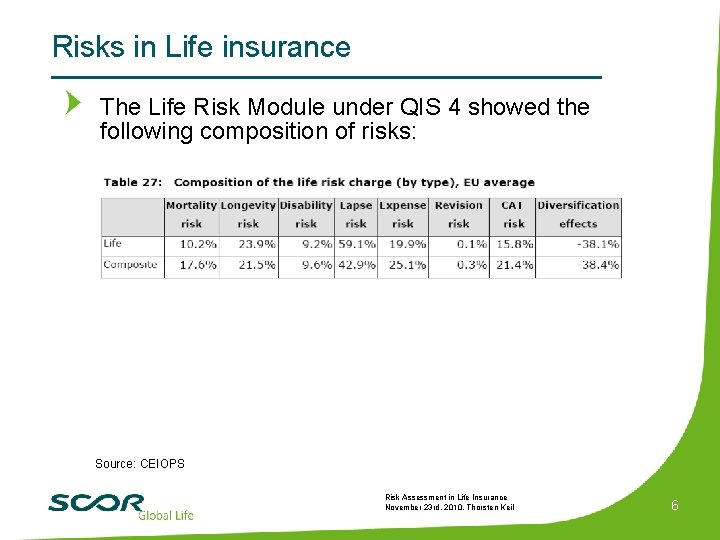
Risks in Life insurance The Life Risk Module under QIS 4 showed the following composition of risks: Source: CEIOPS Risk Assessment in Life Insurance November 23 rd, 2010, Thorsten Keil 6

What is the Best Estimate?
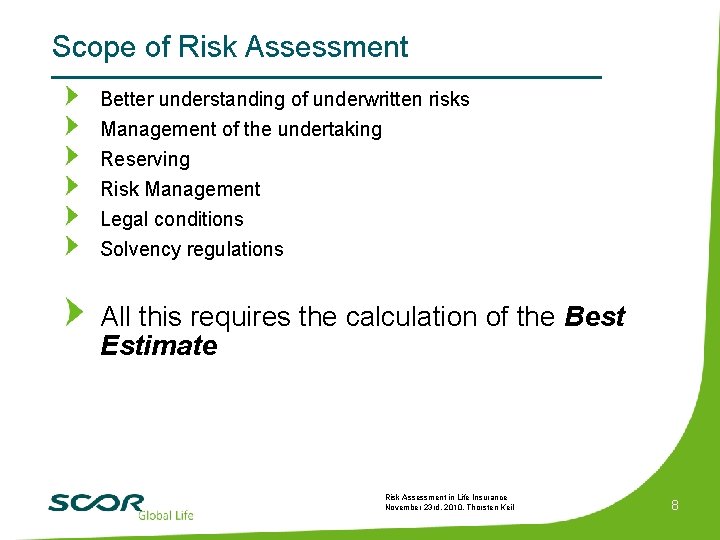
Scope of Risk Assessment Better understanding of underwritten risks Management of the undertaking Reserving Risk Management Legal conditions Solvency regulations All this requires the calculation of the Best Estimate Risk Assessment in Life Insurance November 23 rd, 2010, Thorsten Keil 8

What is the Best Estimate? Ø Best estimation of an expected value Ø E. g. present value of future cash flows between policyholder and insurance company The best estimate can be defined as an appropriate estimation of the expected value of a certain value excluding any margins – especially security margins – based on actual available information. Risk Assessment in Life Insurance November 23 rd, 2010, Thorsten Keil 9
What is the Best Estimate? Ø Projections of the cash flows without risk margin Ø Appropriate projection period Ø Use of known parameters and expected changes, e. g. Ø Contractual premiums and benefits of the current portfolio Ø Expenses Ø Mortality rates and trends Risk Assessment in Life Insurance November 23 rd, 2010, Thorsten Keil 10
Provisions under IAS 37 Ø Measurement of Provisions according to Best Estimate Ø IASB requires a prudent calculation of Provisions. An overestimation of provisions should be avoided since this is a contradiction to the market consistent evaluation (no security margins). Ø If the effect from interest rates is significant, IAS 37 also requires the calculation of the present value of Best Estimate. Ø Please note: There‘s a huge difference between Provisions (the insurer already has an obligation) and Contingent Liabilities (possible obligation) under IAS 37 Risk Assessment in Life Insurance November 23 rd, 2010, Thorsten Keil 11
Main focus of Best Estimate calculation Ø Property / Casualty Insurance Ø Main focus of calculation on reserves Ø Economic approach for IBNR calculation Ø Life insurance Ø Cash Flow Projections based on Best Estimate basis of calculation (e. g. qx, ix) Risk Assessment in Life Insurance November 23 rd, 2010, Thorsten Keil 12
Use of Best Estimate under Solvency II
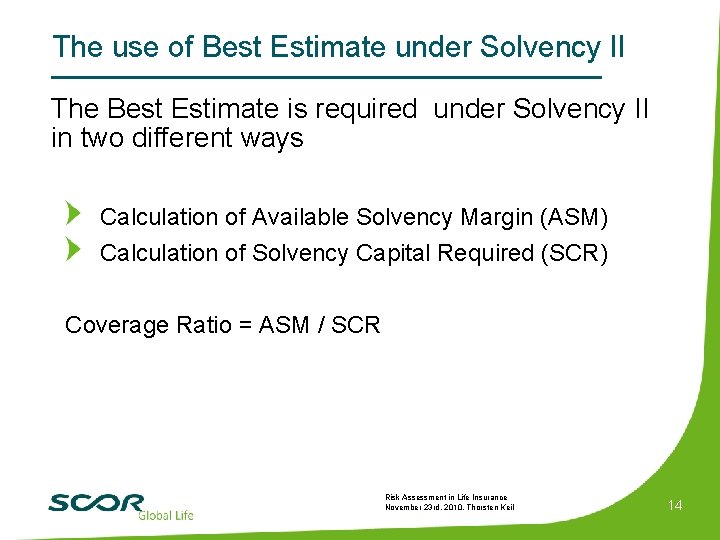
The use of Best Estimate under Solvency II The Best Estimate is required under Solvency II in two different ways Calculation of Available Solvency Margin (ASM) Calculation of Solvency Capital Required (SCR) Coverage Ratio = ASM / SCR Risk Assessment in Life Insurance November 23 rd, 2010, Thorsten Keil 14

The use of Best Estimate under Solvency II Res. Q 3. 4 ECONOMIC BALANCE SHEET Assets Liabilities Ineligible capital Tier 3 Available Capital Free Surplus Tier 2 Tier 1 Solvency Capital Requirement (SCR) MCR Minimum Capital Requirement Risk Margin Assets covering technical provisions Technical Provisions Best Estimate Other Liabilities Risk Assessment in Life Insurance November 23 rd, 2010, Thorsten Keil 15
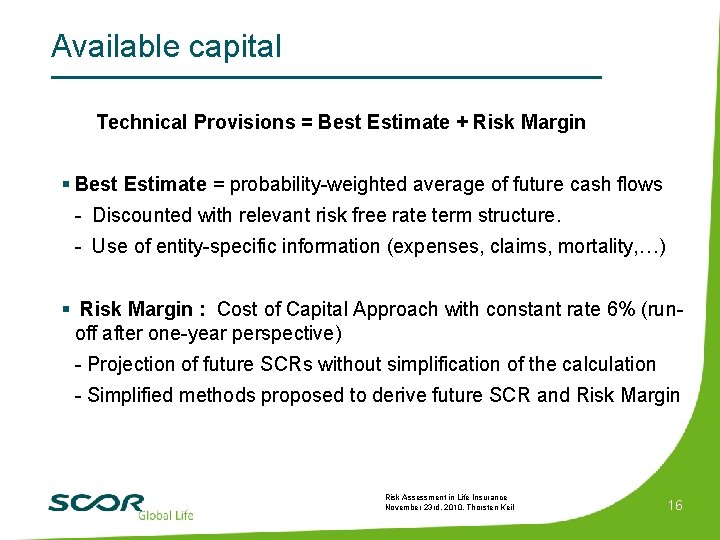
Res. Q 3. 4 Available capital Technical Provisions = Best Estimate + Risk Margin § Best Estimate = probability-weighted average of future cash flows - Discounted with relevant risk free rate term structure. - Use of entity-specific information (expenses, claims, mortality, …) § Risk Margin : Cost of Capital Approach with constant rate 6% (runoff after one-year perspective) - Projection of future SCRs without simplification of the calculation - Simplified methods proposed to derive future SCR and Risk Margin Risk Assessment in Life Insurance November 23 rd, 2010, Thorsten Keil 16
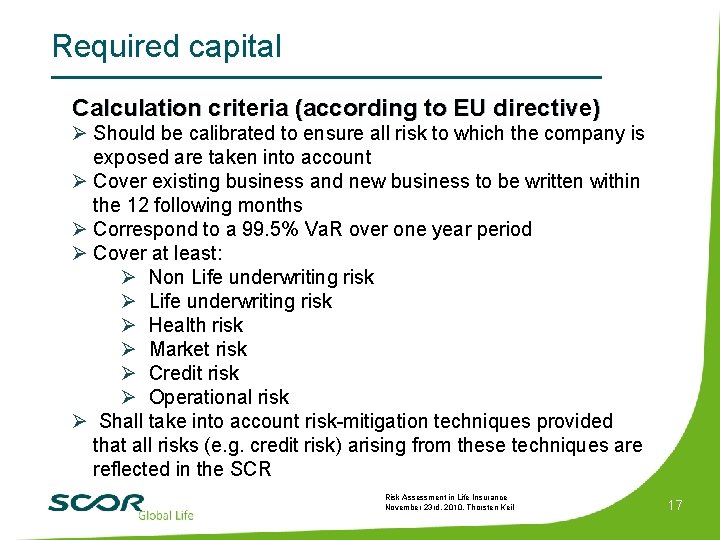
Required capital Calculation criteria (according to EU directive) Ø Should be calibrated to ensure all risk to which the company is exposed are taken into account Ø Cover existing business and new business to be written within the 12 following months Ø Correspond to a 99. 5% Va. R over one year period Ø Cover at least: Ø Non Life underwriting risk Ø Health risk Ø Market risk Ø Credit risk Ø Operational risk Ø Shall take into account risk-mitigation techniques provided that all risks (e. g. credit risk) arising from these techniques are reflected in the SCR Risk Assessment in Life Insurance November 23 rd, 2010, Thorsten Keil 17
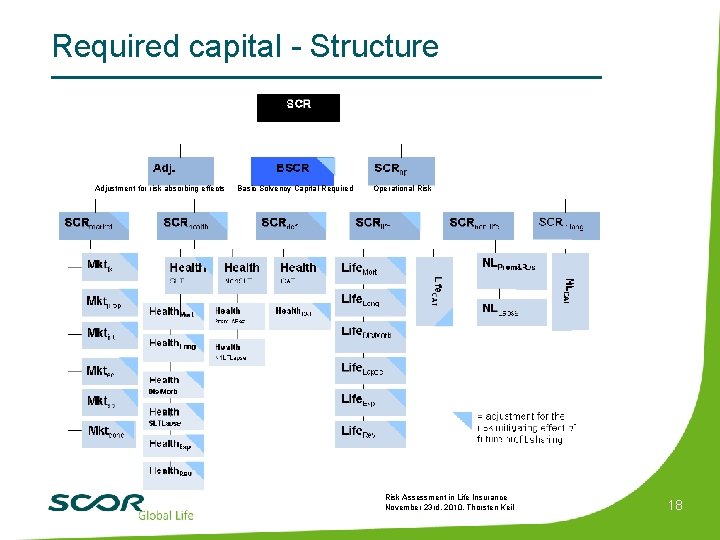
Required capital - Structure Adjustment for risk absorbing effects Basic Solvency Capital Required Operational Risk Assessment in Life Insurance November 23 rd, 2010, Thorsten Keil 18
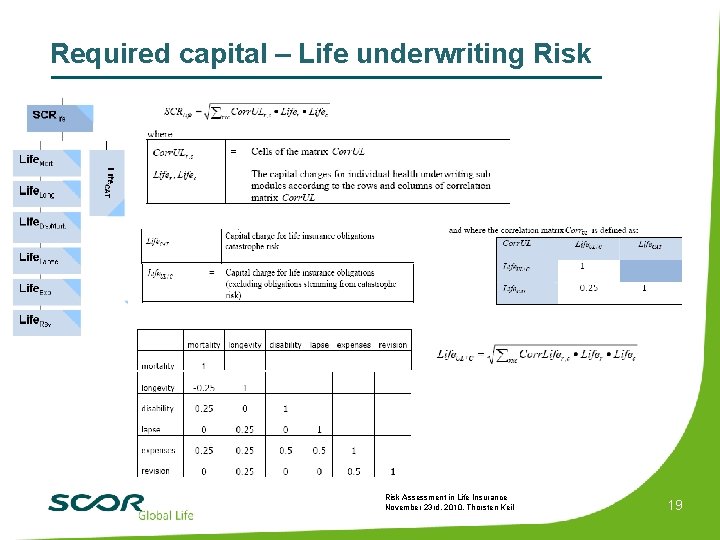
Required capital – Life underwriting Risk Assessment in Life Insurance November 23 rd, 2010, Thorsten Keil 19
Requirements on Best Estimate calculation
Best Estimate calculation for … Balance sheet or P&L positions: Ø Premium income Ø Reserves Ø Claims Ø Lapses Ø Guarantees Ø Options Target: Calculation of future profits resp. losses Risk Assessment in Life Insurance November 23 rd, 2010, Thorsten Keil 21
Requirements on Best Estimate calculation Ø (If possible) for each basis of calculation a best estimate is necessary Ø The calculation should always be based on company specific estimations Ø The actuary has to use common and accepted actuarial methods Ø The appropriateness of the assumption has to be provable Ø The underlying data have to be checked and adjusted regularly Risk Assessment in Life Insurance November 23 rd, 2010, Thorsten Keil 22
2 nd order basis of calculation for Best Estimate Ø Age Ø Gender Ø Socio-economic factors, such as ØProfession / Education ØSmoking habits Ø Product features ØOptions and guarantees ØLapse and surrender rules ØDistribution channel Risk Assessment in Life Insurance November 23 rd, 2010, Thorsten Keil 23
Evaluation of options and guarantees Ø Contractual client‘s options ØLapse with or without surrender value ØWaiver of Premium ØLump sum payment for deferred annuities Risk Assessment in Life Insurance November 23 rd, 2010, Thorsten Keil 24

How to derive Best Estimate assumptions
How to derive Best Estimate assumptions In order to derive appropriate basis of calculation the following steps are required: 1. Comprehensive portfolio analysis for achieving detailed company specific data 2. Segmentation of portfolio into homogenous groups of risks 3. Definition of determining risk factors 4. Calculation of raw probabilities 5. Deriving of Best Estimate rates from raw data Risk Assessment in Life Insurance November 23 rd, 2010, Thorsten Keil 26
Portfolio Analysis Portfolio structure / Distribution of Ø Tariffs Ø Insurance periods Ø Age and gender of insured persons Ø Sum insured Contractual guarantees Ø Option for lump sum payments (deferred annuities) Ø Cancellation rights Ø Indexations (risk increase) Risk Assessment in Life Insurance November 23 rd, 2010, Thorsten Keil 27
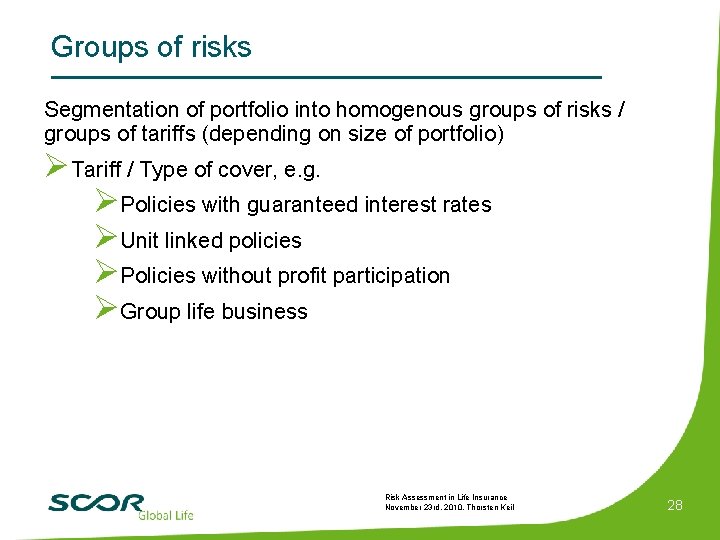
Groups of risks Segmentation of portfolio into homogenous groups of risks / groups of tariffs (depending on size of portfolio) ØTariff / Type of cover, e. g. ØPolicies with guaranteed interest rates ØUnit linked policies ØPolicies without profit participation ØGroup life business Risk Assessment in Life Insurance November 23 rd, 2010, Thorsten Keil 28
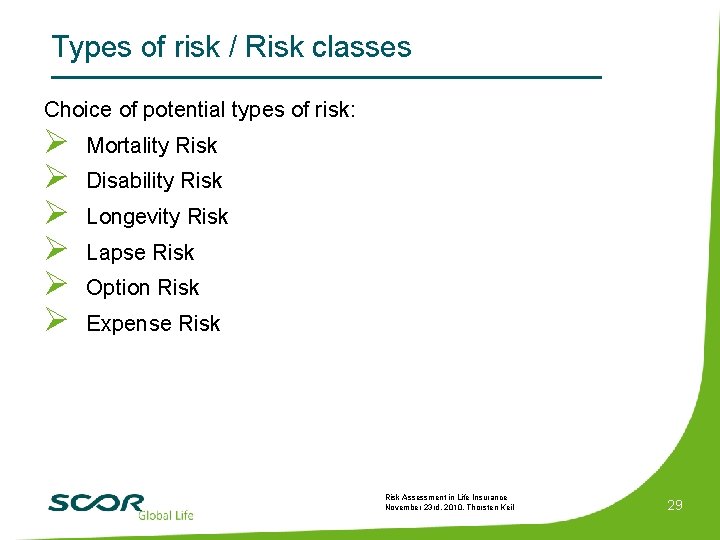
Types of risk / Risk classes Choice of potential types of risk: Ø Ø Ø Mortality Risk Disability Risk Longevity Risk Lapse Risk Option Risk Expense Risk Assessment in Life Insurance November 23 rd, 2010, Thorsten Keil 29

Personal risk factors
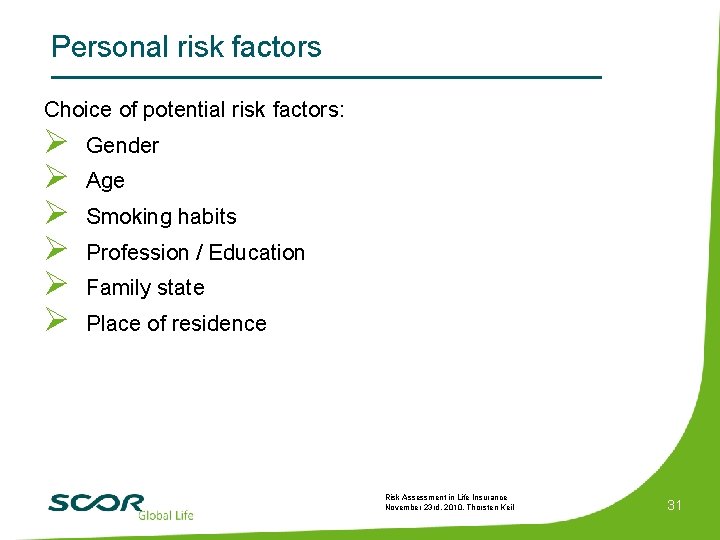
Personal risk factors Choice of potential risk factors: Ø Ø Ø Gender Age Smoking habits Profession / Education Family state Place of residence Risk Assessment in Life Insurance November 23 rd, 2010, Thorsten Keil 31
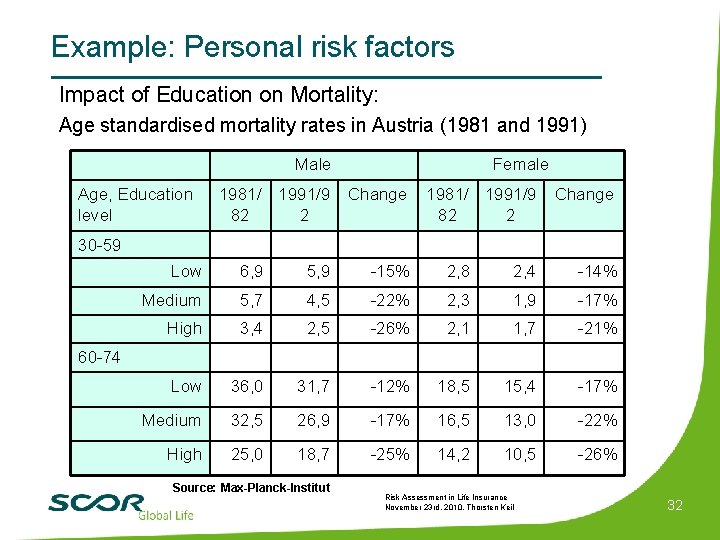
Example: Personal risk factors Impact of Education on Mortality: Age standardised mortality rates in Austria (1981 and 1991) Male Age, Education level 1981/ 1991/9 82 2 Female Change 1981/ 1991/9 82 2 Change 30 -59 Low 6, 9 5, 9 -15% 2, 8 2, 4 -14% Medium 5, 7 4, 5 -22% 2, 3 1, 9 -17% High 3, 4 2, 5 -26% 2, 1 1, 7 -21% Low 36, 0 31, 7 -12% 18, 5 15, 4 -17% Medium 32, 5 26, 9 -17% 16, 5 13, 0 -22% High 25, 0 18, 7 -25% 14, 2 10, 5 -26% 60 -74 Source: Max-Planck-Institut Risk Assessment in Life Insurance November 23 rd, 2010, Thorsten Keil 32
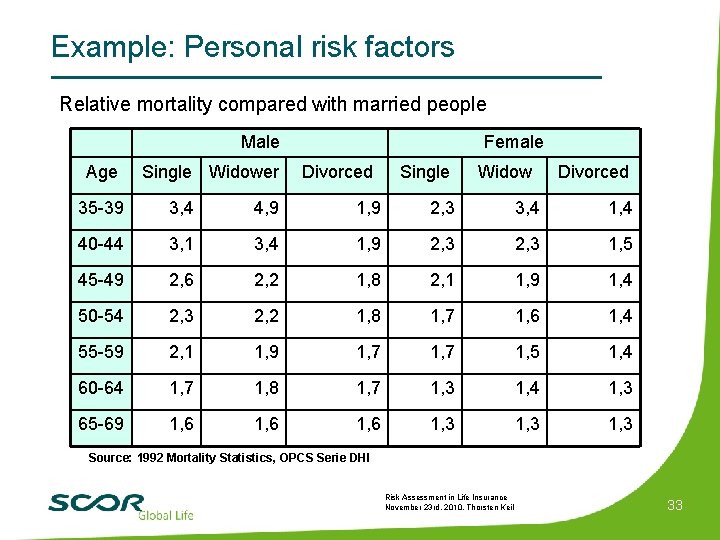
Example: Personal risk factors Relative mortality compared with married people Male Age Single Widower Female Divorced Single Widow Divorced 35 -39 3, 4 4, 9 1, 9 2, 3 3, 4 1, 4 40 -44 3, 1 3, 4 1, 9 2, 3 1, 5 45 -49 2, 6 2, 2 1, 8 2, 1 1, 9 1, 4 50 -54 2, 3 2, 2 1, 8 1, 7 1, 6 1, 4 55 -59 2, 1 1, 9 1, 7 1, 5 1, 4 60 -64 1, 7 1, 8 1, 7 1, 3 1, 4 1, 3 65 -69 1, 6 1, 3 Source: 1992 Mortality Statistics, OPCS Serie DHI Risk Assessment in Life Insurance November 23 rd, 2010, Thorsten Keil 33
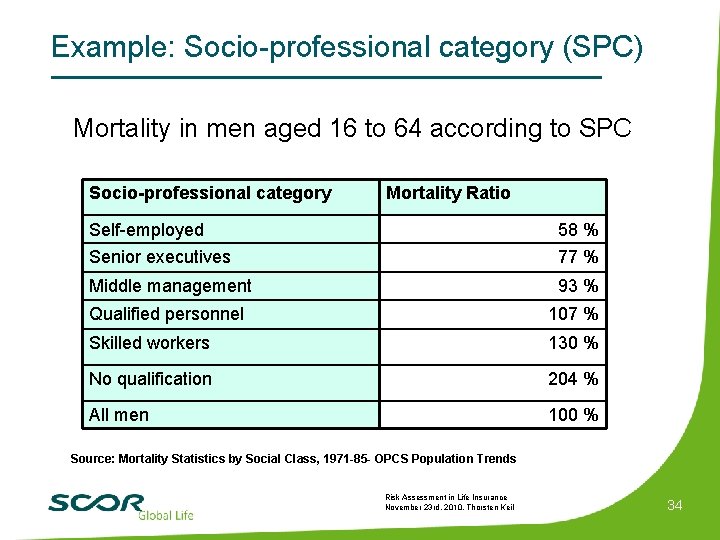
Example: Socio-professional category (SPC) Mortality in men aged 16 to 64 according to SPC Socio-professional category Mortality Ratio Self-employed 58 % Senior executives 77 % Middle management 93 % Qualified personnel 107 % Skilled workers 130 % No qualification 204 % All men 100 % Source: Mortality Statistics by Social Class, 1971 -85 - OPCS Population Trends Risk Assessment in Life Insurance November 23 rd, 2010, Thorsten Keil 34
Product related risk factors
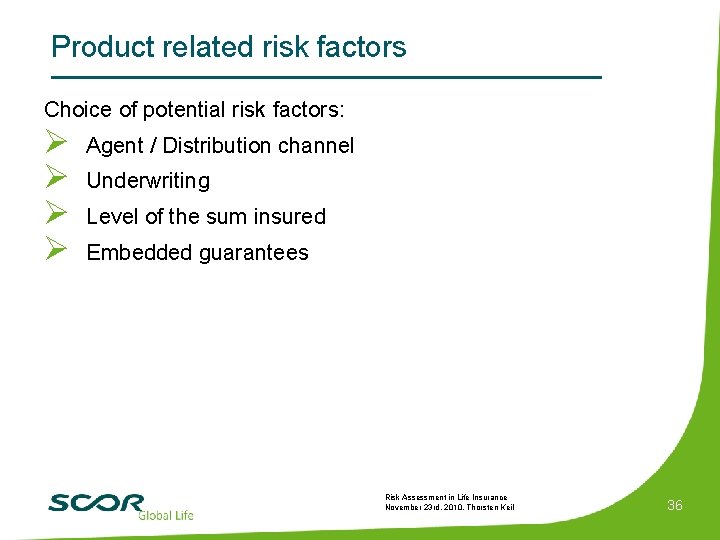
Product related risk factors Choice of potential risk factors: Ø Ø Agent / Distribution channel Underwriting Level of the sum insured Embedded guarantees Risk Assessment in Life Insurance November 23 rd, 2010, Thorsten Keil 36
Example: Product related risk factors Agent / Distribution channel: Ø Analysis from several markets show an increased lapse rate from life insurance policies that were sold via brokers or pyramid sales forces Ø Reduced lapse risk for policies that were sold by direct selling companies or bankassurance Ø Lapse rate increases within policy period (early lapses) Risk Assessment in Life Insurance November 23 rd, 2010, Thorsten Keil 37
Example: Product related risk factors Medical underwriting: Ø Significant selection effect by medical underwriting within first years of policy period Ø Decreasing effect within first five years – afterwards average mortality rate Risk Assessment in Life Insurance November 23 rd, 2010, Thorsten Keil 38
Example: Product related risk factors Level of sum insured: Ø In many portfolios a lower mortality rate for people with higher sums assured can be recognized Ø Positive effect on term insurances Ø Negative effect on annuity portfolios Ø Negative effect on disability insurances with a high sum insured compared with net income Risk Assessment in Life Insurance November 23 rd, 2010, Thorsten Keil 39
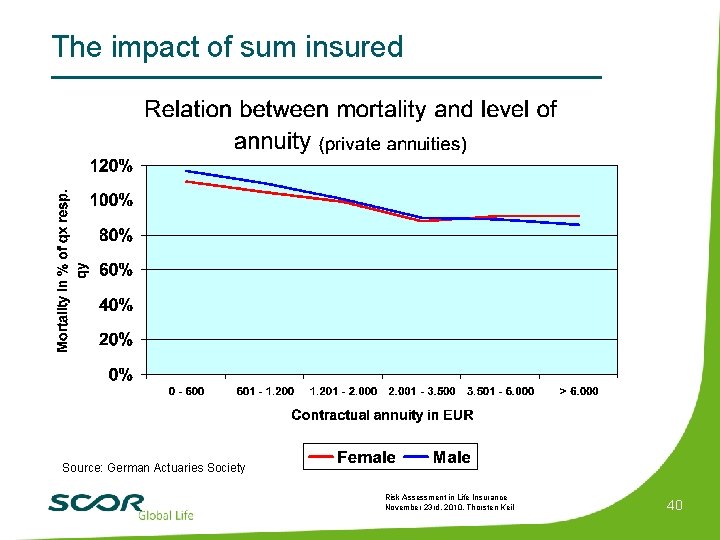
The impact of sum insured Source: German Actuaries Society Risk Assessment in Life Insurance November 23 rd, 2010, Thorsten Keil 40
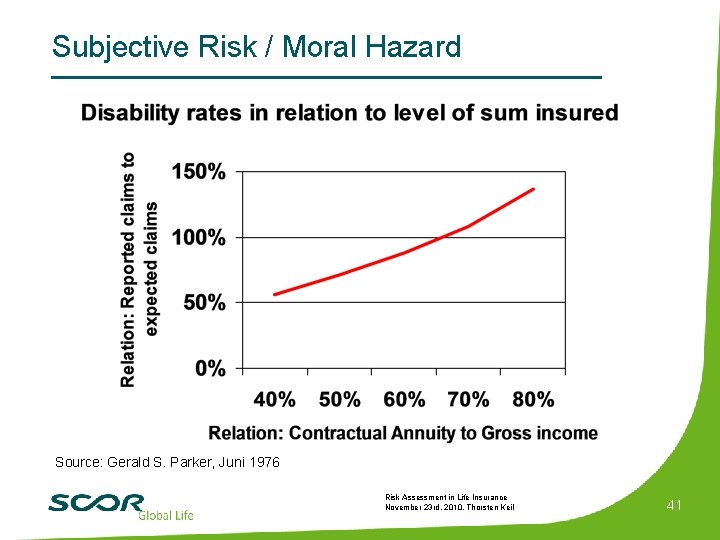
Subjective Risk / Moral Hazard Source: Gerald S. Parker, Juni 1976 Risk Assessment in Life Insurance November 23 rd, 2010, Thorsten Keil 41
Example: Product related risk factors Embedded guarantees: Ø Indexation option (e. g. in case of marriage, birth of a child, …) Ø Up to now rarely taken Ø Option for lump sum payment (instead of an annuity) Ø Cancellation right (Surrender) Ø Depends on legal and fiscal environment Ø Lapse rate depends strongly on economic environment Risk Assessment in Life Insurance November 23 rd, 2010, Thorsten Keil 42
Raw Best Estimate Rates Calculation of raw Best Estimate data Ø Mortality ØMortality trends ØAnnuities ØTerm insurances Ø Morbidity Ø Surrender behaviour (company specific) ØSurrender ØWaiver of Premium Ø Opting for annuity or lump sum payment Risk Assessment in Life Insurance November 23 rd, 2010, Thorsten Keil 43
Raw Best Estimate Rates Key question: Which length the observation period should have? Ø The observation period should not be too long since changes in legislation, taxation or policy conditions might lead to distortions Ø According to experience a period of up to 5 years is reasonable Ø But: In order to evaluate mortality trends a longer period should be considered (e. g. 20 years) Risk Assessment in Life Insurance November 23 rd, 2010, Thorsten Keil 44
Best Estimate Rates The derivation of Best Estimate Rates from raw data should be done by actuarial processes, e. g. Ø Smoothing Ø Extrapolation Ø Benchmarking with reference tables Risk Assessment in Life Insurance November 23 rd, 2010, Thorsten Keil 45

Calculation of Best Estimate
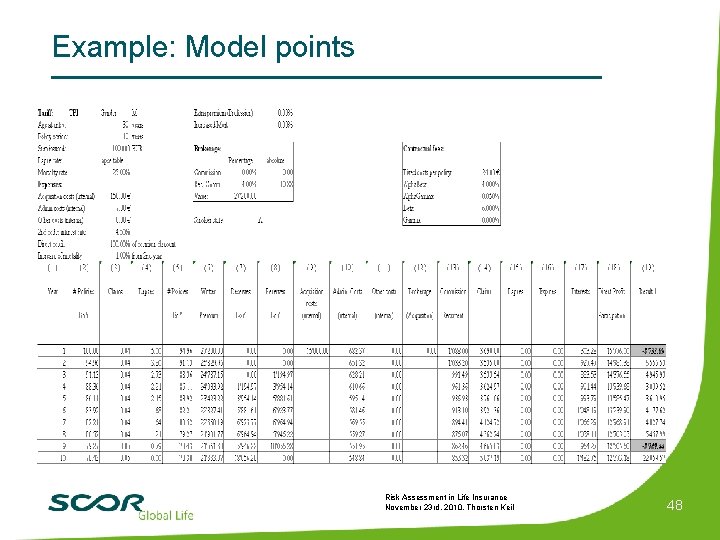
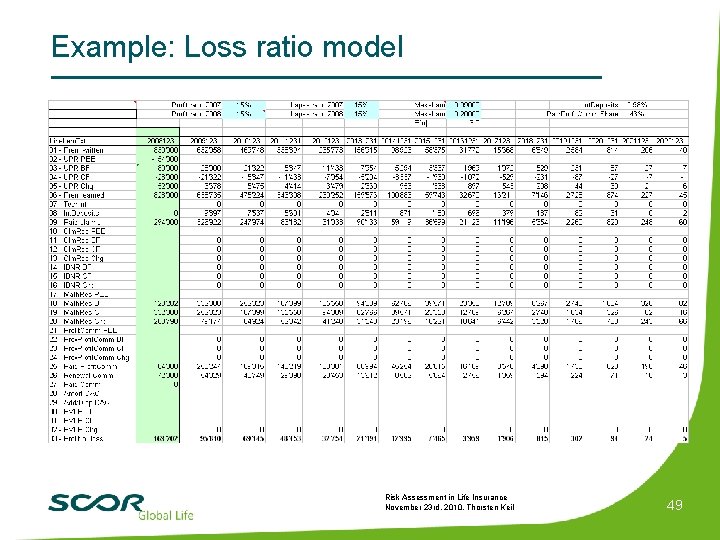
Performance of Cash Flow Projections Ø Policy by policy Ø Very extensive and comprehensive calculation Ø Model Points Ø Building blocks of business, if risks and results don‘t get falsified. Ø Loss ratio models Ø In case of weak portfolio information also a loss ratio model can be considered Ø Separated calculation for profit participation and reinsurance Ø Buffer effect of profit participation Ø Risk mitigation by reinsurance Risk Assessment in Life Insurance November 23 rd, 2010, Thorsten Keil 47
Example: Model points Risk Assessment in Life Insurance November 23 rd, 2010, Thorsten Keil 48
Example: Loss ratio model Risk Assessment in Life Insurance November 23 rd, 2010, Thorsten Keil 49
Performance of Cash Flow Projections Ø In order to calculate the Best Estimate both, a deterministic or a stochastic approach is possible, but Ø Evaluation of options and guarantees only possible with stochastic simulations Ø Basic idea: The difference between stochastic and deterministic calculation shows the value of options and guarantees Ø Life insurers seem to prefer deterministic calculations since also the basic idea of life insurance techniques is deterministic Risk Assessment in Life Insurance November 23 rd, 2010, Thorsten Keil 50
Calculation of Present Value Ø Once all Best Estimate values of future years are available, one has to discount them Ø Which yield curve should be used? Ø Risk free interest rate, since Best Estimate does not allow for additional margins ØBased on government bonds ØSwap curve Ø If available: same period for both, interests and Best Estimate values Ø Congruency of currencies Risk Assessment in Life Insurance November 23 rd, 2010, Thorsten Keil 51

Obstacles on the way to best estimate
Obstacles on the way to Best Estimate Ø Inadequate data quality Ø Missing company specific 2 nd order basis of calculation due to Ø Small sub-portfolios Ø Poor historical data Ø Public available basis of calculation can only be used under certain circumstances Ø Proof of adequacy of basis of calculation Risk Assessment in Life Insurance November 23 rd, 2010, Thorsten Keil 53
Obstacles on the way to Best Estimate Ø Time and effort of the calculations should be in a reasonable relation to the portfolio size Ø If necessary refer to available data from insurance associations, actuarial societies or reinsurers Risk Assessment in Life Insurance November 23 rd, 2010, Thorsten Keil 54
Diversification of life risks under Solvency II
Diversification of risks under Solvency II Mortality and longevity Risk Assessment in Life Insurance November 23 rd, 2010, Thorsten Keil 56
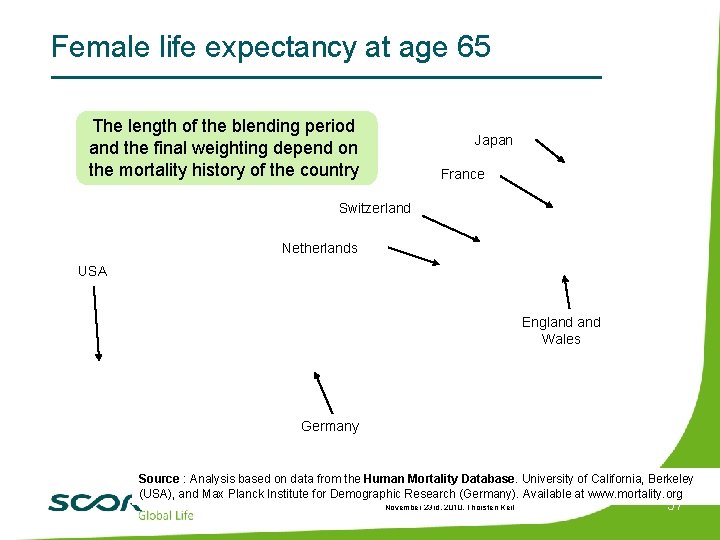
Female life expectancy at age 65 The length of the blending period and the final weighting depend on the mortality history of the country Japan France Switzerland Netherlands USA England Wales Germany Source : Analysis based on data from the Human Mortality Database. University of California, Berkeley (USA), and Max Planck Institute for Demographic Research (Germany). Available at www. mortality. org Risk Assessment in Life Insurance November 23 rd, 2010, Thorsten Keil 57

Is there a maximum life expectancy? The highest life expectancy (worldwide) Source: Max Planck Institute Risk Assessment in Life Insurance November 23 rd, 2010, Thorsten Keil 58

Does it really diversify? Development of the average life expectancy (Female, Germany) Risk Assessment in Life Insurance November 23 rd, 2010, Thorsten Keil 59
The impact of increasing life expectancy The consequences of a mortality improvement of 1% p. a. Risk Assessment in Life Insurance November 23 rd, 2010, Thorsten Keil 60

Conclusion
Conclusion The new solvency rules and accounting standards require a market consistent view of insurance portfolios Best Estimate is a key component of actuarial valuation under the new regime and requires a new approach since additional security margins are not allowed In future times a better knowledge of underwritten risks is required Beside the current actuarial evaluation of balance sheet positions the best estimate calculation will be one of the most important actuarial tasks Risk Assessment in Life Insurance November 23 rd, 2010, Thorsten Keil 63

Thank you for your attention!
- Slides: 63