
RISK ASSESSMENT FOR DENTAL CARIES AMONG INFANTS AND


- Slides: 54
RISK ASSESSMENT FOR DENTAL CARIES AMONG INFANTS AND CHILDREN BY PEDIATRICIANS by Oral Health Program v. 2018. January 1
INTRODUCTION • A substantial portion of children are at high risk for developing dental caries in Indiana • Dental caries can cause a lot of pain and destruction of children’s teeth • We need your help in identifying these children so we can lessen the burden of dental caries in this population • We are very pleased that you are taking this course and look forward to your help v. 2018. January 2
COURSE PREPARED BY: • Charles Fuhrer, DDS, MSD – Dr. Fuhrer is a pediatric dentist located in Noblesville, IN • Nicole Weddell, DDS, MSD – Dr. Weddell is a pediatric dentist located in Indianapolis, IN • James R. Miller, DDS, MSD, Ph. D – Dr. Miller is the State Oral Health Director at the Indiana State Department of Health v. 2018. January 3
RISK ASSESSMENT INSTRUMENTS • There are many risk assessments for dental caries • The one we are suggesting is straight forward and mirrors the American Academy of Pediatric Dentistry’s own Caries Risk Assessment • The assessment we will be discussing today applies to infants and young children under 4 years of age v. 2018. January 4
RISK ASSESSMENT A RISK ASSESSMENT FORM will be presented that uses questions and clinical observations to categorize the risk of dental caries for a child v. 2018. January 5
RISK ASSESSMENT FORM • We suggest you print a copy of the form Risk Assessment for Dental Caries and follow along during this presentation • If you are not able to print a copy and would like one before proceeding, please see directions on the last slide for obtaining one v. 2018. January 6
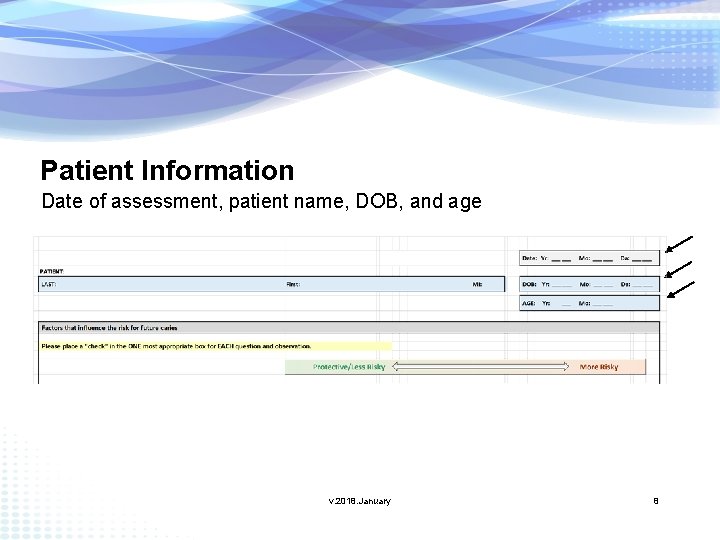
Patient Information • At the top right of the form is a grey box in which you can record the date of the assessment • In the light blue boxes there are places for the child’s name, DOB, and age • Note: The date of the screening and the date of birth of the child are arranged so you can conveniently calculate the age of the child in years and months v. 2018. January 7
Patient Information Date of assessment, patient name, DOB, and age v. 2018. January 8
QUESTIONS • We will now introduce the questions included in the risk assessment • These questions are designed to obtain information about risk factors for dental caries v. 2018. January 9
Questions 1 through 9 v. 2018. January 10
QUESTION #1 (For mother/caregiver) How would you rate your oral health? • Poor oral health in a mother or caregiver is a risk factor for dental caries in a child • This is because evidence suggests that cariogenic bacteria can pass from the primary caregiver to the child v. 2018. January 11
QUESTION #2 • (For mother/caregiver) How would you rate the child’s family income level? • This question is asked to gain some information about a child’s socioeconomic status, since it is known that poverty can be a risk factor for poor oral health • Children and infants under five years old, who are from poorer families, tend to have much higher rates of dental caries v. 2018. January 12
QUESTION #3 How many between meal sugary drinks/snacks does your child have per day? • Sugar is a risk factor for dental caries • Children and infants who consume between meal snacks or drinks that contain sugar are at risk of developing dental caries v. 2018. January 13
QUESTION #4 Is your child put to bed with juice, milk, or any other fluids containing sugar? • Putting a child to bed with a cup, or a bottle, that contains any liquid other than water puts that child at risk of dental caries v. 2018. January 14
QUESTION #5 Does your child drink tap water that is fluoridated or take fluoride supplements? • Exposing a child to an optimum amount of fluoride is known to help prevent dental caries • One way to expose a child to fluoride is by having the child drink water that contains fluoride • Many communities fluoridate their water with an optimum amount of fluoride v. 2018. January 15
QUESTION #6 How often are your infant’s gums cleaned or child’s teeth brushed? • Good oral hygiene is known to help prevent dental caries • An infant should have his/her gums cleaned. This gets the infant acclimated to oral hygiene early • A child’s teeth need to be brushed at least 2 X per day • Children under the age of 5 should always have assistance in brushing their teeth from an adult v. 2018. January 16
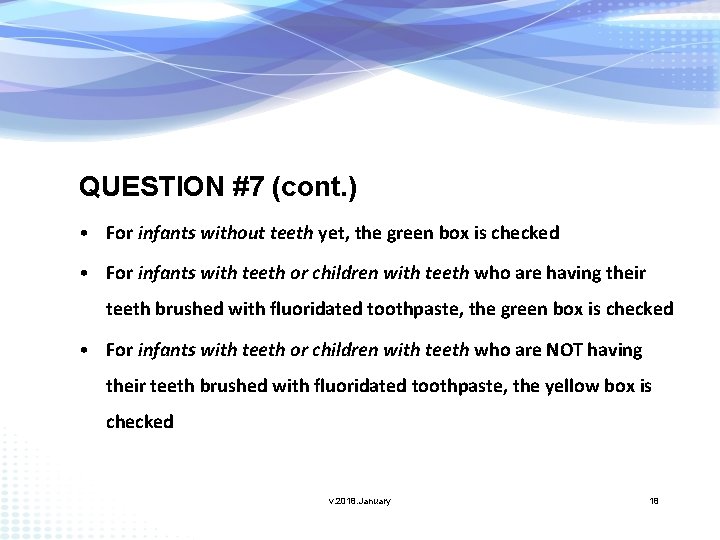
QUESTION #7 Are you using fluoridated toothpaste to brush your child’s teeth? • Once a child’s teeth erupt into the oral cavity, they almost immediately become susceptible to dental caries • Brushing the teeth properly will help disrupt dental plague and reduce the risk of dental caries • Brushing teeth with fluoridated toothpaste will further reduce the risk of dental caries v. 2018. January 17
QUESTION #7 (cont. ) • For infants without teeth yet, the green box is checked • For infants with teeth or children with teeth who are having their teeth brushed with fluoridated toothpaste, the green box is checked • For infants with teeth or children with teeth who are NOT having their teeth brushed with fluoridated toothpaste, the yellow box is checked v. 2018. January 18
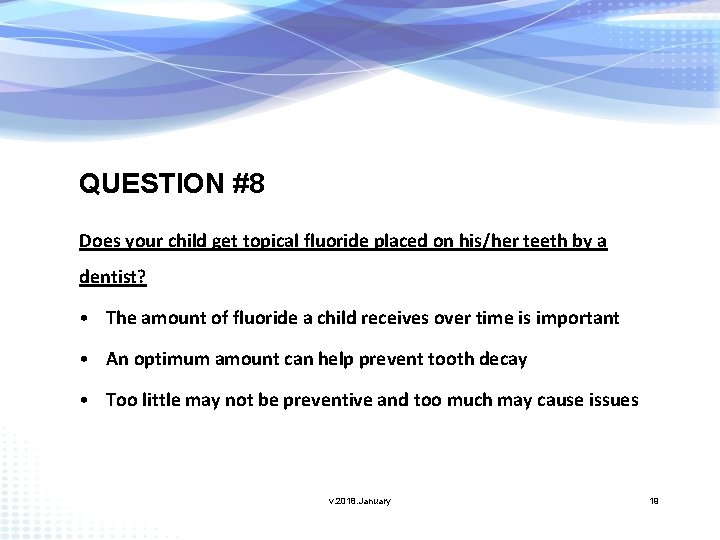
QUESTION #8 Does your child get topical fluoride placed on his/her teeth by a dentist? • The amount of fluoride a child receives over time is important • An optimum amount can help prevent tooth decay • Too little may not be preventive and too much may cause issues v. 2018. January 19
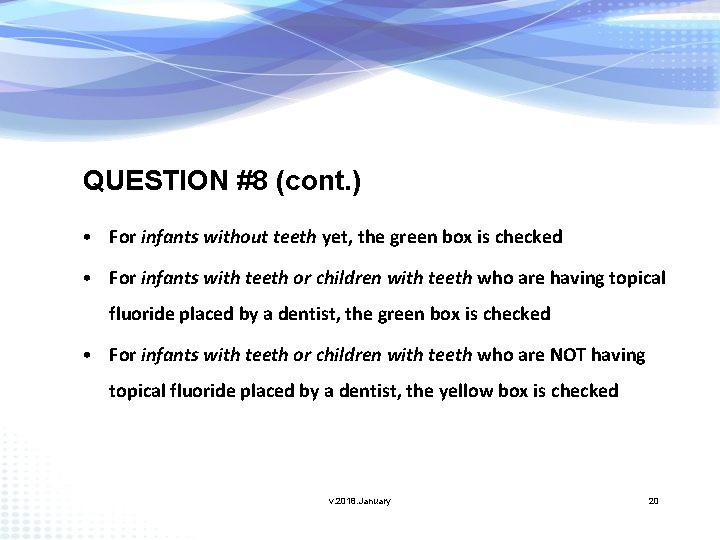
QUESTION #8 (cont. ) • For infants without teeth yet, the green box is checked • For infants with teeth or children with teeth who are having topical fluoride placed by a dentist, the green box is checked • For infants with teeth or children with teeth who are NOT having topical fluoride placed by a dentist, the yellow box is checked v. 2018. January 20
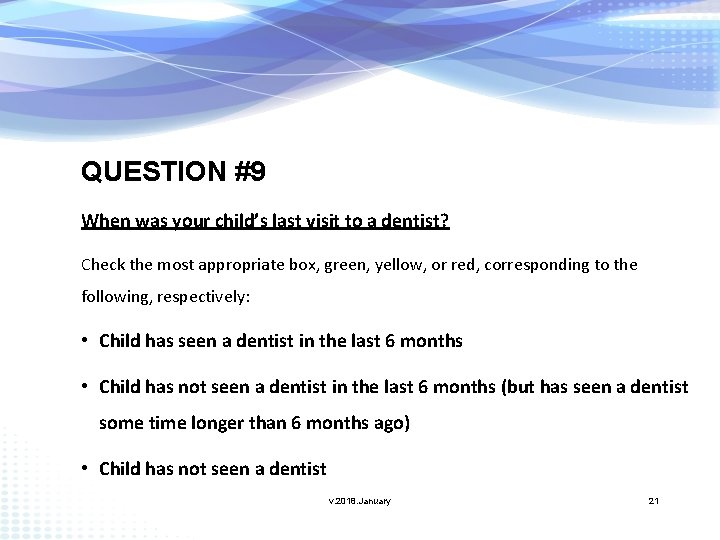
QUESTION #9 When was your child’s last visit to a dentist? Check the most appropriate box, green, yellow, or red, corresponding to the following, respectively: • Child has seen a dentist in the last 6 months • Child has not seen a dentist in the last 6 months (but has seen a dentist some time longer than 6 months ago) • Child has not seen a dentist v. 2018. January 21
QUESTION #9 (cont. ) When was your child’s last visit to a dentist? • Visiting a dentist regularly is known to help prevent dental caries • Knowing how often a child visits a dentist can help determine the risk of a child for developing dental caries • A DENTAL HOME should be established for all children by AGE 1 YEAR v. 2018. January 22
OBSERVATIONS • We will now introduce the observations included in the risk assessment • These observations are designed to obtain additional information about risk factors for dental caries v. 2018. January 23
Observations 1 through 3 v. 2018. January 24
OBSERVATION #1 Does the child’s teeth have WHITE SPOT LESIONS and/or ENAMEL DEFECTS? v. 2018. January 25
OBSERVATION #1 (cont. ) • White spot lesions are an early form of dental caries and their presence elevates the risk for the development of more advanced dental caries and dental cavities Note: Often, white spot lesions occur at the junction of the teeth and gums. Dental plaque is also often located at this region and can cover white spot lesions. However, we suggest you do not disturb the plaque at this point in the screening, as it could cause bleeding which could interfere with this and subsequent observations. During observation #3, you can wipe off the plaque with gauze to determine if white spot lesions are present in this region. If so, you may need to change the box you initially check for observation #1 v. 2018. January 26
OBSERVATION #1 (cont. ) • Enamel defects are caused by abnormal development of the enamel and can mimic dental caries or cavities o These defects may or may not be associated with dental caries at the time of the screening o However, these defects do put a child at elevated risk for dental caries v. 2018. January 27
OBSERVATION #2 Does the child’s teeth have FILLINGS, CAVITIES, or MISSING TEETH? • The number one predictor of future caries activity is past caries activity as indicated by one or more of these conditions v. 2018. January 28
OBSERVATION #2 (cont. ) • Dental fillings are a form of treatment for dental caries and decay • Caries and decay, which has been treated with fillings, puts a child at increased risk for future dental caries o Some fillings are difficult to see o You should ask the parent if a child has ever had a filling v. 2018. January 29
OBSERVATION #2 (cont. ) • Dental cavities generally indicate active dental caries which has progressed to produce a cavity o If no intervention occurs, the cavity will likely get worse, possibly causing pain or infection, and may eventually result in the tooth needing to be extracted o For purposes of this screening, if you see a cavity you should assume it is associated with active dental caries v. 2018. January 30
OBSERVATION #2 (cont. ) • Missing teeth (or a missing tooth), due to decay indicate a child is at high risk of developing future dental caries o You should ask if a missing baby tooth was extracted due to dental decay o Only teeth lost to decay are relevant for this screening Note: Baby teeth can be lost for reasons other than those related to dental caries, such as trauma v. 2018. January 31
OBSERVATION #3 Does the child’s teeth have plaque on them? • Plaque is a biofilm that occurs on the teeth and can put a child at elevated risk for dental caries • Plaque is often found at the margin of the gums where the gums touch the teeth Note: To detect plaque you may need to wipe the teeth with gauze or a cotton roll. This may cause the gums to bleed. At this time you may see white spot lesions that you didn’t see initially. This could result in you needing to change observation #1 v. 2018. January 32
OBSERVATION #3 (cont. ) • Plaque can be removed by brushing and good oral hygiene, which reduces the risk of dental caries • Brushing with fluoridated toothpaste further reduces the risk • If dental plaque is not removed it continues to produce acid, which can cause white spots, more advanced dental caries, and eventually dental cavities v. 2018. January 33
CATEGORIZATION OF RISK • The answers to the screening questions and the observations can be used to categorize the risk for future caries for a child • In this assessment the risk will be assigned a category of either LOW, MODERATE, or HIGH v. 2018. January 34
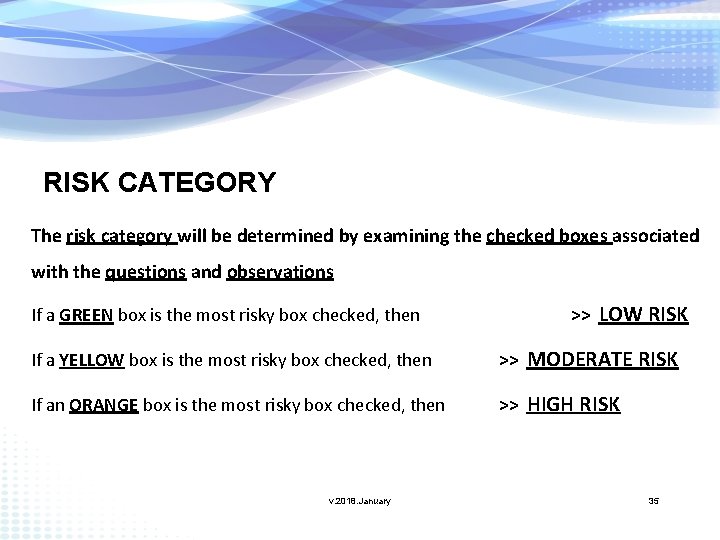
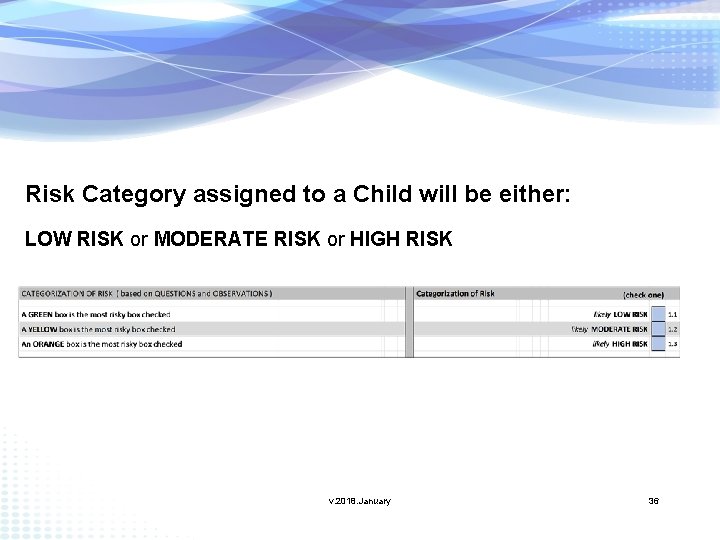
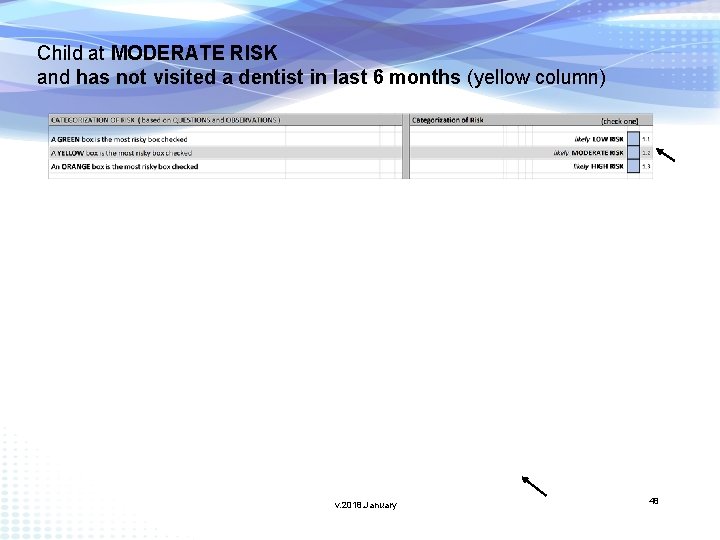
RISK CATEGORY The risk category will be determined by examining the checked boxes associated with the questions and observations If a GREEN box is the most risky box checked, then >> LOW RISK If a YELLOW box is the most risky box checked, then >> MODERATE RISK If an ORANGE box is the most risky box checked, then >> HIGH RISK v. 2018. January 35
Risk Category assigned to a Child will be either: LOW RISK or MODERATE RISK or HIGH RISK v. 2018. January 36
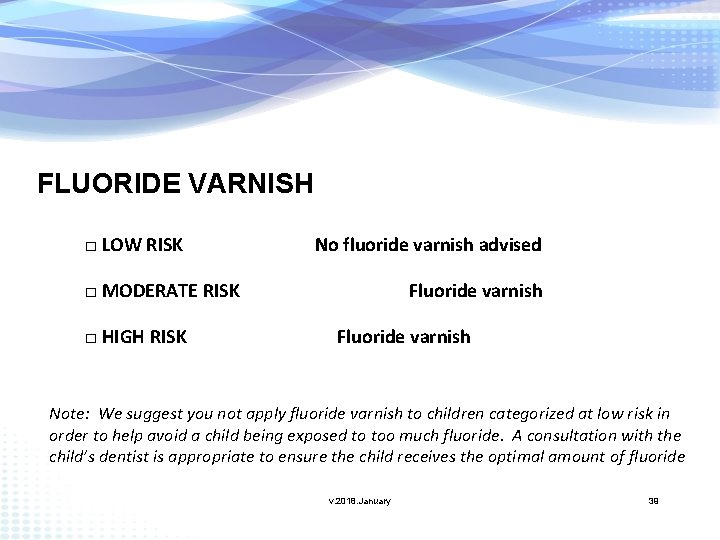
GUIDELINES This risk categories can then be used to develop GUIDELINES v When to apply FLOURIDE VARNISH v When to REFER TO DENTIST v. 2018. January 37
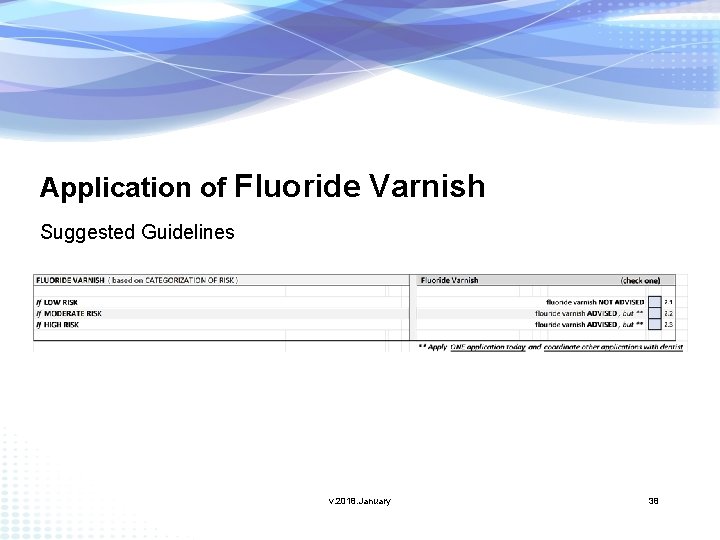
Application of Fluoride Varnish Suggested Guidelines v. 2018. January 38
FLUORIDE VARNISH □ LOW RISK No fluoride varnish advised □ MODERATE RISK □ HIGH RISK Fluoride varnish Note: We suggest you not apply fluoride varnish to children categorized at low risk in order to help avoid a child being exposed to too much fluoride. A consultation with the child’s dentist is appropriate to ensure the child receives the optimal amount of fluoride v. 2018. January 39
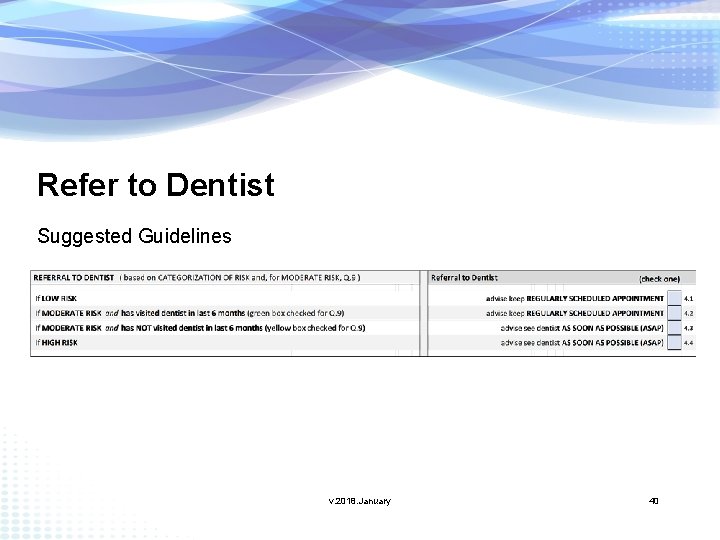
Refer to Dentist Suggested Guidelines v. 2018. January 40
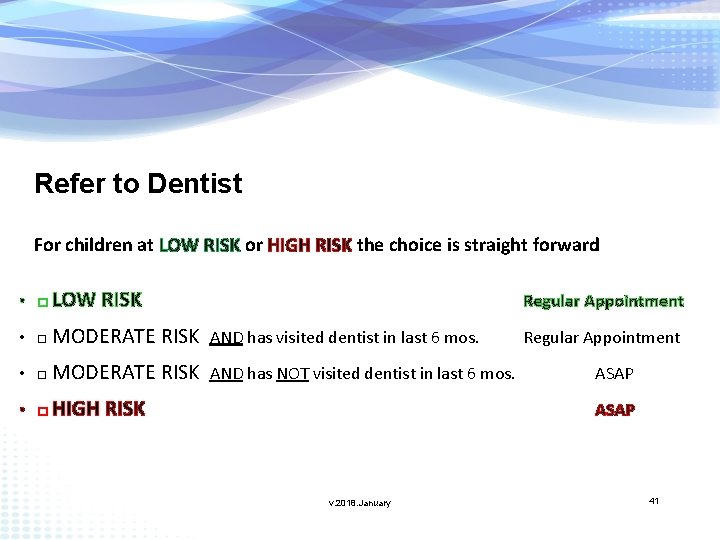
Refer to Dentist For children at LOW RISK or HIGH RISK the choice is straight forward • □ LOW RISK • □ MODERATE RISK AND has visited dentist in last 6 mos. Regular Appointment • □ MODERATE RISK AND has NOT visited dentist in last 6 mos. ASAP • □ HIGH RISK ASAP v. 2018. January 41
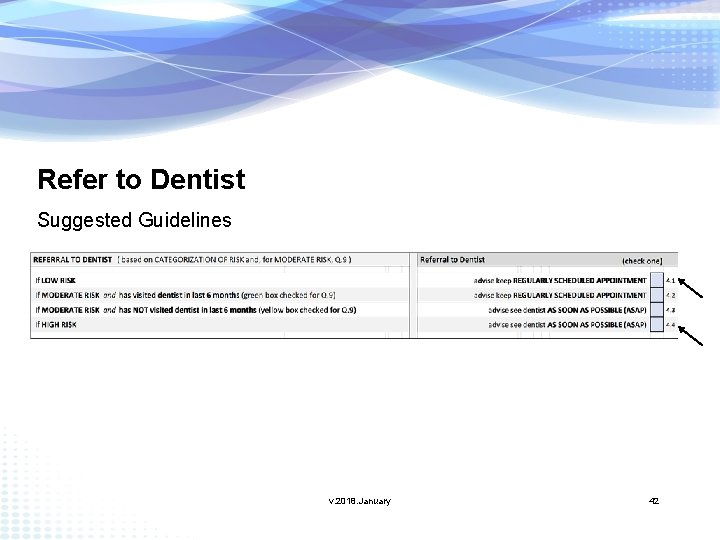
Refer to Dentist Suggested Guidelines v. 2018. January 42
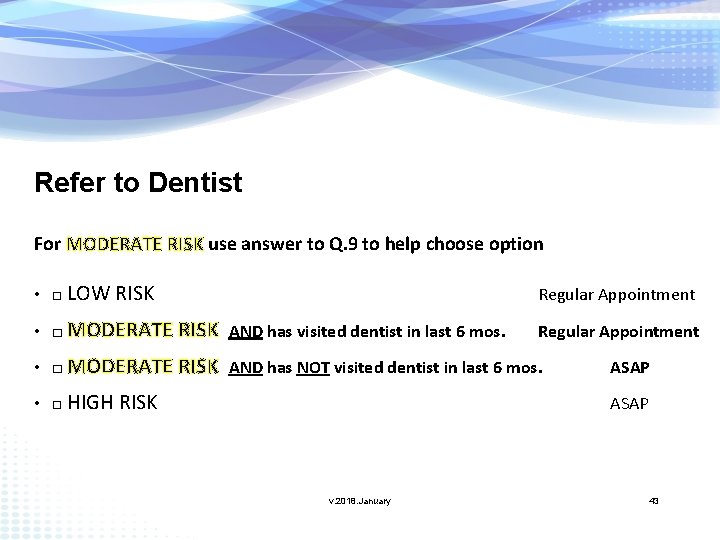
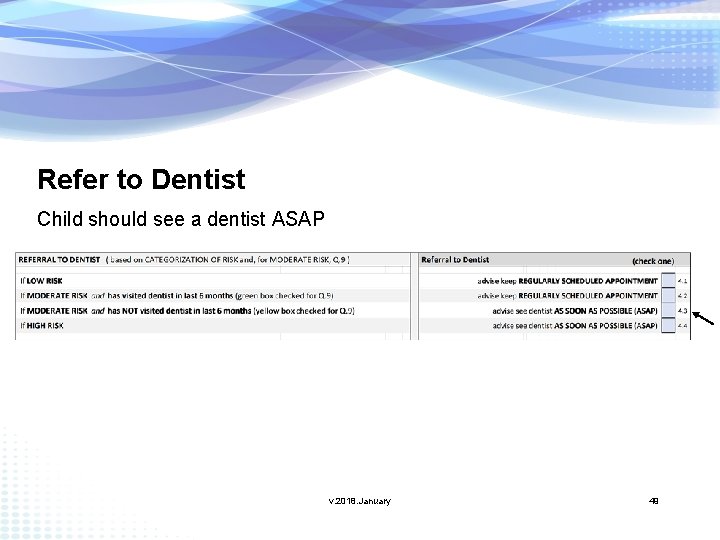
Refer to Dentist For MODERATE RISK use answer to Q. 9 to help choose option • □ LOW RISK Regular Appointment • □ MODERATE RISK AND has visited dentist in last 6 mos. Regular Appointment • □ MODERATE RISK AND has NOT visited dentist in last 6 mos. ASAP • □ HIGH RISK ASAP v. 2018. January 43
Refer to Dentist For a child at MODERATE RISK that has seen a dentist in the last 6 months (see Q. 9), you can generally advise the child to see the dentist at the next regularly scheduled appointment v. 2018. January 44
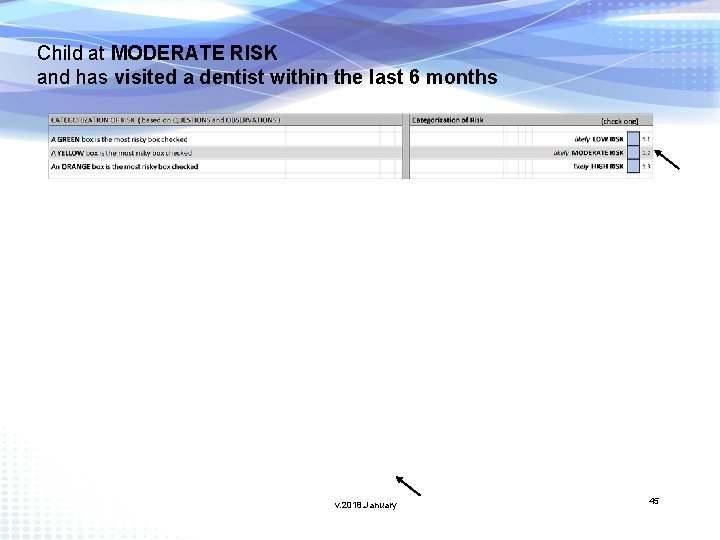
Child at MODERATE RISK and has visited a dentist within the last 6 months v. 2018. January 45
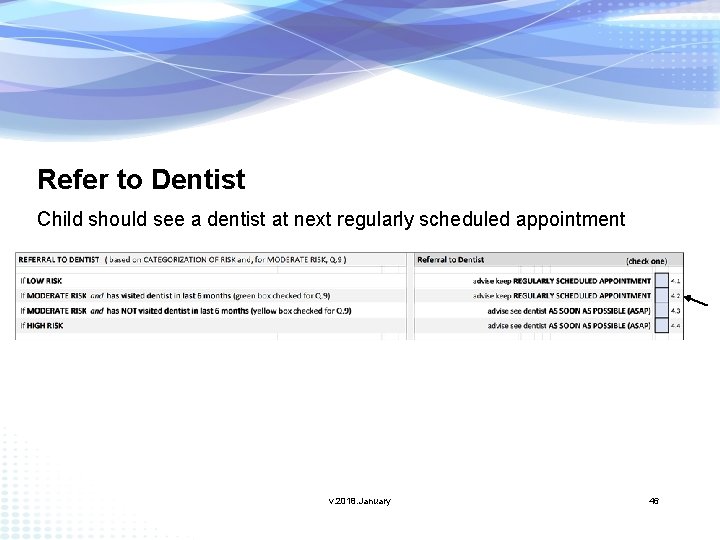
Refer to Dentist Child should see a dentist at next regularly scheduled appointment v. 2018. January 46
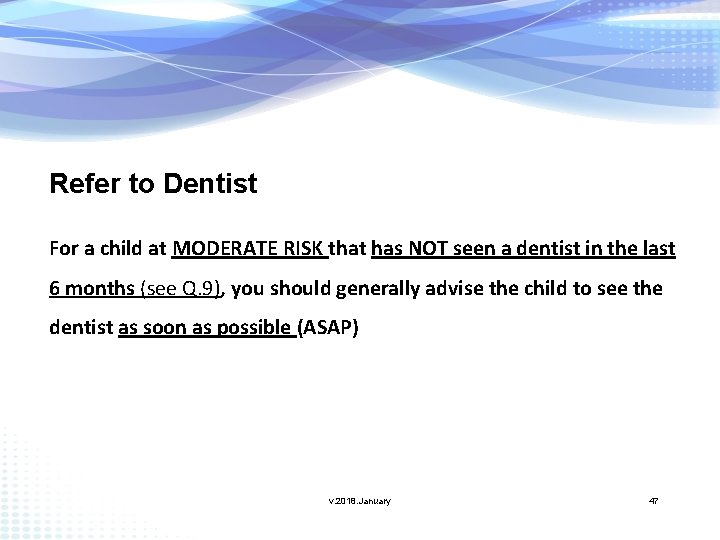
Refer to Dentist For a child at MODERATE RISK that has NOT seen a dentist in the last 6 months (see Q. 9), you should generally advise the child to see the dentist as soon as possible (ASAP) v. 2018. January 47
Child at MODERATE RISK and has not visited a dentist in last 6 months (yellow column) v. 2018. January 48
Refer to Dentist Child should see a dentist ASAP v. 2018. January 49
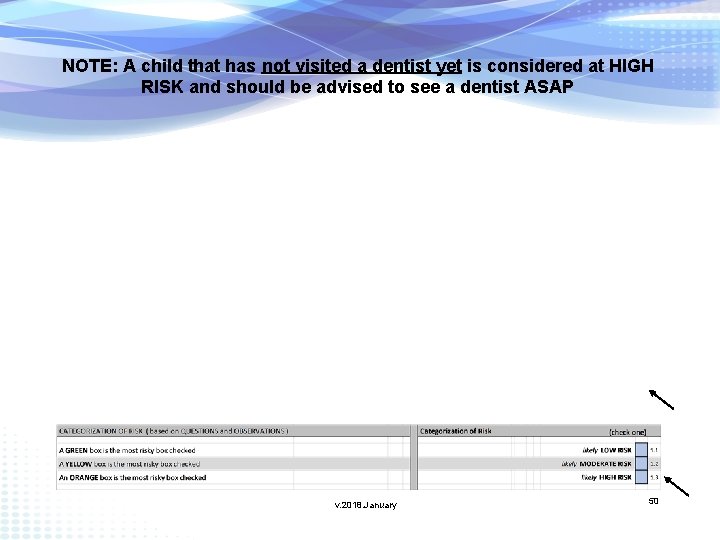
NOTE: A child that has not visited a dentist yet is considered at HIGH RISK and should be advised to see a dentist ASAP v. 2018. January 50
PROMOTE GOOD ORAL HEALTH • SCREEN: Identify children at high risk for dental caries • PREVENT: Apply fluoride varnish where indicated • REFER: Make appropriate referrals to dentists v. 2018. January 51
KEEP IN MIND !! EVERY CHILD should have a DENTAL HOME by AGE 1 YEAR v. 2018. January 52
DEMONSTRATION VIDEOS • INSTRUMENTS/SUPPLIES for assessment and application fluoride varnish • QUESTIONS for mother about mother/child • OBSERVATIONS of child’s oral health status • FLUORIDE VARNISH application v. 2018. January 53
THANK YOU for taking this course • You may request a copy of the Risk Assessment for Dental Caries by contacting one of the health educators at the Oral Health Program • The health educators’ contact information can be found at http: //www. in. gov/isdh/18695. htm under contact us • If you have questions or comments about the material presented in this course, please send them to the health educators • Note: We plan to add clinical pictures of oral health conditions that were mentioned in this course, as they become available v. 2018. January 54