
Risk Assessment for Cultural Institutions Fire Testing vs
- Slides: 24
Risk Assessment for Cultural Institutions: Fire Testing vs Computer Modeling Frederick W. Mowrer, Ph. D. , P. E. Department of Fire Protection Engineering University of Maryland NARA Conference - 2008
Introduction § A number of codes and standards address the fire protection of cultural institutions: • NFPA 909 § Protection of Cultural Resource Properties – Museums, Libraries and Places of Worship • NFPA 914 § Fire Protection of Historic Structures § These documents identify two options to meet life safety and property conservation goals and objectives: • Prescriptive-based • Performance-based. . . focus of this discussion NARA Conference - 2008
Compliance options § Prescriptive option • Codes and standards address specific design • • requirements Relationship between specified requirements and performance objectives is implicit (or nonexistent) Easy to review and enforce § Performance-based option • Goals and objectives are explicitly stated • Achievement of objectives demonstrated through • engineering analysis of performance criteria More difficult to review and evaluate NARA Conference - 2008
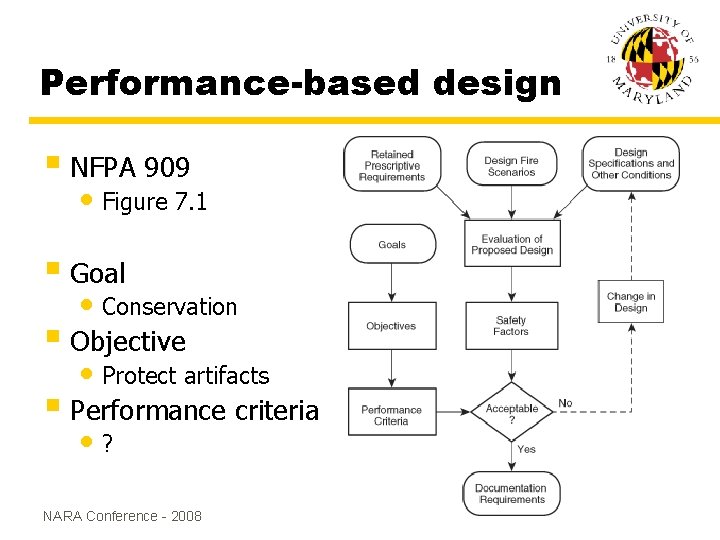
Performance-based design § NFPA 909 • Figure 7. 1 § Goal • Conservation § Objective • Protect artifacts § Performance criteria • ? NARA Conference - 2008
Performance criteria § “Culturally significant features, rooms, spaces, or contents shall not be exposed to instantaneous or cumulative fire effects that would cause irreversible damage. ” • 9. 2. 2. 2 NFPA 909 § How can this performance criterion be achieved and demonstrated? • A. 9. 2. 2. 2 NFPA 909 addresses this issue NARA Conference - 2008
Performance criteria § Demonstrate for each design fire scenario that • each space will be fully isolated from the fire before • • the smoke or thermal layer descends to a level where irreversible damage can occur the smoke and thermal layer will not descend to a level where irreversible damage can occur in any room no fire effects will reach any space beyond the room of origin A. 9. 2. 2. 2 NFPA 909 recommendations NARA Conference - 2008
Performance criteria § The recommendations in NFPA 909 (A. 9. 2. 2. 2) point toward the use of fire modeling to demonstrate compliance. . . §. . . but is fire modeling currently up to this challenge? NARA Conference - 2008
What is fire modeling? § A fire model is a mathematical prediction of fire growth, environmental conditions, and potential effects on structures, systems or components. . . • (3. 3. 26 NFPA 909) NARA Conference - 2008
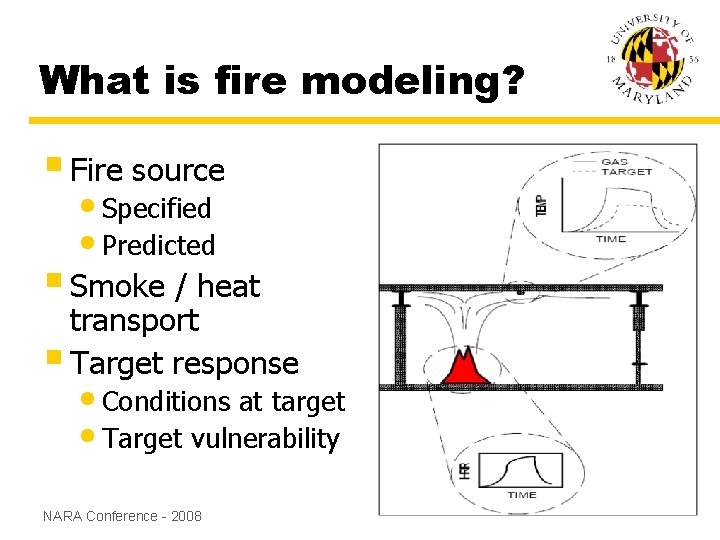
What is fire modeling? § Fire source • Specified • Predicted § Smoke / heat transport § Target response • Conditions at target • Target vulnerability NARA Conference - 2008
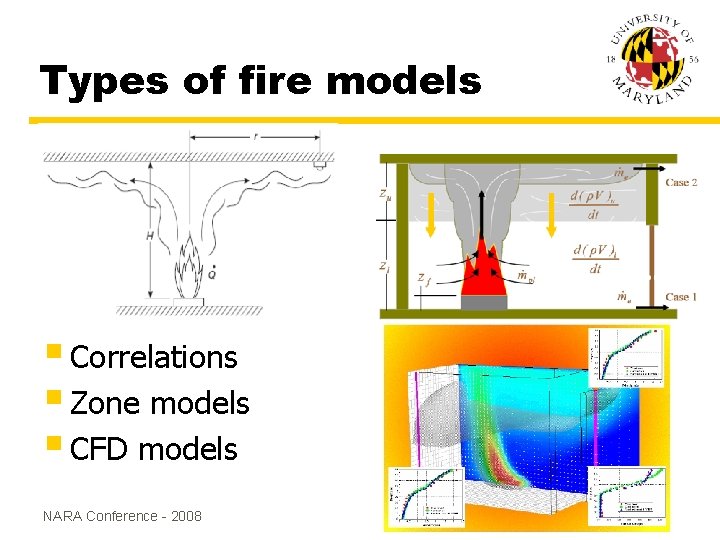
Types of fire models § Correlations § Zone models § CFD models NARA Conference - 2008
How fire models are used § Predict fire growth / fire suppression • Current capabilities are limited § Calculate conditions resulting from specified fire • Current capabilities are relatively good § Both methods require specification of design fire scenarios NARA Conference - 2008
Design fire scenarios § Fire Scenario (3. 3. 72. 2 NFPA 909) • “A set of conditions that defines the development of fire, the spread of combustion products throughout a building or portion of a building, the reactions of people to fire, and the effects of combustion products. ” § Design Fire Scenario (3. 3. 72. 1 NFPA 909) • “A fire scenario used for evaluation of a proposed design. ” NARA Conference - 2008
Design fire scenarios § Each fire scenario shall be challenging, but realistic, with respect to at least one of the following scenario specifications (9. 5. 2. 2 NFPA 909): • Initial fire location • Early rate of growth in fire severity • Smoke generation § What about fire suppression? NARA Conference - 2008
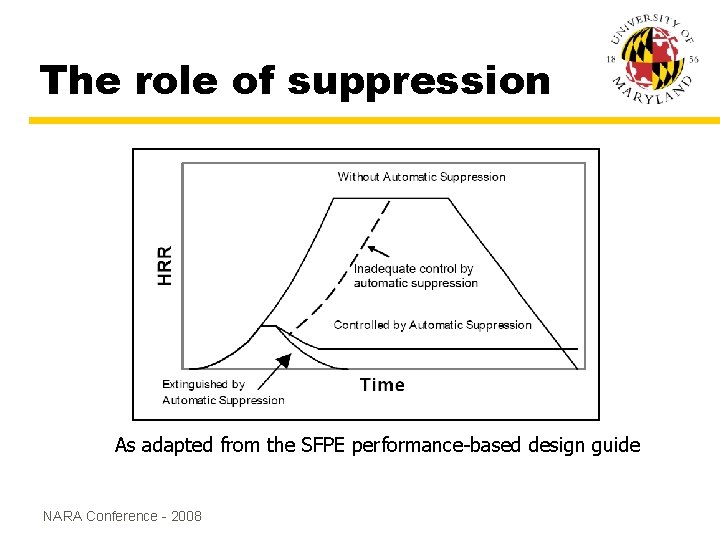
The role of suppression As adapted from the SFPE performance-based design guide NARA Conference - 2008
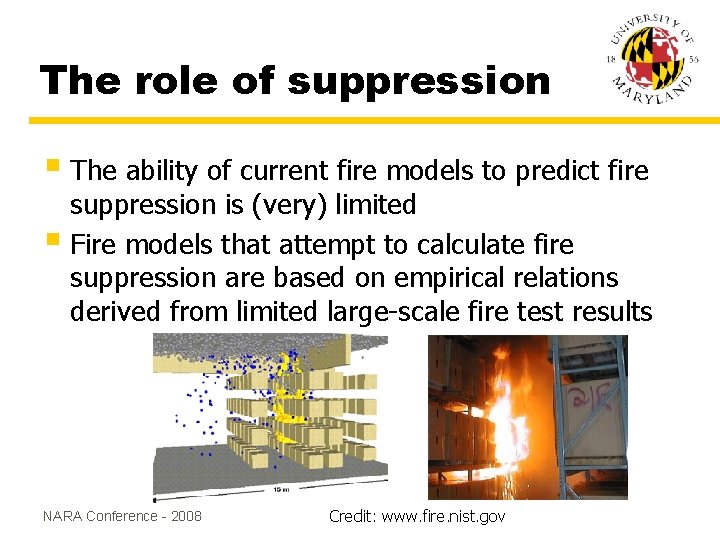
The role of suppression § The ability of current fire models to predict fire suppression is (very) limited § Fire models that attempt to calculate fire suppression are based on empirical relations derived from limited large-scale fire test results NARA Conference - 2008 Credit: www. fire. nist. gov
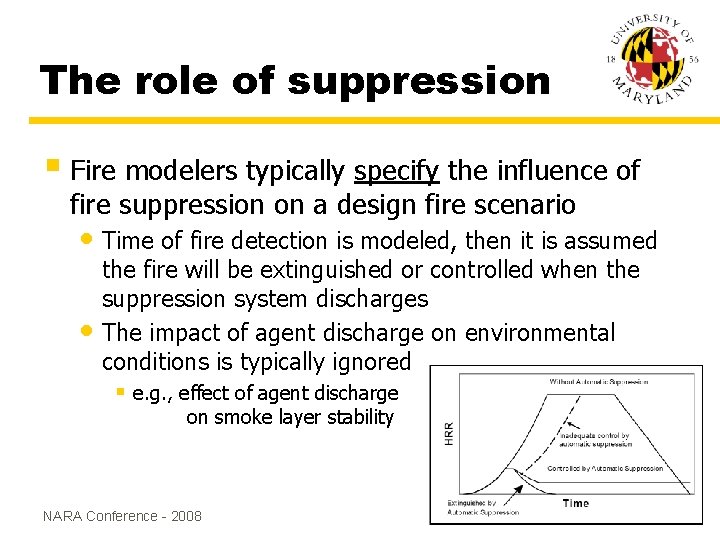
The role of suppression § Fire modelers typically specify the influence of fire suppression on a design fire scenario • Time of fire detection is modeled, then it is assumed • the fire will be extinguished or controlled when the suppression system discharges The impact of agent discharge on environmental conditions is typically ignored § e. g. , effect of agent discharge on smoke layer stability NARA Conference - 2008
The role of fire testing § Large-scale fire testing is still an essential part of fire suppression system design • Needed to prove suppression effectiveness for proposed configurations / designs • Needed to demonstrate that conservation objectives will be achieved § Successful suppression ≠ successful conservation NARA Conference - 2008
Limitations of fire testing § Each test represents only one of many scenarios • Ignition source / location / fuel configuration / building geometry / ventilation. . . § Large-scale fire testing is very expensive • ~$50, 000 per test for warehousing tests § Conservation issues (i. e. , artifact damage) are not typically assessed in fire suppression tests • Some exceptions NARA Conference - 2008
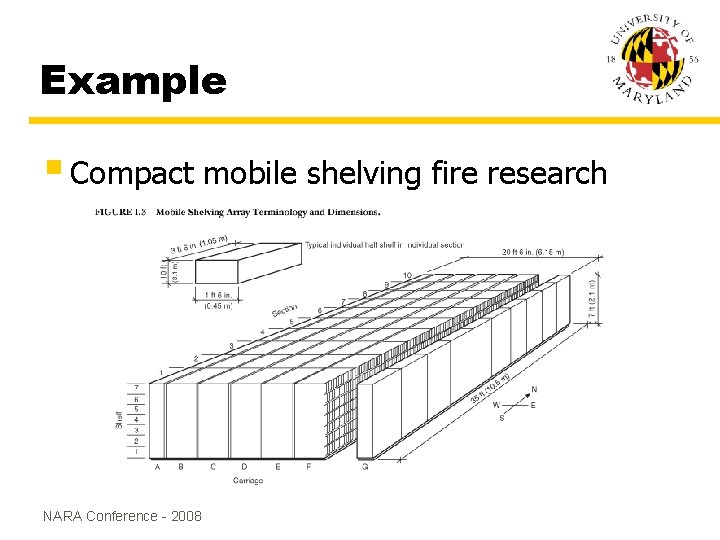
Example § Compact mobile shelving fire research NARA Conference - 2008
Example § Compact mobile shelving fire research • 1978 – GSA sponsored fire tests at FM • 1989 – NARA sponsored fire tests at UL • 1991 – National Archives/Library of Canada sponsored tests at NRCC • Current – FPRF sponsored fire tests NARA Conference - 2008
Summary § Fire modeling is very useful for: • Parametric studies of different variables § What if. . . the fire is twice as big? • Fire hazard analyses of specified scenarios • Estimating times for detector activation § Fire modeling is NOT YET reliable for: • Predicting fire growth / flame spread • Predicting suppression system effectiveness NARA Conference - 2008
Summary § Fire testing is still necessary to: • Evaluate flame spread / fire growth potential • Evaluate fire suppression effectiveness § High challenge / unique storage arrangements § Complex storage / ventilation conditions • Evaluate damage potential to artifacts § Thermal and nonthermal damage from smoke § Fire suppression agent / decomposition product effects NARA Conference - 2008
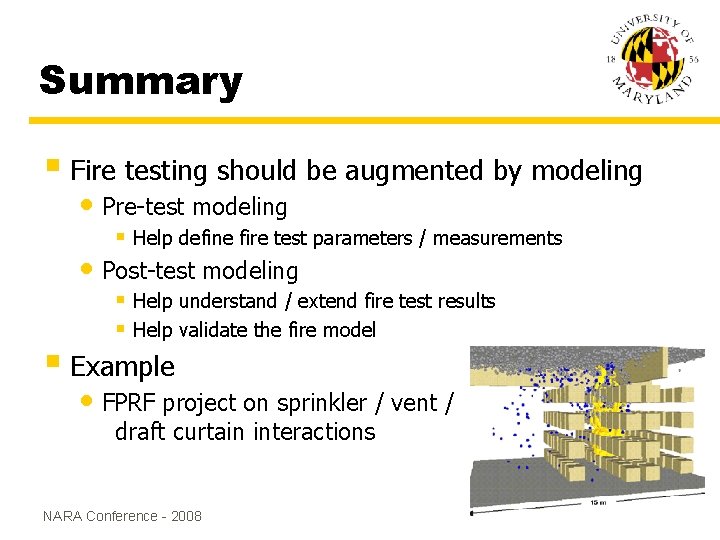
Summary § Fire testing should be augmented by modeling • Pre-test modeling § Help define fire test parameters / measurements • Post-test modeling § Help understand / extend fire test results § Help validate the fire model § Example • FPRF project on sprinkler / vent / draft curtain interactions NARA Conference - 2008
Risk Assessment for Cultural Institutions: Fire Testing AND Computer Modeling Frederick W. Mowrer, Ph. D. , P. E. Department of Fire Protection Engineering University of Maryland NARA Conference - 2008