
RISK ASSESSMENT AND MONITORING FOR ENVIRONMENTAL CHEMICALSJAPAN GROUP
- Slides: 29
RISK ASSESSMENT AND MONITORING FOR ENVIRONMENTAL CHEMICALS-JAPAN GROUP TRAINING COURSE MID-COURSE REPORT PRESENTATION ZEPHANIA. O. OUMA-KENYA
1. My expected Achievements (Expectations) in this training course
Expected Achievements/Expectations-1 • Understanding the concept of Risk Assessment-Risk Management and its application in Regulatory decision making • Gain knowledge on sampling and monitoring techniques of pesticides and environmental chemicals in the environmental media
Expected Achievements/Expectations-2 • Acquire knowledge on other applicable Risk Management approaches critical to Risk Reduction • Gain knowledge in explaining Risk-Based decisions so that the Regulatory Authority can demonstrate confident of wisdom of decision and to be able to articulate the sufficiently sound technical and policy issues to the public, interested and affected parties and to the courtroom.
2. What have I achieved so far? An evaluation of my achievement
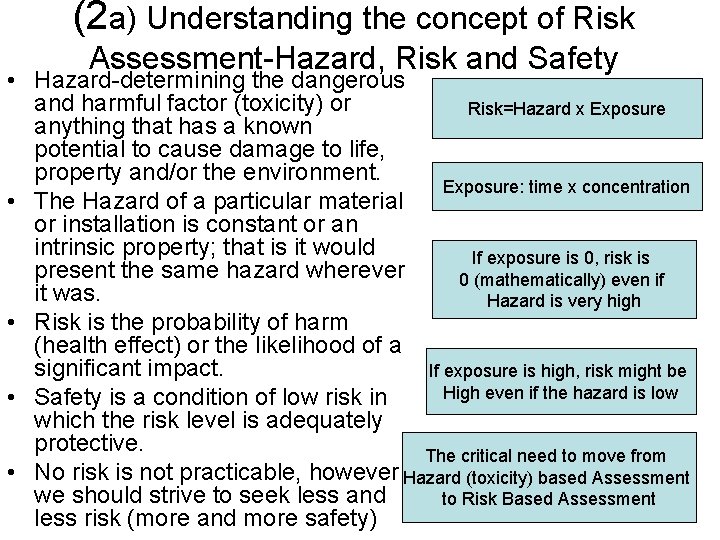
(2 a) Understanding the concept of Risk Assessment-Hazard, Risk and Safety • Hazard-determining the dangerous and harmful factor (toxicity) or Risk=Hazard x Exposure anything that has a known potential to cause damage to life, property and/or the environment. Exposure: time x concentration • The Hazard of a particular material or installation is constant or an intrinsic property; that is it would If exposure is 0, risk is present the same hazard wherever 0 (mathematically) even if it was. Hazard is very high • Risk is the probability of harm (health effect) or the likelihood of a significant impact. If exposure is high, risk might be High even if the hazard is low • Safety is a condition of low risk in which the risk level is adequately protective. The critical need to move from • No risk is not practicable, however Hazard (toxicity) based Assessment we should strive to seek less and to Risk Based Assessment less risk (more and more safety)
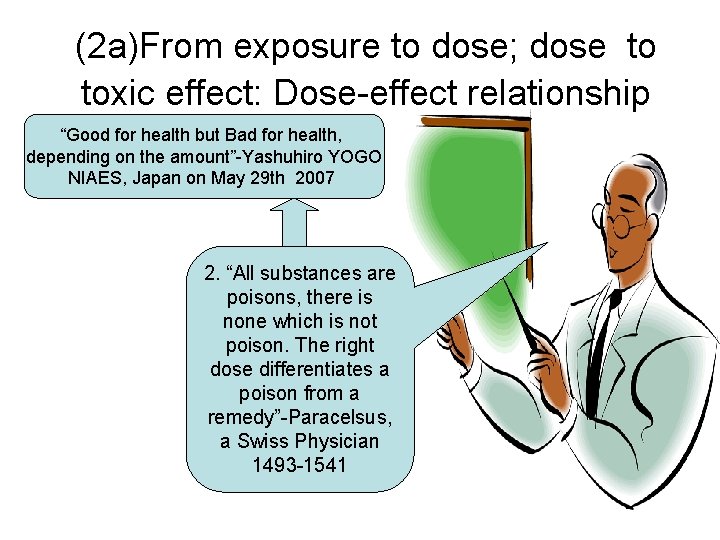
(2 a)From exposure to dose; dose to toxic effect: Dose-effect relationship “Good for health but Bad for health, depending on the amount”-Yashuhiro YOGO NIAES, Japan on May 29 th 2007 2. “All substances are poisons, there is none which is not poison. The right dose differentiates a poison from a remedy”-Paracelsus, a Swiss Physician 1493 -1541
(2 a)-Risk Assessment-Definition 1. “Analytical framework to organize, evaluate and characterize available knowledge and its associated uncertainties regarding the nature and magnitude of threats to human health arising from the environment, including both the natural world and every type of human influence on it so as to guide policy decisions regarding the need to take actions to control or eliminate these threats so that human health is adequately protected”. 2. “scientific characterization of potential adverse effects of a chemical resulting from exposure”
Risk Assessment (RA) • Description of potential adverse health effects based on evaluation of results of epidemiologic, clinical, toxicological and environmental research. • Extrapolation of results to predict the type and estimate the extent of number and characteristics of persons exposed at various intensities and duration. • Characterization of the uncertainties inherent in the process of inferring risk. Incorporation of uncertainty and safety factor into the risk assessment findings. • Requirement for strict adherence to Good Laboratory Practice Guidelines/Regulations to avoid discrepancies. • Manufactures burden to demonstrate safety and efficacy of a given chemical.
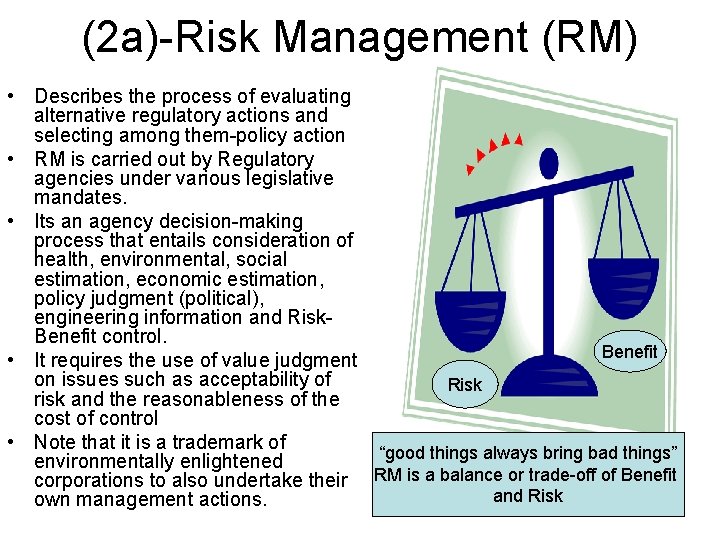
(2 a)-Risk Management (RM) • Describes the process of evaluating alternative regulatory actions and selecting among them-policy action • RM is carried out by Regulatory agencies under various legislative mandates. • Its an agency decision-making process that entails consideration of health, environmental, social estimation, economic estimation, policy judgment (political), engineering information and Risk. Benefit control. Benefit • It requires the use of value judgment on issues such as acceptability of Risk risk and the reasonableness of the cost of control • Note that it is a trademark of “good things always bring bad things” environmentally enlightened corporations to also undertake their RM is a balance or trade-off of Benefit and Risk own management actions.
(2 a)-Risk Communication • Risk communication to the Public, consumers and Interested parties on safety or risk of exposure to emissions and other products • Securing opportunities to get the opinions of the citizens and the consumers • Opportunity to address risk perception and provide public “Relief”. • Role of Regulatory Authorities and the MEDIA • Role of the “close observers of the Regulatory scene”NGOs and other civil society groups. • Political involvement? Complicates the public perception of Risk
Media and Risk Communication • Media play a key role in disseminating well orchestrated scare campaigns; why? Sensational headlines sale!! • The Regulatory Authority therefore has a critical role to communicate the real risk situation and feeding the media with the correct information • A progress in building an informed public with more light being cast on contentious or poorly understood environmental issues and therefore less heat being generated
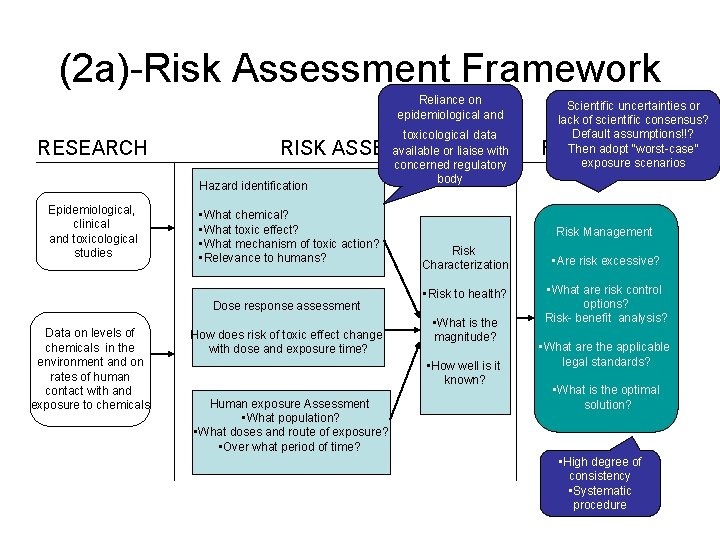
(2 a)-Risk Assessment Framework Reliance on epidemiological and RESEARCH RISK ASSESSMENT Hazard identification Epidemiological, clinical and toxicological studies • What chemical? • What toxic effect? • What mechanism of toxic action? • Relevance to humans? Dose response assessment Data on levels of chemicals in the environment and on rates of human contact with and exposure to chemicals toxicological data available or liaise with concerned regulatory body How does risk of toxic effect change with dose and exposure time? RISK MGT Risk Management Risk Characterization • Risk to health? • What is the magnitude? • How well is it known? Human exposure Assessment • What population? • What doses and route of exposure? • Over what period of time? Scientific uncertainties or lack of scientific consensus? Default assumptions!!? Then adopt “worst-case” exposure scenarios • Are risk excessive? • What are risk control options? Risk- benefit analysis? • What are the applicable legal standards? • What is the optimal solution? • High degree of consistency • Systematic procedure
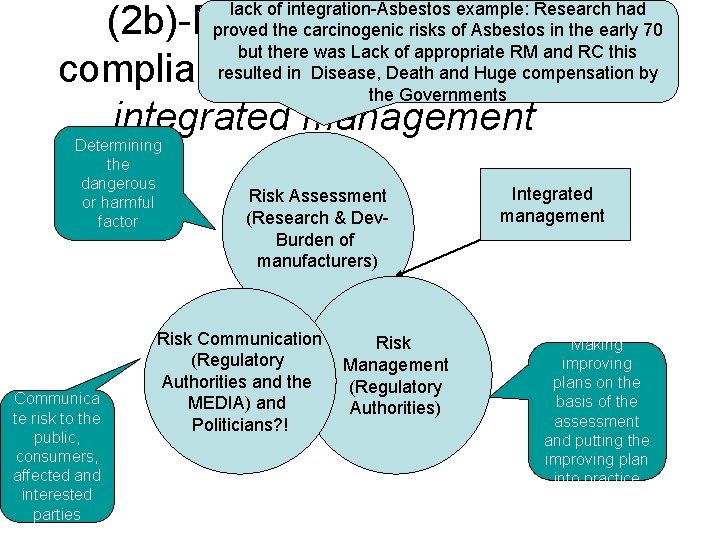
(2 b)-Risk Assessment in compliance and Enforcementintegrated management lack of integration-Asbestos example: Research had proved the carcinogenic risks of Asbestos in the early 70 but there was Lack of appropriate RM and RC this resulted in Disease, Death and Huge compensation by the Governments Determining the dangerous or harmful factor Communica te risk to the public, consumers, affected and interested parties Risk Assessment (Research & Dev. Burden of manufacturers) Risk Communication (Regulatory Authorities and the MEDIA) and Politicians? ! Risk Management (Regulatory Authorities) Integrated management Making improving plans on the basis of the assessment and putting the improving plan into practice
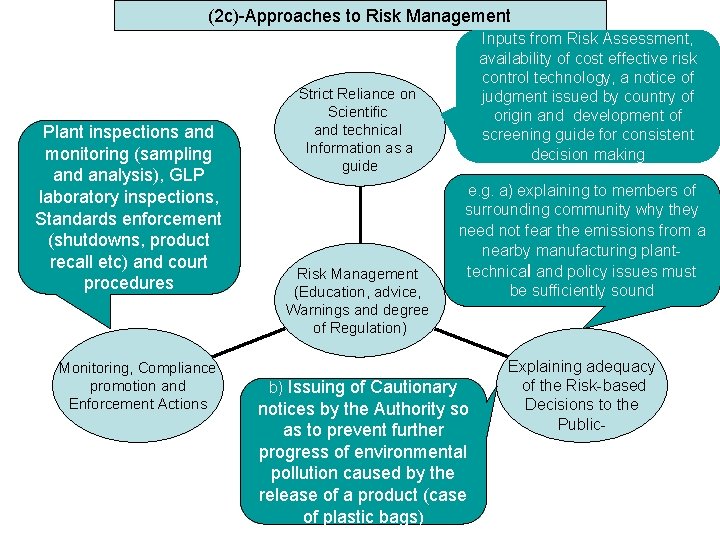
(2 c)-Approaches to Risk Management Plant inspections and monitoring (sampling and analysis), GLP laboratory inspections, Standards enforcement (shutdowns, product recall etc) and court procedures Monitoring, Compliance promotion and Enforcement Actions Inputs from Risk Assessment, availability of cost effective risk control technology, a notice of judgment issued by country of origin and development of screening guide for consistent decision making Strict Reliance on Scientific and technical Information as a guide Risk Management (Education, advice, Warnings and degree of Regulation) e. g. a) explaining to members of surrounding community why they need not fear the emissions from a nearby manufacturing planttechnical and policy issues must be sufficiently sound b) Issuing of Cautionary notices by the Authority so as to prevent further progress of environmental pollution caused by the release of a product (case of plastic bags) Explaining adequacy of the Risk-based Decisions to the Public-
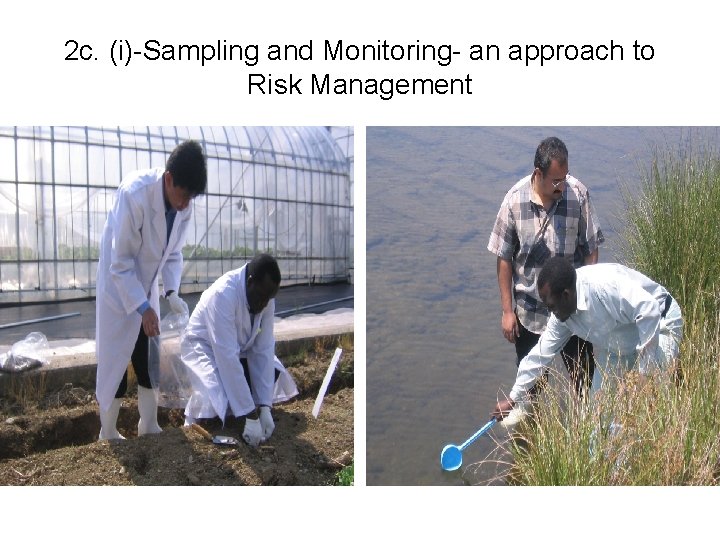
2 c. (i)-Sampling and Monitoring- an approach to Risk Management
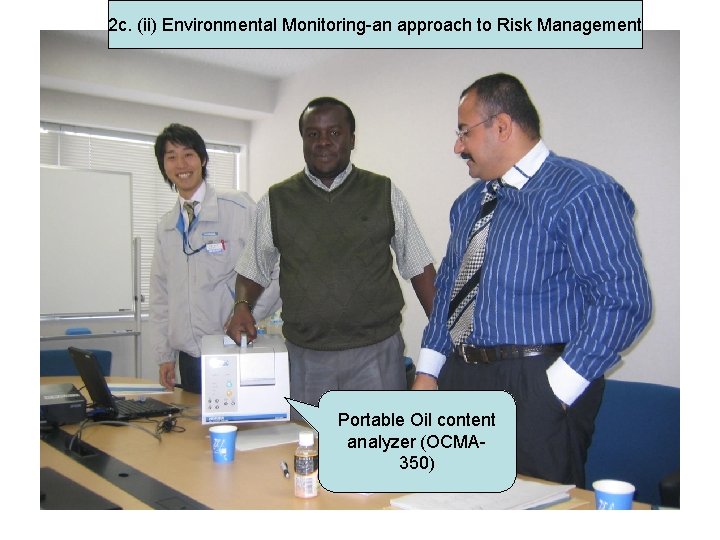
2 c. (ii) Environmental Monitoring-an approach to Risk Management Portable Oil content analyzer (OCMA 350)
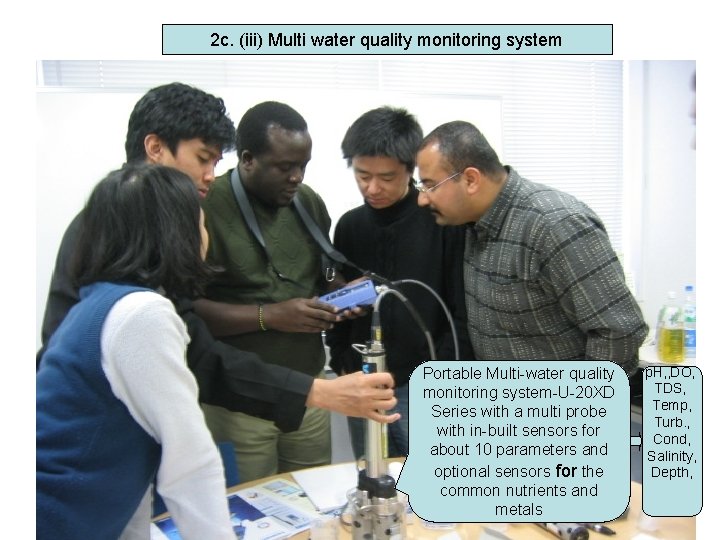
2 c. (iii) Multi water quality monitoring system Portable Multi-water quality monitoring system-U-20 XD Series with a multi probe with in-built sensors for about 10 parameters and optional sensors for the common nutrients and metals p. H, , DO, TDS, Temp, Turb. , Cond, Salinity, Depth,
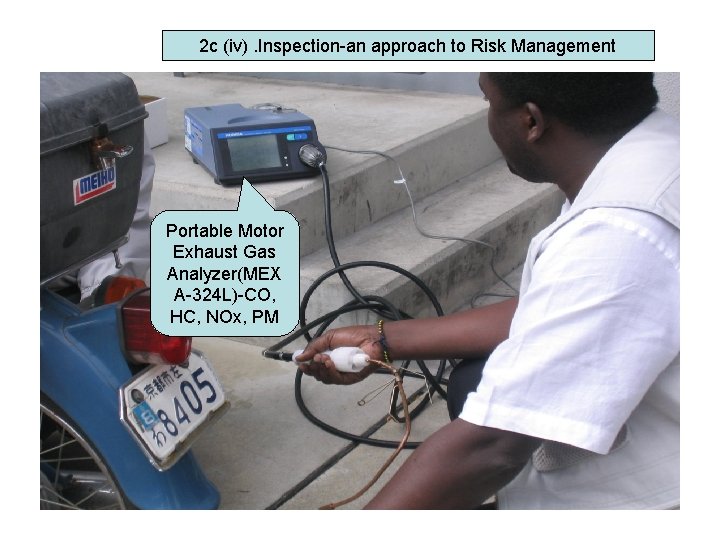
2 c (iv). Inspection-an approach to Risk Management Portable Motor Exhaust Gas Analyzer(MEX A-324 L)-CO, HC, NOx, PM
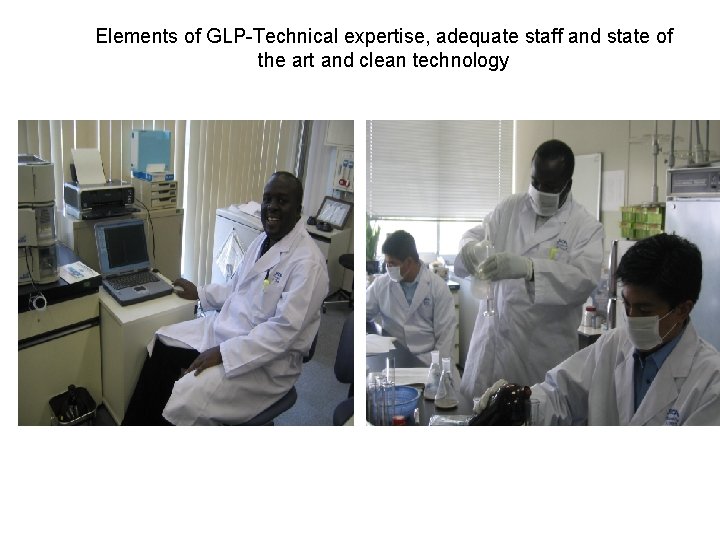
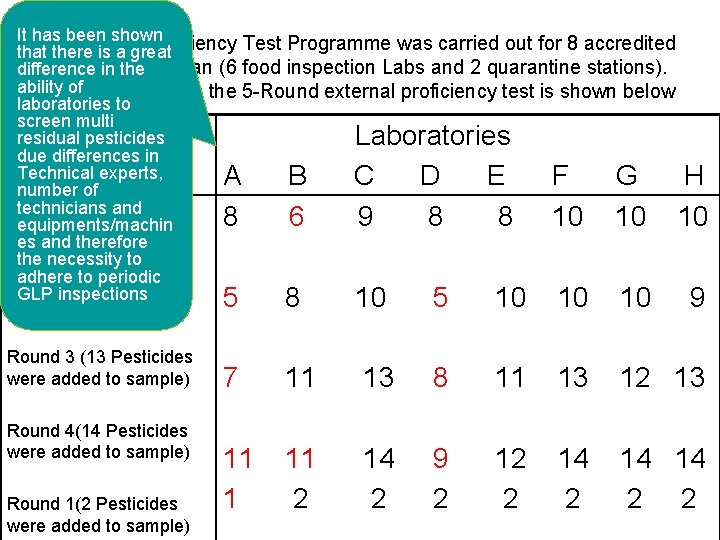
2 c. (v) GLP Inspections-an approach to Risk Management • GLP is a standard guideline that define conditions under which a safety test should be planned, conducted, monitored, reported and archived issued by OECD. This is critical for mutual acceptance of data/test results • Adoption of new, improved and high sensitivity analytical techniques and setting up of Quality Control unit in the Laboratory. • Highly technical and adequate staffing • Attempts to adopt Clean Analysis (avoid analytical methods using toxic chemicals or materials) • Government inspection of the Laboratory at regular interval e. g. Adoption of periodic experimental proficiency test programme for the accredited laboratories.
Elements of GLP-Technical expertise, adequate staff and state of the art and clean technology
It has been shown Experimental proficiency Test Programme was carried out for 8 accredited that there is a great laboratories difference in thein Japan (6 food inspection Labs and 2 quarantine stations). ability Total of performance in the 5 -Round external proficiency test is shown below laboratories to screen multi No. of correctly residual pesticides Laboratories detected pesticides due differences in Technical experts, A B C D E F G H number of technicians and Round 1(10 Pesticides 8 6 9 8 8 10 10 10 equipments/machin were added to sample) es and therefore the necessity to adhere 2 to Round (10 periodic Pesticides GLP inspections 5 8 10 5 10 10 10 9 were added to sample) Round 3 (13 Pesticides were added to sample) Round 4(14 Pesticides were added to sample) Round 1(2 Pesticides were added to sample) 7 11 13 8 11 13 12 13 11 1 11 2 14 2 9 2 12 2 14 14 2 2
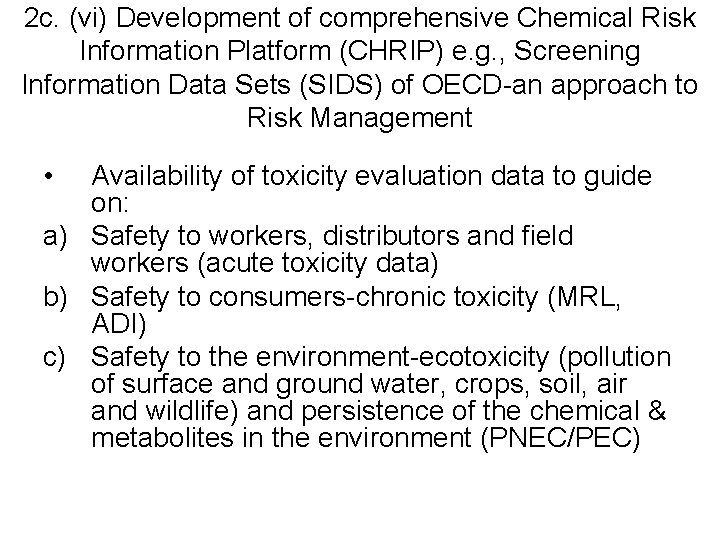
2 c. (vi) Development of comprehensive Chemical Risk Information Platform (CHRIP) e. g. , Screening Information Data Sets (SIDS) of OECD-an approach to Risk Management • Availability of toxicity evaluation data to guide on: a) Safety to workers, distributors and field workers (acute toxicity data) b) Safety to consumers-chronic toxicity (MRL, ADI) c) Safety to the environment-ecotoxicity (pollution of surface and ground water, crops, soil, air and wildlife) and persistence of the chemical & metabolites in the environment (PNEC/PEC)
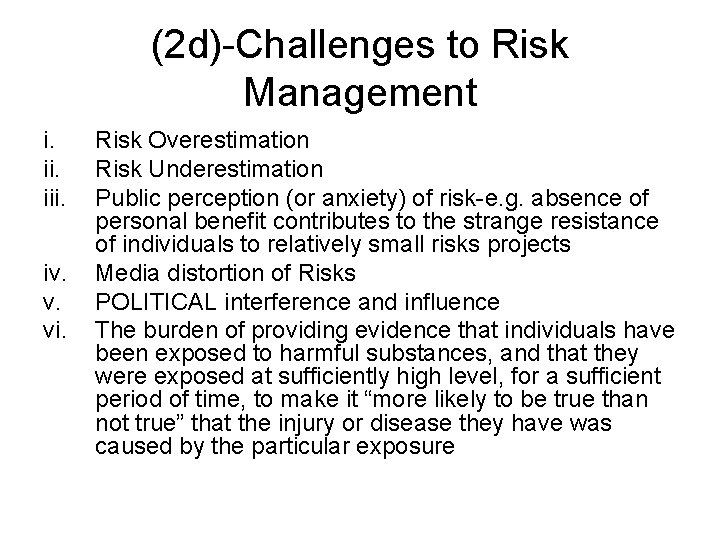
(2 d)-Challenges to Risk Management i. iii. iv. v. vi. Risk Overestimation Risk Underestimation Public perception (or anxiety) of risk-e. g. absence of personal benefit contributes to the strange resistance of individuals to relatively small risks projects Media distortion of Risks POLITICAL interference and influence The burden of providing evidence that individuals have been exposed to harmful substances, and that they were exposed at sufficiently high level, for a sufficient period of time, to make it “more likely to be true than not true” that the injury or disease they have was caused by the particular exposure
3. List of interesting and beneficial subjects • Risk Assessment of Pesticides and other chemicals for Human Health by N. Umetsu • Ecological Risk Assessment of Environmental Contaminants by Masaru Nokata • Pesticides Residue and Positive List System by HPTCAFF • Introduction to Risk Assessment and Monitoring for Environmental Chemicals • Japan’s effort to Reduce Environmental Emissions by Akira Hasegawa • Environmental Toxicology-Science based Risk Assessment of Environmental Chemicals • Waste Management System By T. Okazaki
List of interesting and beneficial subjects • Safety Evaluation of Chemical Substances By Shigeki Miyachi • Mechanism of Dioxin toxicity by H. Ashida • Occupational Diseases due to Chemical Substances and Hazard Assessment in Occupational Health By Kawai Toshio • Practical Operation of the Chemical Substance Control Law By Yohei Ohnishi • Remediation and Bioremediation Technologies for Soil and Groundwater in Japan By Kazuhiro Iwasaki • Project Cycle Management Method
4. List of further subjects to be followed-up in the second half • Risk Assessment and the Courtroom. This lecture should give case studies regarding the nature of reliable scientific evidence and admissibility of scientific evidence and management decisions in courtroom proceedings.
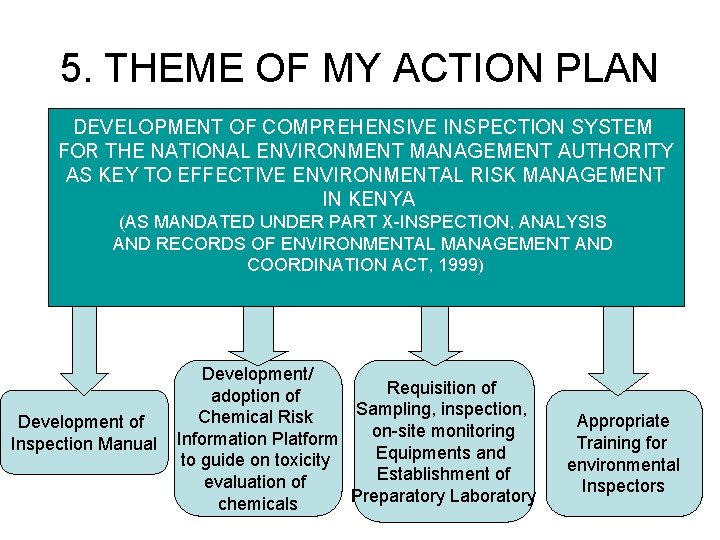
5. THEME OF MY ACTION PLAN DEVELOPMENT OF COMPREHENSIVE INSPECTION SYSTEM FOR THE NATIONAL ENVIRONMENT MANAGEMENT AUTHORITY AS KEY TO EFFECTIVE ENVIRONMENTAL RISK MANAGEMENT IN KENYA (AS MANDATED UNDER PART X-INSPECTION, ANALYSIS AND RECORDS OF ENVIRONMENTAL MANAGEMENT AND COORDINATION ACT, 1999) Development of Inspection Manual Development/ Requisition of adoption of Sampling, inspection, Chemical Risk on-site monitoring Information Platform Equipments and to guide on toxicity Establishment of evaluation of Preparatory Laboratory chemicals Appropriate Training for environmental Inspectors
A look ahead Significant degree of worldwide Movement to adopt the Risk Assessment Framework as critical measure to manage Risks DOMO ARIGATOO GOZAIMASHITA