
RISK ASSESSMENT AND INTERFERENCE MANAGEMENT Bruno Espinosa ECO
RISK ASSESSMENT AND INTERFERENCE MANAGEMENT Bruno Espinosa, ECO ADCO R&TTE Risk Assessment workshop 17 th October 2013
§ ECC: who we are § Avoiding interference: key elements § ECC and the risk assessment: § § Cooperation with ADCO Our understanding and views Footer - add copy here 1

ECC: our role ECC: • Spectrum allocation and technical conditions • 48 member countries acting together • Technical expertise used by EC Footer - add copy here 2

Avoiding interference: typical scenario Typical Scenario Existing Service/System 1 New Service/System 2 3
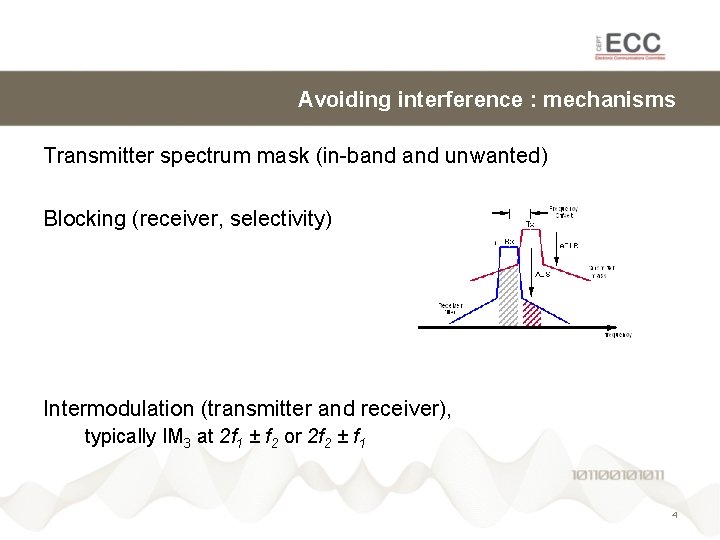
Avoiding interference : mechanisms Transmitter spectrum mask (in-band unwanted) Blocking (receiver, selectivity) Intermodulation (transmitter and receiver), typically IM 3 at 2 f 1 ± f 2 or 2 f 2 ± f 1 4
Avoiding interference: key factors § Interferer: mainly transmitter (emission characteristics, antenna, …) but associated receiver may have impact (e. g. power control). § Victim: mainly receiver but related transmitter has impact (e. g. on wanted signal). § Protection criteria: depend upon technology, application, interference scenario. § Physical factors: distance, propagation characteristics, shielding… Most of these factors are variable. Probabilistic approach to assess interference, taking into account aggregation if relevant. 5
ADCO-ECC cooperation on risk assessment § June 2011 - Letter from ADCO: preliminary discussions within ECC and WG SE. § February/March 2012 - Letter from ADCO with additional details provided to WG SE: draft comments and views prepared by WG SE and approved by the ECC, 1 June 2012. § May 2013 - Letter from ADCO R&TTE: response by ECC in June 2013 providing additional comments and welcoming the workshop to exchange views. Footer - add copy here 6
Risk assessment: ECC understanding § Does not affect limits in Harmonised Standards. § Apply the RAPEX procedure to non compliant products presenting a serious risk to health, safety or other aspects of public interest protection such as radio and EMC. § Objective: define methodology and criteria to identify a non compliance as serious risk to be used by market surveillance. Footer - add copy here 7
Risk assessment: ECC views § Definition of simple criteria is not straightforward. § Strong interaction between interferer and victim in interference assessment. § Classification of interference related to the service and system affected. § Highest priority to safety related services. § Preference for qualitative approach versus quantitative. Footer - add copy here 8
Thanks for your attention bruno. espinosa@eco. cept. org www. cept. org/eco www. cept. org/ecc
- Slides: 10