
Risk Assessment all risks approach John F Ring
- Slides: 26
Risk Assessment – all risks approach John F. Ring BE, Dip. OSH, Dip. SHWW , Dip. Env. Eng. , MIITD, MIFS, MIOSH, Eur Ing C. Eng. MIEI. College Safety Officer, UCC
Application of Risk Assessment u EU/ IRL Legislative Requirement u Safety Management u Risk Management
The Law & Risk Assessment u A Safety Statement must be based on a completed risk assessment u Risk Assessments must be maintained and up-dated. u HSA Inspectors in Cork require to see Risk Assessments as follows: * Job, room, area, equipment, activity, process basis
Application of Risk Assessment q Safety Management u Prioritise safety action programme. u Rank and prioritise safety audit findings. u Evaluate benefit of accident prevention measures & costings. q Risk Management u Relative ranking of various types of risks ( all potential losses) u Prioritise actions. u Prioritise expenditure (via risk and risk reduction benefits)
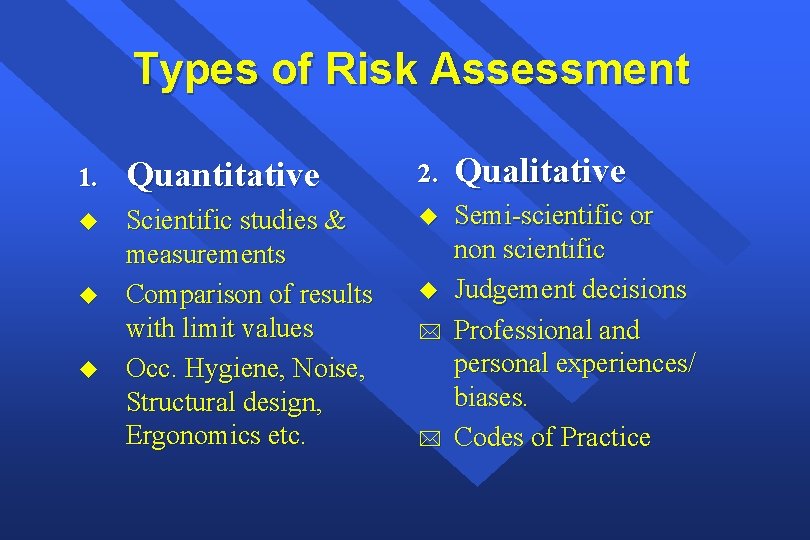
Types of Risk Assessment 1. Quantitative 2. Qualitative u Scientific studies & measurements Comparison of results with limit values Occ. Hygiene, Noise, Structural design, Ergonomics etc. u Semi-scientific or non scientific Judgement decisions Professional and personal experiences/ biases. Codes of Practice u u u * *
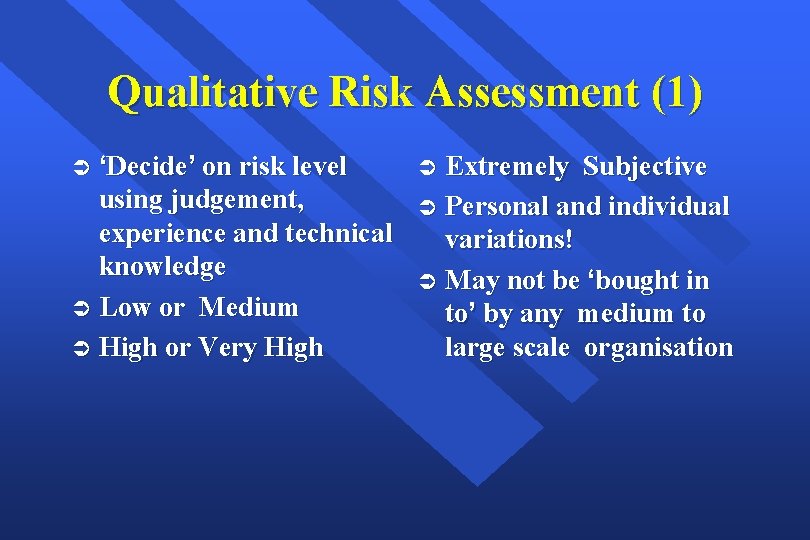
Qualitative Risk Assessment (1) ‘Decide’ on risk level using judgement, experience and technical knowledge Ü Low or Medium Ü High or Very High Ü Extremely Subjective Ü Personal and individual variations! Ü May not be ‘bought in to’ by any medium to large scale organisation Ü
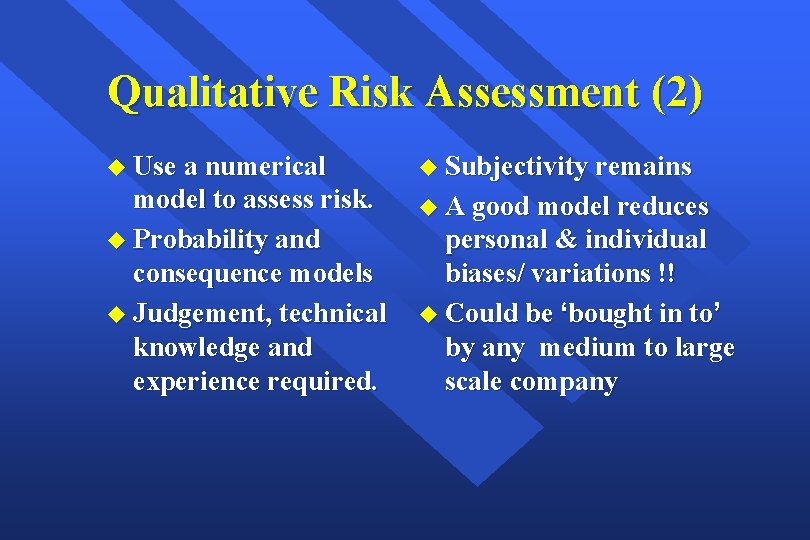
Qualitative Risk Assessment (2) u Use a numerical u Subjectivity remains model to assess risk. u Probability and consequence models u Judgement, technical knowledge and experience required. u A good model reduces personal & individual biases/ variations !! u Could be ‘bought in to’ by any medium to large scale company
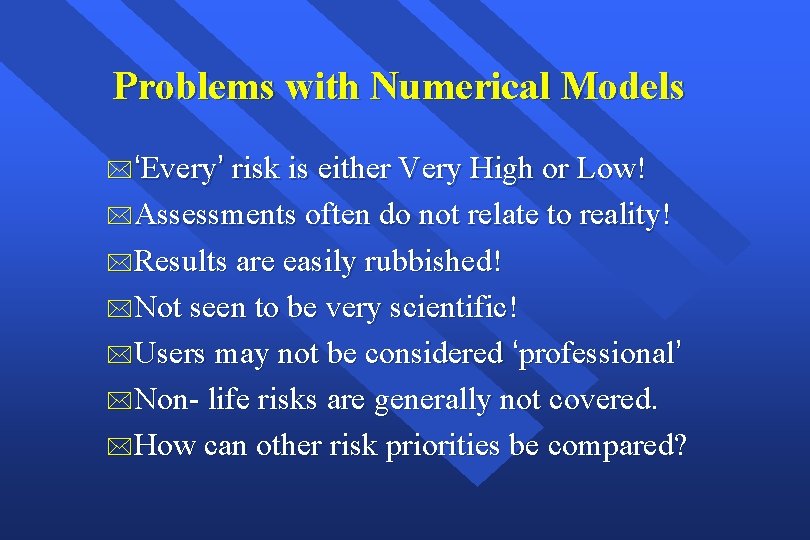
Problems with Numerical Models *‘Every’ risk is either Very High or Low! *Assessments often do not relate to reality! *Results are easily rubbished! *Not seen to be very scientific! *Users may not be considered ‘professional’ *Non- life risks are generally not covered. *How can other risk priorities be compared?
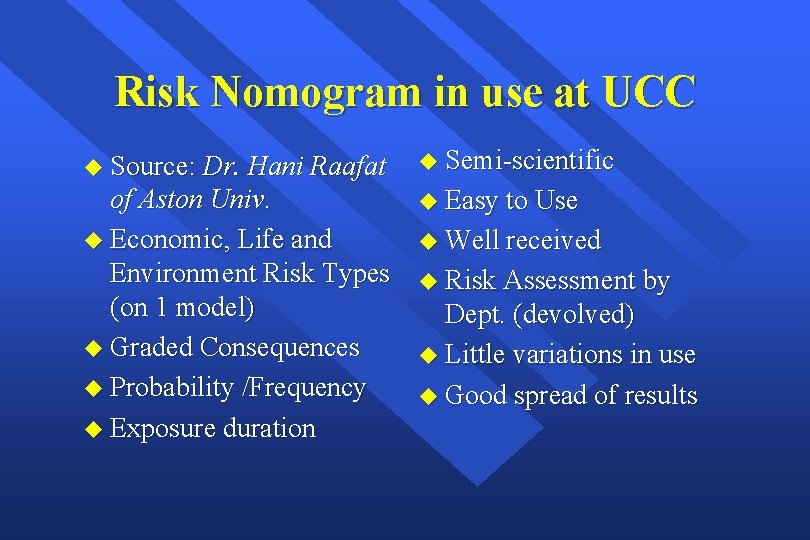
Risk Nomogram in use at UCC u Source: Dr. Hani Raafat u Semi-scientific of Aston Univ. u Economic, Life and Environment Risk Types (on 1 model) u Graded Consequences u Probability /Frequency u Exposure duration u Easy to Use u Well received u Risk Assessment by Dept. (devolved) u Little variations in use u Good spread of results
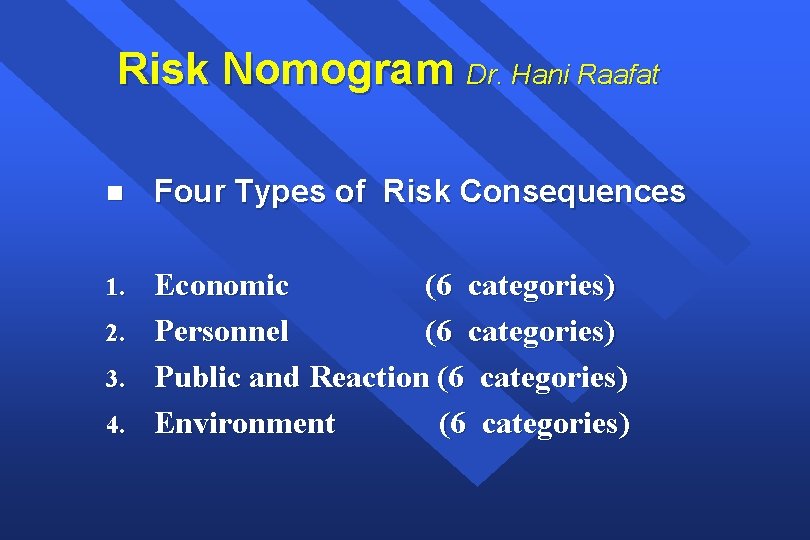
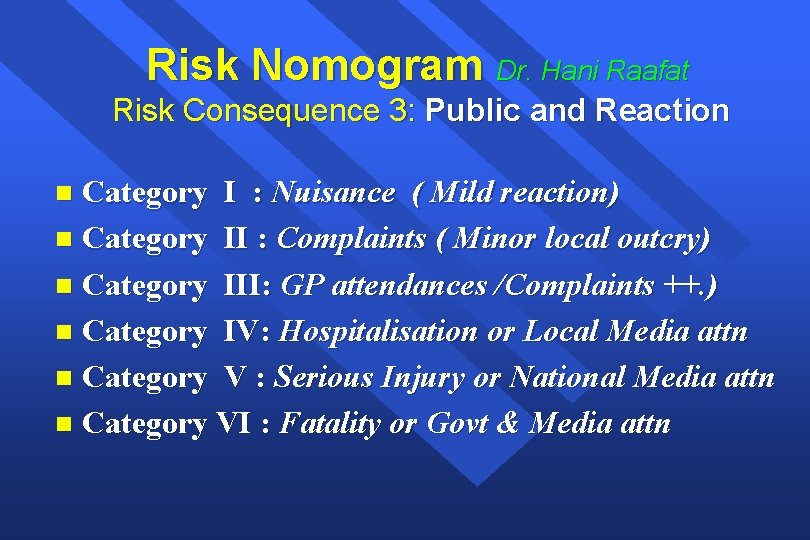
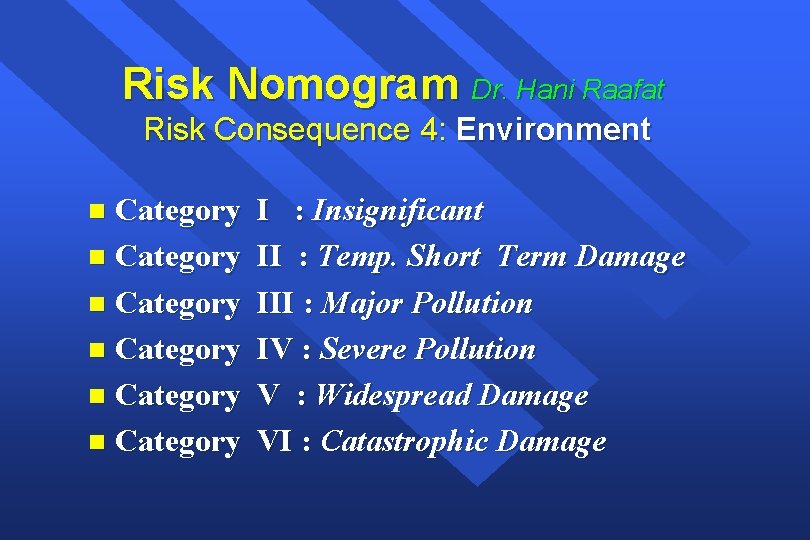
Risk Nomogram Dr. Hani Raafat n Four Types of Risk Consequences Economic (6 categories) 2. Personnel (6 categories) 3. Public and Reaction (6 categories) 4. Environment (6 categories) 1.
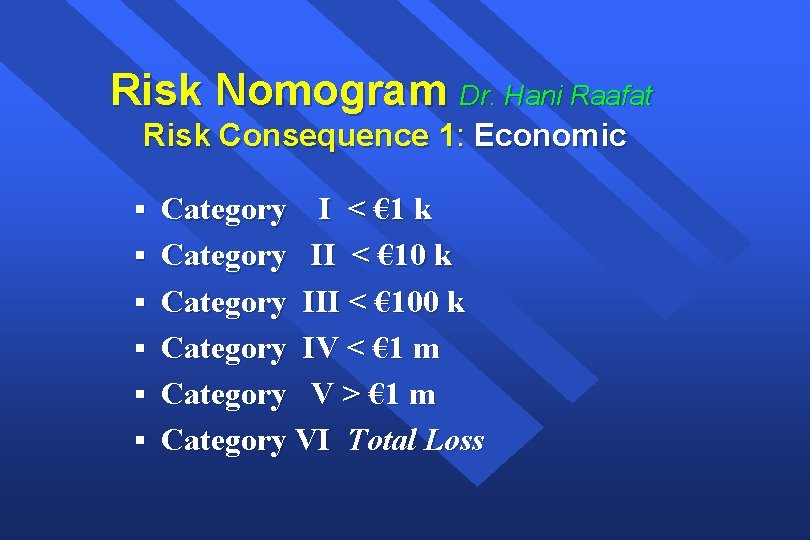
Risk Nomogram Dr. Hani Raafat Risk Consequence 1: Economic § § § Category I < € 1 k Category II < € 10 k Category III < € 100 k Category IV < € 1 m Category V > € 1 m Category VI Total Loss
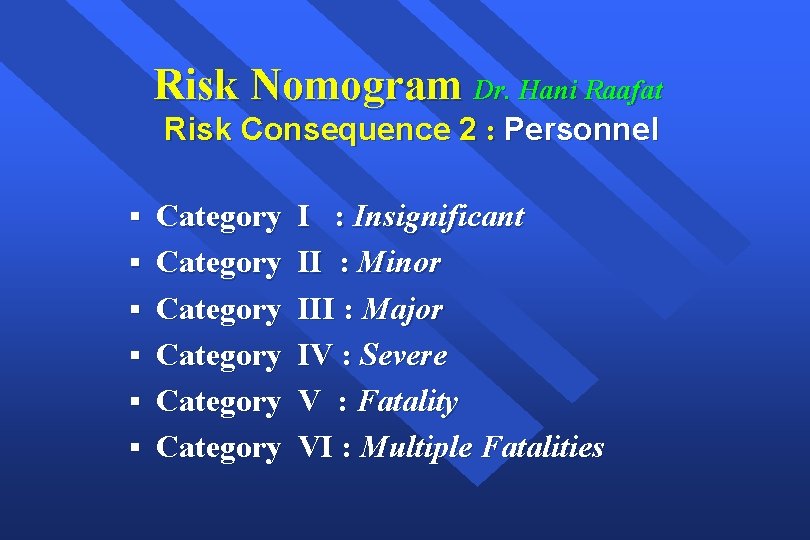
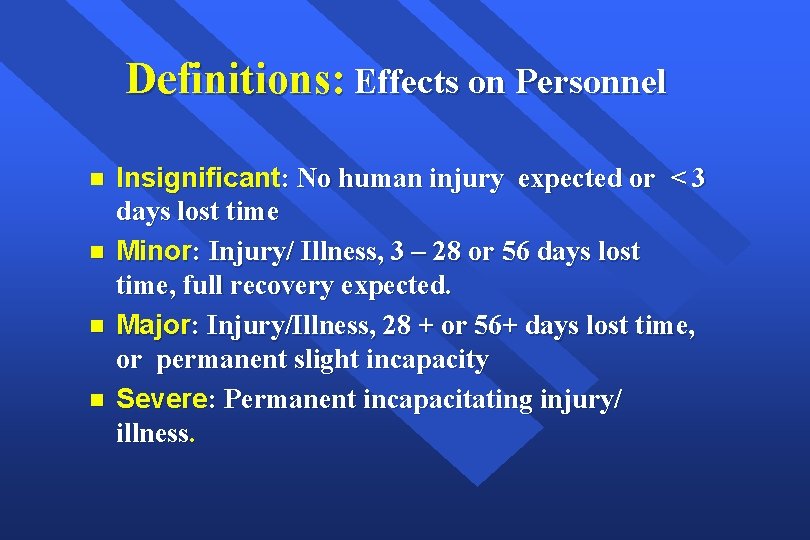
Risk Nomogram Dr. Hani Raafat Risk Consequence 2 : Personnel § § § Category Category I : Insignificant II : Minor III : Major IV : Severe V : Fatality VI : Multiple Fatalities
Definitions: Effects on Personnel n n Insignificant: No human injury expected or < 3 days lost time Minor: Injury/ Illness, 3 – 28 or 56 days lost time, full recovery expected. Major: Injury/Illness, 28 + or 56+ days lost time, or permanent slight incapacity Severe: Permanent incapacitating injury/ illness.
Risk Nomogram Dr. Hani Raafat Risk Consequence 3: Public and Reaction Category I : Nuisance ( Mild reaction) n Category II : Complaints ( Minor local outcry) n Category III: GP attendances /Complaints ++. ) n Category IV: Hospitalisation or Local Media attn n Category V : Serious Injury or National Media attn n Category VI : Fatality or Govt & Media attn n
Risk Nomogram Dr. Hani Raafat Risk Consequence 4: Environment Category n Category n I : Insignificant II : Temp. Short Term Damage III : Major Pollution IV : Severe Pollution V : Widespread Damage VI : Catastrophic Damage
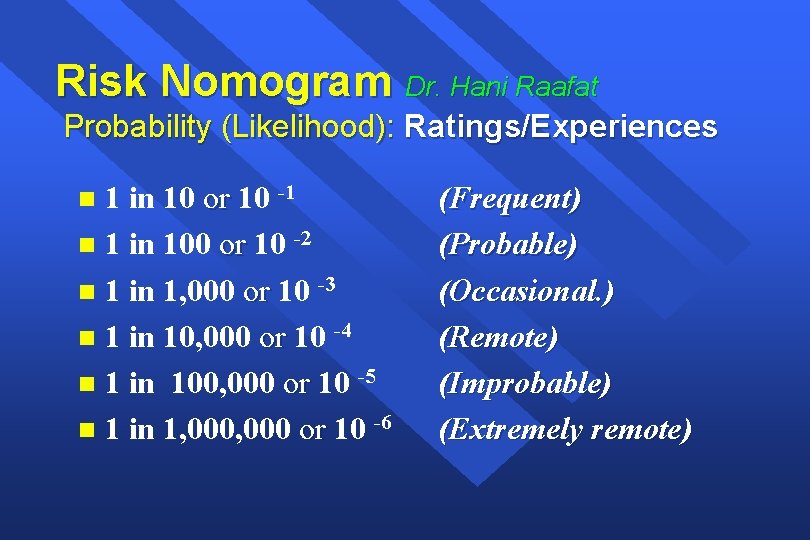
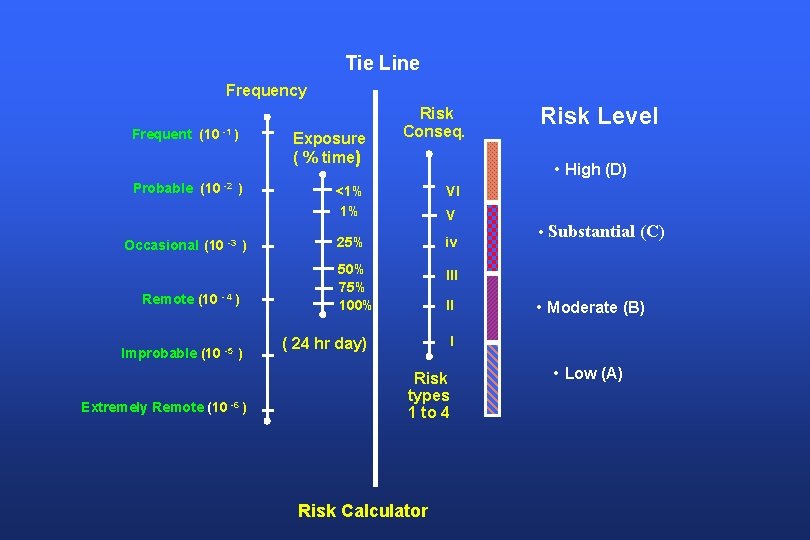
Risk Nomogram Dr. Hani Raafat Probability (Likelihood): Ratings/Experiences 1 in 10 or 10 -1 n 1 in 100 or 10 -2 n 1 in 1, 000 or 10 -3 n 1 in 10, 000 or 10 -4 n 1 in 100, 000 or 10 -5 n 1 in 1, 000 or 10 -6 n (Frequent) (Probable) (Occasional. ) (Remote) (Improbable) (Extremely remote)
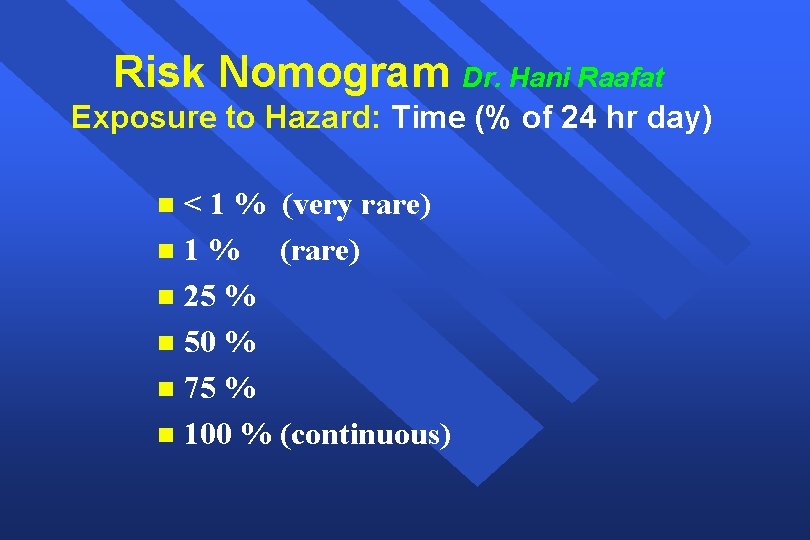
Risk Nomogram Dr. Hani Raafat Exposure to Hazard: Time (% of 24 hr day) < 1 % (very rare) n 1% (rare) n 25 % n 50 % n 75 % n 100 % (continuous) n
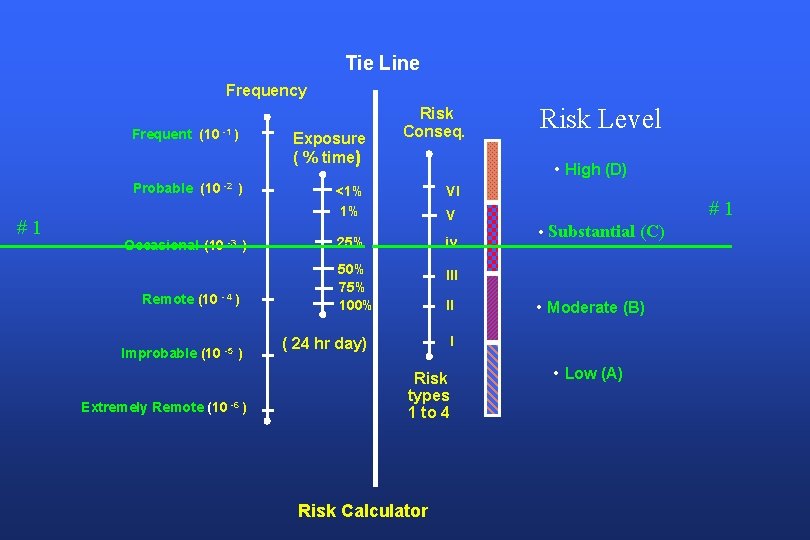
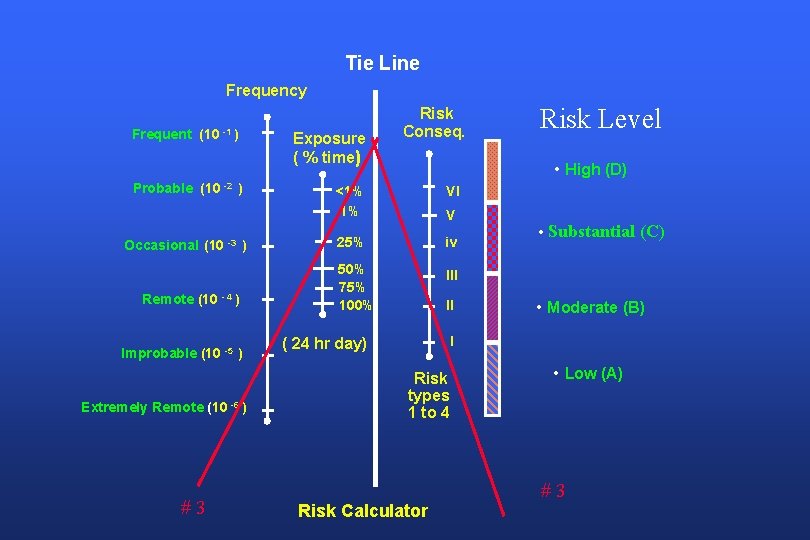
Tie Line Frequency Frequent (10 -1 ) Probable (10 -2 ) Occasional (10 -3 ) Remote (10 - 4 ) Improbable (10 -5 ) Extremely Remote (10 -6 ) Exposure ( % time) Risk Conseq. Risk Level • High (D) <1% 1% VI 25% iv 50% 75% 100% III V II • Substantial (C) • Moderate (B) I ( 24 hr day) Risk types 1 to 4 Risk Calculator • Low (A)
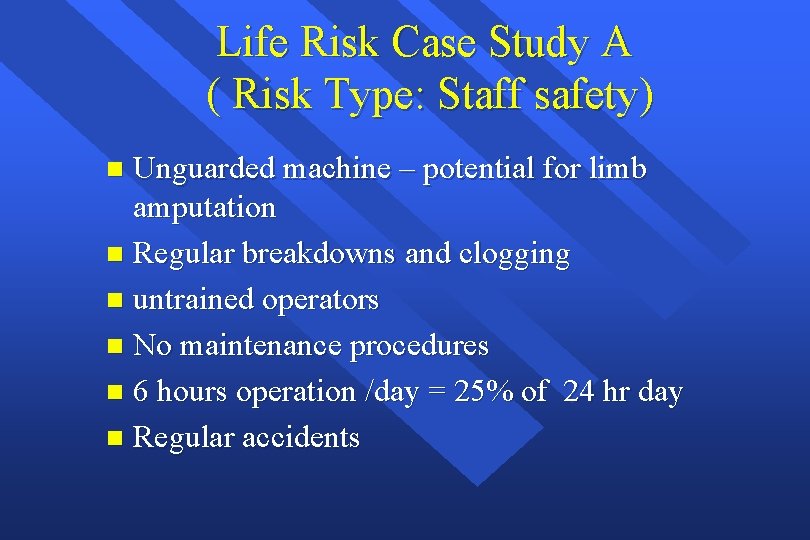
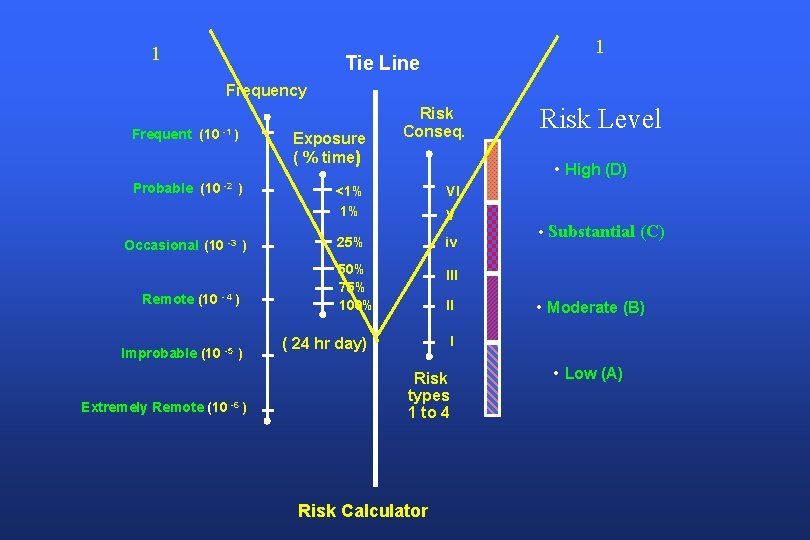
Life Risk Case Study A ( Risk Type: Staff safety) Unguarded machine – potential for limb amputation n Regular breakdowns and clogging n untrained operators n No maintenance procedures n 6 hours operation /day = 25% of 24 hr day n Regular accidents n
1 1 Tie Line Frequency Frequent (10 -1 ) Probable (10 -2 ) Occasional (10 -3 ) Remote (10 - 4 ) Improbable (10 -5 ) Extremely Remote (10 -6 ) Exposure ( % time) Risk Conseq. Risk Level • High (D) <1% 1% VI 25% iv 50% 75% 100% III V II • Substantial (C) • Moderate (B) I ( 24 hr day) Risk types 1 to 4 Risk Calculator • Low (A)
Improvement Option 1 Train staff and provide PPE ( traditional response!) n Same operating hours & machine set up n
Tie Line Frequency Frequent (10 -1 ) Probable (10 -2 ) #1 Occasional (10 -3 ) Remote (10 - 4 ) Improbable (10 -5 ) Extremely Remote (10 -6 ) Exposure ( % time) Risk Conseq. Risk Level • High (D) <1% 1% VI 25% iv 50% 75% 100% III V II #1 • Substantial (C) • Moderate (B) I ( 24 hr day) Risk types 1 to 4 Risk Calculator • Low (A)
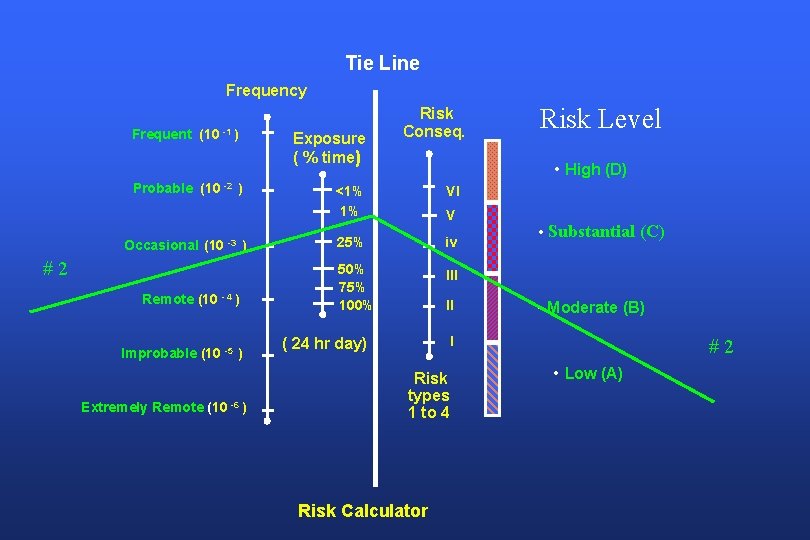
Improvement Option 2 Train staff and provide PPE has been tried n Consider reducing operating hours to 3 hours per day = 12. 5% of a 24 hour day n Retain machine set up ( un-guarded) n
Tie Line Frequency Frequent (10 -1 ) Probable (10 -2 ) Occasional (10 -3 ) #2 Remote (10 - 4 ) Improbable (10 -5 ) Extremely Remote (10 -6 ) Exposure ( % time) Risk Conseq. Risk Level • High (D) <1% 1% VI 25% iv 50% 75% 100% III V II • Substantial (C) • Moderate (B) I ( 24 hr day) Risk types 1 to 4 Risk Calculator #2 • Low (A)
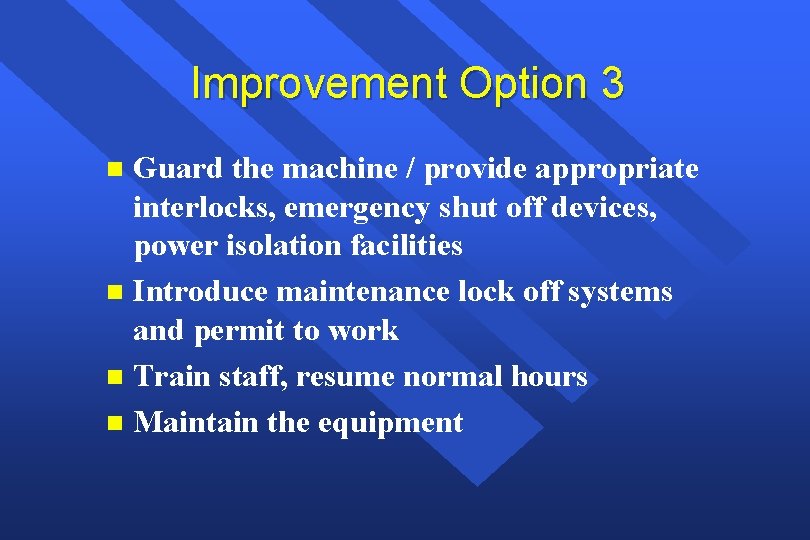
Improvement Option 3 Guard the machine / provide appropriate interlocks, emergency shut off devices, power isolation facilities n Introduce maintenance lock off systems and permit to work n Train staff, resume normal hours n Maintain the equipment n
Tie Line Frequency Frequent (10 -1 ) Probable (10 -2 ) Occasional (10 -3 ) Remote (10 - 4 ) Improbable (10 -5 ) Extremely Remote (10 -6 ) #3 Exposure ( % time) Risk Conseq. Risk Level • High (D) <1% 1% VI 25% iv 50% 75% 100% III V II • Substantial (C) • Moderate (B) I ( 24 hr day) Risk types 1 to 4 Risk Calculator • Low (A) #3