
Risk Assessment A Conceptual Introduction Tee L Guidotti





- Slides: 27
Risk Assessment: A Conceptual Introduction Tee L. Guidotti Occupational Health Program University of Alberta
Risk Assessment • Risk assessment is the systematic evaluation of the likelihood of an adverse effect arising from exposure in a defined population. • Risk assessment is “a systematic process for describing and qualifying the risks associated with hazardous substances, action or events. ” (Covello)
Other Important Terms • Hazard – the intrinsic potential for harm – toxicity, injury, damage, cost – specific to an exposure level • Risk – probability of (adverse) outcome • Opportunity – likelihood that significant exposure will occur
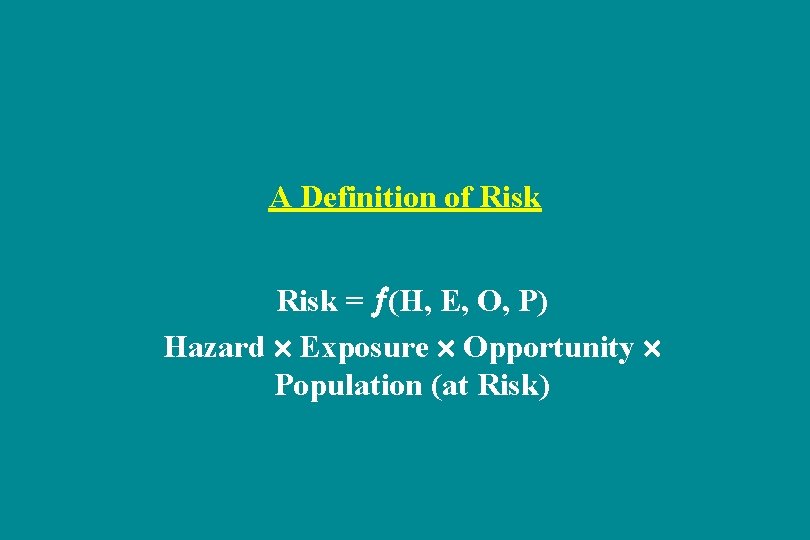
A Definition of Risk = (H, E, O, P) Hazard Exposure Opportunity Population (at Risk)
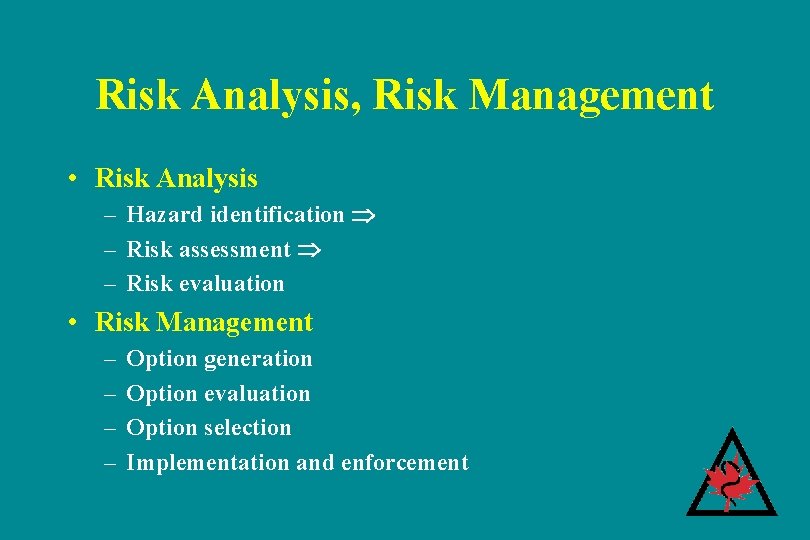
Risk Analysis, Risk Management • Risk Analysis – Hazard identification – Risk assessment – Risk evaluation • Risk Management – – Option generation Option evaluation Option selection Implementation and enforcement
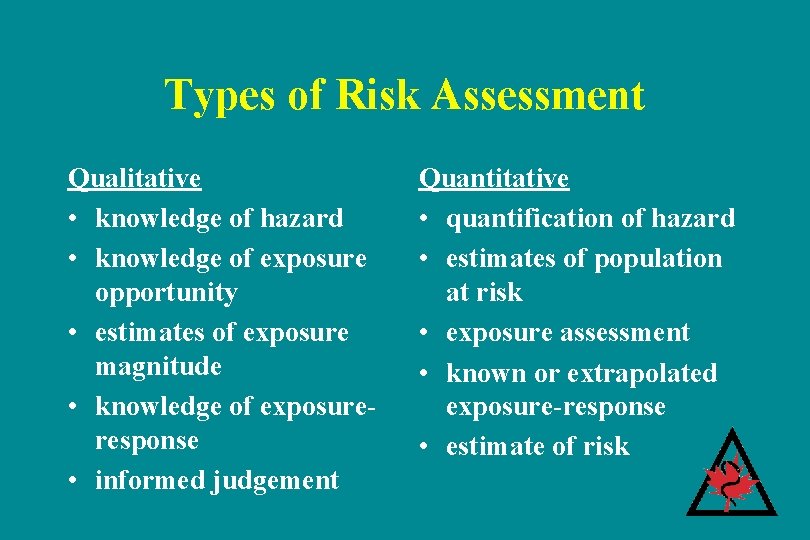
Types of Risk Assessment Qualitative • knowledge of hazard • knowledge of exposure opportunity • estimates of exposure magnitude • knowledge of exposureresponse • informed judgement Quantitative • quantification of hazard • estimates of population at risk • exposure assessment • known or extrapolated exposure-response • estimate of risk
Steps in Risk Assessment - 1 1 Release assessment – potential of emission, effluent, contact – pathways of exposure – subject to change 2 Exposure assessment – intensity – frequency – duration
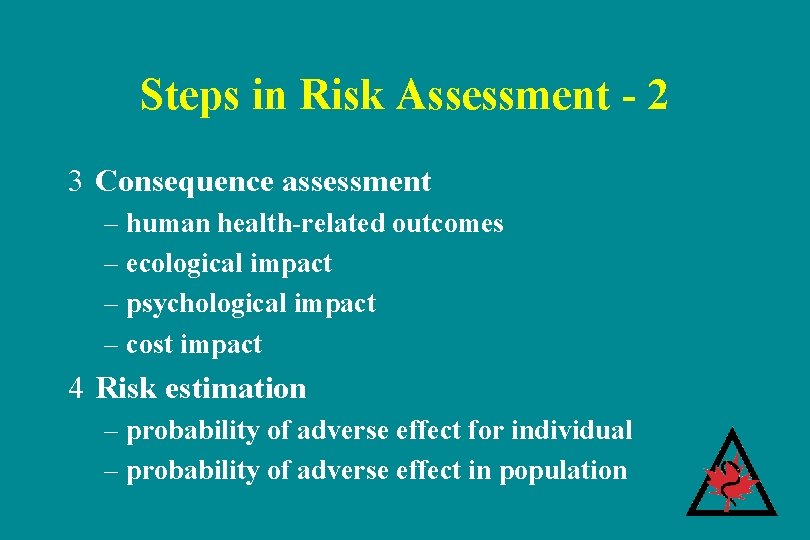
Steps in Risk Assessment - 2 3 Consequence assessment – human health-related outcomes – ecological impact – psychological impact – cost impact 4 Risk estimation – probability of adverse effect for individual – probability of adverse effect in population
Step by Step through Risk Assessment
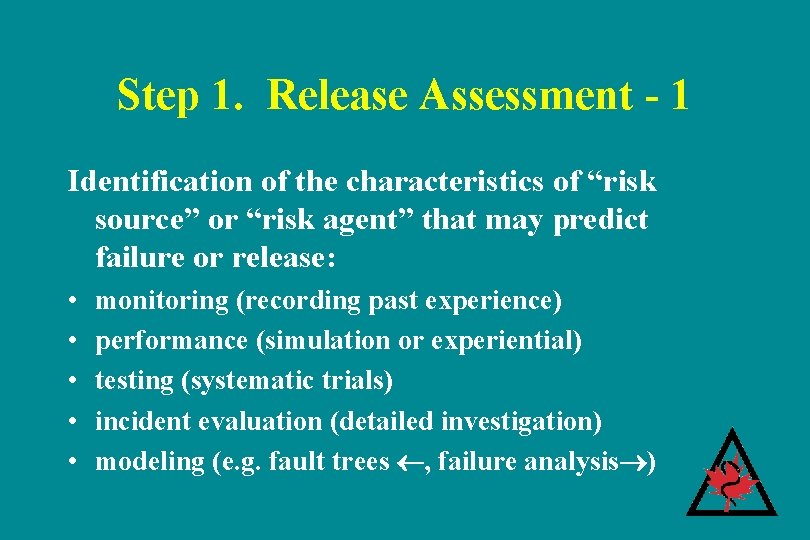
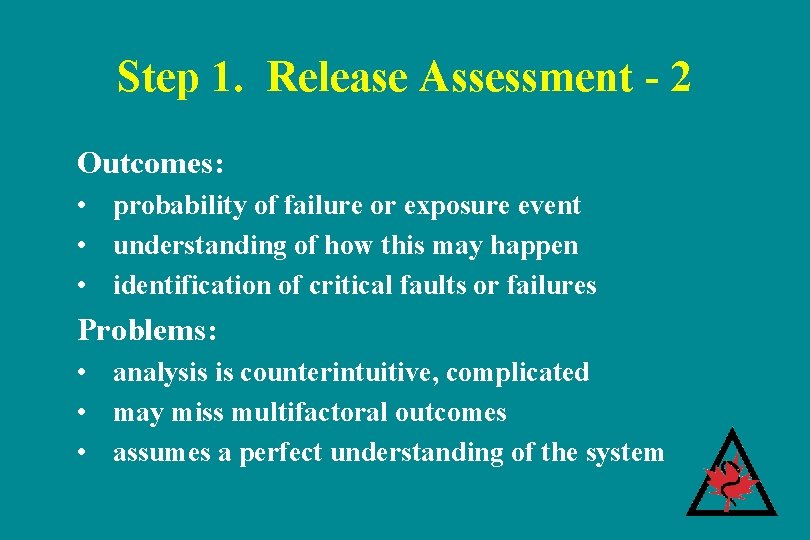
Step 1. Release Assessment - 1 Identification of the characteristics of “risk source” or “risk agent” that may predict failure or release: • • • monitoring (recording past experience) performance (simulation or experiential) testing (systematic trials) incident evaluation (detailed investigation) modeling (e. g. fault trees , failure analysis )
Step 1. Release Assessment - 2 Outcomes: • probability of failure or exposure event • understanding of how this may happen • identification of critical faults or failures Problems: • analysis is counterintuitive, complicated • may miss multifactoral outcomes • assumes a perfect understanding of the system
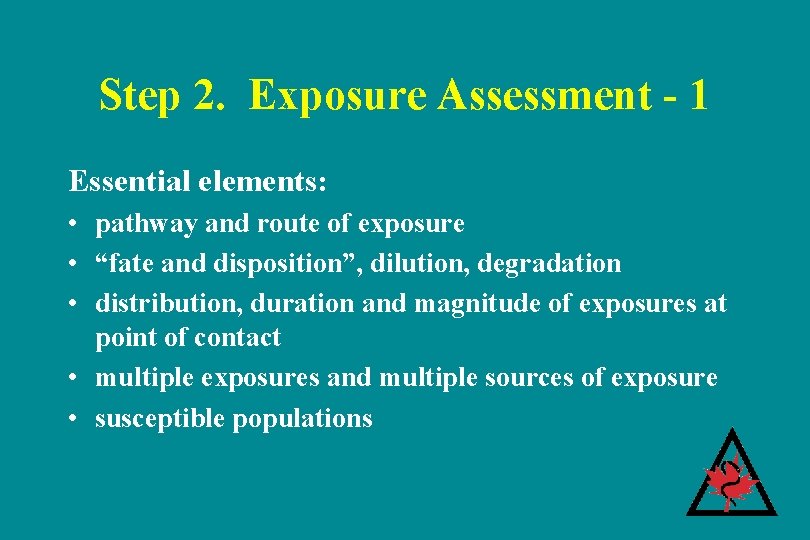
Step 2. Exposure Assessment - 1 Essential elements: • pathway and route of exposure • “fate and disposition”, dilution, degradation • distribution, duration and magnitude of exposures at point of contact • multiple exposures and multiple sources of exposure • susceptible populations
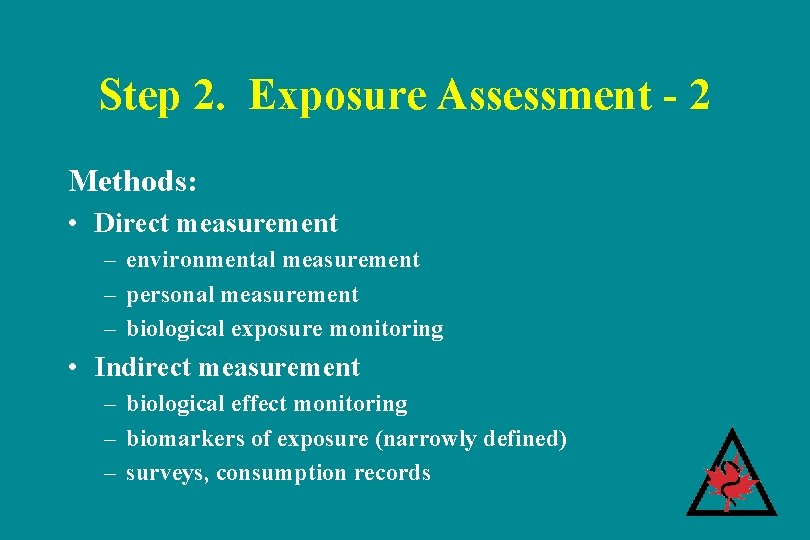
Step 2. Exposure Assessment - 2 Methods: • Direct measurement – environmental measurement – personal measurement – biological exposure monitoring • Indirect measurement – biological effect monitoring – biomarkers of exposure (narrowly defined) – surveys, consumption records
Step 2. Exposure Assessment - 3 • Indirect Exposure Estimation – extrapolation, ecological association – categorization (exposure matrices) – simulation – surrogate measurements – modeling • surface water • groundwater • air dispersion
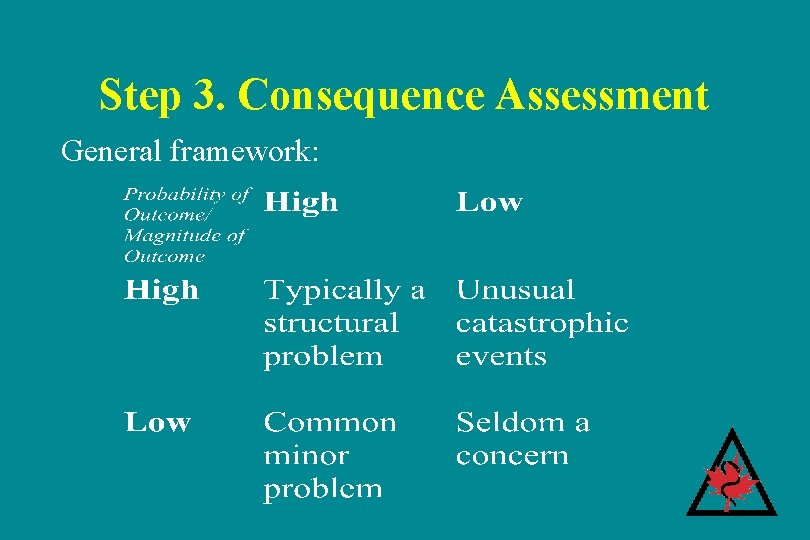
Step 3. Consequence Assessment General framework:
Step 3. Consequence Assessment • Identify plausible outcomes associated with exposure levels implied by exposure assessment • Consider susceptible populations and atypical responses • Consider health effects as: acute, chronic, lethal • Interest in subclinical effects growing
Step 3. Consequence Assessment Key information in Consequence Assessment: • exposure-response relationships – – extrapolation from animal studies toxicological exposure-response relationship epidemiologic exposure-response relationship “low-dose” extrapolation problem • stochastic effects • modeling
Step 4. Risk Estimation - 1 Expressions of risk estimates: • most likely, nominal, “best guess” • worst case, conservative assumptions • range of probabilities Analyses of sensitivity: • critical assumptions • behaviour of model (e. g. Monte Carlo) • multiple models, assess convergence of prediction
Step 4. Risk Estimation - 2 Assumptions: • Human (epidemiological) data preferable to extrapolated data from animal studies • If animal data must be used, correct for BSA • Conservative assumptions; 95% UL • Humans considered as sensitive as most sensitive known animal species • Linear, non-threshold model is the UL of response
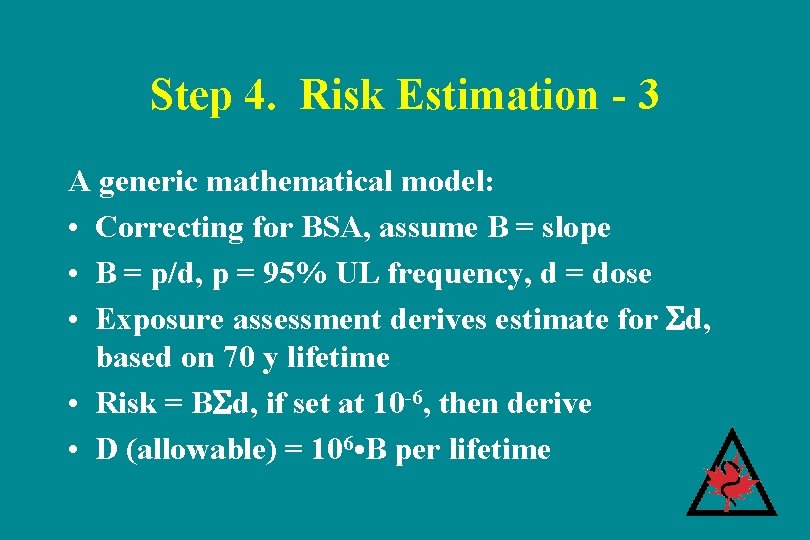
Step 4. Risk Estimation - 3 A generic mathematical model: • Correcting for BSA, assume B = slope • B = p/d, p = 95% UL frequency, d = dose • Exposure assessment derives estimate for d, based on 70 y lifetime • Risk = B d, if set at 10 -6, then derive • D (allowable) = 106 • B per lifetime
Some Problems of Risk Assessment • • • Quantification (conversion to lives, $, P) Comparability Exposure-response relationships at low levels Chronic low-level v. rare catastrophes Uncertainty bands
What Determines When a Risk is Acceptable?
Acceptability of Risk - 1 • • Catastrophic potential – Familiarity + Understanding of risk + Scientific uncertainty – Controllability + (may be an illusion!) Voluntariness + Obvious benefit to community +
Acceptability of Risk - 2 • • Impact on children, future generations – Victim identity – (put a face to the number) Dread – Institutional trust + (few institutions trusted) Media attention – History + Equity + (inequity, maldistribution of risk –)
Acceptability of Risk - 3 • Reversibility + • Personal or family stake in outcome – • Attributability – (responsible party) Also: • Cultural differences in acceptability ± • Outrage (Sandeman), distinct from equity – • Profundity – (threat to social stability)
Utility of Risk Assessment • Facilitates communication • Framework for critical review of data, assumptions • Allows problem to be disaggregated into component parts • Gaps analysis • Comparison of policy options • Risk comparison
Standardization of Risk Assessment • U. S. federal approach – EPA – NAS/NRC/IOM – Interagency Regulatory Liaison Group: EPA, OSHA, CPSC, FDA, FSQS (now defunct) • Health Canada, Health Protection Branch • European Community • World Health Organization