
Risk and Vulnerability Assessment in the Climate Change

Risk and Vulnerability Assessment in the Climate Change Adaptation Process Jeff Zukiwsky Zumundo Consultants Fernie, Canada March 25, 2010

Agenda Topic Time 4 Approaches to Risk and Vulnerability Assessment 40 min Summary of Risk and Vulnerability Assessment 10 min Community updates 10 min Brainstorming discussion: How to proceed with risk and vulnerability assessment 30 min 2 Climate Change Risk & Vulnerability Assessment

Risk and Vulnerability Assessment • Develop a team • Create a plan • Engage and inform stakeholders • Understand potential future climate scenarios • Risk/ Vulnerability Assessment Identify planning areas/ sectors affected by climate change 3 Climate Change Risk & Vulnerability Assessment • Develop strategies to address key risks/ vulnerabilities • Implement • Monitor
Approaches to Risk and Vulnerability Assessment 1. Risk-based Approach 2. Vulnerability Assessment 3. Hybrid – Combined RA/VA Approach 4. Kimberley ‘working group’ approach 4 Climate Change Risk & Vulnerability Assessment
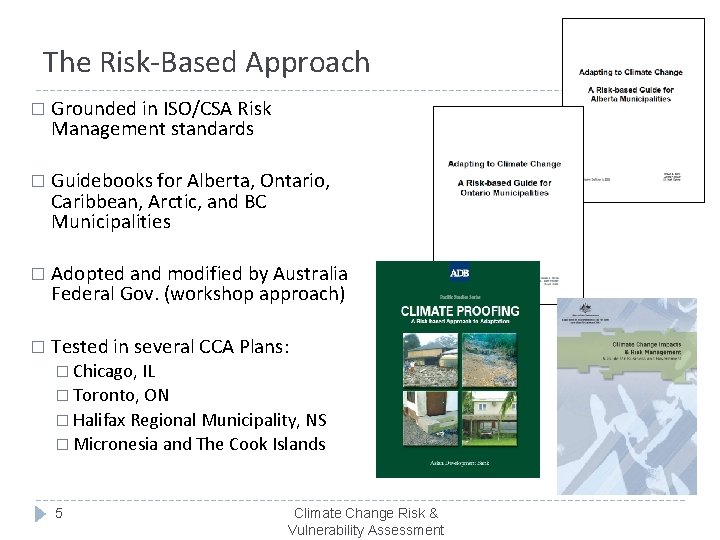
The Risk-Based Approach � Grounded in ISO/CSA Risk Management standards � Guidebooks for Alberta, Ontario, Caribbean, Arctic, and BC Municipalities � Adopted and modified by Australia Federal Gov. (workshop approach) � Tested in several CCA Plans: � Chicago, IL � Toronto, ON � Halifax Regional Municipality, NS � Micronesia and The Cook Islands 5 Climate Change Risk & Vulnerability Assessment
The Risk-Based Approach � 3 Step Risk Assessment Process Risk Identification (Preliminary Analysis) 2. Risk Estimation 3. Risk Evaluation 1. From: ISO/CSA Risk Management standards 6 Climate Change Risk & Vulnerability Assessment
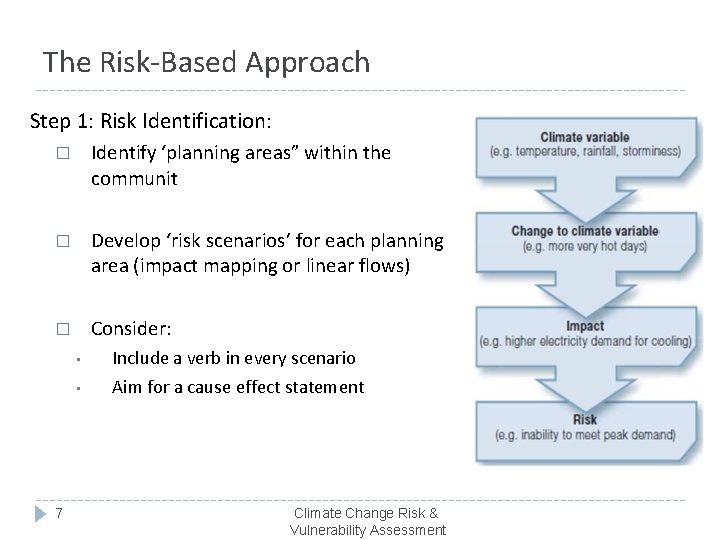
The Risk-Based Approach Step 1: Risk Identification: � Identify ‘planning areas” within the communit � Develop ‘risk scenarios’ for each planning area (impact mapping or linear flows) � Consider: 7 • Include a verb in every scenario • Aim for a cause effect statement Climate Change Risk & Vulnerability Assessment
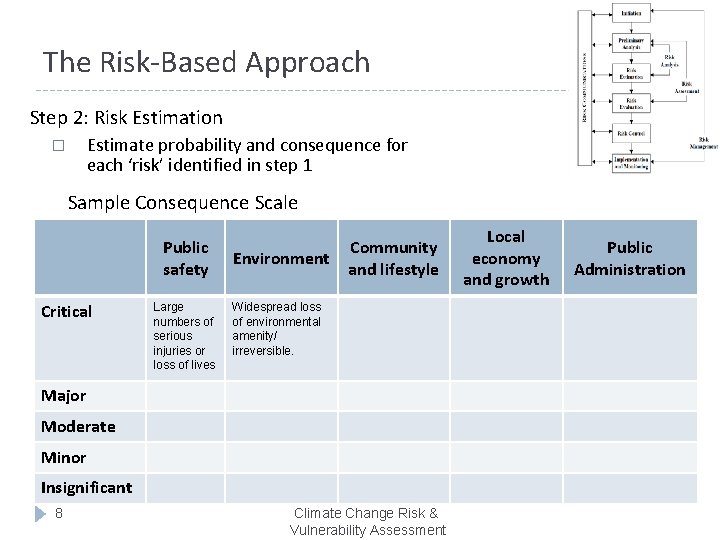
The Risk-Based Approach Step 2: Risk Estimation � Estimate probability and consequence for each ‘risk’ identified in step 1 Sample Consequence Scale Public safety Critical Large numbers of serious injuries or loss of lives Community Environment and lifestyle Widespread loss of environmental amenity/ irreversible. Major Moderate Minor Insignificant 8 Climate Change Risk & Vulnerability Assessment Local economy and growth Public Administration
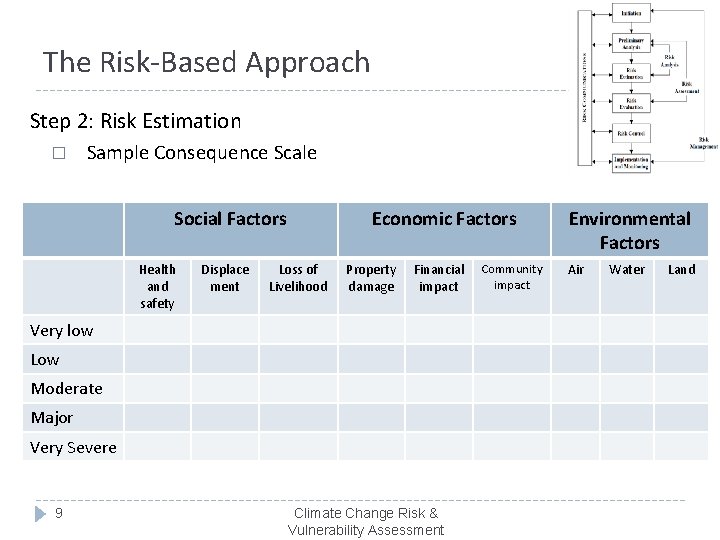
The Risk-Based Approach Step 2: Risk Estimation � Sample Consequence Scale Social Factors Health and safety Displace ment Economic Factors Loss of Livelihood Property damage Financial impact Very low Low Moderate Major Very Severe 9 Climate Change Risk & Vulnerability Assessment Community impact Environmental Factors Air Water Land
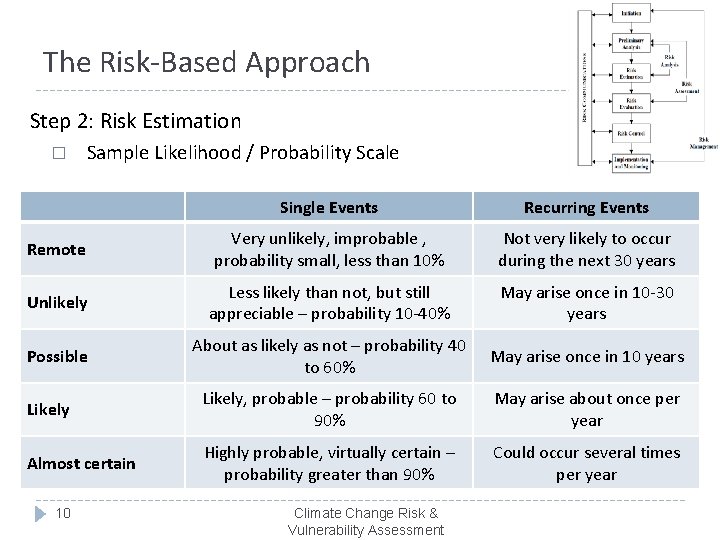
The Risk-Based Approach Step 2: Risk Estimation � Sample Likelihood / Probability Scale Single Events Recurring Events Remote Very unlikely, improbable , probability small, less than 10% Not very likely to occur during the next 30 years Unlikely Less likely than not, but still appreciable – probability 10 -40% May arise once in 10 -30 years Possible About as likely as not – probability 40 to 60% May arise once in 10 years Likely, probable – probability 60 to 90% May arise about once per year Almost certain Highly probable, virtually certain – probability greater than 90% Could occur several times per year 10 Climate Change Risk & Vulnerability Assessment
The Risk-Based Approach Step 3: Risk Evaluation � Assemble risk ratings (probability x consequence) on a risk matrix or risk table � Evaluate costs and benefits of each risk � Manually adjust any risks found to have been over or under-rated 11 Climate Change Risk & Vulnerability Assessment
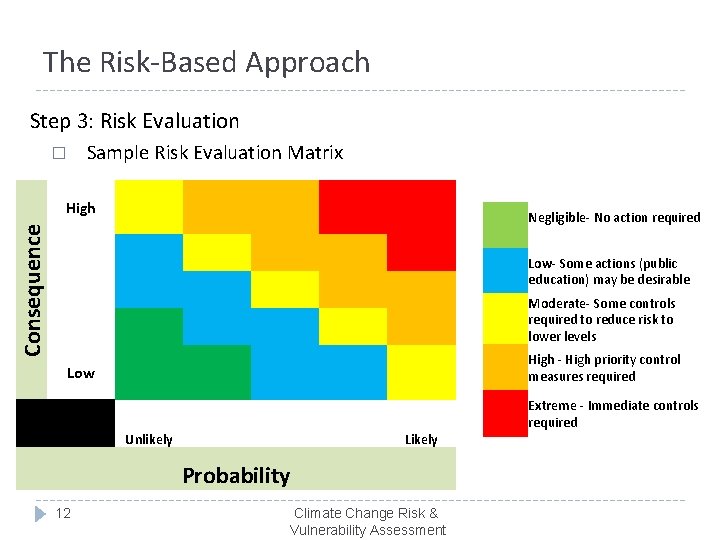
The Risk-Based Approach Step 3: Risk Evaluation Sample Risk Evaluation Matrix � High Consequence Negligible- No action required Low Unlikely Likely Probability 12 Low- Some actions (public education) may be desirable Moderate- Some controls required to reduce risk to lower levels High - High priority control measures required Extreme - Immediate controls required Climate Change Risk & Vulnerability Assessment
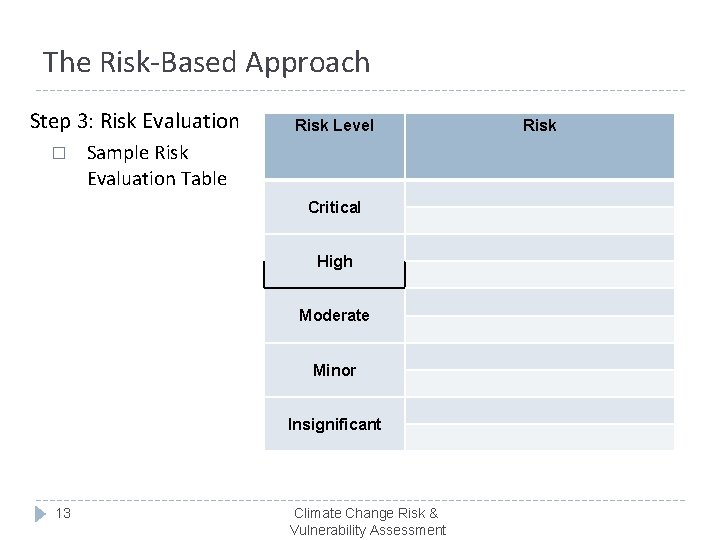
The Risk-Based Approach Step 3: Risk Evaluation � Risk Level Sample Risk Evaluation Table Critical High Moderate Minor Insignificant 13 Climate Change Risk & Vulnerability Assessment Risk
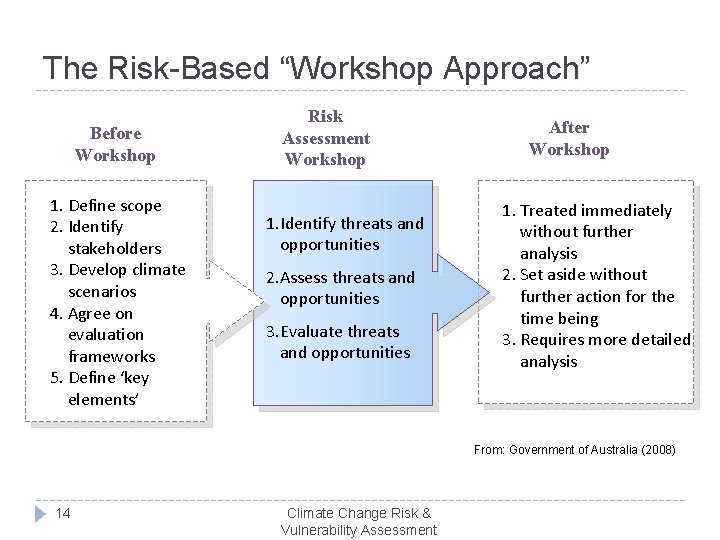
The Risk-Based “Workshop Approach” Before Workshop 1. Define scope 2. Identify stakeholders 3. Develop climate scenarios 4. Agree on evaluation frameworks 5. Define ‘key elements’ Risk Assessment Workshop 1. Identify threats and opportunities 2. Assess threats and opportunities 3. Evaluate threats and opportunities After Workshop 1. Treated immediately without further analysis 2. Set aside without further action for the time being 3. Requires more detailed analysis From: Government of Australia (2008) 14 Climate Change Risk & Vulnerability Assessment
The Vulnerability Assessment Approach � Initiated by the IPCC � Recommended by: NRCAN � C-CIARN � � Used primarily in: Academic journals � Developing countries � 15 Climate Change Risk & Vulnerability Assessment
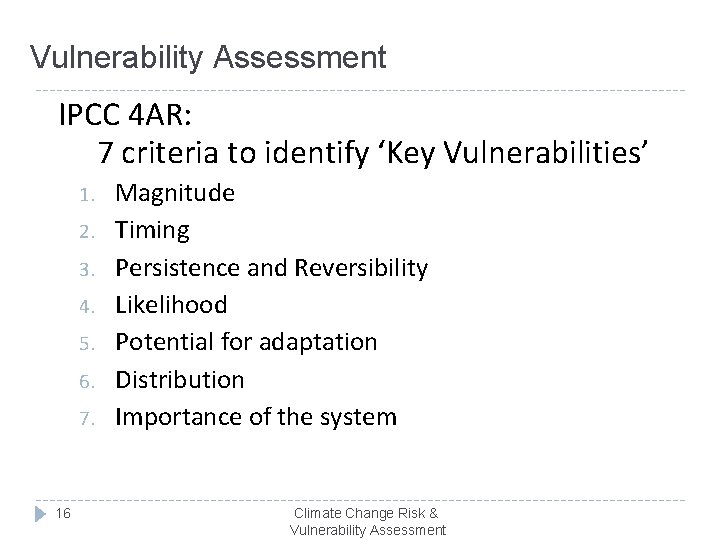
Vulnerability Assessment IPCC 4 AR: 7 criteria to identify ‘Key Vulnerabilities’ 1. 2. 3. 4. 5. 6. 7. 16 Magnitude Timing Persistence and Reversibility Likelihood Potential for adaptation Distribution Importance of the system Climate Change Risk & Vulnerability Assessment
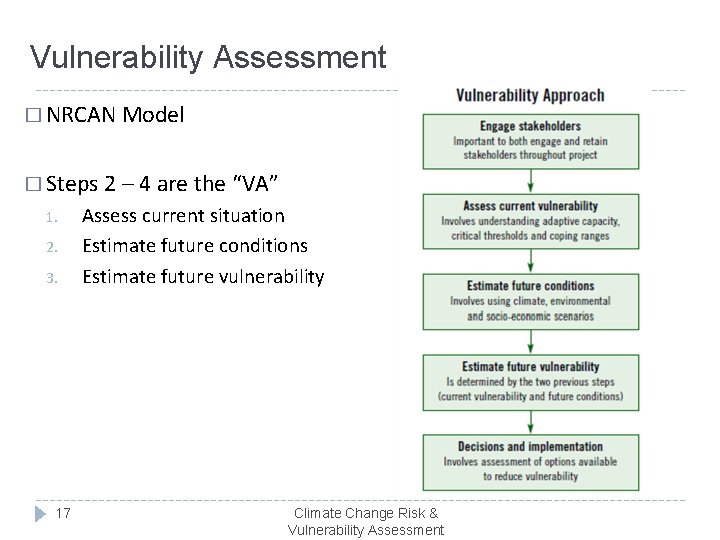
Vulnerability Assessment � NRCAN Model � Steps 2 – 4 are the “VA” 1. 2. 3. 17 Assess current situation Estimate future conditions Estimate future vulnerability Climate Change Risk & Vulnerability Assessment
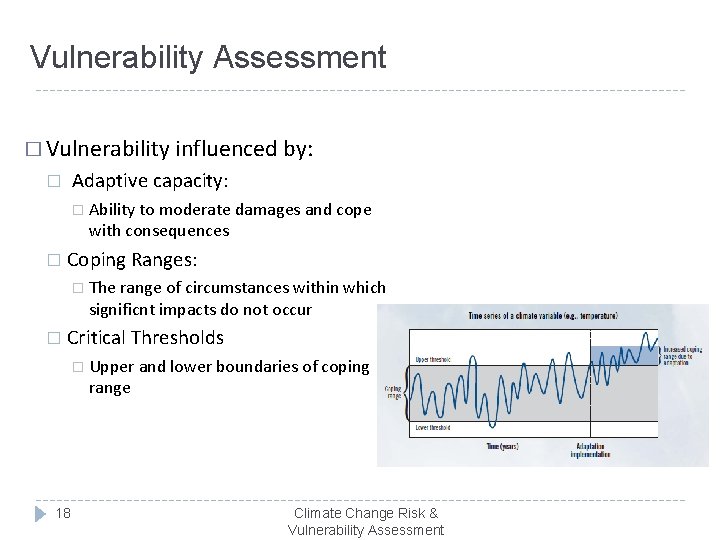
Vulnerability Assessment � Vulnerability influenced by: � Adaptive capacity: � Ability to moderate damages and cope with consequences � Coping Ranges: � The range of circumstances within which significnt impacts do not occur � Critical Thresholds � Upper and lower boundaries of coping range 18 Climate Change Risk & Vulnerability Assessment
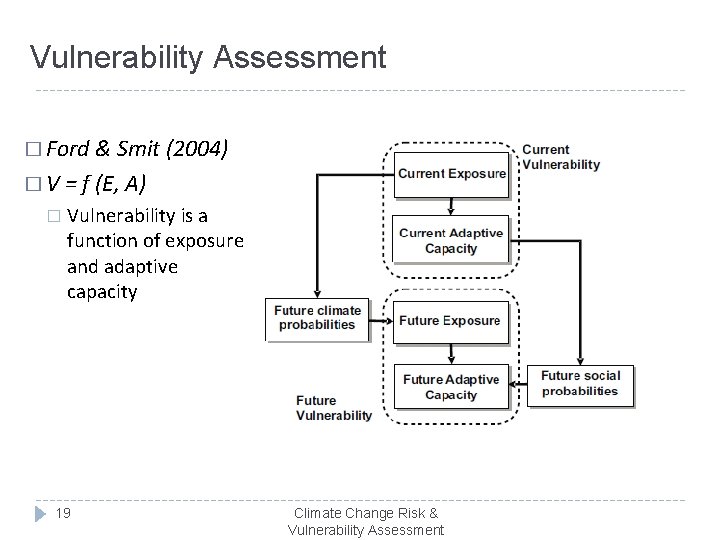
Vulnerability Assessment � Ford & Smit (2004) � V = f (E, A) � Vulnerability is a function of exposure and adaptive capacity 19 Climate Change Risk & Vulnerability Assessment
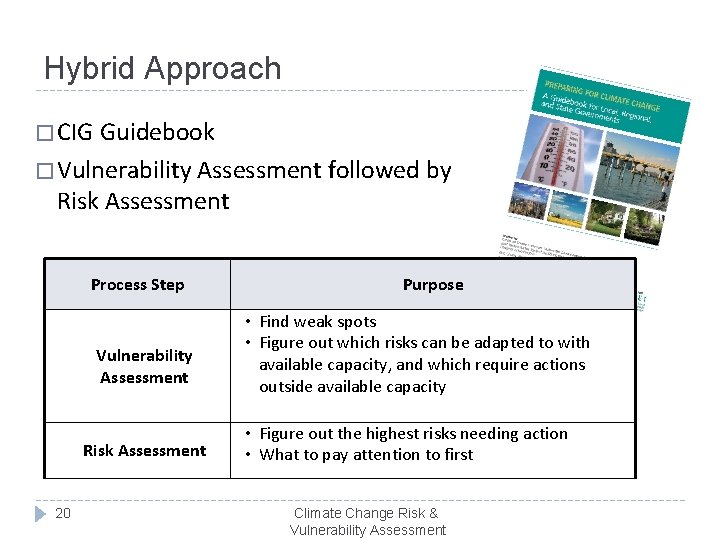
Hybrid Approach � CIG Guidebook � Vulnerability Assessment followed by Risk Assessment Process Step Vulnerability Assessment Risk Assessment 20 Purpose • Find weak spots • Figure out which risks can be adapted to with available capacity, and which require actions outside available capacity • Figure out the highest risks needing action • What to pay attention to first Climate Change Risk & Vulnerability Assessment
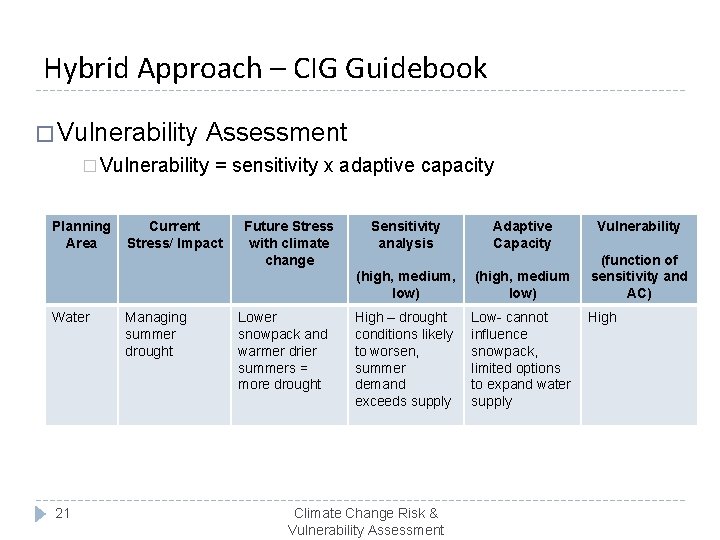
Hybrid Approach – CIG Guidebook � Vulnerability Assessment � Vulnerability = sensitivity x adaptive capacity Planning Area Water 21 Current Stress/ Impact Managing summer drought Future Stress with climate change Lower snowpack and warmer drier summers = more drought Sensitivity analysis Adaptive Capacity (high, medium, low) (high, medium low) High – drought conditions likely to worsen, summer demand exceeds supply Low- cannot influence snowpack, limited options to expand water supply Climate Change Risk & Vulnerability Assessment Vulnerability (function of sensitivity and AC) High
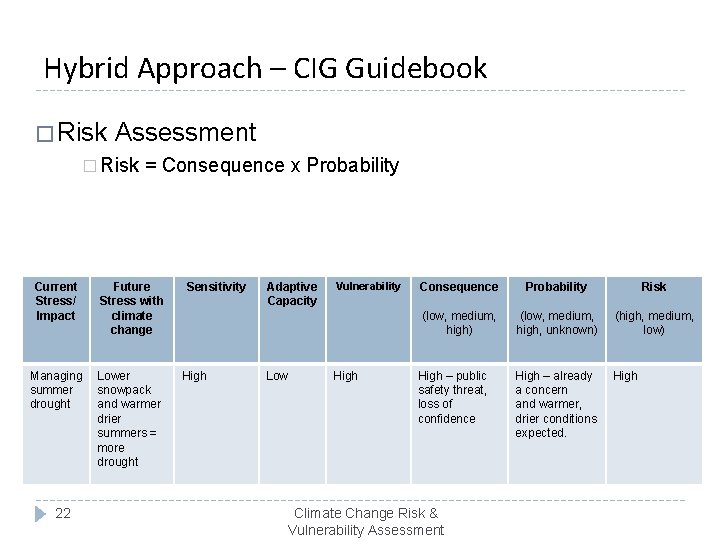
Hybrid Approach – CIG Guidebook � Risk Assessment � Risk = Consequence x Probability Current Stress/ Impact Future Stress with climate change Managing summer drought Lower snowpack and warmer drier summers = more drought 22 Sensitivity High Adaptive Capacity Low Vulnerability High Consequence Probability Risk (low, medium, high) (low, medium, high, unknown) (high, medium, low) High – already a concern and warmer, drier conditions expected. High – public safety threat, loss of confidence Climate Change Risk & Vulnerability Assessment
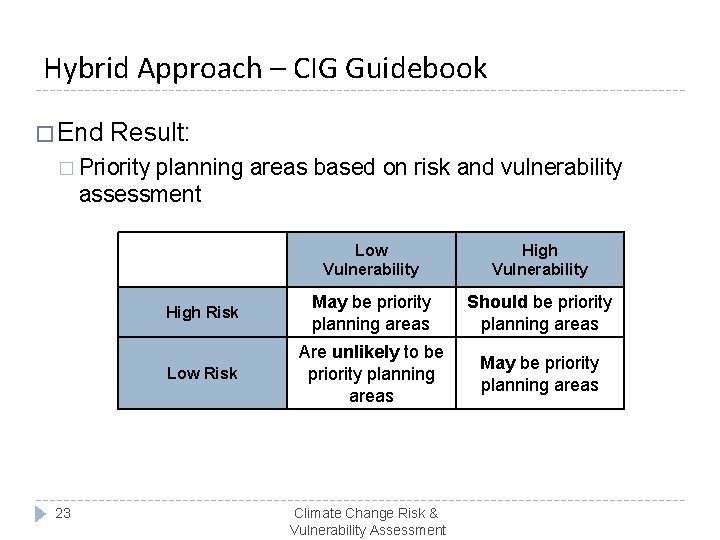
Hybrid Approach – CIG Guidebook � End Result: � Priority planning areas based on risk and vulnerability assessment 23 Low Vulnerability High Risk May be priority planning areas Should be priority planning areas Low Risk Are unlikely to be priority planning areas May be priority planning areas Climate Change Risk & Vulnerability Assessment
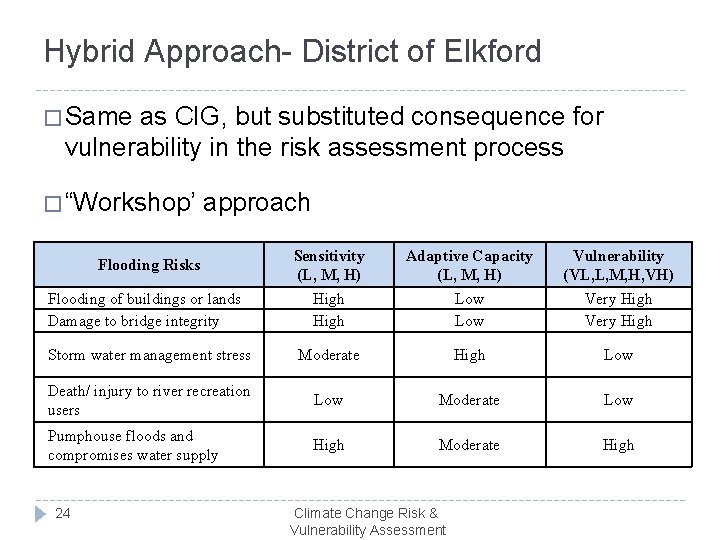
Hybrid Approach- District of Elkford � Same as CIG, but substituted consequence for vulnerability in the risk assessment process � “Workshop’ approach Flooding Risks Sensitivity (L, M, H) Adaptive Capacity (L, M, H) Vulnerability (VL, L, M, H, VH) Flooding of buildings or lands Damage to bridge integrity High Low Very High Storm water management stress Moderate High Low Death/ injury to river recreation users Low Moderate Low Pumphouse floods and compromises water supply High Moderate High 24 Climate Change Risk & Vulnerability Assessment
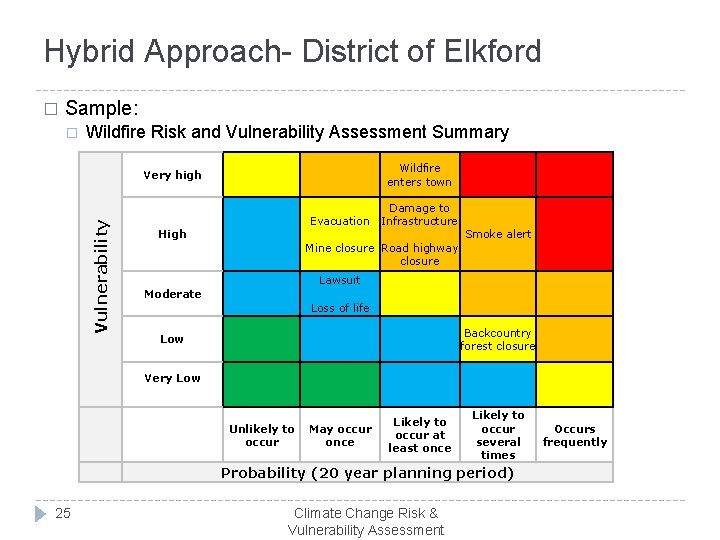
Hybrid Approach- District of Elkford � Sample: Wildfire Risk and Vulnerability Assessment Summary � Wildfire enters town Very high Vulnerability Evacuation Damage to Infrastructure High Smoke alert Mine closure Road highway closure Lawsuit Moderate Loss of life Backcountry forest closure Low Very Low Unlikely to occur May occur once Likely to occur at least once Likely to occur several times Probability (20 year planning period) 25 Climate Change Risk & Vulnerability Assessment Occurs frequently
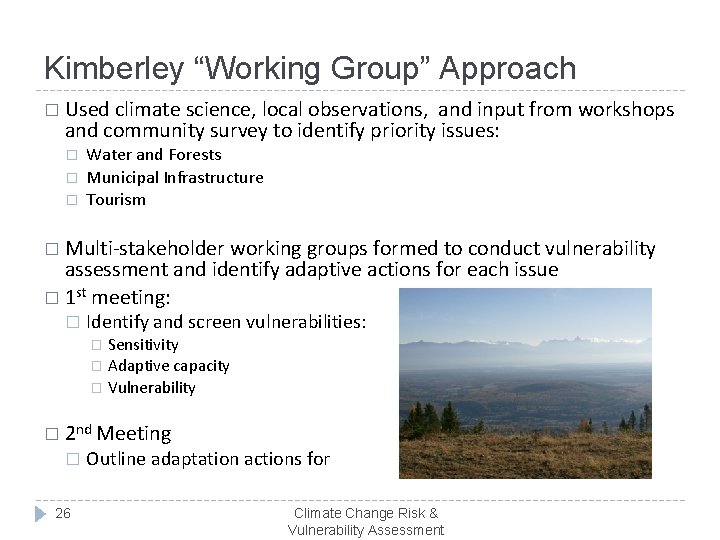
Kimberley “Working Group” Approach � Used climate science, local observations, and input from workshops and community survey to identify priority issues: � � � Water and Forests Municipal Infrastructure Tourism � Multi-stakeholder working groups formed to conduct vulnerability assessment and identify adaptive actions for each issue � 1 st meeting: � Identify and screen vulnerabilities: Sensitivity � Adaptive capacity � Vulnerability � � 2 nd Meeting � 26 Outline adaptation actions for Climate Change Risk & Vulnerability Assessment
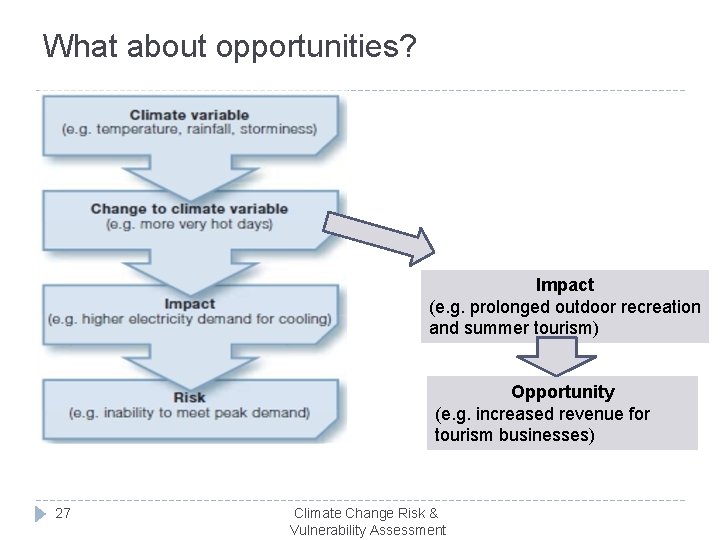
What about opportunities? Impact (e. g. prolonged outdoor recreation and summer tourism) Opportunity (e. g. increased revenue for tourism businesses) 27 Climate Change Risk & Vulnerability Assessment
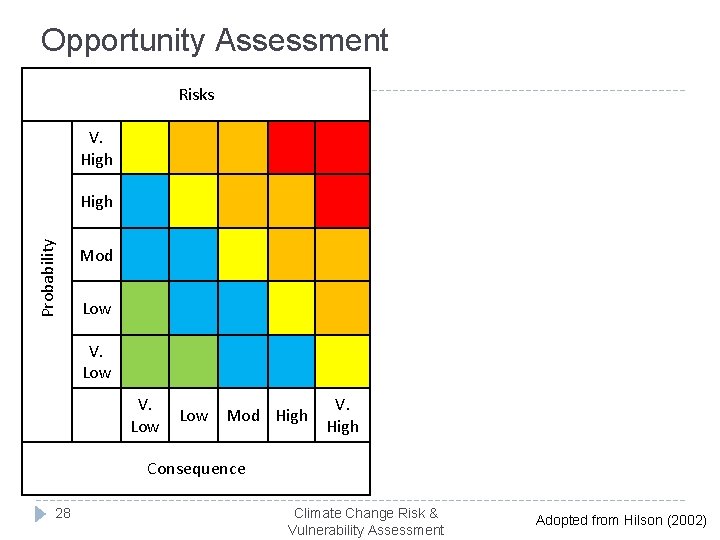
Opportunity Assessment Risks V. High Probability High Mod Low V. Low Mod High V. High Consequence 28 Climate Change Risk & Vulnerability Assessment Adopted from Hilson (2002)
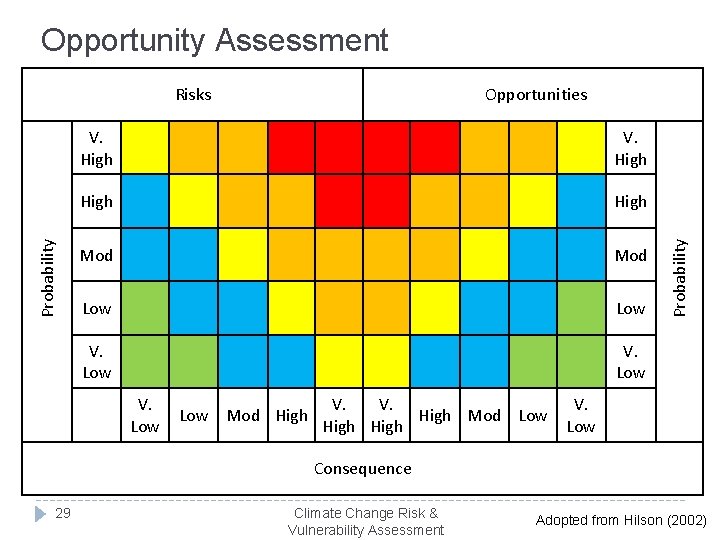
Opportunity Assessment Opportunities V. High Mod Low V. Low Mod High V. High Mod Low High Probability Risks V. Low Consequence 29 Climate Change Risk & Vulnerability Assessment Adopted from Hilson (2002)
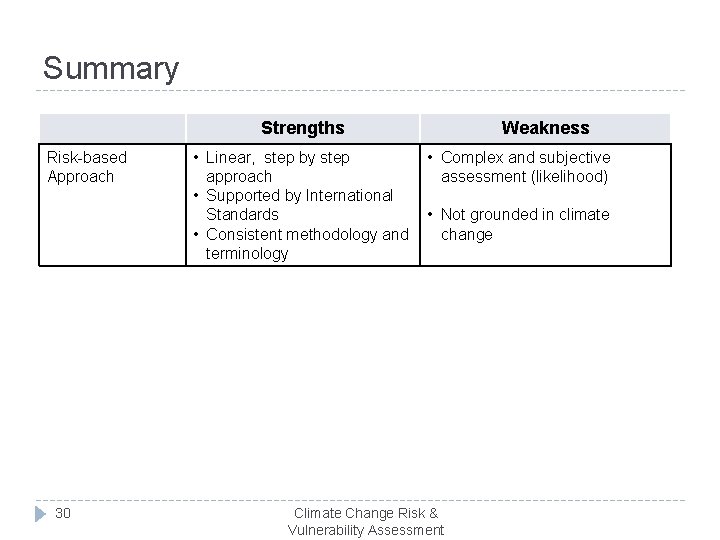
Summary Strengths Risk-based Approach 30 • Linear, step by step approach • Supported by International Standards • Consistent methodology and terminology Weakness • Complex and subjective assessment (likelihood) • Not grounded in climate change Climate Change Risk & Vulnerability Assessment
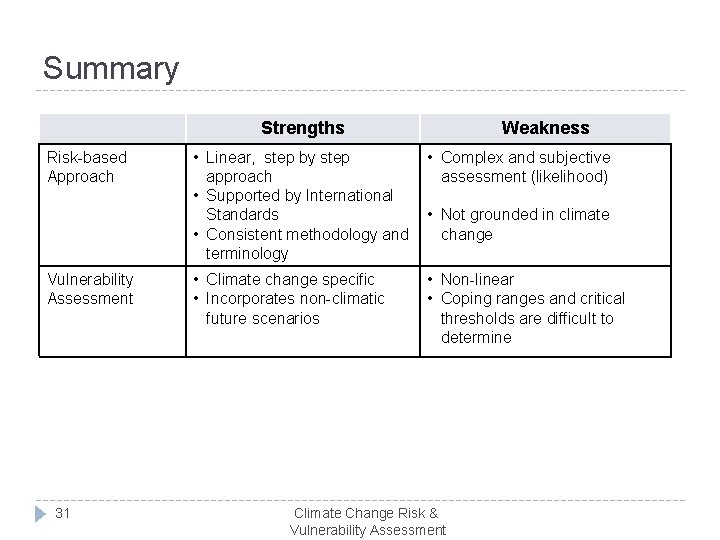
Summary Strengths Risk-based Approach Vulnerability Assessment 31 Weakness • Linear, step by step approach • Supported by International Standards • Consistent methodology and terminology • Complex and subjective assessment (likelihood) • Climate change specific • Incorporates non-climatic future scenarios • Non-linear • Coping ranges and critical thresholds are difficult to determine • Not grounded in climate change Climate Change Risk & Vulnerability Assessment
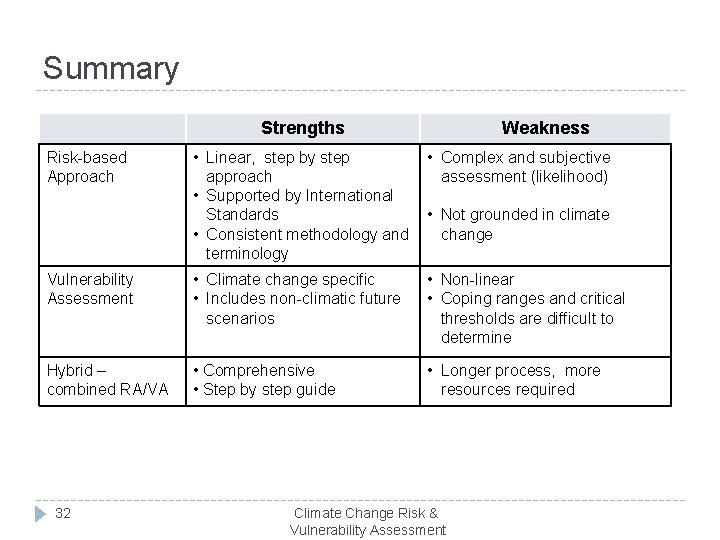
Summary Strengths Weakness • Linear, step by step approach • Supported by International Standards • Consistent methodology and terminology • Complex and subjective assessment (likelihood) Vulnerability Assessment • Climate change specific • Includes non-climatic future scenarios • Non-linear • Coping ranges and critical thresholds are difficult to determine Hybrid – combined RA/VA • Comprehensive • Step by step guide • Longer process, more resources required Risk-based Approach 32 • Not grounded in climate change Climate Change Risk & Vulnerability Assessment
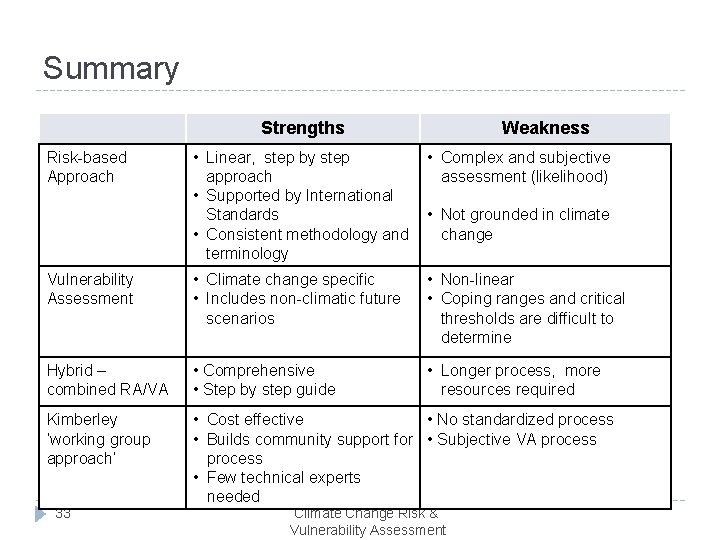
Summary Strengths Weakness • Linear, step by step approach • Supported by International Standards • Consistent methodology and terminology • Complex and subjective assessment (likelihood) Vulnerability Assessment • Climate change specific • Includes non-climatic future scenarios • Non-linear • Coping ranges and critical thresholds are difficult to determine Hybrid – combined RA/VA • Comprehensive • Step by step guide • Longer process, more resources required Kimberley ‘working group approach’ • Cost effective • No standardized process • Builds community support for • Subjective VA process • Few technical experts needed Risk-based Approach 33 • Not grounded in climate change Climate Change Risk & Vulnerability Assessment
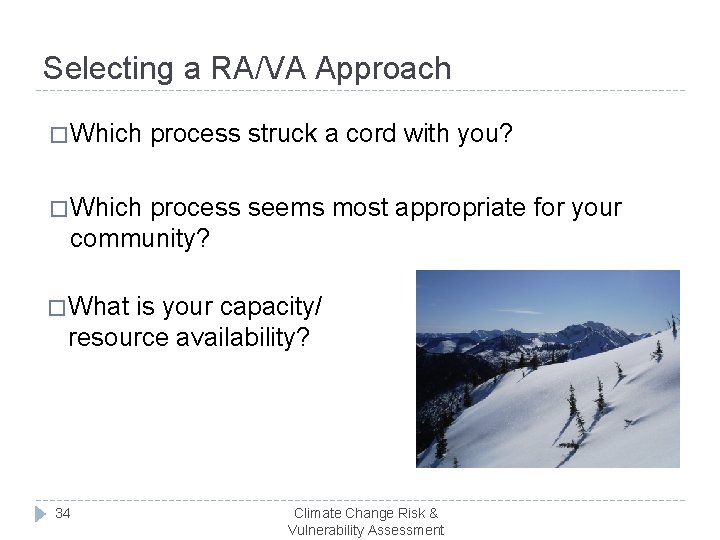
Selecting a RA/VA Approach � Which process struck a cord with you? � Which process seems most appropriate for your community? � What is your capacity/ resource availability? 34 Climate Change Risk & Vulnerability Assessment
Selected References • Australian Government (2008) Climate Change Impacts and Risk Management: A Guide for Business and Government. Retrieved November 22, 2009 from: http: //www. climatechange. gov. au/community/local-government/risk-management. aspx • Black, Bruce, & Egener (2009) Adapting to Climate Change: A Risk-Based Guide for Alberta Municipalities. Retrieved November 22, 2009 from: http: //adaptation. nrcan. gc. ca/projdb/pdf/176 a_e. pdf • Carter, Parry, Nishioka , & Harasawa (1994) Technical guidelines for assessing climate change impacts and adaptations. University College London, England Centre for Global Environmental Research, Tsukuba, Japan, 59 pp • Harford, D. (2008) Climate Change Adaptation: Planning for BC. Retrieved from Pacific Institute for Climate Solutions website: www. pics. uvic. ca/research. php • Hilson, D (2002) Extending the risk process to manage opportunities. International Journal of Project Management, 20, 235– 240. • Noble, Bruce, Egener, (2005) An Overview of the Risk Management Approach to Climate Change in Canada. Retrieved March 11, 2010 from: http: //adaptation. nrcan. gc. ca/pdf/Noble. Bruce. Egener 2005_e. pdf • NRCAN (Natural Resources Canada) (2007) From Impacts to Adaptation: Canada in a Changing Climate. Chapter 8 –British Columbia. Retrieved November 28, 2009 from http: //adaptation. nrcan. gc. ca/assess/2007/index_e. php • Parzen, J. (ed). (2008). Chicago Area Climate Change Quick Guide: Adapting to the Physical Impacts of Climate Change. For Municipalities and Other Organizations. Retrieved March 9, 2010 from: http: //www. chicagoclimateaction. org/filebin/pdf/Chicago_Quick_Guide_to_Climate_Change_Preparation_June_2008. pdf • Schneider, Semenov, & Patwardhan, (2007) Assessing key vulnerabilities and the risk from climate change. Chapter 19, Contribution of Working Group II to the Fourth Assessment Report of the Intergovernmental Panel on Climate Change. Cambridge University Press, Cambridge, UK, 976 pp • Snover, Whitely Binder, Lopez, Willmott, Kay, Howell, & Simmonds. (2007). Preparing for Climate Change: A Guidebook for Local, Regional, and State Governments. In association with and published by ICLEI – Local Governments for Sustainability, Oakland, CA. • Halifax Regional Municipality (2007) Climate Change: Developer's Risk Management Guide. 35 Climate Change Risk & Vulnerability Assessment
- Slides: 35