
Risk Analysis Score Card Likelihood Bins Safety Technical
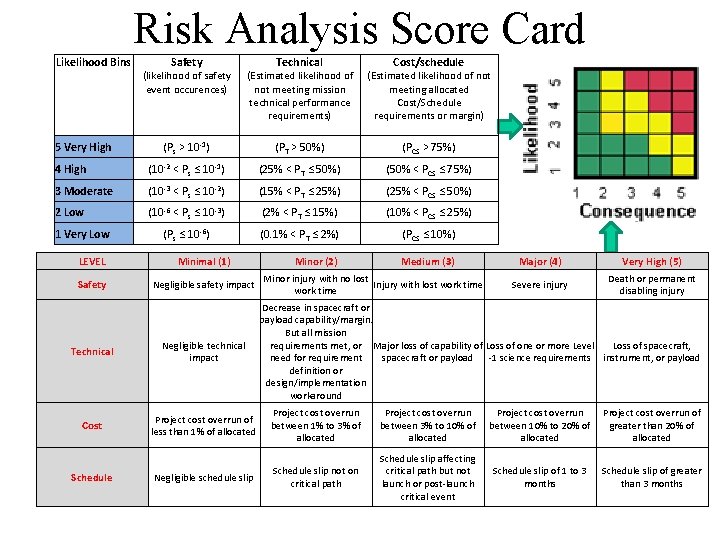
Risk Analysis Score Card Likelihood Bins Safety Technical Cost/schedule (likelihood of safety event occurences) (Estimated likelihood of not meeting mission technical performance requirements) (Estimated likelihood of not meeting allocated Cost/Schedule requirements or margin) (Ps > 10 -1) (PT > 50%) (PCS > 75%) 4 High (10 -2 < Ps ≤ 10 -1) (25% < PT ≤ 50%) (50% < PCS ≤ 75%) 3 Moderate (10 -3 < Ps ≤ 10 -2) (15% < PT ≤ 25%) (25% < PCS ≤ 50%) 2 Low (10 -6 < Ps ≤ 10 -3) (2% < PT ≤ 15%) (10% < PCS ≤ 25%) (Ps ≤ 10 -6) (0. 1% < PT ≤ 2%) (PCS ≤ 10%) Minor (2) Medium (3) 5 Very High 1 Very Low LEVEL Minimal (1) Safety Negligible safety impact Minor injury with no lost Injury with lost work time Major (4) Very High (5) Severe injury Death or permanent disabling injury Decrease in spacecraft or payload capability/margin. But all mission requirements met, or Major loss of capability of Loss of one or more Level Loss of spacecraft, need for requirement spacecraft or payload -1 science requirements instrument, or payload definition or design/implementation workaround Technical Negligible technical impact Cost Project cost overrun of less than 1% of allocated Project cost overrun between 1% to 3% of allocated Project cost overrun between 3% to 10% of allocated Project cost overrun between 10% to 20% of allocated Project cost overrun of greater than 20% of allocated Negligible schedule slip Schedule slip not on critical path Schedule slip affecting critical path but not launch or post-launch critical event Schedule slip of 1 to 3 months Schedule slip of greater than 3 months Schedule
Likelihood/Consequence for SPP Wants/SPP Needs/Risks • SPP Wants: – Likelihood: The likelihood the project will implement the threat + the likelihood the threat will affect ISIS – Consequence: If the threat were to be realized, how much would it impact ISIS. • SPP Needs: – Likelihood: The likelihood the lien will affect ISIS – Consequence: The quantified impact to ISIS. • Risks: – Likelihood: The likelihood the risk will affect ISIS – Consequence: If the risk were to be realized, how much would it impact ISIS. • A note on Wants/Needs Mitigation Plans – Every SPP Want/Need can be mitigated by adding resources (mass/power, cost, schedule). These are quantified in the threats/liens spreadsheet, not as mitigations in the risks.
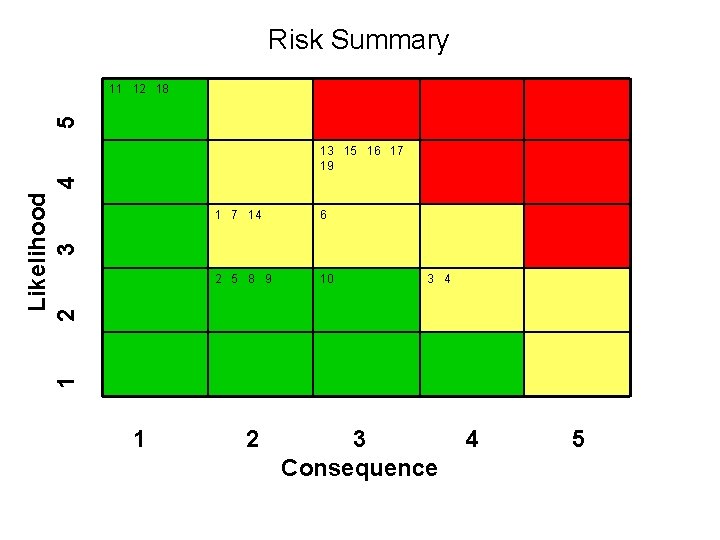
Risk Summary 5 11 12 18 1 7 14 6 2 5 8 9 10 3 4 1 Likelihood 2 3 4 13 15 16 17 19 1 2 3 Consequence 4 5

All Top Risks 5 Rank Likelihood 2 3 4 13 15 16 17 19 1 14 6 1 3 4 1 2 3 4 Consequence Criticality L x C Trend Decreasing (Improving) High Increasing (Worsening) Med Unchanged Low New Since Last Period 5 Approach M - Mitigate W - Watch A - Accept R - Research Trend Risk ID Appro ach Risk Title 1 13 R SPP WANTS: ISIS Time Tagged Commands 2 15 R SPP WANTS: ISIS Increased Ground Software Demands Due to Autonomy 3 16 R SPP WANTS: ISIS Increased Instrument FSW Demands Due to Autonomy 4 17 R SPP WANTS: Configuring ISIS Based on Solar Distance 5 19 R SPP WANTS: ISIS Increased Autonomy 6 6 R SPP WANTS: ISIS Vibration Levels 8 3 R RISK: EPI-Hi LET Thin Windows and Dust Impact Susceptibility 9 4 R RISK: EPI-Lo Dust Impact Susceptibility 10 1 R RISK: EPI-Hi Thin Detector Availability 7 14 R SPP WANTS: ISIS Shock Testing

SPP WANTS: ISIS Time Tagged Commands Description ID: 13 Given that the SPP Project is considering devolving the implementation of Time Tagged Commands to the Instruments, there is a chance that implementing a feature that has historically been performed by the spacecraft would require extra technical, financial, and schedule resources and might also incur extra IV&V scrutiny on the part of all instruments on the SPP spacecraft; Consequence which would result in duplication of effort, inconsistency of design, incompleteness of coordinating testing, and excessive expenditures of precious resources. Overall Status: Accepted(Active) Consequence: 3 Likelihood: 4 Status Message ISIS is working with the Project to better understand the impact instrument autonomy as implemented on SPP will have. ISIS must implement a command handler to enable execution of commands at specific. This function was implemented in the spacecraft on ISIS heritage instruments. Mitigation Plan 1 Status: In Progress Trigger Date: 30 Jan 2013 Title: Analyze and Quantify Impact Description: Work with Project to see if this normally available service can still be provided to the Instruments Mitigation Plan 2 Status: In Progress Trigger Date: 01 July 2013 Title: Implement Design Change Description: Design new software and add extra coding and testing time. Backup Mitigation Plan Status: Not Started Trigger Date: 01 Jan 2014 Title: Test Description: Reduce risk of lack of well-coordinated and tested time-tagged commands by adding additional spacecraft and instrument ground testing resources.
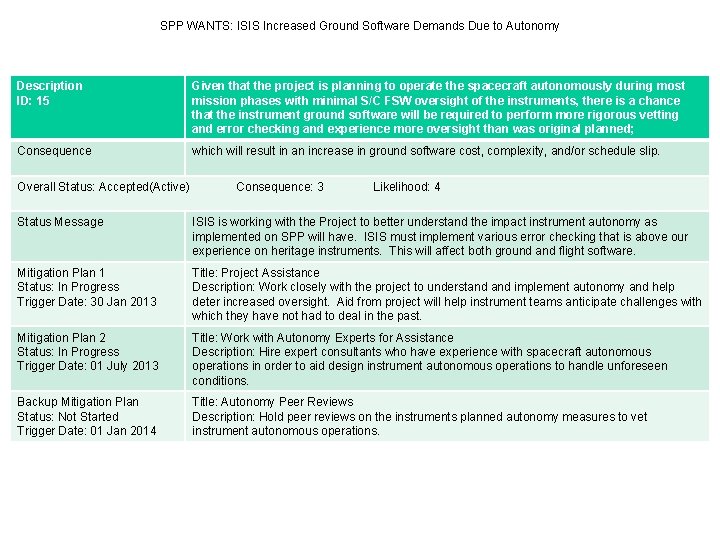
SPP WANTS: ISIS Increased Ground Software Demands Due to Autonomy Description ID: 15 Given that the project is planning to operate the spacecraft autonomously during most mission phases with minimal S/C FSW oversight of the instruments, there is a chance that the instrument ground software will be required to perform more rigorous vetting and error checking and experience more oversight than was original planned; Consequence which will result in an increase in ground software cost, complexity, and/or schedule slip. Overall Status: Accepted(Active) Consequence: 3 Likelihood: 4 Status Message ISIS is working with the Project to better understand the impact instrument autonomy as implemented on SPP will have. ISIS must implement various error checking that is above our experience on heritage instruments. This will affect both ground and flight software. Mitigation Plan 1 Status: In Progress Trigger Date: 30 Jan 2013 Title: Project Assistance Description: Work closely with the project to understand implement autonomy and help deter increased oversight. Aid from project will help instrument teams anticipate challenges with which they have not had to deal in the past. Mitigation Plan 2 Status: In Progress Trigger Date: 01 July 2013 Title: Work with Autonomy Experts for Assistance Description: Hire expert consultants who have experience with spacecraft autonomous operations in order to aid design instrument autonomous operations to handle unforeseen conditions. Backup Mitigation Plan Status: Not Started Trigger Date: 01 Jan 2014 Title: Autonomy Peer Reviews Description: Hold peer reviews on the instruments planned autonomy measures to vet instrument autonomous operations.
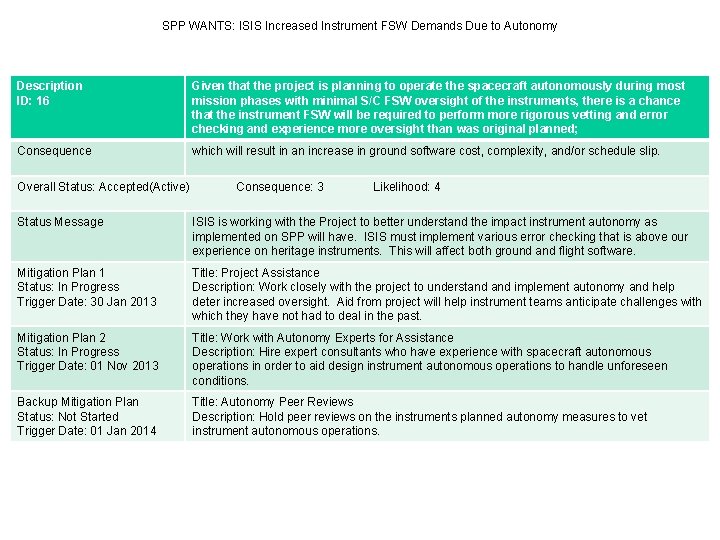
SPP WANTS: ISIS Increased Instrument FSW Demands Due to Autonomy Description ID: 16 Given that the project is planning to operate the spacecraft autonomously during most mission phases with minimal S/C FSW oversight of the instruments, there is a chance that the instrument FSW will be required to perform more rigorous vetting and error checking and experience more oversight than was original planned; Consequence which will result in an increase in ground software cost, complexity, and/or schedule slip. Overall Status: Accepted(Active) Consequence: 3 Likelihood: 4 Status Message ISIS is working with the Project to better understand the impact instrument autonomy as implemented on SPP will have. ISIS must implement various error checking that is above our experience on heritage instruments. This will affect both ground and flight software. Mitigation Plan 1 Status: In Progress Trigger Date: 30 Jan 2013 Title: Project Assistance Description: Work closely with the project to understand implement autonomy and help deter increased oversight. Aid from project will help instrument teams anticipate challenges with which they have not had to deal in the past. Mitigation Plan 2 Status: In Progress Trigger Date: 01 Nov 2013 Title: Work with Autonomy Experts for Assistance Description: Hire expert consultants who have experience with spacecraft autonomous operations in order to aid design instrument autonomous operations to handle unforeseen conditions. Backup Mitigation Plan Status: Not Started Trigger Date: 01 Jan 2014 Title: Autonomy Peer Reviews Description: Hold peer reviews on the instruments planned autonomy measures to vet instrument autonomous operations.
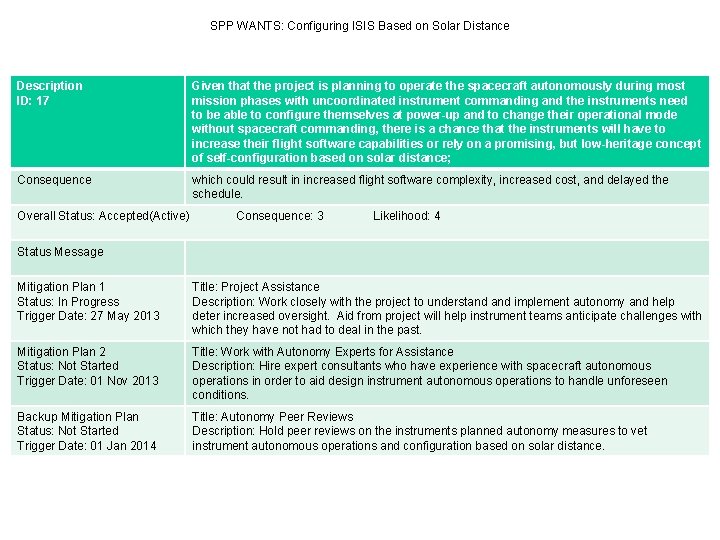
SPP WANTS: Configuring ISIS Based on Solar Distance Description ID: 17 Given that the project is planning to operate the spacecraft autonomously during most mission phases with uncoordinated instrument commanding and the instruments need to be able to configure themselves at power-up and to change their operational mode without spacecraft commanding, there is a chance that the instruments will have to increase their flight software capabilities or rely on a promising, but low-heritage concept of self-configuration based on solar distance; Consequence which could result in increased flight software complexity, increased cost, and delayed the schedule. Overall Status: Accepted(Active) Consequence: 3 Likelihood: 4 Status Message Mitigation Plan 1 Status: In Progress Trigger Date: 27 May 2013 Title: Project Assistance Description: Work closely with the project to understand implement autonomy and help deter increased oversight. Aid from project will help instrument teams anticipate challenges with which they have not had to deal in the past. Mitigation Plan 2 Status: Not Started Trigger Date: 01 Nov 2013 Title: Work with Autonomy Experts for Assistance Description: Hire expert consultants who have experience with spacecraft autonomous operations in order to aid design instrument autonomous operations to handle unforeseen conditions. Backup Mitigation Plan Status: Not Started Trigger Date: 01 Jan 2014 Title: Autonomy Peer Reviews Description: Hold peer reviews on the instruments planned autonomy measures to vet instrument autonomous operations and configuration based on solar distance.
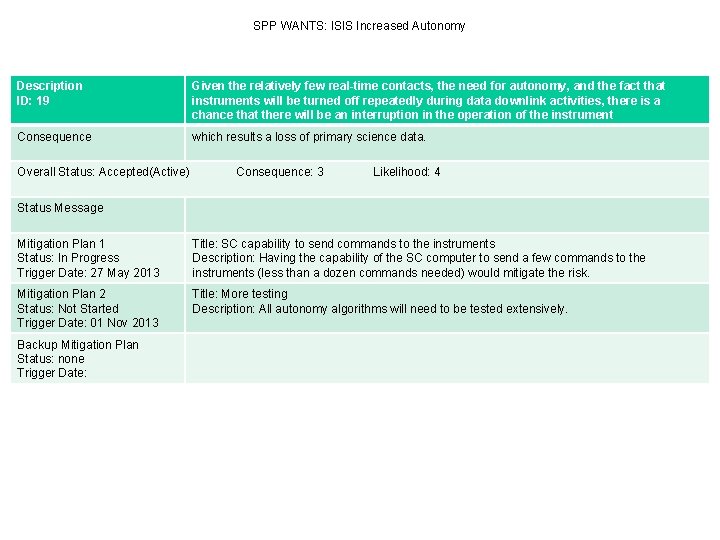
SPP WANTS: ISIS Increased Autonomy Description ID: 19 Given the relatively few real-time contacts, the need for autonomy, and the fact that instruments will be turned off repeatedly during data downlink activities, there is a chance that there will be an interruption in the operation of the instrument Consequence which results a loss of primary science data. Overall Status: Accepted(Active) Consequence: 3 Likelihood: 4 Status Message Mitigation Plan 1 Status: In Progress Trigger Date: 27 May 2013 Title: SC capability to send commands to the instruments Description: Having the capability of the SC computer to send a few commands to the instruments (less than a dozen commands needed) would mitigate the risk. Mitigation Plan 2 Status: Not Started Trigger Date: 01 Nov 2013 Title: More testing Description: All autonomy algorithms will need to be tested extensively. Backup Mitigation Plan Status: none Trigger Date:
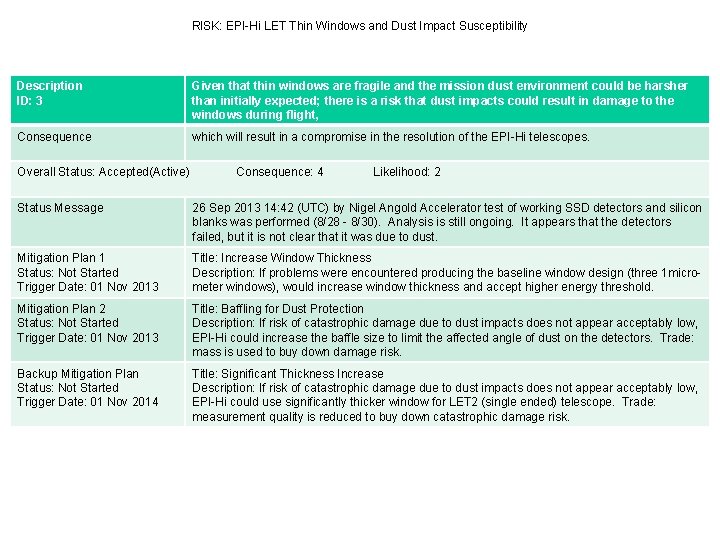
RISK: EPI-Hi LET Thin Windows and Dust Impact Susceptibility Description ID: 3 Given that thin windows are fragile and the mission dust environment could be harsher than initially expected; there is a risk that dust impacts could result in damage to the windows during flight, Consequence which will result in a compromise in the resolution of the EPI-Hi telescopes. Overall Status: Accepted(Active) Consequence: 4 Likelihood: 2 Status Message 26 Sep 2013 14: 42 (UTC) by Nigel Angold Accelerator test of working SSD detectors and silicon blanks was performed (8/28 - 8/30). Analysis is still ongoing. It appears that the detectors failed, but it is not clear that it was due to dust. Mitigation Plan 1 Status: Not Started Trigger Date: 01 Nov 2013 Title: Increase Window Thickness Description: If problems were encountered producing the baseline window design (three 1 micrometer windows), would increase window thickness and accept higher energy threshold. Mitigation Plan 2 Status: Not Started Trigger Date: 01 Nov 2013 Title: Baffling for Dust Protection Description: If risk of catastrophic damage due to dust impacts does not appear acceptably low, EPI-Hi could increase the baffle size to limit the affected angle of dust on the detectors. Trade: mass is used to buy down damage risk. Backup Mitigation Plan Status: Not Started Trigger Date: 01 Nov 2014 Title: Significant Thickness Increase Description: If risk of catastrophic damage due to dust impacts does not appear acceptably low, EPI-Hi could use significantly thicker window for LET 2 (single ended) telescope. Trade: measurement quality is reduced to buy down catastrophic damage risk.
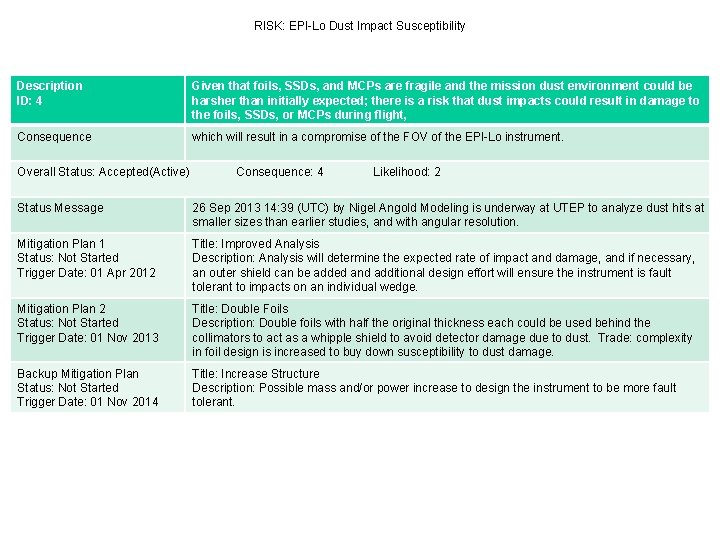
RISK: EPI-Lo Dust Impact Susceptibility Description ID: 4 Given that foils, SSDs, and MCPs are fragile and the mission dust environment could be harsher than initially expected; there is a risk that dust impacts could result in damage to the foils, SSDs, or MCPs during flight, Consequence which will result in a compromise of the FOV of the EPI-Lo instrument. Overall Status: Accepted(Active) Consequence: 4 Likelihood: 2 Status Message 26 Sep 2013 14: 39 (UTC) by Nigel Angold Modeling is underway at UTEP to analyze dust hits at smaller sizes than earlier studies, and with angular resolution. Mitigation Plan 1 Status: Not Started Trigger Date: 01 Apr 2012 Title: Improved Analysis Description: Analysis will determine the expected rate of impact and damage, and if necessary, an outer shield can be added and additional design effort will ensure the instrument is fault tolerant to impacts on an individual wedge. Mitigation Plan 2 Status: Not Started Trigger Date: 01 Nov 2013 Title: Double Foils Description: Double foils with half the original thickness each could be used behind the collimators to act as a whipple shield to avoid detector damage due to dust. Trade: complexity in foil design is increased to buy down susceptibility to dust damage. Backup Mitigation Plan Status: Not Started Trigger Date: 01 Nov 2014 Title: Increase Structure Description: Possible mass and/or power increase to design the instrument to be more fault tolerant.
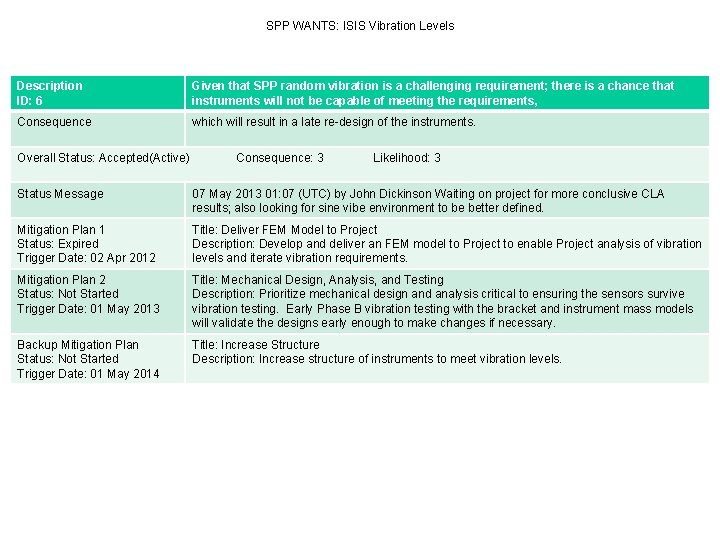
SPP WANTS: ISIS Vibration Levels Description ID: 6 Given that SPP random vibration is a challenging requirement; there is a chance that instruments will not be capable of meeting the requirements, Consequence which will result in a late re-design of the instruments. Overall Status: Accepted(Active) Consequence: 3 Likelihood: 3 Status Message 07 May 2013 01: 07 (UTC) by John Dickinson Waiting on project for more conclusive CLA results; also looking for sine vibe environment to be better defined. Mitigation Plan 1 Status: Expired Trigger Date: 02 Apr 2012 Title: Deliver FEM Model to Project Description: Develop and deliver an FEM model to Project to enable Project analysis of vibration levels and iterate vibration requirements. Mitigation Plan 2 Status: Not Started Trigger Date: 01 May 2013 Title: Mechanical Design, Analysis, and Testing Description: Prioritize mechanical design and analysis critical to ensuring the sensors survive vibration testing. Early Phase B vibration testing with the bracket and instrument mass models will validate the designs early enough to make changes if necessary. Backup Mitigation Plan Status: Not Started Trigger Date: 01 May 2014 Title: Increase Structure Description: Increase structure of instruments to meet vibration levels.
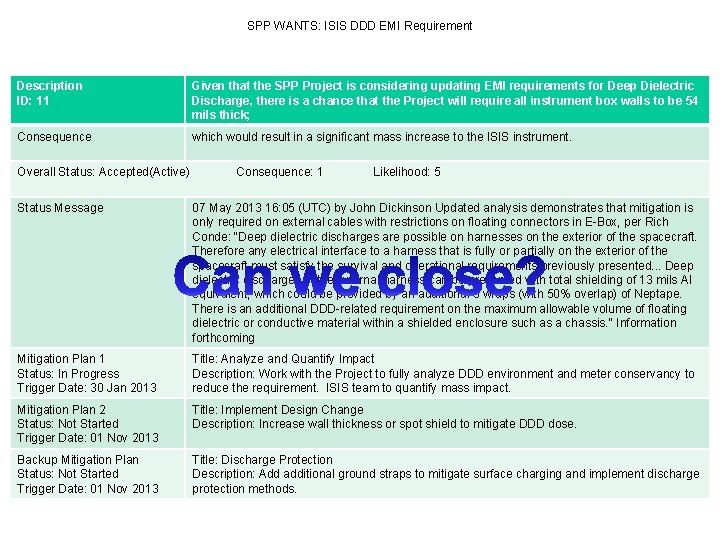
SPP WANTS: ISIS DDD EMI Requirement Description ID: 11 Given that the SPP Project is considering updating EMI requirements for Deep Dielectric Discharge, there is a chance that the Project will require all instrument box walls to be 54 mils thick; Consequence which would result in a significant mass increase to the ISIS instrument. Overall Status: Accepted(Active) Consequence: 1 Likelihood: 5 Status Message 07 May 2013 16: 05 (UTC) by John Dickinson Updated analysis demonstrates that mitigation is only required on external cables with restrictions on floating connectors in E-Box, per Rich Conde: "Deep dielectric discharges are possible on harnesses on the exterior of the spacecraft. Therefore any electrical interface to a harness that is fully or partially on the exterior of the spacecraft must satisfy the survival and operational requirements previously presented. . . Deep dielectric discharges in the external harness can be prevented with total shielding of 13 mils Al equivalent, which could be provided by an additional 3 wraps (with 50% overlap) of Neptape. There is an additional DDD-related requirement on the maximum allowable volume of floating dielectric or conductive material within a shielded enclosure such as a chassis. " Information forthcoming Mitigation Plan 1 Status: In Progress Trigger Date: 30 Jan 2013 Title: Analyze and Quantify Impact Description: Work with the Project to fully analyze DDD environment and meter conservancy to reduce the requirement. ISIS team to quantify mass impact. Mitigation Plan 2 Status: Not Started Trigger Date: 01 Nov 2013 Title: Implement Design Change Description: Increase wall thickness or spot shield to mitigate DDD dose. Backup Mitigation Plan Status: Not Started Trigger Date: 01 Nov 2013 Title: Discharge Protection Description: Add additional ground straps to mitigate surface charging and implement discharge protection methods.
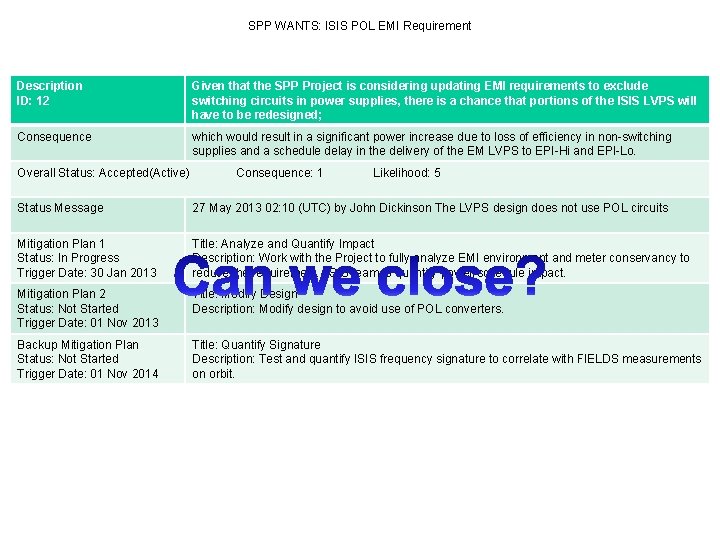
SPP WANTS: ISIS POL EMI Requirement Description ID: 12 Given that the SPP Project is considering updating EMI requirements to exclude switching circuits in power supplies, there is a chance that portions of the ISIS LVPS will have to be redesigned; Consequence which would result in a significant power increase due to loss of efficiency in non-switching supplies and a schedule delay in the delivery of the EM LVPS to EPI-Hi and EPI-Lo. Overall Status: Accepted(Active) Consequence: 1 Likelihood: 5 Status Message 27 May 2013 02: 10 (UTC) by John Dickinson The LVPS design does not use POL circuits Mitigation Plan 1 Status: In Progress Trigger Date: 30 Jan 2013 Title: Analyze and Quantify Impact Description: Work with the Project to fully analyze EMI environment and meter conservancy to reduce the requirement. ISIS team to quantify power/schedule impact. Mitigation Plan 2 Status: Not Started Trigger Date: 01 Nov 2013 Title: Modify Design Description: Modify design to avoid use of POL converters. Backup Mitigation Plan Status: Not Started Trigger Date: 01 Nov 2014 Title: Quantify Signature Description: Test and quantify ISIS frequency signature to correlate with FIELDS measurements on orbit.
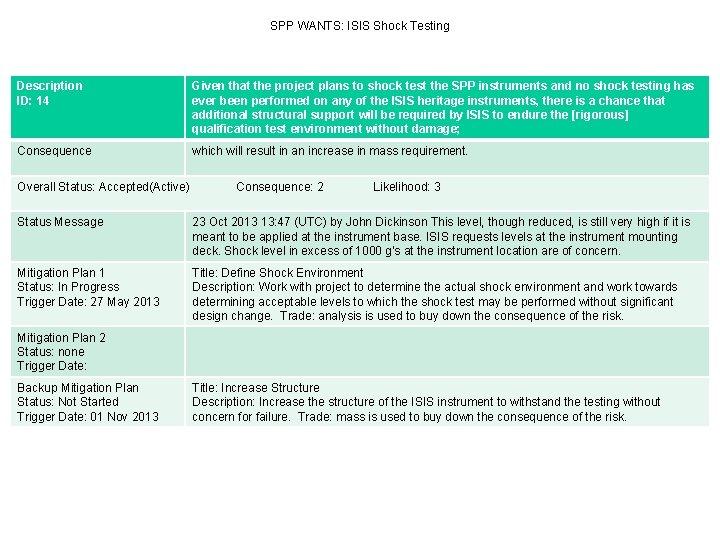
SPP WANTS: ISIS Shock Testing Description ID: 14 Given that the project plans to shock test the SPP instruments and no shock testing has ever been performed on any of the ISIS heritage instruments, there is a chance that additional structural support will be required by ISIS to endure the [rigorous] qualification test environment without damage; Consequence which will result in an increase in mass requirement. Overall Status: Accepted(Active) Consequence: 2 Likelihood: 3 Status Message 23 Oct 2013 13: 47 (UTC) by John Dickinson This level, though reduced, is still very high if it is meant to be applied at the instrument base. ISIS requests levels at the instrument mounting deck. Shock level in excess of 1000 g's at the instrument location are of concern. Mitigation Plan 1 Status: In Progress Trigger Date: 27 May 2013 Title: Define Shock Environment Description: Work with project to determine the actual shock environment and work towards determining acceptable levels to which the shock test may be performed without significant design change. Trade: analysis is used to buy down the consequence of the risk. Mitigation Plan 2 Status: none Trigger Date: Backup Mitigation Plan Status: Not Started Trigger Date: 01 Nov 2013 Title: Increase Structure Description: Increase the structure of the ISIS instrument to withstand the testing without concern for failure. Trade: mass is used to buy down the consequence of the risk.
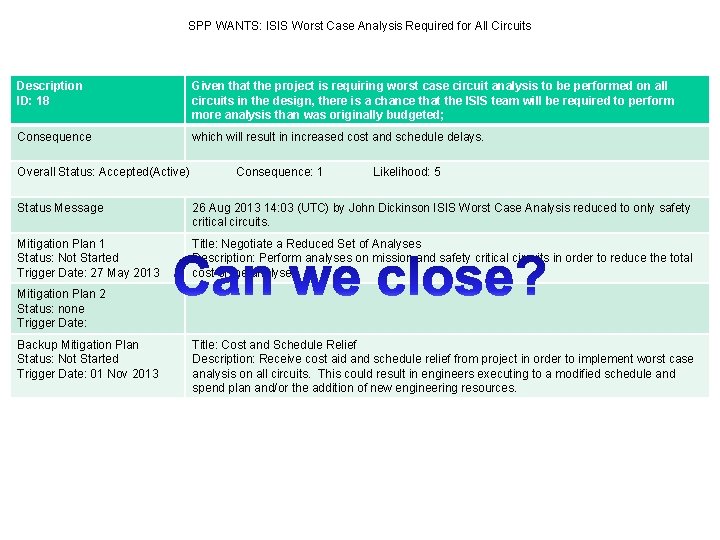
SPP WANTS: ISIS Worst Case Analysis Required for All Circuits Description ID: 18 Given that the project is requiring worst case circuit analysis to be performed on all circuits in the design, there is a chance that the ISIS team will be required to perform more analysis than was originally budgeted; Consequence which will result in increased cost and schedule delays. Overall Status: Accepted(Active) Consequence: 1 Likelihood: 5 Status Message 26 Aug 2013 14: 03 (UTC) by John Dickinson ISIS Worst Case Analysis reduced to only safety critical circuits. Mitigation Plan 1 Status: Not Started Trigger Date: 27 May 2013 Title: Negotiate a Reduced Set of Analyses Description: Perform analyses on mission and safety critical circuits in order to reduce the total cost of the analyses. Mitigation Plan 2 Status: none Trigger Date: Backup Mitigation Plan Status: Not Started Trigger Date: 01 Nov 2013 Title: Cost and Schedule Relief Description: Receive cost aid and schedule relief from project in order to implement worst case analysis on all circuits. This could result in engineers executing to a modified schedule and spend plan and/or the addition of new engineering resources.
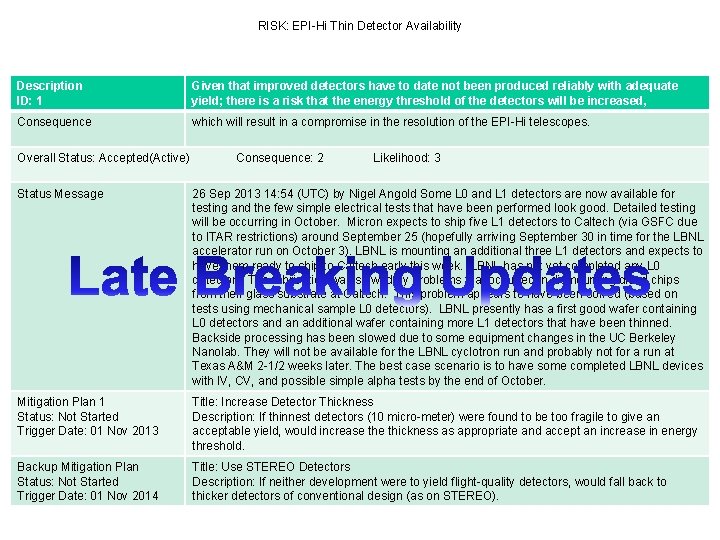
RISK: EPI-Hi Thin Detector Availability Description ID: 1 Given that improved detectors have to date not been produced reliably with adequate yield; there is a risk that the energy threshold of the detectors will be increased, Consequence which will result in a compromise in the resolution of the EPI-Hi telescopes. Overall Status: Accepted(Active) Consequence: 2 Likelihood: 3 Status Message 26 Sep 2013 14: 54 (UTC) by Nigel Angold Some L 0 and L 1 detectors are now available for testing and the few simple electrical tests that have been performed look good. Detailed testing will be occurring in October. Micron expects to ship five L 1 detectors to Caltech (via GSFC due to ITAR restrictions) around September 25 (hopefully arriving September 30 in time for the LBNL accelerator run on October 3). LBNL is mounting an additional three L 1 detectors and expects to have them ready to ship to Caltech early this week. LBNL has not yet completed any L 0 detectors. The fabrication was slowed by problems that occurred in dismounting diced chips from their glass substrate at Caltech. This problem appears to have been solved (based on tests using mechanical sample L 0 detectors). LBNL presently has a first good wafer containing L 0 detectors and an additional wafer containing more L 1 detectors that have been thinned. Backside processing has been slowed due to some equipment changes in the UC Berkeley Nanolab. They will not be available for the LBNL cyclotron run and probably not for a run at Texas A&M 2 -1/2 weeks later. The best case scenario is to have some completed LBNL devices with IV, CV, and possible simple alpha tests by the end of October. Mitigation Plan 1 Status: Not Started Trigger Date: 01 Nov 2013 Title: Increase Detector Thickness Description: If thinnest detectors (10 micro-meter) were found to be too fragile to give an acceptable yield, would increase thickness as appropriate and accept an increase in energy threshold. Backup Mitigation Plan Status: Not Started Trigger Date: 01 Nov 2014 Title: Use STEREO Detectors Description: If neither development were to yield flight-quality detectors, would fall back to thicker detectors of conventional design (as on STEREO).
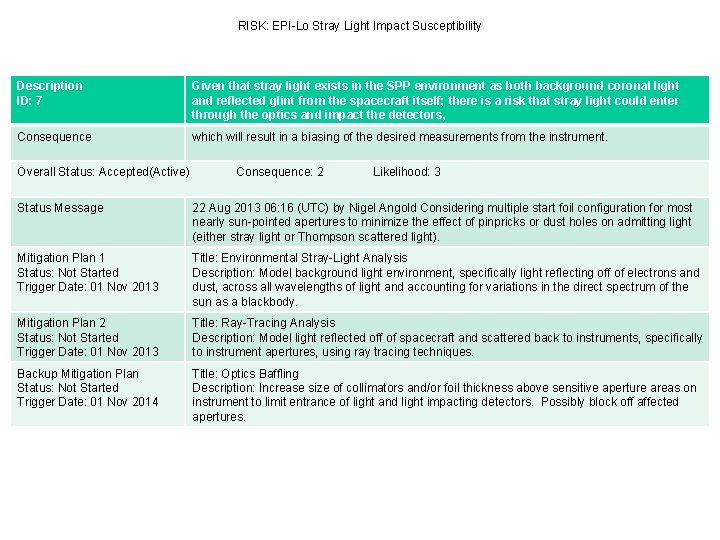
RISK: EPI-Lo Stray Light Impact Susceptibility Description ID: 7 Given that stray light exists in the SPP environment as both background coronal light and reflected glint from the spacecraft itself; there is a risk that stray light could enter through the optics and impact the detectors, Consequence which will result in a biasing of the desired measurements from the instrument. Overall Status: Accepted(Active) Consequence: 2 Likelihood: 3 Status Message 22 Aug 2013 06: 16 (UTC) by Nigel Angold Considering multiple start foil configuration for most nearly sun-pointed apertures to minimize the effect of pinpricks or dust holes on admitting light (either stray light or Thompson scattered light). Mitigation Plan 1 Status: Not Started Trigger Date: 01 Nov 2013 Title: Environmental Stray-Light Analysis Description: Model background light environment, specifically light reflecting off of electrons and dust, across all wavelengths of light and accounting for variations in the direct spectrum of the sun as a blackbody. Mitigation Plan 2 Status: Not Started Trigger Date: 01 Nov 2013 Title: Ray-Tracing Analysis Description: Model light reflected off of spacecraft and scattered back to instruments, specifically to instrument apertures, using ray tracing techniques. Backup Mitigation Plan Status: Not Started Trigger Date: 01 Nov 2014 Title: Optics Baffling Description: Increase size of collimators and/or foil thickness above sensitive aperture areas on instrument to limit entrance of light and light impacting detectors. Possibly block off affected apertures.
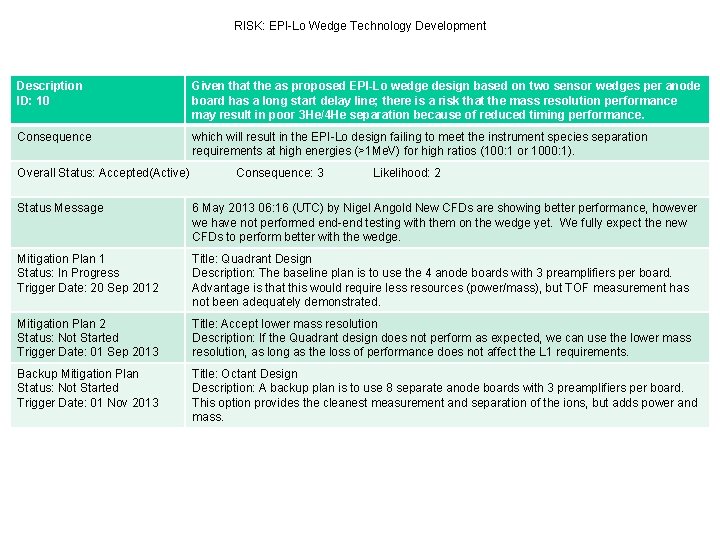
RISK: EPI-Lo Wedge Technology Development Description ID: 10 Given that the as proposed EPI-Lo wedge design based on two sensor wedges per anode board has a long start delay line; there is a risk that the mass resolution performance may result in poor 3 He/4 He separation because of reduced timing performance. Consequence which will result in the EPI-Lo design failing to meet the instrument species separation requirements at high energies (>1 Me. V) for high ratios (100: 1 or 1000: 1). Overall Status: Accepted(Active) Consequence: 3 Likelihood: 2 Status Message 6 May 2013 06: 16 (UTC) by Nigel Angold New CFDs are showing better performance, however we have not performed end-end testing with them on the wedge yet. We fully expect the new CFDs to perform better with the wedge. Mitigation Plan 1 Status: In Progress Trigger Date: 20 Sep 2012 Title: Quadrant Design Description: The baseline plan is to use the 4 anode boards with 3 preamplifiers per board. Advantage is that this would require less resources (power/mass), but TOF measurement has not been adequately demonstrated. Mitigation Plan 2 Status: Not Started Trigger Date: 01 Sep 2013 Title: Accept lower mass resolution Description: If the Quadrant design does not perform as expected, we can use the lower mass resolution, as long as the loss of performance does not affect the L 1 requirements. Backup Mitigation Plan Status: Not Started Trigger Date: 01 Nov 2013 Title: Octant Design Description: A backup plan is to use 8 separate anode boards with 3 preamplifiers per board. This option provides the cleanest measurement and separation of the ions, but adds power and mass.
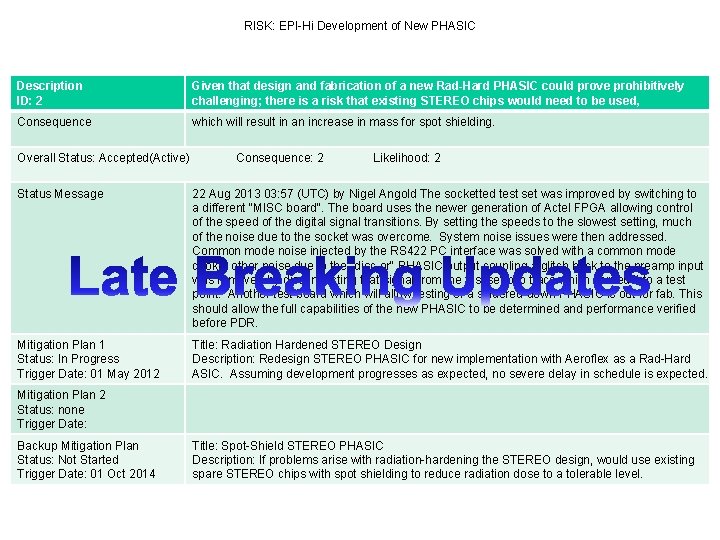
RISK: EPI-Hi Development of New PHASIC Description ID: 2 Given that design and fabrication of a new Rad-Hard PHASIC could prove prohibitively challenging; there is a risk that existing STEREO chips would need to be used, Consequence which will result in an increase in mass for spot shielding. Overall Status: Accepted(Active) Consequence: 2 Likelihood: 2 Status Message 22 Aug 2013 03: 57 (UTC) by Nigel Angold The socketted test set was improved by switching to a different "MISC board". The board uses the newer generation of Actel FPGA allowing control of the speed of the digital signal transitions. By setting the speeds to the slowest setting, much of the noise due to the socket was overcome. System noise issues were then addressed. Common mode noise injected by the RS 422 PC interface was solved with a common mode choke. other noise due to the "disc-or" PHASIC output coupling a glitch back to the preamp input was removed by disconnecting that signal from the test set pcb trace which carried it to a test point. Another test board which will allow testing of a soldered-down PHASIC is out for fab. This should allow the full capabilities of the new PHASIC to be determined and performance verified before PDR. Mitigation Plan 1 Status: In Progress Trigger Date: 01 May 2012 Title: Radiation Hardened STEREO Design Description: Redesign STEREO PHASIC for new implementation with Aeroflex as a Rad-Hard ASIC. Assuming development progresses as expected, no severe delay in schedule is expected. Mitigation Plan 2 Status: none Trigger Date: Backup Mitigation Plan Status: Not Started Trigger Date: 01 Oct 2014 Title: Spot-Shield STEREO PHASIC Description: If problems arise with radiation-hardening the STEREO design, would use existing spare STEREO chips with spot shielding to reduce radiation dose to a tolerable level.
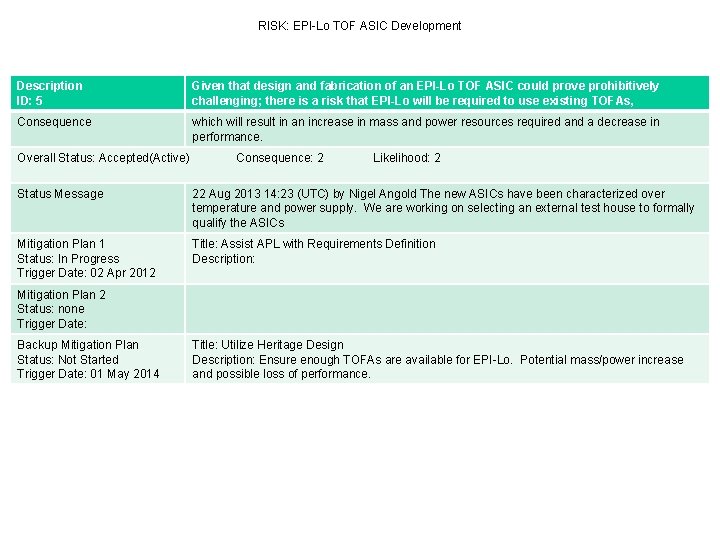
RISK: EPI-Lo TOF ASIC Development Description ID: 5 Given that design and fabrication of an EPI-Lo TOF ASIC could prove prohibitively challenging; there is a risk that EPI-Lo will be required to use existing TOFAs, Consequence which will result in an increase in mass and power resources required and a decrease in performance. Overall Status: Accepted(Active) Consequence: 2 Likelihood: 2 Status Message 22 Aug 2013 14: 23 (UTC) by Nigel Angold The new ASICs have been characterized over temperature and power supply. We are working on selecting an external test house to formally qualify the ASICs Mitigation Plan 1 Status: In Progress Trigger Date: 02 Apr 2012 Title: Assist APL with Requirements Definition Description: Mitigation Plan 2 Status: none Trigger Date: Backup Mitigation Plan Status: Not Started Trigger Date: 01 May 2014 Title: Utilize Heritage Design Description: Ensure enough TOFAs are available for EPI-Lo. Potential mass/power increase and possible loss of performance.
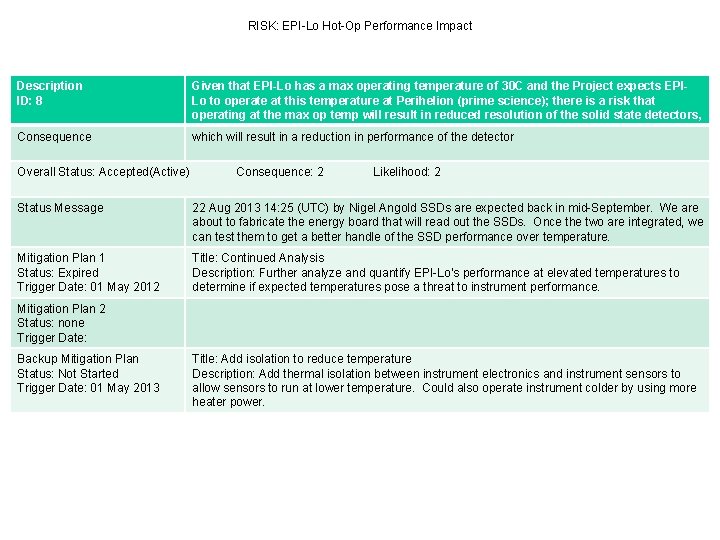
RISK: EPI-Lo Hot-Op Performance Impact Description ID: 8 Given that EPI-Lo has a max operating temperature of 30 C and the Project expects EPILo to operate at this temperature at Perihelion (prime science); there is a risk that operating at the max op temp will result in reduced resolution of the solid state detectors, Consequence which will result in a reduction in performance of the detector Overall Status: Accepted(Active) Consequence: 2 Likelihood: 2 Status Message 22 Aug 2013 14: 25 (UTC) by Nigel Angold SSDs are expected back in mid-September. We are about to fabricate the energy board that will read out the SSDs. Once the two are integrated, we can test them to get a better handle of the SSD performance over temperature. Mitigation Plan 1 Status: Expired Trigger Date: 01 May 2012 Title: Continued Analysis Description: Further analyze and quantify EPI-Lo’s performance at elevated temperatures to determine if expected temperatures pose a threat to instrument performance. Mitigation Plan 2 Status: none Trigger Date: Backup Mitigation Plan Status: Not Started Trigger Date: 01 May 2013 Title: Add isolation to reduce temperature Description: Add thermal isolation between instrument electronics and instrument sensors to allow sensors to run at lower temperature. Could also operate instrument colder by using more heater power.
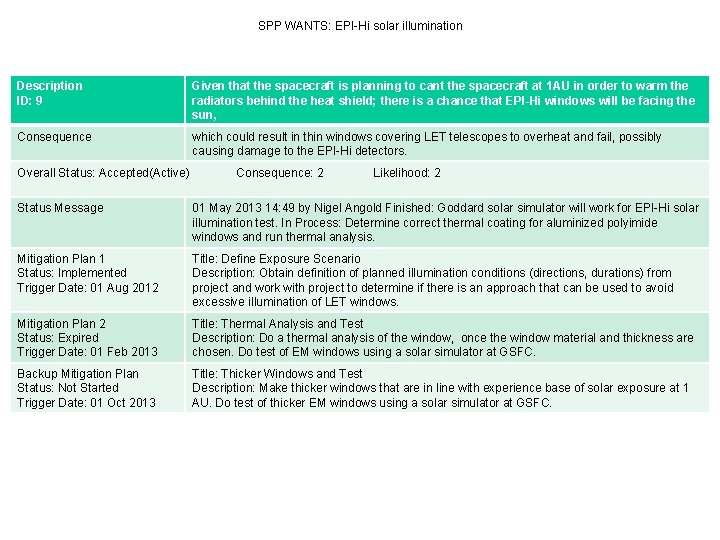
SPP WANTS: EPI-Hi solar illumination Description ID: 9 Given that the spacecraft is planning to cant the spacecraft at 1 AU in order to warm the radiators behind the heat shield; there is a chance that EPI-Hi windows will be facing the sun, Consequence which could result in thin windows covering LET telescopes to overheat and fail, possibly causing damage to the EPI-Hi detectors. Overall Status: Accepted(Active) Consequence: 2 Likelihood: 2 Status Message 01 May 2013 14: 49 by Nigel Angold Finished: Goddard solar simulator will work for EPI-Hi solar illumination test. In Process: Determine correct thermal coating for aluminized polyimide windows and run thermal analysis. Mitigation Plan 1 Status: Implemented Trigger Date: 01 Aug 2012 Title: Define Exposure Scenario Description: Obtain definition of planned illumination conditions (directions, durations) from project and work with project to determine if there is an approach that can be used to avoid excessive illumination of LET windows. Mitigation Plan 2 Status: Expired Trigger Date: 01 Feb 2013 Title: Thermal Analysis and Test Description: Do a thermal analysis of the window, once the window material and thickness are chosen. Do test of EM windows using a solar simulator at GSFC. Backup Mitigation Plan Status: Not Started Trigger Date: 01 Oct 2013 Title: Thicker Windows and Test Description: Make thicker windows that are in line with experience base of solar exposure at 1 AU. Do test of thicker EM windows using a solar simulator at GSFC.
- Slides: 23