
Rising Majoritarianism as Challenge for Democratic Governance Turkey
- Slides: 11
Rising Majoritarianism as Challenge for Democratic Governance – Turkey in Comparative Perspective IPSA Sarajevo Colloquium 12 -15 June 2019 Adam Szymański, Associate Prof. University of Warsaw
Result of projects and research 1. Between Fair and Rigged. Elections as a Key Determinant of the ‘Borderline Political Regime’ Turkey in Comparative Perspective (University of Warsaw) http: //www. inp. uw. edu. pl/projekt_wybory_turcja/en/ 2. PS: Political Science and Politics 52, no. 2 (2019) 3. Research within Polish Research Group on Contemporary Turkey – comparative studies Turkey and Central Europe http: //www. inp. uw. edu. pl/grupa_badawcza_turcja/en/ home-page/
Majoritarianism The idea that the numerical majority of a population should have the final say in determining the outcome of a decision. (Capaldi 2019) The view that legitimate political authority expresses the will of the majority of those subject to this authority (also known as the majority principle). (Mc. Lean and Mc. Millan 2009)
Majoritarianism as tyranny of majority Limiting social and political pluralism trough marginalising different minorities: a) Polity – structural dimension b) Policy – practising majoritarianism c) Politics – public discourse
Main research goal To analyse, using the process-tracing method, the development of majoritarianism at the turn of 1990 s and the 2000 s and its impact on the political regime in the current decade. Selected cases: Turkey and Central European states – i. e. Hungary and Poland
Main research arguments Structural factors emerging within the historical process are behind the development of majoritarianism, which has been even strengthened in the current decade when the single-party governments sharing the majoritarian understanding of democracy have consolidated their power. This leads to limitations in working of political and social pluralism due to increasing dominance of incumbents in political and social life.
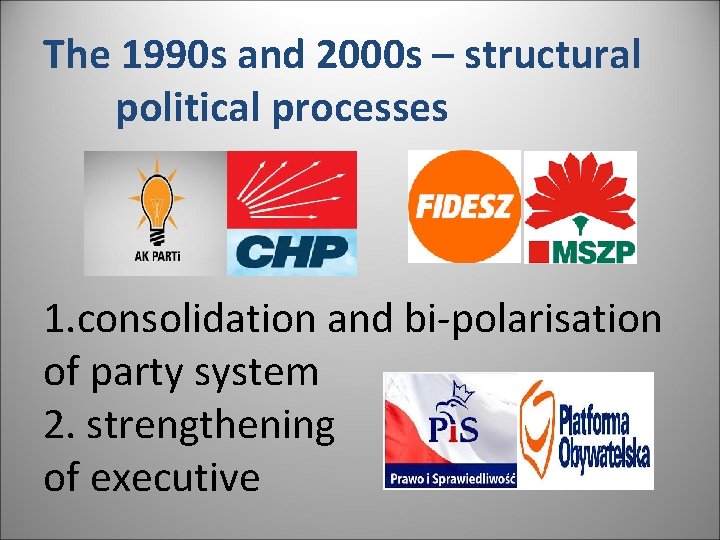
The 1990 s and 2000 s – structural political processes 1. consolidation and bi-polarisation of party system 2. strengthening of executive
Result of structural processes – 1990 s and 2000 s A. Development of majoritarianism: 1. Turkey (long episode already in the 1980 s) 2. Hungary Poland – less polarisation of the party system and bigger parliamentary pluralism – majoritarianism not developed B. Consequences for democracy – not identified yet
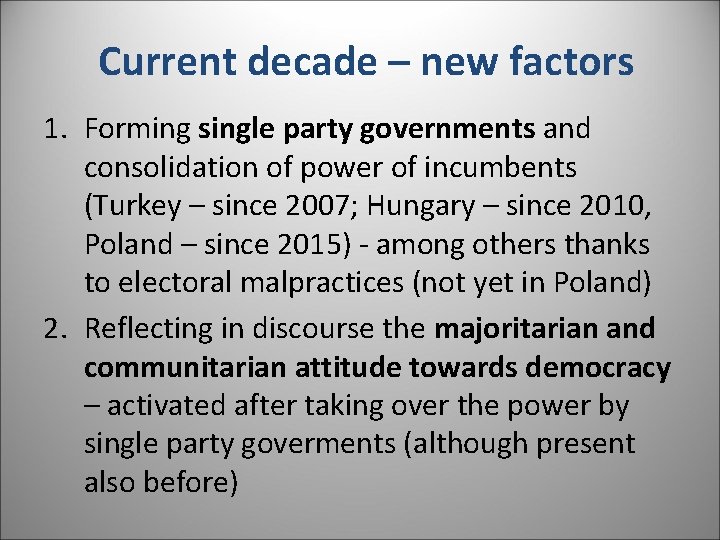
Current decade – new factors 1. Forming single party governments and consolidation of power of incumbents (Turkey – since 2007; Hungary – since 2010, Poland – since 2015) - among others thanks to electoral malpractices (not yet in Poland) 2. Reflecting in discourse the majoritarian and communitarian attitude towards democracy – activated after taking over the power by single party goverments (although present also before)
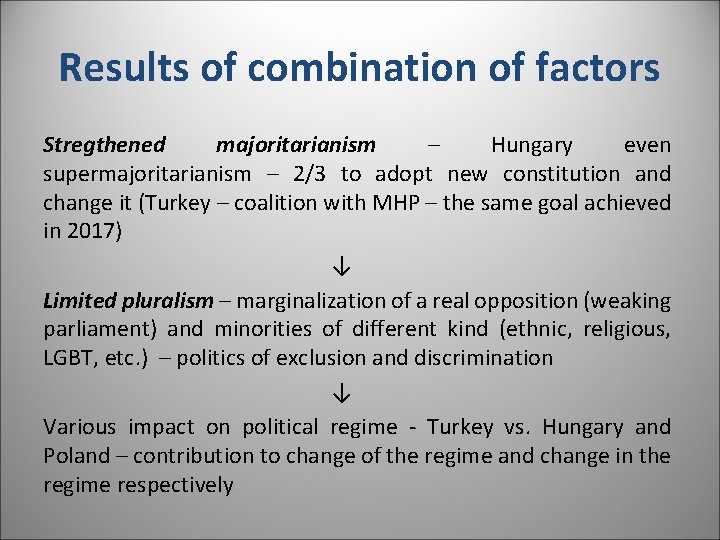
Results of combination of factors Stregthened majoritarianism – Hungary even supermajoritarianism – 2/3 to adopt new constitution and change it (Turkey – coalition with MHP – the same goal achieved in 2017) ↓ Limited pluralism – marginalization of a real opposition (weaking parliament) and minorities of different kind (ethnic, religious, LGBT, etc. ) – politics of exclusion and discrimination ↓ Various impact on political regime - Turkey vs. Hungary and Poland – contribution to change of the regime and change in the regime respectively
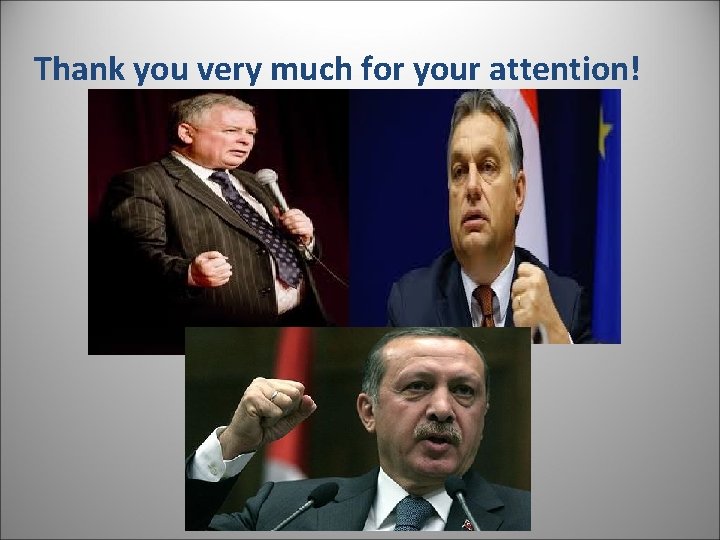
Thank you very much for your attention!