
Rising Action Climax Conflict Falling Actions Resolution or
- Slides: 21
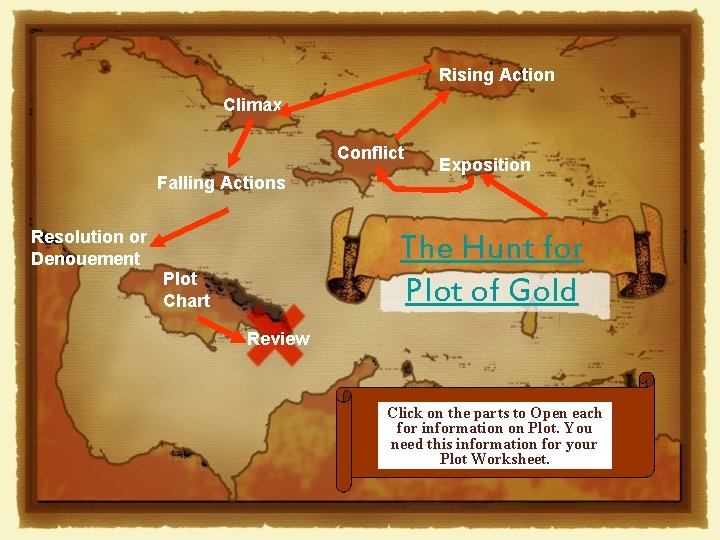
Rising Action Climax Conflict Falling Actions Resolution or Denouement Exposition The Hunt for Plot of Gold Plot Chart Review Click on the parts to Open each for information on Plot. You need this information for your Plot Worksheet.
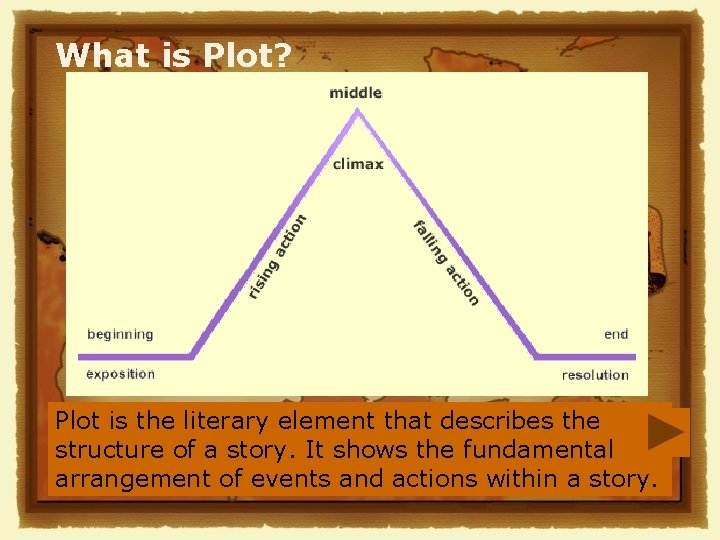
What is Plot? Plot is the literary element that describes the structure of a story. It shows the fundamental arrangement of events and actions within a story.
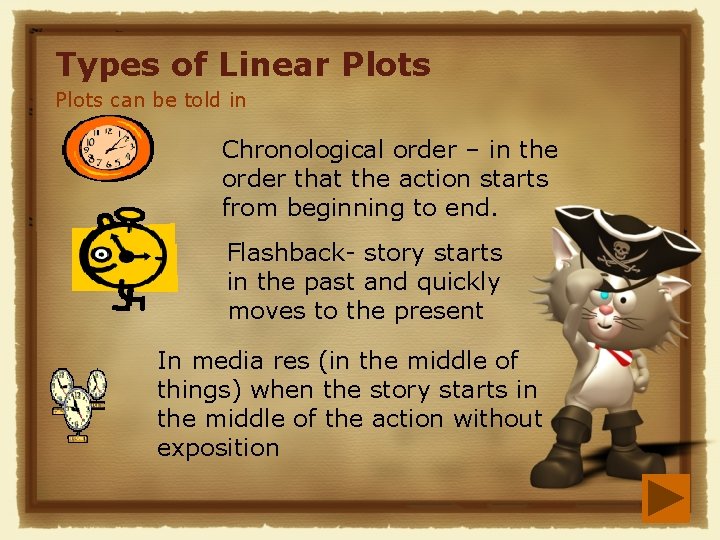
Types of Linear Plots can be told in Chronological order – in the order that the action starts from beginning to end. Flashback- story starts in the past and quickly moves to the present In media res (in the middle of things) when the story starts in the middle of the action without exposition
Exposition The first part of plot is called the “Basic Situation” or “Exposition. ” Exposition is the presentation of essential information regarding what has occurred prior to the beginning of the play. 1. Characters are introduced including their status or place that they will perform in the action of the story. 2. A Setting (time, location) is established so that the reader understand where all the actions are taking place. 3. Not all exposition is at the beginning of the story. Sometimes in a story, the location may move or new characters might be introduced.
Exposition The first part of plot is called the “Basic Situation” or “Exposition. ” This is the opening of the story, when the characters and the setting are introduced. William Nolastname didn’t mind the hard work as the king’s stable boy because he loved horses. He worked very hard in the Kingdom of Sweetland which was ruled by King Nicely had a beautiful daughter named Judith. William had always loved Judith from afar. Without any hope of having the princess return his love, William knew that he was nothing more than a simple stable boy.
Conflict In most stories, we care about what happens next because we are hooked by the conflict, or struggle the characters have to get over. Conflict is the fuel of the narrative (telling the story). The greater the conflict, the more we care about the outcome of the story. In an external conflict the struggle takes place between two characters (Man versus Man), between a character and a group (Man versus Society), between a character and something nonhuman (Man versus Nature) An internal conflict takes place within a character’s mind and/or heart (Man versus Himself): A desire to win someone’s friendship might conflict with a fear of rejection.
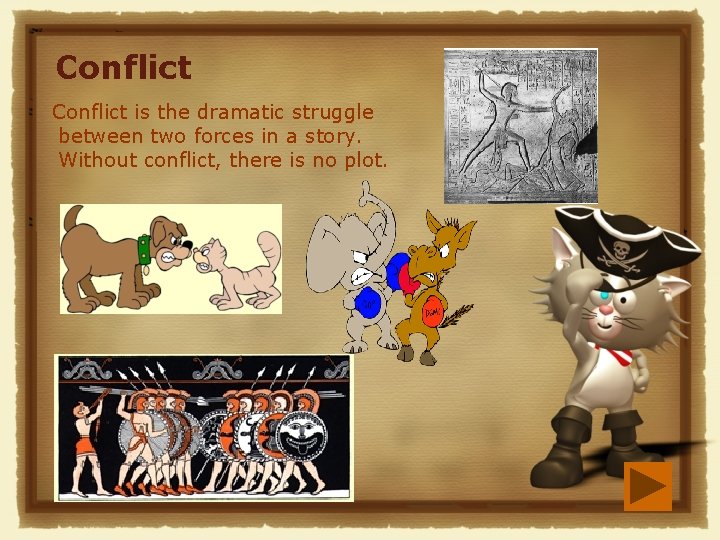
Conflict is the dramatic struggle between two forces in a story. Without conflict, there is no plot.
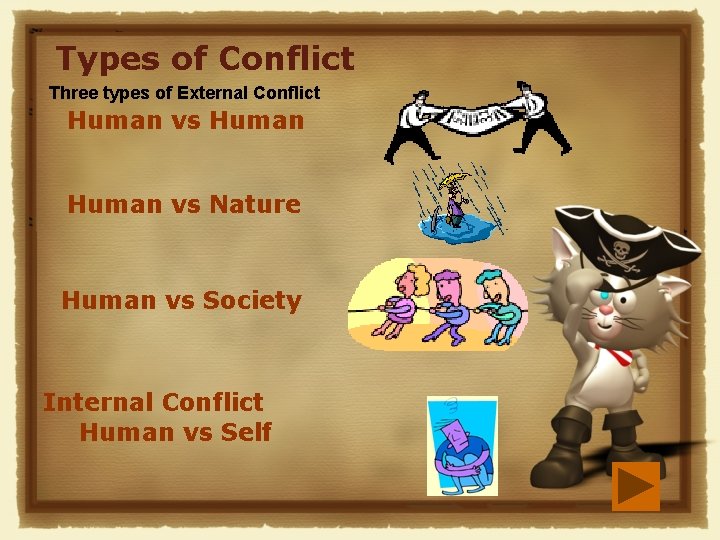
Types of Conflict Three types of External Conflict Human vs Nature Human vs Society Internal Conflict Human vs Self
Conflict After the readers have learned the characters and setting of the story, the major conflict is introduced. However, King Nicely was miserable and face a major problem. His kingdom had been invaded by a large fire -breathing dragon who smelled to high heaven (like rotten garbage). King Nicely offered a reward of wealth and the hand of his daughter in marriage to the man who could kill the dragon.
Complication/Rising Actions The next part of a plot is the complication. Now the main character takes some action to resolve the conflicts but meets with more problems or complications: danger, hostility, fear, or even a new threatening situation. In rising action, a story's inciting incident must be built upon with three key elements: 1. Conflict- more problems are placed in the way of the character who has to solve the overall problem of the story 2. Cause Without something causing characters to act, there is no rising action because there is not a workable point from which to start. So it follows the plot cannot advance without a healthy amount of causes. 3. and Effect The relationship between causes and effects is like that between good and evil. a cause cannot be a cause if some effect, however small, doesn’t follow.
Complication/Rising Actions Now the main character takes some action to resolve the conflicts but meets with more problems or complications: danger, hostility, fear, or even a new threatening situation. After hearing the proclamation in the courtyard of the palace, William knew that his only hope of ever having Princess Judith as his love and wife was to set out to defeat and kill the dragon. William riding his favorite horse, Promise, headed out of the castle toward the plains of Destiny. William was on a mission to kill the Dragon.
Complication/Rising Actions (cont. ) more problems or complications: danger, hostility, fear, or even a new threatening situation. William set out to kill the dragon in order to help the king. While he was riding into the woods, several robbers tried to hijack his horse. Poor William felt himself losing courage. William remembered his father “Son, never give up. Fight to read your goal!” So William turned and fought back the robbers. The robbers fled into the forest and William was able to move on to reach his goal and kill the dragon.
Complication/Rising Actions (cont. ) more problems or complications: danger, hostility, fear, or even a new threatening situation. William finally arrives at the Plains of Destiny only to find a huge river overflowing due to the recent rains. William spies some beavers building a dam and approaches them. “Can you help get across the river? ” pleaded William to the head beaver. “I will give you my most important weapon, a knife. You can use this knife to help you cut the tree stumps and branches to build your dams. ” The beavers agree and quickly build a raft so that William and his horse, Promise can cross the river to get the Plains of Destiny.
Complication/Rising Actions (cont. ) more problems or complications: danger, hostility, fear, or even a new threatening situation. William kept traveling over the Plains of Destiny but he never seemed to get anywhere near where the Dragon was. Finally one day off in the distance, he noticed some black smoke rising in the air. William raced toward the smoke. When he arrived he saw a cave in the side of a huge mountain. Smoke was coming from that cave. William slowly moved inside the cave for he knew that this must be the home of the dragon.
Climax The third part of the story/plot is the climax. This is the key scene in the story– that tense or exciting or terrifying moment when our emotional involvement is the greatest.
Climax Now we learn what the outcome of the conflict is going to be. William slowly entered the cave and crept into the smoky darkness. He could hear the softened roar of the dragon. The floor rumbled and rocked from the dragon. When he had just about decided to give up the chase and return home, William found himself staring down the dragon’s throat. Closing his eyes, he hurled his sword into the dragon’s windpipe. The monster gagged and began to die.
Falling Action In the plot of a story or play, the action following the climax of the work that moves it towards its denouement or resolution. William took his sword and cut off the head of the dragon. He wrapped the huge head in a saddle blanket that he took off his horse. William mounted again to head home with his prize. He was eager to claim his princess.
Resolution or Denouement The final part of the story is the resolution. Sometimes this is also called the denouement (French dénouement, literally, untying). The resolution occurs at the end of the story. Now all the struggles are over, and we know what is going to happen to the characters When he returned to the palace with the dragon’s head, William became a hero, although he had to spend the next two weeks soaking himself to get rid of the smell of a very dead dragon. In the third week, William’s dreams came true. He married the Princess Judith. The country was saved because a new King and Queen were there to rule the land.
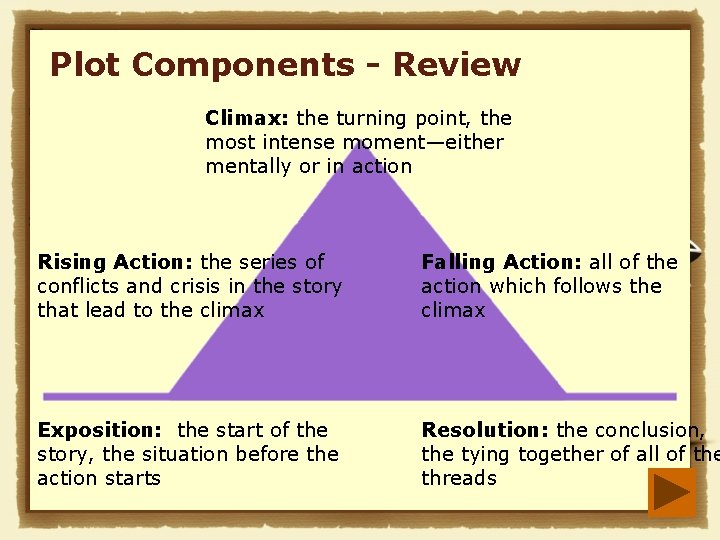
Plot Components - Review Climax: the turning point, the most intense moment—either mentally or in action Rising Action: the series of conflicts and crisis in the story that lead to the climax Falling Action: all of the action which follows the climax Exposition: the start of the story, the situation before the action starts Resolution: the conclusion, the tying together of all of the threads
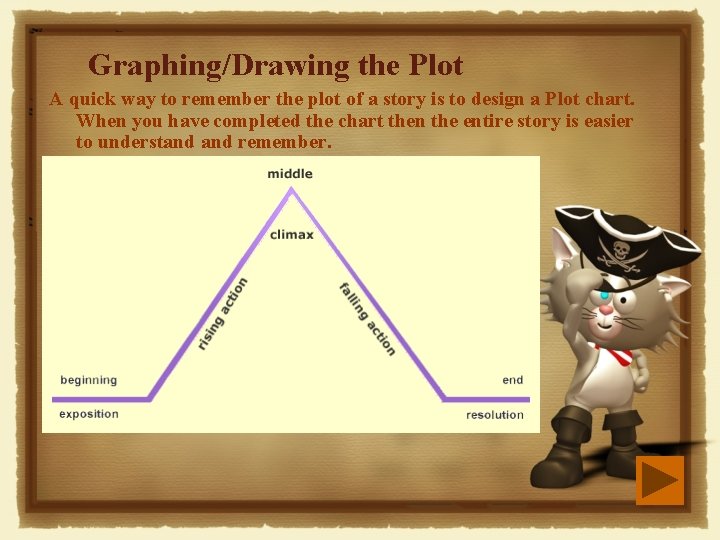
Graphing/Drawing the Plot A quick way to remember the plot of a story is to design a Plot chart. When you have completed the chart then the entire story is easier to understand remember.
Now, that you have taken notes on Plot, you can complete your Plot Worksheet PLOT of Gold Play Again!