
Rise of TotalitarianismFascism in Europe STARTER Begin work
Rise of Totalitarianism/Fascism in Europe STARTER: Begin work on the “Treaty of Versailles”/” “Nazi Party Platform” Document Based Questions Worksheet
Big Picture • In today's lesson we're going to take a look at the rise of totalitarian dictatorships. • The big picture here is that the Great Depression created a complicated situation when people wanted simple answers, and those answers were increasingly provided by regimes that wanted to take complete control of the entire society. • The one that brought people like Hitler to power was called “Fascism”
REVIEW: WHAT IS FASCISM ANYWAY? • Term coined by Mussolini—after an old roman symbol of authority. • A type of collectivism that puts the goals/interests of the state above individual rights. Focus on concepts like ORDER, UNITY, SAFETY, PATRIOTISM. • Also a type of totalitarianism, because the state controls EVERYTHING. • “Everything within the State, Nothing Against the State, Nothing Outside the State. ” • Not all fascist states are alike, but some common traits are: • • • Militarism Extreme Nationalism Disregard for electoral democracy or individual rights (“selfish”) Punishment for ALL dissenting opinion. Rule by “experts” or “elites” Society where individual interests are set aside for the good of the nation.
So Let’s Look at Hitler • Great Depression—People look for scapegoats and solutions. Hitler promised both. Used “brownshirts” to socially enforce his ideals. • Nazi party got popular, so the Prime Minister declared Hitler Chancellor in 1933 to try and keep him under control. • Reichstag fire (February 1933), Hitler blames communists and stirs up terror. • Hitler declares a national emergency and takes dictatorial power (Enabling Act and Reichstag Fire Decree) (later voted official by Reichstag in 1934. )
So Let’s Look at Hitler • 1934: Knight of Long Knives: a purge of Nazi leaders by Adolf Hitler on June 30, 1934. Fearing that the paramilitary “brownshirts” had become too powerful, Hitler ordered his elite SS guards to murder the organization’s leaders, as well as other perceived opponents of Hitler. • 1935: Nuremberg Laws: excluded German Jews from Reich citizenship and prohibited them from having families with "German or related blood. " Addons to the laws disenfranchised Jews and deprived them of most political rights. • Later extended to other ‘undesirables’ as well. • 1938: Kristallnacht—Jewish businesses and synagogues are destroyed, Jewish people are beaten and murdered.
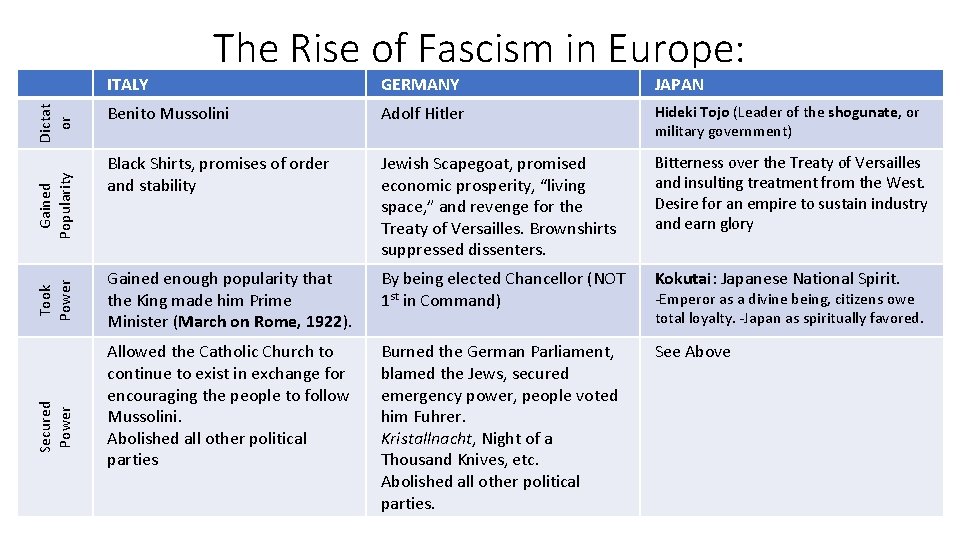
Secured Power Took Power Gained Popularity Dictat or ITALY The Rise of Fascism in Europe: GERMANY JAPAN Benito Mussolini Adolf Hitler Hideki Tojo (Leader of the shogunate, or military government) Black Shirts, promises of order and stability Jewish Scapegoat, promised economic prosperity, “living space, ” and revenge for the Treaty of Versailles. Brownshirts suppressed dissenters. Bitterness over the Treaty of Versailles and insulting treatment from the West. Desire for an empire to sustain industry and earn glory Gained enough popularity that the King made him Prime Minister (March on Rome, 1922). By being elected Chancellor (NOT 1 st in Command) Kokutai: Japanese National Spirit. Allowed the Catholic Church to continue to exist in exchange for encouraging the people to follow Mussolini. Abolished all other political parties Burned the German Parliament, blamed the Jews, secured emergency power, people voted him Fuhrer. Kristallnacht, Night of a Thousand Knives, etc. Abolished all other political parties. See Above -Emperor as a divine being, citizens owe total loyalty. -Japan as spiritually favored.
How did this happen? • An interesting point to consider: • These movements rose to power surprisingly quickly in Europe and Asia (Germany, Italy, Russia, Japan) because they all have a long history of monarchy in one form or another. • A lot of those strong “absolute monarchs” used a lot of the same tactics as these modern dictators. • The difference is in the use of MODERN TECHNOLOGY. It makes the dictators look like “one of the people, ” which is more appealing, and also allows for more effective enforcement, indoctrination and surveillance.
How did this happen? • Fascism and Totalitarianism rose to power because it had the support of the mob. (Ideology, Collective Identity, Social Pressure (enforcement)) • A “mob” in this context is a mass of citizens who are filled with a strong emotion of some kind, usually fear, anger, or hate. • Hitler and Mussolini represented the suppressed fears and resentments of the people, and offered solutions to those problems. (Dynamic Leaders) • They convinced the people to willingly give up more and more power in order to assuage those fears/satisfy their resentment. (Opposition) • They convince the people to give their leaders more and more authority. Once they had it, they used various techniques to hold onto their power— but mostly terror.
Discussion Questions Look at some of the documents provided: • Why do people begin to follow fascist movements? • Are there ways to prevent fascist movements without becoming authoritarian ourselves? • Choose one of these questions and write it on the back of your Totalitarianism Worksheet
Homework Next Time: • Totalitarianism Worksheet • On the back of your Totalitarianism Worksheet, choose one discussion question and answer it in five complete sentences. Draw evidence from one of your readings. • Rise of Hitler, German Expansion
- Slides: 10