
Rise of Islam TYWL How do religions influence
- Slides: 18
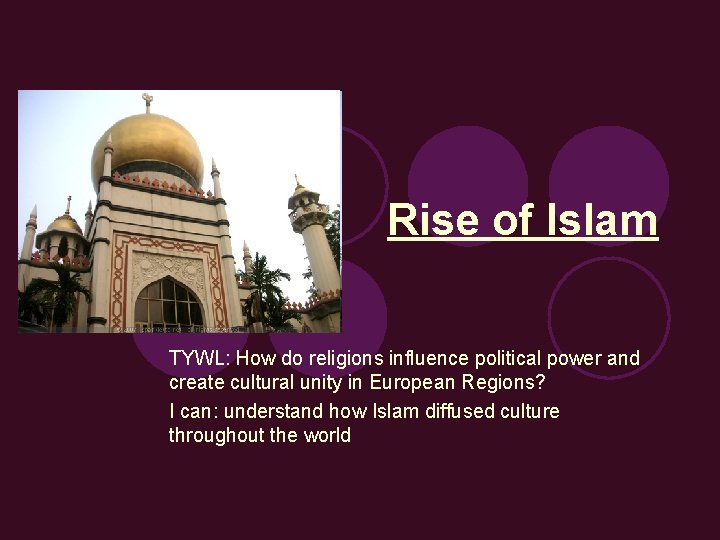
Rise of Islam TYWL: How do religions influence political power and create cultural unity in European Regions? I can: understand how Islam diffused culture throughout the world
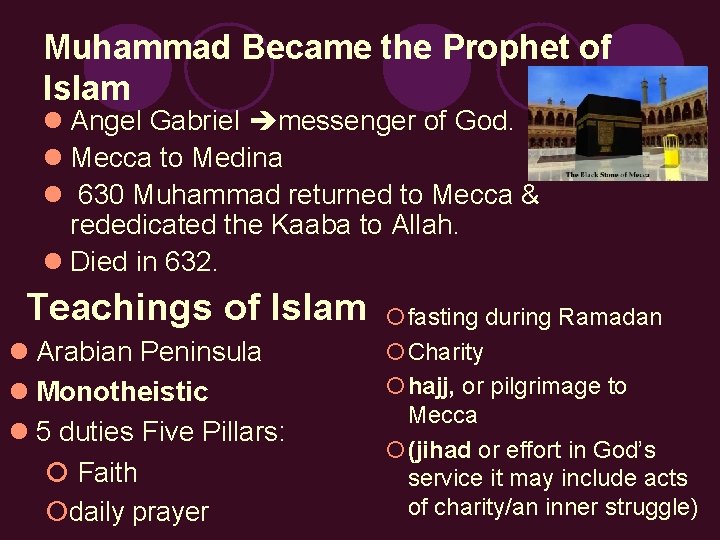
Muhammad Became the Prophet of Islam l Angel Gabriel messenger of God. l Mecca to Medina l 630 Muhammad returned to Mecca & rededicated the Kaaba to Allah. l Died in 632. Teachings of Islam l Arabian Peninsula l Monotheistic l 5 duties Five Pillars: ¡ Faith ¡daily prayer ¡fasting during Ramadan ¡Charity ¡hajj, or pilgrimage to Mecca ¡(jihad or effort in God’s service it may include acts of charity/an inner struggle)
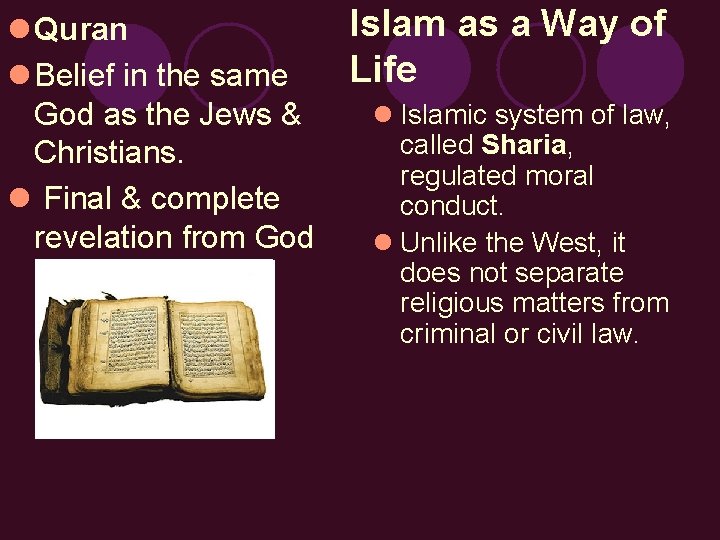
l Quran l Belief in the same God as the Jews & Christians. l Final & complete revelation from God Islam as a Way of Life l Islamic system of law, called Sharia, regulated moral conduct. l Unlike the West, it does not separate religious matters from criminal or civil law.
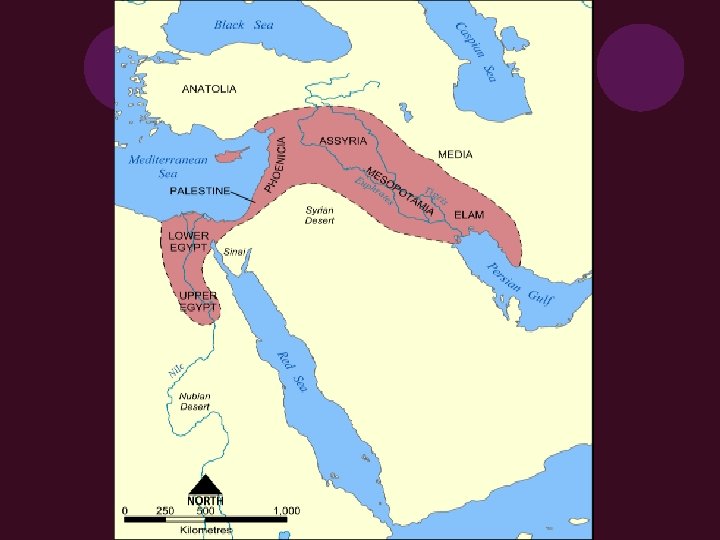
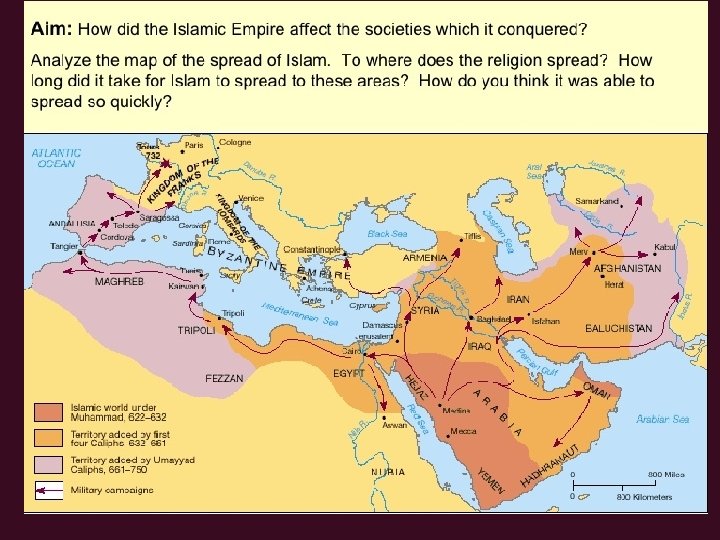
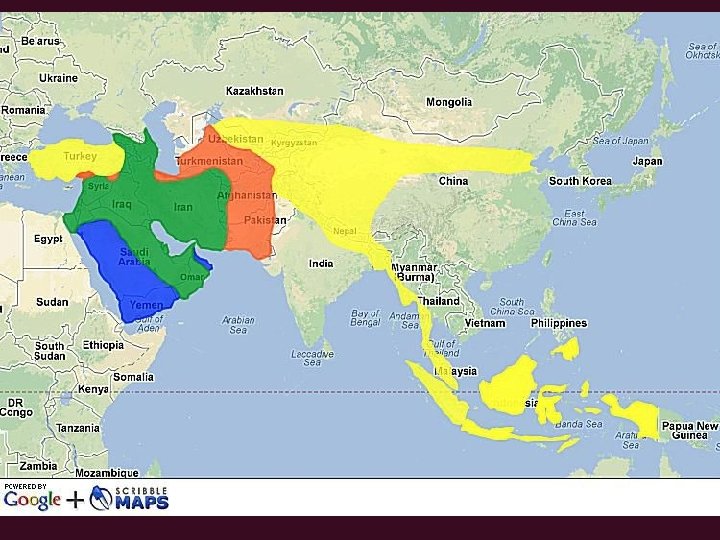
Spread of Islam: Causes and Effects How were the Muslims able to conquer so many lands? ¡People in the Fertile Crescent welcomed Arab conquerors as liberators. ¡ Mostly spread gradually through trade routes Islam Spreads Immediate Effects ¡Centers of learning flourish in Cairo & Córdoba Long-Term Effects ¡Est. trade network
Movements Within Islam l Muhammad’s death l Abu Bakr Muhammad’s father-in-law first caliph, the area he ruled is known as the Caliphate. SHIITES SUNNI ¡ caliph, chosen by leaders of the Muslim community (sunna). l Majority of Muslims today. ¡Named after shi’at Ali, followers of Ali ¡Believed that only descendents, called Imams, of Muhammad could become caliph.
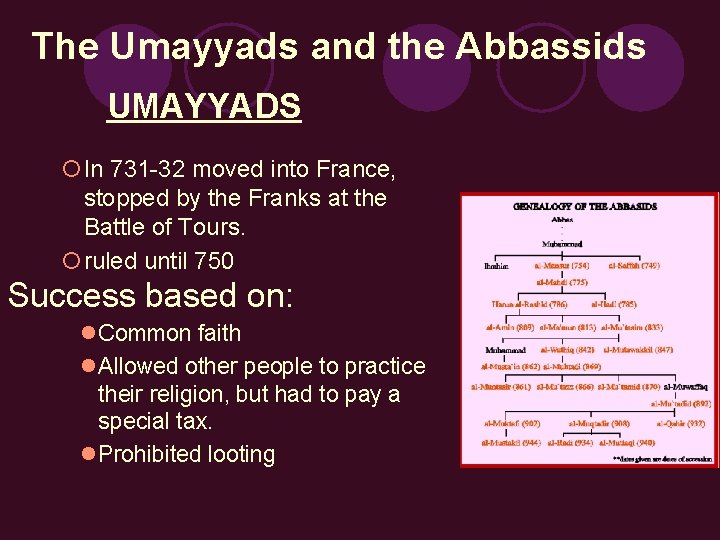
The Umayyads and the Abbassids UMAYYADS ¡In 731 -32 moved into France, stopped by the Franks at the Battle of Tours. ¡ruled until 750 Success based on: l. Common faith l. Allowed other people to practice their religion, but had to pay a special tax. l. Prohibited looting
ABBASSIDS ¡Lasted until 1258 ¡Greatest wealth & power ¡al-Mansur created the capital of Baghdad Decline of the Muslim Empire l Around 850, the empire fragmented. l 900 s, Seljuk Turks invaded By 1055 a Seljuk sultan, or ruler, controlled Baghdad, . l 1099 Christian crusaders captured Jerusalem. l 1200 s and 1300 s, Mongol invaders destroyed Bagdad
Golden Age of Muslim Civilization
Muslim Society u u Islamic law encouraged the freeing of slaves The Muslim Economy (750 and 1360), vast trading network. Camel Caravans “ships of the desert” traveled into W. Africa. Moved along the Silk Road. Influences on Art and Literature u MUSLIM ART & LITERATURE – Couldn’t portray God/human figures. Poetry: The Rubaiyat collection of poems. Arab tales the book The Thousand One Nights.
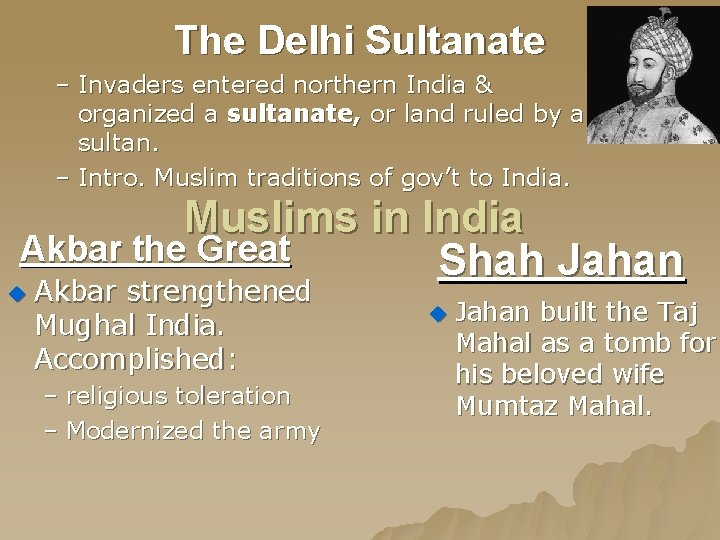
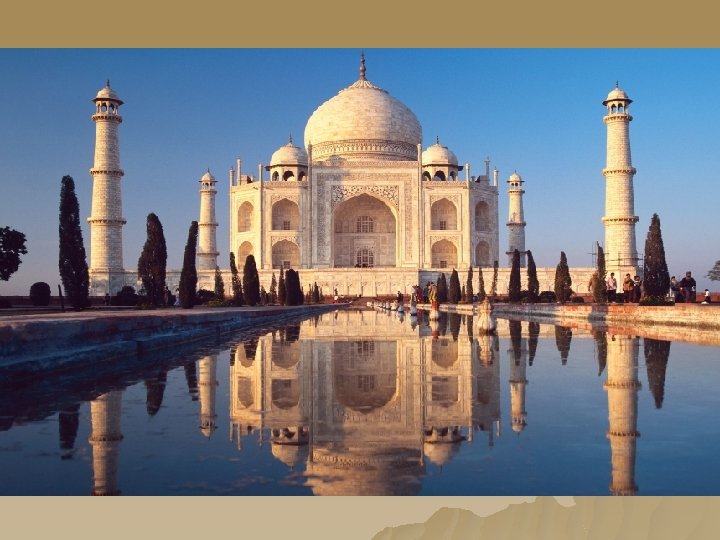
The Delhi Sultanate – Invaders entered northern India & organized a sultanate, or land ruled by a sultan. – Intro. Muslim traditions of gov’t to India. Muslims in India Akbar the Great Shah Jahan u Akbar strengthened Mughal India. Accomplished: – religious toleration – Modernized the army u Jahan built the Taj Mahal as a tomb for his beloved wife Mumtaz Mahal.
The Ottoman and Safavid Empires
“Gunpowder Empires” u u Mughals--India, Ottomans & Safavids Period from about 1450 to 1650: “the age of gunpowder empires. ” The Ottoman Empire Under Suleiman “Lawgiver. ” Government – Absolute power. “Protector of the Sacred Places” (Mecca & Medina). Ruled w/a grand vizier & council. – Christian families in the Balkans sent young sons to the gov’t. – Best soldiers placed in the janissaries, elite force of the Ottoman army.
u The Abbas the Great Safavid shah, or king, Abbas the Great revived the glory of ancient Persia: n n n centralized gov’t strengthened the economy tolerated non-Muslims forged alliances w/ European states Decline of Safavid u u Death of Shah Abbas. Ottoman armies weakened Shiite scholars challenged the shah’s authority. Sunni Afghans rebelled.
Take Aways u 1. The fall of Constantinople will lead to Europe looking for new routes to of trade, around Africa, then across the world u 2. It was trade routes that led to the spread of Islam u 3. The Ottomans spread Islam and were able to unite most of Islam under one ruler