
Rise of Europe Chapter 7 Early Middle Ages
- Slides: 49
Rise of Europe Chapter 7
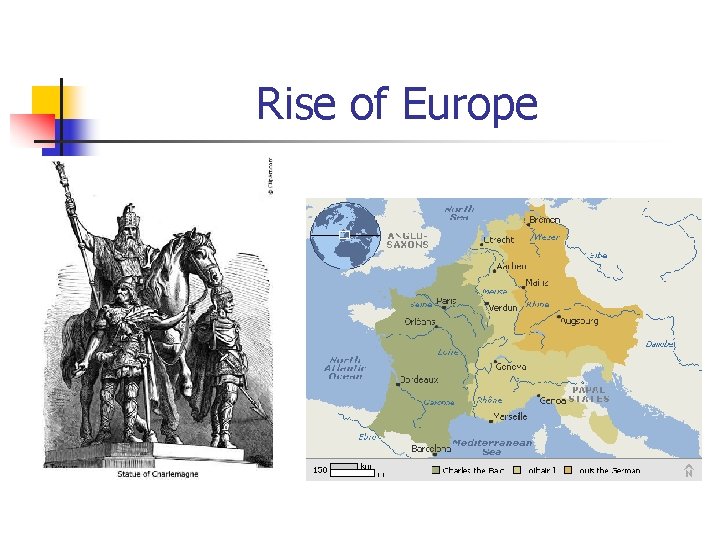
Early Middle Ages n Germanic kingdoms n n n German tribes settled in Western Europe Franks-most successful of the German tribes Clovis n n 1 st Frankish king Conquered Gaul (France) Preserved Roman customs in Gaul Became a Christian
Early Middle Ages n Islam: A New Religion and Power: handout n n n Founded by Muhammad Born in Mecca and then moved to Medina Went back to Mecca to conquer and destroy Islam rejects Christ as savoir Muslims overran N Africa, Spain, and headed for France Charles Martel, a Frankish King, defeated Muslims at Battle of Tours http: //www. youtube. com/watch? v=Cv. Sb. BEo. Be. Pg&feature=related
Age of Charlemagne n n n n Charles Martel’s grandson Build an empire from France to Germany to Italy Frankish descent Pope Leo III asked for help to put down a rebellion in Rome, crowned him king for helping Tried to create a united Christian Europe Set up schools Charlemagne died in 814 and his empire was divided among his grandsons in the Treaty of Verdun
Rise of Europe
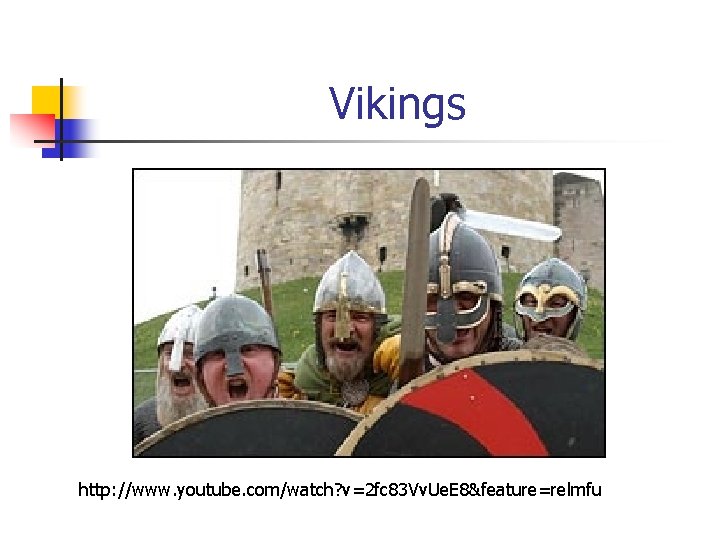
More attacks on Europe n Magyars: n n n Based/settled in modern day Hungary Conquered Eastern Europe, France & Italy Vikings: n n Ferocious fighters and sailors from Scandinavia Looted and burned communities Traders and explorers Leif Erikson founded a colony in N. A.
Vikings http: //www. youtube. com/watch? v=2 fc 83 Vv. Ue. E 8&feature=relmfu
Review n n n Who was Clovis? Who was Charlemagne? What were 3 contributions of Charlemagne? Magyars took over what parts of Europe? Vikings took over what parts of Europe? What new religion emerged during this time?
Manor Economy pgs 219 -224 n Feudalism n n n Fief = estate Vassal = lesser lord See chart Problems could develop if a lesser lord pledges loyalty to several lords who quarreled with each other Example: in class
Knights n n n Knight: Training from age 7 -21 Difficult Strict discipline Modern-day army n http: //www. youtube. com/watch? v=ym. BF 3 nfh. CU
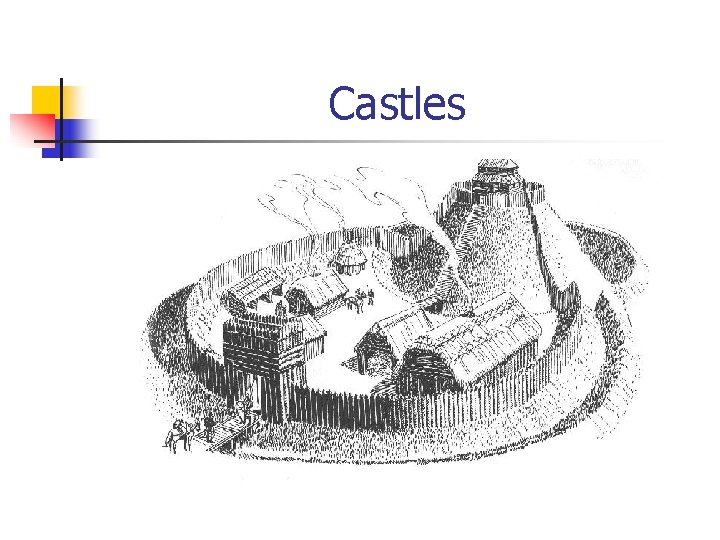
Castles n n Build by lords and kings Started off with a wooden fence, later moat and stone walls developed At first castles resembled forts To defeat a castle, attackers could starve them into surrender or tunnel under the walls n See page 220
Castles
Role of Women n Women might supervise the household if the man was gone Rights to inheritance were restricted Chivalry: code of conduct adopted by knights n n n See book page 222 Required them to be brave, loyal, and true to their word Preached that women should be cherished
The Manor n n Most important aspect of the medieval economy was the manor of the lord’s estate Peasants: n n Most were serfs-bound to the land, NOT slaves, but could not leave manor w/o lord’s permission Serfs had to work several days farming, paid their lord a fee when they married, and paid their lord a fee when they used their mill to grind grain. In return, they had the right to grow things for themselves and were protected from raiders.
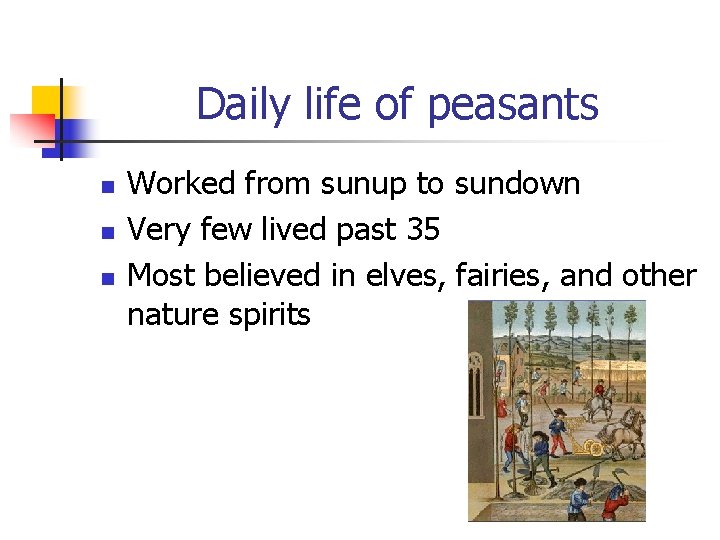
Daily life of peasants n n n Worked from sunup to sundown Very few lived past 35 Most believed in elves, fairies, and other nature spirits
Review n n n Describe Feudalism. Describe a Knights training. Describe Castles and the manor. What was the role of women during this time? What is chivalry and is it dead? What was daily life like for peasants?
The Medieval Church n Structure and Authority n n n Western church headed by the pope became the ruler of the RCC Eventually became more secular- worldy, not of the church Pope was the spiritual leader of the RCC as well as ruling the Papal States in central Italy
Authority of the Church n n Christians believed all people were sinners doomed to eternal sufferings The only way to avoid hell was to participate in the sacraments-sacred rituals of the Church The church had its own body of laws called canon law Anyone who refused to obey church law was subject to punishment. The most severe was excommunication, which means you would not receive the sacraments i. e. go to hell.
Authority of the Church cont. n n If a town or a king broke canon law they could face an interdict which excludes a whole town or region The RCC required all Christian to pay a tithe, a tax of 10% that went directly to the church.
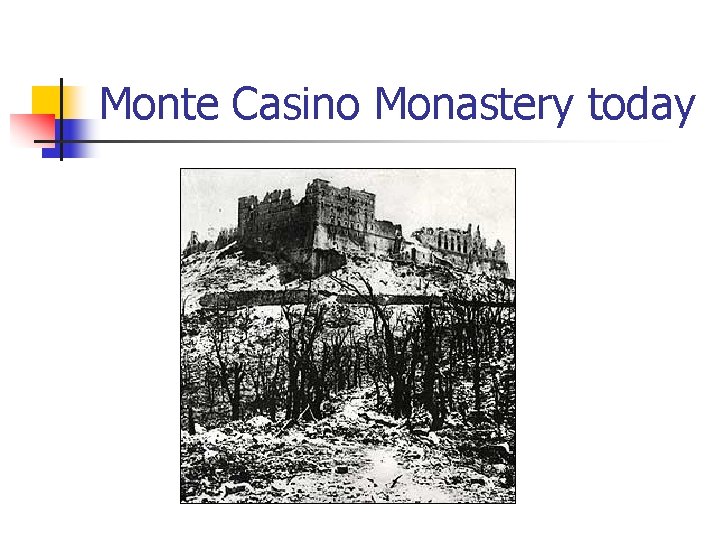
Monks and Nuns n Benedictine Rule n n A monk named Benedict founded the monastery at Monte Casino, Italy. Monks and nuns took an oath of poverty and two others: chastity and obedience to the abbot In time it spread across Europe Chief duties were prayer and worship of God
Monte Casino Monastery today
Monks and Nuns n n n Tended to the sick and poor Preserved writings of the ancient world NO printing press—copied ancient books as a form of labor http: //www. middle-ages. org. uk/medieval-monks. htm http: //www. middle-ages. org. uk/daily-life-nun-middle-ages. htm
Missionaries n n St. Patrick went to Ireland established the Irish Catholic Church St. Augustine went to England to convert the Angles and Saxons: pagans
Reform Movements n n The clergy tended to be secular (worldly) and live in luxury Many ignored their vows Married priests spent more time on their own interests or with their families Moral decay
Monastery at Cluny, France n n n Abbot Berno in Cluny tried to end church abuses Berno filled the monastery with men devoted solely to religious pursuits Gregory VII, pope in 1073, extended the Clunaic reforms throughout the church
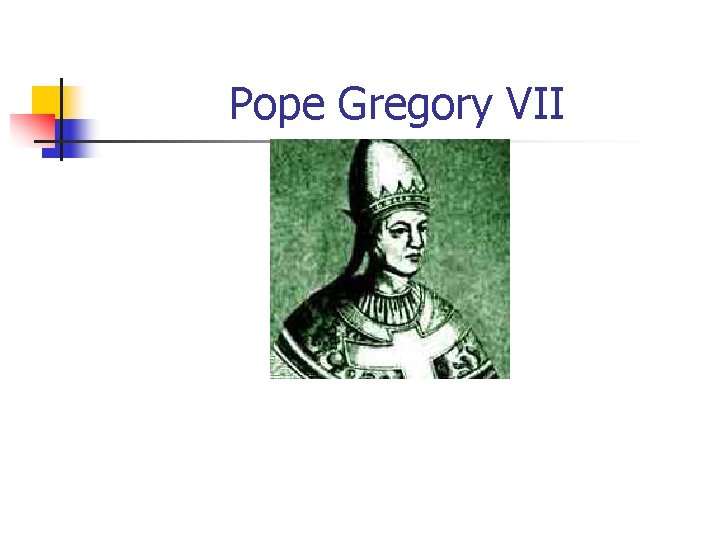
Pope Gregory VII
Pope Gregory VII n n Gregory VII insisted the church and not kings choose church officials Gregory VII instituted the rule that no clergy were allowed to be married
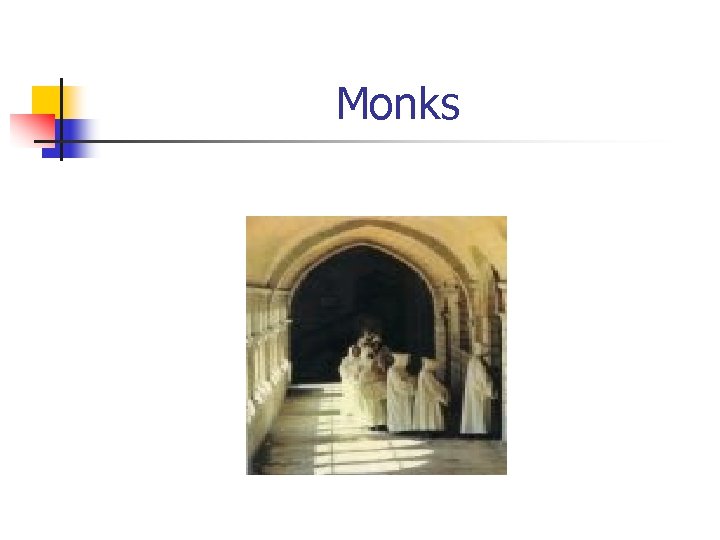
Monks
Preaching Orders n n Monks and friars who preached to the poor Franciscans Dominicans dedicated to educating people about Christianity and ending heresies Beguines: a group of women without the financial means to enter a convent
Jews in Western Europe n n n Jews were tolerated by Muslims and Christians alike However as the RCC’s power increased they banned Jews from many occupations and from owning land Laid the foundation for anti-Semitism —prejudice against the Jews
Review n n n Describe the authority of the church. What/who are monks and nuns? Define the Benedictine rule. Name two missionaries. How did the RCC try to reform? How were Jews treated during this time?
Medieval Economics pgs 231 -236 n New Technologies n n By 800 peasants started using iron plows instead of wooden ones. A new harness system allowed them to use a horse on the plow instead of much slower oxen. In turn their fields were larger. Wind mills grinded grain 3 field system==field #1 for grain, field #2 for legumes, field #3 was fallow. Then rotate crops the following year
Trading n Trade fairs n n n Traders and customers met at trade fairs which at first took place near navigable rivers Gave them an opportunity to buy and sell merchandise Slowly these centers of trade developed into the first medieval cities some topped 100, 000 ppl for the first time since Roman times
Trading n To protect their interests the merchants who set up a new town would ask the lord or king for a charter n n A written document that has rights and privileges of a town. Charters varied but they usually allowed the local townspeople to choose their own leaders and control their affairs
Commercial Revolution n n In time the merchants needed capital – money for investment New Business practices n n Merchants began to pool their money together to support large scale projects that would have cost one person too much Primitive insurance developed
Commercial Revolution n n Bill of exchange—merchants put money in the bank and in return is given a note. Notes could be taken to another city and uses it like money. The use of money helped undermined serfdom and helped the middle class develop n http: //www. youtube. com/watch? v=_dw. L 9 lq. VBx. Y
Guilds n Merchants developed guilds—associations of merchants n n n Passed laws, levied taxes, and spent money on projects thus acting like a city government They organized craft guilds Each guild represented one occupation (weavers, bakers, tailors, etc. ) Guilds were similar to unions today. They limited membership. Why?
Guilds n Becoming a guild member n n n Many hard years as an apprentice or trainee was required Training started at age seven Women worked in craft guilds
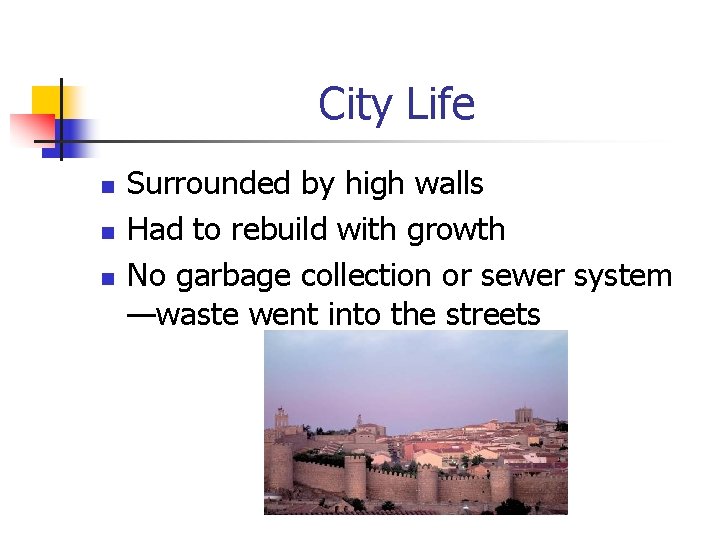
City Life n n n Surrounded by high walls Had to rebuild with growth No garbage collection or sewer system —waste went into the streets
Review n n n Name some new technologies during this time. What are trade fairs? What was the commercial revolution? Describe guilds. What was city life like during this time?
Islam n n Introduction Arabian peninsula Bedouins—nomadic herders Mecca—trade and market city
Islam Muhammed n born 570 n at age 40 heard God’s voice calling him to start a new religion n Hijra—move with first followers to Medina n Caliph—successor to Muhammed
Islam Message and Core Beliefs Monotheism: belief in Allah Quran (Koran)—holy book; written in Arabic; God’s word through Muhammed Sharia—law codes for religious, criminal and civil law Same god as Judaism and Christianity Mosque—house of worship 5 Pillars n n n Profession of faith (only one god, Allah) Daily prayer (face Mecca 5 times daily) Charity to the poor Fast from sunup to sundown during Ramadan Hajj—pilgrimage to Mecca once in your life
Islam n n n Women Not much power in Middle Eastern society before Islam With Islam could divorce, be educated and inherit property 4 wives if treated equally Eventually some were veiled and put in harems and not treated equally
Islam n n n Spread of Islam A. Persia, Byzantium, Egypt, North Africa, Spain and some of France B. Allowed Jews and Christians to practice: equally
Islam n n Divisions A. Sunni—caliph is a leader only and should be the best man; 90% present day B. Shi’ite (Shi’a)—caliph should be a descendant of Muhammed C. Sufi: mystics
Islam n n n n Civilization A. No social classes B. international trade network C. Artistic design very geometric and nature oriented D. Architecture has domes and fountains E. Kept ancient works alive F. Advances in medicine
Review n n n Name the founder of Islam. What are the 5 Pillars of Islam? How are women treated according to the Islamic faith? Name the divisions of Islam. How has Islam contributed to civilization?
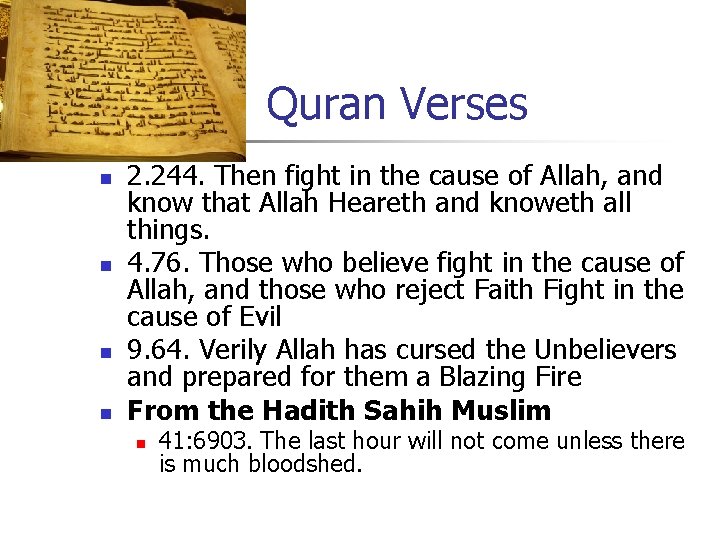
Quran Verses n n 2. 244. Then fight in the cause of Allah, and know that Allah Heareth and knoweth all things. 4. 76. Those who believe fight in the cause of Allah, and those who reject Faith Fight in the cause of Evil 9. 64. Verily Allah has cursed the Unbelievers and prepared for them a Blazing Fire From the Hadith Sahih Muslim n 41: 6903. The last hour will not come unless there is much bloodshed.