
RISE AND FALL OF EMPIRES REVIEW THE ROMAN

- Slides: 11
RISE AND FALL OF EMPIRES REVIEW
THE ROMAN REPUBLIC • Rome’s economy was based almost entirely on agriculture, but because the terrain was mountainous, they had to innovate. • They did this through two major things: • Terraced farming (creating flat surfaces in a slope to make it farmable) • Aqueducts (a bridge that transports water from a reservoir to a specific area for human use or irrigation) • Rome also established a Republic, where representatives were elected. Rome also had distinct social classes. You had Plebeians, or common people, and Patricians, the wealthy upper class. Men born in Rome were citizens, women were caretakers, boys were educated, girls learned handicrafts and household chores • Only the patricians could be elected or hold public office, so they held all political power.
ROME’S RISE • Rome’s rise from a Republic to an Empire began with the Emperor Octavian, Julius Caesar’s grand-nephew • He kept the basic things in place of the Roman Republic, but reorganized the government by having soldiers swear allegiance, setting up governors in Rome’s provinces, and having a census to ensure taxes were paid. • Rome also started using a vast system of roads to help trade and the movement of the army. • Rome also set up a civil service, which is where workers were paid to work in the government. This reorganization made Rome stable, which led to a period of peace known as… • Pax Romana!
PAX ROMANA • For 207 years peace & prosperity existed throughout Rome • 90% of Rome were farmers. People had plenty of food. • Entire empire used silver coins • Huge amount of trade throughout the empire = few economic issues. • The peace that Augustus brought to Rome, caused its people to prosper, civilization spread, and cultures mixed. • With peace came, increased trade as goods moved freely and safely along trade routes. • There were no tariffs, or taxes placed on goods brought into the country. Shipping became a big business, and increased trade meant more business for Romans.
WHY WAS ROME SUCCESSFUL? • There was 200+ years without any wars or major battles • Everyone had a job which helped the economy • About 90% were farmers which led to surplus food (agriculture) • Entertainment kept citizens engaged, not bored • Rome had a huge population • Used the same coins which helped with trade • Had a vast (large) trading network • Roads helped their army protect them and helped traders travel • They traded with many places due to the Silk Road like China and India
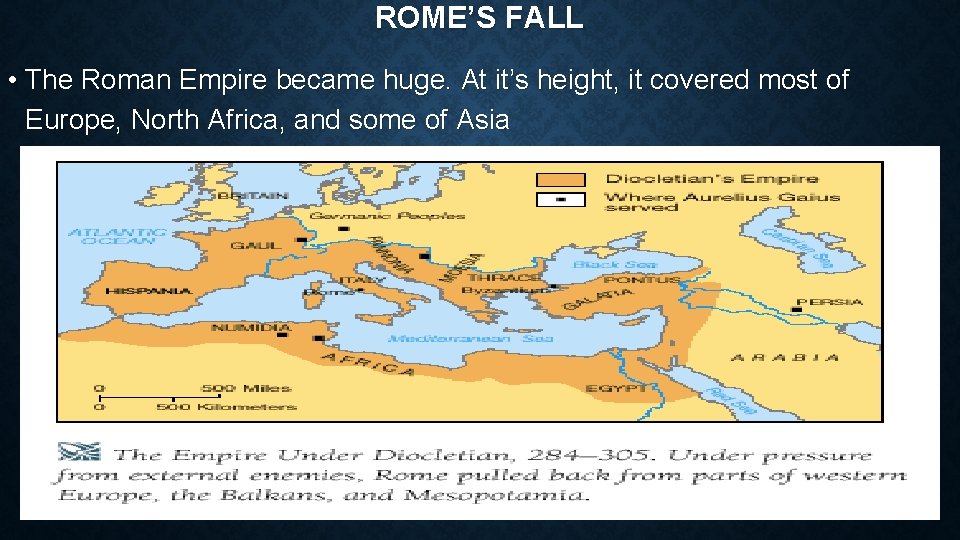
ROME’S FALL • The Roman Empire became huge. At it’s height, it covered most of Europe, North Africa, and some of Asia
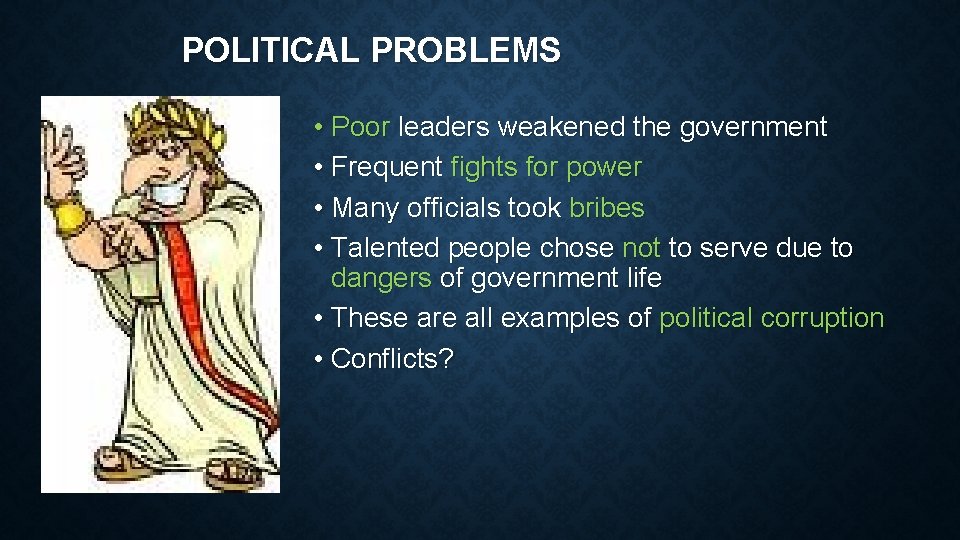
POLITICAL PROBLEMS • Poor leaders weakened the government • Frequent fights for power • Many officials took bribes • Talented people chose not to serve due to dangers of government life • These are all examples of political corruption • Conflicts?
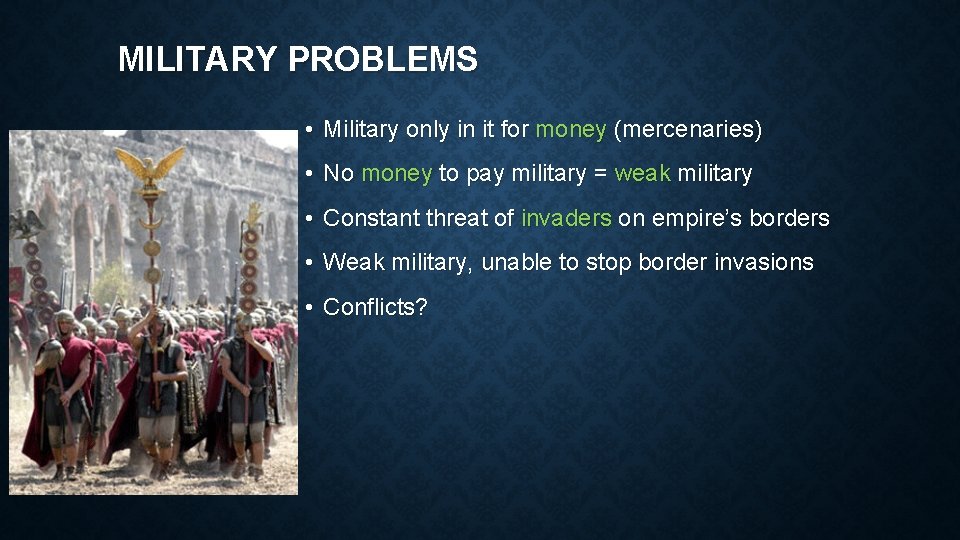
MILITARY PROBLEMS • Military only in it for money (mercenaries) • No money to pay military = weak military • Constant threat of invaders on empire’s borders • Weak military, unable to stop border invasions • Conflicts?
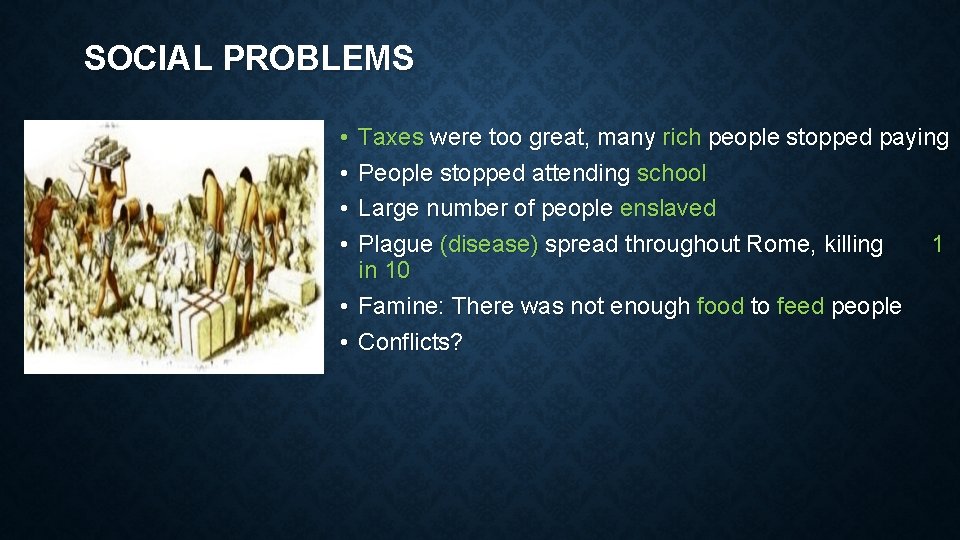
SOCIAL PROBLEMS • • Taxes were too great, many rich people stopped paying People stopped attending school Large number of people enslaved Plague (disease) spread throughout Rome, killing 1 in 10 • Famine: There was not enough food to feed people • Conflicts?
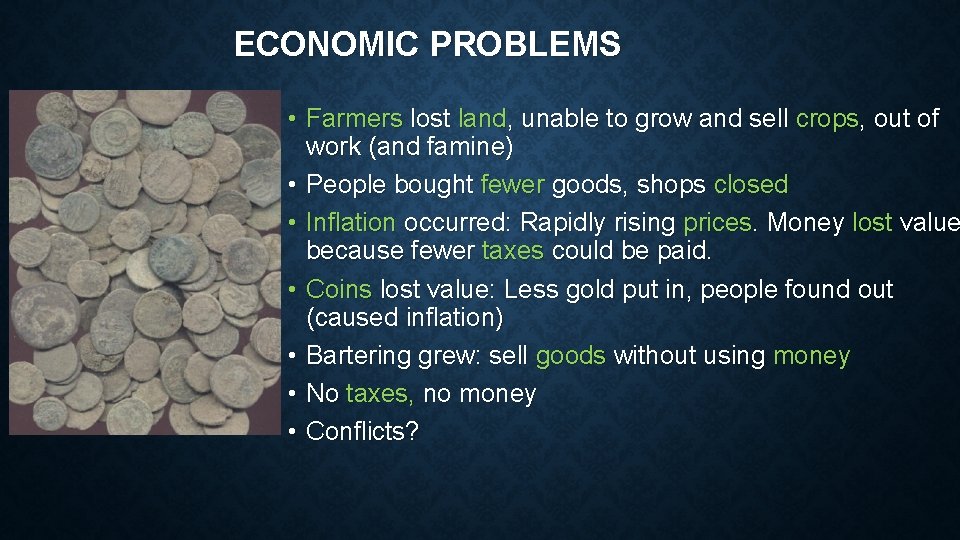
ECONOMIC PROBLEMS • Farmers lost land, unable to grow and sell crops, out of work (and famine) • People bought fewer goods, shops closed • Inflation occurred: Rapidly rising prices. Money lost value because fewer taxes could be paid. • Coins lost value: Less gold put in, people found out (caused inflation) • Bartering grew: sell goods without using money • No taxes, no money • Conflicts?
ROME’S FALL • In order to try and save the empire, Roman Emperor’s try to divide it into East and West, with two separate emperors. But this didn’t always work out for the best. • Constantine reunited the empire and made the capital Byzantium (he named it later after himself “Constantinople”) after Rome continued to decline. After his death, the empire split again – Rome the capital in the West, and Constantinople the capital in the East. • Unable to fully protect its borders, Rome faced a series of invasions from groups like the Franks and Vandals. When the Roman emperor is defeated in 476, this marks the fall of Rome, and the beginning of the Dark Ages. • The Eastern Empire would continue to exist for the next 1, 000 years.