
RISC CISC and ISA Variations Hakim Weatherspoon CS
- Slides: 41
RISC, CISC, and ISA Variations Hakim Weatherspoon CS 3410 Computer Science Cornell University [Weatherspoon, Bala, Bracy, Mc. Kee, and Sirer]
Announcements • Prelim tonight • • • Tuesday at 7: 30 pm Go to location based on Net. ID [a – g]* : HLS 110 (Hollister 110) [h – mg]* : HLSB 14 (Hollister B 14) [mh – z]* : KMBB 11 (Kimball B 11) 2
Announcements • Prelim 1: • • • Time: We will start at 7: 30 pm sharp, so come early Location: on previous slide Closed Book Cannot use electronic device or outside material Practice prelims are online in CMS • Material covered everything up to end of this week • Everything up to and including data hazards • Appendix A (logic, gates, FSMs, memory, ALUs) • Chapter 4 (pipelined [and non] MIPS processor with hazards) • Chapters 2 (Numbers / Arithmetic, simple MIPS instructions) • Chapter 1 (Performance) • Projects 1 and 2, Lab 0 -4, C HW 1 3
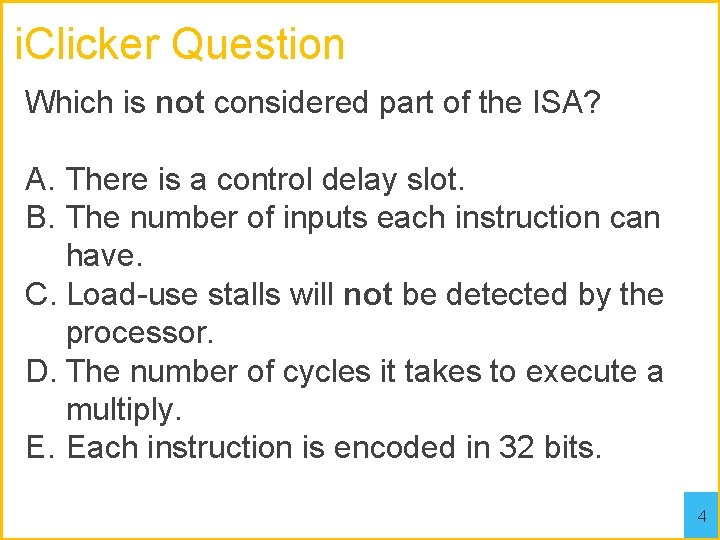
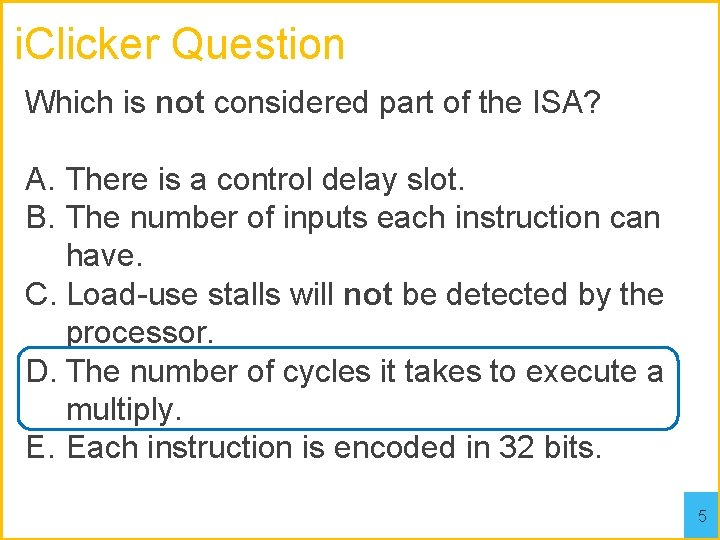
i. Clicker Question Which is not considered part of the ISA? A. There is a control delay slot. B. The number of inputs each instruction can have. C. Load-use stalls will not be detected by the processor. D. The number of cycles it takes to execute a multiply. E. Each instruction is encoded in 32 bits. 4
i. Clicker Question Which is not considered part of the ISA? A. There is a control delay slot. B. The number of inputs each instruction can have. C. Load-use stalls will not be detected by the processor. D. The number of cycles it takes to execute a multiply. E. Each instruction is encoded in 32 bits. 5
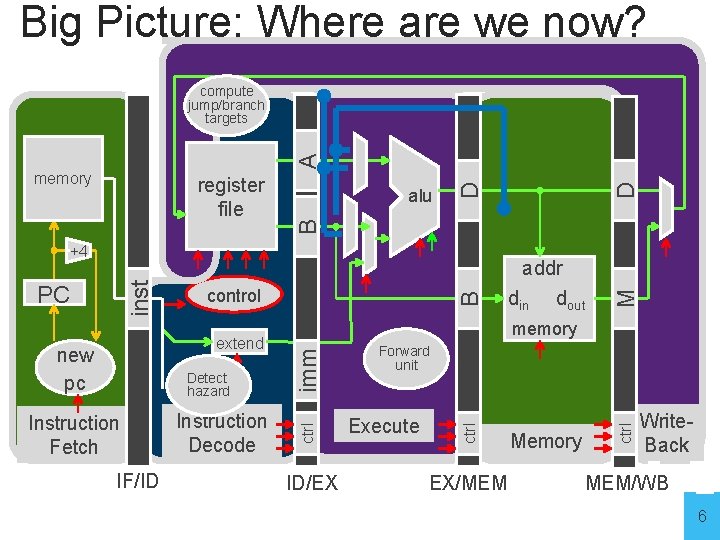
Big Picture: Where are we now? Instruction Fetch IF/ID Instruction Decode ID/EX M Forward unit Execute ctrl Detect hazard addr din dout memory imm extend new pc B control ctrl inst +4 PC D alu EX/MEM Memory ctrl register file B memory D A compute jump/branch targets Write. Back MEM/WB 6
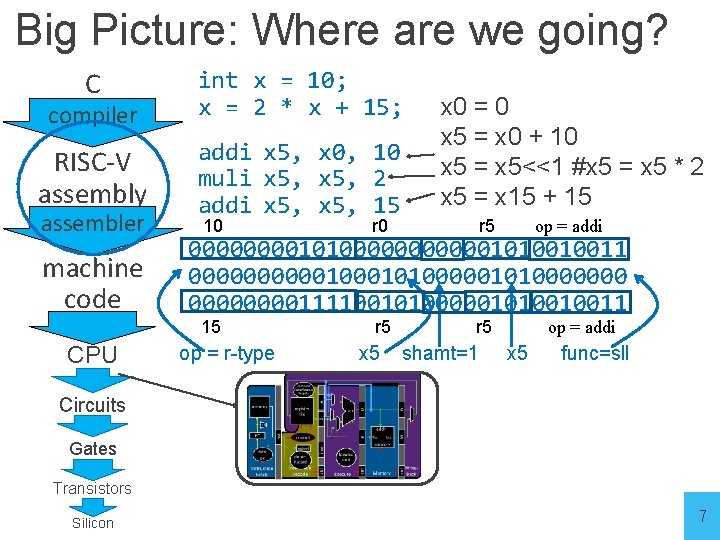
Big Picture: Where are we going? C compiler int x = 10; x = 2 * x + 15; RISC-V assembly addi x 5, x 0, 10 muli x 5, 2 addi x 5, 15 assembler machine code CPU x 0 = 0 x 5 = x 0 + 10 x 5 = x 5<<1 #x 5 = x 5 * 2 x 5 = x 15 + 15 10 r 5 15 r 5 op = addi 00001010000001010010011 0000010001010000000111100101000001010010011 op = r-type x 5 shamt=1 op = addi x 5 func=sll Circuits Gates Transistors Silicon 7
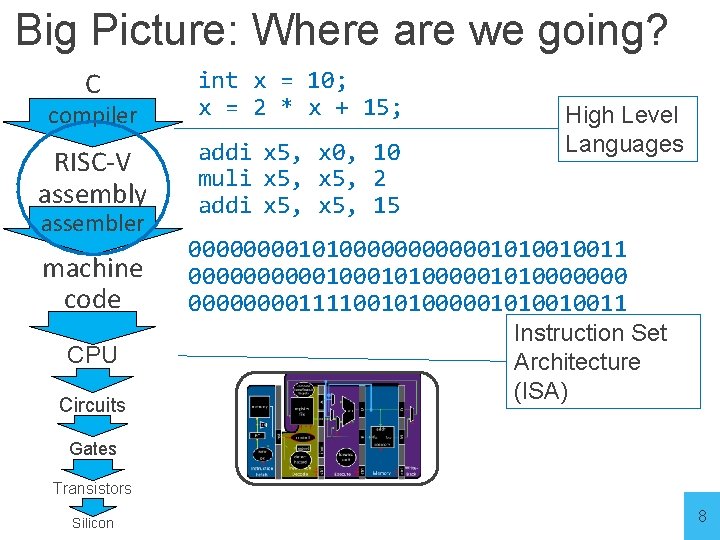
Big Picture: Where are we going? compiler int x = 10; x = 2 * x + 15; RISC-V assembly addi x 5, x 0, 10 muli x 5, 2 addi x 5, 15 C assembler machine code CPU Circuits High Level Languages 00001010000001010010011 0000010001010000000111100101000001010010011 Instruction Set Architecture (ISA) Gates Transistors Silicon 8
Goals for Today Instruction Set Architectures • ISA Variations, and CISC vs RISC • Peek inside some other ISAs: • X 86 • ARM 9
Next Goal Is RISC-V the only possible instruction set architecture (ISA)? What are the alternatives? 10
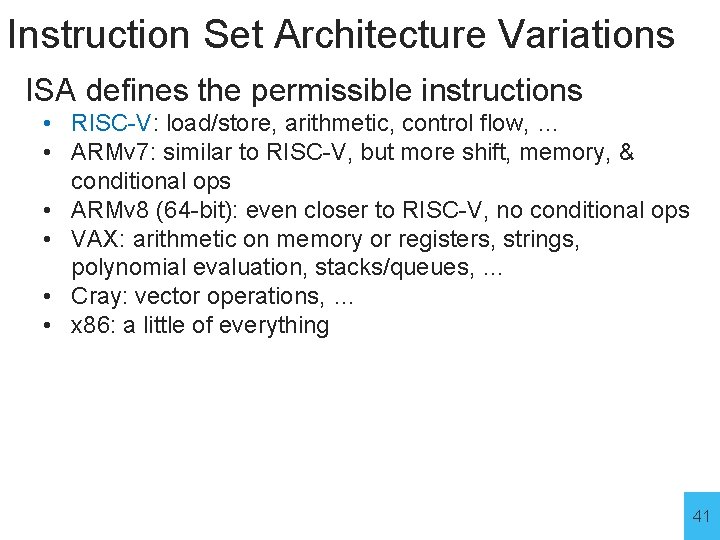
Instruction Set Architecture Variations ISA defines the permissible instructions • RISC-V: load/store, arithmetic, control flow, … • ARMv 7: similar to RISC-V, but more shift, memory, & conditional ops • ARMv 8 (64 -bit): even closer to RISC-V, no conditional ops • VAX: arithmetic on memory or registers, strings, polynomial evaluation, stacks/queues, … • Cray: vector operations, … • x 86: a little of everything 11
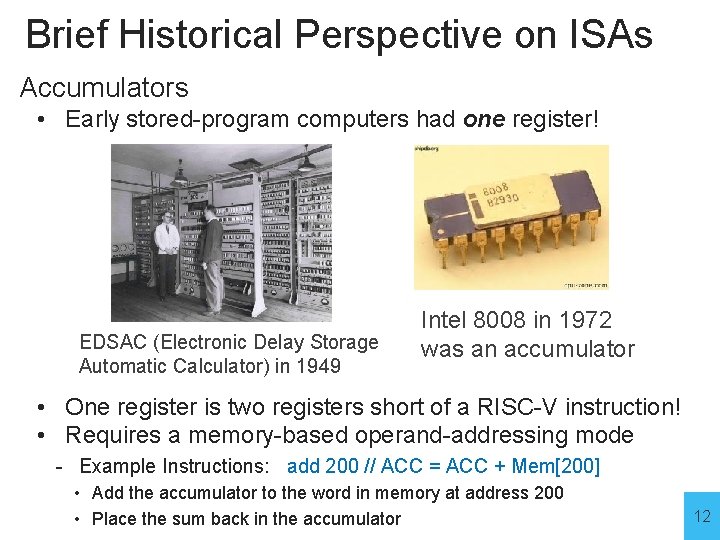
Brief Historical Perspective on ISAs Accumulators • Early stored-program computers had one register! EDSAC (Electronic Delay Storage Automatic Calculator) in 1949 Intel 8008 in 1972 was an accumulator • One register is two registers short of a RISC-V instruction! • Requires a memory-based operand-addressing mode - Example Instructions: add 200 // ACC = ACC + Mem[200] • Add the accumulator to the word in memory at address 200 • Place the sum back in the accumulator 12
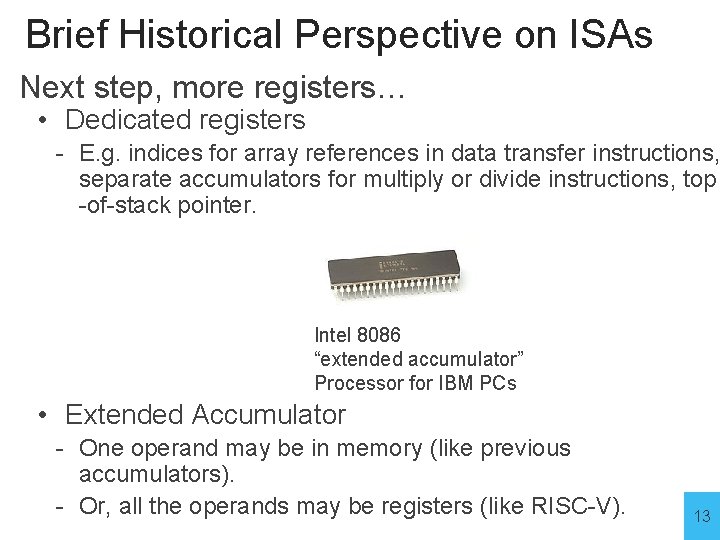
Brief Historical Perspective on ISAs Next step, more registers… • Dedicated registers - E. g. indices for array references in data transfer instructions, separate accumulators for multiply or divide instructions, top -of-stack pointer. Intel 8086 “extended accumulator” Processor for IBM PCs • Extended Accumulator - One operand may be in memory (like previous accumulators). - Or, all the operands may be registers (like RISC-V). 13
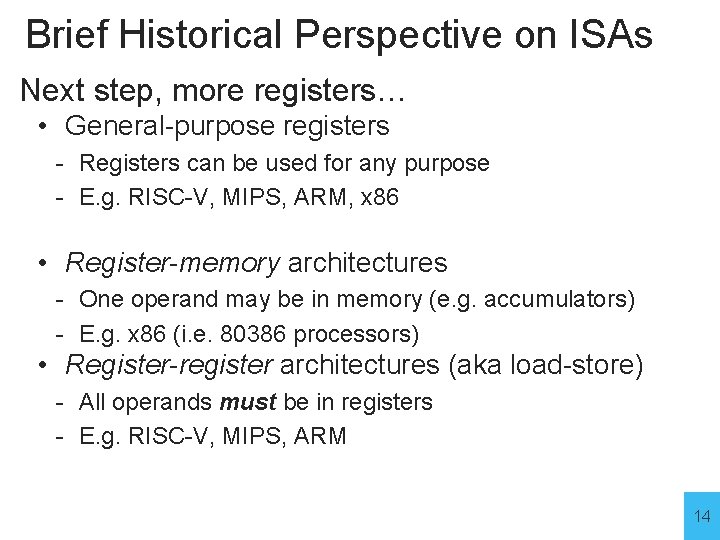
Brief Historical Perspective on ISAs Next step, more registers… • General-purpose registers - Registers can be used for any purpose - E. g. RISC-V, MIPS, ARM, x 86 • Register-memory architectures - One operand may be in memory (e. g. accumulators) - E. g. x 86 (i. e. 80386 processors) • Register-register architectures (aka load-store) - All operands must be in registers - E. g. RISC-V, MIPS, ARM 14
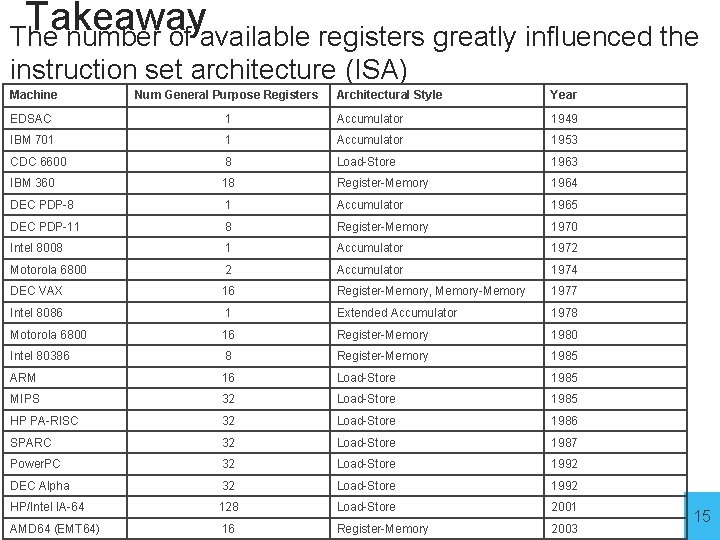
Takeaway The number of available registers greatly influenced the instruction set architecture (ISA) Machine Num General Purpose Registers Architectural Style Year EDSAC 1 Accumulator 1949 IBM 701 1 Accumulator 1953 CDC 6600 8 Load-Store 1963 IBM 360 18 Register-Memory 1964 DEC PDP-8 1 Accumulator 1965 DEC PDP-11 8 Register-Memory 1970 Intel 8008 1 Accumulator 1972 Motorola 6800 2 Accumulator 1974 DEC VAX 16 Register-Memory, Memory-Memory 1977 Intel 8086 1 Extended Accumulator 1978 Motorola 6800 16 Register-Memory 1980 Intel 80386 8 Register-Memory 1985 ARM 16 Load-Store 1985 MIPS 32 Load-Store 1985 HP PA-RISC 32 Load-Store 1986 SPARC 32 Load-Store 1987 Power. PC 32 Load-Store 1992 DEC Alpha 32 Load-Store 1992 HP/Intel IA-64 128 Load-Store 2001 AMD 64 (EMT 64) 16 Register-Memory 2003 15
Next Goal How to compute with limited resources? i. e. how do you design your ISA if you have limited resources? 17
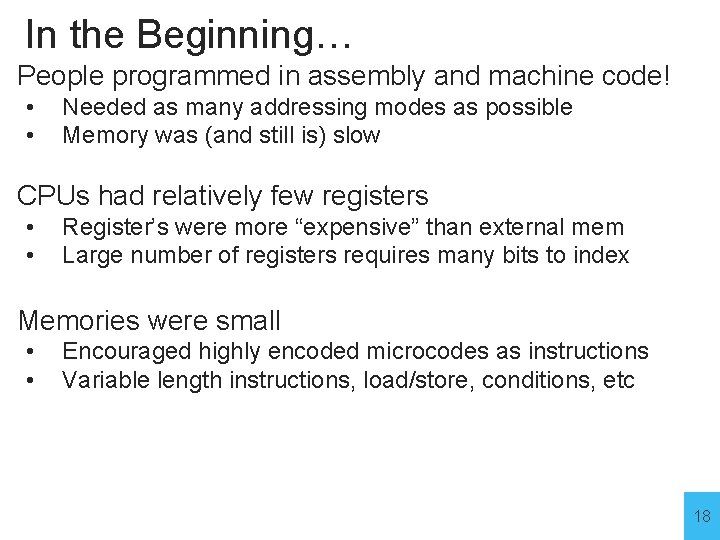
In the Beginning… People programmed in assembly and machine code! • • Needed as many addressing modes as possible Memory was (and still is) slow CPUs had relatively few registers • • Register’s were more “expensive” than external mem Large number of registers requires many bits to index Memories were small • • Encouraged highly encoded microcodes as instructions Variable length instructions, load/store, conditions, etc 18
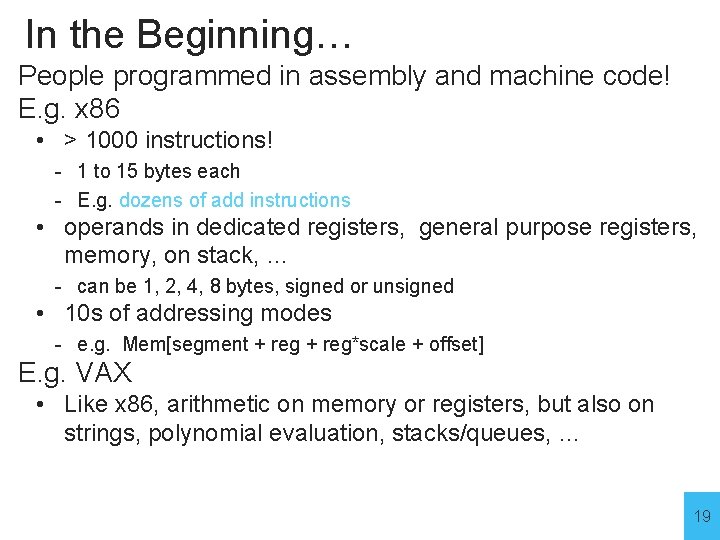
In the Beginning… People programmed in assembly and machine code! E. g. x 86 • > 1000 instructions! - 1 to 15 bytes each - E. g. dozens of add instructions • operands in dedicated registers, general purpose registers, memory, on stack, … - can be 1, 2, 4, 8 bytes, signed or unsigned • 10 s of addressing modes - e. g. Mem[segment + reg*scale + offset] E. g. VAX • Like x 86, arithmetic on memory or registers, but also on strings, polynomial evaluation, stacks/queues, … 19
Complex Instruction Set Computers (CISC) 20
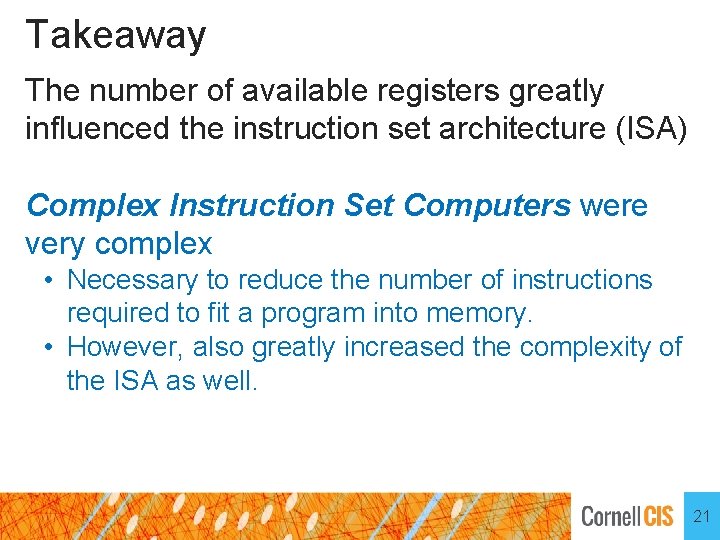
Takeaway The number of available registers greatly influenced the instruction set architecture (ISA) Complex Instruction Set Computers were very complex • Necessary to reduce the number of instructions required to fit a program into memory. • However, also greatly increased the complexity of the ISA as well. 21
Next Goal How do we reduce the complexity of the ISA while maintaining or increasing performance? 22
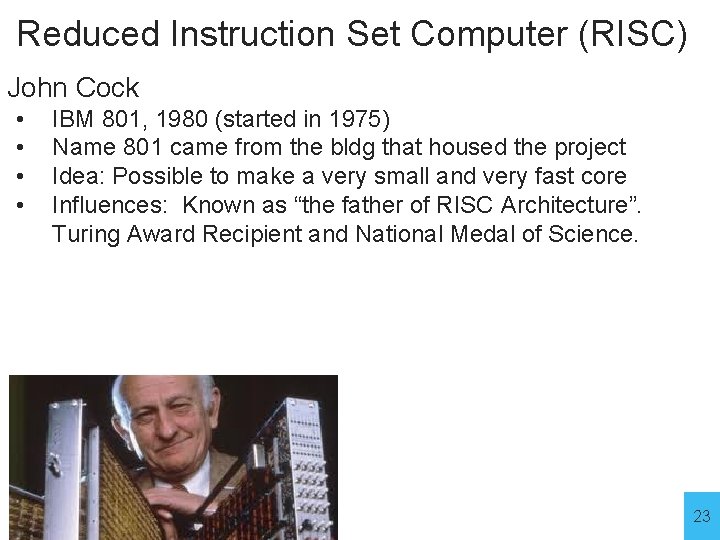
Reduced Instruction Set Computer (RISC) John Cock • • IBM 801, 1980 (started in 1975) Name 801 came from the bldg that housed the project Idea: Possible to make a very small and very fast core Influences: Known as “the father of RISC Architecture”. Turing Award Recipient and National Medal of Science. 23
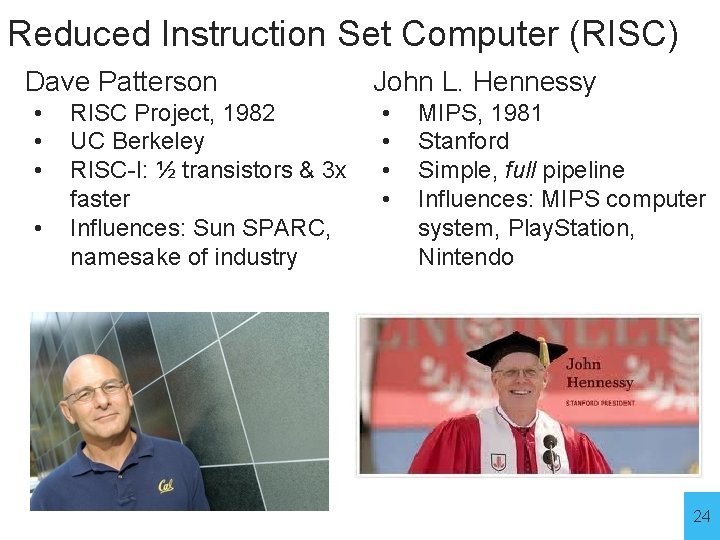
Reduced Instruction Set Computer (RISC) Dave Patterson • • RISC Project, 1982 UC Berkeley RISC-I: ½ transistors & 3 x faster Influences: Sun SPARC, namesake of industry John L. Hennessy • • MIPS, 1981 Stanford Simple, full pipeline Influences: MIPS computer system, Play. Station, Nintendo 24
Reduced Instruction Set Computer (RISC) RISC-V Design Principles Simplicity favors regularity • 32 bit instructions • Same instruction format works at 16 - or 64 -bit formats Smaller is faster • Small register file Make the common case fast • Include support for constants Good design demands good compromises • Support for different type of interpretations/classes 25
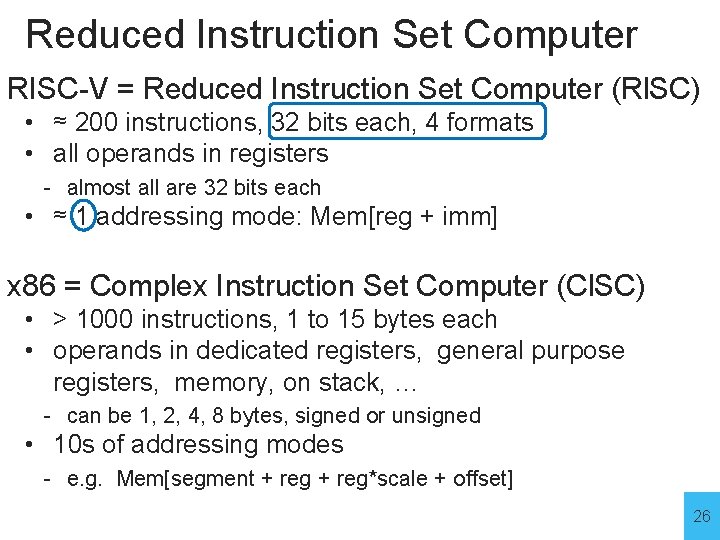
Reduced Instruction Set Computer RISC-V = Reduced Instruction Set Computer (Rl. SC) • ≈ 200 instructions, 32 bits each, 4 formats • all operands in registers - almost all are 32 bits each • ≈ 1 addressing mode: Mem[reg + imm] x 86 = Complex Instruction Set Computer (Cl. SC) • > 1000 instructions, 1 to 15 bytes each • operands in dedicated registers, general purpose registers, memory, on stack, … - can be 1, 2, 4, 8 bytes, signed or unsigned • 10 s of addressing modes - e. g. Mem[segment + reg*scale + offset] 26
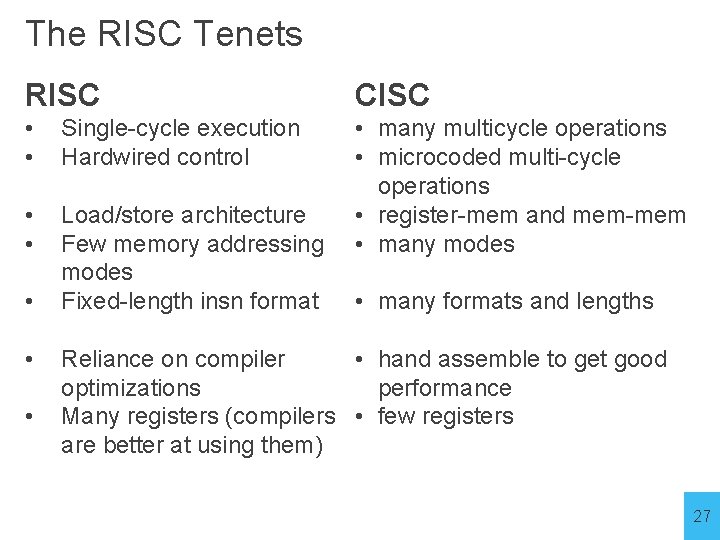
The RISC Tenets RISC CISC • • Single-cycle execution Hardwired control • • Load/store architecture Few memory addressing modes Fixed-length insn format • many multicycle operations • microcoded multi-cycle operations • register-mem and mem-mem • many modes • • many formats and lengths Reliance on compiler • hand assemble to get good optimizations performance Many registers (compilers • few registers are better at using them) 27
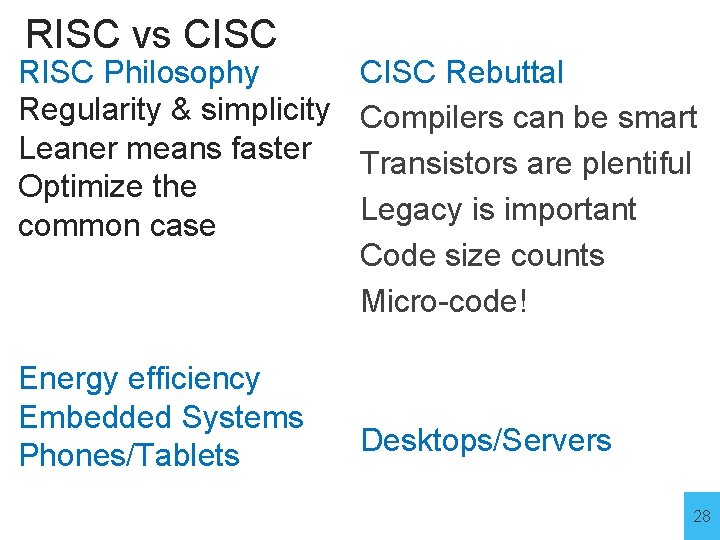
RISC vs CISC RISC Philosophy Regularity & simplicity Leaner means faster Optimize the common case Energy efficiency Embedded Systems Phones/Tablets CISC Rebuttal Compilers can be smart Transistors are plentiful Legacy is important Code size counts Micro-code! Desktops/Servers 28
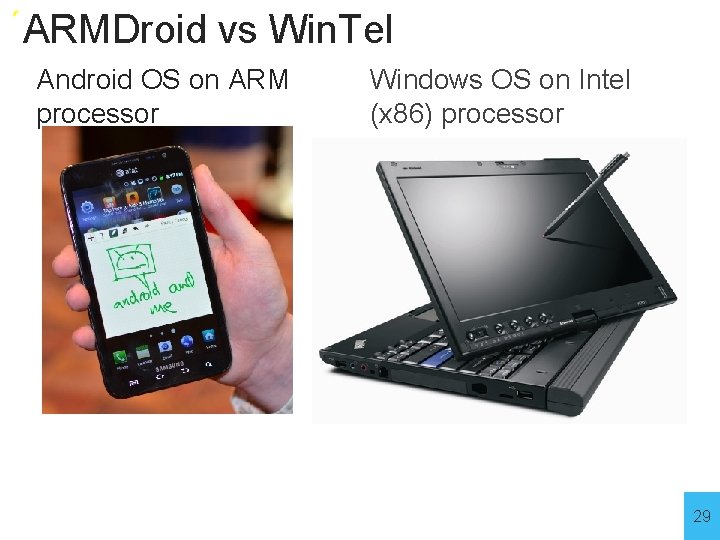
ARMDroid vs Win. Tel Android OS on ARM processor Windows OS on Intel (x 86) processor 29
i. Clicker Question What is one advantage of a CISC ISA? A. It naturally supports a faster clock. B. Instructions are easier to decode. C. The static footprint of the code will be smaller. D. The code is easier for a compiler to optimize. E. You have a lot of registers to use. 30
i. Clicker Question What is one advantage of a CISC ISA? A. It naturally supports a faster clock. B. Instructions are easier to decode. C. The static footprint of the code will be smaller. D. The code is easier for a compiler to optimize. E. You have a lot of registers to use. 31
Takeaway The number of available registers greatly influenced the instruction set architecture (ISA) Complex Instruction Set Computers were very complex - Necessary to reduce the number of instructions required to fit a program into memory. - However, also greatly increased the complexity of the ISA as well. Back in the day… CISC was necessary because everybody programmed in assembly and machine code! Today, CISC ISA’s are still dominant due to the prevalence of x 86 ISA processors. However, RISC ISA’s today such as ARM have an ever increasing market share (of our everyday life!). ARM borrows a bit from both RISC and CISC. 32
Next Goal How does RISC-V and ARM compare to each other? 33
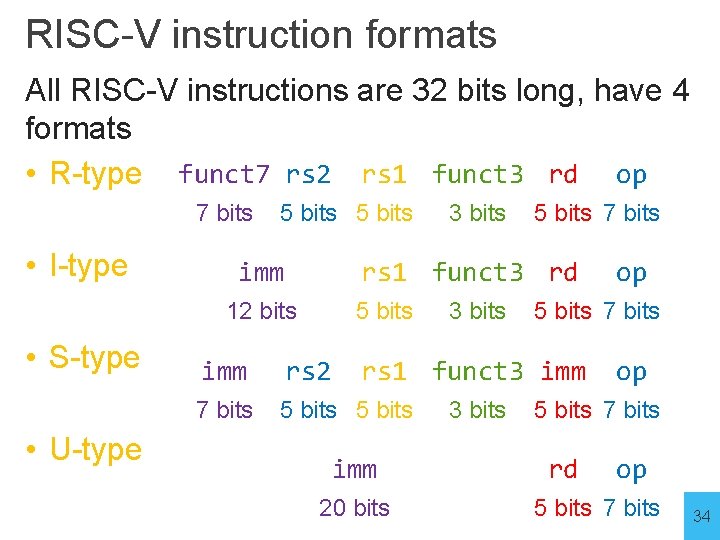
RISC-V instruction formats All RISC-V instructions are 32 bits long, have 4 formats • R-type funct 7 rs 2 rs 1 funct 3 rd op 7 bits • I-type 5 bits imm • U-type 5 bits 7 bits rs 1 funct 3 rd 12 bits • S-type 3 bits 5 bits imm rs 2 7 bits 5 bits 3 bits 5 bits 7 bits rs 1 funct 3 imm 20 bits 3 bits op op 5 bits 7 bits rd op 5 bits 7 bits 34
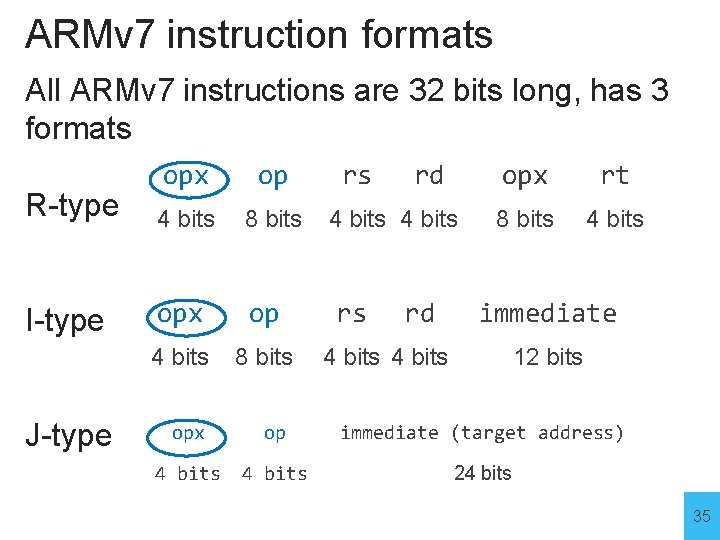
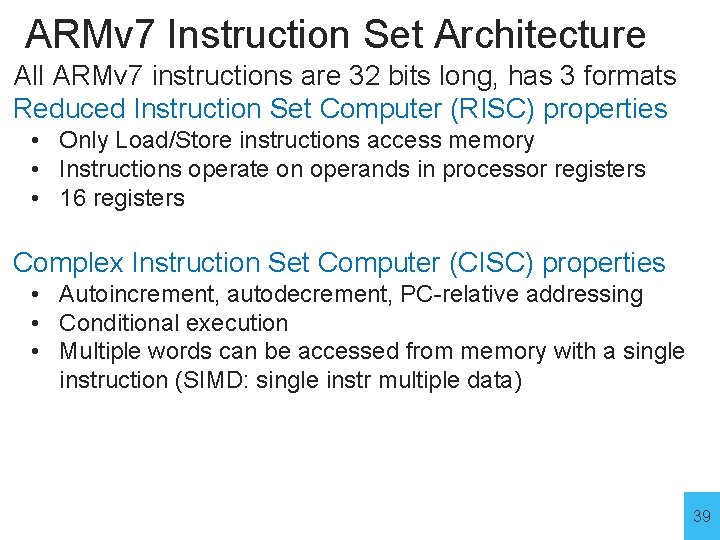
ARMv 7 instruction formats All ARMv 7 instructions are 32 bits long, has 3 formats R-type opx op 4 bits 8 bits I-type opx op 4 bits 8 bits J-type rs rd 4 bits rs rd opx rt 8 bits 4 bits immediate 4 bits 12 bits opx op immediate (target address) 4 bits 24 bits 35
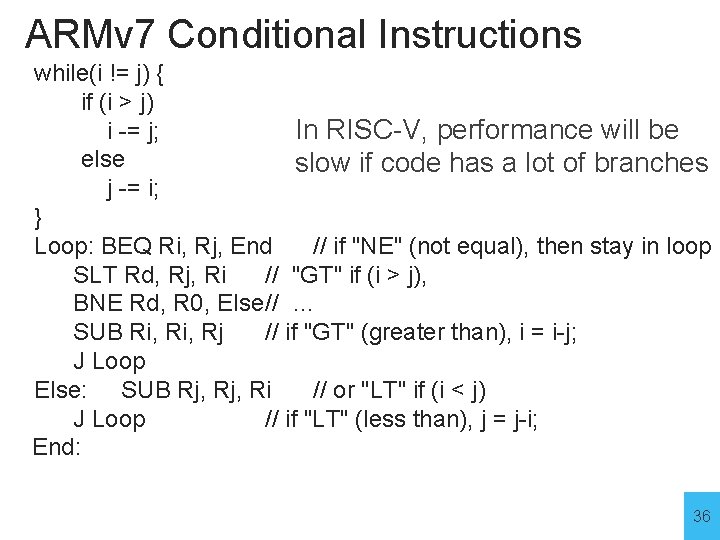
ARMv 7 Conditional Instructions while(i != j) { if (i > j) i -= j; In RISC-V, performance will be else slow if code has a lot of branches j -= i; } Loop: BEQ Ri, Rj, End // if "NE" (not equal), then stay in loop SLT Rd, Rj, Ri // "GT" if (i > j), BNE Rd, R 0, Else// … SUB Ri, Rj // if "GT" (greater than), i = i-j; J Loop Else: SUB Rj, Ri // or "LT" if (i < j) J Loop // if "LT" (less than), j = j-i; End: 36
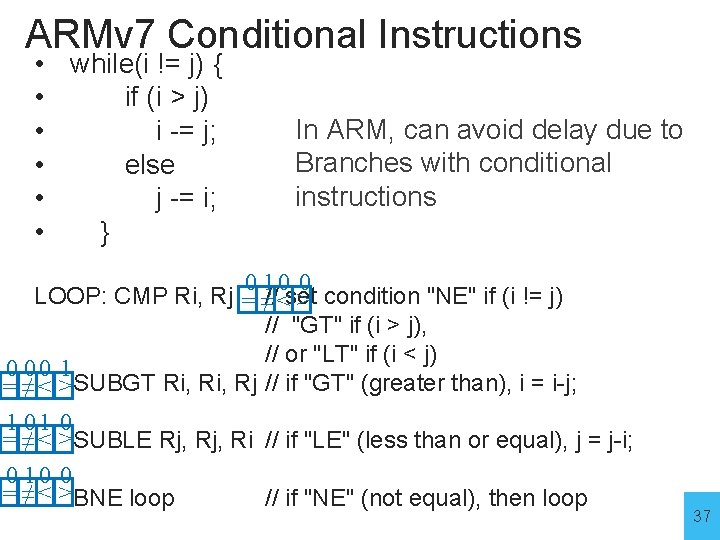
ARMv 7 Conditional Instructions • while(i != j) { • if (i > j) • i -= j; • else • j -= i; • } In ARM, can avoid delay due to Branches with conditional instructions 0 10 0 LOOP: CMP Ri, Rj = ≠//<set > condition "NE" if (i != j) // "GT" if (i > j), // or "LT" if (i < j) 0 00 1 = ≠ < > SUBGT Ri, Rj // if "GT" (greater than), i = i-j; 1 01 0 = ≠ < > SUBLE Rj, Ri // if "LE" (less than or equal), j = j-i; 0 10 0 = ≠ < > BNE loop // if "NE" (not equal), then loop 37
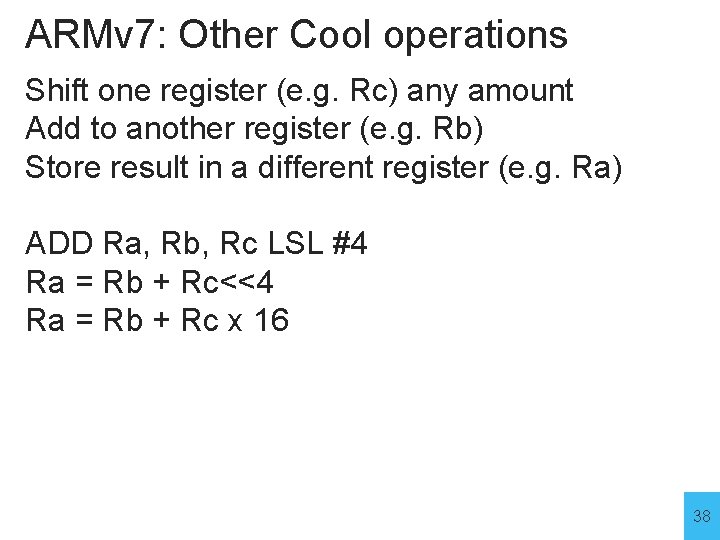
ARMv 7: Other Cool operations Shift one register (e. g. Rc) any amount Add to another register (e. g. Rb) Store result in a different register (e. g. Ra) ADD Ra, Rb, Rc LSL #4 Ra = Rb + Rc<<4 Ra = Rb + Rc x 16 38
ARMv 7 Instruction Set Architecture All ARMv 7 instructions are 32 bits long, has 3 formats Reduced Instruction Set Computer (RISC) properties • Only Load/Store instructions access memory • Instructions operate on operands in processor registers • 16 registers Complex Instruction Set Computer (CISC) properties • Autoincrement, autodecrement, PC-relative addressing • Conditional execution • Multiple words can be accessed from memory with a single instruction (SIMD: single instr multiple data) 39
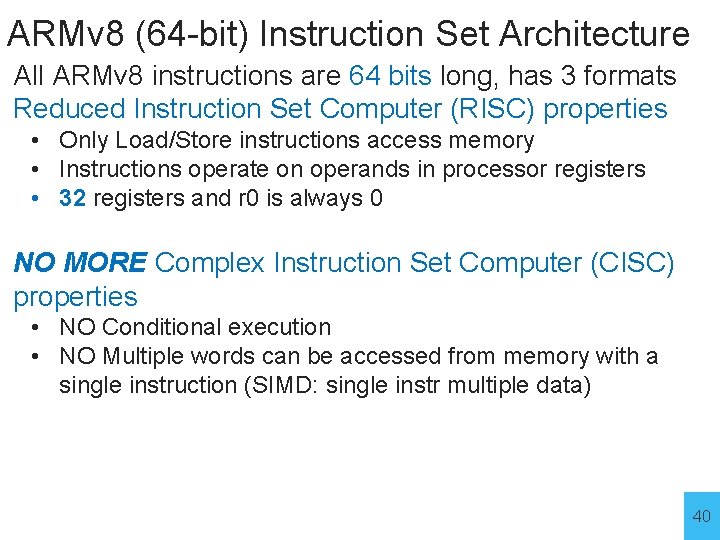
ARMv 8 (64 -bit) Instruction Set Architecture All ARMv 8 instructions are 64 bits long, has 3 formats Reduced Instruction Set Computer (RISC) properties • Only Load/Store instructions access memory • Instructions operate on operands in processor registers • 32 registers and r 0 is always 0 NO MORE Complex Instruction Set Computer (CISC) properties • NO Conditional execution • NO Multiple words can be accessed from memory with a single instruction (SIMD: single instr multiple data) 40
Instruction Set Architecture Variations ISA defines the permissible instructions • RISC-V: load/store, arithmetic, control flow, … • ARMv 7: similar to RISC-V, but more shift, memory, & conditional ops • ARMv 8 (64 -bit): even closer to RISC-V, no conditional ops • VAX: arithmetic on memory or registers, strings, polynomial evaluation, stacks/queues, … • Cray: vector operations, … • x 86: a little of everything 41
ISA Takeaways The number of available registers greatly influenced the instruction set architecture (ISA) Complex Instruction Set Computers were very complex + Small # of insns necessary to fit program into memory. - greatly increased the complexity of the ISA as well. Back in the day… CISC was necessary because everybody programmed in assembly and machine code! Today, CISC ISA’s are still dominant due to the prevalence of x 86 ISA processors. However, RISC ISA’s today such as ARM have an ever increasing market share (of our everyday life!). ARM borrows a bit from both RISC and CISC. 42