
Ripple Joins for Online Aggregation By Peter J
Ripple Joins for Online Aggregation By: Peter J. Haas and Joseph M. Hellerstein published in June 1999 : Presented By: Sthuti Kripanidhi 9/28/2010 CSE 6339 - Data Exploration 1
Overview �What the paper is all about �Traditional Algorithms �Online Aggregation �Ripple Joins: Introduction �How different is Ripple join �Ripple Join variants �Aspect ratios �Future Work 9/28/2010 CSE 6339 - Data Exploration 2
What the paper is about. . �The paper talks about a class of join algorithms called Ripple joins for the online processing of multi-table aggregation queries. �This paper tells how to join a bunch of tables and get the SUM, COUNT, or AVG in GROUP BY clauses showing approximate results immediately and the confidence interval of the results from the first few tuples retrieved. 9/28/2010 CSE 6339 - Data Exploration 3
Traditional Algorithms �Traditional algorithms take a lot of time since they have to process the entire tables or relations �The users have to wait for a long time before the results are returned. �An better method is Online Aggregation. 9/28/2010 CSE 6339 - Data Exploration 4
Online Aggregation �A running estimate of the final aggregates are continuously displayed to the user. �Quick results rather than minimize time for completion. �The proximity of the running estimate to the final result is also displayed to the user. (confidence interval). 9/28/2010 CSE 6339 - Data Exploration 5
GUI 9/28/2010 CSE 6339 - Data Exploration 6
Ripple Joins: Introduction �Generalize the traditional block nested loops and hash joins. �Non blocking �Square ripple join – samples are drawn at the same rate �Rectangular ripple join – samples out one relation at a higher rate than another. 9/28/2010 CSE 6339 - Data Exploration 7
Ripple Join: Introduction �Typical query forms SELECT op(expression) FROM R 1, R 2, … , RK WHERE predicate GROUP BY columns; 9/28/2010 CSE 6339 - Data Exploration 8
How different is Ripple join? �Traditional hash join blocks until the entire query output is finished. Ripple join reports approximate results after each sampling step, and allows user intervention. �In the inner loop, an entire table is scanned. Ripple join expands the sample set incrementally. �Ripple joins avoid complete scan of the relations. 9/28/2010 CSE 6339 - Data Exploration 9
How Ripple Join works. . Assume ripple join of relations R and S Ø Select a random tuple r from R. Ø Join with previously selected S tuples. Ø Select a random tuple s from S. Ø Join with previously selected R tuples. Ø Join r and s. 9/28/2010 CSE 6339 - Data Exploration 10
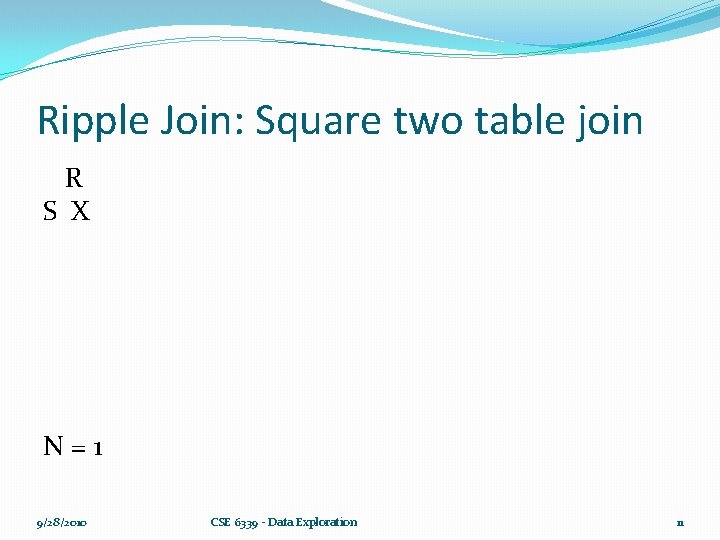
Ripple Join: Square two table join R S X N=1 9/28/2010 CSE 6339 - Data Exploration 11

R S XX XX N=2 9/28/2010 CSE 6339 - Data Exploration 12
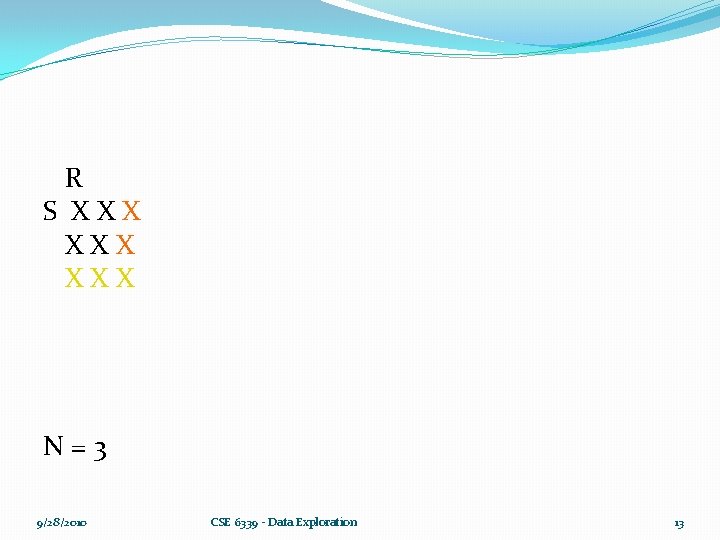
R S XXX XXX N=3 9/28/2010 CSE 6339 - Data Exploration 13
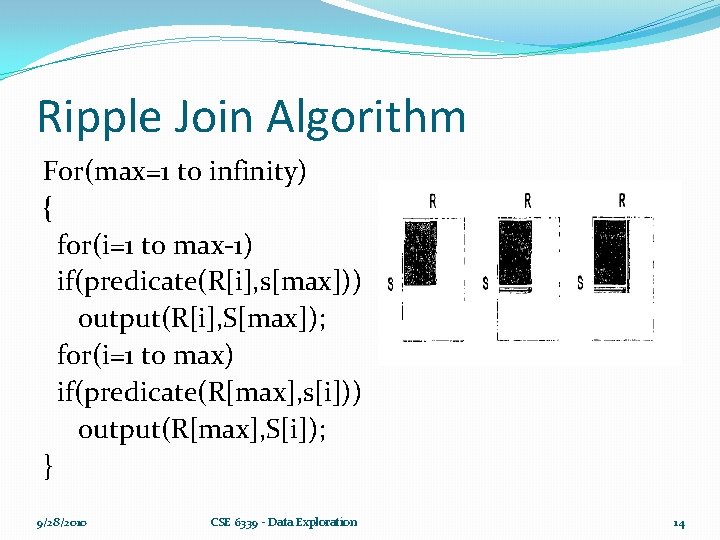
Ripple Join Algorithm For(max=1 to infinity) { for(i=1 to max-1) if(predicate(R[i], s[max])) output(R[i], S[max]); for(i=1 to max) if(predicate(R[max], s[i])) output(R[max], S[i]); } 9/28/2010 CSE 6339 - Data Exploration 14
Ripple Join Iterator �An iterator based DBMS invokes an iterator’s next() method each time an output tuple is needed. �The iterator needs to store the next position to be fetched from each of its inputs R and S. 9/28/2010 CSE 6339 - Data Exploration 15
Pipelining �Can easily be pipelined for multiple binary joins �Cannot do three-table joins as two binary ripple joins. 9/28/2010 CSE 6339 - Data Exploration 16
Ripple Join Variants �Block Ripple Join �Hash Ripple Join �Index Ripple Join 9/28/2010 CSE 6339 - Data Exploration 17
Block Ripple Join �Takes disk blocks of R and S in turn (not tuples) �Read a disk block of R and scan against old S �Evict from memory �Read Block of S and compare with older R tuples. �Has I/O saving since each block is taken out at a time. 9/28/2010 CSE 6339 - Data Exploration 18
Index and Hash Ripple Joins �Index Ripple Join �Identical to indexed-enhanced nested loop join �Hash Ripple Join �Used only for Equijoin queries. 9/28/2010 CSE 6339 - Data Exploration 19
Statistical Considerations �Goal-to provide efficient, accurate, interactive estimation. �Estimator unbiased, consistent �Running average is biased but consistent �Capable of giving tight confidence intervals 9/28/2010 CSE 6339 - Data Exploration 20
Aspect Ratios � Aspect ratio: how many tuples are retrieved from each base relation per sampling step. e. g. β 1 = 1, β 2 = 3, … � Ripple join adjusts the aspect ratio according to the sizes of the base relations. 9/28/2010 CSE 6339 - Data Exploration 21
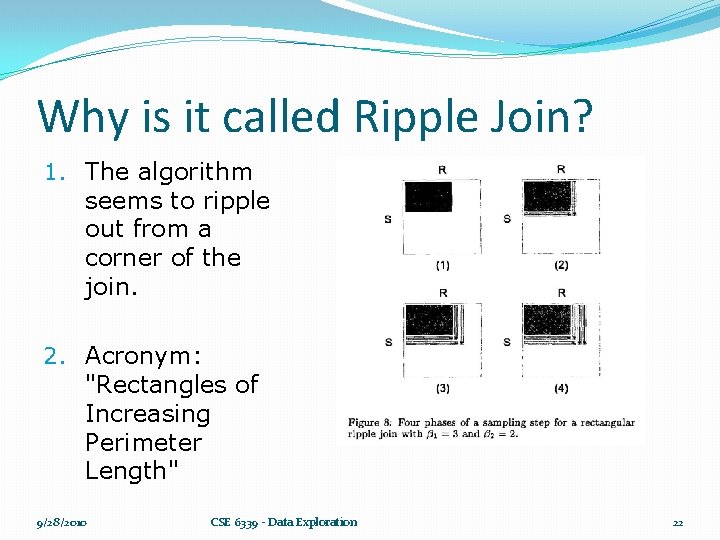
Why is it called Ripple Join? 1. The algorithm seems to ripple out from a corner of the join. 2. Acronym: "Rectangles of Increasing Perimeter Length" 9/28/2010 CSE 6339 - Data Exploration 22
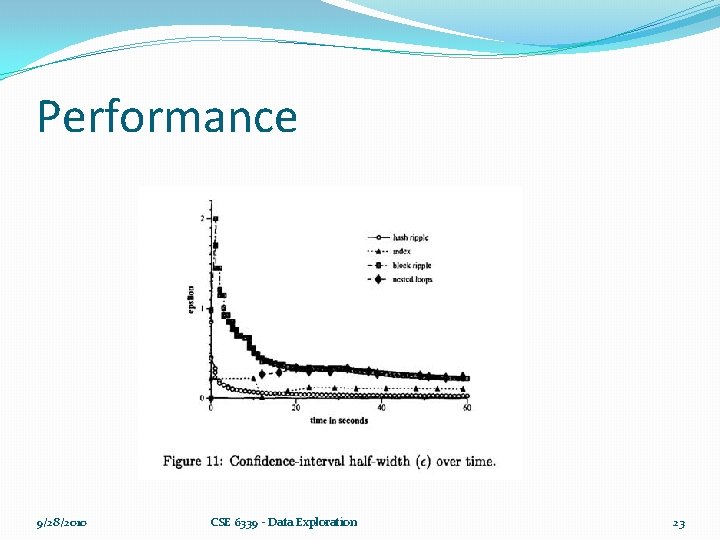
Performance 9/28/2010 CSE 6339 - Data Exploration 23
Conclusions and Future Work �Complete implementation of online aggregation must be able to handle multi-table queries. �This paper introduces ripple joins, a family of join algorithms designed to meet the performance needs of online aggregation system. 9/28/2010 CSE 6339 - Data Exploration 24
�Though ripple joins are symmetric, it is still not clear how a query optimizer should choose among the ripple join variants, nor how it should order a sequence of ripple joins. 9/28/2010 CSE 6339 - Data Exploration 25
References �Haas & Hellerstein, “Ripple Joins for Online Aggregation” (SIGMOD ’ 99) �Haas & Hellerstein, “Online Query Processing: A Tutorial” �P. J Haas, J. M Hellerstein and H. J Wang Online aggregation. In Proc. 1997 ACM SIGMOD Intl Conf. Management of data pages. 9/28/2010 CSE 6339 - Data Exploration 26
- Slides: 26