
Riparian Buffers for Water Resource Protection Michael R
Riparian Buffers for Water Resource Protection Michael R. Burchell II Associate Professor and Extension Specialist Department of Biological and Agricultural Engineering
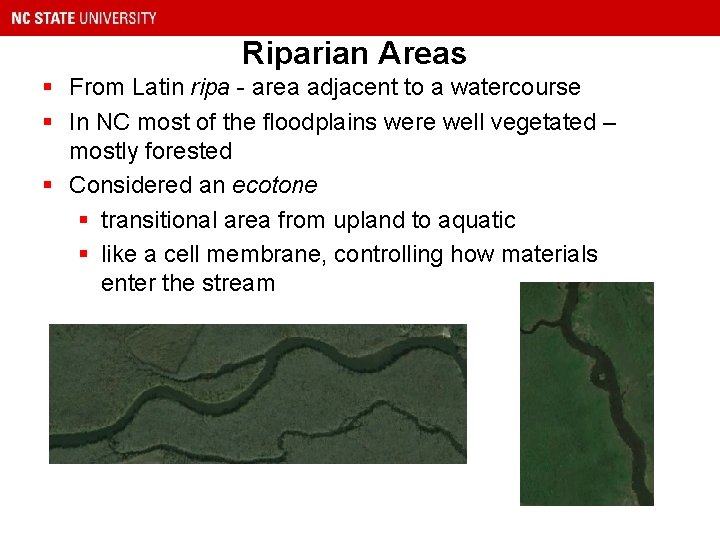
Riparian Areas § From Latin ripa - area adjacent to a watercourse § In NC most of the floodplains were well vegetated – mostly forested § Considered an ecotone § transitional area from upland to aquatic § like a cell membrane, controlling how materials enter the stream

Riparian Buffers § Vegetated streamside corridors (either protected or restored) meant to protect stream ecological functions and downstream water quality www. ifgene. org
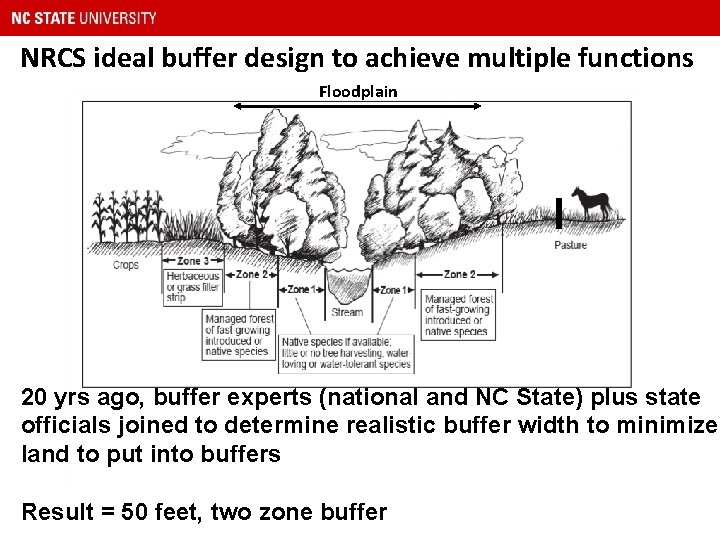
NRCS ideal buffer design to achieve multiple functions Floodplain 20 yrs ago, buffer experts (national and NC State) plus state officials joined to determine realistic buffer width to minimize land to put into buffers Result = 50 feet, two zone buffer
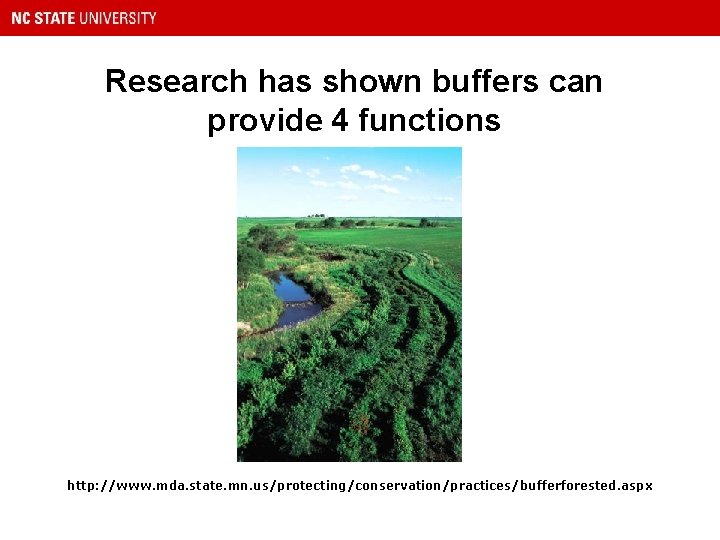
Research has shown buffers can provide 4 functions http: //www. mda. state. mn. us/protecting/conservation/practices/bufferforested. aspx
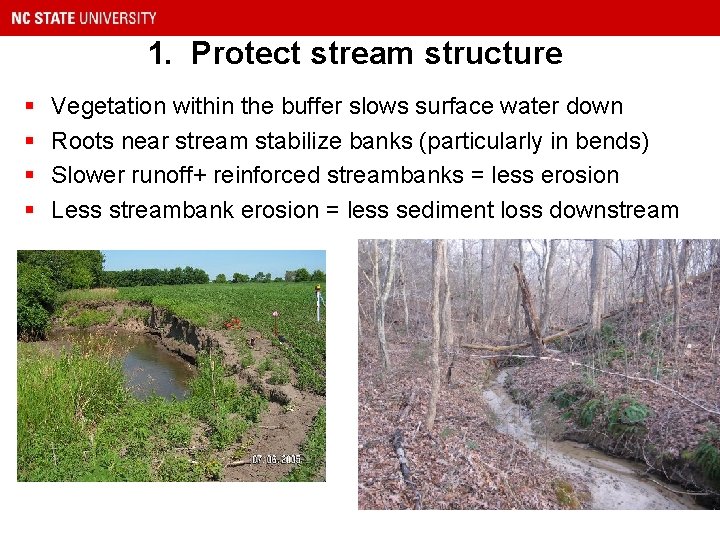
1. Protect stream structure § § Vegetation within the buffer slows surface water down Roots near stream stabilize banks (particularly in bends) Slower runoff+ reinforced streambanks = less erosion Less streambank erosion = less sediment loss downstream

2. Enhance aquatic environment § Tree canopy provides shade § Temp control § Higher oxygen § Controls algae § Leaf litter § Carbon and organic nutrients (energy for food web) § Habitat § Coarse woody debris § Habitat
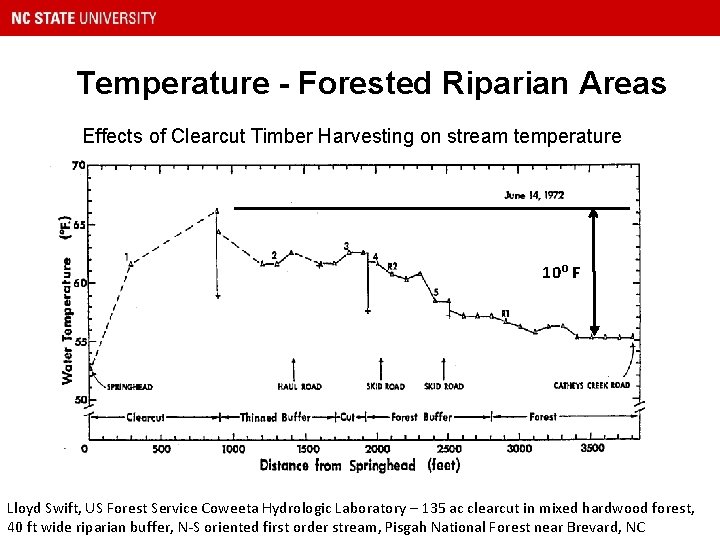
Temperature - Forested Riparian Areas Effects of Clearcut Timber Harvesting on stream temperature 10⁰ F Lloyd Swift, US Forest Service Coweeta Hydrologic Laboratory – 135 ac clearcut in mixed hardwood forest, 40 ft wide riparian buffer, N-S oriented first order stream, Pisgah National Forest near Brevard, NC
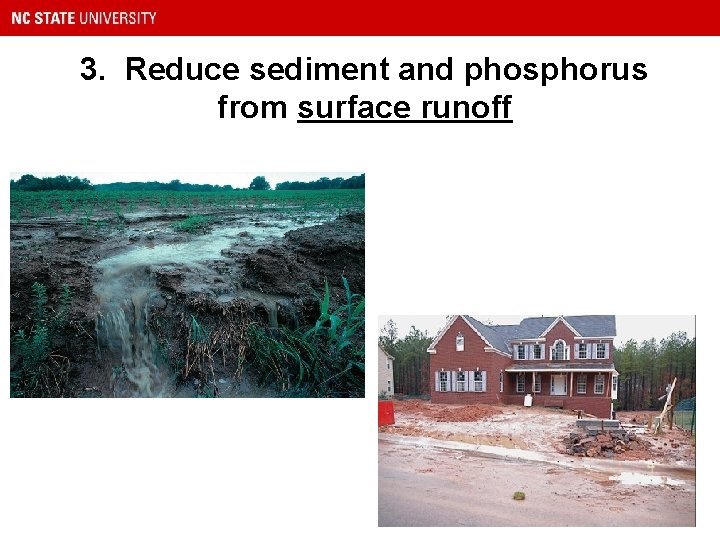
3. Reduce sediment and phosphorus from surface runoff
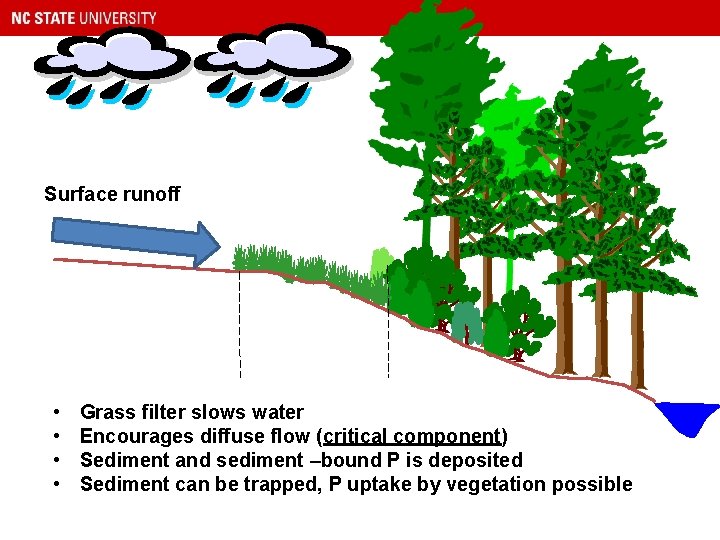
Surface runoff • • Grass filter slows water Encourages diffuse flow (critical component) Sediment and sediment –bound P is deposited Sediment can be trapped, P uptake by vegetation possible
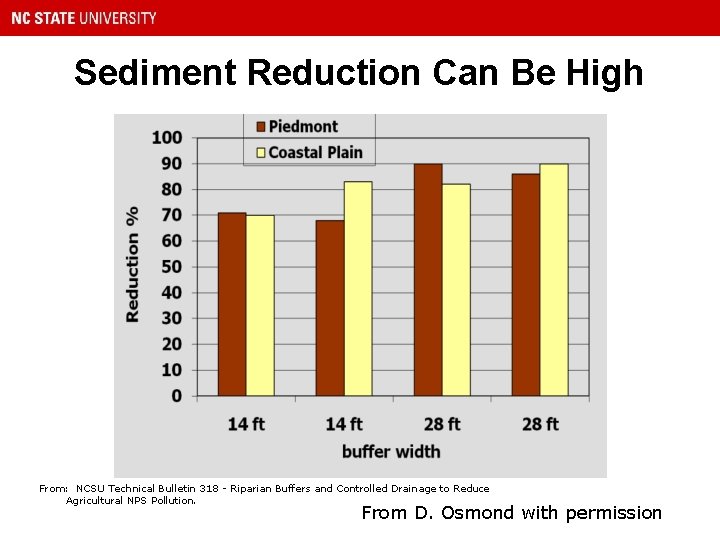
Sediment Reduction Can Be High From: NCSU Technical Bulletin 318 - Riparian Buffers and Controlled Drainage to Reduce Agricultural NPS Pollution. From D. Osmond with permission
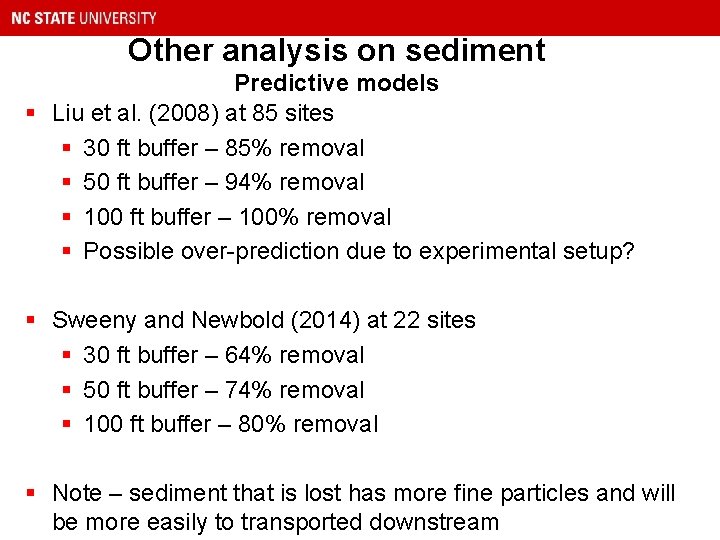
Other analysis on sediment Predictive models § Liu et al. (2008) at 85 sites § 30 ft buffer – 85% removal § 50 ft buffer – 94% removal § 100 ft buffer – 100% removal § Possible over-prediction due to experimental setup? § Sweeny and Newbold (2014) at 22 sites § 30 ft buffer – 64% removal § 50 ft buffer – 74% removal § 100 ft buffer – 80% removal § Note – sediment that is lost has more fine particles and will be more easily to transported downstream
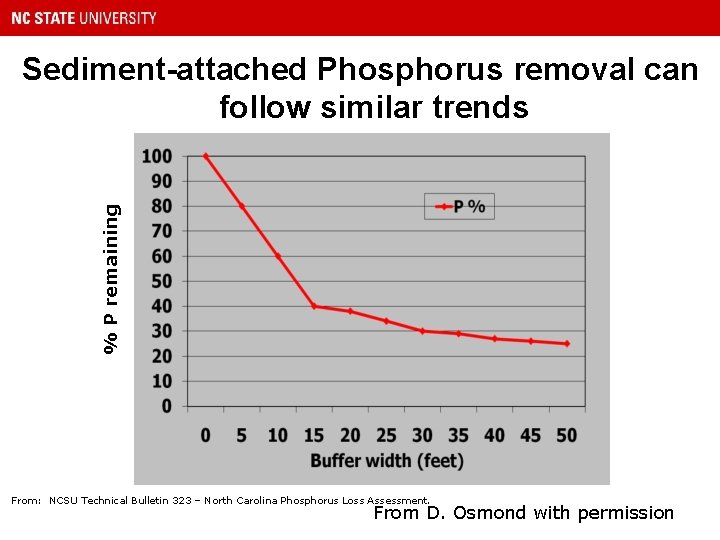
% P remaining Sediment-attached Phosphorus removal can follow similar trends From: NCSU Technical Bulletin 323 – North Carolina Phosphorus Loss Assessment. From D. Osmond with permission
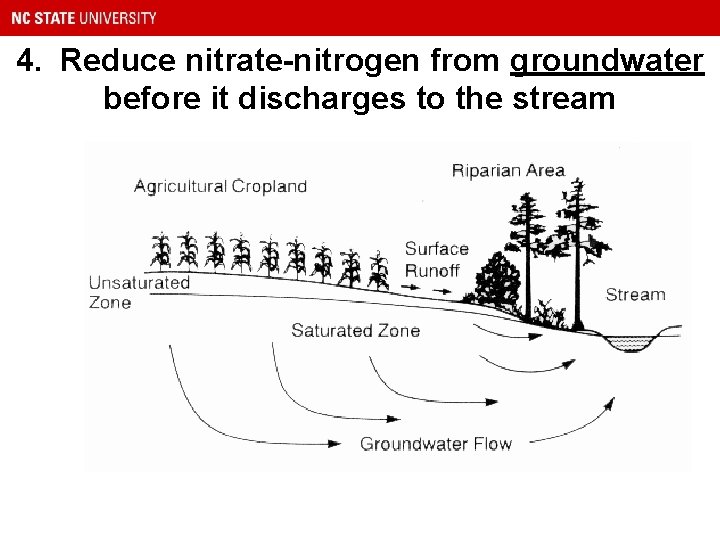
4. Reduce nitrate-nitrogen from groundwater before it discharges to the stream
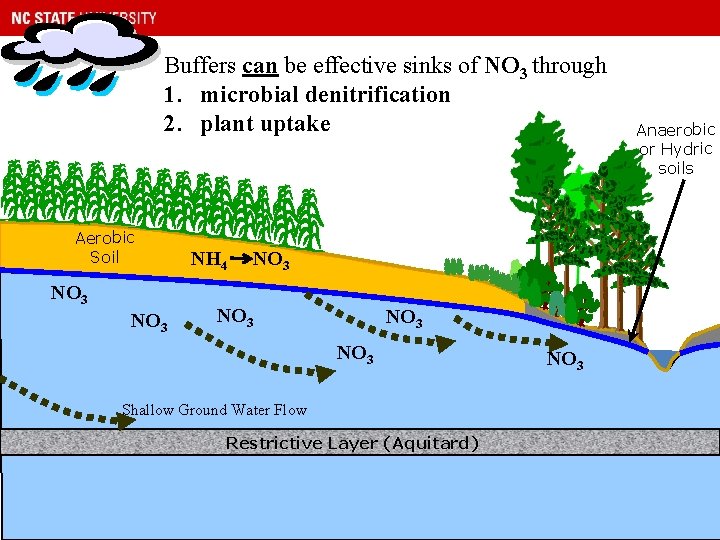
Buffers can be effective sinks of NO 3 through 1. microbial denitrification 2. plant uptake Aerobic Soil NO 3 NH 4 NO 3 Shallow Ground Water Flow Restrictive Layer (Aquitard) NO 3 Anaerobic or Hydric soils
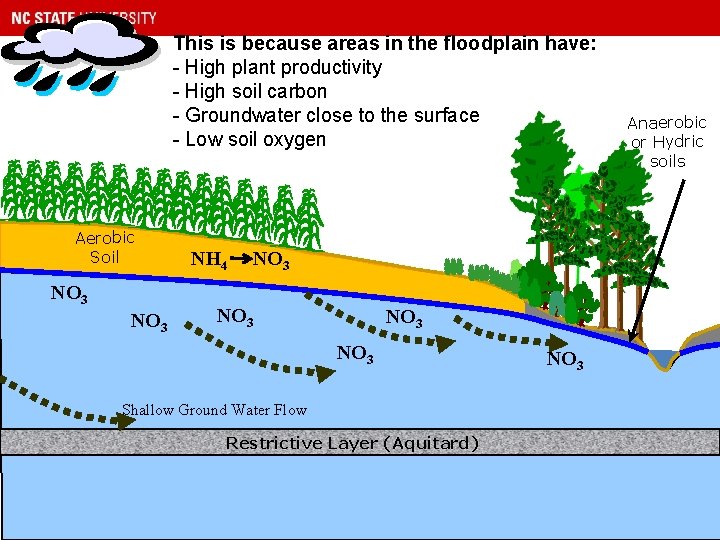
This is because areas in the floodplain have: - High plant productivity - High soil carbon - Groundwater close to the surface - Low soil oxygen Aerobic Soil NO 3 NH 4 NO 3 Shallow Ground Water Flow Restrictive Layer (Aquitard) NO 3 Anaerobic or Hydric soils
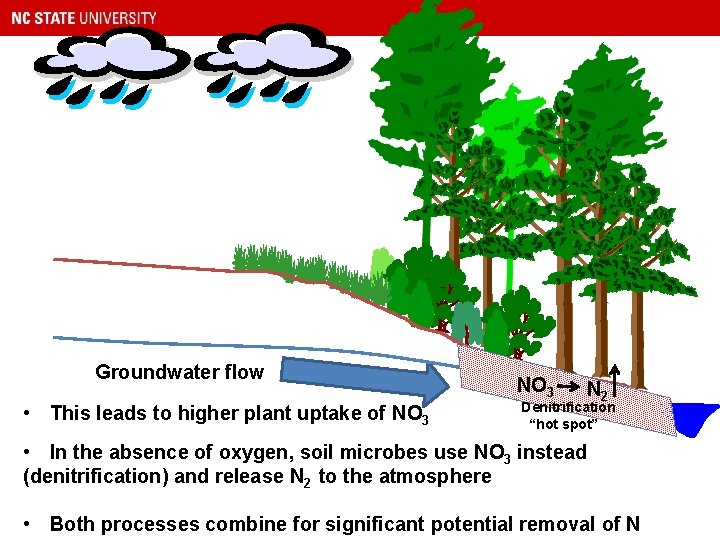
Groundwater flow • This leads to higher plant uptake of NO 3 N 2 Denitrification “hot spot” • In the absence of oxygen, soil microbes use NO 3 instead (denitrification) and release N 2 to the atmosphere • Both processes combine for significant potential removal of N
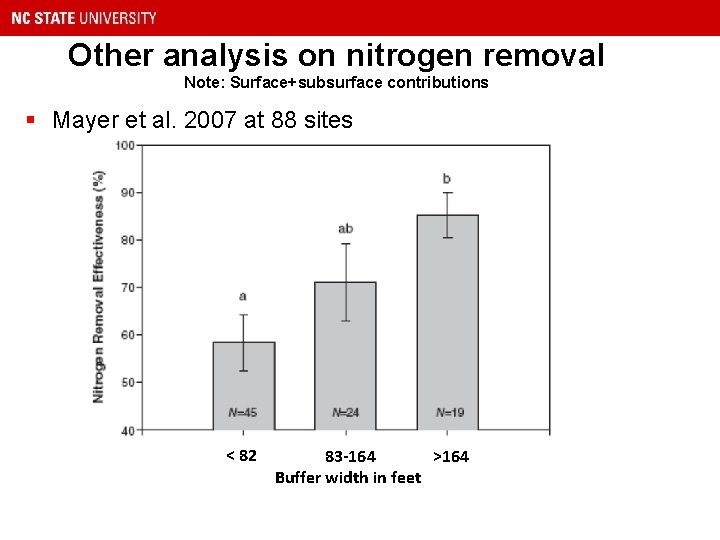
Other analysis on nitrogen removal Note: Surface+subsurface contributions § Mayer et al. 2007 at 88 sites < 82 83 -164 >164 Buffer width in feet
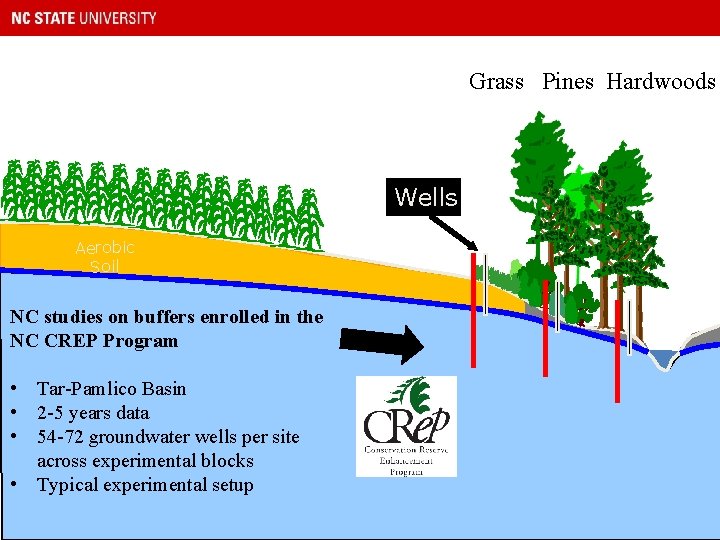
Grass Pines Hardwoods Wells Aerobic Soil NC studies on buffers enrolled in the NC CREP Program • Tar-Pamlico Basin • 2 -5 years data • 54 -72 groundwater wells per site across experimental blocks • Typical experimental setup
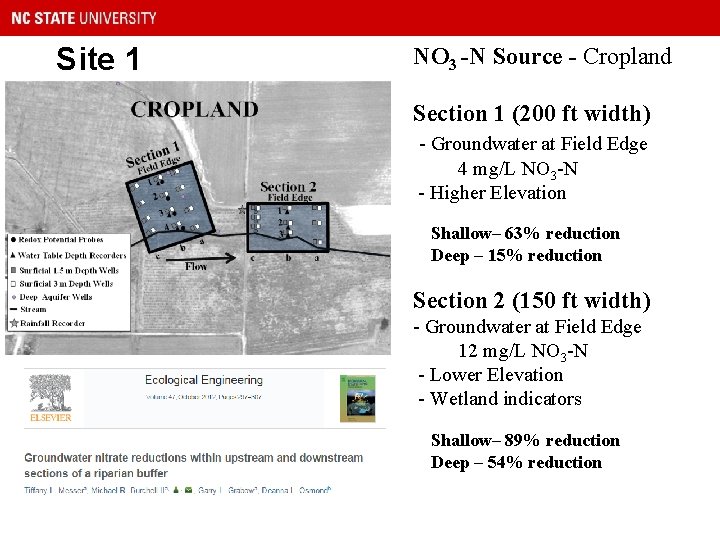
Site 1 NO 3 -N Source - Cropland Section 1 (200 ft width) - Groundwater at Field Edge 4 mg/L NO 3 -N - Higher Elevation Shallow– 63% reduction Deep – 15% reduction Section 2 (150 ft width) - Groundwater at Field Edge 12 mg/L NO 3 -N - Lower Elevation - Wetland indicators Shallow– 89% reduction Deep – 54% reduction
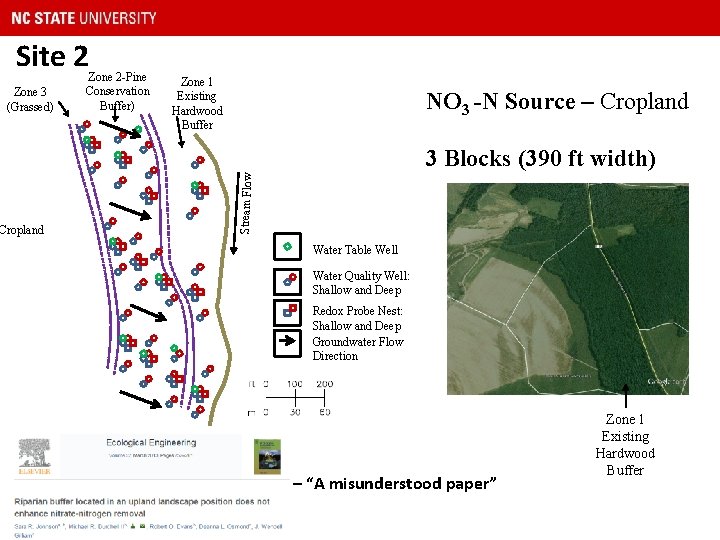
Site 2 Cropland Zone 1 Existing Hardwood Buffer NO 3 -N Source – Cropland 3 Blocks (390 ft width) Stream Flow Zone 3 (Grassed) Zone 2 -Pine Conservation Buffer) Water Table Well Water Quality Well: Shallow and Deep Redox Probe Nest: Shallow and Deep Groundwater Flow Direction – “A misunderstood paper” Zone 1 Existing Hardwood Buffer
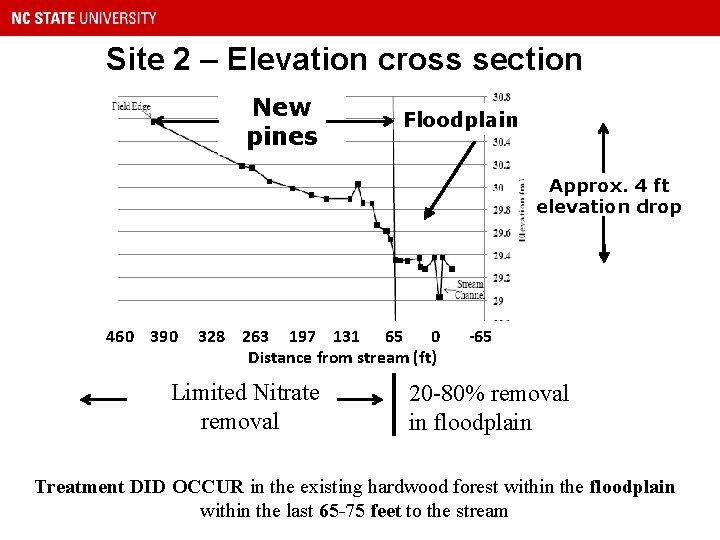
Site 2 – Elevation cross section New pines Floodplain Approx. 4 ft elevation drop 460 390 328 263 197 131 65 0 Distance from stream (ft) Limited Nitrate removal -65 20 -80% removal in floodplain Treatment DID OCCUR in the existing hardwood forest within the floodplain within the last 65 -75 feet to the stream
Conclusions § Riparian Buffers can: 1. Protect stream structure 2. Enhance the aquatic environment 3. Reduce sediment and phosphorus from surface runoff 4. Reduce nitrate-nitrogen from groundwater before it discharges to the stream § Often, riparian buffers will provide most of these important functions at all sites § Research strongly supports the fact that buffers are a critical component of successful water quality protection strategy in NC watersheds
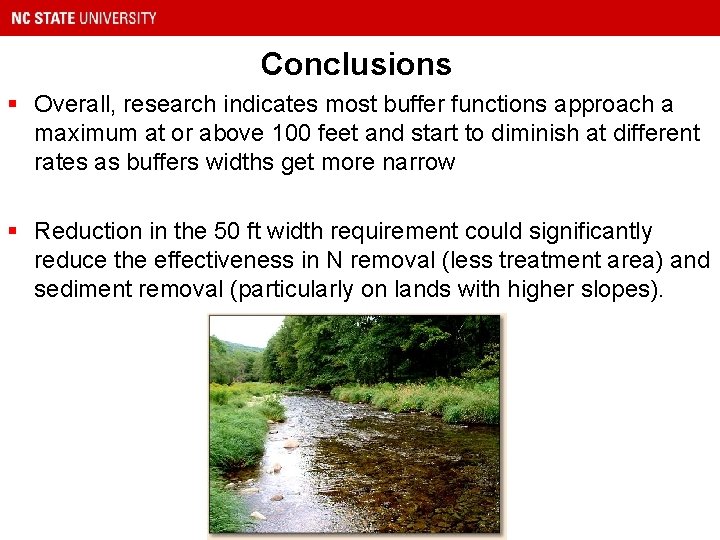
Conclusions § Overall, research indicates most buffer functions approach a maximum at or above 100 feet and start to diminish at different rates as buffers widths get more narrow § Reduction in the 50 ft width requirement could significantly reduce the effectiveness in N removal (less treatment area) and sediment removal (particularly on lands with higher slopes).

Questions? mike_burchell@ncsu. edu
- Slides: 25