
Rip Van Winkle Romanticism Washington Irving and His


- Slides: 8
“Rip Van Winkle” Romanticism, Washington Irving, and His Works
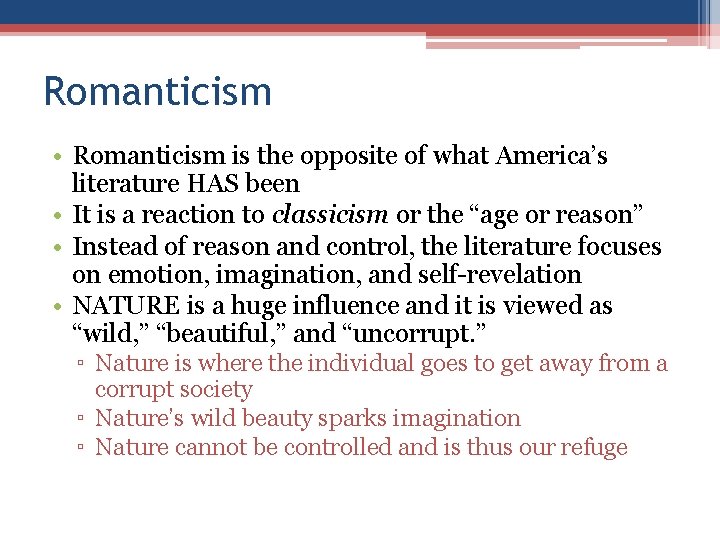
Romanticism • Romanticism is the opposite of what America’s literature HAS been • It is a reaction to classicism or the “age or reason” • Instead of reason and control, the literature focuses on emotion, imagination, and self-revelation • NATURE is a huge influence and it is viewed as “wild, ” “beautiful, ” and “uncorrupt. ” ▫ Nature is where the individual goes to get away from a corrupt society ▫ Nature’s wild beauty sparks imagination ▫ Nature cannot be controlled and is thus our refuge
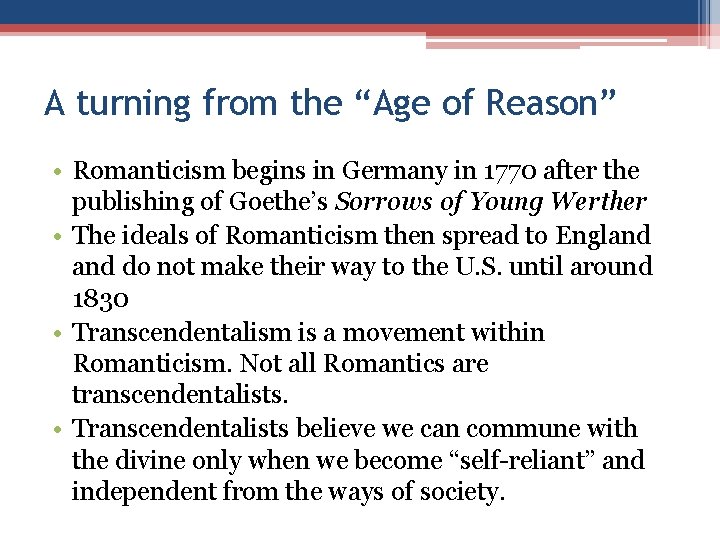
A turning from the “Age of Reason” • Romanticism begins in Germany in 1770 after the publishing of Goethe’s Sorrows of Young Werther • The ideals of Romanticism then spread to England do not make their way to the U. S. until around 1830 • Transcendentalism is a movement within Romanticism. Not all Romantics are transcendentalists. • Transcendentalists believe we can commune with the divine only when we become “self-reliant” and independent from the ways of society.
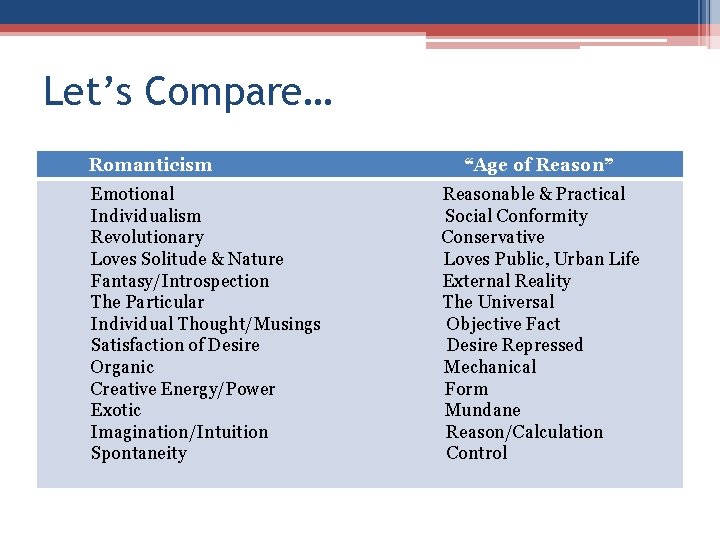
Let’s Compare… Romanticism Emotional Individualism Revolutionary Loves Solitude & Nature Fantasy/Introspection The Particular Individual Thought/Musings Satisfaction of Desire Organic Creative Energy/Power Exotic Imagination/Intuition Spontaneity “Age of Reason” Reasonable & Practical Social Conformity Conservative Loves Public, Urban Life External Reality The Universal Objective Fact Desire Repressed Mechanical Form Mundane Reason/Calculation Control
Aspects of Romantic Literature • Shift from urban focus to a rural one: country life • Shift from scientific and formal to personal • Emphasis on imagination, intuition, and the individual • Emotions over Reason • Love of nature • Respect/focus on the common Man • Includes Supernatural, Gothic, Mystical elements • Rebellion and Revolution (esp. regarding human rights, oppression, etc…) • Focus on introspection, melancholy, and sadness
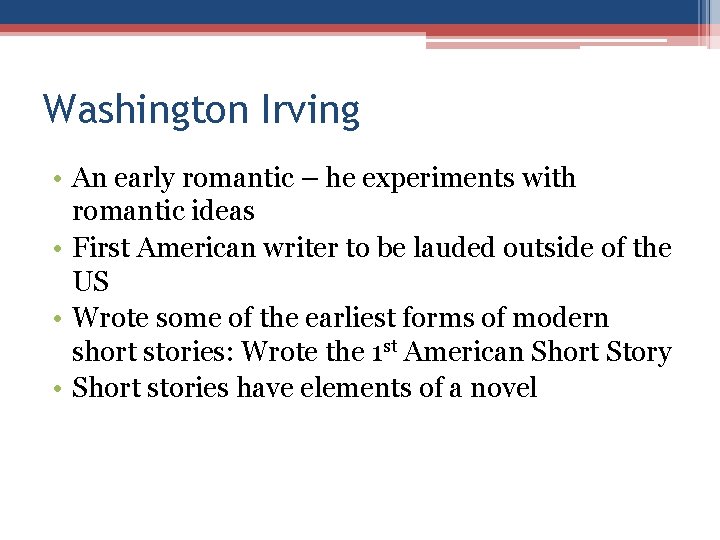
Washington Irving • An early romantic – he experiments with romantic ideas • First American writer to be lauded outside of the US • Wrote some of the earliest forms of modern short stories: Wrote the 1 st American Short Story • Short stories have elements of a novel
Washington Irving, cont… • Wrote both “Sleepy Hollow” and “Rip Van Winkle. ” Both are part of a larger “sketchbook” of his works • Creates a persona (Deidrich Knickerbocker) in his writing to allow for a “suspension of disbelief, ” and thus gives credibility to the tale • Geoffrey Crayon adds satirical humor as the narrator of the story
The Romantic Hero • Usually the protagonist • Rejected by society/non-conventional in their ideas and ways of life • On a quest (usually for himself, but he ends up doing something even more grand). • Innocent, intuitive – could even be alienated or disillusioned • Introspective • Fond of nature • Sometimes distrustful of women