
Ring Formation l Also called the intramolecular reaction
- Slides: 6
Ring Formation l Also called the intramolecular reaction l. A chain containing two mutually reactive groups can react with it self and a ring structure forms. l Ring formation depends strongly on the number of atoms linked together in the ring.
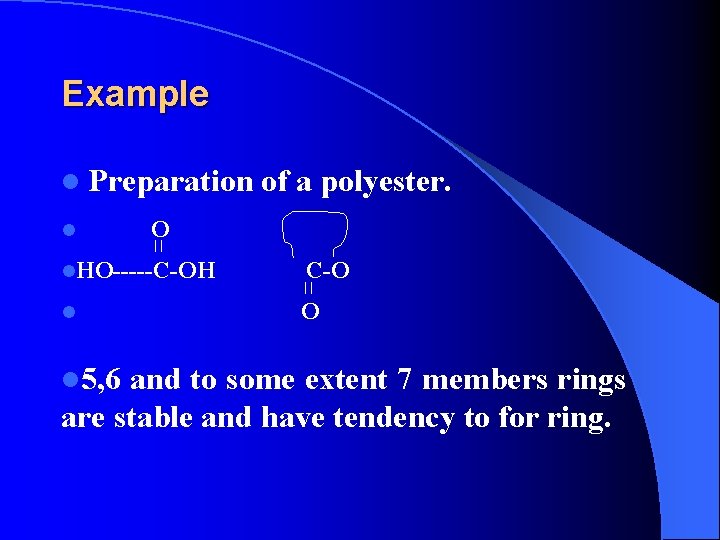
Example l Preparation l of a polyester. O l. HO-----C-OH C-O l 5, 6 and to some extent 7 members rings are stable and have tendency to for ring.
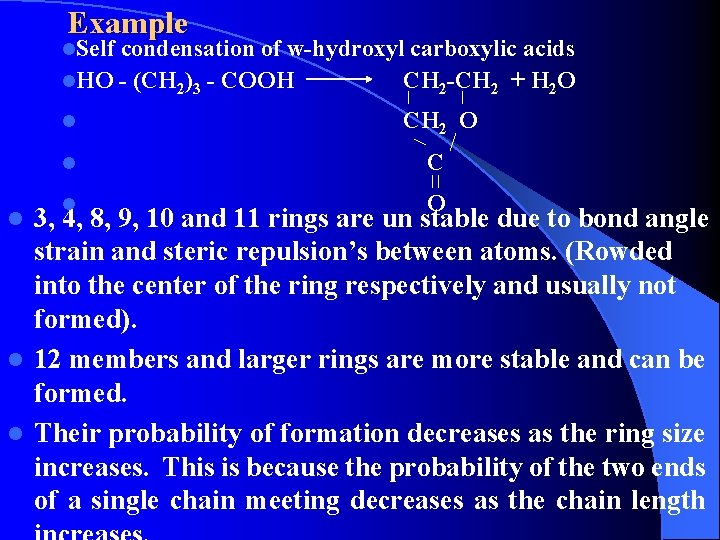
Example l. Self condensation of w-hydroxyl carboxylic acids l. HO - (CH 2)3 - COOH CH 2 -CH 2 + H 2 O l CH 2 O l C l O 3, 4, 8, 9, 10 and 11 rings are un stable due to bond angle strain and steric repulsion’s between atoms. (Rowded into the center of the ring respectively and usually not formed). l 12 members and larger rings are more stable and can be formed. l Their probability of formation decreases as the ring size increases. This is because the probability of the two ends of a single chain meeting decreases as the chain length l
Non Linear Step Polymerization l The presence of a reactivity monomer with functionality > 2, causes branching initially and crosslinking structure ultimately. l This has a great effect on the structure and molar mass of the polymer. l Normally the resulting polymer are rigid. l The point at which the first net work molecules is formed is known as the gel-point (gelation) i. e. change of the Reaction mixture from a viscous liquid to solid gel which shows no tendency to flow.
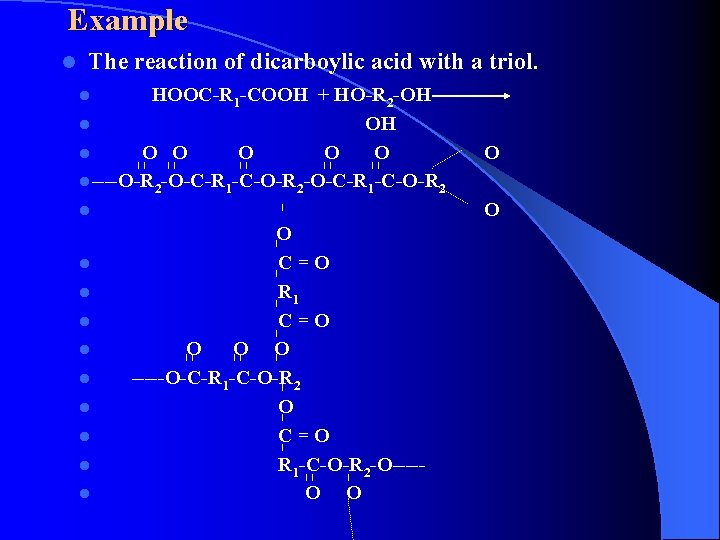
Example l The reaction of dicarboylic acid with a triol. HOOC-R 1 -COOH + HO-R 2 -OH l O O O l----O-R 2 -O-C-R 1 -C-O-R 2 l O l l l l l O O C=O R 1 C=O O -----O-C-R 1 -C-O-R 2 O C=O R 1 -C-O-R 2 -O----O O
Thank You See You Next Lecture